Written by: Raoul Pal
Compiled by: Chopper, Foresight News
You've been managing your assets according to the financial advice passed down to you, yet the results are far from satisfactory.
Save an emergency fund, allocate a pension, buy index-tracking funds, and if the timing is right, purchase a property... Every year, you receive an account statement showing a higher number than the previous year. You file it away, feeling a slight sense of relief. Twenty years pass in a flash, the account numbers keep climbing, yet your real life hasn't fundamentally changed. You still can't afford to take a full year off, still can't refuse work you dislike. By now, you should have had greater financial freedom, but reality says otherwise. Perhaps for a moment, you blame yourself for all of this.
But the problem isn't you. People advised you to build a traditional asset portfolio: allocate bonds for safety, buy a little gold, purchase property if possible, and invest in index funds for growth—diversifying assets to avoid a single asset's crash causing a devastating blow. This advice worked well in the past, but it belonged to another era, one that no longer exists.
I know this firsthand; building such investment portfolios used to be my job.
I was a hedge fund manager. This asset allocation logic wasn't my personal preference; it was the survival rule of the industry I was in. People constructed an asset package that could withstand various market shocks, using one type of risk to hedge another, holding it comfortably because a single asset's collapse wouldn't be fatal to overall wealth. I followed this trading paradigm for many years. For the next 21 years, I continued writing research newsletters for hedge funds and family offices. The macroeconomic environment on which this system relied was undergoing dramatic changes.
Next, I will explain a new approach to asset allocation while clarifying that this plan isn't the aggressive speculation choice often stereotyped.
The Source of Economic Growth
Let's start with the underlying logic of economic growth; all wealth laws derive from it. A country can grow its wealth through only three paths: increasing the labor supply, improving output per worker, or expanding through debt. That's the entire formula for economic growth.
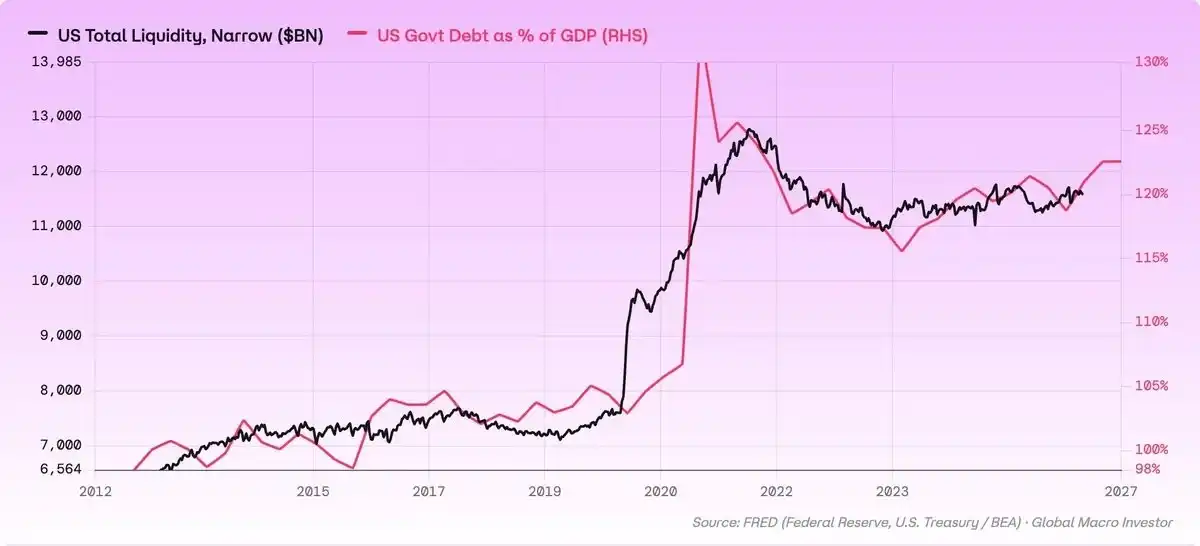
For most of the last century, the first two engines drove economic growth. The population kept growing, technological innovation continuously improved labor productivity, and debt played only a supportive role. Now, both major growth engines have stalled: birth rates began declining decades ago, and labor productivity growth has slowed year after year. Economic growth now almost entirely relies on the third path—debt—which is itself a trap. Debt requires interest payments, and the only politically feasible way to repay debt is to print more money.
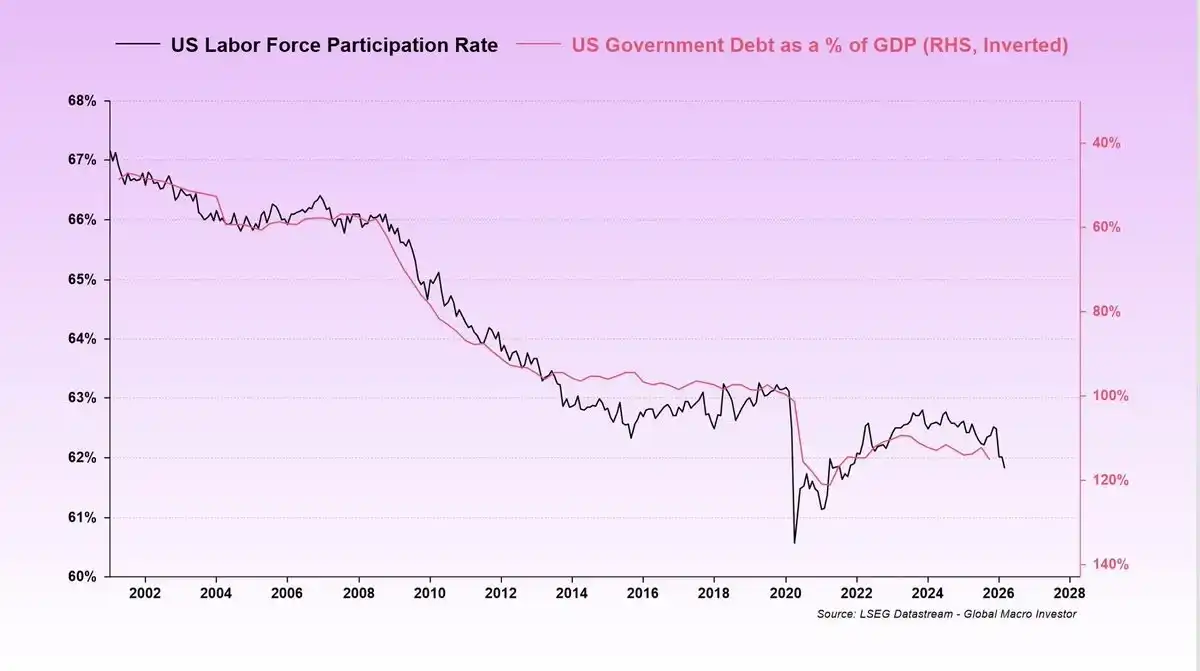
Governments keep borrowing, interest compounds, central banks issue currency to absorb the debt, and the cash you hold depreciates every year.
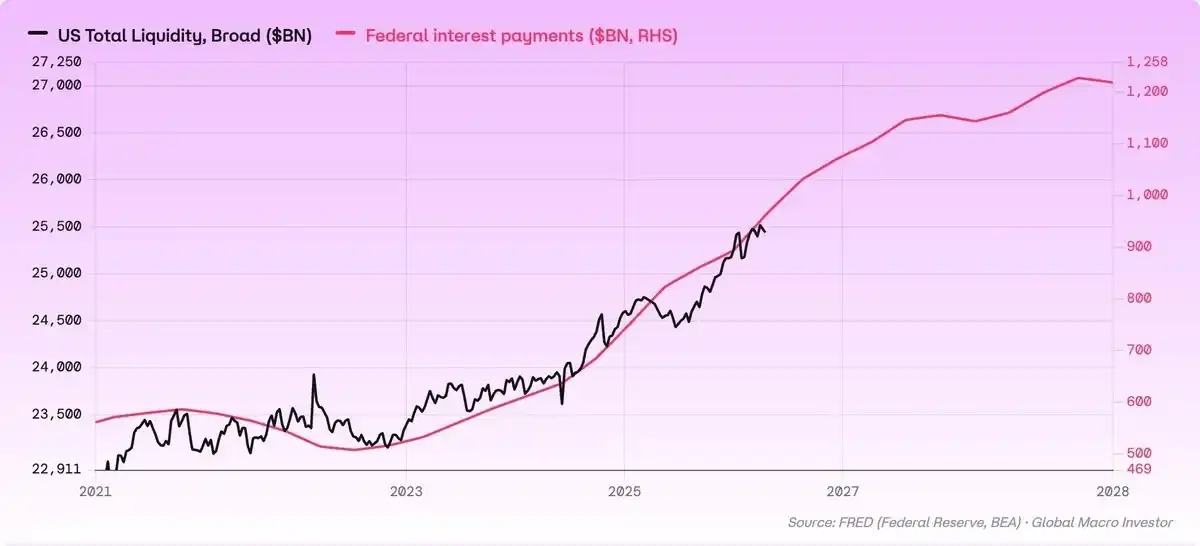
Global liquidity—the total money and credit within the financial system—expands at about 8% annually. This is the essence of currency depreciation. If the total money in the market increases by 8% each year, money's scarcity decreases by 8%, and its value ultimately shrinks by 8% annually. On top of this, add daily inflation—the 2%-3% price increases often mentioned in the news, covering daily consumption and rent. Almost everyone aims to beat this number. Beating ordinary inflation only means you maintain your current living expenses; it doesn't mean your wealth has truly grown.
Adding these two values gives us the true wealth watershed. Let's take an 11% annualized rate as the baseline.
If an asset's annualized return exceeds 11%, your purchasing power increases; below this line, no matter how good the numbers on your statement look, your purchasing power is eroding because the currency in which those assets are priced is continuously shrinking. You need an 11% return every year just to preserve your original wealth level.
This definition completely rewrites the criteria for asset selection. We are no longer obsessed with choosing assets that seem safe and well-diversified, but rather filtering for assets that can break through the 11% annualized return baseline.
Next, let's evaluate mainstream investment categories one by one.
Evaluating Mainstream Assets One by One
Let's start with bonds. Most people hold bonds but never truly understand their essence.
A bond is essentially a loan. You lend out money, receive a fixed interest payment each year, and get your principal back at maturity. That's the complete return model of a bond. The issuer sets a fixed interest rate based on ordinary inflation levels, not accounting for the depreciation loss from currency dilution. For example, a government bond with a 4% annual yield promises to pay 4% interest annually, but the currency it's priced in depreciates at 8% per year; by the time the bond matures and returns the principal, the actual purchasing power of that money has greatly diminished. Even if you hold the bond to maturity and receive every promised return in full, your actual wealth still shrinks in the end.
Real estate is the most controversial category and needs careful handling.
The underlying logic for real estate hedging depreciation still holds: borrowing at a fixed rate to purchase a physical asset priced in a continuously depreciating currency. The real burden of the debt decreases year by year, while property prices rise with the money supply. Admittedly, real estate is a decent tool against depreciation, and I also hold property.
However, the core windfall for a generation achieving wealth leap through real estate wasn't property itself but the timing window for mortgages. If you leveraged to buy property at the beginning of a 40-year interest rate decline cycle, asset valuations would rise yearly during the holding period. This windfall trade cannot be replicated; interest rates first fell to zero and then rebounded upwards.
Now, it's very difficult for most people to obtain a good mortgage: the house price-to-income ratio remains high, and mortgage rates are also elevated.
Even if you secure a mortgage, real estate's ability to hedge currency depreciation has weakened significantly. Since 2007, the expansion of global liquidity has far outpaced house prices, with their ratio continuously declining. Your property's nominal dollar price rises, but its actual purchasing power is long gone.
Now let's talk about gold. We need to view gold's value objectively, avoiding wrong conclusions based on recent market performance.
Gold has experienced an epic rally. In January this year, gold broke through $5,500 per ounce, hitting a record high; as of late August when this article is written, the price has retreated to around $4,600, still up about one-third for the year. The financial media even gave this rally a special name: the depreciation trade. On the surface, gold's returns significantly exceeded the 11% baseline, yet I previously wasn't optimistic about gold's appreciation potential.
The core difference lies in this: comparing gold prices to the size of central bank balance sheets over the past 15 years shows that gold's value has roughly kept pace with central bank expansion, and that is precisely gold's role. Gold can preserve purchasing power and hedge against the depreciation risk from money printing. This value should not be denied; I don't intend to belittle gold's role.
Preserving purchasing power and creating new wealth are two completely different things. Gold does not have a user adoption growth curve; no commercial ecosystem is built upon gold. Gold price fluctuations depend entirely on market panic about the monetary system. When market anxiety is high, gold prices are naturally elevated. Looking over decades-long cycles, gold does not compound in value because more and more users globally adopt it. Gold is for preservation, not for creating new wealth.
Finally, equity assets: the index commonly held by the masses performs better than the previous categories. Over the past decade, the S&P 500's annualized compound return has been about 13%, barely crossing the 11% threshold; and this achievement relies on the strongest bull market in financial history for that index over the past ten years.
The only asset categories that can consistently break through this return line are two: tech assets and crypto assets.
Why Tech and Crypto Assets?
Let's compare ten-year annualized returns. A ten-year cycle is long enough to cover a market crash while fully residing within the macroeconomic cycle of currency depreciation.
Gold's annualized return is about 12%, the S&P 500 about 13%, the Nasdaq 100 about 20%; Bitcoin's annualized return, depending on the statistical method and start date, falls between 58% and 70%.
Compared to the 11% return baseline, the difference is clear.
The logic behind this result is more critical than the returns themselves. If the returns were merely due to luck, this conclusion would have no practical value.
The fundamental reason these two asset categories can achieve high compounding is that both follow the growth law of the user adoption S-curve, rather than being traditional value assets. Metcalfe's Law states that the larger a network, the greater the value each existing user obtains. User adoption doesn't grow linearly but follows the classic S-curve: slow initial growth, explosive expansion in the middle phase, and market saturation later. As long as an asset is in the steep upward growth phase of the curve, returns can logically outpace the money supply expansion rate, not solely relying on market sentiment speculation.
Therefore, our discussion focus is no longer whether tech and crypto assets outperform traditional categories, but whether their user adoption curves have reached the end. The answer is no; the next wave of participants joining the ecosystem will no longer be human users. I will elaborate later; this is a long-term variable severely underestimated by the market.
Why Traditional Diversification Loses Protective Power
Traditional investment portfolios are built on a core assumption: bonds, gold, real estate, and stocks belong to four completely independent risk types. Holding all four means a single black swan event won't destroy the entire asset package. This logic held for a long time, but after 2008, the landscape changed completely. Liquidity became the core force determining the pricing of all assets. The four asset types no longer correspond to four independent risks; they are essentially different pricing outcomes under the same macroeconomic variable.
Your bond trade essentially bets on liquidity changes, gold is a liquidity trading target, real estate also fluctuates with the liquidity cycle, and index funds are just better-packaged liquidity assets.
I'm not denying the value of diversification; a diversified approach is reasonable, and I myself diversify. The problem lies in the underlying assets of the traditional asset package: among the four asset types, three cannot break through the 11% return baseline, and the fourth only barely meets it during the strongest bull market in history. You meticulously combine four assets, essentially betting on the same macroeconomic logic, with most targets failing to outpace the expansion rate of the money supply.
The real question worth pondering is never how many holdings you have, but whether the funds you use to seek appreciation are allocated to assets with long-term compounding potential. Allocate as much as possible to real long-term growth sectors; if you diversify into assets whose returns lag the baseline, the so-called stable diversification only provides psychological comfort without boosting actual returns.
Where Value Truly Accumulates
In the crypto industry, we need to decide which layer of assets to allocate to, weighing trade-offs objectively and avoiding absolute, dogmatic conclusions.
Application-layer protocols can indeed generate high returns; if you pick a truly commercially viable, high-quality project, returns can even surpass those of the underlying blockchain.
The difficulty lies in accurately selecting the winning applications. The underlying blockchain carries the settlement activity of the entire ecosystem. No matter which application ultimately wins, value will accumulate at the underlying infrastructure. You don't need to precisely predict which application will win; you just need to be certain that future economic activities will gradually migrate on-chain. Betting on the underlying blockchain may yield lower returns than betting on a breakout application, but it's easier to judge and still has enormous growth space.
This is also why traditional valuation models don't apply to crypto assets. The industry directly adopts stock valuation systems without verifying whether these metrics fit blockchain ecosystems: fee multiples, revenue growth, value locked ratios. At GMI, we backtested all valuation metrics for 12 major blockchains; none effectively predicted future returns. The only metric with predictive power is whether capital inflows remain within the ecosystem long-term after entering.
When you understand the essence of blockchain, this logic is easy to grasp. A blockchain isn't a company selling products for profit; its network value comes from all applications built on it, not from collecting fees. Valuing Ethereum based solely on fees is like estimating the entire internet's value in 1998 based on email service fees.
This is also why I choose to write this article now rather than two years later.
All industry size forecast reports on the market share the same underlying assumption: ecosystem users are human, participating in economic activities at human pace—a few transactions per day, small payments monthly, occasional query requests.
This assumption will soon become invalid. AI agents—software programs that can perceive, decide, and act autonomously without human instruction—are about to enter as independent economic participants, not just as tools. According to industry predictions I've seen, the number of non-human intelligent entities within enterprises could even reach an 80:1 ratio compared to human employees in the future.
An AI agent cannot open a bank account; it lacks legal identity, cannot visit a physical branch, and cannot tolerate a traditional settlement system that shuts down at 5 PM, with transfers taking three days. Agents need programmable money, built upon a payment layer that never stops operating, which is precisely the native capability of blockchains that traditional financial systems cannot achieve.
The entire infrastructure is being publicly deployed: Anthropic open-sourced its model context protocol; Google launched Agent2Agent, released a preview of WebMCP, allowing websites to directly open functional interfaces to agents without simulating human clicks; Coinbase revived the x402 protocol, enabling agents to pay each other via HTTP links.
This set of product launches itself foreshadows the demand for settlement capabilities. Regardless of whether speculative capital enters, real business demand will continue to expand.
Worth Heeding Risk Warnings
Betting on a single sector easily falls into survivor bias; those who deliberately avoid this risk often have marketing motives.
You always see success stories of people going all-in on a single asset to achieve wealth freedom, but you don't see the thousands of investors who went all-in on a single asset and ended up bankrupt. Losers don't speak publicly. Try reading anonymous trading confession posts; the real outcomes are often bleak, offering a more objective market sample than get-rich-quick stories.
Therefore, I don't advise putting all your funds into a single asset; that has never been my point.
The true wealth management logic is: when you identify a real long-term growth sector, the number of holdings isn't decisive. Ultimate returns are determined by two core variables: the proportion of funds allocated to the growth sector and the holding period.
There is a third iron rule, a hard prohibition: no leverage. Don't use slight leverage, not so-called cautious leverage, and don't set stop-losses for protection. Leverage strips away the core strength of this long-term strategy—the confidence that you won't be forced to exit during a 50% drawdown. Even if your ten-year judgment is completely correct, you could still get liquidated during two weeks of sharp decline. The market won't compensate you for your losses just because your long-term logic is right.
For the vast majority of ordinary people, a reasonable asset allocation plan is layered. Keep a portion in traditional asset portfolios for safety and peace of mind; allocate a substantial sum to long-term growth sectors, controlling the position size of this high-volatility asset so that even a 50% drop won't force you to make a panic-selling decision; then invest the remaining energy into life.
Over thirteen years observing the crypto market, I've found that investors who achieve long-term compounding often aren't frequent traders. During a crash, the drawdown is a heart-stopping reality; looking back over time, it's just a minor blip on the chart. Doing nothing is itself a trading strategy, but few truly practice it; it's far more difficult than imagined.
What Is the True Opportunity Cost?
If your assets' annual compound return is below the 11% baseline, the wealth you earn from your labor each year buys you less freedom than the year before.
Investors who understand this logic ultimately gain not a huge amount of money on paper, but choice. They don't need to constantly watch the market, have the confidence to refuse work they despise, go to places they desire while still young, and spend time with cherished people.
This is the true opportunity cost behind the 11% return baseline.
I won't directly give you a fixed asset allocation list. I don't know your debt pressure, investment horizon, or risk tolerance. Anyone who directly gives position allocations without understanding these three premises is essentially gambling with your money.
What I can provide is this screening ruler. Use the 11% annual return standard to measure every asset you hold. No matter how safe and comfortable it feels, any asset that cannot beat this baseline is consuming your time and freedom.