Strategy Launches 'Digital Credit Capital Framework': Authorizes Sale of $12 Billion in Bitcoin, Ending the 'Never Sell' Script

marsbitPublicado a 2026-06-29Actualizado a 2026-06-29

Resumen

Strategic, the world’s largest corporate holder of Bitcoin (formerly MicroStrategy), has dramatically shifted its long-standing “never sell Bitcoin” strategy by announcing a new “Digital Credit Capital Framework” on June 29. This plan authorizes the sale of up to $1.25 billion worth of Bitcoin to raise cash, establishes a $2.55 billion USD reserve, increases the dividend rate on its STRG preferred shares to 12%, and authorizes up to $1 billion each for repurchases of its own digital credit securities and Class A common stock. This pivot comes amid severe financial pressure. The company’s STRG preferred shares are trading at a ~24% discount to their $100 face value, making new issuances difficult and stalling its buy-Bitcoin funding flywheel. Its annualized dividend obligation has surged to ~$1.2 billion. Meanwhile, its MSTR stock has plummeted 36% in eight days, erasing its traditional premium over its Bitcoin holdings per share. In recent weeks, Strategic has already shifted focus from accumulating Bitcoin to bolstering cash reserves by selling its own MSTR shares. The new framework formalizes this defensive turn, aiming to ensure liquidity, cover dividends, and support its securities prices through buybacks. However, the move risks triggering a “death spiral” if Bitcoin sales pressure the market, further devaluing the company’s core asset. The company also faces a potential securities investigation and carries significant debt, with Bitcoin’s current price below its avera...

Curry, Shenchao TechFlow

Shenchao Insights:

Strategy, which holds 847,000 Bitcoin, officially rewrote its four-year 'buy only, never sell' script on June 29 by launching a 'Digital Credit Capital Framework'. The new framework authorizes the sale of Bitcoin to raise up to $12.5 billion, establishes a $25.5 billion cash reserve, raises the STRC dividend rate to 12%, and authorizes up to $10 billion each for repurchasing its own securities. This comes against a backdrop where MSTR plunged 36% in eight days, the preferred stock STRC fell to about 24% below its face value, and the annual dividend obligation quadrupled in a year to $12 billion. For holders, this is a 'stop-loss plan', but whether it will work depends on the Bitcoin price.
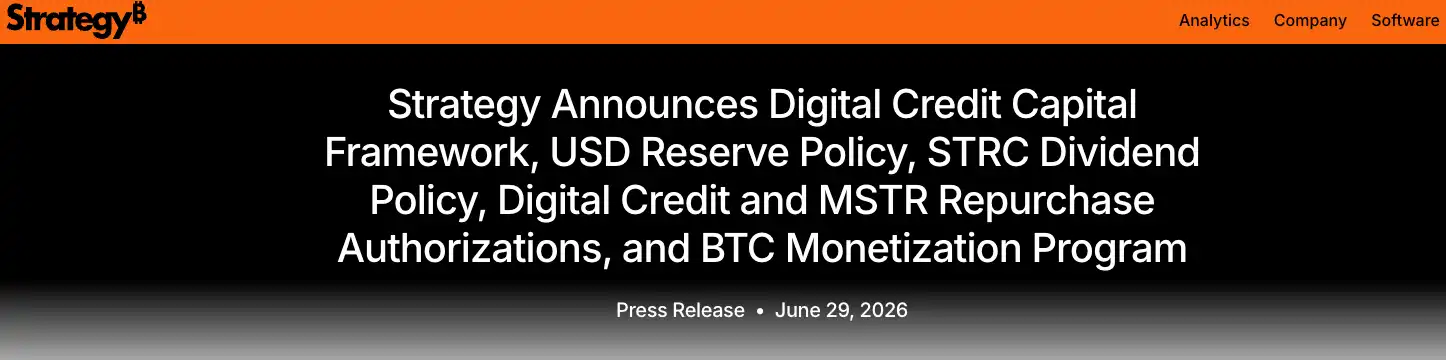
Strategy (formerly MicroStrategy) has officially acknowledged that the flywheel of buying Bitcoin indefinitely by issuing preferred stock can no longer keep spinning.

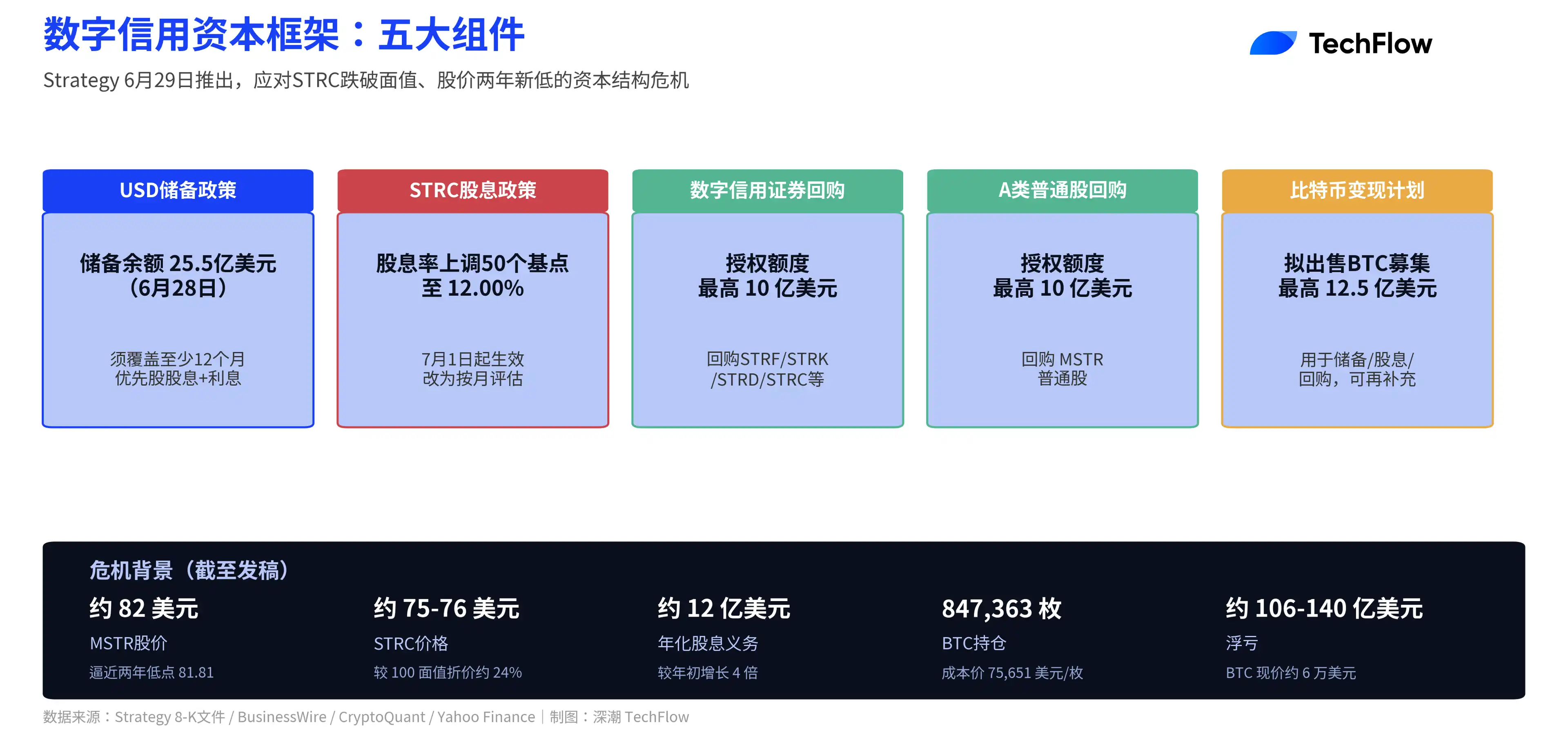
On June 29, the world's largest corporate Bitcoin holder announced the launch of a 'Digital Credit Capital Framework', introducing a comprehensive set of cash reserves, repurchase, and Bitcoin sale mechanisms to provide a safety net for its nearly out-of-control capital structure. The framework consists of five components: a USD reserve policy, a revised STRC dividend policy, a Digital Credit Securities Repurchase Plan, a Class A Common Stock Repurchase Plan, and a Bitcoin Monetization Plan.

The most impactful item is this: the company's board has authorized the sale of Bitcoin to raise up to $12.5 billion, to be used to supplement the cash reserve, pay preferred stock dividends and interest, or repurchase its own securities. For a company that built its faith on 'never selling Bitcoin', this is akin to officially laying down the institutional runway for selling.

Founder Michael Saylor's wording in the statement has already shifted from the past. He said Bitcoin remains the company's 'primary treasury reserve asset,' but immediately admitted: 'Digital credit requires liquidity, discipline, and proactive capital management.'

Translated, it means holding Bitcoin alone can no longer support the $1.2 billion annual dividend bill.

STRC Dividend Rate Soars to 12%, Preferred Stock Falling Below Par is the Trigger

To understand this framework, one must first see how passive Strategy's situation has become.

The company simultaneously announced it is raising the annual dividend rate for its variable-rate Series A Perpetual Preferred Stock STRC from approximately 11.5% by 50 basis points to 12.00%, effective for record dates on or after July 1. Superficially, this offers increased returns to investors, but the essence is being forced by the market—the STRC price has fallen to around $75-$76, a discount of about 24% from its $100 face value, hitting a record low.

STRC falling below par strikes at the heart of Strategy's financing model. This preferred stock was the company's 'money printer': continuously issuing new shares at or above face value to raise funds for buying Bitcoin. Once the price is deeply discounted, new preferred shares cannot be issued at a favorable price, and the entire financing flywheel jams. Julio Moreno, Head of Research at on-chain analytics firm CryptoQuant, calculated in a report on June 23: Strategy's annualized dividend obligation has skyrocketed from about $300 million at the beginning of the year to about $12 billion, quadrupling in one year, while the dividend coverage period shrank from over seven years to about 14 months. He directly advised the company to pause Bitcoin purchases and rebuild its cash reserve to about $28 billion first.

For preferred stock holders, a 12% coupon sounds attractive, but only if the company can pay. The new framework requires the USD reserve to cover at least 12 months of preferred stock dividend and interest obligations, effectively writing the ability to 'pay on time' into a hard constraint.

$25.5 Billion Cash Reserve: Shifting from 'HODLing' to 'HODLing Cash'

Strategy's cash reserve is visibly swelling, in the opposite direction of its past strategy.

According to the company's 8-K filing, as of June 28, the USD reserve balance was $25.5 billion, including anticipated cash proceeds from Class A common stock ATM offerings that have not yet settled. This number shows a significant jump compared to $1.4 billion on June 21 and $1.44 billion when it was initially established in early December 2025. Where is the money coming from? The answer is selling its own stock, not buying Bitcoin.

Operations over the past three weeks have already hinted at the pivot. In the week of June 22, the company bought only 520 Bitcoin for approximately $34.9 million, one-third of the previous week; during the same period, it sold 2.71 million shares of MSTR common stock, raising $335.5 million, but allocated less than 11% into Bitcoin, with the remainder all going to the cash reserve.

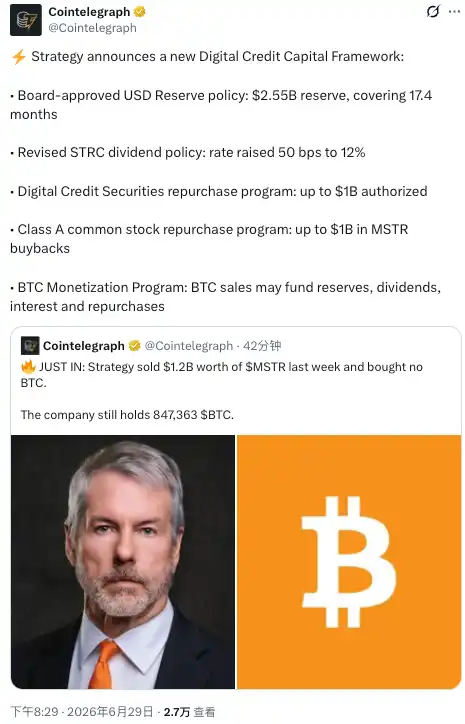
Cointelegraph posted on June 29 that Strategy sold $1.2 billion worth of MSTR shares last week and did not buy any Bitcoin. If accurate, this indicates that the intensity of selling shares to replenish cash is increasing (Note: The $1.2 billion weekly sale figure is significantly higher than previously disclosed weekly data and should be verified against the company's latest filing prior to publication). The company currently holds 847,363 Bitcoin with a weighted average cost of approximately $75,651 per coin.
The cost of shifting to 'HODLing cash' is dilution. Issuing new shares when the MSTR stock price is below its per-share Bitcoin Net Asset Value dilutes the amount of Bitcoin backing each share. MSTR fell to around $82 this week, approaching a two-year low of $81.81; the 'premium' that fueled the flywheel's operation no longer exists.

$10 Billion Each for Repurchases: Trying to Buy Back the Discount

The framework also hides two 'repurchase knives': the Digital Credit Securities Repurchase Plan and the Class A Common Stock Repurchase Plan, each with an authorization ceiling of up to $10 billion.
The logic isn't complicated. STRC and other preferred securities and MSTR common stock are trading at deep discounts. The company using cash (or proceeds from Bitcoin sales) to repurchase at low prices can theoretically narrow the discount and protect the price. Bitcoin critic Peter Schiff has repeatedly posted on X in recent days, saying Saylor's best option is to sell Bitcoin to repurchase shares and close the discount.

Now Strategy has written this suggestion into its formal framework, though Schiff simultaneously warned that forced Bitcoin sales could conversely crash the Bitcoin price, plunging the entire structure into a death spiral.

Whether the repurchases will work depends on how much cash the company has. For investors holding MSTR or preferred stock, the $10 billion authorization is just a ceiling, not a guarantee of full execution; the actual buying pace will depend on subsequent disclosures.

More Than Just Stopping the Bleeding: Legal Probes and Mounting Debt

This framework was hastily launched under multiple pressures; looking at financial numbers alone is insufficient.

On June 25, Rosen Law Firm disclosed it is investigating Strategy and Saylor, alleging they may have issued 'materially misleading information' to investors regarding Bitcoin holdings. The investigation covers all five of the company's securities: MSTR, STRF, STRC, STRK, and STRD. The probe is still in its early stages with no formal lawsuit yet, but the timing coincides with the continuous decline in stock price.

The debt situation is equally tight.

According to multiple media reports, Strategy's total debt on its balance sheet is about $8.2 billion. Since 2026, its cash reserve has shrunk by approximately 38%, and the company also conducted a debt buyback in May. With Bitcoin currently around $60,000, it has fallen below the cost basis of all Strategy's purchase batches from 2024 to 2026. Paper losses range between $10.6 billion and $14 billion (varies by source).

For investors on the sidelines, the key metric to watch now is the discount of the MSTR stock price relative to its per-share Bitcoin Net Asset Value. If the discount remains persistently deep, the ATM offering engine will stall. That is the outcome this framework truly aims to avoid—yet may not be able to prevent.


Criptos en tendencia

Preguntas relacionadas

QWhat is the new 'Digital Credit Capital Framework' announced by Strategy, and what major shift does it represent?

AStrategy announced a 'Digital Credit Capital Framework' to stabilize its capital structure. It includes five components: a USD reserve policy, a revised STRC dividend policy, a digital credit securities repurchase plan, a Class A common stock repurchase plan, and a Bitcoin monetization plan. The major shift is the authorization to sell up to $1.25 billion worth of Bitcoin to fund cash reserves and obligations, effectively ending its previous 'never sell' Bitcoin strategy and marking a turn towards active capital management.

QWhat was the immediate trigger for Strategy to implement this new capital framework?

AThe immediate trigger was the market pressure stemming from its STRC preferred stock trading at a significant discount. The STRC shares fell to approximately $75-76, a discount of about 24% from their $100 par value. This threatened the company's core funding model, which relied on issuing preferred shares near or above par value to buy Bitcoin. Furthermore, the annualized dividend obligation on these preferred shares had surged to around $1.2 billion, creating a critical liquidity strain.

QHow has Strategy's approach to its cash reserves changed recently, and what are the implications?

AStrategy has shifted from aggressively accumulating Bitcoin to aggressively building its USD cash reserves. The reserve balance grew to $2.55 billion by June 28, up from $1.4 billion in early December 2025. This growth is funded primarily by selling its own MSTR common stock through its ATM program, with a decreasing portion of the proceeds being used to buy Bitcoin. The implication is a strategic pivot from 'hoarding Bitcoin' to 'hoarding cash' to meet obligations, which comes at the cost of potential shareholder dilution when MSTR trades below its Bitcoin-per-share NAV.

QWhat are the two key repurchase plans included in the framework, and what is their intended purpose?

AThe framework authorizes two repurchase plans, each with a ceiling of $1 billion: a Digital Credit Securities Repurchase Plan (targeting preferred shares like STRC) and a Class A Common Stock Repurchase Plan (targeting MSTR stock). The intended purpose is to buy back these securities while they are trading at deep discounts to their par value or NAV. The goal is to support their market prices, narrow the discount gap, and restore investor confidence in the company's capital structure.

QWhat are some of the additional pressures, beyond financials, that Strategy is currently facing?

ABeyond the financial pressures, Strategy is facing a legal investigation and significant debt burdens. On June 25, Rosen Law Firm announced it is investigating the company and Michael Saylor for potentially issuing 'materially misleading' information to investors regarding its Bitcoin holdings. Additionally, the company carries approximately $8.2 billion in cumulative debt, and with Bitcoin's price below its average acquisition cost, the company is facing substantial paper losses estimated between $10.6 billion and $14 billion.

Lecturas Relacionadas

In Such a Crowded Cross-border Payment Track, Where Does the Next Stop Lie in the Future?

The crowded cross-border payments industry faces a paradox: intense competition above water with financing and narratives, while beneath, price wars and shrinking margins in basic PSP services are common. The path forward lies not in simple "cross-border" solutions but in deep **localization**. Success requires mastering the fragmented and tightening regulations of fiat currencies in each market—the "last mile" of compliance, banking, and settlement. Many Chinese PSPs have succeeded by following Chinese merchants overseas but have not deeply penetrated mainstream local merchant ecosystems abroad. Their strong product capabilities need to be applied to new, complex markets. The future belongs to companies that evolve from single-channel providers to **cross-border capital network operators**. This means moving beyond competing on transaction fees to creating internal networks that optimize capital efficiency through multi-directional matching, netting, and position reuse across countries and currencies. For Web3 and stablecoins, the key is integration, not replacement. Stablecoins offer efficiency gains but cannot bypass the foundational trust, compliance, and legal frameworks of traditional finance. The realistic path is the gradual adoption and "taming" of Web3 technologies by established financial institutions. The ultimate solution is a **dual clearing infrastructure** combining deep local fiat capabilities (local accounts, compliance, banking) with lightweight stablecoin-native capabilities (on-chain settlement, wallets). The biggest opportunity lies not in oversaturated mainstream corridors but in complex, underserved regional corridors (e.g., specific CIS, Middle East-Southeast Asia, or Latin American trade pairs). The winners will be those who build hard-to-replicate, deep capabilities in these areas—acting as the essential "clearing shovels" or infrastructure providers. The future keywords are **more local, more networked, and more stablecoin-native**. High-profit opportunities remain in the non-standardized, difficult-to-replicate deep waters of the industry, requiring genuine on-the-ground presence and long-term patience.

链捕手Hace 1 hora(s)

In Such a Crowded Cross-border Payment Track, Where Does the Next Stop Lie in the Future?

链捕手Hace 1 hora(s)

Lightning Fast Five-Whip Combo! Strategy's Self-Rescue Plan Officially Released

Strategy, amidst the STRC de-pegging crisis, has unveiled its "Digital Credit Capital Framework" self-rescue plan. The five-part framework includes: 1) **Cash Reserves**: Management of ~$2.55B in USD reserves, dedicated solely to covering ~17.4 months of preferred stock dividends and debt interest, with a 12-month minimum coverage floor. 2) **Dividend Policy**: STRC's dividend yield rises to 12% from July 1st, with monthly reviews. Strategy clarifies de-pegging does not automatically trigger further hikes. 3) **Preferred Stock Buyback**: A $1B authorization, prioritizing STRC repurchases to support its price, reduce future dividend obligations, and signal commitment, using funds separate from dividend reserves. 4) **Common Stock Buyback**: A separate $1B authorization for MSTR stock, aimed at creating shareholder value when the stock is deemed undervalued, establishing a two-way capital management mechanism. 5) **Bitcoin Monetization**: Formal authorization to sell BTC (up to $1.25B earmarked) to build USD reserves, cover dividends/interest, or fund buybacks, marking a strategic shift where BTC becomes a managed asset rather than a strictly "hold-only" reserve. Market reaction saw MSTR and STRC shares rise pre-market, while BTC remained stable. The plan aims to restore confidence in STRC, ensure dividend sustainability, and reopen Strategy's funding channels.

Odaily星球日报Hace 2 hora(s)

Lightning Fast Five-Whip Combo! Strategy's Self-Rescue Plan Officially Released

Odaily星球日报Hace 2 hora(s)

The Sword of Damocles Over the AI Bull Market: Not Just in South Korea, Leverage in U.S. Stocks Is Equally Staggering

Global equity markets are hitting new highs driven by the AI boom, but the fuel behind this rally is becoming increasingly dangerous. From the US to South Korea, margin debt and leveraged ETF assets have soared to historical extremes, with their pro-cyclical nature amplifying tail risks in market volatility. In the US, margin debt rose 54% year-over-year in May, reaching a record $1.4 trillion. Simultaneously, leveraged ETF assets nearly doubled in under 70 days to over $220 billion by early June, with intense focus on tech, semiconductor indices, and single stocks like NVIDIA and Tesla. A warning sign appeared in South Korea, where the KOSPI index experienced extreme volatility, plunging 10% to trigger a circuit breaker, then sharply rebounding before halting again, partly driven by concentrated, highly leveraged positions in chip stocks. Analysts are raising alarms. Barclays warns that leveraged funds have accumulated roughly $300 billion in equity-linked derivatives since late March, creating a major source of non-discretionary risk. Morgan Stanley notes an unprecedented reliance on leveraged financing by marginal buyers, with financing becoming more expensive and scarce. Charles Schwab has tightened margin requirements. The core risk lies in the mechanics: leveraged ETFs and derivatives can create a "tail wags the dog" effect, where fund flows force market makers to buy underlying stocks, amplifying gains. This process reverses in a downturn, triggering a self-reinforcing selling spiral as funds deleverage. Additionally, the cost of borrowing to buy stocks has spiked to multi-year highs. Morgan Stanley warns this sets up a nonlinear risk: high financing costs stall momentum, a price decline triggers forced deleveraging, and selling pressure is multiplied by leverage, potentially leading to outsized declines. The current market breadth is narrow, with gains heavily concentrated in tech, making the rally vulnerable to a pullback in leveraged positions. In summary, the AI-fueled bull market is increasingly propped up by record leverage. When this trend reverses, the deleveraging process could magnify losses, posing a significant threat to financial stability.

marsbitHace 2 hora(s)

The Sword of Damocles Over the AI Bull Market: Not Just in South Korea, Leverage in U.S. Stocks Is Equally Staggering

marsbitHace 2 hora(s)

Trading

Spot

Artículos destacados

Qué es BITCOIN

Entendiendo HarryPotterObamaSonic10Inu (ERC-20) y Su Posición en el Espacio Cripto En los últimos años, el mercado de criptomonedas ha sido testigo de un aumento en la popularidad de las monedas meme, capturando el interés no solo de los comerciantes, sino también de aquellos que buscan compromiso comunitario y valor de entretenimiento. Entre estos tokens únicos se encuentra HarryPotterObamaSonic10Inu (ERC-20), un proyecto intrigante que mezcla referencias culturales en el tejido de las criptomonedas. Este artículo profundiza en los aspectos clave de HarryPotterObamaSonic10Inu, explorando sus mecanismos, ethos impulsado por la comunidad y su relación con el paisaje cripto más amplio. ¿Qué es HarryPotterObamaSonic10Inu (ERC-20)? Como su nombre sugiere, HarryPotterObamaSonic10Inu es una moneda meme construida sobre la blockchain de Ethereum, clasificada bajo el estándar ERC-20. A diferencia de las criptomonedas tradicionales que pueden enfatizar la utilidad práctica o el potencial de inversión, este token prospera en el valor de entretenimiento y la fuerza de su comunidad. El proyecto tiene como objetivo fomentar un entorno donde los usuarios comprometidos puedan reunirse, compartir ideas y participar en actividades inspiradas por diversos fenómenos culturales. Una característica notable de HarryPotterObamaSonic10Inu es su cero impuestos en las transacciones. Este atractivo elemento tiene como objetivo incentivar el comercio y la participación comunitaria, sin cargos adicionales que puedan disuadir a los comerciantes de pequeña escala. El suministro total de la moneda está establecido en mil millones de tokens, una cifra que marca su intención de mantener una circulación sustancial dentro de la comunidad. Creador de HarryPotterObamaSonic10Inu (ERC-20) Los orígenes de HarryPotterObamaSonic10Inu están algo envueltos en misterio; los detalles sobre el creador siguen siendo desconocidos. El desarrollo de este token carece de un equipo identificable o de un plan explícito, lo cual no es inusual dentro del sector de monedas meme. En cambio, el proyecto ha surgido de manera orgánica, con su progreso muy dependiente del entusiasmo y la participación de su comunidad. Inversores de HarryPotterObamaSonic10Inu (ERC-20) En cuanto a inversiones externas y respaldo, HarryPotterObamaSonic10Inu también sigue siendo ambiguo. El token no lista ninguna fundación de inversión conocida o apoyo organizacional significativo. En cambio, la savia del proyecto es su comunidad de base, que informa su crecimiento y sostenibilidad a través de la acción colectiva y el compromiso en el espacio cripto. ¿Cómo Funciona HarryPotterObamaSonic10Inu (ERC-20)? Como una moneda meme, HarryPotterObamaSonic10Inu opera principalmente fuera de los marcos tradicionales que a menudo rigen el valor de los activos. Hay varios aspectos distintivos que definen cómo funciona el proyecto: Transacciones Sin Impuestos: Sin tarifas impositivas en las transacciones, los usuarios pueden comprar y vender el token libremente sin preocuparse por costos ocultos. Compromiso Comunitario: El proyecto prospera en la interacción comunitaria, aprovechando plataformas de redes sociales para crear entusiasmo y facilitar la participación. Las discusiones, el intercambio de contenido y el compromiso son elementos cruciales que ayudan a expandir su alcance y fomentar la lealtad entre los seguidores. Sin Utilidad Práctica: Cabe señalar que HarryPotterObamaSonic10Inu no ofrece utilidad concreta dentro del ecosistema financiero. Más bien, se clasifica como un token principalmente para actividades de entretenimiento y comunitarias. Referencia Cultural: El token incorpora astutamente elementos de la cultura popular para atraer interés, conectando con entusiastas de los memes y seguidores de las criptomonedas por igual. HarryPotterObamaSonic10Inu ejemplifica cómo las monedas meme operan de manera diferente a los proyectos de criptomonedas más tradicionales, ingresando al mercado como construcciones sociales innovadoras en lugar de activos utilitarios. Cronología de HarryPotterObamaSonic10Inu (ERC-20) La historia de HarryPotterObamaSonic10Inu está marcada por varios hitos notables: Creación: El token surgió de un meme viral, capturando la imaginación de muchos entusiastas de las criptomonedas. Las fechas específicas de creación no están disponibles, subrayando su ascenso orgánico. Listado en Exchanges: HarryPotterObamaSonic10Inu ha llegado a varios exchanges, permitiendo un acceso y comercio más fácil por parte de la comunidad. Iniciativas de Compromiso Comunitario: Actividades continuas destinadas a mejorar la interacción comunitaria, incluyendo concursos, campañas en redes sociales y generación de contenido por parte de fanáticos y defensores. Planes de Expansión Futuros: La hoja de ruta del proyecto incluye el lanzamiento de una colección de NFT, mercancía y un sitio de comercio electrónico relacionado con sus temas culturales, involucrando aún más a la comunidad e intentando añadir más dimensiones a su ecosistema. Puntos Clave Sobre HarryPotterObamaSonic10Inu (ERC-20) Naturaleza Impulsada por la Comunidad: El proyecto prioriza la participación colectiva y la creatividad, asegurando que la involucración de los usuarios esté a la vanguardia de su desarrollo. Clasificación como Moneda Meme: Representa la epítome de las criptomonedas basadas en el entretenimiento, diferenciándose de los vehículos de inversión tradicionales. Sin Afiliación Directa con Bitcoin: A pesar de la similitud en el nombre del ticker, HarryPotterObamaSonic10Inu es distinto y no tiene relación con Bitcoin u otras criptomonedas establecidas. Enfoque en la Colaboración: HarryPotterObamaSonic10Inu está diseñado para crear un espacio para la colaboración y el intercambio de historias entre sus poseedores, proporcionando una vía para la creatividad y el vínculo comunitario. Perspectivas Futuras: La ambición de expandirse más allá de su premisa inicial hacia NFTs y mercancías describe un camino para que el proyecto potencialmente ingrese a avenidas más tradicionales dentro de la cultura digital. A medida que las monedas meme continúan capturando la imaginación de la comunidad de criptomonedas, HarryPotterObamaSonic10Inu (ERC-20) se destaca debido a sus lazos culturales y su enfoque centrado en la comunidad. Si bien puede no encajar en el molde típico de un token impulsado por la utilidad, su esencia radica en la alegría y la camaradería fomentadas entre sus seguidores, destacando la naturaleza en evolución de las criptomonedas en una era cada vez más digital. A medida que el proyecto continúa desarrollándose, será importante observar cómo las dinámicas comunitarias influyen en su trayectoria en el cambiante paisaje de la tecnología blockchain.

1.8k Vistas totalesPublicado en 2024.04.01Actualizado en 2024.12.03

Qué es BITCOIN

Cómo comprar BTC

¡Bienvenido a HTX.com! Hemos hecho que comprar Bitcoin (BTC) sea simple y conveniente. Sigue nuestra guía paso a paso para iniciar tu viaje de criptos.Paso 1: crea tu cuenta HTXUtiliza tu correo electrónico o número de teléfono para registrarte y obtener una cuenta gratuita en HTX. Experimenta un proceso de registro sin complicaciones y desbloquea todas las funciones.Obtener mi cuentaPaso 2: ve a Comprar cripto y elige tu método de pagoTarjeta de crédito/débito: usa tu Visa o Mastercard para comprar Bitcoin (BTC) al instante.Saldo: utiliza fondos del saldo de tu cuenta HTX para tradear sin problemas.Terceros: hemos agregado métodos de pago populares como Google Pay y Apple Pay para mejorar la comodidad.P2P: tradear directamente con otros usuarios en HTX.Over-the-Counter (OTC): ofrecemos servicios personalizados y tipos de cambio competitivos para los traders.Paso 3: guarda tu Bitcoin (BTC)Después de comprar tu Bitcoin (BTC), guárdalo en tu cuenta HTX. Alternativamente, puedes enviarlo a otro lugar mediante transferencia blockchain o utilizarlo para tradear otras criptomonedas.Paso 4: tradear Bitcoin (BTC)Tradear fácilmente con Bitcoin (BTC) en HTX's mercado spot. Simplemente accede a tu cuenta, selecciona tu par de trading, ejecuta tus trades y monitorea en tiempo real. Ofrecemos una experiencia fácil de usar tanto para principiantes como para traders experimentados.

5.2k Vistas totalesPublicado en 2024.12.12Actualizado en 2026.06.02

Cómo comprar BTC

Qué es $BITCOIN

ORO DIGITAL ($BITCOIN): Un Análisis Integral Introducción al ORO DIGITAL ($BITCOIN) ORO DIGITAL ($BITCOIN) es un proyecto basado en blockchain que opera en la red Solana, cuyo objetivo es combinar las características de los metales preciosos tradicionales con la innovación de las tecnologías descentralizadas. Aunque comparte un nombre con Bitcoin, a menudo referido como “oro digital” debido a su percepción como un refugio de valor, ORO DIGITAL es un token separado diseñado para crear un ecosistema único dentro del paisaje Web3. Su meta es posicionarse como un activo digital alternativo viable, aunque los detalles sobre sus aplicaciones y funcionalidades aún están en desarrollo. ¿Qué es ORO DIGITAL ($BITCOIN)? ORO DIGITAL ($BITCOIN) es un token de criptomoneda diseñado explícitamente para su uso en la blockchain de Solana. A diferencia de Bitcoin, que proporciona un papel de almacenamiento de valor ampliamente reconocido, este token parece centrarse en aplicaciones y características más amplias. Aspectos notables incluyen: Infraestructura Blockchain: El token está construido sobre la blockchain de Solana, conocida por su capacidad para manejar transacciones de alta velocidad y bajo costo. Dinámicas de Suministro: ORO DIGITAL tiene un suministro máximo limitado a 100 cuatrillones de tokens (100P $BITCOIN), aunque los detalles sobre su suministro circulante no se han divulgado actualmente. Utilidad: Si bien las funcionalidades precisas no están delineadas explícitamente, hay indicios de que el token podría ser utilizado para diversas aplicaciones, potencialmente involucrando aplicaciones descentralizadas (dApps) o estrategias de tokenización de activos. ¿Quién es el Creador de ORO DIGITAL ($BITCOIN)? En la actualidad, la identidad de los creadores y el equipo de desarrollo detrás de ORO DIGITAL ($BITCOIN) sigue siendo desconocida. Esta situación es típica entre muchos proyectos innovadores dentro del espacio blockchain, particularmente aquellos alineados con las finanzas descentralizadas y fenómenos de monedas meme. Si bien tal anonimato puede fomentar una cultura impulsada por la comunidad, intensifica las preocupaciones sobre la gobernanza y la responsabilidad. ¿Quiénes son los Inversores de ORO DIGITAL ($BITCOIN)? La información disponible indica que ORO DIGITAL ($BITCOIN) no tiene patrocinadores institucionales conocidos ni inversiones destacadas de capital de riesgo. El proyecto parece operar en un modelo de peer-to-peer centrado en el apoyo y la adopción de la comunidad en lugar de rutas de financiamiento tradicionales. Su actividad y liquidez se sitúan principalmente en intercambios descentralizados (DEX), como PumpSwap, en lugar de plataformas de trading centralizadas establecidas, lo que resalta aún más su enfoque de base. Cómo Funciona ORO DIGITAL ($BITCOIN) Los mecanismos operativos de ORO DIGITAL ($BITCOIN) pueden elaborarse en función de su diseño blockchain y atributos de red: Mecanismo de Consenso: Al aprovechar el único proof-of-history (PoH) de Solana combinado con un modelo de proof-of-stake (PoS), el proyecto asegura una validación de transacciones eficiente que contribuye al alto rendimiento de la red. Tokenómica: Si bien los mecanismos deflacionarios específicos no se han detallado extensamente, el vasto suministro máximo de tokens implica que podría atender microtransacciones o casos de uso nicho que aún están por definirse. Interoperabilidad: Existe el potencial de integración con el ecosistema más amplio de Solana, incluyendo varias plataformas de finanzas descentralizadas (DeFi). Sin embargo, los detalles sobre integraciones específicas permanecen no especificados. Cronología de Eventos Clave Aquí hay una cronología que destaca hitos significativos relacionados con ORO DIGITAL ($BITCOIN): 2023: El despliegue inicial del token ocurre en la blockchain de Solana, marcado por su dirección de contrato. 2024: ORO DIGITAL gana visibilidad al estar disponible para trading en intercambios descentralizados como PumpSwap, permitiendo a los usuarios comerciar contra SOL. 2025: El proyecto presencia actividad de trading esporádica y potencial interés en compromisos liderados por la comunidad, aunque no se han documentado asociaciones notables o avances técnicos hasta el momento. Análisis Crítico Fortalezas Escalabilidad: La infraestructura subyacente de Solana soporta altos volúmenes de transacciones, lo que podría mejorar la utilidad de $BITCOIN en varios escenarios de transacción. Accesibilidad: El potencial bajo precio de trading por token podría atraer a inversores minoristas, facilitando una participación más amplia debido a oportunidades de propiedad fraccionada. Riesgos Falta de Transparencia: La ausencia de patrocinadores, desarrolladores o un proceso de auditoría conocidos públicamente puede generar escepticismo sobre la sostenibilidad y confiabilidad del proyecto. Volatilidad del Mercado: La actividad de trading depende en gran medida del comportamiento especulativo, lo que puede resultar en una volatilidad de precios significativa y en incertidumbre para los inversores. Conclusión ORO DIGITAL ($BITCOIN) surge como un proyecto intrigante pero ambiguo dentro del ecosistema de Solana en rápida evolución. Si bien intenta aprovechar la narrativa del “oro digital”, su alejamiento del papel establecido de Bitcoin como refugio de valor subraya la necesidad de una diferenciación más clara de su utilidad y estructura de gobernanza previstas. La aceptación y adopción futura dependerán probablemente de abordar la actual opacidad y de definir sus estrategias operativas y económicas de manera más explícita. Nota: Este informe abarca información sintetizada disponible hasta octubre de 2023, y pueden haber ocurrido desarrollos más allá del período de investigación.

101 Vistas totalesPublicado en 2025.05.13Actualizado en 2025.05.13

Qué es $BITCOIN

Discusiones

Bienvenido a la comunidad de HTX. Aquí puedes mantenerte informado sobre los últimos desarrollos de la plataforma y acceder a análisis profesionales del mercado. A continuación se presentan las opiniones de los usuarios sobre el precio de BTC (BTC).

活动图片