A galaxy that NASA satellites have orbited for a decade was completed by Claude in just a few days.
Just now, Anthropic unveiled SI's first complete full-sky ultraviolet map, covering the entire sky without leaving a single gap.
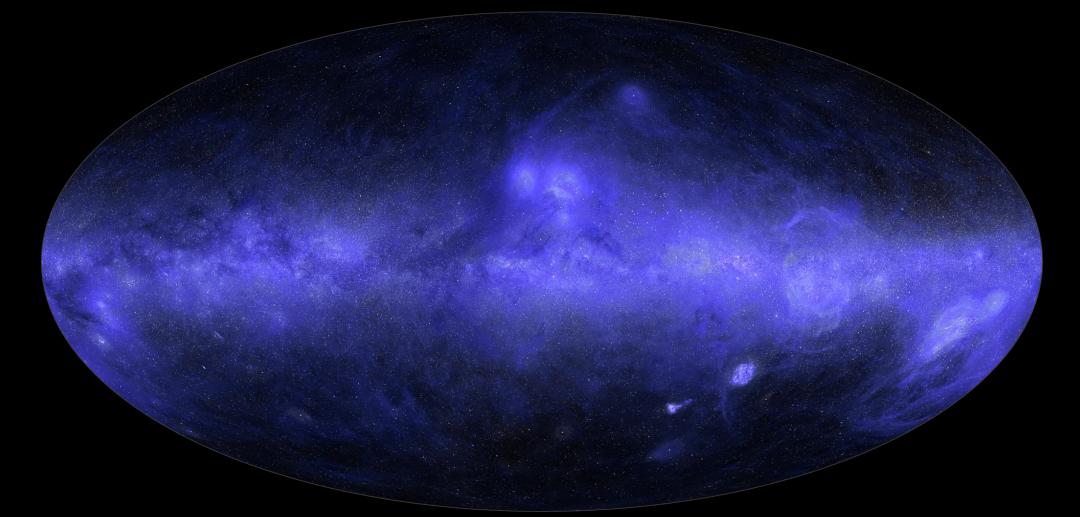
The entire sky in ultraviolet light, with the Galactic Center at the center. About one-third of the sky area, including most of the Galactic plane, was inferred by Claude.
One-third of the sky in this map has never been seen by any ultraviolet telescope before.
The one who filled in this blank is Claude.
An astrophysicist, using Claude Science to direct a team of Agents, gathered all ultraviolet data collected by satellites over the past 50 years, pieced it together, and then filled in the blanks piece by piece through inference.

Work that would take a human weeks, Claude completed in a few days. During those days, the professor was busy with other projects.
The tasks that scientists have put off for decades, forever stuck at the bottom of the priority list, are now starting to be done.
The Galaxy Satellites Dared Not Look At, Claude Filled In
From radio to gamma rays, astronomers have long completed full-sky maps for every wavelength band, except for ultraviolet.
Ultraviolet light is absorbed by the ozone layer in the atmosphere. To see the ultraviolet sky, telescopes must be sent into space.
Over the past 50 years, space telescopes have imaged portions of the ultraviolet sky. The most data came from NASA's GALEX, which operated from 2003 to 2013, taking about 38,000 images covering roughly two-thirds of the sky.
The remaining portion was intentionally avoided by GALEX.
The Galactic plane is the densest region of stars, with too many bright stars. GALEX, fearing detector damage from intense light, simply avoided it. After 2009, it could no longer observe in the far ultraviolet, leaving only the near ultraviolet operational.
Later, NASA's Swift and Korea's FIMS/SPEAR added some more observations, but when pieced together, the sky was still full of holes. After GALEX retired, no ultraviolet all-sky survey telescope of comparable scale has been launched.
The creator of this map, Brice Ménard, is an astrophysicist at Johns Hopkins University and also a researcher at Anthropic.
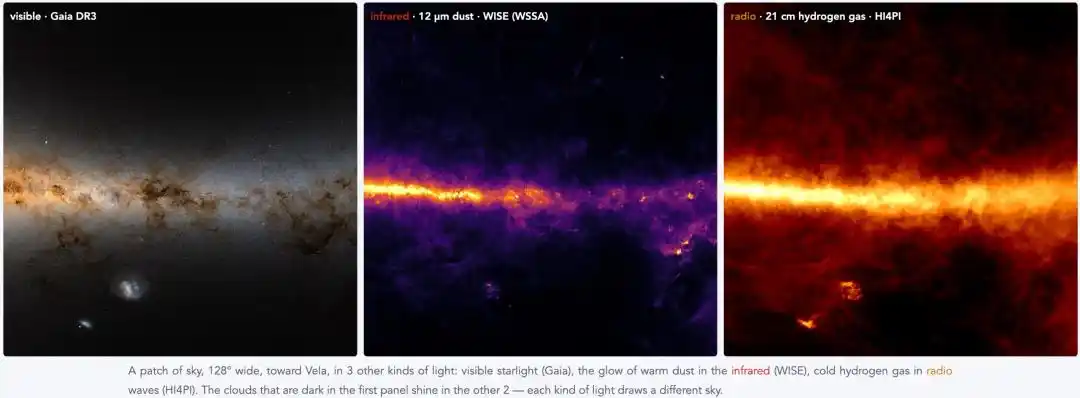
When teaching astrophysics to his students, he often starts with how the same patch of sky appears at different wavelengths. The same sky looks completely different when viewed in a different band.
When it comes to ultraviolet, he always has to apologize to his students first, because the full-sky ultraviolet map he has is "full of holes."
The ultraviolet sky is almost a negative of the familiar starry sky.
The Galactic Center, brightest in visible light, is one of the darkest regions in ultraviolet because dust blocks ultraviolet light even more effectively than visible light. In contrast, star-forming regions above and below the Galactic plane, such as Orion, Scorpius, and the Large and Small Magellanic Clouds, glow brightly blue in ultraviolet.
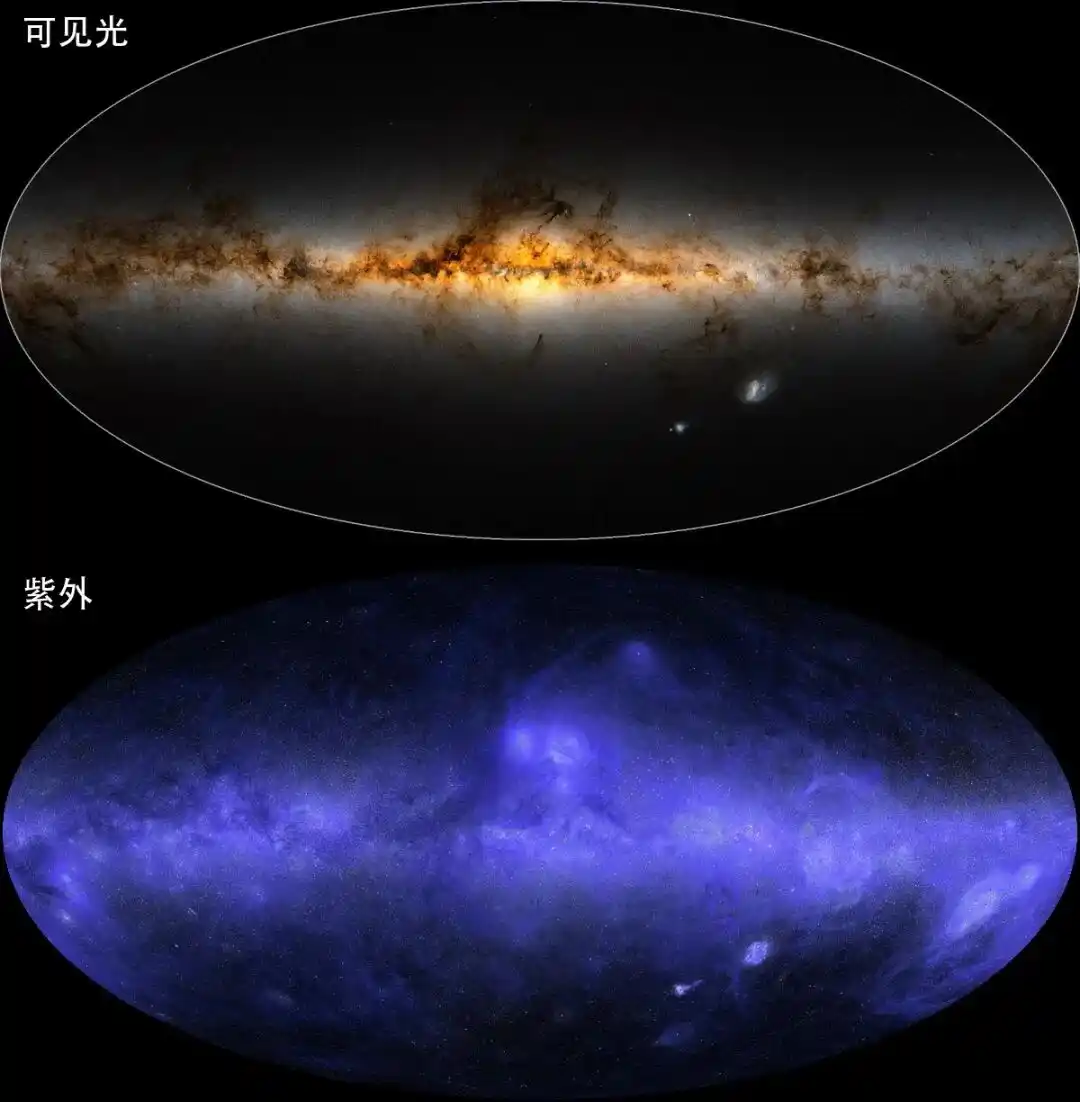
The same patch of sky, top in visible light, bottom in ultraviolet. The brightness and darkness along the Milky Way are almost reversed.
Filling the holes using statistical methods has been technically feasible for a long time. The difficulty lies in the workload: each pixel needs careful calibration, analysis must be run multiple times, requiring weeks of tedious work.
Astrophysicists all have more pressing research, so this task kept being postponed.
This summer, Ménard handed it over to Claude.
Claude first learned the correspondence between ultraviolet brightness and visible light, infrared, and radio brightness across the two-thirds of the sky with ultraviolet data. It then applied this relationship to the remaining one-third, inferring point-by-point how bright the ultraviolet should be, while also providing confidence levels.
To test the accuracy of the inferences, Ménard had Claude deliberately mask a portion of the sky with existing ultraviolet data, treat it as a blank to fill, and then compare the filled result with the actual measurements.
After several rounds of refinement, the inferred values differed from the real measurements by only about 10%. In his words, the human eye could hardly tell the difference.
Finally, Claude used visible-light measurements from ESA's Gaia satellite to infer the ultraviolet brightness of 119 million stars, stacking them onto the map one by one.
One Sentence, One Team of Agents Gets to Work
Ménard's instruction to Claude was just one sentence: gather all available ultraviolet data, unify the scales, synthesize a map, and fill in the areas not observed by ultraviolet telescopes.
The main Agent in Claude Science first dispatched a batch of Agents to search online for publicly available ultraviolet survey data. GALEX alone has tens of thousands of images, taken over several years under varying conditions.
Once the data was downloaded, the first step was to ensure internal consistency within each dataset.
The most troublesome were bright stars. Just like streetlights add glare to a photo, bright stars also add glare to space telescope images. If not removed, the ultraviolet light from fainter nearby objects cannot be accurately measured.
A group of Agents worked on different sky regions separately, smoothing out the discrepancies piece by piece.
The next step was to combine data from several telescopes. Different instruments see the ultraviolet sky slightly differently. They needed cross-calibration, unified resolution, and conversion to the same coordinate system to merge into a single map.
For this step, Ménard only gave the general direction; the specifics of how to do it were left to the Agents dispatched by Claude.
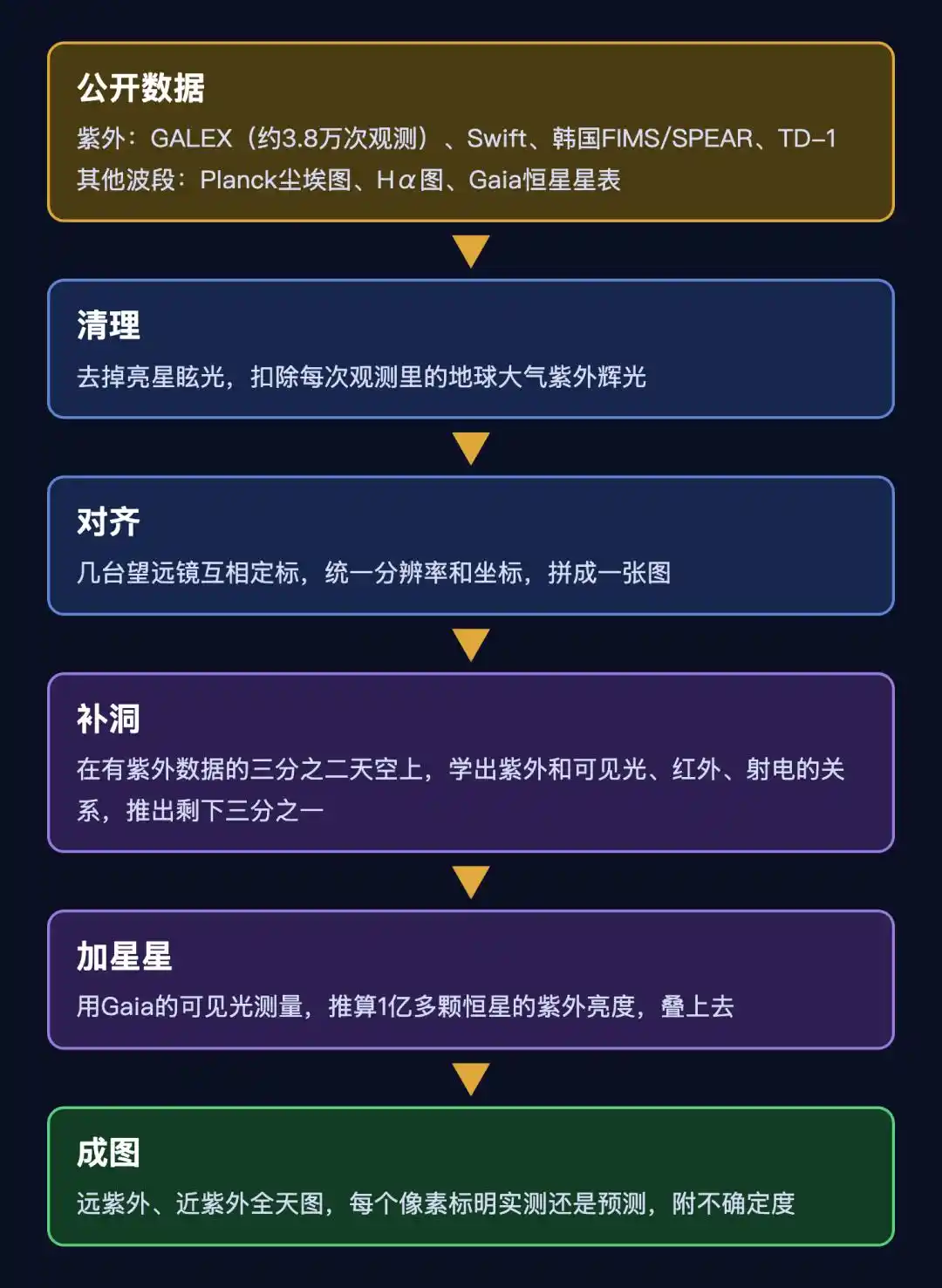
Claude Science is a research workspace launched by Anthropic at the end of June this year. A main Agent can spawn new Agents at any time, alongside a Reviewer Agent specifically for checking citations and calculations.
The entire collaboration lasted a few days with a fixed rhythm. Ménard would chat back and forth a few rounds in Claude Science to decide the next steps, Claude would then compute on its own for several hours, while he turned back to other projects.
They produced over a dozen versions, each more detailed than the last.
Two Rounds of AI Cross-Review, Both Missed These Circular Patches
Claude didn't get it right the first time either.
One night, Ménard was reviewing the processed map and noticed something odd in the darkest sky region. Faint, round circles floated across the image, each slightly brighter or darker than its surroundings.
These circles were the "footprints" left by individual GALEX observations.
Each time GALEX observed a circular area of the sky 1.2 degrees in diameter, a bit of uneven ultraviolet airglow from Earth's atmosphere was mixed into each image. If this airglow wasn't completely subtracted, the individual circles became visible.
The problem was, Claude had listed this as a known issue at the very beginning of the project. Yet, this map had gone through two rounds of review by other Agents, and none caught it.
Ménard said just one sentence to Claude.
"I can see circular disks, traces left by individual observations. Can you fix them?"
The Agents followed this clue, tracing it back to the residual atmospheric airglow. Subsequently, Claude reprocessed all 38,000 observations, subtracting the background anew. After computing for several hours, the circles completely disappeared.
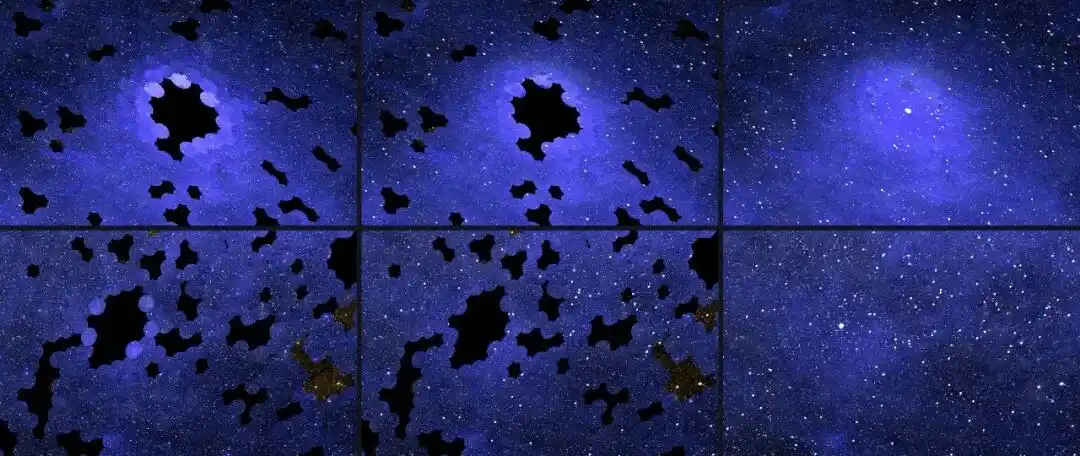
Two sky regions with bright stars avoided by GALEX. Left: circular patches left by individual observations. Middle: residual after background subtraction per image. Right: final map after hole-filling and stacking Gaia stars.
The professor spotted the flaw at a glance; the tedious work of redoing it was all handed over to the Agents.
The Professor Finally Doesn't Have to Apologize
In the final map, structures in the ultraviolet sky are revealed one by one.
Dust clouds around young, bright stars are glowing; massive stellar explosions have blown out huge dust rings. Far from the Galactic plane, faint dust filaments lit by the integrated starlight of the entire Galaxy drift.
Above the Galactic Center, in the direction of Scorpius and Ophiuchus, lies a large patch of blue light—dust clouds illuminated by hot, young stars. The same clouds appear dark in visible light.
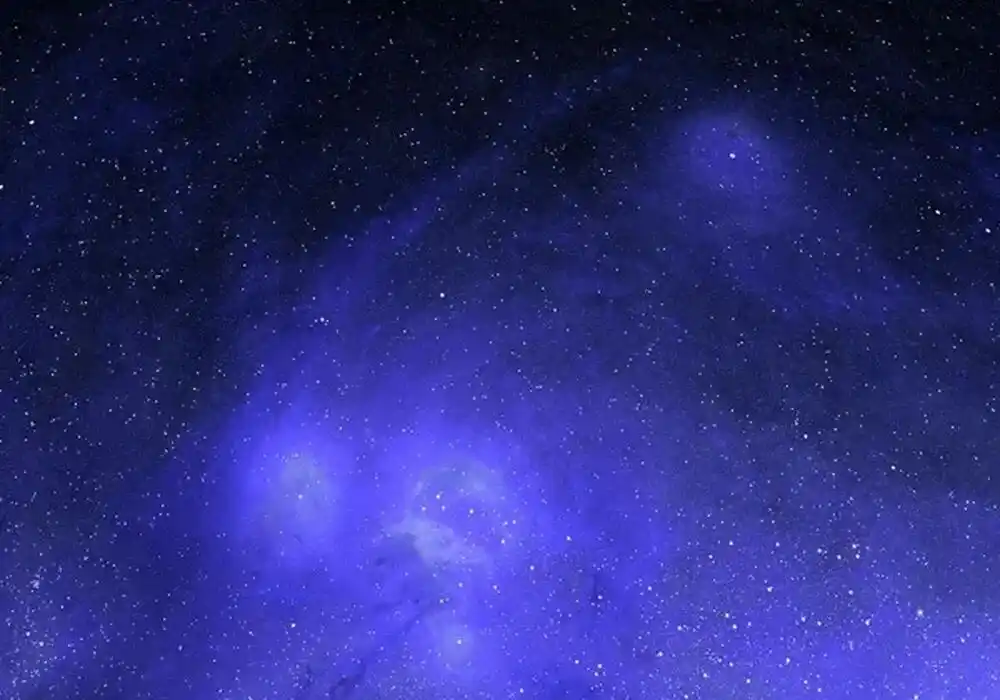
Above the Galactic Center, dust clouds illuminated by young stars in the direction of Scorpius and Ophiuchus.
Below the Galactic plane are the Large and Small Magellanic Clouds, two neighboring galaxies teeming with young stars. In the full-resolution map, the star-forming nursery Tarantula Nebula within the Large Magellanic Cloud is visible.
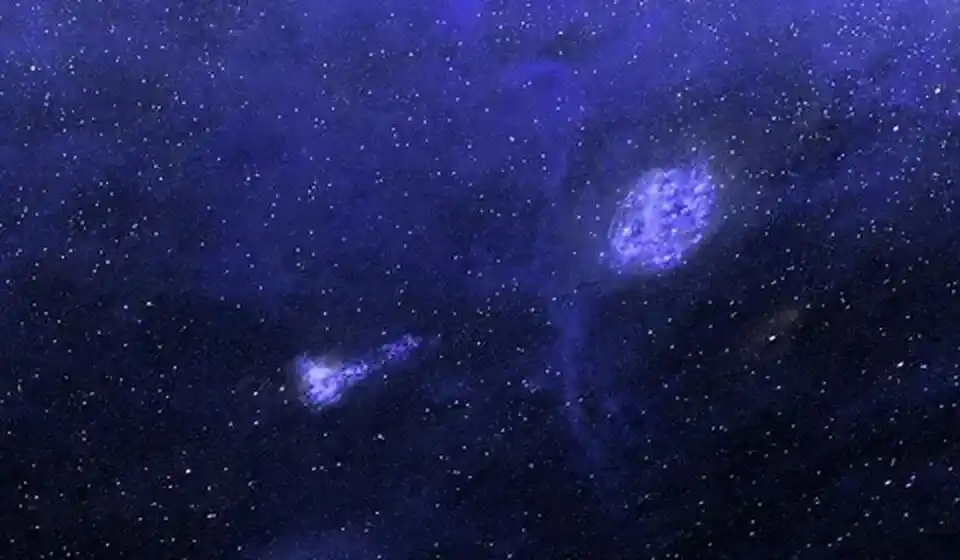
Below the Galactic plane: the Large Magellanic Cloud (right) and the Small Magellanic Cloud (left).
"I think it's beautiful," Ménard said. This map can be placed alongside other classic full-sky maps to help generations of students understand the physical processes happening in our Galaxy.
After Anthropic's official announcement, some users on X questioned whether a map with one-third inferred data could be considered complete.
On Ménard's map page, each pixel is labeled as either observed or inferred, along with error ranges. He specifically notes on the page that "complete" does not mean "fully observed," and that when using the inferred regions for plotting, these two layers of annotation should be included.
The Backlog of Scientist Tasks, AI Begins to Take Over
After completing this map, what struck Ménard most was the time.
"This time, doing such a project, I didn't sacrifice the time I should have spent on research."
In his view, almost every field has such tasks backlogged. They can clarify a key concept and help other researchers, yet never make it to the top of anyone's priority list.
"I suspect many scientists can think of a chart, a graph, or a resource that has been put off for the same reason."
In this map, not a single photon is newly observed. GALEX, Swift, FIMS/SPEAR, TD-1, Planck, Gaia—all used publicly available data accumulated over decades.
NASA's actual mission to resurvey the full ultraviolet sky, UVEX, costing about $300 million, won't launch until 2030.
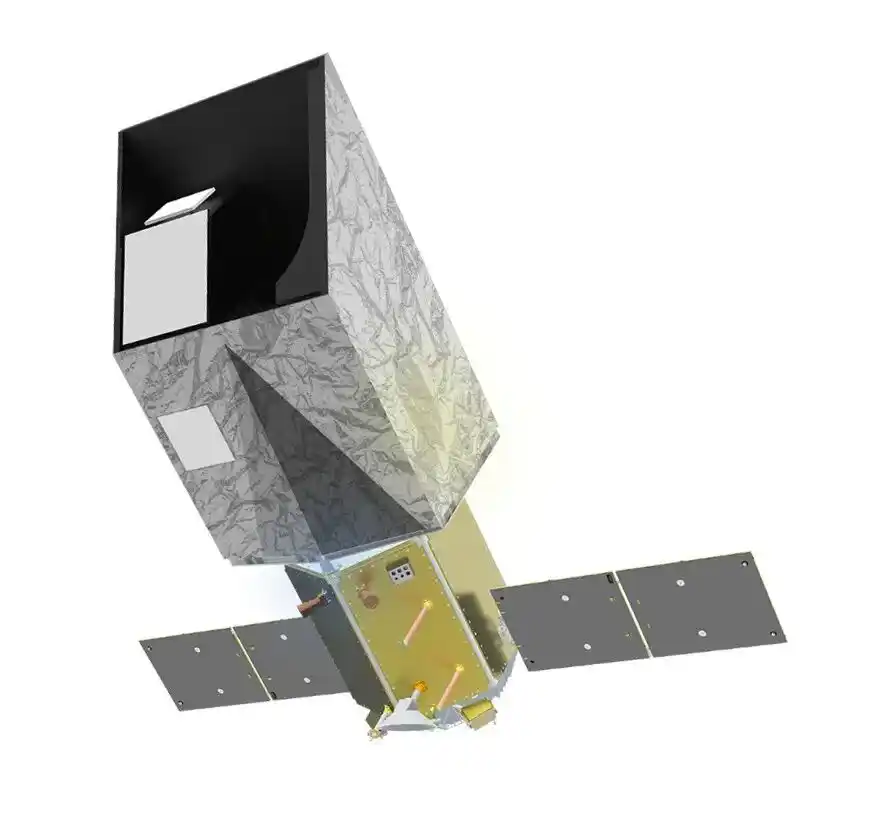
Render of NASA's next-generation ultraviolet detector UVEX, planned for launch in 2030.
Until then, Claude has first delivered a full-sky map using old data—a map without holes, with every pixel labeled for its origin.
Not long ago, Harvard physicist Matthew Schwartz worked with Claude for three months and ended up with drafts for 36 papers spanning 18 disciplines.
On the road to ASI, the tasks AI is taking over first are these fundamental projects that humans don't have time for, yet everyone can use.
Spotting what's wrong and deciding which direction to go remain human tasks. The remaining tedious labor is gradually being handed over to Agents.
In his acknowledgments, Ménard wrote that behind this map is the patient work of many Agents within Claude Science.
"My contribution was limited to guiding them through the process."
References:
https://www.anthropic.com/research/the-missing-map-of-the-sky
https://x.com/AnthropicAI/status/2108290395599667700
This article is from the WeChat public account "Xin Zhi Yuan" (New Wisdom), author: ASI Revelations; Editors: Moses, Peach.