Variant Founder: Everything is a Market, the Endgame of Finance is 'Invisible'

marsbitPublicado a 2026-02-23Actualizado a 2026-02-23

Resumen

Jesse Walden, founder of Variant Fund, argues that crypto is fundamentally about finance—but in a radically expanded sense. He identifies three core drivers reshaping finance: mass participation, permissionless markets, and programmable endpoints. Mass participation is lowering barriers, intertwining finance with culture as trading becomes a form of expressive, accessible engagement. Permissionless innovation allows new markets to emerge outside traditional systems, forcing regulatory evolution—as seen with prediction markets, stablecoins, and ICOs. Programmable markets, combined with AI, are evolving from outputs into infrastructure. Markets generate real-time, hard-to-fake data that AI and applications can consume as APIs, enabling new products and automated decision-making. Ultimately, finance is transitioning from a vertical industry to a horizontal, invisible infrastructure layer embedded into the fabric of culture and technology.

Author: Jesse Walden, Founder of Variant

Compiled by: Yuliya, PANews

Editor's Note: Variant Fund founder Jesse Walden presents the forward-looking view that "everything is a market" in this article, arguing that cryptocurrency is expanding the boundaries of finance into the cultural realm, becoming a horizontal infrastructure layer. The article explores the three core drivers—mass participation, permissionless innovation, and market programmability—to discuss how finance is evolving into a ubiquitous infrastructure, and paints a future vision of finance becoming invisible as crypto technology integrates with artificial intelligence.

Full text below:

There has been much debate about whether cryptocurrency is purely for finance or has a grander purpose. My view is: yes, cryptocurrency is for finance. But the key point is that the connotation of finance is becoming much broader than commonly understood.

Behind this transformation lie three fundamental drivers:

  • Mass Participation: As market access barriers lower, finance is increasingly intertwining with and being deeply influenced by culture.

  • Permissionless Markets: This force acts as an agent of change, allowing global users to exhibit new behavioral patterns and, in the process, forcing regulators and traditional institutions to evolve.

  • Programmable Endpoints: Financial markets are evolving from discrete venues into APIs. They embed economic data, generate real-time information that other systems cannot produce and is extremely difficult to fake, and are seamlessly available for use by AI Agents.

Mass participation changes who uses markets; permissionless innovation changes which markets can exist; and the programmability of new markets opens up a new design space for how we (and AI agents) use them.

In summary, as value in the world becomes increasingly software-based, finance is undergoing a radical transformation, requiring us to adopt a more expansive perspective on its endgame.
Towards a Billion Traders

In 2020, Variant proposed the vision of the "Ownership Economy" at its inception, aiming to make a billion users become owners: owning their identity, funds, data, and the products and services they use daily. Today, user ownership has been realized in some important but vertical software areas, primarily focused on financial attributes: such as store-of-value assets (BTC/ETH), decentralized blockchains, and financial markets (Solana, Uniswap, Morpho, Hyperliquid)—we are fortunate to be investors in these projects.

In hindsight, the 2020 thesis was correct: people want economic upside in things they understand and care about. But I originally thought this would extend to all products users engage with daily, similar to employee stock options; however, the opportunity turned out to be making a "stake" in anything you have conviction in.

Today, "trading" has become a broader, non-skeuomorphic way for users to participate in economic upside (and downside). It turns out that trading provides more immediate and expressive feedback compared to owning digital identity, money, data, or platforms.

Trading is often the gateway to participating in broader markets. Many of the talented people I've met in crypto follow a similar growth trajectory:

  • Learning a lesson on a volatile altcoin;

  • Learning to manage risk like a trader;

  • Eventually becoming a more mature long-term investor.

Even failed experiences are meaningful: a gambler who loses everything becomes a trader if they decide to only bet on what they understand; a trader becomes an investor if they develop conviction and extend their time horizon.

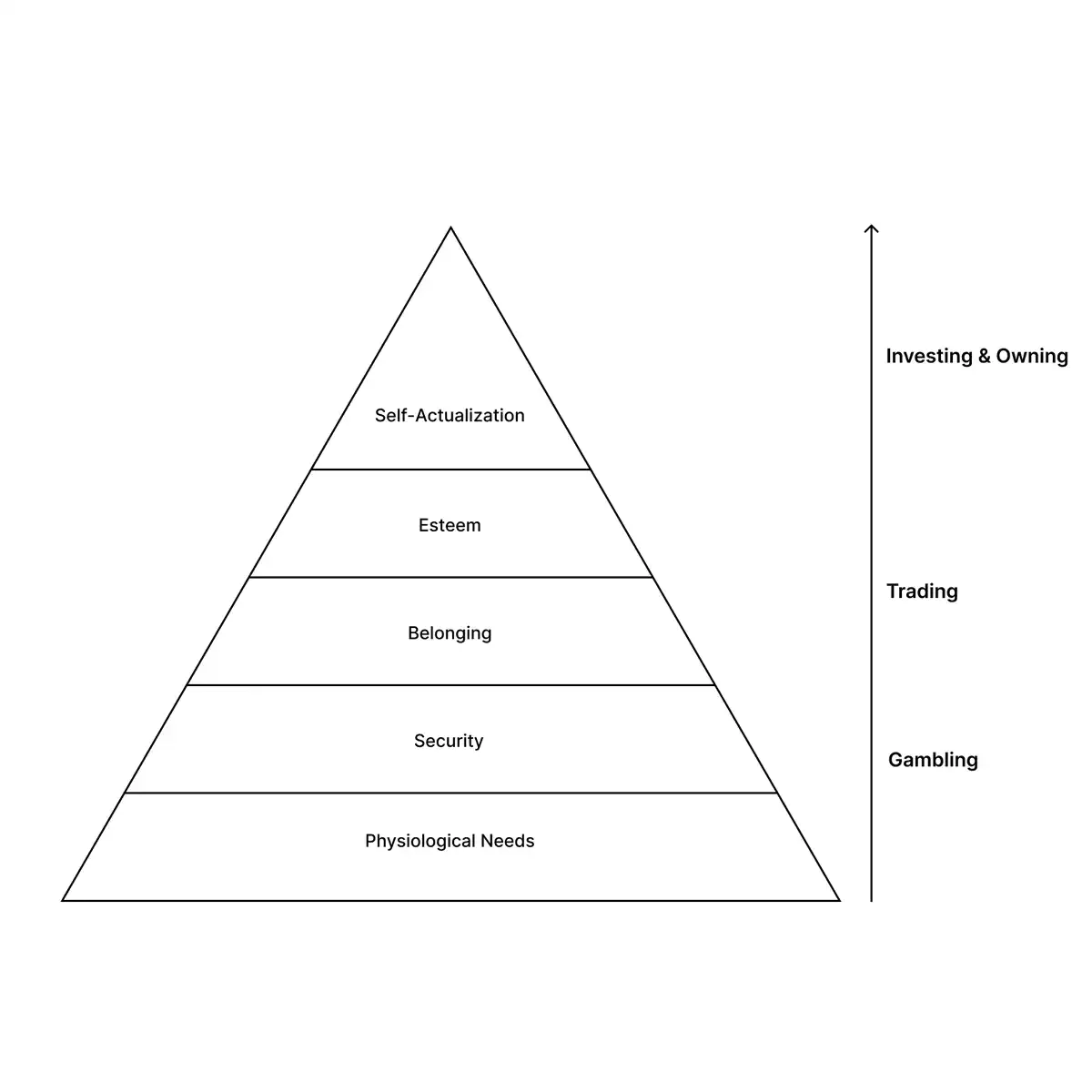
We can view this continuum of risk-taking through the lens of Maslow's hierarchy of needs:

  • Gambling and trading satisfy lower-level needs: security (escaping economic hardship by making a big win), or a sense of belonging (like WallStreetBets trying to fight Citadel, or you and your friends betting on a team).

  • Investing is closer to self-actualization and purpose at the top. Owning a home is the American Dream; investing in a company is expressing belief in its future. But it's hard to achieve this conviction if your attention is still focused on lower-level needs.

PANews Note: WallStreetBets (WSB) is a famous subreddit known as a hub for retail investors famous for high-risk, aggressive investing, and meme stock trading. It is renowned for encouraging the use of leveraged options trading and pursuing short-term, high returns, gaining global financial notoriety in 2021 for orchestrating the GameStop (GME) short squeeze. Citadel is a top-tier hedge fund and financial services company, known for its rigorous risk control and high returns, and is one of the most influential financial giants on Wall Street.
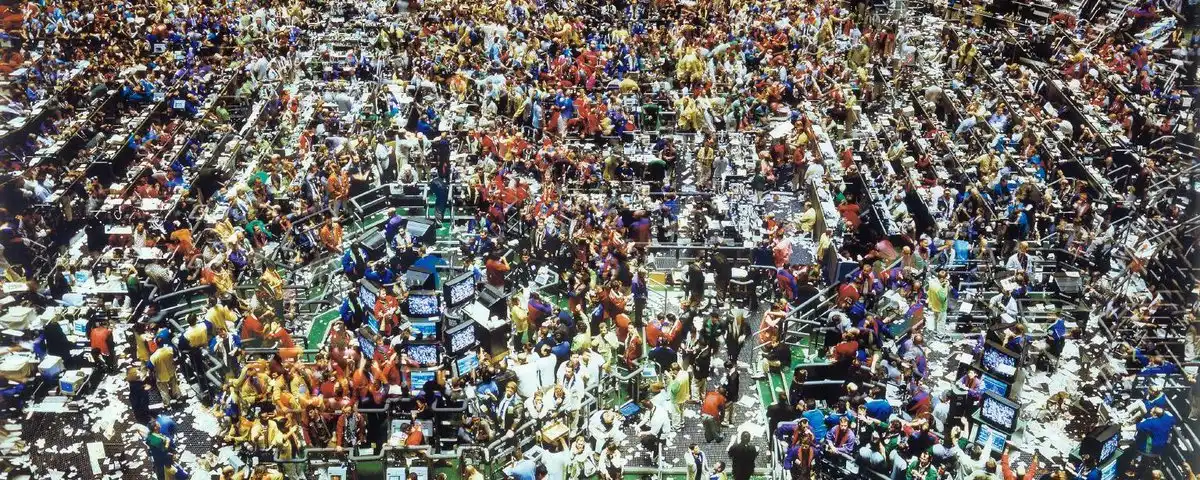
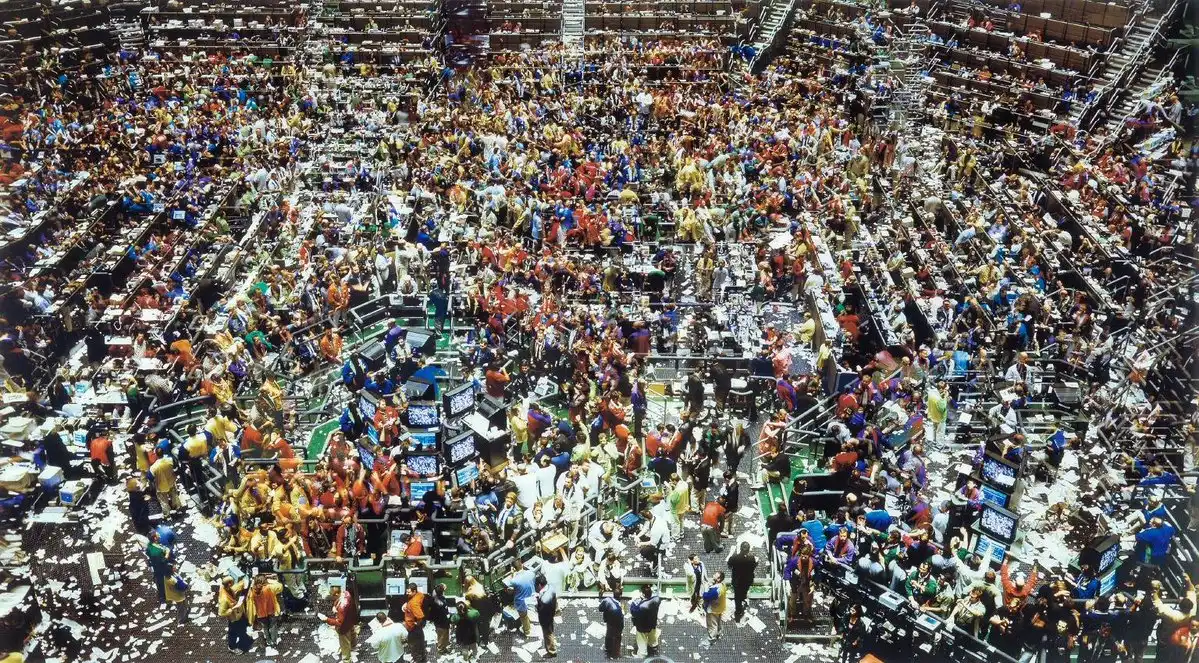
Due to short timeframes and high volatility, trading can satisfy more urgent needs for more people. And, because permissionless markets can exist for almost anything—from derivatives to memes to political outcomes—the channels for people to access economic gains have never been broader.

In many of these markets, life experience can (at least briefly) become an advantage. A kid who understands TikTok trends understands memes better than Citadel; a player living in a virtual economy understands the game better than a game analyst.

The old adage "invest in what you know" is becoming increasingly feasible today. The result is that market participation is no longer a professional career but a mass-participation culture with its own status games, memes, heroes, villains, subcultures, and language. Due to this newfound expressiveness and accessibility, financial markets are increasingly intertwining with culture. And culture—from trends to political events—is increasingly expressed through markets.

(Image: Balenciaga S2023 fashion show at the New York Stock Exchange)

We are witnessing exponential expansion of global economic access through stablecoins; at the other end of the spectrum, financial risk-taking through trading and markets is also expanding, moving towards a scale of a billion daily active traders.

Markets as Agents of Change

In the 1960s, the average holding period for stocks was over 8 years. By 2020, this average had fallen to less than a year. This is the world we live in today: a mass-participation market where trading has become the main artery for people trying to capture economic gains.

This world hasn't entirely emerged within the boundaries of the traditional financial system. New markets have been built primarily outside, often intentionally and out of necessity. Leveraging new technology and free markets to pressure regulators and institutions is one of the most reliable patterns for the adaptation and evolution of traditional systems.

As I wrote in the original thesis:

"The history of protocol adoption follows a pattern: first, early adopters use the new protocol to do things that were impossible before the new technology enabled them. This new behavior often involves breaking the rules. Then, the winning strategy for founders is to build products that make these new patterns accessible to a broader audience."

A classic example is BitTorrent, invented in 2003. It enabled streaming, and at its peak, piracy via this protocol accounted for a third of total internet traffic. Later, Spotify productized streaming by striking compliant deals (and actually used BitTorrent technology underneath initially).

Cryptocurrency is doing to value what BitTorrent did to information: remaking it permissionlessly.

  • Prediction Markets: Polymarket operated for years on offshore crypto rails when prediction markets were banned in the US. Today, thanks to new regulatory clarity, they have a mobile app in the US (though not on-chain).

  • Stablecoins: Similarly survived in a regulatory gray area, initially bootstrapping liquidity on offshore exchanges. Last year, the GENIUS bill brought them inside the system.

  • ICOs & Fundraising: In 2017, ICOs enabled permissionless crowdfunding when early-stage venture investment was restricted. A hostile SEC subsequently cracked down, but this highlighted a problem: the returns from technological innovation and growth were captured privately, with diminishing opportunities for public participation in the upside. But this year, Congress is working on market structure legislation in the CLARITY Act, explicitly allowing founders to raise funds broadly via public token sales and share ownership.

Permissionless markets constantly try to "break the rules," allowing people to access the economic gains of private companies (wouldn't you want to own a piece of Claude or ChatGPT?). Robinhood recently tried to launch tokenized exposure to private companies like OpenAI and SpaceX on crypto rails in Europe and applied to the SEC to bring private market funds to US retail investors. Startups are trying to offer synthetic exposure to private companies through novel products.

This could be a path back to the original "Ownership Economy" thesis, where users actually get economic exposure to the products and services they use daily. But as we've seen with other markets, forcing regulatory change takes time and often relies on scaled and proven market demand.

More directly, I expect we will see many new, net-add markets take off, which raises the question: what is the full design space of these new markets? How are they different from previous ones? And who, or what, is trading and consuming them?

Markets as APIs

What makes this moment different from previous waves of financial innovation is the simultaneous expansion of two representations in software:

  • Cryptocurrency (Crypto): Provides the most powerful rails for new markets—permissionless creation, programmable settlement, composable liquidity, and global access, with costs rapidly approaching zero. Now, we can tokenize and trade things that were previously illiquid, inaccessible, or simply didn't exist.

  • Artificial Intelligence (AI): Makes it possible to build, model, and automate things that were previously unmanageable.

Crypto + AI creates a combinatorial design space: every price generated by a market is a signal an AI can act on, and every new thing an AI can model is an object a market can use to price.

Arguably, intelligence is the ability to predict or make informed decisions. Markets and crypto provide the best "prediction" mechanisms we know. AI can use these prices to understand and simulate the future and make decisions.

This design space is why markets are evolving from "outputs" to "infrastructure." The last decade, crypto built the underlying infrastructure enabling an explosion of new markets. The next decade, markets will increasingly become infrastructure themselves; endpoints consumed as inputs by applications and agents.
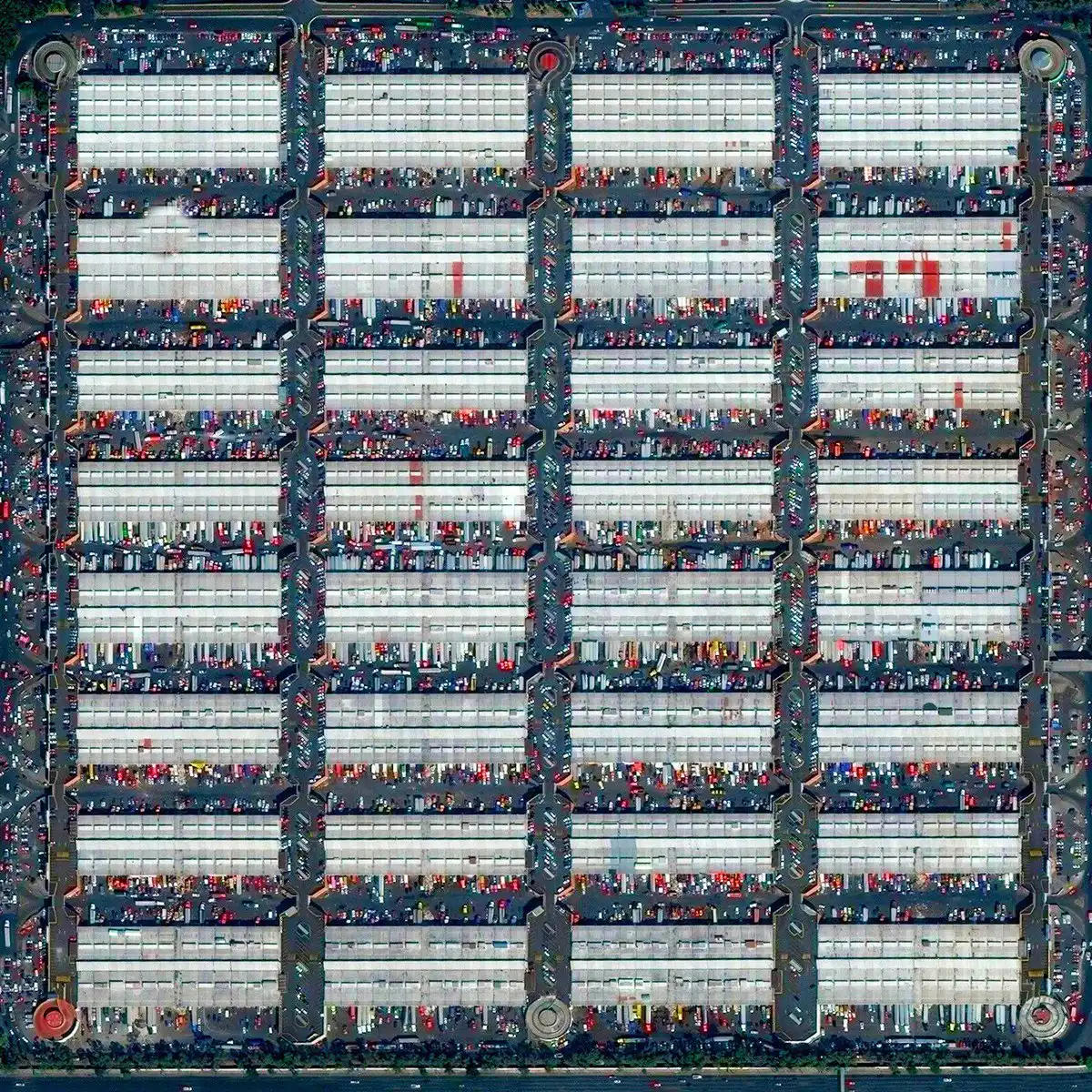
(Image: Central de Abasto food wholesale market in Mexico City)

Traditional APIs return stored data. As APIs, markets generate real-time data through adversarial competition between participants willing to risk capital on their convictions. This makes markets more expressive than ordinary APIs; they don't just provide information, they generate it. And because the information generated by markets is costly to produce, it is also harder to fake.

On-chain markets are even superior to traditional APIs because, by default, they are permissionless and composable (anyone can call them), globalized, and use standardized interfaces.

Composing markets directly into products has already begun in finance, known as the "DeFi Mullet": fintech products with familiar front-end experiences built on DeFi back-end rails, like Morpho vaults. Coinbase's borrow and earn products offer users dynamic interest rates, which are paid or earned by querying Morpho's on-chain lending markets. Users enjoy these features without needing to understand the underlying lending market dynamics.

Beyond financial services, Polymarket's odds for the Golden Globes are a recent intuitive example of this phenomenon. The API provides real-time prices, composed into entertainment products (the market accurately predicted 26 out of 27 winners).

As we tokenize more of the world's value and bring new markets on-chain, this pattern will expand beyond fintech wrappers or live event odds. Although not currently on-chain, Apple's "Clean Energy Charging" is an illustrative mainstream example. In the US, when you plug in your phone to charge, Apple uses real-time predictions of grid carbon intensity to schedule charging times for maximum energy and cost efficiency. You never see the underlying energy market, but Apple's product is calling an endpoint for market data, using its signal as an input to make decisions and optimize the product.

MetaDAO, a crowdfunding platform powered by prediction markets, takes this idea further. When faced with a governance decision, it creates two conditional markets: one assuming the token price if the proposal passes, another if it fails. Whichever market price is higher determines the outcome: the proposal automatically takes effect or is rejected. The DAO no longer decides by voting but calls upon markets to make decisions, with participants betting real money on the future outcome they believe is better. Here, the underlying market is not just an input to the decision but the decision mechanism itself.

If you assume all finance and markets are becoming programmable while AI is becoming more powerful, then holding an expansive view of finance's endgame is reasonable and exciting. Price signals, prediction market outcomes, on-chain capital flows, etc., will become inputs that any application or agent can read, interpret, and act upon. If an agent can earn a penny more than its inference cost by creating or participating in a market, it becomes rational to do so.

When we factor in the consumption and market participation of AI agents, "a billion active traders" might be a severe underestimate of the scale of the future.

The Endgame of Finance

Finance is undergoing a transformation from a unique vertical industry into a horizontal foundational layer.

As markets become more expressive and accessible, finance is embedding itself into culture, and culture itself is increasingly expressed through finance. Simultaneously, as markets become permissionless software, they accelerate their role as agents of change, opening new opportunities for users seeking economic upside (and downside) in things they understand and love. And users will also want their AI agents to participate in markets to improve their lives.

As markets become more programmable, finance is becoming increasingly ubiquitous as a new building block of information infrastructure. The most successful infrastructure is often invisible, and finance is on a path to being woven into the fabric of everything.

This is why I'm willing to hold an extremely grand, expansive perspective on the endgame of "finance."

Preguntas relacionadas

QWhat are the three fundamental drivers behind the expansion of finance's meaning according to Jesse Walden?

AThe three fundamental drivers are: 1) Mass participation, as lower market access barriers intertwine finance with culture; 2) Permissionless markets, which act as change agents allowing global users to exhibit new behaviors; 3) Programmable endpoints, where financial markets evolve from discrete venues into APIs embedded with economic data.

QHow does the author describe the evolution of a participant's journey in the crypto space?

AThe author describes a common trajectory: starting with a lesson from a volatile altcoin, learning to manage risk like a trader, and eventually maturing into a long-term investor. Even failed experiences are meaningful, transforming a gambler into a trader who bets on what they know, and then into an investor with conviction and a longer time horizon.

QWhat role do permissionless markets play in driving regulatory and institutional change?

APermissionless markets, often built outside traditional financial systems, act as change agents by allowing new behaviors that 'break the rules.' This forces regulators and traditional institutions to adapt and evolve. Examples include prediction markets (Polymarket), stablecoins, and ICOs, which eventually lead to new legislation and regulatory clarity after demonstrating proven market demand.

QHow does the combination of Crypto and AI create a new design space for markets?

ACrypto provides the infrastructure for permissionless, programmable, and globally accessible markets, while AI enables the modeling and automation of previously unmanageable things. This combination creates a design space where every price generated by a market becomes actionable data for AI, and every new thing AI can model becomes an object that markets can price. Markets evolve from outputs to infrastructure, serving as APIs that applications and AI agents can consume.

QWhat is the ultimate vision for the future of finance as presented in the article?

AThe ultimate vision is that finance is transitioning from a distinct vertical industry into a horizontal infrastructure layer that becomes 'invisible.' It is increasingly embedded into culture and expressed through it, driven by mass participation and permissionless innovation. As markets become more accessible and programmable, finance will integrate into the fabric of everything, serving as a universal information infrastructure for both humans and AI agents to consume and act upon.

Lecturas Relacionadas

When Teams Use Prediction Markets to Hedge Risks, a Trillion-Dollar Financial Market Emerges

Professional sports teams are increasingly using prediction markets to hedge financial risks tied to performance-based bonuses, moving beyond traditional insurance models. As the global sports industry grows—now worth $560 billion annually—contracts increasingly include incentive clauses, such as bonuses for making playoffs or achieving specific milestones. These create significant financial liabilities. Traditionally, teams managed this risk through customized insurance and reinsurance policies, a private and costly process where probabilities were hidden in negotiated premiums. Now, prediction markets like Kalshi offer publicly traded, real-time probabilities for discrete outcomes (e.g., “Will Team X make the playoffs?”). These markets provide transparent, crowd-sourced odds that often outperform traditional models in accuracy. Studies show prediction markets are highly reliable, with platforms like Polymarket matching or exceeding the predictive power of sportsbooks and polls. This allows teams to hedge exposures at lower costs—for instance, securing coverage at a 6% implied probability instead of 12% in private markets—potentially saving millions. The emergence of identity-verification services and analytics platforms (e.g., Dflow, Kalshinomics) is making these markets more accessible and credible for institutional use, enabling teams, sponsors, and studios to manage outcome-based financial exposures efficiently. This shift is transforming a once-opaque insurance niche into a transparent, scalable financial layer built on real-time probability trading.

marsbitHace 42 min(s)

When Teams Use Prediction Markets to Hedge Risks, a Trillion-Dollar Financial Market Emerges

marsbitHace 42 min(s)

Why Do 85% of Token Launches Ultimately Become Expensive 'Funerals'?

According to Arrakis Research, 85% of tokens launched in 2025 ended the year with negative returns, highlighting a systemic failure in token design rather than market conditions. Token Generation Events (TGEs) are not celebrations but "open gladiator arenas" where flawed economic models are exploited. Key failures include excessive Fully Diluted Valuations (FDV) over $1 billion, which had a 100% failure rate, and low initial circulation, leading to massive sell pressure upon unlocks. Only 9.4% of tokens that dropped in their first week recovered. The report identifies four critical success factors: 1. **Sybil Resistance:** Filtering out airdrop farmers (e.g., LayerZero’s efforts reduced initial sell-off). 2. **Revenue-Based Airdrops:** Treating airdrops as customer acquisition costs tied to real protocol usage. 3. **Ready Infrastructure:** Staking, governance, and custody must be operational at launch to provide utility and retain holders. 4. **Effective Market Makers:** Choosing transparent market-making services that provide liquidity depth, not artificial demand. The ultimate goal is achieving decentralization in development, governance, value distribution, and participation. Success requires building genuine demand through protocol utility, not marketing hype. Tokens must be designed to withstand inherent sell pressure from airdrop recipients, exchanges, and market makers from day one.

marsbitHace 48 min(s)

Why Do 85% of Token Launches Ultimately Become Expensive 'Funerals'?

marsbitHace 48 min(s)

Trading

Spot
Futuros

Artículos destacados

Qué es $S$

Entendiendo SPERO: Una Visión General Completa Introducción a SPERO A medida que el panorama de la innovación continúa evolucionando, la aparición de tecnologías web3 y proyectos de criptomonedas juega un papel fundamental en la configuración del futuro digital. Un proyecto que ha atraído la atención en este campo dinámico es SPERO, denotado como SPERO,$$s$. Este artículo tiene como objetivo reunir y presentar información detallada sobre SPERO, para ayudar a entusiastas e inversores a comprender sus fundamentos, objetivos e innovaciones dentro de los dominios web3 y cripto. ¿Qué es SPERO,$$s$? SPERO,$$s$ es un proyecto único dentro del espacio cripto que busca aprovechar los principios de descentralización y tecnología blockchain para crear un ecosistema que promueva la participación, la utilidad y la inclusión financiera. El proyecto está diseñado para facilitar interacciones de igual a igual de nuevas maneras, proporcionando a los usuarios soluciones y servicios financieros innovadores. En su esencia, SPERO,$$s$ tiene como objetivo empoderar a los individuos al proporcionar herramientas y plataformas que mejoren la experiencia del usuario en el espacio de las criptomonedas. Esto incluye habilitar métodos de transacción más flexibles, fomentar iniciativas impulsadas por la comunidad y crear caminos para oportunidades financieras a través de aplicaciones descentralizadas (dApps). La visión subyacente de SPERO,$$s$ gira en torno a la inclusividad, buscando cerrar brechas dentro de las finanzas tradicionales mientras aprovecha los beneficios de la tecnología blockchain. ¿Quién es el Creador de SPERO,$$s$? La identidad del creador de SPERO,$$s$ sigue siendo algo oscura, ya que hay recursos públicos limitados que proporcionan información de fondo detallada sobre su(s) fundador(es). Esta falta de transparencia puede derivarse del compromiso del proyecto con la descentralización, una ética que muchos proyectos web3 comparten, priorizando las contribuciones colectivas sobre el reconocimiento individual. Al centrar las discusiones en torno a la comunidad y sus objetivos colectivos, SPERO,$$s$ encarna la esencia del empoderamiento sin señalar a individuos específicos. Como tal, comprender la ética y la misión de SPERO sigue siendo más importante que identificar a un creador singular. ¿Quiénes son los Inversores de SPERO,$$s$? SPERO,$$s$ cuenta con el apoyo de una diversa gama de inversores que van desde capitalistas de riesgo hasta inversores ángeles dedicados a fomentar la innovación en el sector cripto. El enfoque de estos inversores generalmente se alinea con la misión de SPERO, priorizando proyectos que prometen avances tecnológicos sociales, inclusión financiera y gobernanza descentralizada. Estas fundaciones de inversores suelen estar interesadas en proyectos que no solo ofrecen productos innovadores, sino que también contribuyen positivamente a la comunidad blockchain y sus ecosistemas. El respaldo de estos inversores refuerza a SPERO,$$s$ como un contendiente notable en el dominio de proyectos cripto que evoluciona rápidamente. ¿Cómo Funciona SPERO,$$s$? SPERO,$$s$ emplea un marco multifacético que lo distingue de los proyectos de criptomonedas convencionales. Aquí hay algunas de las características clave que subrayan su singularidad e innovación: Gobernanza Descentralizada: SPERO,$$s$ integra modelos de gobernanza descentralizada, empoderando a los usuarios para participar activamente en los procesos de toma de decisiones sobre el futuro del proyecto. Este enfoque fomenta un sentido de propiedad y responsabilidad entre los miembros de la comunidad. Utilidad del Token: SPERO,$$s$ utiliza su propio token de criptomoneda, diseñado para servir diversas funciones dentro del ecosistema. Estos tokens permiten transacciones, recompensas y la facilitación de servicios ofrecidos en la plataforma, mejorando la participación y la utilidad general. Arquitectura en Capas: La arquitectura técnica de SPERO,$$s$ apoya la modularidad y escalabilidad, permitiendo la integración fluida de características y aplicaciones adicionales a medida que el proyecto evoluciona. Esta adaptabilidad es fundamental para mantener la relevancia en el cambiante paisaje cripto. Participación de la Comunidad: El proyecto enfatiza iniciativas impulsadas por la comunidad, empleando mecanismos que incentivan la colaboración y la retroalimentación. Al nutrir una comunidad sólida, SPERO,$$s$ puede abordar mejor las necesidades de los usuarios y adaptarse a las tendencias del mercado. Enfoque en la Inclusión: Al ofrecer tarifas de transacción bajas e interfaces amigables para el usuario, SPERO,$$s$ busca atraer a una base de usuarios diversa, incluyendo a individuos que anteriormente pueden no haber participado en el espacio cripto. Este compromiso con la inclusión se alinea con su misión general de empoderamiento a través de la accesibilidad. Cronología de SPERO,$$s$ Entender la historia de un proyecto proporciona información crucial sobre su trayectoria de desarrollo y hitos. A continuación se presenta una cronología sugerida que mapea eventos significativos en la evolución de SPERO,$$s$: Fase de Conceptualización e Ideación: Las ideas iniciales que forman la base de SPERO,$$s$ fueron concebidas, alineándose estrechamente con los principios de descentralización y enfoque comunitario dentro de la industria blockchain. Lanzamiento del Whitepaper del Proyecto: Tras la fase conceptual, se lanzó un whitepaper completo que detalla la visión, los objetivos y la infraestructura tecnológica de SPERO,$$s$ para generar interés y retroalimentación de la comunidad. Construcción de Comunidad y Primeras Interacciones: Se realizaron esfuerzos de divulgación activa para construir una comunidad de primeros adoptantes y posibles inversores, facilitando discusiones en torno a los objetivos del proyecto y obteniendo apoyo. Evento de Generación de Tokens: SPERO,$$s$ llevó a cabo un evento de generación de tokens (TGE) para distribuir sus tokens nativos a los primeros seguidores y establecer liquidez inicial dentro del ecosistema. Lanzamiento de la dApp Inicial: La primera aplicación descentralizada (dApp) asociada con SPERO,$$s$ se puso en marcha, permitiendo a los usuarios interactuar con las funcionalidades centrales de la plataforma. Desarrollo Continuo y Alianzas: Actualizaciones y mejoras continuas a las ofertas del proyecto, incluyendo alianzas estratégicas con otros actores en el espacio blockchain, han moldeado a SPERO,$$s$ en un jugador competitivo y en evolución en el mercado cripto. Conclusión SPERO,$$s$ se erige como un testimonio del potencial de web3 y las criptomonedas para revolucionar los sistemas financieros y empoderar a los individuos. Con un compromiso con la gobernanza descentralizada, la participación comunitaria y funcionalidades diseñadas de manera innovadora, allana el camino hacia un paisaje financiero más inclusivo. Como con cualquier inversión en el espacio cripto que evoluciona rápidamente, se anima a los posibles inversores y usuarios a investigar a fondo y participar de manera reflexiva con los desarrollos en curso dentro de SPERO,$$s$. El proyecto muestra el espíritu innovador de la industria cripto, invitando a una mayor exploración de sus innumerables posibilidades. Mientras el viaje de SPERO,$$s$ aún se desarrolla, sus principios fundamentales pueden, de hecho, influir en el futuro de cómo interactuamos con la tecnología, las finanzas y entre nosotros en ecosistemas digitales interconectados.

72 Vistas totalesPublicado en 2024.12.17Actualizado en 2024.12.17

Qué es AGENT S

Agent S: El Futuro de la Interacción Autónoma en Web3 Introducción En el paisaje en constante evolución de Web3 y las criptomonedas, las innovaciones están redefiniendo constantemente cómo los individuos interactúan con las plataformas digitales. Uno de estos proyectos pioneros, Agent S, promete revolucionar la interacción humano-computadora a través de su marco agente abierto. Al allanar el camino para interacciones autónomas, Agent S busca simplificar tareas complejas, ofreciendo aplicaciones transformadoras en inteligencia artificial (IA). Esta exploración detallada profundizará en las complejidades del proyecto, sus características únicas y las implicaciones para el dominio de las criptomonedas. ¿Qué es Agent S? Agent S se presenta como un marco agente abierto innovador, diseñado específicamente para abordar tres desafíos fundamentales en la automatización de tareas informáticas: Adquisición de Conocimiento Específico del Dominio: El marco aprende inteligentemente de diversas fuentes de conocimiento externas y experiencias internas. Este enfoque dual le permite construir un rico repositorio de conocimiento específico del dominio, mejorando su rendimiento en la ejecución de tareas. Planificación a Largo Plazo de Tareas: Agent S emplea planificación jerárquica aumentada por la experiencia, un enfoque estratégico que facilita la descomposición y ejecución eficiente de tareas complejas. Esta característica mejora significativamente su capacidad para gestionar múltiples subtareas de manera eficiente y efectiva. Manejo de Interfaces Dinámicas y No Uniformes: El proyecto introduce la Interfaz Agente-Computadora (ACI), una solución innovadora que mejora la interacción entre agentes y usuarios. Utilizando Modelos de Lenguaje Multimodal de Gran Escala (MLLMs), Agent S puede navegar y manipular diversas interfaces gráficas de usuario sin problemas. A través de estas características pioneras, Agent S proporciona un marco robusto que aborda las complejidades involucradas en la automatización de la interacción humana con las máquinas, preparando el terreno para una multitud de aplicaciones en IA y más allá. ¿Quién es el Creador de Agent S? Si bien el concepto de Agent S es fundamentalmente innovador, la información específica sobre su creador sigue siendo elusiva. El creador es actualmente desconocido, lo que resalta ya sea la etapa incipiente del proyecto o la elección estratégica de mantener a los miembros fundadores en el anonimato. Independientemente de la anonimidad, el enfoque sigue siendo en las capacidades y el potencial del marco. ¿Quiénes son los Inversores de Agent S? Dado que Agent S es relativamente nuevo en el ecosistema criptográfico, la información detallada sobre sus inversores y patrocinadores financieros no está documentada explícitamente. La falta de información disponible públicamente sobre las bases de inversión u organizaciones que apoyan el proyecto plantea preguntas sobre su estructura de financiamiento y hoja de ruta de desarrollo. Comprender el respaldo es crucial para evaluar la sostenibilidad del proyecto y su posible impacto en el mercado. ¿Cómo Funciona Agent S? En el núcleo de Agent S se encuentra una tecnología de vanguardia que le permite funcionar de manera efectiva en diversos entornos. Su modelo operativo se basa en varias características clave: Interacción Humano-Computadora Similar a la Humana: El marco ofrece planificación avanzada de IA, esforzándose por hacer que las interacciones con las computadoras sean más intuitivas. Al imitar el comportamiento humano en la ejecución de tareas, promete elevar las experiencias de los usuarios. Memoria Narrativa: Empleada para aprovechar experiencias de alto nivel, Agent S utiliza memoria narrativa para hacer un seguimiento de las historias de tareas, mejorando así sus procesos de toma de decisiones. Memoria Episódica: Esta característica proporciona a los usuarios una guía paso a paso, permitiendo que el marco ofrezca apoyo contextual a medida que se desarrollan las tareas. Soporte para OpenACI: Con la capacidad de ejecutarse localmente, Agent S permite a los usuarios mantener el control sobre sus interacciones y flujos de trabajo, alineándose con la ética descentralizada de Web3. Fácil Integración con APIs Externas: Su versatilidad y compatibilidad con varias plataformas de IA aseguran que Agent S pueda encajar sin problemas en ecosistemas tecnológicos existentes, convirtiéndolo en una opción atractiva para desarrolladores y organizaciones. Estas funcionalidades contribuyen colectivamente a la posición única de Agent S dentro del espacio cripto, ya que automatiza tareas complejas y de múltiples pasos con una intervención humana mínima. A medida que el proyecto evoluciona, sus posibles aplicaciones en Web3 podrían redefinir cómo se desarrollan las interacciones digitales. Cronología de Agent S El desarrollo y los hitos de Agent S pueden encapsularse en una cronología que resalta sus eventos significativos: 27 de septiembre de 2024: El concepto de Agent S fue lanzado en un documento de investigación integral titulado “Un Marco Agente Abierto que Usa Computadoras Como un Humano”, mostrando las bases del proyecto. 10 de octubre de 2024: El documento de investigación fue puesto a disposición del público en arXiv, ofreciendo una exploración profunda del marco y su evaluación de rendimiento basada en el benchmark OSWorld. 12 de octubre de 2024: Se lanzó una presentación en video, proporcionando una visión visual de las capacidades y características de Agent S, involucrando aún más a posibles usuarios e inversores. Estos marcadores en la cronología no solo ilustran el progreso de Agent S, sino que también indican su compromiso con la transparencia y la participación comunitaria. Puntos Clave Sobre Agent S A medida que el marco Agent S continúa evolucionando, varios atributos clave destacan, subrayando su naturaleza innovadora y potencial: Marco Innovador: Diseñado para proporcionar un uso intuitivo de las computadoras similar a la interacción humana, Agent S aporta un enfoque novedoso a la automatización de tareas. Interacción Autónoma: La capacidad de interactuar de manera autónoma con las computadoras a través de GUI significa un salto hacia soluciones informáticas más inteligentes y eficientes. Automatización de Tareas Complejas: Con su metodología robusta, puede automatizar tareas complejas y de múltiples pasos, haciendo que los procesos sean más rápidos y menos propensos a errores. Mejora Continua: Los mecanismos de aprendizaje permiten a Agent S mejorar a partir de experiencias pasadas, mejorando continuamente su rendimiento y eficacia. Versatilidad: Su adaptabilidad en diferentes entornos operativos como OSWorld y WindowsAgentArena asegura que pueda servir a una amplia gama de aplicaciones. A medida que Agent S se posiciona en el paisaje de Web3 y criptomonedas, su potencial para mejorar las capacidades de interacción y automatizar procesos significa un avance significativo en las tecnologías de IA. A través de su marco innovador, Agent S ejemplifica el futuro de las interacciones digitales, prometiendo una experiencia más fluida y eficiente para los usuarios en diversas industrias. Conclusión Agent S representa un audaz avance en la unión de la IA y Web3, con la capacidad de redefinir cómo interactuamos con la tecnología. Aunque aún se encuentra en sus primeras etapas, las posibilidades para su aplicación son vastas y atractivas. A través de su marco integral que aborda desafíos críticos, Agent S busca llevar las interacciones autónomas al primer plano de la experiencia digital. A medida que nos adentramos más en los reinos de las criptomonedas y la descentralización, proyectos como Agent S sin duda desempeñarán un papel crucial en la configuración del futuro de la tecnología y la colaboración humano-computadora.

214 Vistas totalesPublicado en 2025.01.14Actualizado en 2025.01.14

Cómo comprar S

¡Bienvenido a HTX.com! Hemos hecho que comprar Sonic (S) sea simple y conveniente. Sigue nuestra guía paso a paso para iniciar tu viaje de criptos.Paso 1: crea tu cuenta HTXUtiliza tu correo electrónico o número de teléfono para registrarte y obtener una cuenta gratuita en HTX. Experimenta un proceso de registro sin complicaciones y desbloquea todas las funciones.Obtener mi cuentaPaso 2: ve a Comprar cripto y elige tu método de pagoTarjeta de crédito/débito: usa tu Visa o Mastercard para comprar Sonic (S) al instante.Saldo: utiliza fondos del saldo de tu cuenta HTX para tradear sin problemas.Terceros: hemos agregado métodos de pago populares como Google Pay y Apple Pay para mejorar la comodidad.P2P: tradear directamente con otros usuarios en HTX.Over-the-Counter (OTC): ofrecemos servicios personalizados y tipos de cambio competitivos para los traders.Paso 3: guarda tu Sonic (S)Después de comprar tu Sonic (S), guárdalo en tu cuenta HTX. Alternativamente, puedes enviarlo a otro lugar mediante transferencia blockchain o utilizarlo para tradear otras criptomonedas.Paso 4: tradear Sonic (S)Tradear fácilmente con Sonic (S) en HTX's mercado spot. Simplemente accede a tu cuenta, selecciona tu par de trading, ejecuta tus trades y monitorea en tiempo real. Ofrecemos una experiencia fácil de usar tanto para principiantes como para traders experimentados.

270 Vistas totalesPublicado en 2025.01.15Actualizado en 2025.03.21

Discusiones

Bienvenido a la comunidad de HTX. Aquí puedes mantenerte informado sobre los últimos desarrollos de la plataforma y acceder a análisis profesionales del mercado. A continuación se presentan las opiniones de los usuarios sobre el precio de S (S).

活动图片