Author: Aleks Larsen, Partner at Blockchain Capital
Translation: Jiahuan, ChainCatcher
The financial industry has long suffered from a costly "packaging" problem.
Each type of asset has its own method of recording and management, residing within separate, siloed systems: a mortgage loan is comprised of a contract, PDF files, databases, and post-lending management relationships; a private equity fund interest might just be a subscription agreement and a line entry in a transfer agent's spreadsheet; ownership of a share of stock is distributed across a series of records held by brokers, custodians, and securities depositories.
When an asset transfers from one institution to another, the original records often need to be disassembled, then verified and reconciled, before being re-registered according to the recipient's rules. Many operational processes exist solely because different institutions record the same underlying asset or right in different ways.
This fragmentation incurs massive hidden costs globally. The world's various balance sheets record nearly $1.8 quadrillion in assets, a significant portion of which still cannot flow freely between institutions without dedicated operational processes designed for them. This friction slows the speed at which capital can be redeployed towards new businesses, infrastructure, housing, and other productive uses.
Tokenization fundamentally solves this problem. Tokens provide a standardized, machine-readable interface for assets or financial rights. When assets can be recognized and used within shared networks, exchanges, lenders, custodians, asset servicers, and software applications can interact with them directly, without needing to rebuild financial infrastructure each time.
This gives capital markets the opportunity to be built upon a universal, programmable underlying network, allowing assets to flow, settle, and be utilized more smoothly.
The best analogy for understanding how tokenization will change the world is containerization.
Containerization Gave Birth to Modern Global Supply Chains
Before the 1960s, goods were transported in various forms. Coffee was in sacks, machines were in wooden crates, cotton was bales, oil was in barrels. Each commodity had different loading/unloading requirements, so every ship had to rely on manual labor for its handling.
A skilled craft of dockworkers developed around this work. They needed to pack goods as tightly as possible, balance weight, and secure cargo to prevent movement and damage at sea. This craft was indispensable precisely because there was no unified standard for freight packaging.
The result was that ships often spent more time in port than sailing. When general cargo was transferred between ships, trains, trucks, and warehouses, it had to be repeatedly loaded, unloaded, and counted, making it more prone to damage, loss, or theft.
In 1956, North Carolina trucking entrepreneur Malcolm McLean converted a tanker into the Ideal-X, carrying 58 detachable truck containers from Newark to Houston.
When the ship arrived, trucks could drive away with the containers without opening them. The Ideal-X's loading/unloading cost was just $0.16 per ton, roughly 36 times cheaper than traditional general cargo transport. The modern shipping container was born.
Over the next two decades, unified standards for container dimensions, connection mechanisms, and load requirements gradually emerged. The entire supply chain began reorganizing around this standardized box, allowing each link to become more specialized.
Ships began using vertical cells to allow safe stacking of containers; cranes were designed for high-speed, standardized lifting; truck chassis and railcars adopted uniform dimensions and securing fixtures; ports gradually evolved into large hubs for efficiently transferring containers between different modes of transport.
The most direct impact of containerization was dramatically reducing transportation time and cost. Shipping time from Australia to Europe fell from 70 days to 34 days, while ship capacity quadrupled.
International trade began focusing more on manufactured goods and intermediate products, and companies started splitting production processes across different countries. As supply chains expanded rapidly, new logistics firms emerged to coordinate the increasingly complex global network.
The deeper impact was a massive increase in the scale of economic activity. The World Bank estimated that over the 15 years after both trading partners adopted containers, bilateral trade between developed countries grew by 1,240%.
Containerization and the infrastructure restructuring it drove allowed global supply chains to expand massively, significantly accelerating global economic development.
Tokens are the Containers of the Financial World
Tokens are standardized containers for carrying financial rights.
They carry not physical goods, but ownership of assets, transfer rules, cash flows, permission requirements, and other state information. In other words, tokens record who owns an asset, how it can be transferred, what cash flows it generates, and what actions software can perform on it.
When an asset has a machine-readable interface, exchanges can provide trading for it, lending markets can accept it as collateral, custodians can safekeep it, and wallets can receive and direct its cash flows. Software applications can directly recognize the asset and execute corresponding rules, without needing to negotiate and integrate with each relevant institution separately.
This is the fundamental difference between tokenization and simply "digitizing a document" or "adding a database": all participants can recognize and use the asset according to the same set of standards. When this standard is adopted by an entire ecosystem, network effects begin to accumulate.
Stablecoins most clearly demonstrate the potential of tokenization.
A traditional international wire transfer typically takes days to complete via the correspondent banking system; a stablecoin can reach anywhere in the world in seconds, with near-zero cost for pure on-chain transfers.
This is because a global network has formed, comprised of exchanges, custodians, fiat-to-stablecoin conversion services, payment processors, and wallets that can all recognize the stablecoin's token interface. They are like the ports, cranes, trucks, trains, and ships of the financial world, responsible for moving value in tokenized form.
Much of this infrastructure was initially built for Bitcoin and Ethereum, but once it existed, stablecoins and other tokens could flow along the same network. Stablecoin activity further attracted users, liquidity, applications, and infrastructure, allowing other tokens entering later to directly utilize this network.
The results are already evident. The current circulating supply of stablecoins is approximately $300 billion, processing transaction volumes already approaching Visa's scale, with a velocity of funds roughly 10 times that of traditional M1/M2 money.
Cross-border payment costs have dropped by an order of magnitude, and hundreds of millions of people globally have gained access to more reliable dollars and payment channels. At least for the dollar use case, this network has proven its value, clearly outperforming the traditional system in cost, speed, and reach. The same dollar funds can circulate more frequently within the network, increasing capital efficiency.
Today, this highly active pool of dollar liquidity is beginning to attract other assets on-chain to absorb these stablecoin funds. The scale of on-chain tokenized assets other than stablecoins is now close to $40 billion, about 10 times what it was two years ago, and growth is still accelerating.
These assets cover U.S. Treasuries, money market funds, commodities, private credit, stocks, and fund interests, with hundreds of issuers already participating.
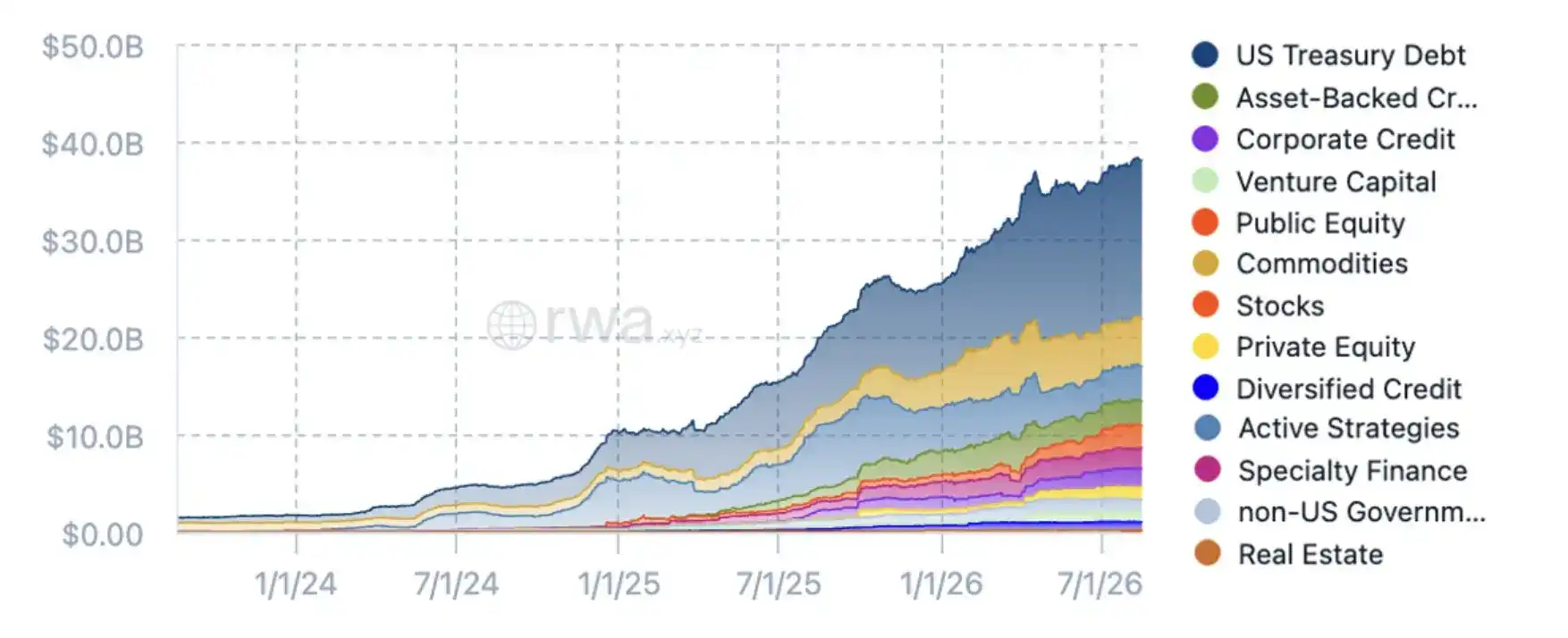
Image: RWA.xyz, Total On-chain RWA Scale
The natural next step is to bring the business processes behind these financial assets on-chain as well.
For example, Tare, a company we've invested in, is moving loan origination, servicing, and securitization on-chain, using tokens to record the complete lifecycle information for each underlying loan.
Through lightweight software and transparent markets, Tare can replace the costly, multi-intermediary loan chains of the traditional system. In this market, lenders and borrowers can record and verify tokenized loans on the same ledger.
This model can reduce borrowing costs while also making loans more easily usable as collateral across different on-chain applications, thereby attracting more assets and capital into the tokenization network.
Similar opportunities exist across every asset class. As infrastructure improves, network effects will continue to attract more liquidity, users, and applications, further accelerating the growth of tokenized assets.
Capital Markets Will Be Reorganized Around Tokens
Just as global supply chains reorganized around containers, global capital markets will reorganize around tokens.
This new form is already visible in DeFi. Another company we've invested in, Aave, allows users to deposit eligible tokens as collateral to borrow funds from a lending market at floating rates. The rules are encoded in the protocol, and whether a specific asset can serve as collateral is determined by standards at the asset level.
This structure is fundamentally different from traditional lending markets.
In today's financial system, an individual or company seeking a loan against an asset typically must first find an institution. The institution controls access, assesses the borrower according to its own processes, and provides products through its network. Which financial services a customer can access depends primarily on their relationship with financial institutions.
On Aave, the real entry condition is the asset itself. Smart contracts recognize the token, execute transparent rules, and connect it to capital markets.
The logic of accessing financial services has thus changed:
Financial services begin to revolve around the asset itself, rather than depending on which institution the asset holder has a relationship with.
In other words, tokens make assets executable, like software.
When an asset exists in a form recognizable by public networks, different applications can provide trading, financing, payments, and treasury management services around the same asset. Exchanges can bring it to market, lending protocols can accept it as collateral, and wallets can receive and direct its cash flows.
Issuers need to put an asset on-chain only once to connect to various applications, without having to build a separate system for each use case.
This will also change the organizational structure of financial institutions. Banks, brokerages, and asset managers currently bundle functions like custody, underwriting, liquidity, asset management, compliance, and distribution within closed product systems.
Crypto networks allow these functions to be unbundled and specialized. One institution can be responsible for originating and servicing loans, while others can provide funding, assess risk, execute trades, offer insurance, or develop applications that use these assets.
Assets can flow between different specialized services via a uniform interface, without needing to be re-registered and reconnected upon entering each service provider's system.
Thus, scale advantages will shift from individual institutions to the entire network.
In the traditional financial system, large institutions can support more products because they can bear the fixed costs of building infrastructure for different assets and customer segments. In public crypto networks, much of the infrastructure is shared by all participants.
New service providers can connect to existing networks of assets, capital, and users without rebuilding ledgers, trading, custody, and settlement systems. This not only lowers the cost of building systems but also lowers the barrier to entry for new service providers.
The network effects of stablecoins have already passed a tipping point and are becoming self-reinforcing. Capital markets will also increasingly reorganize into open service networks built around tokenized assets.
In this new paradigm, competition between institutions will be about who provides better capital, underwriting, risk management, asset servicing, and distribution, rather than who owns the database or controls the sole gateway to the market for their clients.
The Global Balance Sheet Will Go On-Chain
The most important outcome of this transformation is the establishment of a truly global capital market.
Today's capital markets are still constrained by financial institutions. Most individuals and businesses cannot access capital markets directly; they can only choose from a limited set of products offered by institutions willing and able to serve them.
Which clients to serve, which regions to cover, which asset classes to support, and what transaction sizes to accept are all determined by institutions.
Investors face the same constraints, just in the opposite direction. They cannot access all global assets; they can only invest in assets that have been underwritten, packaged, connected, and distributed by institutions.
Consequently, a vast amount of global economic value remains out of reach for existing capital markets.
Small receivables, local infrastructure, private businesses, emerging market credit, and non-traditional cash flows may have genuine economic value, but they are too small, too fragmented, insufficiently understood, or too far from major capital centers to bear the high costs required by the traditional financial system to finance them.
Investment opportunities may exist, capital may exist, but the network connecting them does not.
Tokenization provides assets with a standard interface, allowing them to be discovered and used on global financial networks. As the financial system reorganizes around this interface, the cost of market access for all participants will drop dramatically.
Financial functions can be embedded directly into all kinds of software, much like payment and data APIs. Developers can build specialized services for niche asset classes and specific regions, allowing capital markets to cover areas they previously couldn't reach.
Business applications that previously struggled to access sophisticated financial services can integrate functions like payments, working capital financing, collateral management, and treasury directly into their systems, bringing vast amounts of idle or non-mainstream financial system assets on-chain to access capital markets.
Of course, tokenization won't magically make un-bankable assets bankable. But in the long run, it can bring many sound assets that are currently excluded from capital markets for structural reasons into the fold.
AI will further amplify this change, helping to handle complex aspects of asset evaluation and operations.
AI agents can evaluate assets, price risk, allocate capital, manage collateral, and execute settlements within this global, efficient, machine-readable market, further lowering the cost of providing financial services.
Driven jointly by AI and crypto infrastructure, markets that currently rely heavily on customization and operate discontinuously have the opportunity to become continuously operating, globally accessible, and increasingly automated markets. This will create more opportunities worldwide and gradually free capital from institutional gatekeepers.
Capital allocation is one of the core mechanisms determining where societal resources flow. It determines which companies can expand, which technologies can scale, which homes and factories get built, and which regions develop.
For today's financial system, some assets may be too small, too local, too bespoke in structure, or too costly to administer to justify the resources needed to evaluate and finance them. But when the cost of finding, financing, and managing these assets drops dramatically, they too may re-enter capital markets.
This is the deeper impact of containerization as well. Containers didn't just lower shipping costs; they made entirely new models of trade and production economically viable. Goods could be made where costs were lowest, assembled elsewhere, and sold globally because the cost of coordinating this network had fallen so dramatically.
Tokens can do the same for capital.
Over the coming decades, the global balance sheet could evolve from a set of isolated records into a market that software can directly recognize and access. Capital will increasingly flow based on asset quality and return potential, rather than only to institutions that control market access.
If stablecoins serve as a guide, this change could drive a significant expansion of global capital markets into regions they have never truly covered before.