OpenAI Researcher: 100% of Code Handed Over to AI, Claude Rewrites Python Library

marsbitPublicado a 2026-08-17Actualizado a 2026-08-17

Resumen

OpenAI researchers and prominent developers like DHH (creator of Ruby on Rails) are reporting a dramatic shift toward AI-driven coding, with some claiming they no longer write code manually. DHH recently used Claude Fable 5 to fully rewrite the Python library "TerminalTextEffects" into Rust in a single, largely unassisted session, consuming 110 million tokens. The resulting Rust executable is only 3MB, with startup time slashed from 87ms to 2ms and a 9.6x render speed increase. This follows DHH's own reversal from a year ago, when he opposed ceding coding to AI, fearing the loss of "muscle memory" and deep learning. Now, he predicts that within five years, few people will be writing or reading code directly. The article highlights other large-scale migrations, like Bun's move from Zig to Rust in under two weeks, suggesting the marginal cost of code generation is nearing zero. The future role of programmers is envisioned as shifting from writing code to defining requirements, designing constraints, establishing test frameworks, and validating AI output—focusing on discerning "what is worth building" and "what is correct."

Claude Code's creator has publicly stated that he hasn't handwritten a single line of code in over two months.

In a single day, he can merge 27 PRs, all handled by Claude.
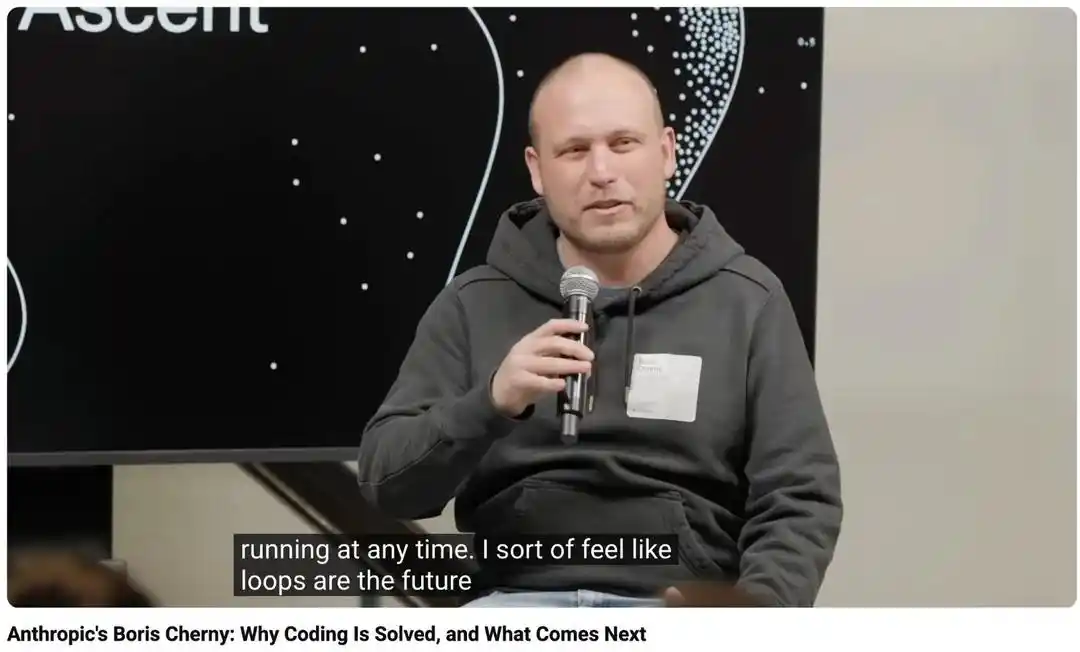
OpenAI researcher roon was even more extreme: 'I don't write code anymore; 100% is done by GPT.'

Now, another big name, after deeply experiencing Claude Code and Codex, declared, 'In five years, humans won't write code anymore!'

These past few days, Rails creator DHH personally took on a major task—

Using only Claude Fable 5, he completely rewrote the Python library 'TerminalTextEffects' into Rust in one go.

What's astonishing is that this refactoring consumed a staggering 11 million tokens, almost completing it in a single pass.
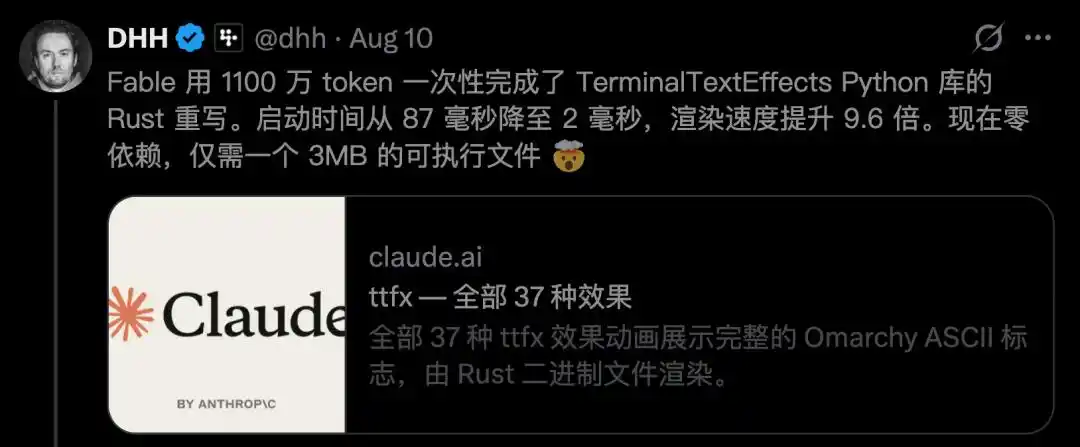
The results after it ran were nothing short of 'cheating'—startup time was compressed from 87 milliseconds to just 2 milliseconds, and rendering speed skyrocketed by 9.6 times.

The post instantly garnered millions of views across the internet.

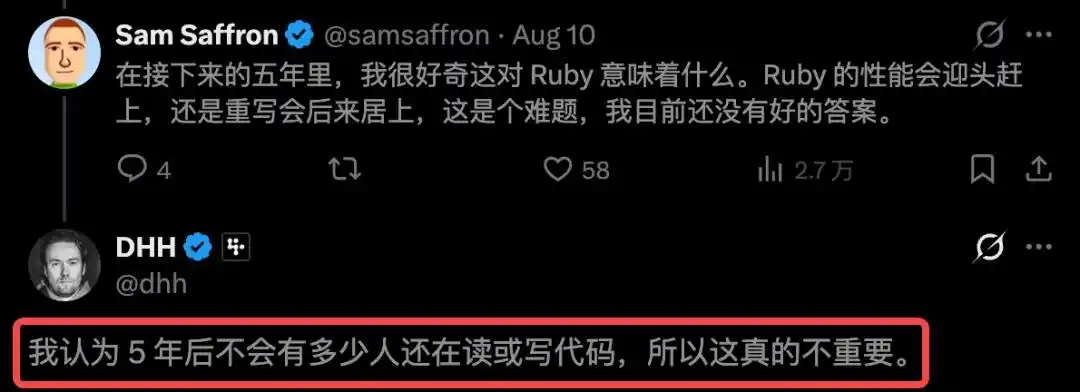
One AI expert directly posed a soul-searching question to the Rails creator: 'If that's the case, where does Ruby go in the next five years?'

DHH's answer was straightforward—

Within five years, not many people will be writing or reading code by hand anymore. So, it really doesn't matter.
Who would have thought that in just one year, the contrast would be so stark!

Handing the Keyboard to AI, Rather Retire

Remember, in May of last year, DHH was firmly stating online that he refused to cede the joy of coding to AI.

In that lengthy post 'Coding should be a vibe!', he clearly stated:

AI is, at best, an assistive 'pair programmer,' good for looking up APIs and answering questions.

He even issued a stern warning: 'If the day comes when I must completely hand the keyboard over to AI, I would rather retire.'
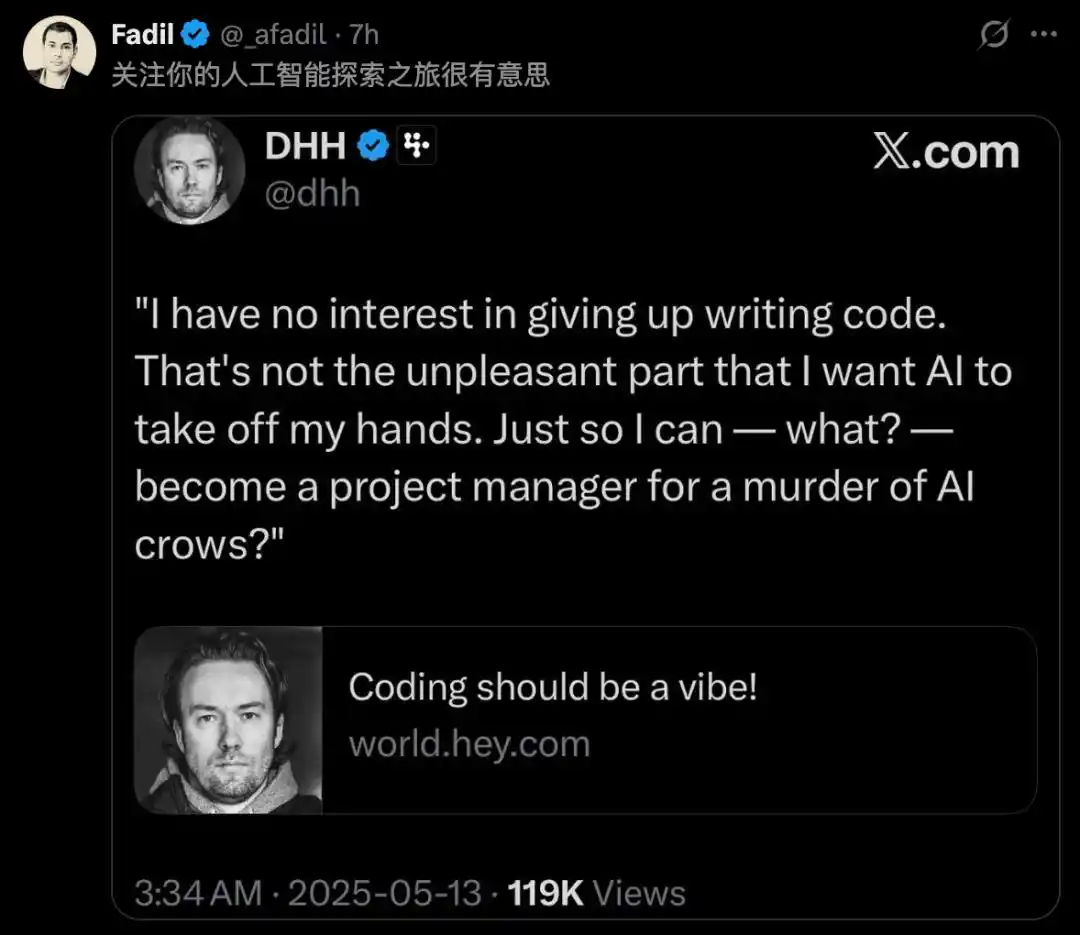
I have zero interest in giving up coding. It's not some chore to offload to AI. What would be the point? To become a project manager for a pack of AI 'hooligans'?

In that six-hour deep-dive conversation with Lex Fridman, DHH insisted that every line of his code was typed by his own hands.

Once, while building a Linux distribution, he repeatedly asked AI to generate the same Bash conditional statement, only to realize that because he lacked the physical act of typing, he never truly mastered it.

This loss of 'muscle memory' left him deeply unsettled. 'Is this the end of learning?'

However, by April this year, the winds had shifted dramatically.

On a podcast, he admitted he had now fully switched to 'Agent-first,' essentially saying goodbye to handwritten code.

Yet, no one expected the phrase 'in five years, not many people will be reading or writing code' to come from the mouth of the Rails creator.

Fable 5 All-in, No One Writes Code in Five Years

Let's take a closer look at this hardcore Python rewrite by Claude.

TerminalTextEffects, or TTE for short, is a terminal visual effects engine.

It can be used both as a command-line program and imported as a Python library into other applications.

Developers can, like magicians, control text trajectories, colors, gradient effects, and animation sequences, transforming dull UIs into something cool.
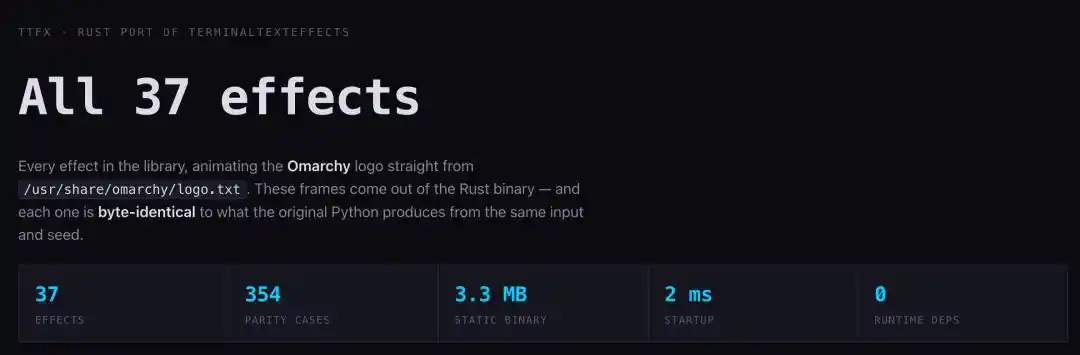
The Rust version demonstrated by DHH can run 37 effects.

A piece of software that originally required a Python runtime environment was transformed by Claude's refactoring into a mere 3MB executable.

This new repository is called ttfx, hosted under DHH's own Omarchy organization, with every commit history intact.

The entire process took 3 hours and 11 minutes. The main Rust code is 21,000 lines, almost the same volume as the original Python version.

During the task, 8 Agents each worked on a separate branch simultaneously, in batches: reading the code themselves, generating implementations, compiling, running tests, handling failures, then moving to the next round.

The so-called 'one-shot' was essentially handing the task over once.

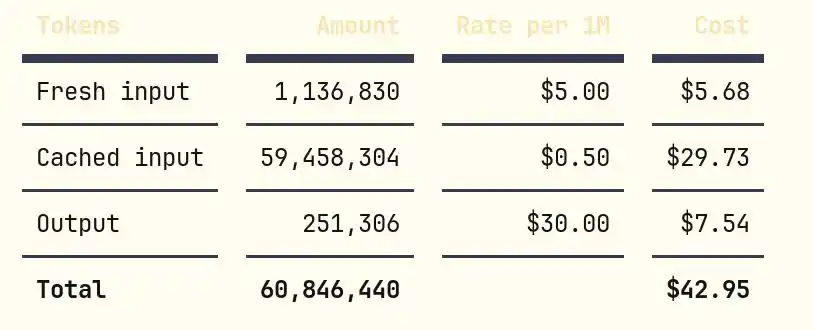
Using the same method, DHH had Codex complete it, and the results after a single prompt were also excellent.

However, it was 30% slower and cost $43 (290 RMB) in Tokens.
DHH's hardcore operation directly blew up the community, drawing out several Anthropic bigwigs.

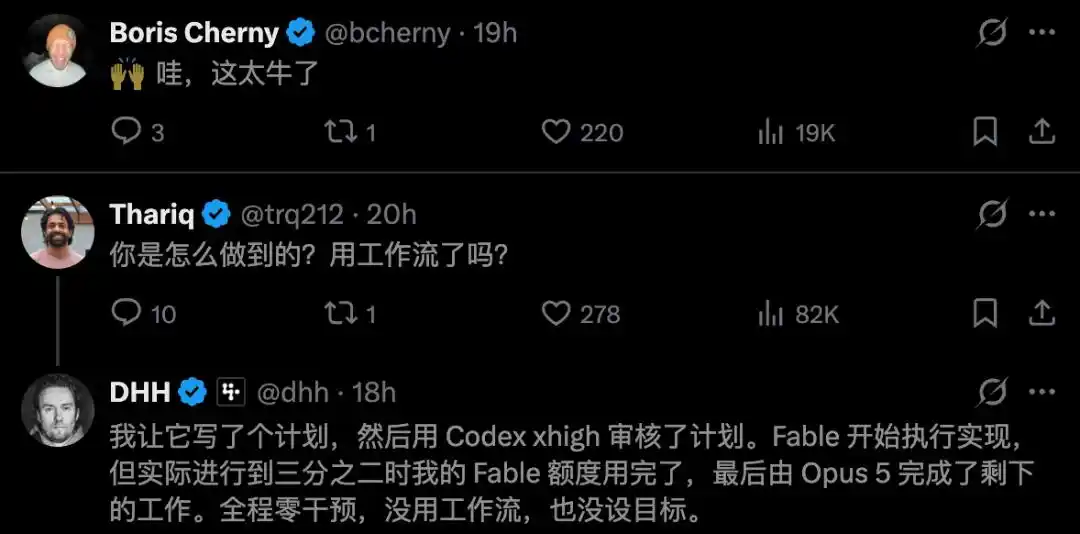
Claude Code creator Boris Cherny couldn't help but appear in the comments exclaiming, 'This is insane!'

Faced with a follow-up question from another researcher, Thariq, DHH revealed an even more astonishing detail—

He simply asked Claude to formulate a plan. After that, it was zero intervention throughout, no complex workflows applied, no specific goals pre-set; it was all about complete delegation of authority.
Million-Line Codebase, Bun One-Click Migration

TerminalTextEffects, after all, is limited in scale.

What truly demonstrates the power of AI coding is a massive refactoring in Bun's core.

A few months ago, founder Jarred Sumner personally spearheaded the migration of the massive codebase from Zig to Rust in its entirety.

It's astonishing that this monumental project, involving a million lines of code, was declared 'complete' in less than two weeks.

If this were a few years ago, a project of this magnitude would have been a marathon lasting several quarters, if not years.

Future Coders to Become 'Dragon Tamers'

Now, all signs are frantically hinting at a fact that is both brutal and exciting—

The marginal cost of code generation is approaching zero.

This inevitably plunges many into panic. 'If no one reads or writes code in five years, will programmers disappear?'

Actually, 'no one writes code' absolutely does not equal 'programmers disappear.'

The core work of future programmers will undergo a fundamental shift—

From 'personally implementing code' to fully focusing on defining requirements, designing constraints, establishing testing frameworks, and judging whether the AI wrote it correctly.

It's foreseeable that when 'handcrafting code' becomes history, the only remaining scarce moats will be two points:

Insight into 'what is worth doing' + defining 'what counts as correct.'

Rather than worrying about losing your keyboard, it's better to start thinking now: what kind of Rome do you want to command this boundless-compute 'super coder' AI to build?

References:

https://x.com/dhh/status/2086713611934695848?s=20

https://claude.ai/code/artifact/287825bc-7aad-4541-a7e7-fa4ba8d03612

This article is from the WeChat public account "New Zhiyuan", author: Taozi

Preguntas relacionadas

QWhat major transformation did DHH perform using Claude Fable 5?

AHe completely rewrote the Python library 'TerminalTextEffects' into Rust in one go.

QWhat were the performance improvements after the AI-assisted rewrite of TerminalTextEffects?

AStartup time was reduced from 87 milliseconds to just 2 milliseconds, and rendering speed increased by 9.6 times.

QAccording to DHH, what will happen to human coding in the next five years?

AVery few people will be hand-writing or reading code anymore, as the focus will shift to other tasks.

QWhat significant project did Bun founder Jarred Sumner undertake with AI assistance?

AHe migrated the entire massive codebase of Bun from Zig to Rust in less than two weeks.

QWhat does the article suggest will be the core role of future programmers in the age of AI coding?

ATheir core role will shift from writing code to defining requirements, designing constraints, establishing testing systems, and judging whether the AI's output is correct.

Lecturas Relacionadas

Founders Fund Leads $5 Million Token Purchase of ANVL: What Exactly is This "Non-Lending" DeFi Protocol Doing?

On October 6th, Founders Fund, led by Peter Thiel, invested $5 million to purchase ANVL tokens from the DeFi protocol Anvil's treasury. The round included participation from Pantera Capital and others, alongside angel investors like Compound founder Robert Leshner. Anvil is not a lending protocol. Instead, users lock assets like ETH or USDC into its vault to generate a verifiable on-chain "Letter of Credit" (LOC). This LOC acts as an economic guarantee, proving the user has sufficient locked collateral to back financial commitments, without borrowing funds. The protocol applies this mechanism to use cases like payment guarantees for merchants (via integration with Flexa) and enabling instant deposits for traders on exchanges like Bullish. Anvil's economic model is unique: it charges zero protocol fees. Its native token, ANVL, derives value solely from governance rights over parameters like supported collateral types. The total supply is 100 billion tokens. Despite an 83% price surge on the investment news, ANVL remains down approximately 89% from its all-time high. The protocol's Total Value Locked (TVL) has also fallen about 87% from its peak of ~$109 million in July 2025 to around $14 million currently. The investment represents a strategic bet that on-chain credit guarantees could become a significant category. Key factors to watch include the rate of real enterprise adoption through Anvil's SDK, the long-term sustainability of its zero-fee model, and the broader migration of traditional trade finance needs to blockchain infrastructure.

marsbitHace 20 min(s)

Founders Fund Leads $5 Million Token Purchase of ANVL: What Exactly is This "Non-Lending" DeFi Protocol Doing?

marsbitHace 20 min(s)

Mathematical Explosion: OpenAI Overnight Solves 722 Math Problems, Quasi-Riemann Hypothesis Proven

OpenAI has stunned the global mathematics and AI communities by releasing a GitHub repository containing 722 manuscripts addressing 372 previously unresolved major mathematical problem families, all reportedly generated by an unreleased internal AI model. The announcement, made without prior peer review, has provoked both excitement and alarm among mathematicians. The most notable breakthrough claims to be a proof of a "quasi-Riemann Hypothesis," establishing a zero-free region for Dirichlet L-functions with real part greater than 7/8 and eliminating the Landau-Siegel zeros—a significant leap in analytic number theory. The work has reportedly undergone formal verification using Lean. Other highlighted results include: unconditionally proving the NP-hardness of the basic semidefinite programming (SDP) threshold for approximation algorithms, based solely on P ≠ NP and circumventing the Unique Games Conjecture; proving the rational Hodge conjecture for abelian varieties with complex multiplication (CM); and resolving both the symmetric and asymmetric Mahler conjectures in convex geometry. According to OpenAI, most proofs were generated automatically by the model, with an average "thinking" time of just three hours per problem. This unprecedented scale and speed have sparked intense debate about the future of human mathematicians. While some express fear about the concentration of intellectual power, others see it as the dawn of a new era of discovery driven by AI. The mathematical world is now tasked with scrutinizing these claims, which, if verified, would represent historic milestones.

marsbitHace 53 min(s)

Mathematical Explosion: OpenAI Overnight Solves 722 Math Problems, Quasi-Riemann Hypothesis Proven

marsbitHace 53 min(s)

As Midterm Elections Approach, the Real Trade in U.S. Stocks Isn't About Who Wins

With the US midterm elections approaching in early November, political uncertainty has re-emenrged as a market variable. While market participants are weighing potential shifts in congressional control and policy direction, historical data suggests midterm elections themselves are not a definitive negative catalyst for US equities. Since 1937, the S&P 500 has averaged a positive gain of 9.2% in midterm election years, though this lags behind the 13.3% average for non-election years. A more consistent historical pattern is increased market volatility and a tendency for stronger performance concentrated in the fourth quarter, as political uncertainty is resolved. The article, citing analysis from J.P. Morgan and Capital Group, argues that the market's primary concern is policy path uncertainty rather than which party wins. This uncertainty tends to depress markets in the run-up to the vote, with a potential rebound afterward as the political risk premium dissipates. However, the article cautions against attributing market performance solely to the election. Recent midterm years like 2018 and 2022 saw significant market declines primarily driven by factors like Federal Reserve tightening and inflation, not the election outcome itself. The core argument is that the midterm election's impact on markets is often secondary to more fundamental drivers. Regardless of whether the result is a unified or divided government, the market's longer-term trajectory has historically been determined by underlying economic conditions. For the current environment, the key variables to watch post-election are not political labels but the path of interest rates, corporate earnings trends, and whether any actual policy changes materially alter cash flow expectations for businesses. The election may influence sentiment and policy expectations, but the sustainability of any year-end rally will ultimately depend on these core fundamentals of profitability, rates, and economic data.

marsbitHace 59 min(s)

As Midterm Elections Approach, the Real Trade in U.S. Stocks Isn't About Who Wins

marsbitHace 59 min(s)

AI Can't Change 'DNA': How Long Can SanDisk Stay Strong?

**AI Cannot Alter the "DNA": How Much Longer Can Western Digital's Run Last?** This analysis examines the sustainability of the current "super cycle" for NAND flash memory, driven by AI, with a focus on Western Digital (WD). The core argument is that while AI demand has fundamentally shifted NAND's role from a data warehouse to an essential component on the compute path, especially for AI inference, this does not eliminate the industry's cyclical nature. The piece first assesses the supply-demand dynamics. On the supply side, major producers are showing capital expenditure restraint for NAND, prioritizing DRAM/HBM. Capacity growth through 2028 relies heavily on technological upgrades (increasing 3D layers to 300+) and expansion primarily from China's YMTC, rather than new fabs. Global new fab capacity from players like Samsung and WD/Kioxia is concentrated post-2029. This results in estimated bit supply growth (CAGR ~24% for 2026-2028) largely driven by higher per-wafer output. Demand is undergoing a structural shift. AI-related NAND demand (for data lakes, KV cache, and staging) is forecast to grow at a 75% CAGR from 2025-2028, becoming the dominant driver. Data center demand will surpass 50% of total NAND demand in 2026. Consumer demand (PC, smartphone) is being squeezed and is expected to decline or stagnate. A key 2027 demand catalyst is NVIDIA's Rubin platform with its dedicated contextual memory storage (ICMS). The analysis concludes that a supply-demand deficit will persist into 2027. However, 2028 is identified as a potential inflection point where supply (led by YMTC's new fab) could outpace demand, ending the price rally. For Western Digital, the analysis models a more conservative path than management's guidance. It forecasts Average Selling Price (ASP) peaking in FY28 (ending June 2028) before declining in FY29-30 as the market loosens, though supported by long-term agreements (LTAs) and a higher mix of data center products. Consequently, margins and profits are expected to peak in FY28 and then contract. The valuation suggests WD's current price largely reflects a neutral scenario, with limited short-term upside unless the market becomes convinced that prices will remain stable post-2028. The fundamental takeaway is that despite AI's transformative impact, NAND's cyclical "DNA" remains intact.

marsbitHace 1 hora(s)

AI Can't Change 'DNA': How Long Can SanDisk Stay Strong?

marsbitHace 1 hora(s)

Trading

Spot
活动图片