Public bitcoin miners are spending billions in a drive to generate revenue from artificial intelligence and high-performance computing, but revenue is not yet keeping pace with expenses. This underscores the scale of upfront investment required to diversify beyond bitcoin mining.
In the latest issue of the Miner Weekly newsletter, BlocksBridge Consulting reported that a group of 15 mining companies and AI data center operators collectively spent $30.7 billion on capital assets over the recent reporting periods of 2026—a 42.6% increase from the $21.53 billion spent in all of 2025.
Looking specifically at bitcoin miners, the gap between capital expenditure and AI revenue remains significant. Nine comparable mining companies spent $5.11 billion on capital assets in the first half of 2026, receiving only $341.2 million in disclosed revenue from AI and HPC—a capital expenditure-to-revenue ratio of roughly 15:1.
BlocksBridge calculated capital expenditures based on cash purchases and funds allocated to equipment, real estate, facilities, and other productive assets, minus revenue and refunds from asset sales.
Despite this gap, AI and HPC revenues are growing faster. In the second quarter, the nine miners generated $205.8 million from these segments—a 52% increase from the previous quarter. Core Scientific, TeraWulf, and Bitdeer reported growth.
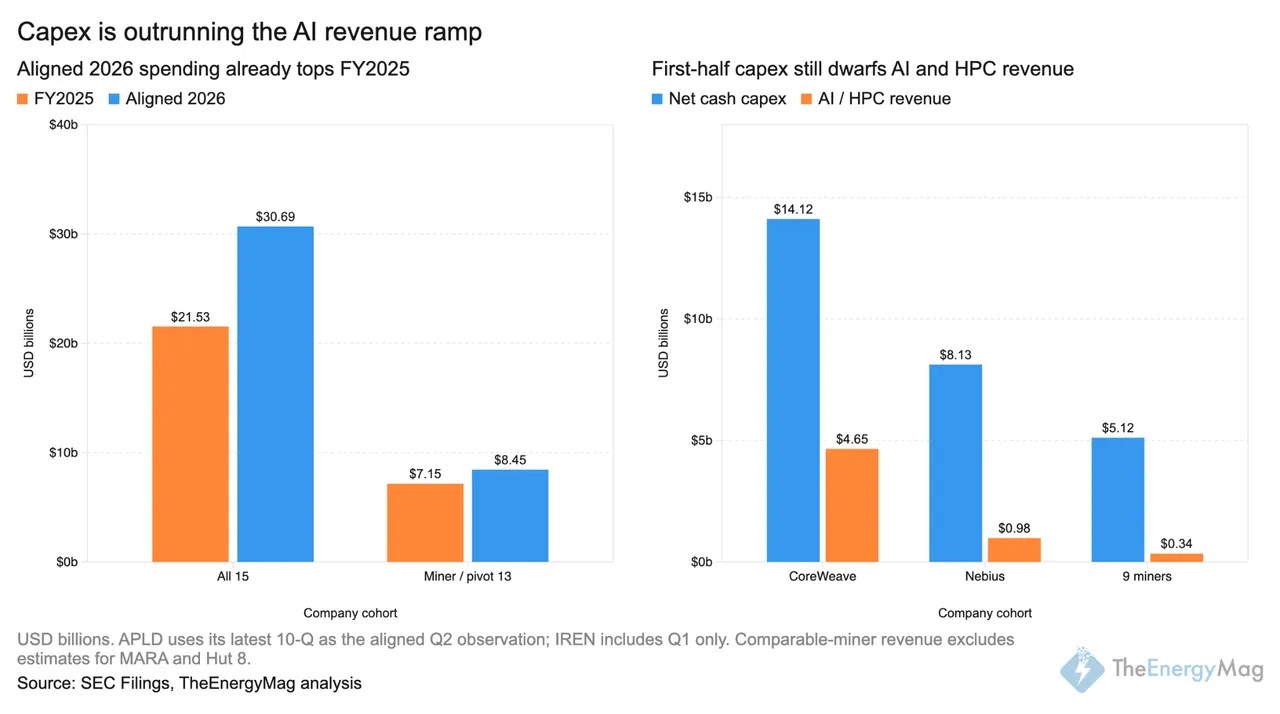
The capital expenditures of bitcoin miners still significantly outpace AI and HPC revenues. Source: Miner Weekly
Related: Public Bitcoin Miners Cut Hashrate by 13.4% as AI Infrastructure Revenue Grows
The High Cost of Transitioning to AI
AI and data centers have been seen as a way for bitcoin mining companies to diversify their operations amid a challenging mining sector environment. However, BlocksBridge data shows that such a transition requires substantial upfront investment.
"Power contracts and available land parcels can give miners a head start, but converting these assets into AI-ready capacity requires substations, buildings, cooling systems, networking equipment, and in some business models, GPUs," stated BlocksBridge.
It remains to be seen whether bitcoin's recent price recovery will bring relief to companies that still maintain significant mining operations.
This week, bitcoin rose more than 13% and climbed back above $72,000 after the U.S. Treasury Department stated it would at least double the maximum size of its long-term bond buybacks—to $4 billion per operation. This measure aims to enhance liquidity in the Treasury bond market; it initially led to lower yields and increased risk appetite.
Amid the transition to AI and HPC, CoinShares this week announced a strategic shift for its industry-tracking exchange-traded fund.
The fund is now named the CoinShares Bitcoin Mining and Digital Power ETF (WGMI), with assets under management of $222.4 million. Its portfolio includes 29 assets related to bitcoin miners, data center operators, AI semiconductor manufacturers, energy companies, and HPC; CoinShares describes them as "companies powering the digital economy."
Related: Crypto Biz: A $116 Million Self-Custody Bitcoin Wake-Up Call
end-content