He Kaiming's Team's New Work: After Deleting VAE and Private Data, Text-to-Image Generation Becomes Even Stronger

marsbitPublicado a 2026-06-22Actualizado a 2026-06-22

Resumen

KaiMing He's team introduces **MiniT2I**, a minimalist text-to-image (T2I) model that challenges the complexity of mainstream approaches. It eliminates components commonly considered essential: the VAE encoder-decoder, AdaLN conditioning mechanisms, auxiliary losses, private training data, and post-training alignment stages like RL/DPO. Instead, it uses a pure flow-matching objective trained directly on RGB pixels. The model employs a simplified **MM-JiT** Transformer architecture. It removes AdaLN blocks for conditioning and instead prepends two lightweight text adapter blocks to a standard pre-norm Transformer, allowing frozen T5 text features to adapt to the denoiser. Training follows a two-stage, LLM-like paradigm using only public datasets: pre-training on LLaVA-recaptioned CC12M for coverage, followed by fine-tuning on ~120k high-quality image-text pairs. With just 258M parameters (B/16), MiniT2I achieves competitive scores (0.87 on GenEval, 84.2 on DPG-Bench), outperforming larger pixel-space models. Scaling to 912M parameters (L/16) yields results comparable to SD3-Medium (~2B parameters) in style, composition, and imagination, though it lags in text rendering and named entities due to public data limitations. Key advantages include lower computational cost (~570 GFLOPs vs. ~1379 for latent models) and architectural simplicity. Acknowledged limitations include patch boundary artifacts in pixel space, side effects of high CFG scales, resolution ceilings for sequence...

The field of text-to-image generation has long been a fiercely competitive red ocean, seemingly with no room left to innovate.

What do you need to train a powerful text-to-image model today?

Following the current mainstream approach, you would need: a pre-trained VAE encoder-decoder, concatenated text encoders, meticulously designed conditional injection mechanisms, massive datasets, RL or DPO alignment phases...

Overall, there seems to be a consensus: text-to-image generation must be this complex.

He Kaiming's team, however, takes a contrarian approach, offering a new perspective in the field of text-to-image models. They have released MiniT2I — a minimalist, pixel-space text-to-image model that deliberately pursues simplicity.

No VAE encoder-decoder, no AdaLN conditional injection, no auxiliary loss functions, no private data, no RL/DPO alignment, just pure flow matching trained directly on pixels. The 258M-parameter B/16 version achieves 0.87 on GenEval and 84.2 on DPG-Bench, surpassing pixel-space models several times its size.
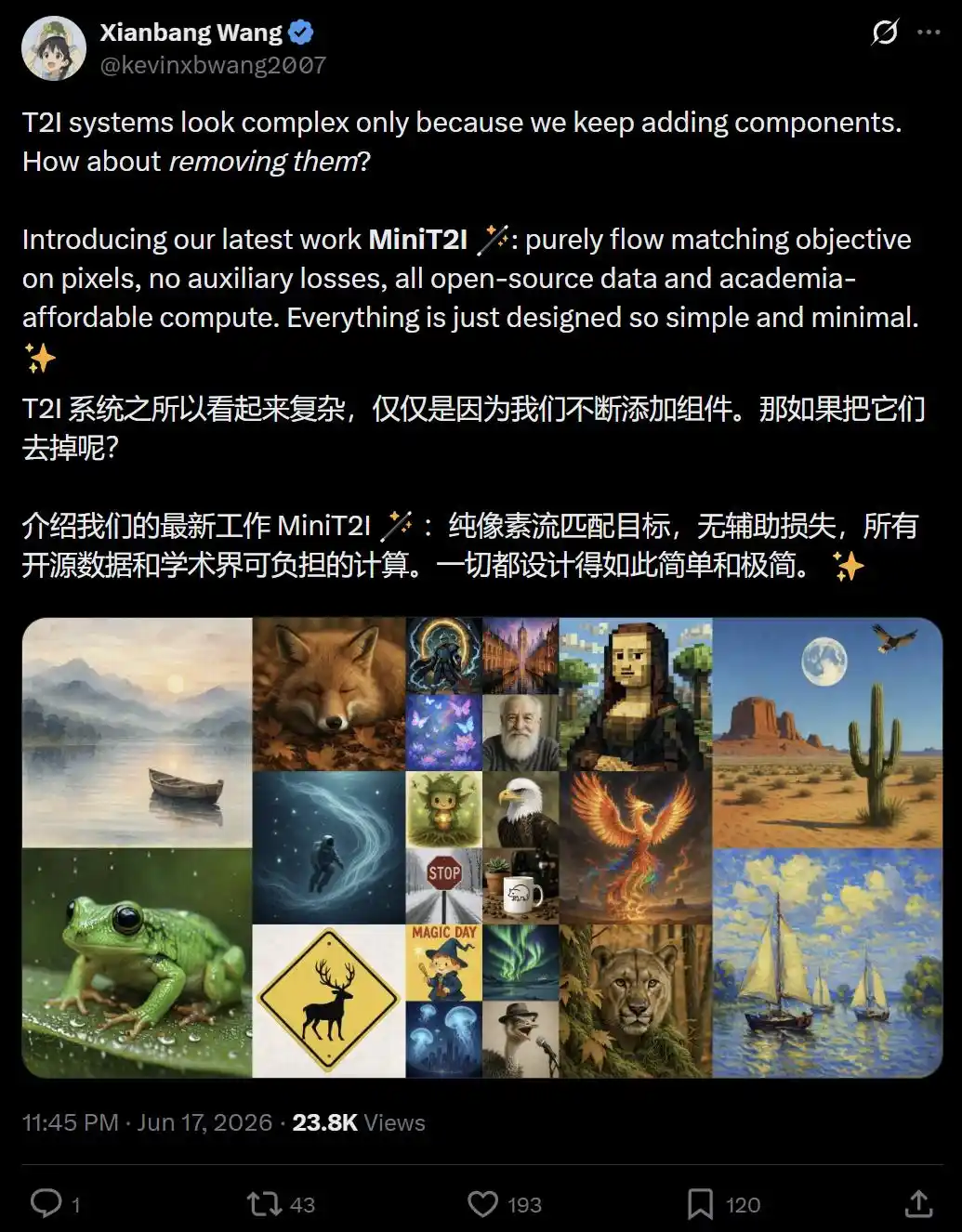
The core proposition of MiniT2I is: If text conditioning is treated as 'context tokens with semantic information' and injected into the model, text-to-image generation and class-conditional ImageNet generation are not fundamentally that different — the architecture can be similar, computational requirements comparable, and even the scale of data can be aligned.
  • Paper Title: A Minimalist Baseline for Text-to-Image Generation
  • Technical Blog: https://peppaking8.github.io/#/post/minit2i
  • Open Source Repo: https://github.com/PeppaKing8/minit2i-jax

Technical Approach: Subtraction at Every Step

Direct Pixel-Space Output, No VAE

MiniT2I's first design choice is radical: discard the VAE, perform denoising directly on RGB pixels.

Latent Diffusion Models are the current mainstream paradigm, first compressing images into a low-dimensional latent space using an autoencoder before diffusion. This makes high-resolution generation feasible, but at the cost of introducing reconstruction error, an extra training phase, and misalignment between the encoder and denoiser objectives.

MiniT2I's choice of pixel space is pragmatic: For 512×512 resolution, using 16×16 patches to divide the image into 1024 tokens keeps the sequence length well within the Transformer's comfort zone. Removing the VAE reduces single-step forward computation from ~1379 GFLOPs to ~570 GFLOPs (B/16 setting), and eliminates the ceiling on reconstruction accuracy — the output quality is only limited by the denoiser's capability.

Experiments confirm this: Under the same parameter budget, pixel models achieve FID on par with latent space models (18.7 vs 19.0), but with a 5x lower per-step cost.

MM-JiT Architecture: Returning to a Simple Transformer

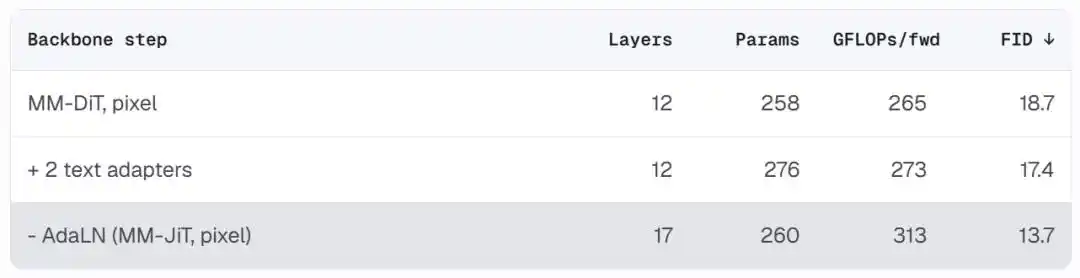
SD3's MM-DiT uses AdaLN (Adaptive Layer Normalization) within each block to inject timestep and pooled text embeddings into the network — each sub-block needs to compute scale, shift, and gate parameters generated by an extra MLP from the conditioning vectors. This is an elaborate modulation mechanism, but MiniT2I finds it non-essential.
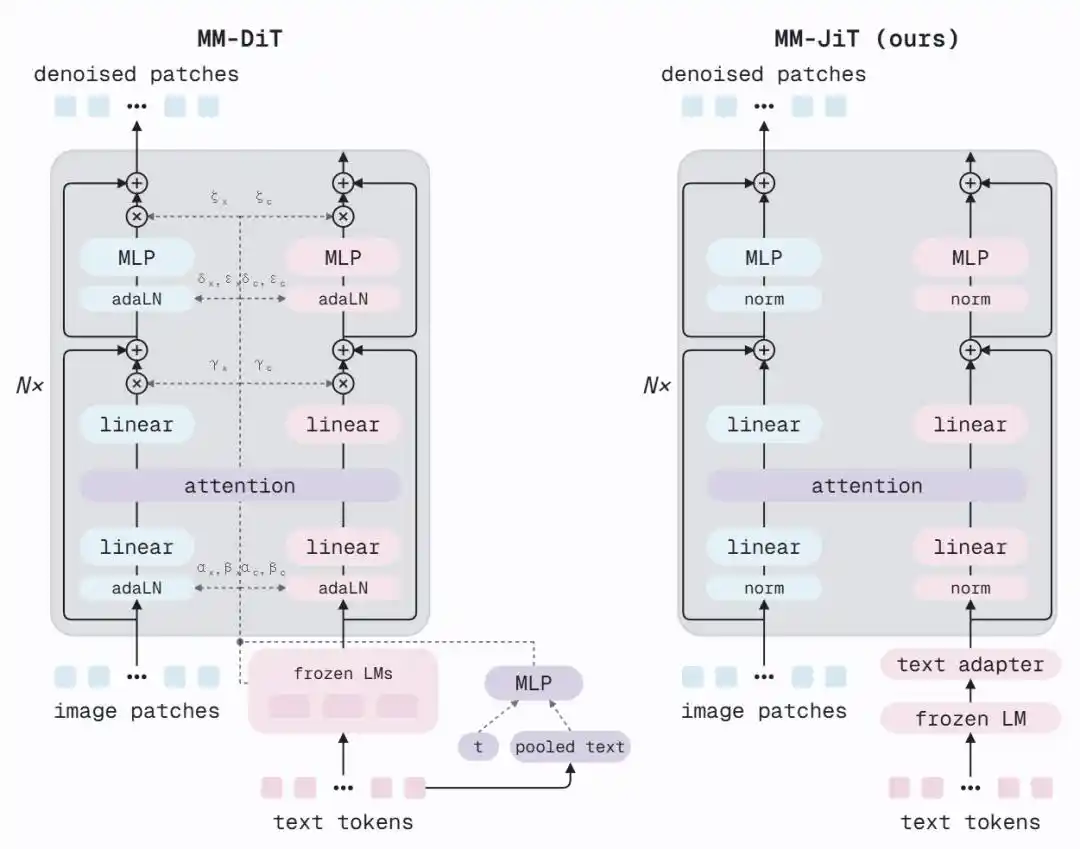
The proposed MM-JiT architecture does two things:

1. Add Two Text Adapter Layers: Insert two lightweight Transformer blocks before joint attention, allowing the frozen T5 features to first 'adapt' to the denoiser's needs.

2. Remove the AdaLN Branch: No longer inject timestep and global text information through an additional path. The model can still perceive noise levels — because the noise-corrupted image itself carries timestep information.

The result is a clean architecture nearly identical to a standard pre-normalization Transformer. Removing AdaLN reduces parameters, allowing for more layers within the same compute budget (12 layers → 17 layers). FID drops from 18.7 to 13.7, and the architecture itself is easier to understand and modify.
Training Data: Fully Public, Two-Phase

MiniT2I's training data also pursues minimalism:

  • Pre-training: LLaVA-recaptioned CC12M (publicly available VLM re-captioned dataset), 250K steps
  • Fine-tuning: ~120K high-quality image-text pairs (BLIP3o-60K + LAION DALL・E 3 Discord set + ShareGPT-4o-Image), 40K steps

This 'pre-train then fine-tune' two-stage pattern directly mirrors LLM training paradigms: pre-training buys coverage, fine-tuning teaches the model what a good answer is. Ablations show both are indispensable — pre-training alone yields acceptable image quality but poor prompt following; fine-tuning alone makes the model's world too narrow, causing generative diversity to collapse.

Results: Small Model, Big Performance

In comparisons among pixel-space text-to-image models, MiniT2I offers exceptional value:
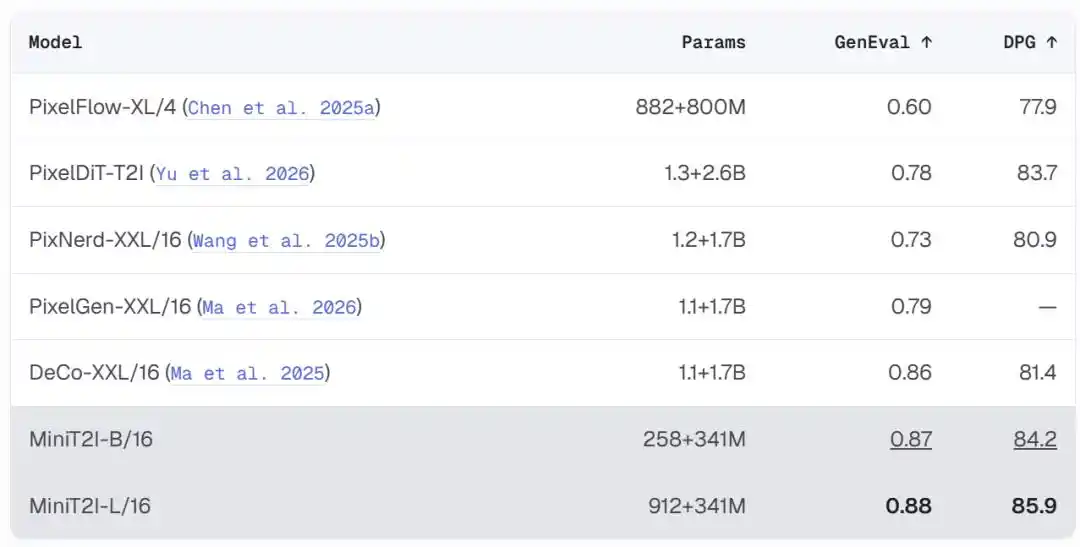
MiniT2I-B/16, with only ~600M total parameters (including text encoder), surpasses models 3-4 times its size on GenEval and DPG-Bench. Moreover, training cost is extremely low: the B/32 ablation model required only about 3 days on 8 H100s, with total training FLOPs comparable to a standard 200-epoch ImageNet experiment.
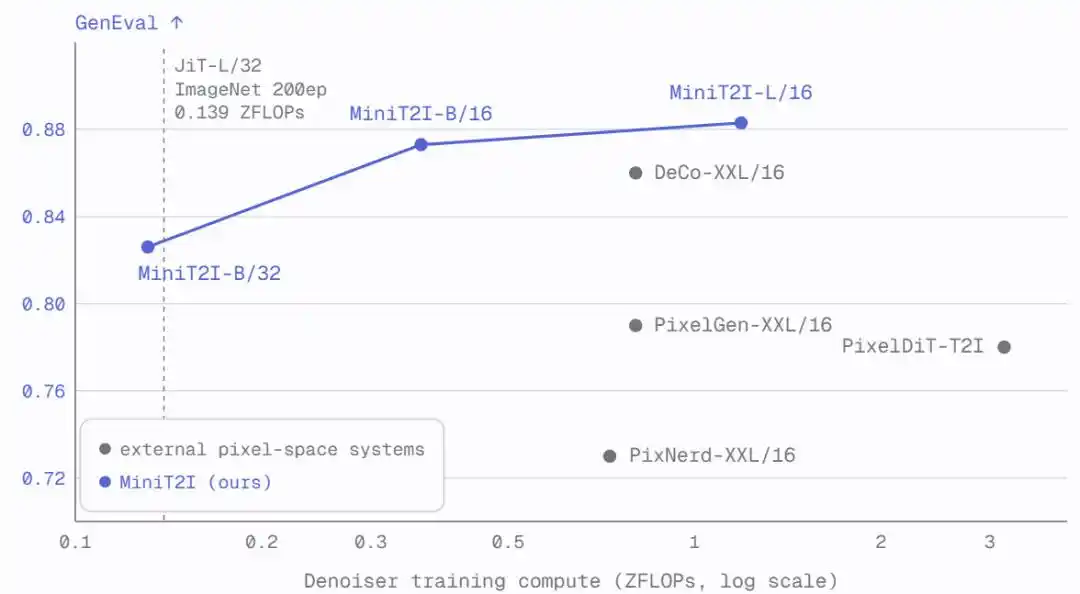
Scaling to L/16 (912M parameters) yields noticeable improvements in style diversity, spatial relationships, and text rendering, achieving quality on imaginative scenes comparable to or even better than SD3-Medium (~2B parameters).

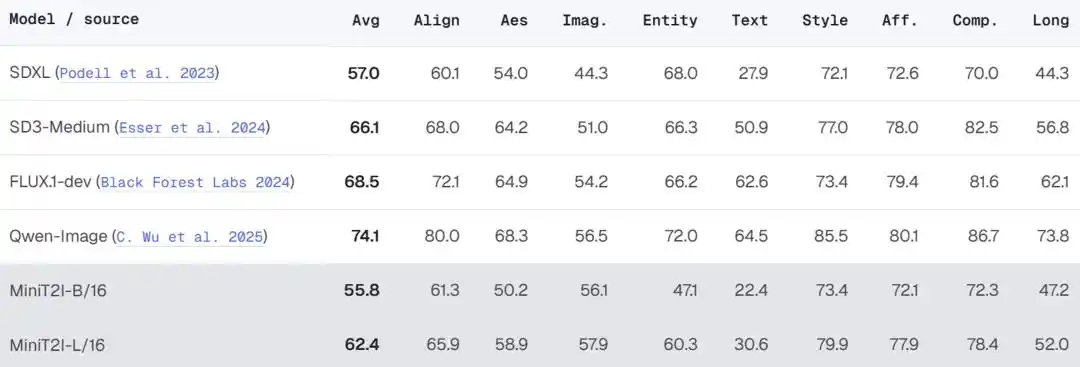
In the more comprehensive PRISM-Bench evaluation, MiniT2I-L/16 performs well in style, composition, and imagination dimensions (79.9, 78.4, 57.9), approaching SD3-Medium levels. However, gaps remain in text rendering (30.6 vs SD3's 50.9) and named entities (60.3 vs 66.3) — the team acknowledges these are inherent limitations of the public data recipe, requiring targeted data to bridge.
Limitations and Outlook

MiniT2I is a proof of concept for a technical path, not a final product. The team honestly points out several unresolved issues:

  • Patch artifacts in pixel space: Measurable discontinuities exist at patch boundaries (gradients 17-22% higher at boundaries than elsewhere), a problem latent-space models do not have.
  • Side effects of CFG in pixel space: High guidance scales (~6) push local tokens away from the data manifold, directly exposing visual artifacts without a decoder's 'smoothing' effect.
  • Resolution ceiling: Works well at 512×512 currently; pushing to 4K+ requires longer sequences or more efficient attention mechanisms.
  • Data bottleneck: Text rendering and named entities remain weaker than industrial systems, requiring specialized data augmentation.

MiniT2I demonstrates that state-of-the-art text-to-image generation is no longer a game only for top industrial labs.

When a 258M-parameter model, trained on purely public data with academic-level compute for just 3 days, can defeat opponents orders of magnitude larger, perhaps text-to-image is undergoing a paradigm shift from 'brute force' to 'distillation'.

"T2I is no longer an insurmountable wall. Welcome to use and improve it, to build a simpler baseline."

This article is from the WeChat public account "机器之心" (Almost Human)

Criptos en tendencia

Preguntas relacionadas

QWhat is the main contribution or innovation of the MiniT2I model proposed by He Kaiming's team?

AThe main contribution is proposing MiniT2I, a minimalist text-to-image baseline model. It removes numerous complex components standard in current models—such as the VAE encoder-decoder, the AdaLN conditional injection mechanism, auxiliary loss functions, and private training data—and relies solely on flow matching objectives trained directly on pixel space. It demonstrates that with a simpler architecture and public data, it can achieve competitive performance against much larger models.

QHow does the architectural design of MiniT2I's MM-JiT differ from the commonly used MM-DiT in models like SD3?

AThe MM-JiT architecture in MiniT2I differs from MM-DiT by performing simplification in two key ways. First, it adds two lightweight text adapter Transformer blocks before joint attention to help frozen T5 features adapt to the denoiser. Second, and more importantly, it deletes the complex AdaLN (Adaptive Layer Normalization) branches used to inject timestep and text conditioning. This results in a cleaner, near-standard pre-norm Transformer architecture, reducing parameters and allowing for more layers within the same compute budget.

QWhat is the core argument for MiniT2I's choice to operate directly in pixel space instead of a latent space like most models?

AThe core argument is simplicity and alignment. Removing the VAE eliminates several issues: reconstruction error, extra training stages, and misalignment between encoder and denoiser objectives. For 512x512 images, patchifying into 1024 16x16 tokens keeps the sequence length manageable for Transformers. This direct approach reduces computational cost per forward pass significantly (~570 vs ~1379 GFLOPs for the B/16 configuration) and removes the upper bound of reconstruction accuracy, meaning the output quality depends directly on the denoiser's capability.

QWhat were the two stages of data used to train MiniT2I, and why was this two-stage approach necessary?

AMiniT2I was trained in two stages using only public data: 1) Pre-training on LLaVA-recaptioned CC12M (a VLM-recaptioned dataset) for 250K steps. 2) Fine-tuning on a combined set of ~120K high-quality image-text pairs from sources like BLIP3o-60K, LAION DALL・E 3 Discord set, and ShareGPT-4o-Image for 40K steps. This 'pre-train then fine-tune' paradigm mirrors LLM training. Ablation studies showed both stages are essential: pre-training alone gives good image quality but poor prompt following, while fine-tuning alone causes a collapse in generation diversity due to a limited worldview.

QAccording to the article, what are some of the key limitations or unsolved problems with the MiniT2I approach?

AThe key limitations highlighted include: 1) Patch boundary artifacts in pixel space, leading to measurable discontinuities not present in latent models. 2) Negative side effects of high CFG (Classifier-Free Guidance) scales in pixel space, which push local tokens off the data manifold and manifest as visual flaws. 3) A resolution ceiling, as scaling to 4K+ would require longer sequences or more efficient attention. 4) Data bottlenecks, particularly in text rendering and named entity accuracy, which lag behind industrial systems and would require specialized data to improve.

Lecturas Relacionadas

Two Giants' Credit Expansion: Loan Balances of $9.9 Billion vs. $14.6 Billion, Brazil Emerges as the Main Battlefield

Title: Two Giants "Credit" Surge: Loan Balances of 99 Billion vs. 146 Billion USD, Brazil Emerges as Main Battlefield Summary: The article compares the rapid expansion of credit businesses by two major e-commerce and fintech players, Sea (via Monee) and Mercado Libre (via Mercado Pago), in overseas markets like Southeast Asia and Latin America, contrasting with a slowing domestic Chinese credit market. Using Q1 2026 financial data, it highlights their significant growth. Sea's Monee reached a loan balance of $99 billion, up 71% year-over-year (YoY), contributing 17.5% to Sea's total revenue. Mercado Pago's loan balance hit $146 billion, up 87% YoY, contributing 45% to its parent company's revenue. Both maintained stable risk metrics (e.g., Monee's 90+ day NPL at 1.1%) despite rapid scaling. Brazil is identified as a key and accelerating growth market for both. Sea's Brazilian operations saw loan volumes exceed $10 billion, growing 250% YoY, with SPayLater GMV penetration still low (~10%) indicating high potential. Sea also secured a key Brazilian financial credit license (SCFI). Mercado Libre's Brazil segment contributed over half (54%) of total group revenue, with its credit business there generating $11.24 billion in revenue, up 89% YoY and accounting for 12.7% of global revenue. Mercado Pago's credit portfolio, especially credit cards (46% of loans, +105% YoY), is a strategic focus, described as crucial as building logistics was a decade ago. Its net interest margin after loss (NIMAL) remains high at 17.8%. The article concludes that while Brazil presents immense opportunities, the success is largely driven by these integrated "e-commerce + fintech" giants with proprietary transaction data and ecosystems, making it challenging for standalone fintech players to compete effectively.

链捕手Hace 12 min(s)

Two Giants' Credit Expansion: Loan Balances of $9.9 Billion vs. $14.6 Billion, Brazil Emerges as the Main Battlefield

链捕手Hace 12 min(s)

Research Report Analysis: Is Intel Making a Comeback with Apple? Bernstein's Calculations Show the Right Direction, but the Price Is Already Overvalued

Bernstein analyst Stacy A. Rasgon published a report on June 18 regarding Intel, assessing the potential impact of recent political support for a US-based PC chip design and manufacturing collaboration between Apple and Intel. The report views this as a significant signal for the foundry landscape shift but concludes the initial financial contribution would be minimal. Key conclusions: 1) An Apple deal is seen as a small-scale "proof of concept." Even if Intel wins 40% of Apple's premium notebook chip orders (~5 million units/year), Bernstein estimates it would generate only about $500M in annual revenue and ~$0.03 EPS, negligible against Intel's ~$55B revenue. 2) Political encouragement is not equivalent to enforceable mandates. Winning orders ultimately depends on Intel demonstrating competitive technology (like its 18A node), cost, and reliable supply. 3) The path from validation to large-scale production involves significant challenges, capital investment, and time. Due to these uncertainties, Bernstein maintains a Market-Perform (Hold) rating with a $100 price target, implying potential downside from the ~$121.10 price at the report date. The analysis highlights the tension between near-term validation value—serving as a crucial trust signal for Intel's foundry ambitions and US supply chain resilience—and the long-term opportunity to attract larger cloud and AI chip customers. The investment thesis hinges on successful 18A execution and sustained policy support, not on immediate financial gains from Apple.

marsbitHace 37 min(s)

Research Report Analysis: Is Intel Making a Comeback with Apple? Bernstein's Calculations Show the Right Direction, but the Price Is Already Overvalued

marsbitHace 37 min(s)

27-Year Reign Ends: SK Hynix Market Cap Surpasses Samsung for First Time, an AI-Driven Reshuffle of Korean Chip Power

On June 22, 2026, SK Hynix made history by surpassing Samsung Electronics in market capitalization, ending Samsung's 27-year reign as South Korea's most valuable company. This dramatic reversal is powered by the AI boom and SK Hynix's dominant position in High Bandwidth Memory (HBM), a critical component for AI model training. Once a heavily indebted firm on the brink of bankruptcy, SK Hynix bet early on HBM, which has evolved from a niche product to essential AI infrastructure. It now commands a 59% share of the global HBM market. Its financial performance is staggering, with Q1 2026 net profit soaring nearly fourfold year-over-year to KRW 40.35 trillion, translating to over 2 billion RMB in daily net profit. HBM now drives roughly 40% of its revenue with exceptionally high margins. In contrast, Samsung, with its broad portfolio spanning memory chips, smartphones, and foundry services, has lagged in the HBM race while facing headwinds in other divisions. This shift signifies a deeper restructuring of South Korea's economy, moving from consumer electronics to AI-driven growth. However, the future remains competitive. With major capacity expansions planned industry-wide by 2028 and Samsung aiming to catch up in HBM technology, the new market leader cannot afford complacency. This event marks a pivotal moment in the global semiconductor industry's ongoing power realignment.

marsbitHace 48 min(s)

27-Year Reign Ends: SK Hynix Market Cap Surpasses Samsung for First Time, an AI-Driven Reshuffle of Korean Chip Power

marsbitHace 48 min(s)

Trading

Spot
Futuros

Artículos destacados

Qué es ₿O₿

Bitcoin Bob ($₿o₿): Pionero en DeFi Centrado en Bitcoin a Través de la Innovación Híbrida de Capa 2 En una era donde la economía digital está evolucionando rápidamente, Bitcoin Bob ($₿o₿) surge como un proyecto revolucionario que busca mejorar la utilidad de Bitcoin en el sector de las finanzas descentralizadas (DeFi). Lanzado oficialmente en mayo de 2024, Bitcoin Bob, también conocido como Build on Bitcoin (BOB), representa una solución híbrida de blockchain de Capa 2 que combina la reconocida seguridad e inmutabilidad de Bitcoin con la programabilidad de Ethereum. Esta iniciativa busca llenar un vacío crucial en el ecosistema de Bitcoin al facilitar la integración de contratos inteligentes y aplicaciones descentralizadas, manteniendo al mismo tiempo los principios fundamentales de confianza y seguridad inherentes a Bitcoin. Con un respaldo significativo de destacados capitalistas de riesgo, Bitcoin Bob está posicionado para redefinir el papel de Bitcoin en el paisaje DeFi, convirtiéndolo en una piedra angular de las operaciones financieras descentralizadas a nivel global. ¿Qué es Bitcoin Bob, $₿o₿? En su esencia, Bitcoin Bob es una solución de blockchain híbrida diseñada para mejorar la funcionalidad de Bitcoin. El objetivo principal del proyecto es habilitar las finanzas descentralizadas en Bitcoin, facilitando transacciones rápidas y sin problemas mientras se asegura altos niveles de seguridad. Bitcoin Bob emplea tecnología avanzada, específicamente una arquitectura híbrida de capa 2 que combina los atributos de seguridad de Bitcoin con la programabilidad y flexibilidad de la Máquina Virtual de Ethereum (EVM). Este enfoque pragmático permite que el proyecto opere de manera efectiva sin comprometer los valores fundamentales de Bitcoin, convirtiéndolo en un paso monumental para cerrar la brecha entre los tenedores tradicionales de Bitcoin y el emergente ecosistema DeFi. Una de las características destacadas de Bitcoin Bob es su papel en proporcionar un entorno minimizado en confianza a través de mecanismos innovadores, como los rollups optimistas que inicialmente dependen de Ethereum, y que eventualmente transicionan a una integración completa con Bitcoin. Este sistema híbrido está diseñado para asegurar que la vasta liquidez presente en Bitcoin no solo se preserve, sino que también se utilice de manera efectiva en varios protocolos DeFi. ¿Quién es el Creador de Bitcoin Bob, $₿o₿? La fuerza creativa detrás de Bitcoin Bob es el cofundador y CEO Alexei Zamyatin, quien aporta una gran experiencia y conocimiento de su extensa trayectoria en el espacio de las criptomonedas. Zamyatin tiene un doctorado en Ciencias de la Computación y ha estado involucrado activamente en el desarrollo de Bitcoin desde 2015. Su profundo entendimiento de los ecosistemas de Bitcoin y Ethereum juega un papel crucial en la formación de la visión y los fundamentos tecnológicos de Bitcoin Bob. Junto a Zamyatin está el cofundador Dominik Harz, quien se desempeña como Director de Tecnología (CTO). Juntos, el dúo ha cultivado un equipo de individuos talentosos con una pasión compartida por empujar los límites de la tecnología blockchain, asegurando el estatus innovador de Bitcoin Bob en el mercado. ¿Quiénes son los Inversores de Bitcoin Bob, $₿o₿? Bitcoin Bob ha logrado obtener apoyo de una variedad de inversores prominentes y firmas de capital de riesgo que reconocen su potencial para transformar el paisaje de Bitcoin. En marzo de 2024, el proyecto completó una robusta ronda de financiamiento inicial de $10 millones, liderada por Castle Island Ventures, con la notable participación de firmas como Coinbase Ventures y Bankless Ventures. Poco después, en julio de 2024, Bitcoin Bob aseguró un adicional de $1.6 millones en financiamiento estratégico. Esta ronda fue co-liderada por Ledger Ventures y contó con ángeles de varias firmas prominentes como BlackRock, Aave y Curve. El fuerte respaldo financiero refleja un reconocimiento en toda la industria del enfoque innovador de Bitcoin Bob para desbloquear el potencial de Bitcoin en el espacio DeFi. Este financiamiento es crucial no solo para el desarrollo continuo del proyecto, sino también para establecer un incubador que fomente aplicaciones descentralizadas (dApps) nativas de Bitcoin, dirigidas específicamente a satisfacer las necesidades de una base de usuarios en crecimiento. ¿Cómo Funciona Bitcoin Bob, $₿o₿? La mecánica operativa de Bitcoin Bob se basa en su arquitectura de rollup híbrido, que está diseñada para combinar los beneficios de la seguridad de Bitcoin con la versatilidad de la EVM de Ethereum. El proyecto emplea un modelo de seguridad por fases que describe su interacción con usuarios y desarrolladores de la siguiente manera: Fase 1 – La fase inicial opera como un rollup optimista en Ethereum, donde las transacciones se procesan con una expectativa prometedora de validez, allanando el camino para futuros desarrollos en Bitcoin. Fase 2 – A medida que el proyecto transiciona, integrará la finalización de Bitcoin a través de Staking de Bitcoin, aprovechando la Red Babylon para mejorar la seguridad. Este mecanismo requiere que los validadores bloqueen Bitcoin, verificando así las transacciones de BOB, lo que no solo mejora la seguridad, sino que también crea perspectivas de rendimiento para los participantes. Fase 3 – La visión a futuro para Bitcoin Bob es integrarse completamente con Bitcoin, utilizando tecnologías innovadoras como BitVM y pruebas de conocimiento cero para facilitar la computación fuera de la cadena mientras se mantiene la integridad de seguridad de Bitcoin. Innovaciones clave como BitVM2, un protocolo de puente minimizado en confianza co-autorado por Zamyatin, son críticas para la funcionalidad del proyecto, permitiendo depósitos y retiros de Bitcoin sin necesidad de una extensa dependencia de la red. Esto permite que el ecosistema se conecte de manera eficiente con Ethereum y otras cadenas compatibles, creando un modelo de interacción fluido y efectivo para usuarios y desarrolladores. Cronología de Bitcoin Bob, $₿o₿ Entender la evolución de Bitcoin Bob implica rastrear sus hitos importantes: 2019: Alexei Zamyatin y Dominik Harz establecen una firma de investigación enfocada en soluciones blockchain, sentando las bases para futuros proyectos. Marzo 2024: Bitcoin Bob recauda exitosamente $10 millones en una ronda de financiamiento inicial, marcando su entrada en el competitivo paisaje de blockchain. 1 de mayo de 2024: Ocurre el lanzamiento oficial de la mainnet, mostrando las capacidades del proyecto con una adopción significativa de usuarios y valor total bloqueado (TVL). Julio 2024: El proyecto atrae un adicional de $1.6 millones en financiamiento estratégico para establecer su incubadora, destinada a fomentar innovaciones impulsadas por Bitcoin. Octubre 2024: Bitcoin Bob publica un “Documento de Visión”, detallando su diseño de capa 2 híbrida y estrategias a futuro. 2025: Se espera el lanzamiento de las características de la Fase 2, enfocándose en la finalización de Bitcoin y puentes BitVM destinados a mejorar la funcionalidad general. Conclusión: Redefiniendo el Papel de Bitcoin en las Finanzas Descentralizadas Bitcoin Bob ($₿o₿) no es solo otro proyecto de blockchain; representa un cambio de paradigma en la forma en que Bitcoin puede interactuar con aplicaciones financieras más amplias. Al combinar meticulosamente la seguridad de Bitcoin con la flexibilidad de Ethereum, Bitcoin Bob busca remodelar el paisaje DeFi, cerrando la brecha entre la moneda digital y las aplicaciones descentralizadas. Con un robusto marco tecnológico, un liderazgo fuerte y financiamiento estratégico, Bitcoin Bob está bien posicionado para establecerse como un jugador fundamental en el ecosistema de criptomonedas, desbloqueando nuevas dimensiones de liquidez y utilidad para Bitcoin. A medida que el proyecto continúa evolucionando y expandiéndose, promete inaugurar una nueva era de innovación, demostrando que el potencial de Bitcoin se extiende mucho más allá de ser un mero almacén de valor, sino más bien como una piedra angular del futuro paisaje financiero. A medida que el proyecto avanza a través de sus fases anticipadas, todas las miradas estarán puestas en Bitcoin Bob, particularmente en lo que respecta a su compromiso de incorporar principios descentralizados y asegurar que los usuarios puedan disfrutar de todos los beneficios de DeFi anclados en Bitcoin.

22 Vistas totalesPublicado en 2025.06.30Actualizado en 2025.06.30

Qué es ₿O₿

Cómo comprar O

¡Bienvenido a HTX.com! Hemos hecho que comprar O1 exchange (O) sea simple y conveniente. Sigue nuestra guía paso a paso para iniciar tu viaje de criptos.Paso 1: crea tu cuenta HTXUtiliza tu correo electrónico o número de teléfono para registrarte y obtener una cuenta gratuita en HTX. Experimenta un proceso de registro sin complicaciones y desbloquea todas las funciones.Obtener mi cuentaPaso 2: ve a Comprar cripto y elige tu método de pagoTarjeta de crédito/débito: usa tu Visa o Mastercard para comprar O1 exchange (O) al instante.Saldo: utiliza fondos del saldo de tu cuenta HTX para tradear sin problemas.Terceros: hemos agregado métodos de pago populares como Google Pay y Apple Pay para mejorar la comodidad.P2P: tradear directamente con otros usuarios en HTX.Over-the-Counter (OTC): ofrecemos servicios personalizados y tipos de cambio competitivos para los traders.Paso 3: guarda tu O1 exchange (O)Después de comprar tu O1 exchange (O), guárdalo en tu cuenta HTX. Alternativamente, puedes enviarlo a otro lugar mediante transferencia blockchain o utilizarlo para tradear otras criptomonedas.Paso 4: tradear O1 exchange (O)Tradear fácilmente con O1 exchange (O) en HTX's mercado spot. Simplemente accede a tu cuenta, selecciona tu par de trading, ejecuta tus trades y monitorea en tiempo real. Ofrecemos una experiencia fácil de usar tanto para principiantes como para traders experimentados.

7 Vistas totalesPublicado en 2026.06.19Actualizado en 2026.06.19

Cómo comprar O

Discusiones

Bienvenido a la comunidad de HTX. Aquí puedes mantenerte informado sobre los últimos desarrollos de la plataforma y acceder a análisis profesionales del mercado. A continuación se presentan las opiniones de los usuarios sobre el precio de O (O).

活动图片