How Likely is it for TradeXYZ to Go Solo from Hyperliquid?

marsbitPublicado a 2026-08-03Actualizado a 2026-08-03

Resumen

The article analyzes the possibility of TradeXYZ, a dominant project on Hyperliquid's HIP-3 real-world asset (RWA) perpetual contracts market, splitting off to build its own independent trading platform. With TradeXYZ commanding over 90% of HIP-3 volume and over 35% of Hyperliquid's total open interest, its leverage and influence are significant. The primary motive for a split is seen as capturing the underlying protocol fees, of which TradeXYZ currently receives only half. However, several factors strongly discourage such a move. First, replicating Hyperliquid's high-performance infrastructure would be challenging and could degrade TradeXYZ's product quality. Second, Hyperliquid serves as a crucial distribution channel, with most users accessing TradeXYZ's liquidity through its frontend. Third, the close, trusting relationship between the founders of both projects makes a hostile "betrayal" unlikely. The conclusion is that a split would likely result in a lose-lose scenario. Hyperliquid would lose its main growth narrative and see its valuation impacted, while TradeXYZ would face immense technical hurdles, lose its primary user channel, and damage its reputation. Instead of a full separation, the more probable path is for TradeXYZ to negotiate better terms while deepening integration, focusing on enhancing its own brand and user ownership.

Author | Golem, Odaily Planet Daily

As TradeXYZ's business scale continues to expand, and it consistently occupies over 90% of the Hyperliquid HIP-3 market share, recent community discussions about the possibility of TradeXYZ breaking away from Hyperliquid to independently build its own trading platform have been intensifying.

Former Messari researcher Sam posted on the X platform, stating that as an investor bullish on HYPE due to the explosion of the RWA perpetual contract market, one should ask themselves three questions: First, if TradeXYZ leaves Hyperliquid and launches its own exchange, where will users go to trade; Second, what impact would TradeXYZ launching its own stock/token have on HYPE's valuation; Third, how high is the probability of the above two scenarios actually happening.

This post garnered over 470,000 views in just a few days. The reason for the rapid rise in discussion around this question is essentially that more and more market participants are beginning to realize that within the cooperative relationship between TradeXYZ and Hyperliquid, the value contribution of both parties is changing, with TradeXYZ gradually accumulating stronger market influence and bargaining power compared to Hyperliquid.

In business collaborations, once one party gradually gains more resources and market voice, and the distribution of benefits between the two becomes significantly skewed, "betrayal" often occurs.

A recent example comes from the AI industry. Cursor was once the largest programming AI Coding tool on the market, built on the underlying Claude model from Anthropic. They were a "golden duo" in terms of cooperation, until Anthropic made a betrayal—launching Claude Code, a direct competitor to Cursor. By mid-2026, Claude Code's ARR officially surpassed Cursor's, pushing it off the table.

The blockchain industry also has similar examples. When a single product becomes large, it often breaks away from its original infrastructure to build its own chain ecosystem, such as Uniswap, dYdX, etc. This cycle's hottest project, Polymarket, has also been rumored multiple times to be leaving the existing Polygon infrastructure to build independent infrastructure.

Returning to the current question, how likely is it for TradeXYZ to leave Hyperliquid and go its own way? If this situation were to actually happen, what impact would it have on both Hyperliquid and TradeXYZ? Odaily Planet Daily will provide a brief analysis in this article.

Is Going Solo Inevitable?

A phenomenon exists in the blockchain industry where projects start and grow on a public chain or infrastructure, and then later choose to build their own independent infrastructure (L2 or independent L1) for reasons of performance, control, underlying fee capture, or a bigger narrative for financing. TradeXYZ has indeed grown large enough now.

According to flowscan data, as of now, the total trading volume on Hyperliquid HIP-3 exceeds $469.62 billion, with TradeXYZ contributing over $437.4 billion, accounting for 93%; as of the time of writing, the total open interest (OI) on Hyperliquid HIP-3 reached $3.9 billion, with TradeXYZ contributing over $3.8 billion, accounting for 99.7%.
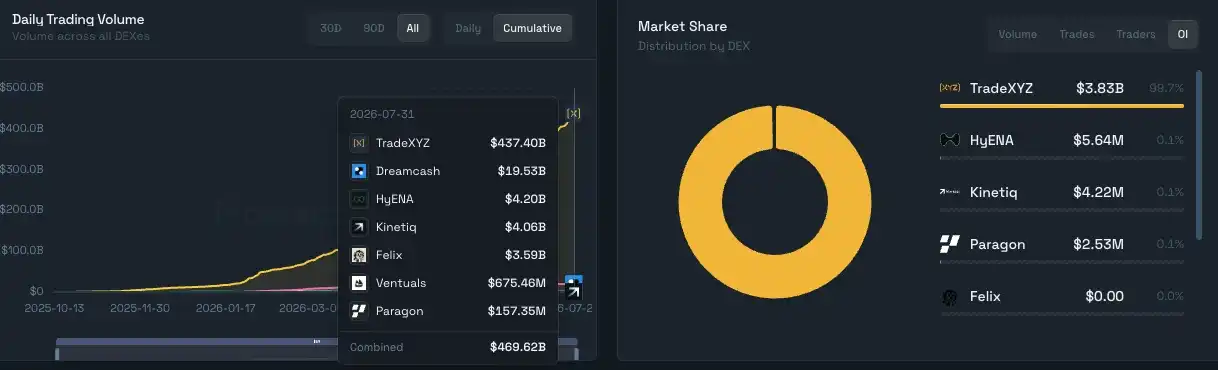
Total Hyperliquid HIP-3 Trading Volume and TradeXYZ's Share

The combined market share of the remaining trading platforms doesn't even reach 10%. The HIP-3 market has formed a massive Matthew Effect. Looking at it this way, it's not an exaggeration to say that the Hyperliquid HIP-3 market is completely dominated by TradeXYZ. The narrative premium that RWA on-chain contracts development has brought to Hyperliquid is, in essence, the narrative premium that TradeXYZ has brought to Hyperliquid.

Whether from a valuation or protocol revenue perspective, TradeXYZ has long been far from optional for Hyperliquid. Instead, it plays a crucial role in carrying the banner in the current situation where the crypto market is sluggish and trading volume for crypto derivatives like Bitcoin is shrinking.

According to official data, the HIP-3 share of Hyperliquid's total trading volume has reached 71.92%, setting a new historical high. Based on TradeXYZ's dominant position in HIP-3, this means that TradeXYZ's contributed trading volume accounts for over 70% of Hyperliquid's total trading volume; the HIP-3 share of Hyperliquid's total OI reaches 36%, which similarly means that TradeXYZ's contributed OI accounts for over 35% of Hyperliquid's total OI.
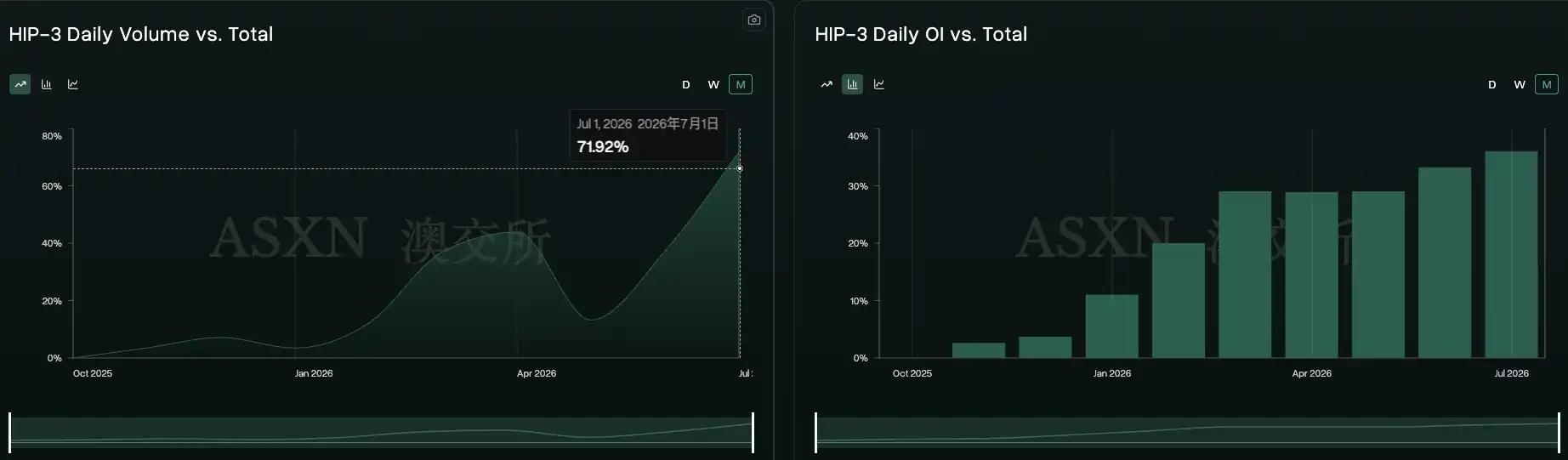
HIP-3's Share of Hyperliquid's Total Trading Volume and Total OI

Therefore, TradeXYZ has already grown into a behemoth capable of influencing traditional financial markets, leveraging Hyperliquid's infrastructure. Now, within its cooperative relationship with Hyperliquid, its leverage, influence, and voice are also beginning to dominate. So, should the grown child go its own way? Under what triggering factors might TradeXYZ choose to build its own infrastructure?

Setting aside unpredictable capital operation factors like financing and token issuance, and looking purely from a practical business perspective, if TradeXYZ truly chooses to go solo, the most likely reason would be to capture the underlying transaction fees.

In Hyperliquid's HIP-3 market, the trading fee split between TradeXYZ and Hyperliquid is a fixed 50/50. Furthermore, because the standard trading fee for HIP-3 assets is twice that of the core perp market, Hyperliquid's actual protocol fee per HIP-3 transaction is the same as from the core perp market.

According to statistics, as of the time of writing, TradeXYZ has generated close to $50 million in total fee revenue. Under the stipulated split ratio for HIP-3, TradeXYZ can take at most $25 million.
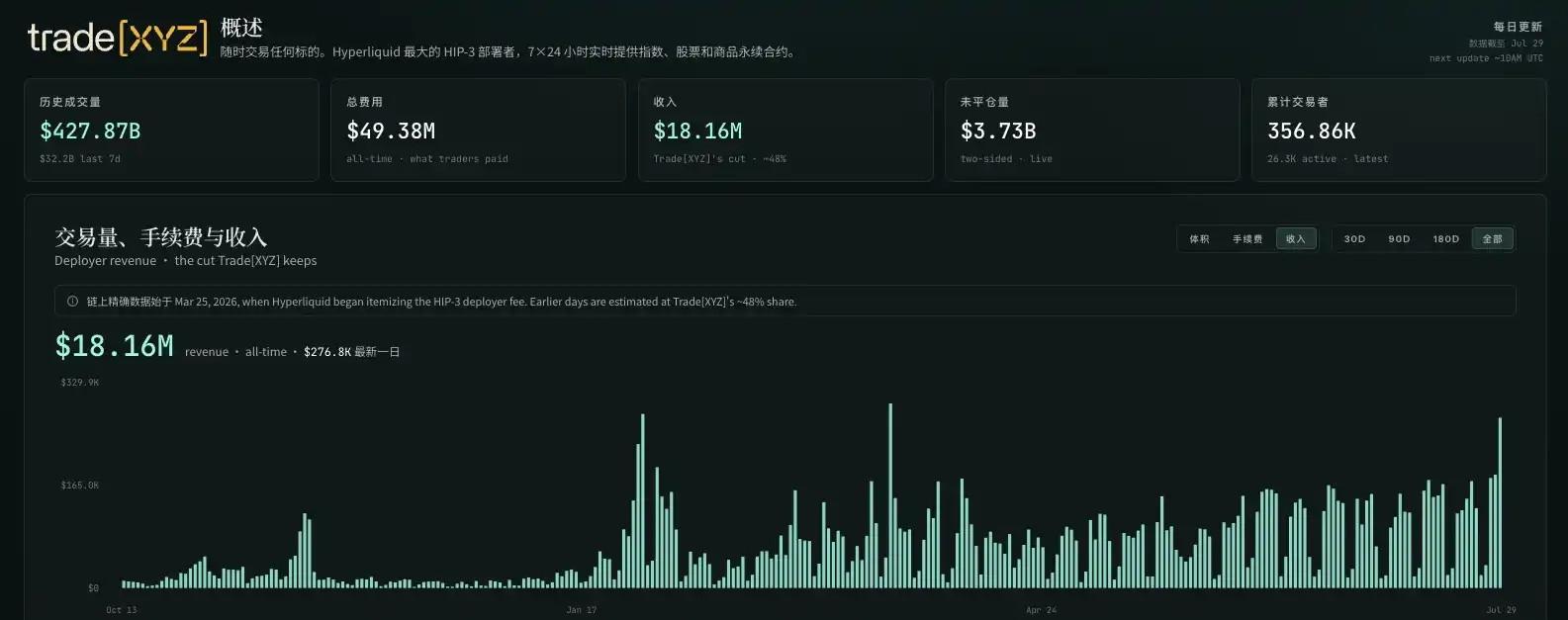
Fees Generated by TradeXYZ

It's hard to imagine that a project which has created over $400 billion in trading volume has a total revenue less than one ten-thousandth of its total volume. Giving away nearly half of its revenue is unbearable for most projects. Given TradeXYZ's current leverage and influence over Hyperliquid, it is entirely possible for it to negotiate with Hyperliquid to change the revenue split to 70/30 or higher. If a satisfactory agreement cannot be reached, TradeXYZ is very likely to embark on the path of going solo.

Why Wouldn't TradeXYZ Leave?

Of course, going solo has its appeal for TradeXYZ, but there are also constraints.

The first constraint is Hyperliquid's powerful performance. TradeXYZ's perpetual contracts are deployed on Hyperliquid's HIP-3 platform, where matching, order types, funds, liquidation, and automatic deleveraging are all managed by HyperCore. Technically, TradeXYZ only manages oracle prices, mark prices, external prices, and related components.

If TradeXYZ chooses to go solo, they would need to assemble their own team to build the underlying infrastructure. This itself is not a difficult problem, but building an L1 with performance as powerful as Hyperliquid's in a short time is a challenge. Even TradeXYZ founder Shoku himself has admitted the excellence of the Hyperliquid team. In March 2024, Shoku posted on X, saying he wasn't sure how big Hyperliquid could ultimately become as an L1 in terms of traditional metrics like TVL and trading volume, but he was completely certain that the quality and rigor of Hyperliquid's on-chain products and dApps would have no rivals across the entire crypto space.

These rivals naturally include himself. If the infrastructure TradeXYZ builds upon going solo cannot compete with Hyperliquid, it would negatively impact its product experience and the narrative of providing price discovery earlier than traditional financial markets.

The second constraint is that channels and distribution are also crucial. Why is Circle willing to give away over 50% of USDC's savings interest to Coinbase? The reason is that Coinbase has indeed made tremendous contributions to the market distribution and promotion of USDC. According to Coinbase's latest Q2 financial report, over 30% of circulating USDC is stored on Coinbase. Whoever controls the channels and distribution controls everything. This rule also applies between TradeXYZ and Hyperliquid.

In essence, Hyperliquid's frontend is just one interface to access TradeXYZ's liquidity markets, but it's not the only way. Users can currently also access TradeXYZ's liquidity markets directly through the TradeXYZ official website, and the trading interface is highly similar to Hyperliquid's. To further facilitate users, TradeXYZ's internal accounts are even interoperable with Hyperliquid's, meaning that connecting the same wallet on the TradeXYZ website allows direct use of any balance from Hyperliquid.
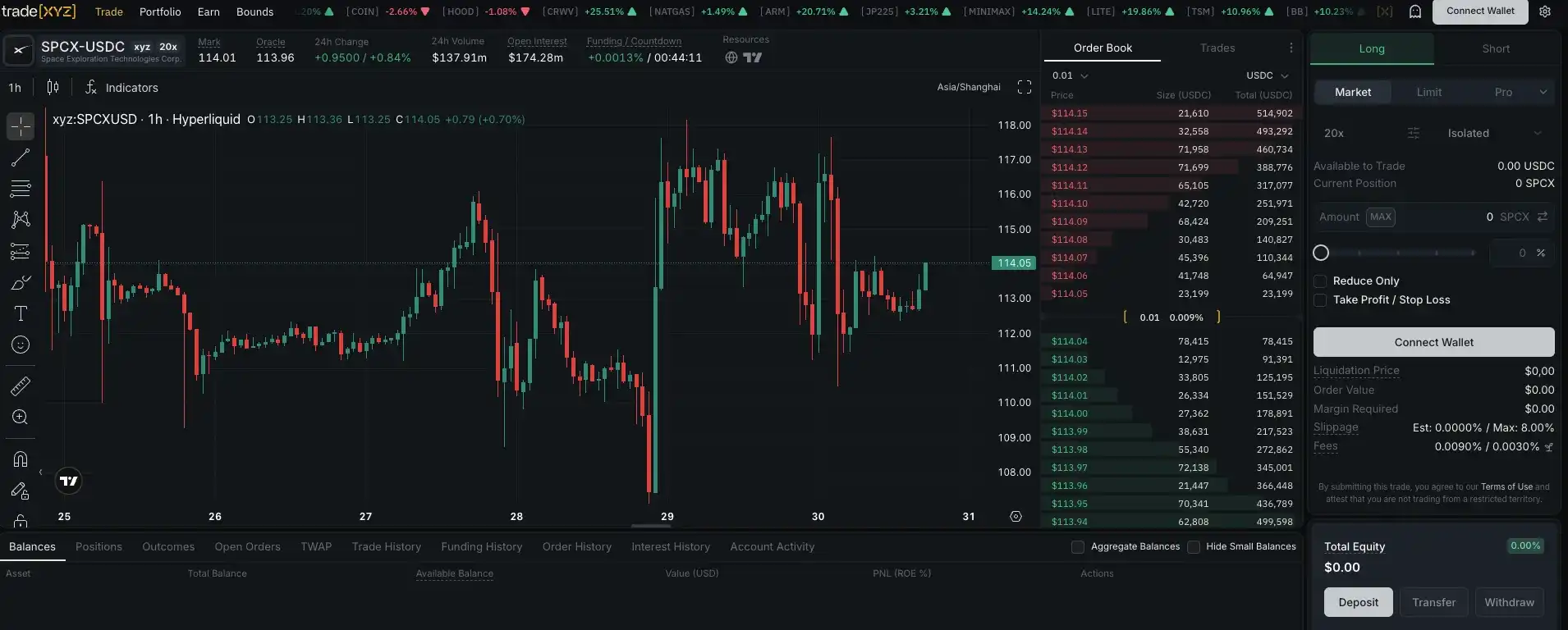
TradeXYZ's Own Trading Frontend

Nevertheless, among TradeXYZ's over 350,000 trading users, most still access TradeXYZ's liquidity markets through Hyperliquid's frontend. This is a user habit cultivated over time and is not easy to change. There might even be a certain proportion of trading users who don't even distinguish between TradeXYZ and Hyperliquid, simply trusting the Hyperliquid brand and passively choosing to trade TradeXYZ's products.

Therefore, Hyperliquid not only provides technical support for TradeXYZ but is also the main channel for distributing TradeXYZ's liquidity. The cost and time of building infrastructure can be calculated, but the value lost from losing a channel is immeasurable.

The third constraint is the inherent trust and "childhood friendship" between the founders of the two projects. Solana's well-known KOL Ansem believes the possibility of TradeXYZ going solo is almost zero, reasoning that tradexyz and Hyperliquid are the most compatible teams in the cryptocurrency space. "The two founders show no signs of greed and are both very smart. I believe they can choose a development path that is most beneficial for both teams."

This statement is not without merit. Shoku was one of the earliest investors to bet on Hyperliquid. As early as 2023, Shoku connected with Jeff and began contributing to the Hyperliquid ecosystem. In 2024, he developed the Hyperliquid Bitcoin cross-chain bridge, Unit. He once told friends that Hyperliquid was one of the few exciting things in the crypto world.

All signs indicate that Shoku deeply admires Hyperliquid and Jeff. From a personal relationship perspective, the likelihood of a "betrayal" is low.

If TradeXYZ Goes Solo, the Result is Lose-Lose

If we are to discuss this topic thoroughly, this article shouldn't end here. We should also discuss a low-probability event: what would the outcome be if TradeXYZ truly broke away from Hyperliquid and went solo? The answer I deduced is a lose-lose situation.

Because in the current state, TradeXYZ and Hyperliquid have a win-win situation. If TradeXYZ splits, the enormous uncertainty will harm both parties. After TradeXYZ goes solo, Hyperliquid could certainly support other HIP-3 market participants, but it would turn from a collaborator with TradeXYZ into a competitor. This wouldn't have too much impact on Hyperliquid's revenue because over 70% of Hyperliquid's main revenue still comes from the core Perp market; the HIP-3 market only accounts for a small portion. The biggest impact would be on its valuation.

First, after TradeXYZ migrates, Hyperliquid's total trading volume would decrease by over 50%, and HYPE might also be halved. This is because Hyperliquid would no longer be the leading on-chain RWA perpetual contract trading platform. Instead, it would be redefined as a crypto derivatives trading platform that has lost its biggest growth driver and narrative foundation.

TradeXYZ itself wouldn't fare much better. Both infrastructure and user habits would need to be cultivated from scratch. The aforementioned performance and channel issues become the biggest constraints on TradeXYZ's development. Moreover, such a betrayal could very likely trigger public controversy, further damaging TradeXYZ's credibility.

Additionally, TradeXYZ and Hyperliquid are not just competing with each other; the entire RWA trading market has other competitors. "When the snipe and the clam grapple, the fisherman profits." Hyperliquid would need time to cultivate new HIP-3 markets, and TradeXYZ would need time to build its infrastructure. By the time they look back, the market gap would have already been filled by other competitors.

In summary, although TradeXYZ is becoming increasingly important to Hyperliquid, going solo is clearly irrational. Even if TradeXYZ wants to increase profitability, the best approach might be to gradually shift focus towards its own issuance and user ownership while preserving the advantages of its existing integration with Hyperliquid.


Criptos en tendencia

Preguntas relacionadas

QAccording to the article, what is the primary reason that could drive TradeXYZ to consider building its own infrastructure, separate from Hyperliquid?

AThe primary reason is to capture the underlying transaction fees. Currently, TradeXYZ shares fees 50/50 with Hyperliquid. The article states that if TradeXYZ cannot renegotiate this split, it might choose to go independent to retain more of the significant revenue it generates.

QWhat are the two main constraints or challenges mentioned that might prevent TradeXYZ from leaving Hyperliquid?

AThe two main constraints are: 1) The powerful performance of Hyperliquid's infrastructure, which would be difficult and time-consuming to replicate. 2) Hyperliquid acts as the primary distribution channel and front-end for TradeXYZ's users, and changing established user habits is challenging.

QWhat does the article suggest would be the consequence for Hyperliquid's valuation (HYPE token) if TradeXYZ were to leave?

AThe article suggests that HYPE's price could potentially be halved ('face a 50% drop'). Hyperliquid would lose its status as the leading on-chain RWA perpetual platform, and its main growth narrative would be undermined, leading to a significant revaluation.

QWhat analogy from the AI industry is used in the article to illustrate the risk of a 'backstabbing' in a business partnership?

AThe article uses the example of Anthropic and Cursor. Cursor, a leading AI coding tool, initially used Anthropic's Claude model. However, Anthropic later launched a direct competitor, Claude Code, which eventually surpassed Cursor in revenue, effectively pushing it out of the market.

QWhat is the overall conclusion of the article regarding the likelihood and outcome of TradeXYZ going independent?

AThe article concludes that while the discussion is relevant due to TradeXYZ's growing influence, an independent move is seen as irrational and would likely result in a lose-lose scenario for both parties. It suggests the best path for TradeXYZ is to focus on enhancing its own distribution and user ownership while maintaining the current beneficial integration with Hyperliquid.

Lecturas Relacionadas

Annual Salary of Millions Competing for Electricians, Meta Rushes to Open Its Own Technical School

The AI boom is facing an unexpected bottleneck: a severe shortage of skilled construction workers and electricians. As tech giants like Meta, OpenAI, and Alphabet race to build massive data centers—such as OpenAI's $16 billion "Stargate" project—they are hitting a critical labor wall. The U.S. needs an estimated 130,000 more electricians, 240,000 construction workers, and 150,000 supervisors by 2030 for AI infrastructure alone, but tens of thousands of electrician jobs go unfilled each year. While AI companies offer high premiums, with electricians earning up to $280,000 annually, worker scarcity still causes massive losses—delays on a single project can cost $14.2 million per month. The complexity of building AI data centers, which require immense power (equivalent to powering hundreds of thousands of homes), sophisticated electrical systems, and advanced liquid cooling solutions, demands highly skilled technicians who are in short supply. To combat this, companies are investing heavily in training. Meta has committed $115 million to a free training school offering tuition, housing, and stipends, targeting 5,000 new workers. OpenAI is partnering with unions to secure skilled labor. These efforts are paying off, with a significant rise in Gen Z interest in trade schools over college. However, the power demands are staggering. AI data centers are driving a rapid surge in electricity consumption, projected to account for up to 12% of U.S. power use by 2028 and raising costs for consumers. Furthermore, the construction boom is project-based, leading to a potential future glut of trained workers once building peaks, which could depress wages industry-wide. The race for AI supremacy now depends as much on skilled hands as on advanced chips.

marsbitHace 1 hora(s)

Annual Salary of Millions Competing for Electricians, Meta Rushes to Open Its Own Technical School

marsbitHace 1 hora(s)

OpenAI No Longer Sells Its Most Expensive Model for Profit

OpenAI is shifting its business strategy away from promoting its most expensive, flagship models for every task. Recent price cuts—80% for GPT-5.6 Luna and 20% for Terra—signal a deeper change: the company now actively advises users that many tasks don't require the most powerful model. Instead, OpenAI recommends a tiered approach: use the high-end GPT-5.6 Sol for complex planning and analysis, then delegate execution to cheaper models like Luna. This mirrors moves by Anthropic, which recently launched Claude Opus 5 at half the price of its top model, Fable 5. Both companies are de-emphasizing flagship models as primary revenue drivers, using them instead for brand prestige and technological showcases. The industry is entering a "mass-market" phase, similar to automotive, where high-volume, cost-effective models handle daily operations and drive scale. OpenAI's price reductions are partly enabled by AI models themselves optimizing underlying code and infrastructure, creating a self-reinforcing cycle of efficiency gains and cost reduction. Competition is shifting from "who is smartest" to "who offers the best value." The goal is no longer selling individual models but fostering widespread API adoption and ecosystem lock-in. By making AI calls cheap and ubiquitous, companies like OpenAI aim to become the indispensable, utility-like infrastructure powering automated workflows—the "water and electricity" of software, quietly embedded everywhere.

marsbitHace 1 hora(s)

OpenAI No Longer Sells Its Most Expensive Model for Profit

marsbitHace 1 hora(s)

Trading

Spot

Artículos destacados

Qué es $S$

Entendiendo SPERO: Una Visión General Completa Introducción a SPERO A medida que el panorama de la innovación continúa evolucionando, la aparición de tecnologías web3 y proyectos de criptomonedas juega un papel fundamental en la configuración del futuro digital. Un proyecto que ha atraído la atención en este campo dinámico es SPERO, denotado como SPERO,$$s$. Este artículo tiene como objetivo reunir y presentar información detallada sobre SPERO, para ayudar a entusiastas e inversores a comprender sus fundamentos, objetivos e innovaciones dentro de los dominios web3 y cripto. ¿Qué es SPERO,$$s$? SPERO,$$s$ es un proyecto único dentro del espacio cripto que busca aprovechar los principios de descentralización y tecnología blockchain para crear un ecosistema que promueva la participación, la utilidad y la inclusión financiera. El proyecto está diseñado para facilitar interacciones de igual a igual de nuevas maneras, proporcionando a los usuarios soluciones y servicios financieros innovadores. En su esencia, SPERO,$$s$ tiene como objetivo empoderar a los individuos al proporcionar herramientas y plataformas que mejoren la experiencia del usuario en el espacio de las criptomonedas. Esto incluye habilitar métodos de transacción más flexibles, fomentar iniciativas impulsadas por la comunidad y crear caminos para oportunidades financieras a través de aplicaciones descentralizadas (dApps). La visión subyacente de SPERO,$$s$ gira en torno a la inclusividad, buscando cerrar brechas dentro de las finanzas tradicionales mientras aprovecha los beneficios de la tecnología blockchain. ¿Quién es el Creador de SPERO,$$s$? La identidad del creador de SPERO,$$s$ sigue siendo algo oscura, ya que hay recursos públicos limitados que proporcionan información de fondo detallada sobre su(s) fundador(es). Esta falta de transparencia puede derivarse del compromiso del proyecto con la descentralización, una ética que muchos proyectos web3 comparten, priorizando las contribuciones colectivas sobre el reconocimiento individual. Al centrar las discusiones en torno a la comunidad y sus objetivos colectivos, SPERO,$$s$ encarna la esencia del empoderamiento sin señalar a individuos específicos. Como tal, comprender la ética y la misión de SPERO sigue siendo más importante que identificar a un creador singular. ¿Quiénes son los Inversores de SPERO,$$s$? SPERO,$$s$ cuenta con el apoyo de una diversa gama de inversores que van desde capitalistas de riesgo hasta inversores ángeles dedicados a fomentar la innovación en el sector cripto. El enfoque de estos inversores generalmente se alinea con la misión de SPERO, priorizando proyectos que prometen avances tecnológicos sociales, inclusión financiera y gobernanza descentralizada. Estas fundaciones de inversores suelen estar interesadas en proyectos que no solo ofrecen productos innovadores, sino que también contribuyen positivamente a la comunidad blockchain y sus ecosistemas. El respaldo de estos inversores refuerza a SPERO,$$s$ como un contendiente notable en el dominio de proyectos cripto que evoluciona rápidamente. ¿Cómo Funciona SPERO,$$s$? SPERO,$$s$ emplea un marco multifacético que lo distingue de los proyectos de criptomonedas convencionales. Aquí hay algunas de las características clave que subrayan su singularidad e innovación: Gobernanza Descentralizada: SPERO,$$s$ integra modelos de gobernanza descentralizada, empoderando a los usuarios para participar activamente en los procesos de toma de decisiones sobre el futuro del proyecto. Este enfoque fomenta un sentido de propiedad y responsabilidad entre los miembros de la comunidad. Utilidad del Token: SPERO,$$s$ utiliza su propio token de criptomoneda, diseñado para servir diversas funciones dentro del ecosistema. Estos tokens permiten transacciones, recompensas y la facilitación de servicios ofrecidos en la plataforma, mejorando la participación y la utilidad general. Arquitectura en Capas: La arquitectura técnica de SPERO,$$s$ apoya la modularidad y escalabilidad, permitiendo la integración fluida de características y aplicaciones adicionales a medida que el proyecto evoluciona. Esta adaptabilidad es fundamental para mantener la relevancia en el cambiante paisaje cripto. Participación de la Comunidad: El proyecto enfatiza iniciativas impulsadas por la comunidad, empleando mecanismos que incentivan la colaboración y la retroalimentación. Al nutrir una comunidad sólida, SPERO,$$s$ puede abordar mejor las necesidades de los usuarios y adaptarse a las tendencias del mercado. Enfoque en la Inclusión: Al ofrecer tarifas de transacción bajas e interfaces amigables para el usuario, SPERO,$$s$ busca atraer a una base de usuarios diversa, incluyendo a individuos que anteriormente pueden no haber participado en el espacio cripto. Este compromiso con la inclusión se alinea con su misión general de empoderamiento a través de la accesibilidad. Cronología de SPERO,$$s$ Entender la historia de un proyecto proporciona información crucial sobre su trayectoria de desarrollo y hitos. A continuación se presenta una cronología sugerida que mapea eventos significativos en la evolución de SPERO,$$s$: Fase de Conceptualización e Ideación: Las ideas iniciales que forman la base de SPERO,$$s$ fueron concebidas, alineándose estrechamente con los principios de descentralización y enfoque comunitario dentro de la industria blockchain. Lanzamiento del Whitepaper del Proyecto: Tras la fase conceptual, se lanzó un whitepaper completo que detalla la visión, los objetivos y la infraestructura tecnológica de SPERO,$$s$ para generar interés y retroalimentación de la comunidad. Construcción de Comunidad y Primeras Interacciones: Se realizaron esfuerzos de divulgación activa para construir una comunidad de primeros adoptantes y posibles inversores, facilitando discusiones en torno a los objetivos del proyecto y obteniendo apoyo. Evento de Generación de Tokens: SPERO,$$s$ llevó a cabo un evento de generación de tokens (TGE) para distribuir sus tokens nativos a los primeros seguidores y establecer liquidez inicial dentro del ecosistema. Lanzamiento de la dApp Inicial: La primera aplicación descentralizada (dApp) asociada con SPERO,$$s$ se puso en marcha, permitiendo a los usuarios interactuar con las funcionalidades centrales de la plataforma. Desarrollo Continuo y Alianzas: Actualizaciones y mejoras continuas a las ofertas del proyecto, incluyendo alianzas estratégicas con otros actores en el espacio blockchain, han moldeado a SPERO,$$s$ en un jugador competitivo y en evolución en el mercado cripto. Conclusión SPERO,$$s$ se erige como un testimonio del potencial de web3 y las criptomonedas para revolucionar los sistemas financieros y empoderar a los individuos. Con un compromiso con la gobernanza descentralizada, la participación comunitaria y funcionalidades diseñadas de manera innovadora, allana el camino hacia un paisaje financiero más inclusivo. Como con cualquier inversión en el espacio cripto que evoluciona rápidamente, se anima a los posibles inversores y usuarios a investigar a fondo y participar de manera reflexiva con los desarrollos en curso dentro de SPERO,$$s$. El proyecto muestra el espíritu innovador de la industria cripto, invitando a una mayor exploración de sus innumerables posibilidades. Mientras el viaje de SPERO,$$s$ aún se desarrolla, sus principios fundamentales pueden, de hecho, influir en el futuro de cómo interactuamos con la tecnología, las finanzas y entre nosotros en ecosistemas digitales interconectados.

233 Vistas totalesPublicado en 2024.12.17Actualizado en 2024.12.17

Qué es $S$

Qué es AGENT S

Agent S: El Futuro de la Interacción Autónoma en Web3 Introducción En el paisaje en constante evolución de Web3 y las criptomonedas, las innovaciones están redefiniendo constantemente cómo los individuos interactúan con las plataformas digitales. Uno de estos proyectos pioneros, Agent S, promete revolucionar la interacción humano-computadora a través de su marco agente abierto. Al allanar el camino para interacciones autónomas, Agent S busca simplificar tareas complejas, ofreciendo aplicaciones transformadoras en inteligencia artificial (IA). Esta exploración detallada profundizará en las complejidades del proyecto, sus características únicas y las implicaciones para el dominio de las criptomonedas. ¿Qué es Agent S? Agent S se presenta como un marco agente abierto innovador, diseñado específicamente para abordar tres desafíos fundamentales en la automatización de tareas informáticas: Adquisición de Conocimiento Específico del Dominio: El marco aprende inteligentemente de diversas fuentes de conocimiento externas y experiencias internas. Este enfoque dual le permite construir un rico repositorio de conocimiento específico del dominio, mejorando su rendimiento en la ejecución de tareas. Planificación a Largo Plazo de Tareas: Agent S emplea planificación jerárquica aumentada por la experiencia, un enfoque estratégico que facilita la descomposición y ejecución eficiente de tareas complejas. Esta característica mejora significativamente su capacidad para gestionar múltiples subtareas de manera eficiente y efectiva. Manejo de Interfaces Dinámicas y No Uniformes: El proyecto introduce la Interfaz Agente-Computadora (ACI), una solución innovadora que mejora la interacción entre agentes y usuarios. Utilizando Modelos de Lenguaje Multimodal de Gran Escala (MLLMs), Agent S puede navegar y manipular diversas interfaces gráficas de usuario sin problemas. A través de estas características pioneras, Agent S proporciona un marco robusto que aborda las complejidades involucradas en la automatización de la interacción humana con las máquinas, preparando el terreno para una multitud de aplicaciones en IA y más allá. ¿Quién es el Creador de Agent S? Si bien el concepto de Agent S es fundamentalmente innovador, la información específica sobre su creador sigue siendo elusiva. El creador es actualmente desconocido, lo que resalta ya sea la etapa incipiente del proyecto o la elección estratégica de mantener a los miembros fundadores en el anonimato. Independientemente de la anonimidad, el enfoque sigue siendo en las capacidades y el potencial del marco. ¿Quiénes son los Inversores de Agent S? Dado que Agent S es relativamente nuevo en el ecosistema criptográfico, la información detallada sobre sus inversores y patrocinadores financieros no está documentada explícitamente. La falta de información disponible públicamente sobre las bases de inversión u organizaciones que apoyan el proyecto plantea preguntas sobre su estructura de financiamiento y hoja de ruta de desarrollo. Comprender el respaldo es crucial para evaluar la sostenibilidad del proyecto y su posible impacto en el mercado. ¿Cómo Funciona Agent S? En el núcleo de Agent S se encuentra una tecnología de vanguardia que le permite funcionar de manera efectiva en diversos entornos. Su modelo operativo se basa en varias características clave: Interacción Humano-Computadora Similar a la Humana: El marco ofrece planificación avanzada de IA, esforzándose por hacer que las interacciones con las computadoras sean más intuitivas. Al imitar el comportamiento humano en la ejecución de tareas, promete elevar las experiencias de los usuarios. Memoria Narrativa: Empleada para aprovechar experiencias de alto nivel, Agent S utiliza memoria narrativa para hacer un seguimiento de las historias de tareas, mejorando así sus procesos de toma de decisiones. Memoria Episódica: Esta característica proporciona a los usuarios una guía paso a paso, permitiendo que el marco ofrezca apoyo contextual a medida que se desarrollan las tareas. Soporte para OpenACI: Con la capacidad de ejecutarse localmente, Agent S permite a los usuarios mantener el control sobre sus interacciones y flujos de trabajo, alineándose con la ética descentralizada de Web3. Fácil Integración con APIs Externas: Su versatilidad y compatibilidad con varias plataformas de IA aseguran que Agent S pueda encajar sin problemas en ecosistemas tecnológicos existentes, convirtiéndolo en una opción atractiva para desarrolladores y organizaciones. Estas funcionalidades contribuyen colectivamente a la posición única de Agent S dentro del espacio cripto, ya que automatiza tareas complejas y de múltiples pasos con una intervención humana mínima. A medida que el proyecto evoluciona, sus posibles aplicaciones en Web3 podrían redefinir cómo se desarrollan las interacciones digitales. Cronología de Agent S El desarrollo y los hitos de Agent S pueden encapsularse en una cronología que resalta sus eventos significativos: 27 de septiembre de 2024: El concepto de Agent S fue lanzado en un documento de investigación integral titulado “Un Marco Agente Abierto que Usa Computadoras Como un Humano”, mostrando las bases del proyecto. 10 de octubre de 2024: El documento de investigación fue puesto a disposición del público en arXiv, ofreciendo una exploración profunda del marco y su evaluación de rendimiento basada en el benchmark OSWorld. 12 de octubre de 2024: Se lanzó una presentación en video, proporcionando una visión visual de las capacidades y características de Agent S, involucrando aún más a posibles usuarios e inversores. Estos marcadores en la cronología no solo ilustran el progreso de Agent S, sino que también indican su compromiso con la transparencia y la participación comunitaria. Puntos Clave Sobre Agent S A medida que el marco Agent S continúa evolucionando, varios atributos clave destacan, subrayando su naturaleza innovadora y potencial: Marco Innovador: Diseñado para proporcionar un uso intuitivo de las computadoras similar a la interacción humana, Agent S aporta un enfoque novedoso a la automatización de tareas. Interacción Autónoma: La capacidad de interactuar de manera autónoma con las computadoras a través de GUI significa un salto hacia soluciones informáticas más inteligentes y eficientes. Automatización de Tareas Complejas: Con su metodología robusta, puede automatizar tareas complejas y de múltiples pasos, haciendo que los procesos sean más rápidos y menos propensos a errores. Mejora Continua: Los mecanismos de aprendizaje permiten a Agent S mejorar a partir de experiencias pasadas, mejorando continuamente su rendimiento y eficacia. Versatilidad: Su adaptabilidad en diferentes entornos operativos como OSWorld y WindowsAgentArena asegura que pueda servir a una amplia gama de aplicaciones. A medida que Agent S se posiciona en el paisaje de Web3 y criptomonedas, su potencial para mejorar las capacidades de interacción y automatizar procesos significa un avance significativo en las tecnologías de IA. A través de su marco innovador, Agent S ejemplifica el futuro de las interacciones digitales, prometiendo una experiencia más fluida y eficiente para los usuarios en diversas industrias. Conclusión Agent S representa un audaz avance en la unión de la IA y Web3, con la capacidad de redefinir cómo interactuamos con la tecnología. Aunque aún se encuentra en sus primeras etapas, las posibilidades para su aplicación son vastas y atractivas. A través de su marco integral que aborda desafíos críticos, Agent S busca llevar las interacciones autónomas al primer plano de la experiencia digital. A medida que nos adentramos más en los reinos de las criptomonedas y la descentralización, proyectos como Agent S sin duda desempeñarán un papel crucial en la configuración del futuro de la tecnología y la colaboración humano-computadora.

639 Vistas totalesPublicado en 2025.01.14Actualizado en 2025.01.14

Qué es AGENT S

Cómo comprar S

¡Bienvenido a HTX.com! Hemos hecho que comprar Sonic (S) sea simple y conveniente. Sigue nuestra guía paso a paso para iniciar tu viaje de criptos.Paso 1: crea tu cuenta HTXUtiliza tu correo electrónico o número de teléfono para registrarte y obtener una cuenta gratuita en HTX. Experimenta un proceso de registro sin complicaciones y desbloquea todas las funciones.Obtener mi cuentaPaso 2: ve a Comprar cripto y elige tu método de pagoTarjeta de crédito/débito: usa tu Visa o Mastercard para comprar Sonic (S) al instante.Saldo: utiliza fondos del saldo de tu cuenta HTX para tradear sin problemas.Terceros: hemos agregado métodos de pago populares como Google Pay y Apple Pay para mejorar la comodidad.P2P: tradear directamente con otros usuarios en HTX.Over-the-Counter (OTC): ofrecemos servicios personalizados y tipos de cambio competitivos para los traders.Paso 3: guarda tu Sonic (S)Después de comprar tu Sonic (S), guárdalo en tu cuenta HTX. Alternativamente, puedes enviarlo a otro lugar mediante transferencia blockchain o utilizarlo para tradear otras criptomonedas.Paso 4: tradear Sonic (S)Tradear fácilmente con Sonic (S) en HTX's mercado spot. Simplemente accede a tu cuenta, selecciona tu par de trading, ejecuta tus trades y monitorea en tiempo real. Ofrecemos una experiencia fácil de usar tanto para principiantes como para traders experimentados.

1.3k Vistas totalesPublicado en 2025.01.15Actualizado en 2026.06.02

Cómo comprar S

Discusiones

Bienvenido a la comunidad de HTX. Aquí puedes mantenerte informado sobre los últimos desarrollos de la plataforma y acceder a análisis profesionales del mercado. A continuación se presentan las opiniones de los usuarios sobre el precio de S (S).

活动图片












