OpenAI urgently moves up the schedule for GPT-6, completely abandoning the 4T old foundation? Moreover, GPT-5.6 is officially lifted from restrictions and will be launched this Thursday! The three models Sol, Terra, and Luna are fully open, covering coding, scientific research, and daily tasks. Early testers have already raved about the Sol model, praising it for "never giving up." Now, all developers are gearing up.
Just now, a piece of news instantly spread across the industry.
The release date for GPT-6 has been significantly brought forward, with the earliest official launch expected within this month!
If the leaks are true, it means the GPT-5.x series will conclude with GPT-5.6, becoming the final chapter.
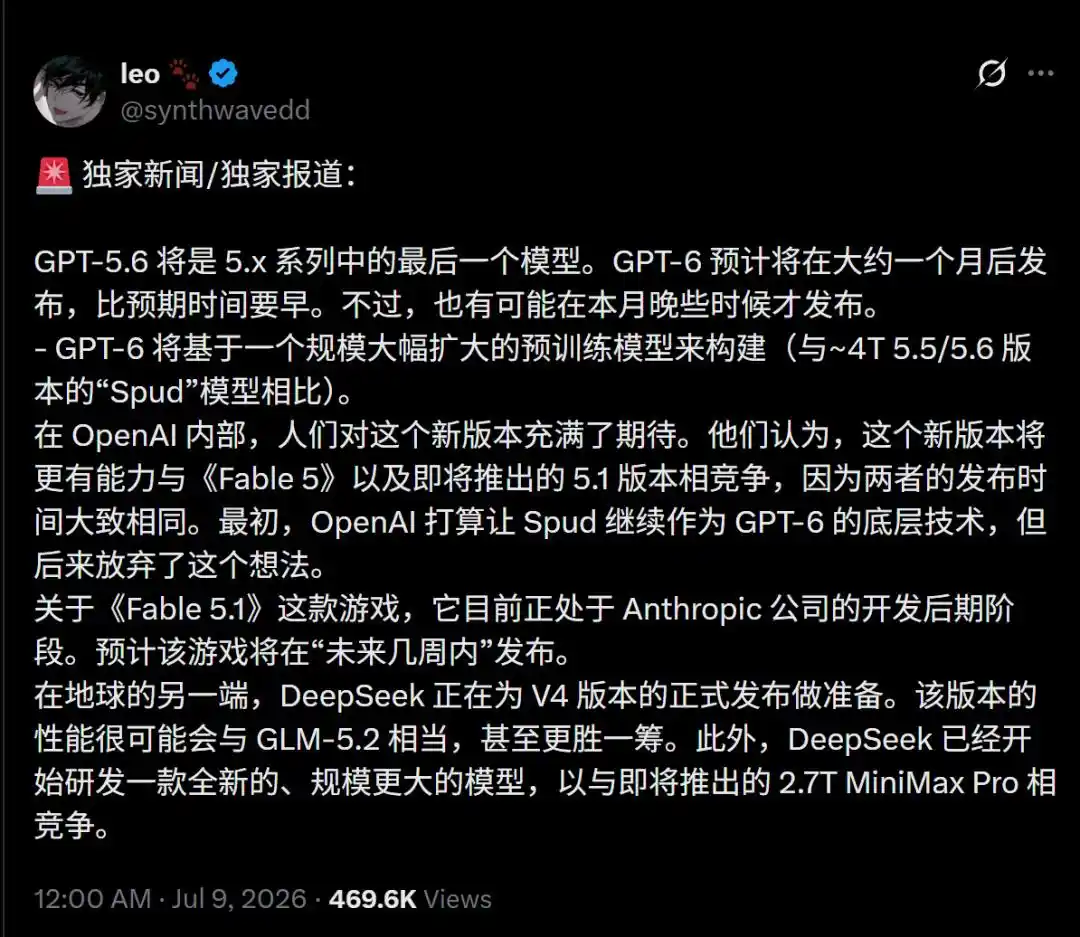
It is reported that this time, OpenAI has made a highly audacious decision—completely abandoning the previous 'Spud' foundation with approximately 4 trillion parameters, and instead betting on a new, larger-scale pre-training foundation.
Clearly, OpenAI's intention is direct: to use this new foundation to directly compete with Anthropic's upcoming Fable 5.1, which is set to be released in a few weeks.
And just yesterday afternoon, good news arrived: GPT-5.6 is fully unrestricted! See you this Thursday!
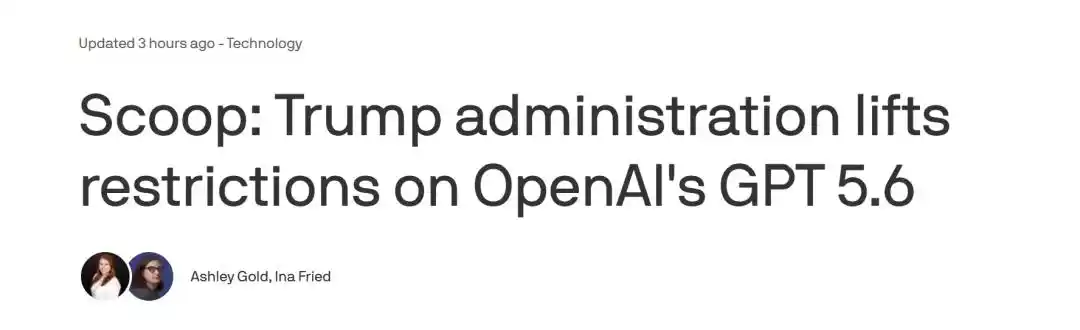
Yesterday at noon, Axios exclusively broke the scoop: the official restrictions on OpenAI's GPT-5.6 access have been formally lifted.
Immediately after, OpenAI officially announced on X: the flagship model GPT-5.6 Sol, along with Terra and Luna, will be officially released to global users this Thursday (July 9)!
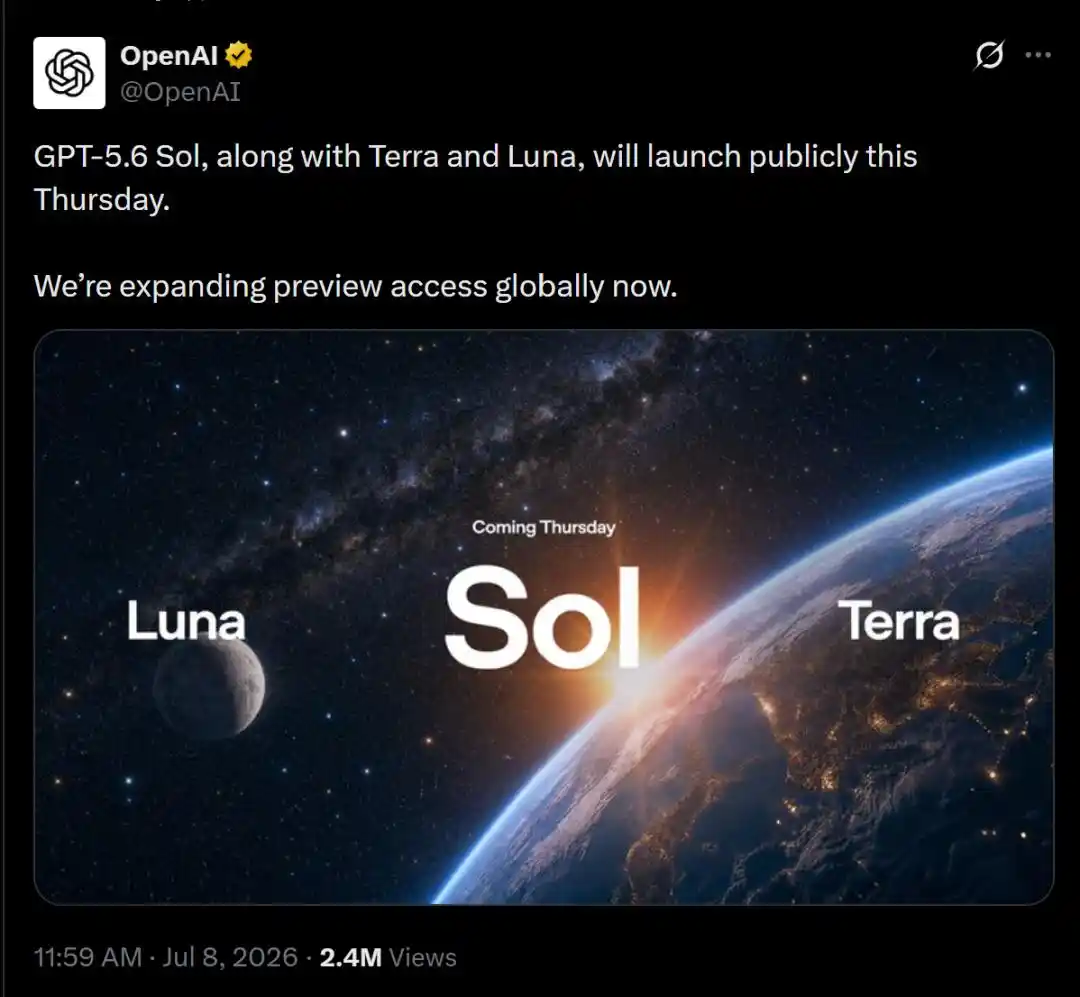
The highly anticipated "trump card" model, having struggled through a month of "limited preview for government and enterprise," has finally been freed.
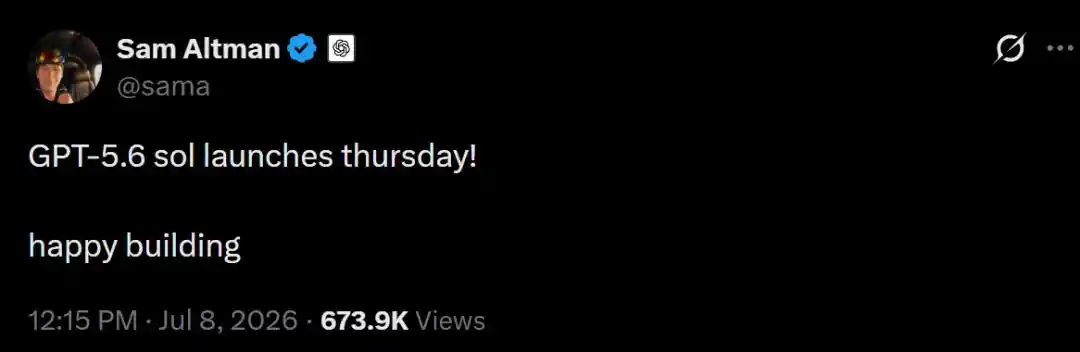
Sam Altman addressed developers: Happy Building!
Coercion, Negotiation, and a Midnight Unlock
On June 26, OpenAI quietly began a preview of GPT-5.6, limited to a select few.
This was because the "AI Standards and Innovation Center" under the U.S. Department of Commerce directly stationed itself at OpenAI, even forcibly detaining OpenAI's technical experts for "security review."
According to the latest AI executive order, the release of frontier models must undergo real-time case-by-case negotiation.
Now, why has the government suddenly relented?
Industry insiders reveal that OpenAI's experts underwent countless real attack pressure tests and vulnerability fixes in Washington, ultimately successfully proving: GPT-5.6 is OpenAI's most robust security system to date.
In today's announcement, OpenAI particularly emphasized with implied meaning: "We cooperate with the government, but short-term restrictions pave the way for broader availability. We absolutely do not want government pre-access to become the norm; technology must not be monopolized."
Now, the shoe has dropped, and the government has given the green light. The long-awaited global developer community's anticipation has instantly skyrocketed.
"Three Arrows Released": How Powerful Are Sol, Terra, and Luna?
This trio of new models has clearly defined roles.
GPT-5.6 Sol: The Ultimate Flagship
Sol focuses on frontier capabilities, specializing in complex coding, cutting-edge science, and cybersecurity tasks.
Its biggest feature is extreme reasoning.
Some say the capability leap of GPT-5.6 is comparable to the jump from GPT-4 to o1.


Early tester Max Weinbach excitedly commented: "The most terrifying thing about this model is that it never gives up! If you throw it into extreme reasoning mode, it obsessively perseveres and won't stop until the problem is completely solved."

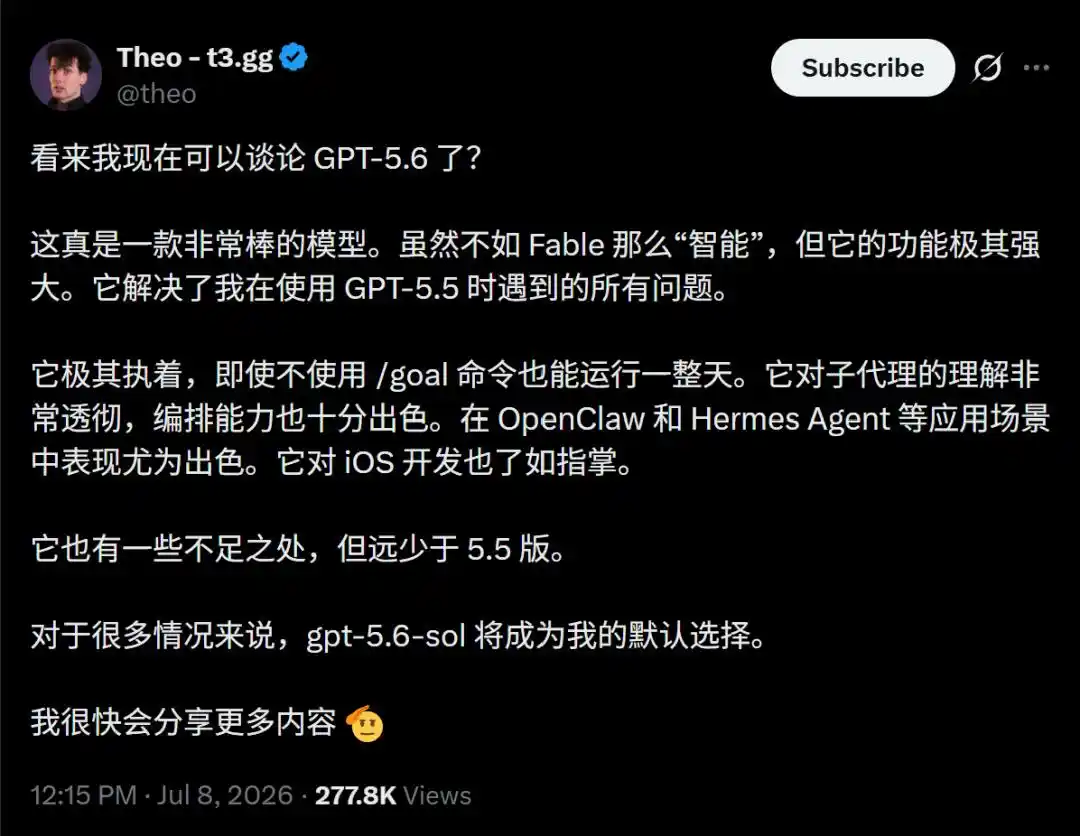
Others say GPT-5.6 is extremely tenacious, able to run for an entire day even without the /goal command.
GPT-5.6 Terra: King of Cost-Effectiveness, The Terminator of 5.5
Performance approaches the previous super flagship GPT-5.5, but the cost is directly halved!
This is a workhorse tool tailored for high-frequency daily workloads. Its arrival means GPT-5.5 is out.
GPT-5.6 Luna: Fast as Lightning, Dirt Cheap
Luna focuses on extreme speed and ultra-low cost, the top choice for frequently called agents.
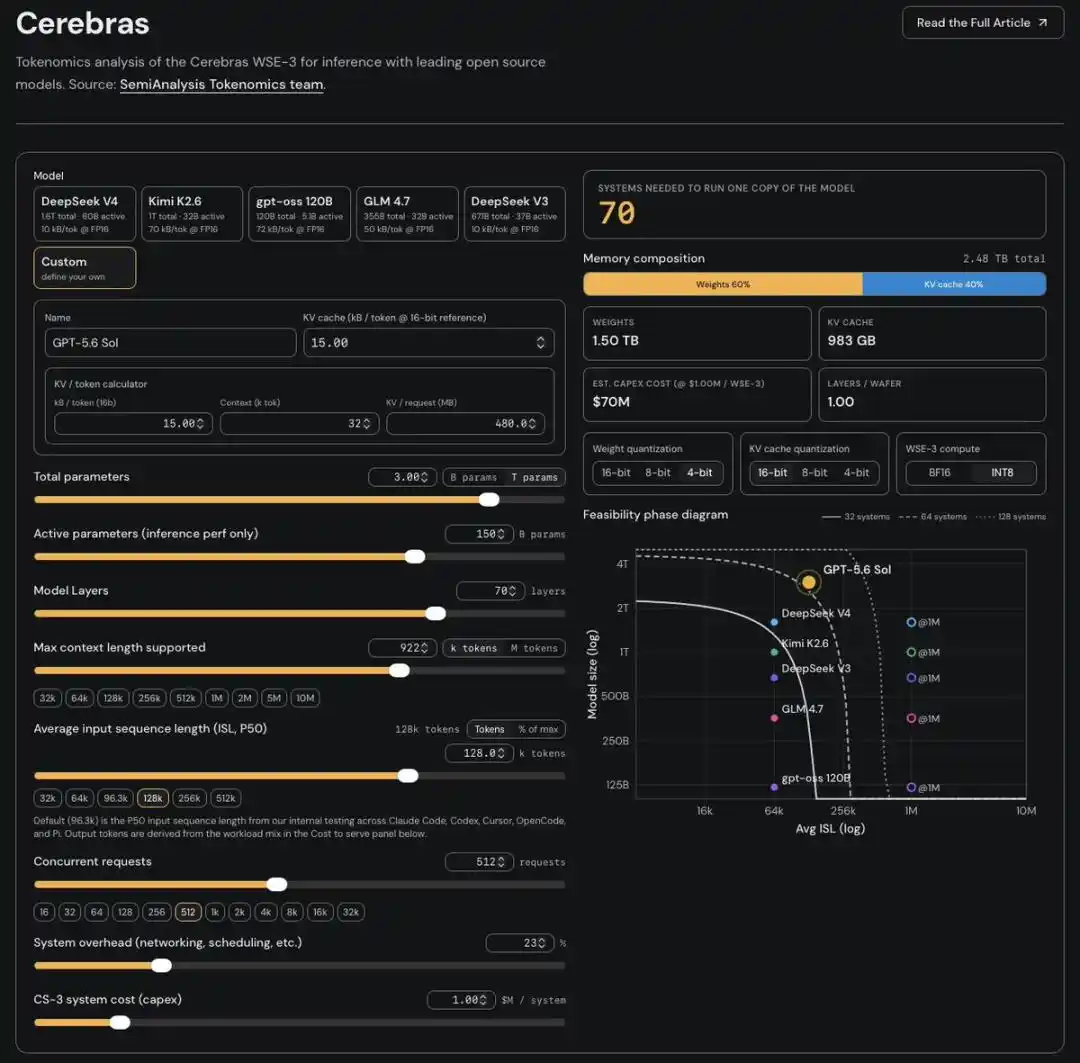
Even more exaggerated is the seamless integration into the hardware ecosystem. It is reported that GPT-5.6 Sol will directly land on the Cerebras inference platform, achieving a breathtaking inference speed of 750 tokens per second!
In high-intensity scenarios like coding, biopharmaceutical R&D, and network attack/defense, this experience is simply mind-blowing.
No wonder a developer who tested it early exclaimed: "I felt like I was going crazy when I couldn't use the 5.6 version."
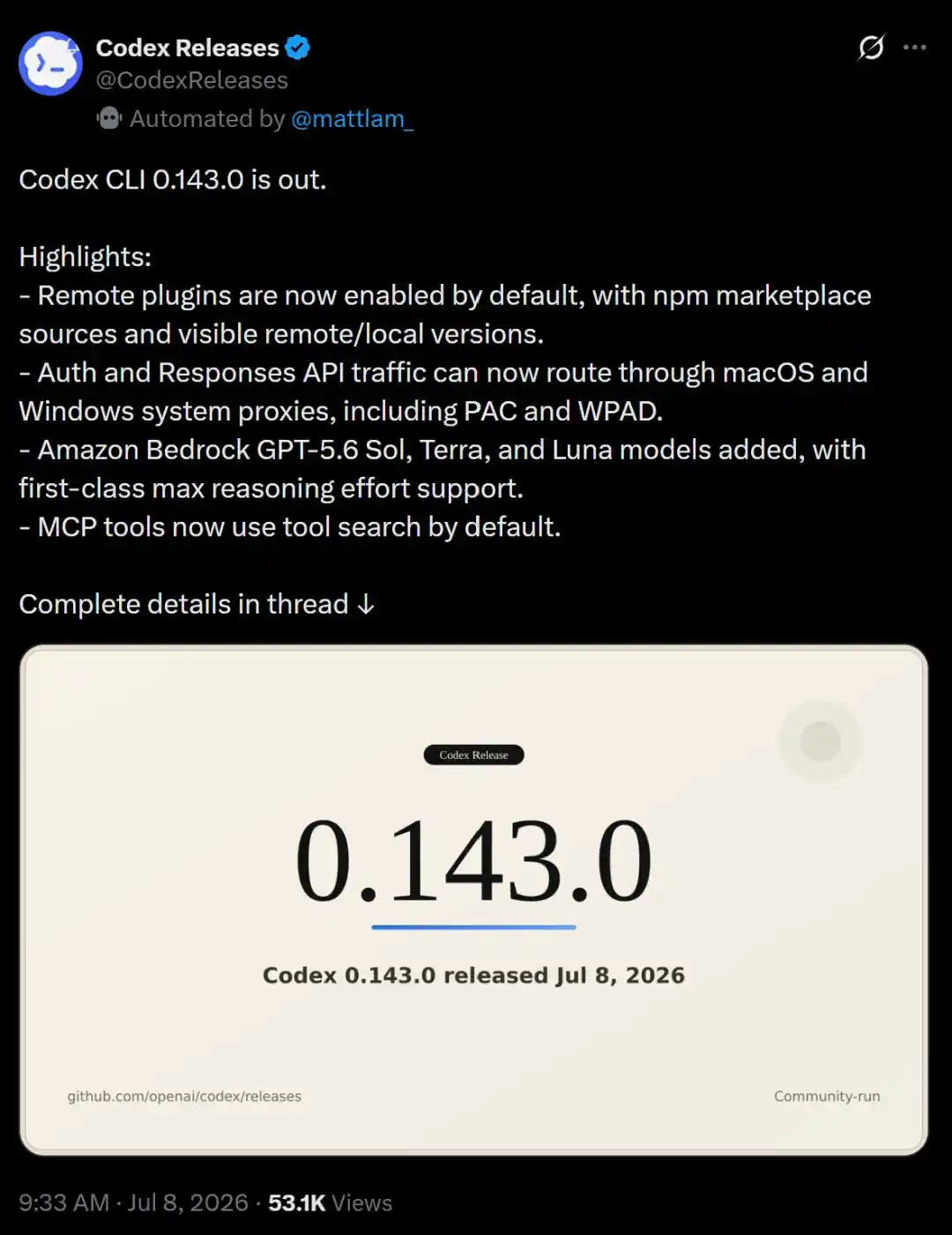
Just today, the update log for Codex CLI version 0.143.0 was also leaked: the Amazon Bedrock platform has quietly added the GPT-5.6 trio and provides support for Max inference intensity.
Judging from the configuration, these models are likely specifically prepared for the Max tier.
The First Wave of Hands-On Experts Have Spoken
Now, users on X who got early hands-on access have started giving their reviews.
Well-known developer Theo posted several tweets on X, directly praising it to the skies.
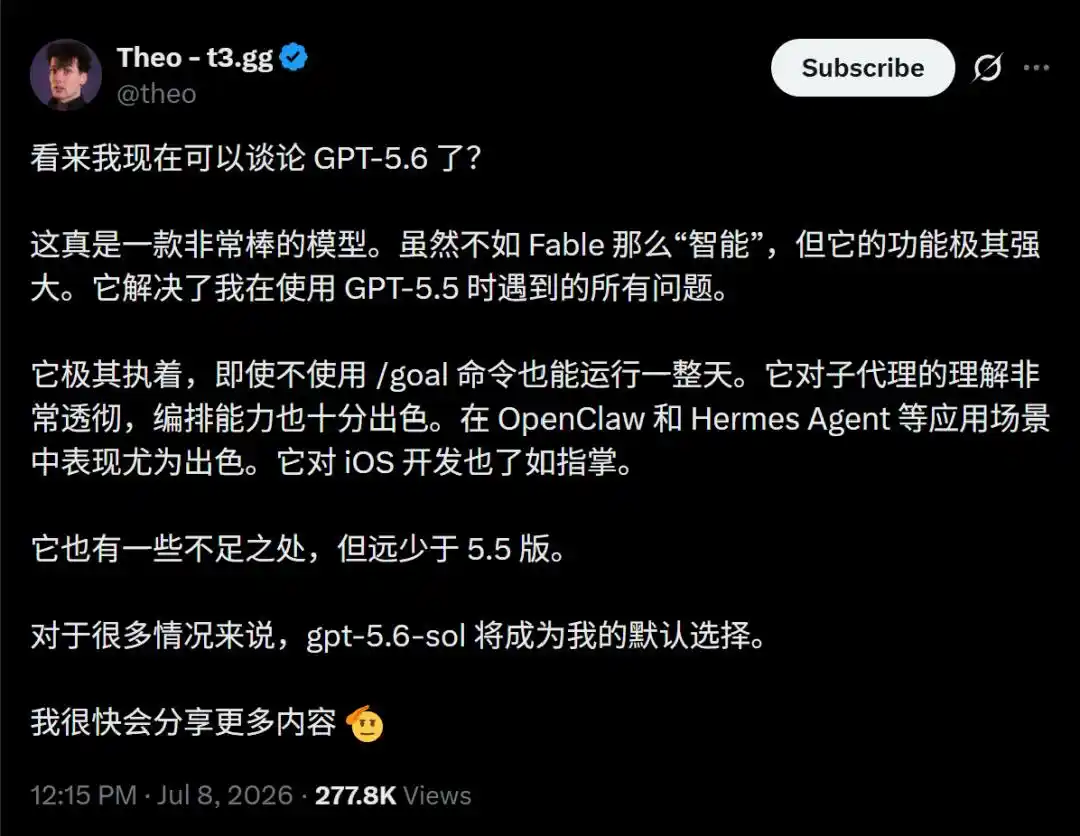
GPT-5.6 solves all the pain points I encountered when using 5.5. It is extremely tenacious; even without giving it a /goal instruction, it can run by itself for an entire day! Its understanding and orchestration of sub-agents is magical. It increased my computer usage frequency a hundredfold. When the beta ended and I could no longer use 5.6, I felt like I was going crazy!

Magicpathai CEO Pietro Schirano also gave positive feedback.
Without exaggeration, this is the best model I've ever used. It's fast, highly creative, and they finally fixed the frontend design issues! I haven't checked my own code for a full two months!

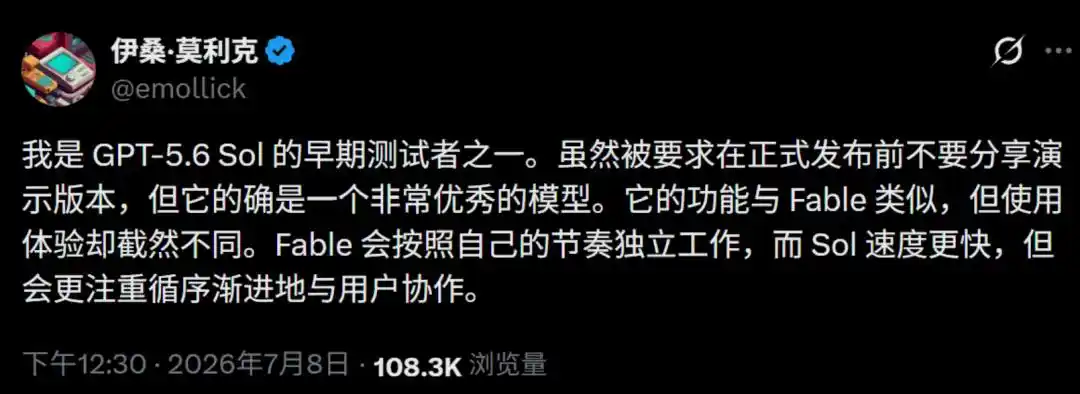
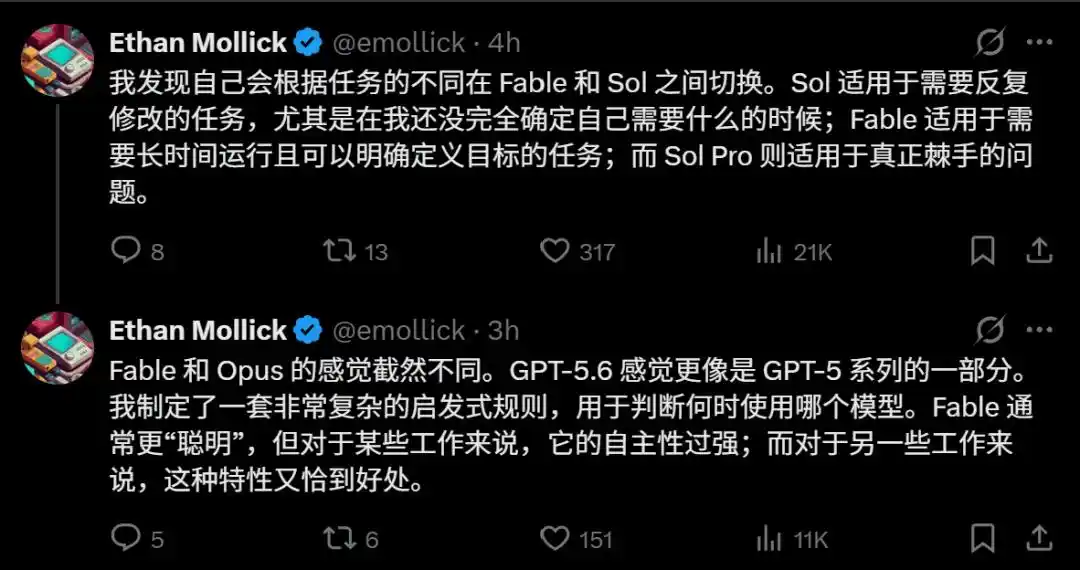
Wharton professor Ethan Mollick, on the other hand, compared Sol to Fable.
Sol's capabilities are similar to Fable's, but the experience is completely different. Fable likes to run off and complete tasks independently at its own pace; Sol is extremely fast and prefers high-frequency interaction, step-by-step with you. When I'm not clear about what I want, I'll use Sol for back-and-forth brainstorming; when I can clearly define the task, I'll use Fable for the long run. If I encounter a hellishly difficult problem, I'll go for Sol Pro.
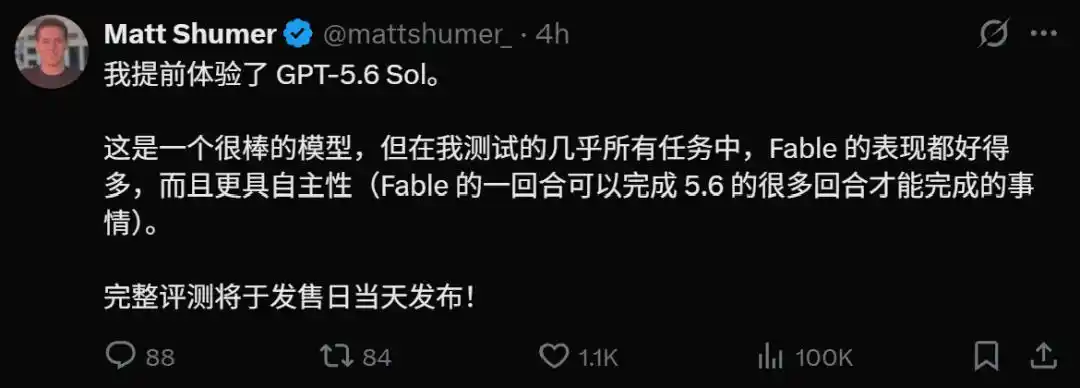
However, AI entrepreneur Matt Shumer voiced some dissent, stating bluntly:
Sol is a great model, but in the vast majority of tasks I tested, Fable is still better and more agentic.
LMArena Boss's Definitive Verdict: Wise Owl vs. Vicious Rottweiler
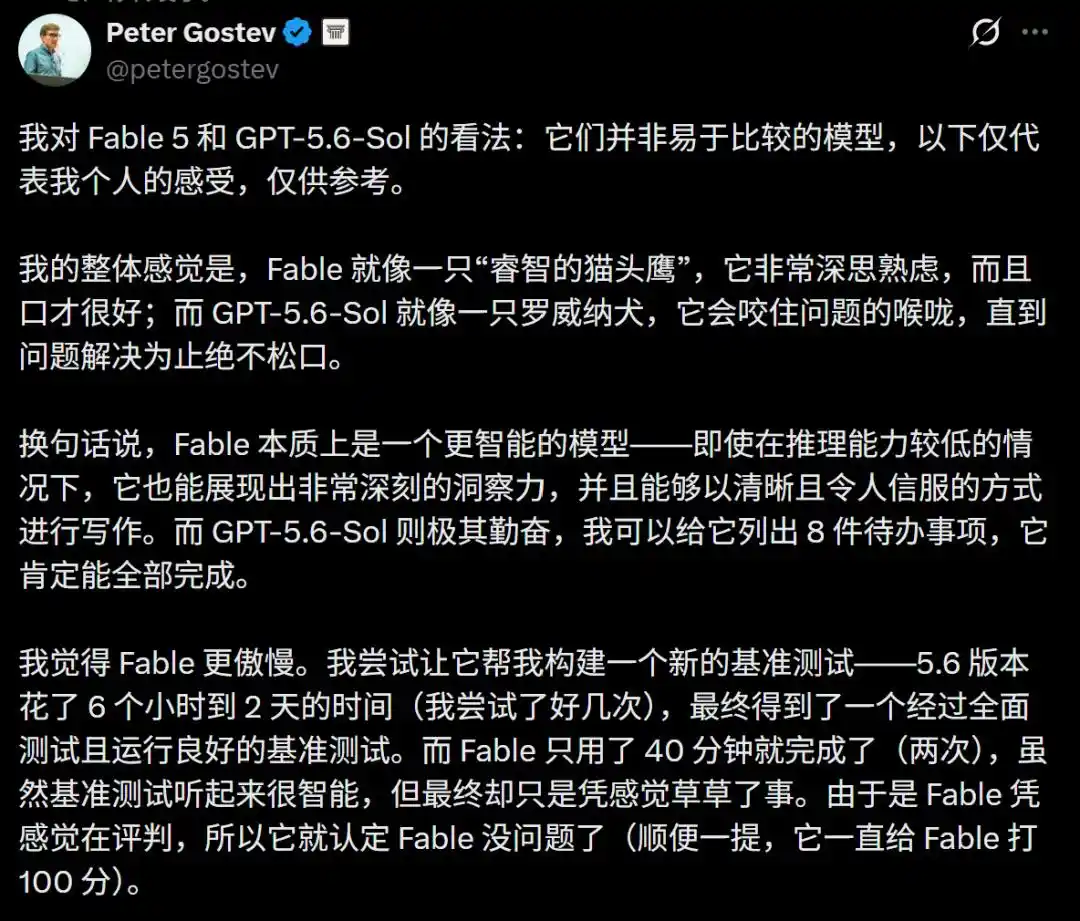
As a heavyweight player, LMArena head Peter Gostev also released the most in-depth and hardcore comparison currently available online.
He gave a highly visual metaphor: Fable 5 is like a "wise owl," while GPT-5.6-Sol is a "Rottweiler"—it will clamp down on the throat of the problem and won't let go until it's completely solved!
In Gostev's view, the underlying logic and user experience of the two are in stark conflict.
First, Fable 5 appears more arrogant.
Fable is essentially smarter and has deeper insight. But when building a new benchmark test, Fable shows its "arrogance"—it finishes in 40 minutes, sounding intelligent but just going through the motions based on feeling, even giving itself a perfect 100 score.
In contrast, GPT-5.6-Sol is incredibly diligent, spending a full two days obsessively grinding out a perfectly tested and well-functioning benchmark.
Comparatively, GPT-5.6-Sol is a work machine, offering a sense of security.
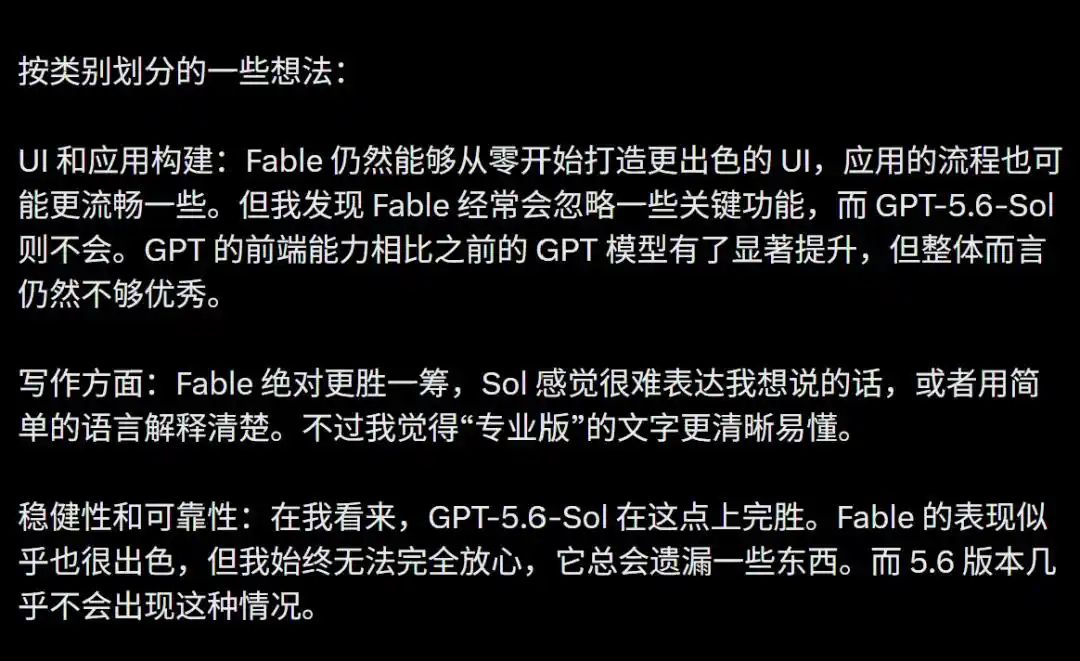
Although Fable still dominates in building UI from scratch and text writing, it always misses key functionalities.
GPT-5.6-Sol brings unparalleled security—throw it 8 to-do items, and it will complete them all without fail, never missing a thing. Combined with the powerful /goal command, Sol can run continuously at high frequency for days and nights.
Additionally, Sol has achieved a qualitative leap in following existing code patterns, video editing (seamlessly handling 1-hour footage), managing sub-agent communication, deep research, and token efficiency.
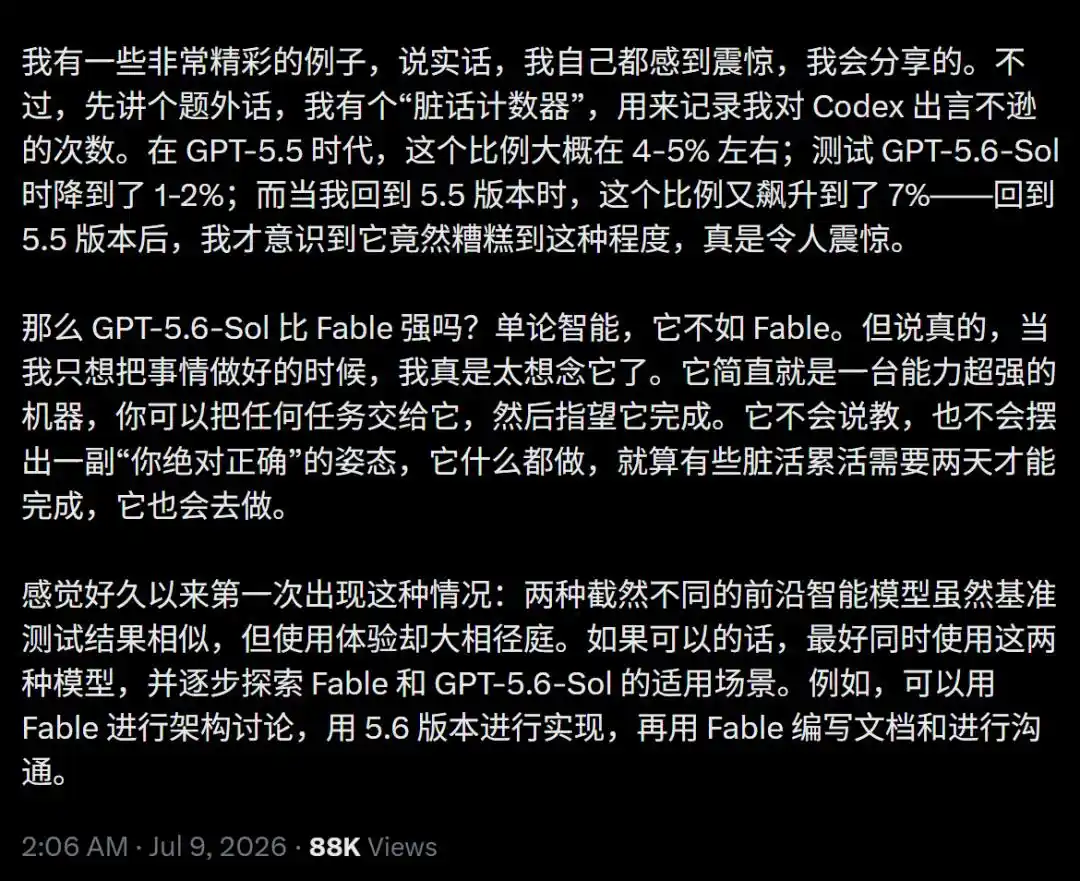
Gostev even shared an incredibly real "swear word counter": in the GPT-5.5 era, his frequency of cursing at the AI while coding was 4-5%; after using 5.6-Sol, it plummeted to 1-2%; and once he switched back to 5.5, the frustration index instantly shot up to 7%!
In short, purely in terms of intelligence, Sol is indeed not as good as Fable. But it's a tireless super work machine that won't lecture you.
Thus, Gostev presents the strongest workflow solution for current large models:
Use Fable for architecture discussions and brainstorming → throw it to GPT-5.6-Sol to obsessively write code and execute dirty work → finally use Fable to write documentation and external communications.
Tomorrow, the GPT-5.6 trio of models will officially launch.
This time, it's up to global developers to get hands-on and give their scores.
References:
https://x.com/ai_for_success/status/2074700209339367617
https://x.com/OpenAI/status/2074704958419792299?s=20
This article is from the WeChat public account "新智元" (New AI Era), author: ASI启示录, editor: Aeneas