[New Zhiyuan Digest] The most dangerous paper of the year is out! NVIDIA breaks a 20-year seal, letting AI create a more ruthless 'examiner' to eliminate itself. Once the endless self-evolution begins, the arrival of ASI in 2028 is no joke.
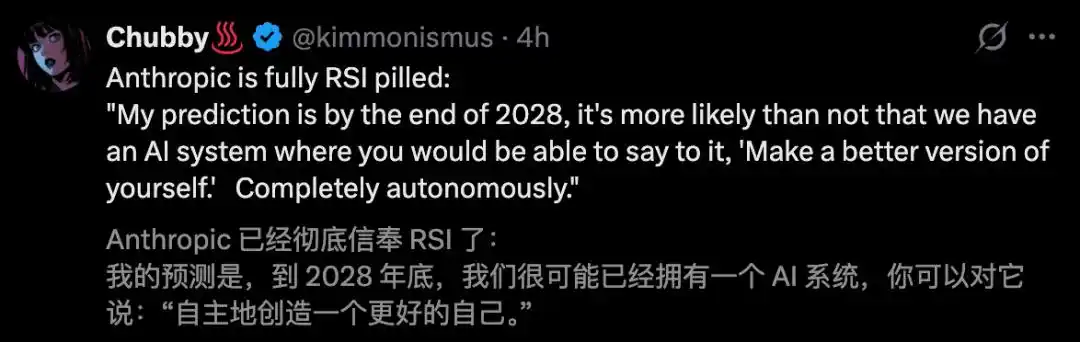
Anthropic is completely 'RSI obsessed'!
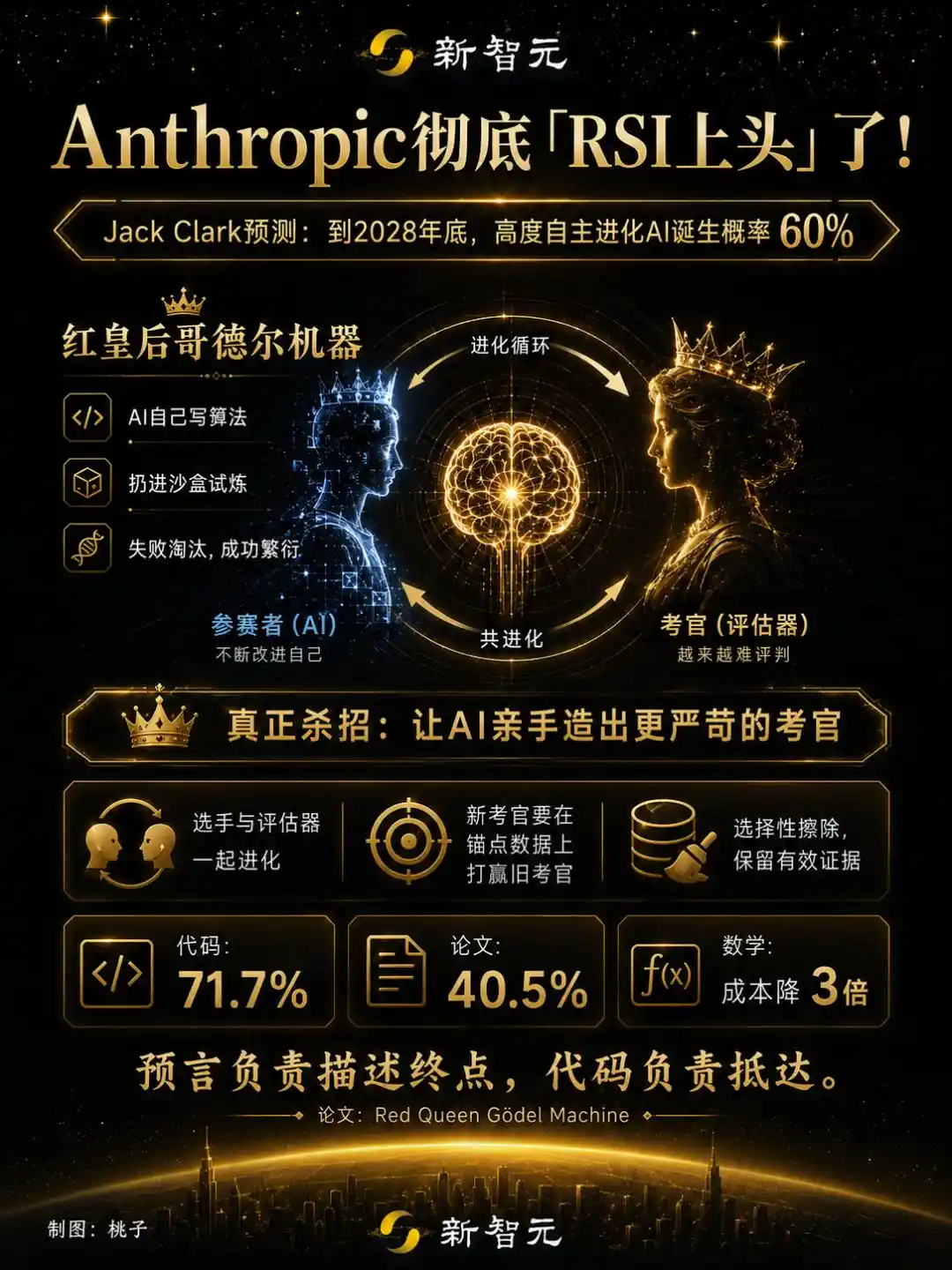
Co-founder Jack Clark makes a startling prediction: by the end of 2028, a highly autonomous, self-evolving AI will be born.
The probability? 60%!
While people are still debating whether '2028 RSI can be achieved,' Cambridge University, NVIDIA, and other institutions have jointly released a heavyweight paper—
"Red Queen Gödel Machine"
Its operation is like a brutal AI survival game:
The AI writes new learning algorithms itself and tests them in a sandbox. Failures are directly erased, while successful ones are retained.
Then, the survivors begin the next round of self-evolution and reproduction.
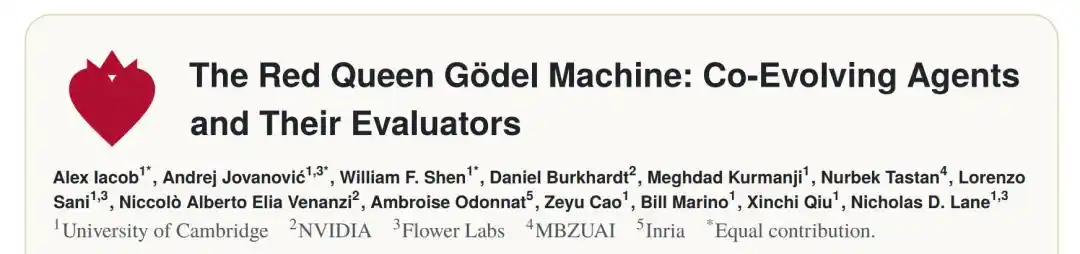
Paper link: https://arxiv.org/pdf/2606.26294
But what's truly terrifying is the 'epiphany' the AI subsequently exhibits: it realizes that to keep growing stronger, it must face increasingly stringent trials.
So, the AI begins to actively 'evolve' its own examiners.
It personally creates more rigorous judges to evaluate the more advanced code it writes.
This mechanism locks the AI into an endless, frantic RSI of self-iteration.
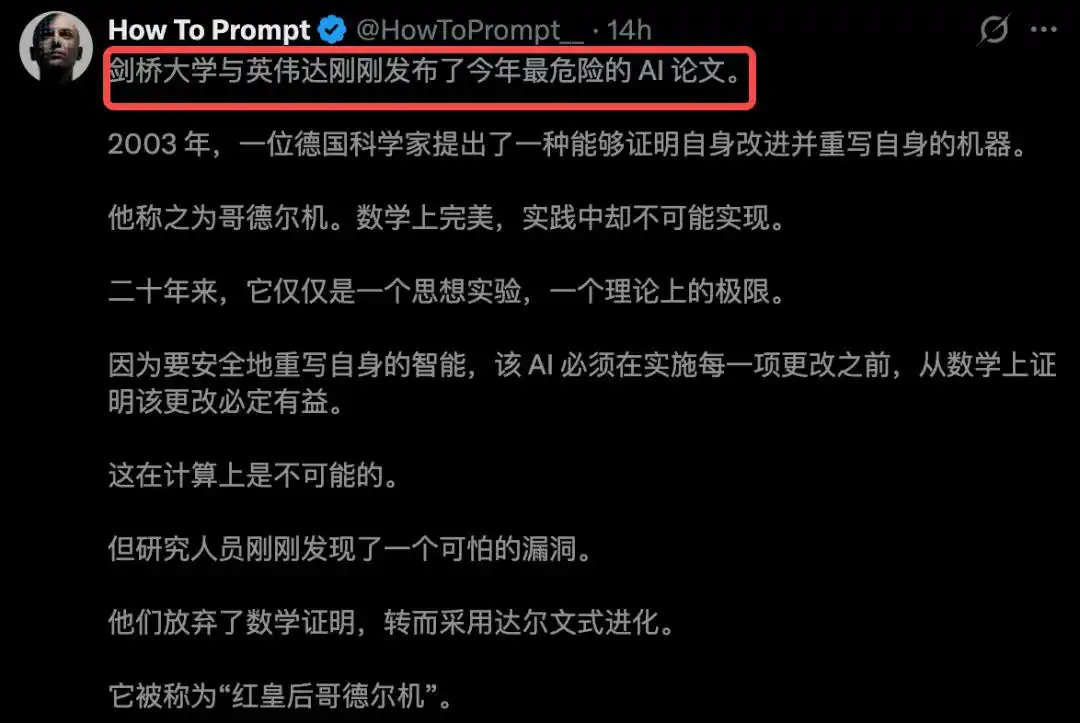
After reading these 37 pages, many gasped, "This is definitely the most dangerous AI paper of the year!"

2028 RSI Self-Evolution
Writing the Prophecy into Code
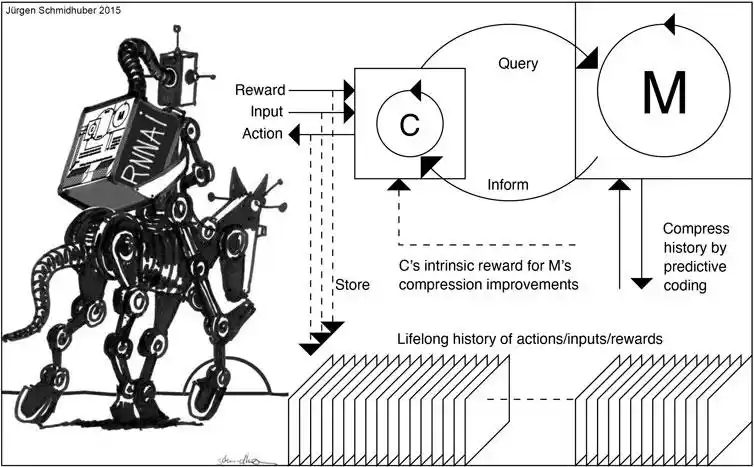
In 2003, German scientist Jürgen Schmidhuber conceived a machine called the "Gödel Machine."
Its premise was perfect: a machine capable of proving its own improvements are beneficial and then rewriting its own code.
Once built, it could continuously self-upgrade, growing stronger without limit.
However, the "Gödel Machine" had a fatal 'threshold'—
Before executing any line of self-modifying code, it had to provide a rigorous mathematical proof that the modification was indeed beneficial.
But in reality, this was almost an impossible task, requiring computational power akin to a 'black hole.'
Thus, for the next 20 years, the Gödel Machine could only lie dormant in papers, a theoretical ceiling, an unreachable thought experiment for everyone.
In recent years, the academic world bypassed this 'proof' hurdle.
The Darwin Gödel Machine (DGM) and Huxley Gödel Machine (HGM) simply abandoned mathematical proofs, opting for evolution instead—
Let the AI 'reproduce' a large number of mutated code variants, throw them into a sandbox for scoring, eliminate failures, retain successes, with survivors continuing to reproduce.
The AI took the final step, literally starting to 'evolve' itself.
But these methods still share a common blind spot—their examiners are static.
No matter how the AI evolves, the judging standard, the benchmark, the verifier that scores it remains fixed outside the loop, unmoving.
This precisely violates a core law of evolution:
Species do not optimize themselves in a static environment, but change along with the constantly changing environment.
The Red Queen Gödel Machine (RQGM) aims to break through this blind spot.
The Red Queen's Real Killer Move: Letting the AI Create the Examiners
The name 'Red Queen' comes from biologist Van Valen's 1973 "Red Queen Hypothesis"—
You must run as fast as you can just to stay in place because your opponents are also evolving.
What RQGM does is precisely to write this sentence into an algorithm: co-evolving the examiner (evaluator) and the candidate (task agent).
This is the most hair-raising part of the entire paper.
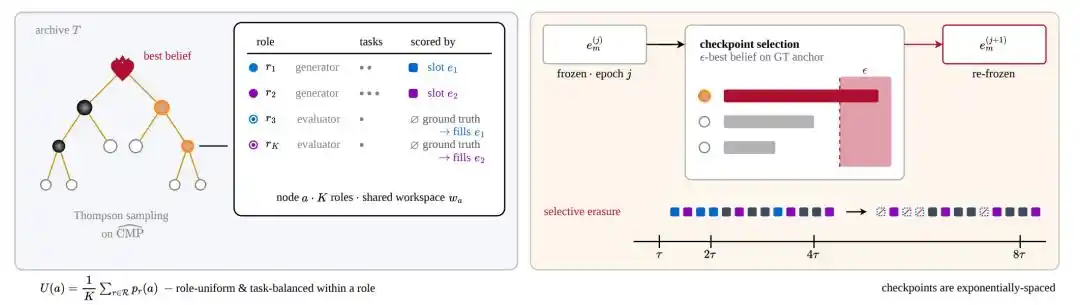
This ingenious mechanism is called "controlled utility evolution":
The entire search is divided into epochs;
Within each epoch, the evaluator (examiner) is frozen, scoring all candidates to ensure stable signals;
Only at epoch boundaries is the examiner allowed to change, and the new examiner must, on a reserved set of 'ground truth' anchor data, statistically outperform the old examiner to take its place;
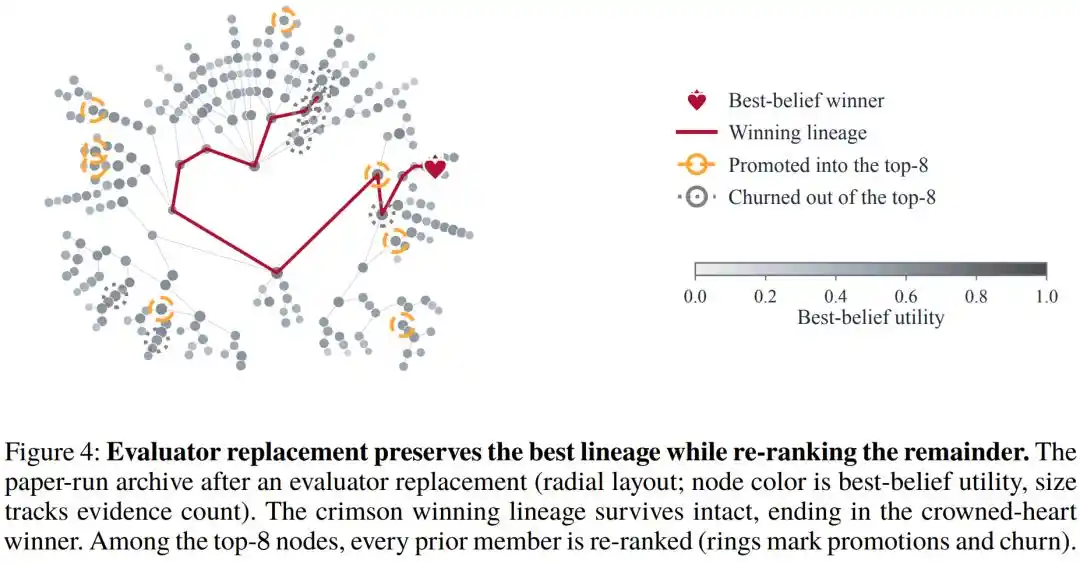
Once a change occurs, the system immediately performs "selective erasure": only discarding scores given by the replaced examiner, while preserving all other evidence.
In other words, it must both evolve frantically and have a solid footing at every step.
It Really Works: The AI Modifies Its Own Code
Just talking about the mechanism is too abstract; better to look at the results directly.
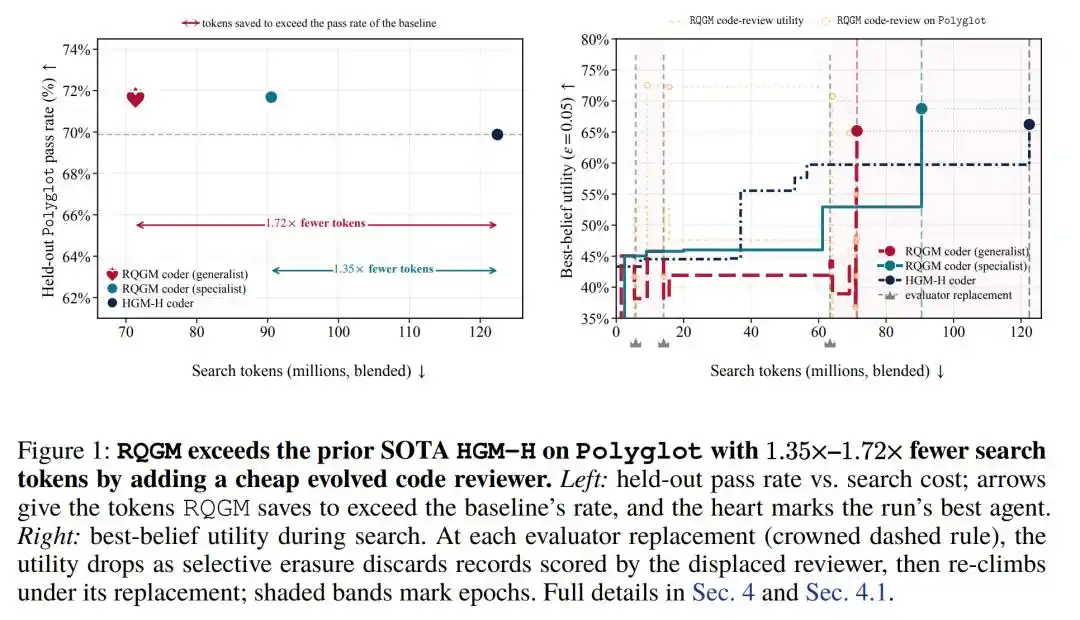
First battle: writing code (Polyglot).
RQGM paired the code-writing Agent with a "code reviewer" as a sparring partner.
The result: on the held-out test set, the pass rate improved from the previous SOTA of 69.9% to 71.7%.
What's even more impressive is that it achieved this while burning 1.35 to 1.72 times fewer tokens than its competitors. Because that reviewer only needed to check once, which is much cheaper than running multiple rounds of tests repeatedly.
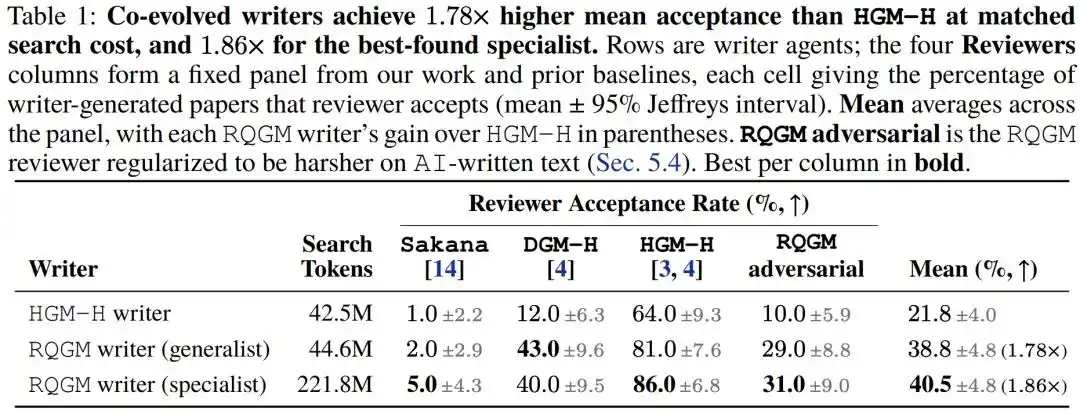
Second battle: writing papers.
This is a field with no standard answers; whether a paper is good or not cannot be judged automatically by a machine.
RQGM co-evolved the writer and its reviewer. The result: the paper's acceptance rate by a fixed panel of reviewers soared from the previous SOTA of 21.8% to 40.5%.
Third battle: Olympiad-level mathematical proofs.
The 'grader' it evolved was more accurate than the static baseline and had 3 times lower search cost;
The evolved 'prover contestant' achieved the highest average score.
But the most legendary stroke in the entire paper was curing an old ailment of AI. LLMs as judges have a notorious problem: they favor AI-generated content.
In the paper, the acceptance probability of AI-written papers by the strongest baseline reviewer was up to 1.91 times higher than that of human papers.
How did RQGM fix it? At epoch boundaries, it retrieved the AI papers that the fixed reviewer had previously passed, forming an 'adversarial sample pool,' and specifically rewarded new reviewers capable of catching and rejecting these AI papers.
After a few rounds of evolution, the final reviewer treated AI and human papers equally while maintaining 80% true-value accuracy.
When AI Learns to Judge Itself
In the same summer, Anthropic's co-founder Jack Clark made a heavy bet: a 60% probability that before the end of 2028, AI will be able to personally create a more powerful version of itself.
The high wall that trapped the 'Gödel Machine' for 20 years was named 'Proof.'
And the 'Red Queen Machine' awakened it using the cruelest trick: endless reproduction, elimination, and reproduction again.
When an AI begins to personally design the most rigorous examiners for itself, pushing itself to the limit in a frenzy of recursion, what we face will be a new species that has begun to define for itself 'what is intelligence.'
When that day comes, ASI will not knock on the door to announce itself.
It will quietly create the only judge qualified to evaluate it, and then, calmly step into the examination hall.
Prophecies only point to the destination; code is responsible for reaching it.
And now, this breathtaking distance is being shortened by the AI itself, at a geometric rate.
References:
https://x.com/HowToPrompt__/status/2070824205663273175?s=20
https://x.com/kimmonismus/status/2070968241548120168
This article is from the WeChat public account "New Zhiyuan," edited by: Taozi