Giants Wage the Context War, Reconstructing AI Moats

marsbitPublicado a 2026-06-23Actualizado a 2026-06-23

Resumen

The article "Giants Launch the Context War, Reconstructing AI's Moat" discusses how leading AI companies—OpenAI, Anthropic, and Google—are shifting their competitive focus from model size to acquiring, managing, and utilizing user context (Context). Initially, Context referred to the length of text a model could process, leading to a "arms race" for longer context windows. However, the competition has evolved through three key phases: expanding text capacity (long context windows), enabling memory across sessions, and finally, integrating AI into real user environments like browsers and desktops to capture dynamic task states. Each company is pursuing a distinct strategy. OpenAI is building Context around the ChatGPT account, turning it into a central hub that accumulates user understanding across various integrated applications and tools. Anthropic, lacking a major user base, focuses on high-value verticals like coding, empowering its Claude model to actively gather Context through GUI interaction (Computer Use) and system connections (MCP protocol). Google, with vast existing user data from products like Search and Gmail, faces the challenge of restructuring this data into actionable, AI-understandable Context for its Gemini model within its ecosystem. The core argument is that the nature of competitive advantage in AI is changing. The internet era prized network effects—connecting more users. The AI era values "individual depth": the ability to build deep, task-specific ...

This year, the three major US AI giants have been labeling their own model products with some "sci-fi" tags.

OpenAI says ChatGPT has learned to "dream"; Anthropic wants to give Claude a built-in "personal Wiki"; Google claims Gemini "natively comes with ten years of your memories".

These three statements seem unrelated, but they are actually competing for the same thing—Context.

Early on, Context was just an unremarkable technical parameter, measuring how many characters a model could process at once. Today, the meaning of Context is broadening: it is user assets, tool permissions, the real-time state of a task's progress, and ultimately, how well the AI understands you.

According to "Deep Flow Research Institute," since the beginning of this year, OpenAI, Anthropic, and Google have released over 40 important product and feature updates centered around Context—on average, a new capability hits the market every three to four days.

From long-context windows to cross-session Memory, to browser, desktop, and GUI capabilities, almost all the most significant changes in AI products over the past two years have revolved around Context.

A war over "Context" has already begun, which is quietly reconstructing the moats of the AI era.

1. From Long Windows to the Real Environment: Three Leaps in the Boundaries of Context

The earliest competition over Context happened in "text length."

In the Chatbot era, Context primarily meant how much information a model could ingest at one time. The longer the window, the more capable the model was at handling papers, codebases, even complete project documentation. Thus, OpenAI, Anthropic, and Google ignited an arms race in context window length.

In May 2023, Anthropic led the charge by extending Claude's context window from 9K to 100K, equivalent to about 75,000 words, making "uploading an entire book" a reality for the first time. In November 2023, OpenAI followed up with GPT-4 Turbo's 128K window. Three months later, Google pushed the window to the million-level with Gemini 1.5 Pro.

In less than a year, Context leaped from the hundred-thousand level to the million level.
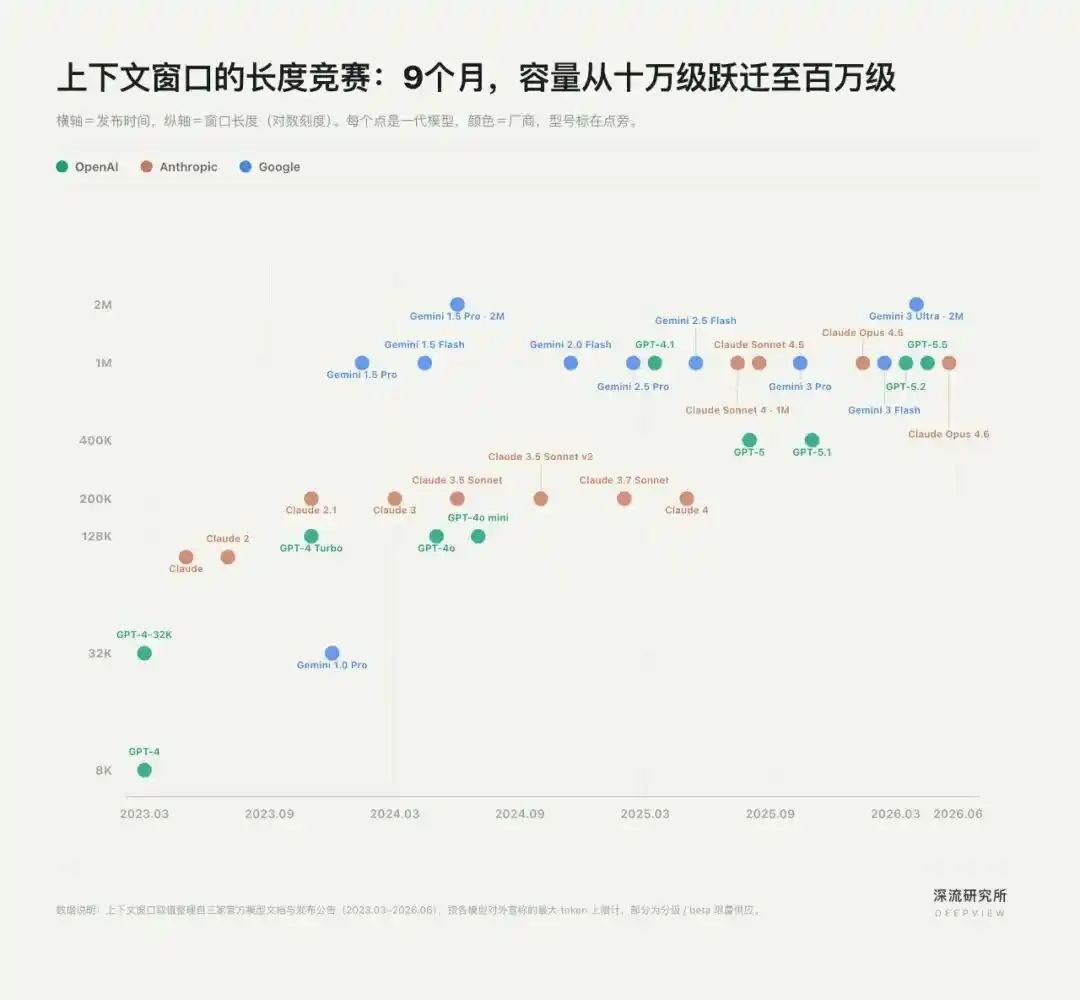
Long windows solved the AI's "throughput" problem, but this race quickly exposed its limitations: the model seeing more information doesn't necessarily mean it can better understand the task.

Especially as AI products evolved from Chatbot to Agent, the boundaries of Context began to change. It was no longer just the input text in a single conversation, but the continuously accumulating, dynamically updated state flow within the task loop.

The focus of competition shifted accordingly: from "how much the model can know at once" to "what the model can remember long-term." Memory became the typical product form of this stage.

In early 2024, OpenAI was the first to introduce cross-session memory for ChatGPT, allowing the model to remember user preferences, backgrounds, and long-term needs. Subsequently, Anthropic and Google also equipped Claude and Gemini with memory capabilities.

Context began to have a time dimension. AI no longer only processed the current input; it also started trying to establish continuity between a user's interactions today, last week, and last month. Only AI with long-term Context could string discrete interactions into an ongoing relationship.

However, Memory answers "what happened in the past," but hasn't yet touched upon an even more critical question: what is happening now?

The real watershed moment appeared in the second half of 2025.

Starting in August of that year, the three companies almost simultaneously pushed the Context front to the browser: Anthropic released Claude for Chrome, Google embedded Gemini into Chrome, and OpenAI launched the standalone AI browser ChatGPT Atlas.

The browser is a natural Context goldmine. Web content, search intent, login status, forms, history, tabs, and the tasks the user is executing are all deposited within the browser. More importantly, the Context here is more real-time, continuous, and closer to the actual task site.

Previously, the way AI obtained Context was essentially still waiting for the user to deliver materials: uploading files, inputting instructions, authorizing memory, connecting data sources.

After entering the browser, the logic changed. AI began entering the user's work environment, observing page state, understanding task progress, capturing operational intent, and executing the next step within the real interface.

This was the third leap in Context boundaries: it transformed from static data input on the model side to the dynamic state captured by Agents in GUI, web pages, and system environments.

Long windows determine how much information the model can ingest at once; Memory determines whether the model can understand the user across time; browser, desktop products, and GUI capabilities determine whether the model can enter the real task site.

Together, these three constitute the main thread of AI product competition over the past two years: Context is no longer just a model capability issue; it is gradually becoming a product entry point issue, a user relationship issue, and an asset accumulation issue.

2. Context Becomes the New Battleground: Three Paths for the US AI "Big Three"

When Context evolves from a model parameter to a user asset, the core of competition becomes: who can more stably acquire, organize, and invoke Context.

Centered on this, OpenAI, Anthropic, and Google have taken three differentiated paths.
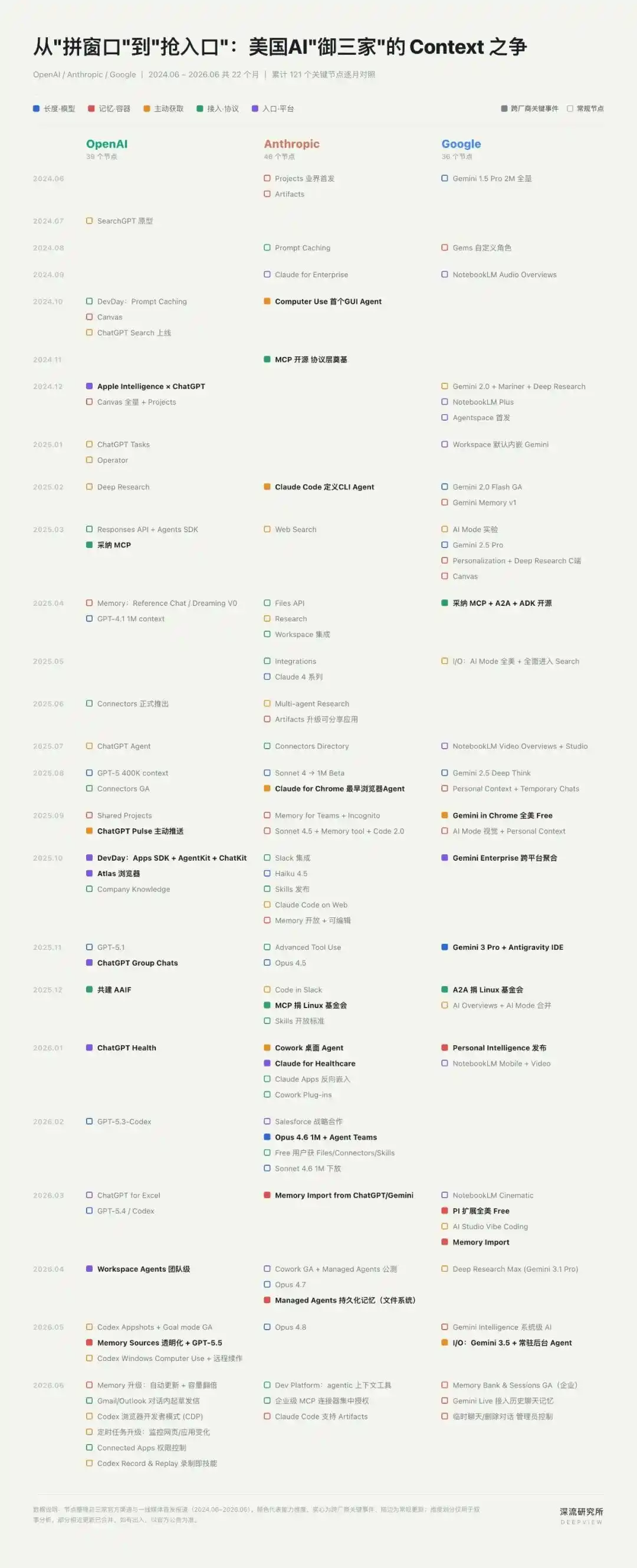
ChatGPT is OpenAI's most core source of Context.

Memories, preferences, historical tasks, and tool usage records left by users in countless conversations gradually accumulate under the same ChatGPT account.

This account differs from traditional internet accounts. Traditional accounts record login status, subscription relationships, and payment information; ChatGPT accounts record the user's "history understood by AI."

This is an AI-native user asset. Its value lies not only in more personalized answers but also in reducing cold-start costs, continuing task states, and reusing the same set of user understanding across different product scenarios.

For OpenAI, lacking Google's native data ecosystem, it must have users continuously generate new Context within the ChatGPT system.

Therefore, OpenAI's product moves over the past two years have consistently expanded the task radius that the ChatGPT account can cover—the Apps SDK brings third-party apps into ChatGPT, Atlas brings the browser into ChatGPT, and the newly integrated Codex brings programming tasks into the same workflow.

OpenAI's unique path lies in not first controlling the entry point and then plugging AI into it; rather, it takes ChatGPT as the origin point and pulls application, browser, programming, and other scenarios back into the same account system.

ChatGPT thus is no longer just a conversational entry point but a hub for converging, invoking, and updating Context.

In contrast, Anthropic lacks both C-end entry points and large-scale existing user data.

Its path is to cut into high-value vertical scenarios like Coding and Agent and strengthen Claude's ability to actively acquire Context within these scenarios.

For Claude, Context is not a piece of text input by the user but the dynamically changing environment within the task site: codebases, file systems, terminal output, browser pages, databases, project documentation, and feedback after each execution step.

Therefore, Anthropic emphasizes the proactivity of Context acquisition more. The model should not just wait for user input; it should also actively enter the environment, read the state, and obtain feedback during task execution.

In October 2024, Anthropic launched Computer Use, allowing Claude to move the mouse, click buttons, and input text based on screen captures.

According to the official statement, Claude 3.5 Sonnet is the first frontier AI model publicly offering computer use capabilities.

This means that when Context exists in web pages, forms, backend system interfaces, and local software UIs, rather than in structured APIs, Claude can still enter the environment via GUI, observe the state, and execute operations.

A month later, Anthropic released MCP. This open protocol connecting AI assistants with external tools and data sources is officially defined as connecting AI assistants to "systems where data resides," including content libraries, business tools, and development environments.

Its value lies in allowing Claude to no longer rely on users copy-pasting but to access external tools and data sources through standardized methods.

These two types of capabilities correspond to Anthropic's two paths for acquiring Context:

Computer Use enters interfaces via GUI; MCP connects systems via protocol. One enters the task site; the other connects to external tools, collectively enabling Claude to obtain dynamic Context.
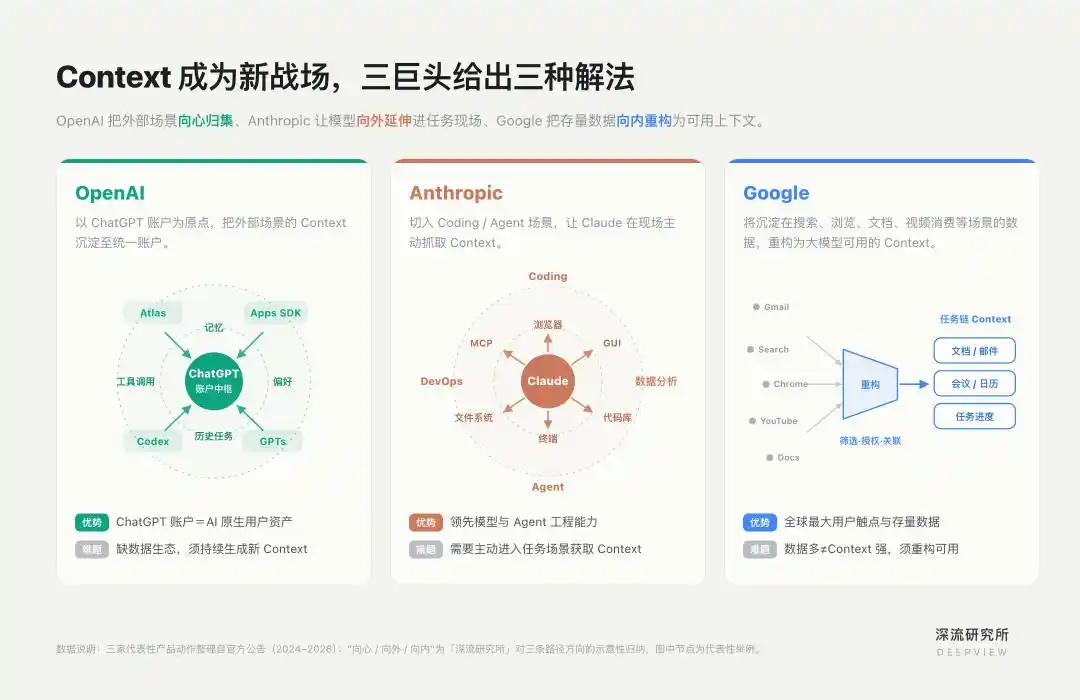
Now, looking at Google. It's often said externally that Google is one of the companies with the most Context. It lacks neither entry points nor data. Products like Chrome, Gmail, YouTube, and Search constitute one of the largest collections of user touchpoints globally.

But from an AI perspective, more data does not equal stronger Context.

What Google accumulated in the past was search, browsing, email, documents, location, video consumption, and other data, primarily serving search ranking, ad delivery, content recommendation, and office collaboration. They are essentially behavioral signals needed for system operation.

What Agents need is task background that can be understood, reasoned about, and invoked by models.

Only when a model can judge which information is relevant to the current task, which is outdated, which can be invoked, and how these pieces of information are related, does data truly become Context.

The challenge Google faces is not simply "accessing data," but a data refactoring. It needs to re-screen, correlate, authorize, and transform old data scattered across different products, serving different system goals, into personal context usable by Gemini.

The difficulty of this engineering task is no less than OpenAI re-accumulating Context or Anthropic entering the task site.

Over the past two years, Google's product moves have not been starting from scratch but reforming inward along its existing strongholds. The core of this path is organizing fragmented data into task chains.

In May 2024, Gemini 1.5 Pro entered the Workspace sidebar, allowing the model to first invoke current context within work scenarios like Gmail, Docs, and Drive.

In July 2025, the Gemini app began connecting to tools like Gmail, Drive, and Calendar, extending Context from a single application to cross-application tasks.

In January 2026, Personal Intelligence launched a test version, further incorporating personal data like Gmail and Photos into Gemini's personalized background.

Google's Context strategy is not "we have more data, so we're naturally ahead."

What it truly needs to accomplish is a data usability engineering project: transforming historically accumulated behavioral data serving system goals like search, ads, and recommendation into understandable, authorizable, actionable Context for the AI era.

3. From "Network Scale" to "Individual Depth": AI Era Moats Are Changing

Over the past two years, OpenAI, Anthropic, and Google have all accelerated the accumulation and mining of Context, building capabilities around its acquisition, organization, and invocation, attempting to form new competitive barriers.

But a seemingly contradictory change is also happening simultaneously: since this year, the three companies have coincidentally made Memory more transparent, explainable, and even migratable.

In March 2026, Anthropic and Google successively launched Memory Import, supporting users in migrating memories between ChatGPT, Gemini, and Claude.

Subsequently, OpenAI, through Memory Sources, allowed users to see which memories, historical chats, or external data sources were invoked behind a personalized answer.

If Context is the most important asset in the AI era, why are platforms starting to open its permissions?

The answer lies in the fact that Memory Import truly only opens surface-level Context: user preferences, memory summaries, compressed versions of chat history.

This information is highly structured and easily described in natural language. Migrating it is not technically difficult.

What's truly hard to migrate is another type of Context: task states, tool permissions, enterprise system integrations, real-time feedback from execution sites.

This Context is deeply embedded within product and system environments and cannot be fully moved with a prompt.

This also indicates that the competitive logic of the AI era differs from that of the internet era.

The basic form of the internet is the network. It connects people, content, goods, services, and information into nodes. The more nodes and denser the connections, the more valuable the product. Therefore, the strongest moat in the internet era was network effects; value came from more people using it.

The basic form of AI is closer to a new kind of computer, or a new information processing system.

Its primary value is not connecting more people, but understanding information, processing tasks, invoking tools, and completing actions. An AI could create enormous value even serving just one user.

Therefore, the moats of the AI era are shifting from "network scale" to "individual depth." This "individual depth" barrier primarily comes from three layers:

First, the compounding effect of Context. Every time an AI completes a task, it understands the user's expression habits, judgment standards, data sources, and workflow better. The next time it executes, the cold-start cost is lower.

Second, the embedding of permissions and toolchains. When users authorize AI to access their email, documents, codebases, etc., AI is no longer just a replaceable Q&A tool; it enters the real task site.

Third, the formation of trust relationships. The more complex and high-value the task, the less likely users are to casually hand it to an unfamiliar AI. Only an AI that has long understood them, knows their boundaries, and can continue the context will likely be allowed to execute the next step.

If internet products compete for attention entry points, then AI products compete for task entry points.

Once an AI consistently enters a user's workflow, accumulates context, and gains execution permissions, the migration cost isn't just switching an app; it's re-establishing a whole set of task relationships of being understood, authorized, and trusted.

Changes in domestic products can also be understood within this logic.

Take Tencent as an example. It accumulated relationship chains, content, service ecosystems, and high-frequency entry points in the internet era; in the AI era, the value of these assets lies in whether they can be reorganized into Context that Agents can understand, invoke, and execute.

Whether it's WorkBuddy accessing work scenarios like documents, meetings, and WeCom, or WeChat's "Xiao Wei" attempting to invoke mini-programs and services within the WeChat ecosystem, the essence is transforming content, relationships, and processes originally serving humans into task environments AI can enter.

As Tencent's Chief AI Scientist Yao Shunyu judges: Context may appear as a data asset, but essentially it is a comprehensive reflection of product capabilities, engineering capabilities, and organizational coordination capabilities.

In the internet era, moats were about scale. In the AI era, moats should be more about conversion efficiency:

Who can transform their existing ecosystem into an AI work environment faster? Who can allow AI to accumulate deeper user understanding through each task? Whoever does this is more likely to build new barriers.

This is what truly deserves attention about the Context War.

This article is from WeChat public account "Deep Flow Research Institute," author: Jiang Feng

Criptos en tendencia

Preguntas relacionadas

QAccording to the article, what are the three major evolutions of the meaning of 'Context' in AI, and what does each represent?

AThe article describes three major evolutions in the meaning of 'Context'. First, it started as a technical parameter for text length (long context windows), addressing the model's 'throughput'. Second, it evolved to include a time dimension through 'Memory', allowing AI to understand users across sessions. Third, it expanded to become dynamic state captured from real environments like browsers and GUIs, enabling AI to operate within real task contexts.

QHow do the strategies of OpenAI, Anthropic, and Google for acquiring and utilizing Context differ, as outlined in the article?

ATheir strategies differ significantly. OpenAI focuses on the ChatGPT account as a central hub to accumulate Context from diverse tasks (apps, browser, coding). Anthropic, lacking major data ecosystems, emphasizes proactive Context acquisition through capabilities like Computer Use (GUI interaction) and the MCP protocol (connecting to external tools and data). Google's strategy involves transforming its vast existing user data from products like Search, Gmail, and Chrome into actionable, task-relevant Context usable by its Gemini AI, a complex data restructuring effort.

QWhat key shift in the nature of AI-era competitive moats does the article identify, compared to the internet era?

AThe article identifies a shift from moats based on 'network scale' in the internet era to moats based on 'individual depth' in the AI era. Internet value came from connecting more people (network effects). AI value comes from deeply understanding and efficiently completing tasks for individuals or organizations. The new moat is built on Context compounding, embedded permissions/toolchains, and formed trust relationships within a user's workflow.

QWhat is the apparent contradiction the article notes regarding Memory in AI systems, and what is the explanation provided?

AThe contradiction is that while companies are heavily competing on Context/Memory as a core asset, they are also making Memory features like 'Memory Import' transparent and portable between platforms. The explanation is that what is made portable is only surface-level, structured Context (preferences, summaries). The truly valuable, hard-to-migrate Context is deeply embedded in task states, tool permissions, system integrations, and real-time environmental feedback, which remains locked within each platform's ecosystem.

QHow does the article interpret the value of a company like Tencent's existing internet-era assets in the new AI context-driven competition?

AThe article interprets that the value of Tencent's assets (social graphs, content, services, high-frequency apps) in the AI era lies not in their scale alone, but in their potential to be reorganized and converted into 'Context'—task environments that AI agents can understand, access, and operate within. Success depends on the efficiency of transforming these human-centric ecosystems into AI-actionable workflows, as seen in products like WorkBuddy and the 'Xiaowei' assistant within WeChat.

Lecturas Relacionadas

Conversation with Jason Huang, Founder of NDV: Puncturing the AI Bubble and the MicroStrategy Myth, Searching for the Ultimate Trump Card in the Crypto Market

In a podcast interview, NDV founder Jason Huang discusses the recent crypto market downturn, attributing the initial phase to typical Bitcoin cycle selling pressure, now compounded by a US stock market correction, tightening liquidity, and MicroStrategy's financial strain. He argues the market hasn't bottomed yet, noting true bear market lows often require a major, despair-inducing event like FTX's collapse. Huang details MicroStrategy's precarious position: its debt-and-equity fueled Bitcoin buying model has reversed into a negative cycle as prices fell. He interprets its sale of just 32 BTC as a signal prioritizing creditors over shareholders, sparking market "front-running" of its larger potential sell-off. A true bottom may arrive only after MicroStrategy resolves its looming debt payments, possibly via a large, private Bitcoin sale. His fund is up ~20% this year, outperforming Bitcoin by 50-60%, by shorting crypto and trading commodities like oil and gold. He avoided AI stocks despite being a heavy user, citing a lack of trading edge in the crowded semiconductor hardware trade, which he views as ripe for a significant correction. Long-term, Huang remains bullish on stablecoins as crypto's clearest, most practical innovation with high growth potential. He is very bearish on Ethereum and skeptical that Bitcoin has found its floor, suggesting $48,000 may not hold. He expects a sharp decline followed by a strong recovery within a year, but only after a major panic event leads to widespread capitulation and despair—the true hallmark of a market bottom.

链捕手Hace 6 min(s)

Conversation with Jason Huang, Founder of NDV: Puncturing the AI Bubble and the MicroStrategy Myth, Searching for the Ultimate Trump Card in the Crypto Market

链捕手Hace 6 min(s)

U.S. Stocks Trend (June 24): Korean Stock Plunge Ripples Global Chip Sector, Micron Tumbles Over 10%, Long-Term Supply Certainty Faces a 'Hard Test'

US Stock Market Trend (June 24): South Korean Market Plunge Disrupts Global Chips, Micron Drops Over 10%, Long-Term Supply Certainty Faces Hard Test On Monday, the South Korean KOSPI index plunged 10%, with SK Hynix and Samsung dropping over 12%, triggered by rumors that SK Hynix might slow its HBM4 production expansion. This shock quickly spread to the U.S. semiconductor sector. Micron plummeted 13.18% to $1,051.77, SanDisk fell 13.64%, and Marvell declined 8%. The Philadelphia Semiconductor Index closed down 7.87%, while the Nasdaq fell 2.21% to 25,587.04 points. The sell-off particularly hit memory chip stocks. Defensive sectors showed relative resilience, with gains in stocks like IBM and Johnson & Johnson. Market volatility spiked, with the VIX index jumping 12.79%. Commodities weakened, with WTI crude oil hitting a near three-month low and gold falling below $4,100. The core issue is not a challenge to AI demand itself, but a market reassessment of overly optimistic capacity expectations for memory chips, especially HBM. The rumor about SK Hynix undermined perceived certainty in the AI infrastructure cycle. Key upcoming events include Thursday's PCE inflation data, which will influence Fed rate expectations, and Micron's earnings report. The market will focus on Micron's HBM gross margins and its long-term capacity guidance. The shift indicates the AI investment cycle is moving from euphoria to rational pricing. Large institutions are questioning the sustainability of AI-related capital expenditure growth. Micron's repricing from an "AI infrastructure staple" to a more cyclical stock highlights this change. Thursday's data and earnings represent a critical juncture for assessing long-term supply certainty, which has now significantly decreased.

marsbitHace 14 min(s)

U.S. Stocks Trend (June 24): Korean Stock Plunge Ripples Global Chip Sector, Micron Tumbles Over 10%, Long-Term Supply Certainty Faces a 'Hard Test'

marsbitHace 14 min(s)

Preferred Stock Is Not the Trigger for Corporate Bankruptcy, MicroStrategy's Dollar Reserves Can Cover Dividend and Interest Payments Until February 2027

Preferred Shares Are Not the Catalyst for Corporate Bankruptcy; MicroStrategy's Dollar Reserves Can Cover Dividend and Interest Payments Until February 2027. This article analyzes the nature of preferred shares used by MicroStrategy (MSTR). Legally equity but economically similar to debt, these shares, including its Bitcoin-linked STR convertible preferred notes (STRC), offer fixed or floating dividends. Crucially, MicroStrategy's preferred shares lack rigid redemption clauses, meaning they are not classified as traditional debt. This eliminates principal repayment pressure and means missed dividends do not constitute default or trigger bankruptcy, creating a "self-contradictory virtuous cycle." The article clarifies that if funds are short, MicroStrategy can defer or suspend preferred share dividends (except for non-cumulative types like STRD) without immediate risk. The real potential crisis point lies with its convertible bonds. If a prolonged bear market prevents conversion, MicroStrategy might need to sell Bitcoin to repay these bonds starting from the earliest maturity in September 2027, potentially creating a downward spiral. Preferred dividend suspensions would only exacerbate market panic in such a scenario. Recent financial activity shows MicroStrategy strengthened its position through four weeks of common stock (MSTR) issuances, raising over $851 million without issuing new preferred shares. It increased its dollar reserves to approximately $1.4 billion, which is sufficient to cover all preferred share dividends and interest until around March 2027. While Bitcoin purchases slowed recently, this prioritization of cash reserves enhances the company's near-term financial safety. The analysis concludes that if the Bitcoin bear market ends by early 2025 as anticipated, MicroStrategy can resume issuing MSTR stock in a rising market to replenish reserves and manage future dividend obligations, thereby reducing the long-term pressure from its preferred share structure.

marsbitHace 1 hora(s)

Preferred Stock Is Not the Trigger for Corporate Bankruptcy, MicroStrategy's Dollar Reserves Can Cover Dividend and Interest Payments Until February 2027

marsbitHace 1 hora(s)

Foundation Steps Back, Ethlabs Steps Forward: Ethereum Undergoes Its Largest Restructuring in History

On June 23rd, the Ethereum ecosystem witnessed two major shifts, signaling a significant governance realignment. First, former Ethereum Foundation researchers established Ethlabs, a new independent non-profit. Backed by major ETH holders like Bitmine and SharpLink, Ethlabs aims to address practical needs for institutional adoption, including faster settlement, native asset issuance, cross-chain transactions, and mainnet scaling. Secondly, the Ethereum Foundation announced a major restructuring, laying off 54 employees (20% of its staff) to become a leaner entity focused on protocol governance and maintenance rather than being the primary builder. This move represents a pivotal correction. Criticisms had mounted over the Foundation's perceived slowness, lack of clear strategy, and over-reliance on Vitalik Buterin's influence. Ethlabs emerges as a more execution-oriented, "industrialized" layer focused on market adoption—bridging the gap between research and real-world use. Notably, Vitalik Buterin is absent from its list of supporters, interpreted as an intentional step to avoid excessive personal endorsement and allow the organization to build independent credibility. The Ethereum Foundation's downsizing and redefinition mark a retreat from its former central coordinating role. It now aims to share the "privilege of stewarding Ethereum" with other emerging groups like Ethlabs, the Ethereum Applications Guild, and The Ethereum Economic Zone. Analysts frame this dual shift as the Foundation ensuring Ethereum remains "correct" (credibly neutral), while Ethlabs must prove it remains "effective" (competitive and attractive for capital and adoption). This addresses community "shareholder-like anxiety" about ETH's market performance. While risks exist—such as concerns over shifting from Foundation centrality to large-holder influence—the consensus is that the greater risk for Ethereum was inaction, caught between technical idealism and organizational inertia. These steps aim to create a more multi-stakeholder, execution-driven future for the network.

链捕手Hace 9 hora(s)

Foundation Steps Back, Ethlabs Steps Forward: Ethereum Undergoes Its Largest Restructuring in History

链捕手Hace 9 hora(s)

Trading

Spot
Futuros

Artículos destacados

Qué es GROK AI

Grok AI: Revolucionando la Tecnología Conversacional en la Era Web3 Introducción En el paisaje de rápida evolución de la inteligencia artificial, Grok AI se destaca como un proyecto notable que une los dominios de la tecnología avanzada y la interacción del usuario. Desarrollado por xAI, una empresa liderada por el renombrado empresario Elon Musk, Grok AI busca redefinir la forma en que interactuamos con la inteligencia artificial. A medida que el movimiento Web3 continúa floreciendo, Grok AI tiene como objetivo aprovechar el poder de la IA conversacional para responder consultas complejas, proporcionando a los usuarios una experiencia que no solo es informativa, sino también entretenida. ¿Qué es Grok AI? Grok AI es un sofisticado chatbot de IA conversacional diseñado para interactuar dinámicamente con los usuarios. A diferencia de muchos sistemas de IA tradicionales, Grok AI abraza una gama más amplia de consultas, incluyendo aquellas que normalmente se consideran inapropiadas o fuera de las respuestas estándar. Los objetivos centrales del proyecto incluyen: Razonamiento Confiable: Grok AI enfatiza el razonamiento de sentido común para proporcionar respuestas lógicas basadas en la comprensión contextual. Supervisión Escalable: La integración de asistencia de herramientas asegura que las interacciones de los usuarios sean monitoreadas y optimizadas para la calidad. Verificación Formal: La seguridad es primordial; Grok AI incorpora métodos de verificación formal para mejorar la confiabilidad de sus resultados. Comprensión de Largo Contexto: El modelo de IA sobresale en retener y recordar un extenso historial de conversaciones, facilitando discusiones significativas y contextualizadas. Robustez Adversarial: Al enfocarse en mejorar sus defensas contra entradas manipuladas o maliciosas, Grok AI busca mantener la integridad de las interacciones de los usuarios. En esencia, Grok AI no es solo un dispositivo de recuperación de información; es un compañero conversacional inmersivo que fomenta un diálogo dinámico. Creador de Grok AI La mente detrás de Grok AI no es otra que Elon Musk, una persona sinónimo de innovación en varios campos, incluyendo la automoción, los viajes espaciales y la tecnología. Bajo el paraguas de xAI, una empresa enfocada en avanzar la tecnología de IA de maneras beneficiosas, la visión de Musk busca remodelar la comprensión de las interacciones de IA. El liderazgo y la ética fundacional están profundamente influenciados por el compromiso de Musk de empujar los límites tecnológicos. Inversores de Grok AI Si bien los detalles específicos sobre los inversores que respaldan a Grok AI son limitados, se reconoce públicamente que xAI, el incubador del proyecto, está fundado y apoyado principalmente por el propio Elon Musk. Las empresas y participaciones anteriores de Musk proporcionan un respaldo robusto, fortaleciendo aún más la credibilidad y el potencial de crecimiento de Grok AI. Sin embargo, hasta ahora, la información sobre fundaciones de inversión adicionales u organizaciones que apoyan a Grok AI no está fácilmente accesible, marcando un área para una posible exploración futura. ¿Cómo Funciona Grok AI? La mecánica operativa de Grok AI es tan innovadora como su marco conceptual. El proyecto integra varias tecnologías de vanguardia que facilitan sus funcionalidades únicas: Infraestructura Robusta: Grok AI está construido utilizando Kubernetes para la orquestación de contenedores, Rust para rendimiento y seguridad, y JAX para computación numérica de alto rendimiento. Este trío asegura que el chatbot opere de manera eficiente, escale efectivamente y sirva a los usuarios de manera oportuna. Acceso a Conocimiento en Tiempo Real: Una de las características distintivas de Grok AI es su capacidad para acceder a datos en tiempo real a través de la plataforma X—anteriormente conocida como Twitter. Esta capacidad otorga a la IA acceso a la información más reciente, permitiéndole proporcionar respuestas y recomendaciones oportunas que otros modelos de IA podrían pasar por alto. Dos Modos de Interacción: Grok AI ofrece a los usuarios una elección entre “Modo Divertido” y “Modo Regular”. El Modo Divertido permite un estilo de interacción más lúdico y humorístico, mientras que el Modo Regular se centra en ofrecer respuestas precisas y exactas. Esta versatilidad asegura una experiencia personalizada que se adapta a diversas preferencias de los usuarios. En esencia, Grok AI une rendimiento con compromiso, creando una experiencia que es tanto enriquecedora como entretenida. Cronología de Grok AI El viaje de Grok AI está marcado por hitos cruciales que reflejan sus etapas de desarrollo y despliegue: Desarrollo Inicial: La fase fundamental de Grok AI tuvo lugar durante aproximadamente dos meses, durante los cuales se realizó el entrenamiento inicial y el ajuste del modelo. Lanzamiento Beta de Grok-2: En un avance significativo, se anunció la beta de Grok-2. Este lanzamiento introdujo dos versiones del chatbot—Grok-2 y Grok-2 mini—cada una equipada con capacidades para chatear, programar y razonar. Acceso Público: Tras su desarrollo beta, Grok AI se volvió disponible para los usuarios de la plataforma X. Aquellos con cuentas verificadas por un número de teléfono y activas durante al menos siete días pueden acceder a una versión limitada, haciendo que la tecnología esté disponible para un público más amplio. Esta cronología encapsula el crecimiento sistemático de Grok AI desde su inicio hasta el compromiso público, enfatizando su compromiso con la mejora continua y la interacción del usuario. Características Clave de Grok AI Grok AI abarca varias características clave que contribuyen a su identidad innovadora: Integración de Conocimiento en Tiempo Real: El acceso a información actual y relevante diferencia a Grok AI de muchos modelos estáticos, permitiendo una experiencia de usuario atractiva y precisa. Estilos de Interacción Versátiles: Al ofrecer modos de interacción distintos, Grok AI se adapta a diversas preferencias de los usuarios, invitando a la creatividad y la personalización en la conversación con la IA. Avanzada Infraestructura Tecnológica: La utilización de Kubernetes, Rust y JAX proporciona al proyecto un marco sólido para asegurar confiabilidad y rendimiento óptimo. Consideración de Discurso Ético: La inclusión de una función generadora de imágenes muestra el espíritu innovador del proyecto. Sin embargo, también plantea consideraciones éticas en torno a los derechos de autor y la representación respetuosa de figuras reconocibles—una discusión en curso dentro de la comunidad de IA. Conclusión Como una entidad pionera en el ámbito de la IA conversacional, Grok AI encapsula el potencial de experiencias transformadoras para los usuarios en la era digital. Desarrollado por xAI y guiado por el enfoque visionario de Elon Musk, Grok AI integra conocimiento en tiempo real con capacidades avanzadas de interacción. Busca empujar los límites de lo que la inteligencia artificial puede lograr mientras mantiene un enfoque en consideraciones éticas y la seguridad del usuario. Grok AI no solo encarna el avance tecnológico, sino que también representa un nuevo paradigma de conversación en el paisaje Web3, prometiendo involucrar a los usuarios con tanto conocimiento hábil como interacción lúdica. A medida que el proyecto continúa evolucionando, se erige como un testimonio de lo que la intersección de la tecnología, la creatividad y la interacción similar a la humana puede lograr.

411 Vistas totalesPublicado en 2024.12.26Actualizado en 2024.12.26

Qué es GROK AI

Qué es ERC AI

Euruka Tech: Una Visión General de $erc ai y sus Ambiciones en Web3 Introducción En el paisaje en rápida evolución de la tecnología blockchain y las aplicaciones descentralizadas, nuevos proyectos emergen con frecuencia, cada uno con objetivos y metodologías únicas. Uno de estos proyectos es Euruka Tech, que opera en el amplio dominio de las criptomonedas y Web3. El enfoque principal de Euruka Tech, particularmente su token $erc ai, es presentar soluciones innovadoras diseñadas para aprovechar las crecientes capacidades de la tecnología descentralizada. Este artículo tiene como objetivo proporcionar una visión general completa de Euruka Tech, una exploración de sus objetivos, funcionalidad, la identidad de su creador, posibles inversores y su importancia dentro del contexto más amplio de Web3. ¿Qué es Euruka Tech, $erc ai? Euruka Tech se caracteriza como un proyecto que aprovecha las herramientas y funcionalidades ofrecidas por el entorno Web3, centrándose en integrar inteligencia artificial dentro de sus operaciones. Aunque los detalles específicos sobre el marco del proyecto son algo elusivos, está diseñado para mejorar la participación del usuario y automatizar procesos en el espacio cripto. El proyecto tiene como objetivo crear un ecosistema descentralizado que no solo facilite transacciones, sino que también incorpore funcionalidades predictivas a través de inteligencia artificial, de ahí la designación de su token, $erc ai. El objetivo es proporcionar una plataforma intuitiva que facilite interacciones más inteligentes y un procesamiento eficiente de transacciones dentro de la creciente esfera de Web3. ¿Quién es el Creador de Euruka Tech, $erc ai? En la actualidad, la información sobre el creador o el equipo fundador detrás de Euruka Tech permanece no especificada y algo opaca. Esta ausencia de datos genera preocupaciones, ya que el conocimiento del trasfondo del equipo es a menudo esencial para establecer credibilidad dentro del sector blockchain. Por lo tanto, hemos categorizado esta información como desconocida hasta que se disponga de detalles concretos en el dominio público. ¿Quiénes son los Inversores de Euruka Tech, $erc ai? De manera similar, la identificación de inversores u organizaciones de respaldo para el proyecto Euruka Tech no se proporciona fácilmente a través de la investigación disponible. Un aspecto que es crucial para los posibles interesados o usuarios que consideren involucrarse con Euruka Tech es la garantía que proviene de asociaciones financieras establecidas o respaldo de firmas de inversión de renombre. Sin divulgaciones sobre afiliaciones de inversión, es difícil sacar conclusiones completas sobre la seguridad financiera o la longevidad del proyecto. De acuerdo con la información encontrada, esta sección también se encuentra en estado de desconocido. ¿Cómo Funciona Euruka Tech, $erc ai? A pesar de la falta de especificaciones técnicas detalladas para Euruka Tech, es esencial considerar sus ambiciones innovadoras. El proyecto busca aprovechar el poder computacional de la inteligencia artificial para automatizar y mejorar la experiencia del usuario dentro del entorno de las criptomonedas. Al integrar IA con tecnología blockchain, Euruka Tech tiene como objetivo proporcionar características como operaciones automatizadas, evaluaciones de riesgo e interfaces de usuario personalizadas. La esencia innovadora de Euruka Tech radica en su objetivo de crear una conexión fluida entre los usuarios y las vastas posibilidades que presentan las redes descentralizadas. A través de la utilización de algoritmos de aprendizaje automático e IA, busca minimizar los desafíos de los usuarios primerizos y optimizar las experiencias transaccionales dentro del marco de Web3. Esta simbiosis entre IA y blockchain subraya la importancia del token $erc ai, que actúa como un puente entre las interfaces de usuario tradicionales y las capacidades avanzadas de las tecnologías descentralizadas. Cronología de Euruka Tech, $erc ai Desafortunadamente, como resultado de la información limitada disponible sobre Euruka Tech, no podemos presentar una cronología detallada de los principales desarrollos o hitos en el viaje del proyecto. Esta cronología, típicamente invaluable para trazar la evolución de un proyecto y entender su trayectoria de crecimiento, no está actualmente disponible. A medida que la información sobre eventos notables, asociaciones o adiciones funcionales se haga evidente, las actualizaciones seguramente mejorarán la visibilidad de Euruka Tech en la esfera cripto. Aclaración sobre Otros Proyectos “Eureka” Es importante señalar que múltiples proyectos y empresas comparten una nomenclatura similar con “Eureka”. La investigación ha identificado iniciativas como un agente de IA de NVIDIA Research, que se centra en enseñar a los robots tareas complejas utilizando métodos generativos, así como Eureka Labs y Eureka AI, que mejoran la experiencia del usuario en educación y análisis de servicio al cliente, respectivamente. Sin embargo, estos proyectos son distintos de Euruka Tech y no deben confundirse con sus objetivos o funcionalidades. Conclusión Euruka Tech, junto con su token $erc ai, representa un jugador prometedor pero actualmente oscuro dentro del paisaje de Web3. Si bien los detalles sobre su creador e inversores permanecen no revelados, la ambición central de combinar inteligencia artificial con tecnología blockchain se presenta como un punto focal de interés. Los enfoques únicos del proyecto para fomentar la participación del usuario a través de la automatización avanzada podrían destacarlo a medida que el ecosistema Web3 progresa. A medida que el mercado cripto continúa evolucionando, los interesados deben mantener un ojo atento a los avances en torno a Euruka Tech, ya que el desarrollo de innovaciones documentadas, asociaciones o una hoja de ruta definida podría presentar oportunidades significativas en el futuro cercano. Tal como está, esperamos más información sustancial que podría revelar el potencial de Euruka Tech y su posición en el competitivo paisaje cripto.

395 Vistas totalesPublicado en 2025.01.02Actualizado en 2025.01.02

Qué es ERC AI

Qué es DUOLINGO AI

DUOLINGO AI: Integrando el Aprendizaje de Idiomas con Web3 e Innovación en IA En una era donde la tecnología redefine la educación, la integración de la inteligencia artificial (IA) y las redes blockchain anuncia una nueva frontera para el aprendizaje de idiomas. Entra DUOLINGO AI y su criptomoneda asociada, $DUOLINGO AI. Este proyecto aspira a fusionar la capacidad educativa de las principales plataformas de aprendizaje de idiomas con los beneficios de la tecnología descentralizada Web3. Este artículo profundiza en los aspectos clave de DUOLINGO AI, explorando sus objetivos, marco tecnológico, desarrollo histórico y potencial futuro, mientras mantiene claridad entre el recurso educativo original y esta iniciativa independiente de criptomoneda. Visión General de DUOLINGO AI En su esencia, DUOLINGO AI busca establecer un entorno descentralizado donde los aprendices puedan ganar recompensas criptográficas por alcanzar hitos educativos en la competencia lingüística. Al aplicar contratos inteligentes, el proyecto tiene como objetivo automatizar los procesos de verificación de habilidades y asignación de tokens, adhiriéndose a los principios de Web3 que enfatizan la transparencia y la propiedad del usuario. El modelo se aparta de los enfoques tradicionales para la adquisición de idiomas al apoyarse en gran medida en una estructura de gobernanza impulsada por la comunidad, permitiendo a los poseedores de tokens sugerir mejoras al contenido del curso y a las distribuciones de recompensas. Algunos de los objetivos notables de DUOLINGO AI incluyen: Aprendizaje Gamificado: El proyecto integra logros en blockchain y tokens no fungibles (NFTs) para representar niveles de competencia lingüística, fomentando la motivación a través de recompensas digitales atractivas. Creación de Contenido Descentralizada: Abre avenidas para que educadores y entusiastas de los idiomas contribuyan con sus cursos, facilitando un modelo de reparto de ingresos que beneficia a todos los contribuyentes. Personalización Impulsada por IA: Al emplear modelos avanzados de aprendizaje automático, DUOLINGO AI personaliza las lecciones para adaptarse al progreso de aprendizaje individual, similar a las características adaptativas que se encuentran en plataformas establecidas. Creadores del Proyecto y Gobernanza A partir de abril de 2025, el equipo detrás de $DUOLINGO AI permanece seudónimo, una práctica frecuente en el paisaje descentralizado de criptomonedas. Esta anonimidad está destinada a promover el crecimiento colectivo y la participación de los interesados en lugar de centrarse en desarrolladores individuales. El contrato inteligente desplegado en la blockchain de Solana anota la dirección de la billetera del desarrollador, lo que significa el compromiso con la transparencia en las transacciones a pesar de que la identidad de los creadores sea desconocida. Según su hoja de ruta, DUOLINGO AI aspira a evolucionar hacia una Organización Autónoma Descentralizada (DAO). Esta estructura de gobernanza permite a los poseedores de tokens votar sobre cuestiones críticas como implementaciones de características y asignaciones del tesoro. Este modelo se alinea con la ética del empoderamiento comunitario que se encuentra en diversas aplicaciones descentralizadas, enfatizando la importancia de la toma de decisiones colectiva. Inversores y Asociaciones Estratégicas Actualmente, no hay inversores institucionales o capitalistas de riesgo identificables públicamente vinculados a $DUOLINGO AI. En cambio, la liquidez del proyecto proviene principalmente de intercambios descentralizados (DEXs), marcando un contraste marcado con las estrategias de financiamiento de las empresas de tecnología educativa tradicionales. Este modelo de base indica un enfoque impulsado por la comunidad, reflejando el compromiso del proyecto con la descentralización. En su libro blanco, DUOLINGO AI menciona la formación de colaboraciones con “plataformas de educación blockchain” no especificadas, destinadas a enriquecer su oferta de cursos. Si bien aún no se han divulgado asociaciones específicas, estos esfuerzos colaborativos sugieren una estrategia para fusionar la innovación blockchain con iniciativas educativas, ampliando el acceso y la participación de los usuarios a través de diversas avenidas de aprendizaje. Arquitectura Tecnológica Integración de IA DUOLINGO AI incorpora dos componentes principales impulsados por IA para mejorar su oferta educativa: Motor de Aprendizaje Adaptativo: Este sofisticado motor aprende de las interacciones de los usuarios, similar a los modelos propietarios de las principales plataformas educativas. Ajusta dinámicamente la dificultad de las lecciones para abordar desafíos específicos de los aprendices, reforzando áreas débiles a través de ejercicios dirigidos. Agentes Conversacionales: Al emplear chatbots impulsados por GPT-4, DUOLINGO AI proporciona una plataforma para que los usuarios participen en conversaciones simuladas, fomentando una experiencia de aprendizaje de idiomas más interactiva y práctica. Infraestructura Blockchain Construido sobre la blockchain de Solana, $DUOLINGO AI utiliza un marco tecnológico integral que incluye: Contratos Inteligentes de Verificación de Habilidades: Esta característica otorga automáticamente tokens a los usuarios que superan con éxito las pruebas de competencia, reforzando la estructura de incentivos para resultados de aprendizaje genuinos. Insignias NFT: Estos tokens digitales significan varios hitos que los aprendices logran, como completar una sección de su curso o dominar habilidades específicas, permitiéndoles intercambiar o mostrar sus logros digitalmente. Gobernanza DAO: Los miembros de la comunidad con tokens pueden participar en la gobernanza votando sobre propuestas clave, facilitando una cultura participativa que fomenta la innovación en las ofertas de cursos y características de la plataforma. Línea de Tiempo Histórica 2022–2023: Conceptualización Los cimientos de DUOLINGO AI comienzan con la creación de un libro blanco, destacando la sinergia entre los avances en IA en el aprendizaje de idiomas y el potencial descentralizado de la tecnología blockchain. 2024: Lanzamiento Beta Un lanzamiento beta limitado introduce ofertas en idiomas populares, recompensando a los primeros usuarios con incentivos en tokens como parte de la estrategia de participación comunitaria del proyecto. 2025: Transición a DAO En abril, se produce un lanzamiento completo de la red principal con la circulación de tokens, lo que provoca discusiones comunitarias sobre posibles expansiones a idiomas asiáticos y otros desarrollos de cursos. Desafíos y Direcciones Futuras Obstáculos Técnicos A pesar de sus ambiciosos objetivos, DUOLINGO AI enfrenta desafíos significativos. La escalabilidad sigue siendo una preocupación constante, particularmente en equilibrar los costos asociados con el procesamiento de IA y mantener una red descentralizada y receptiva. Además, garantizar la creación y moderación de contenido de calidad en medio de una oferta descentralizada plantea complejidades en el mantenimiento de estándares educativos. Oportunidades Estratégicas Mirando hacia adelante, DUOLINGO AI tiene el potencial de aprovechar asociaciones de micro-certificación con instituciones académicas, proporcionando validaciones verificadas en blockchain de habilidades lingüísticas. Además, la expansión entre cadenas podría permitir que el proyecto acceda a bases de usuarios más amplias y a ecosistemas blockchain adicionales, mejorando su interoperabilidad y alcance. Conclusión DUOLINGO AI representa una fusión innovadora de inteligencia artificial y tecnología blockchain, presentando una alternativa centrada en la comunidad a los sistemas tradicionales de aprendizaje de idiomas. Si bien su desarrollo seudónimo y su modelo económico emergente traen ciertos riesgos, el compromiso del proyecto con el aprendizaje gamificado, la educación personalizada y la gobernanza descentralizada ilumina un camino hacia adelante para la tecnología educativa en el ámbito de Web3. A medida que la IA continúa avanzando y el ecosistema blockchain evoluciona, iniciativas como DUOLINGO AI podrían redefinir cómo los usuarios se involucran con la educación lingüística, empoderando comunidades y recompensando la participación a través de mecanismos de aprendizaje innovadores.

437 Vistas totalesPublicado en 2025.04.11Actualizado en 2025.04.11

Qué es DUOLINGO AI

Discusiones

Bienvenido a la comunidad de HTX. Aquí puedes mantenerte informado sobre los últimos desarrollos de la plataforma y acceder a análisis profesionales del mercado. A continuación se presentan las opiniones de los usuarios sobre el precio de AI (AI).

活动图片