Original Author: Vaidik Mandloi
Original Compilation: Chopper, Foresight News
Last week, Aave announced it would shut down lending markets on six blockchains. Each of these six chains individually generated less than $5,000 in quarterly revenue. Based on Aave's typical fee of 13 cents per dollar of interest, the revenue from its deployments on Mentis and Aptos would barely cover a meal. In contrast, Aave's deployment on Ethereum generated $142 million in revenue last year; meanwhile, it expanded to new chains like Linea, and the V4 version surpassed $300 million in deposits within months.
This article will delve into what will happen to these public chains after Aave's departure, and whether any projects will take its place. If no one steps in, these chains may permanently lose their credit function.
The Domino Effect of Collapse
What exactly happens when a leading lending protocol leaves a public chain? Let's review past cases.
The first case is Harmony Protocol. In June 2022, its core cross-chain bridge, Horizon, was hacked, resulting in a loss of approximately $100 million. As the largest lending protocol on the chain, Aave froze all reserve assets on the chain. Later that year, the community proposed a rescue plan, but it was rejected by 99% of Aave token holders. Today, this public chain is dead, primarily due to the complete loss of lending liquidity.
You might wonder: Why not just fork Aave and redeploy it on Harmony? After all, the code is open source, and deploying a lending protocol takes less than a day. That's true, but what's easily overlooked is: a lending market also requires continuous operation, capital-backed oracles to price collateral assets; it requires sufficient DEX liquidity to ensure that when a borrower is liquidated, the collateral can be automatically sold without causing more than 40% price slippage.
It also needs stablecoin issuers to recognize the chain and support native on-chain redemption. That means issuers like Circle and Tether can natively issue tokens on the chain, allowing users to directly redeem USDC for fiat without cross-chain transfers. After Harmony's cross-chain bridge became paralyzed, all stablecoins on the chain depegged, oracle feeds failed, and the liquidation mechanism completely ceased to function. The entire suite of components supporting the lending market collectively failed. After that, no party had the commercial incentive to rebuild this system. On a public chain with no lending demand, who would be willing to pay to maintain oracle price feeds?
Another typical case is Fantom, which also suffered a cross-chain bridge hack in 2023. Prior to that, 78% of the chain's market cap depended on that bridge. After the attack, the price of bridged USDC on Fantom plummeted to about $0.22, causing the value of a large amount of collateral to shrink and become insolvent.
The most thought-provoking point is: Fantom was once the third-largest DeFi public chain in the crypto industry, with real users and lending demand. Even with this foundation, it still failed to rebuild its credit market. For a chain losing users, the cost of rebuilding the entire underlying infrastructure—including oracles and stablecoins—always exceeds the potential revenue, as the core user base has already left.
Later, Fantom attempted a rebranded restart as Sonic, trying to rely solely on capital to turn the situation around. The project conducted a $190 million token airdrop. On the first day of launch, Aave, Silo, and Euler were all deployed, with Wintermute providing market-making support. However, the results backfired, as the project suffered a sybil attack. Depositors and borrowers were largely the same group of users: depositing assets to farm airdrop points, then using the same assets as collateral to borrow, maximizing point gains. The TVL was inflated, with the same capital being double-counted repeatedly through leverage loops.
Lending demand came entirely from airdrop incentives, not from genuine on-chain economic activity requiring working capital or leverage. For example, Ethereum users might borrow to leverage stake stETH or to fund trading strategies; such demand exists regardless of whether the protocol offers rewards. But on Sonic, once the incentives were removed, no real lending demand existed. This directly led to, after Wintermute's partnership expired, the on-chain TVL plummeting by 98%, the token price dropping to less than 1 cent, and both founders resigning from the board. Subsidies and market-making partnerships can create the appearance of a credit market, but cannot sustain its long-term operation.
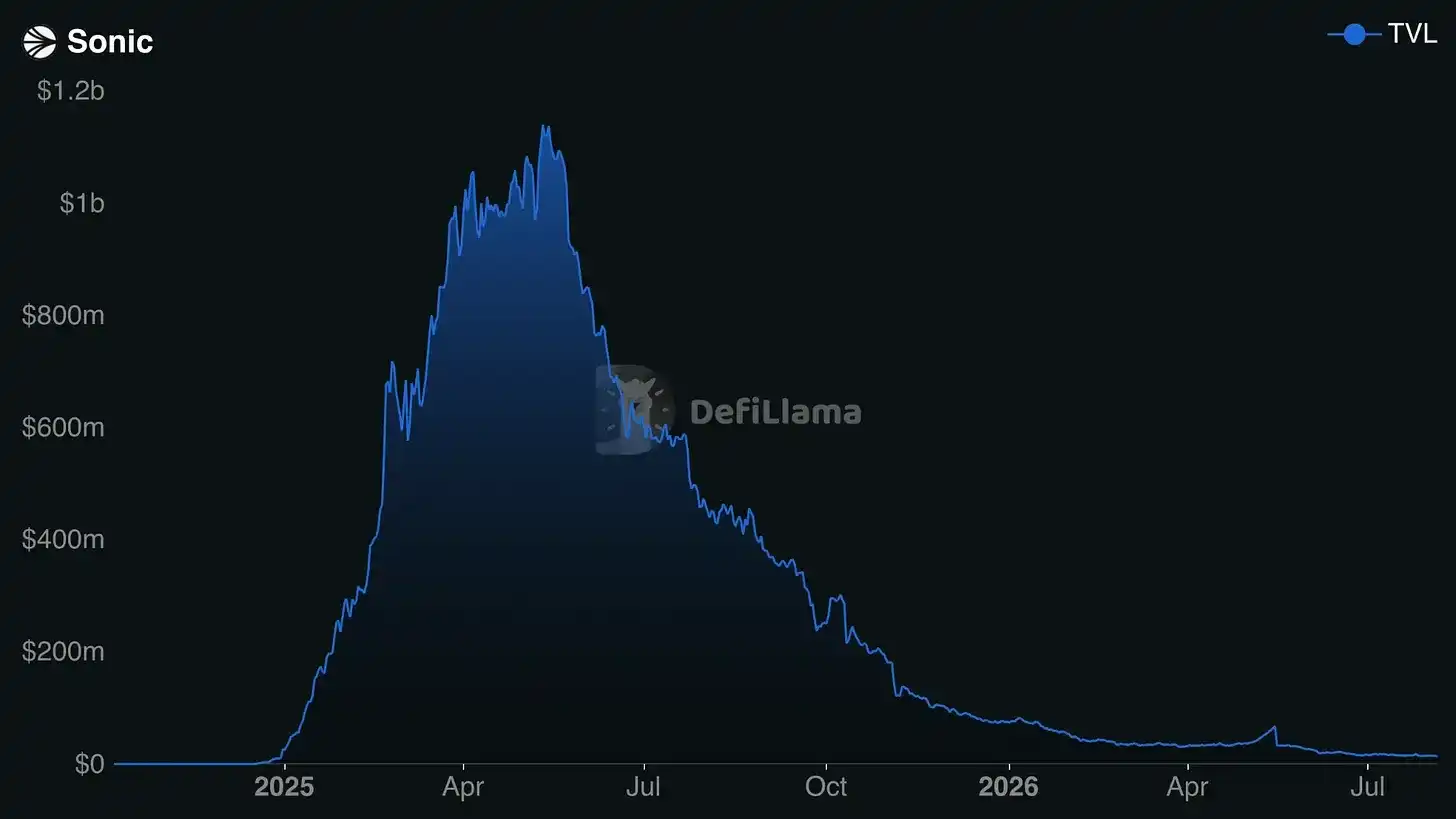
Data Source: DeFiLlama
Now, looking at the public chains from which Aave is about to withdraw—Soneium, Aptos, Zksync, Scroll, etc.—their situation is even worse than Harmony and Fantom. On-chain deposits have already plunged by 95%, and lending business quarterly revenue is less than $5,000.
At least before the hacks, Harmony and Fantom had genuine native lending demand generated by real users. But these six public chains never developed native business demand from the start. These chains raised an average of $250 million each and deployed one of the most cost-efficient lending protocols in DeFi, yet still failed to catalyze real demand.
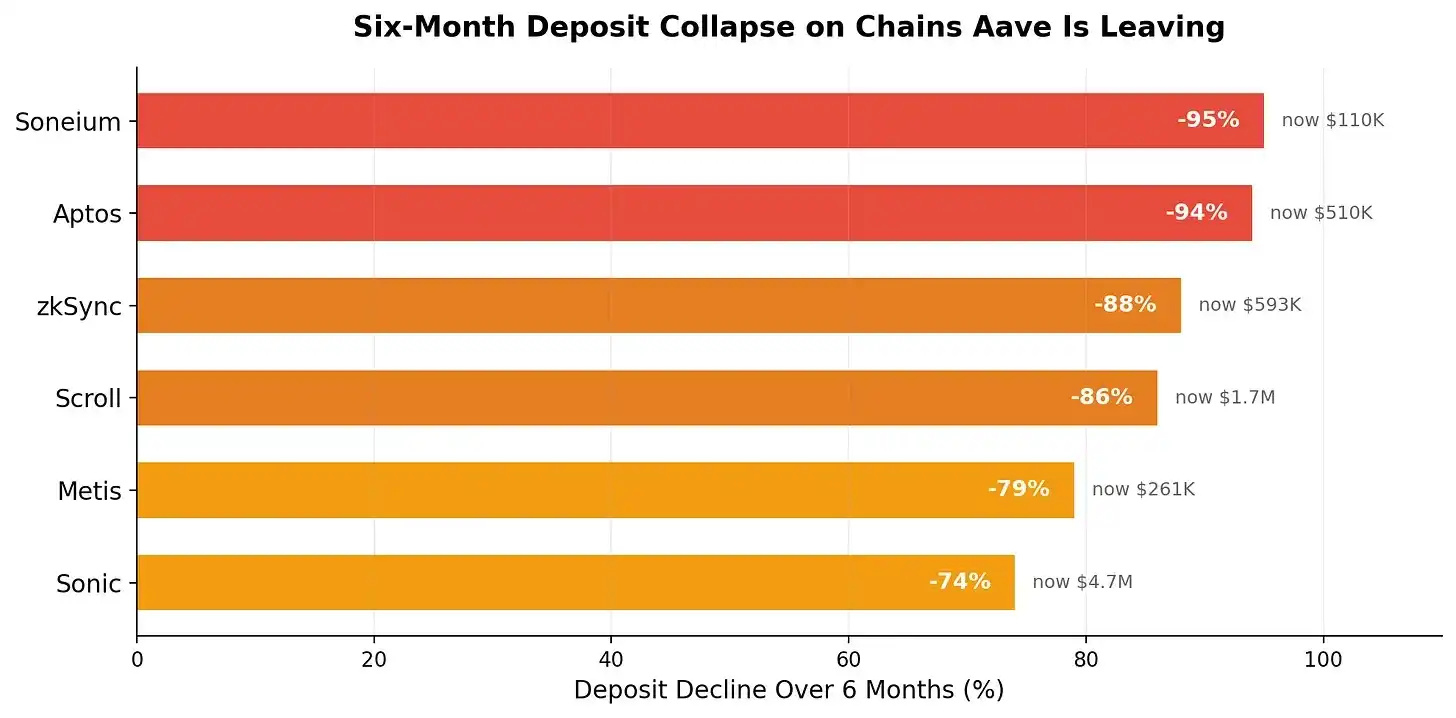
Data Source: Aave Governance Page
Aave's exit will also trigger a chain reaction. Many people don't realize that Aave is the core pillar of the financial infrastructure on these public chains. Almost all Chainlink oracle price feeds on these chains are maintained at Aave's cost, as Aave is the largest caller. After Aave leaves, all oracle service providers will reassess whether it's worth maintaining feeds for a public chain without an active lending market. Market makers will also stop allocating capital to DEXs on these chains for the same reason. Even stablecoin issuers won't provide native issuance support for chains with monthly revenue under a thousand dollars. The departure of one service provider accelerates the next provider's exit. The commercial viability of all these service providers is built on the premise that other supporting services are functioning normally.
Resources will increasingly concentrate towards public chains that are operating well, have ample liquidity, and where lending markets function normally. Every infrastructure withdrawal from a niche public chain further strengthens the aggregation effect of leading chains, making the business case for remaining niche chains to maintain their own lending infrastructure even weaker.
This centralization is self-reinforcing. Lending is the foundation of a public chain's entire financial system. Without lending, most yield strategies cannot operate, as many strategies require borrowing one type of asset by collateralizing another; efficient liquidity market-making also becomes impossible, as concentrated liquidity positions often rely on borrowed funds. Once lending disappears, all financial applications built on top of it lose their foundation. Subsequently, developers gradually leave, on-chain activity further declines, and even fewer infrastructure service providers are willing to stay.
This is precisely why Aave has set thresholds for future deployments on new chains: a minimum annual revenue of $2 million. This amount essentially covers the cost of maintaining the entire lending infrastructure—oracle feeds, risk monitoring, and liquidation—for a single public chain. This also fully illustrates that the past model of public chains raising hundreds of millions and quickly onboarding liquidity through subsidies is no longer viable or sustainable.
A Dilemma Not Unique to the Crypto Industry
The loss of credit infrastructure on public chains is not a phenomenon unique to the crypto space. Any industry with high fixed costs but a small market size faces similar issues.
After 2008, global banks began cutting correspondent banking relationships with some smaller countries. The logic is highly similar to Aave's: anti-money laundering monitoring, regulatory reporting—each relationship established incurs fixed costs, and the revenue from some small-scale cross-border businesses cannot cover these costs. Between 2011 and 2022, the number of active global correspondent banking relationships decreased by 30%. Dollar clearing channels for Pacific island nations shrunk by over 60%, with some countries left with only one correspondent bank. The situation became so severe that the World Bank had to allocate $69 million in subsidies to keep the last clearing service providers operating in eight Pacific nations.
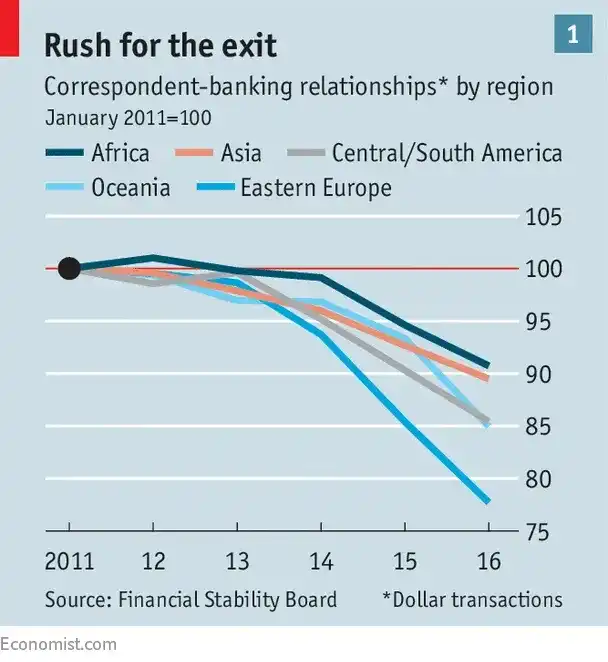
There is a crucial difference between the crypto industry and traditional cases. In the traditional correspondent banking system, entities like the World Bank step in as a backstop, with central banks and development agencies providing subsidies to sustain operations. But the crypto industry almost entirely lacks such a backstop mechanism, which is precisely the reality these public chains are experiencing. A medium-sized bank spends $15–40 million annually on compliance costs alone; the World Bank's $68 million investment merely preserved the last dollar clearing channel for 8 countries. Meanwhile, the total cost for Aave's risk monitoring contracts across all public chains is only $5–8 million, and these six chains can't even afford their share of that cost.
Of course, this doesn't mean DeFi lending as a whole is shrinking; quite the opposite: the industry is growing rapidly, but also highly concentrated. Morpho's TVL grew from $105 million to over $8 billion within a year; Euler expanded from $6 million to $300 million in just a few months. Aave's V4 surpassed $300 million in deposits within months of launch, and Société Générale became the first traditional bank to integrate with a DeFi lending protocol. The credit market is vibrant, but resources are concentrated on Ethereum and two or three layer-2 networks like Base and Arbitrum, rather than being dispersed across dozens of public chains.
The proliferation of many public chains was based on the assumption that deploying infrastructure costs very little, and each chain could build its own financial system. This assumption is only half right. Launching a public chain is indeed cheap, but operating a credit infrastructure on it is extremely costly. Looking at the current layer-2 landscape, Ethereum and the top three public chains command 90% of the TVL. The remaining chains can only compete for meager shares, and this revenue might not even cover the cost of a single set of Chainlink price feeds. In the future, these chains might see a forked version of Aave with flawed oracles, or perhaps nothing at all will remain.