Just Now, GPT-6 Astra Collaborates with Non-Professional Mathematicians to Prove 57-Year-Old "Circle Packing" Problem

marsbitPublished on 2026-10-12Last updated on 2026-10-12

Abstract

AI has made another breakthrough in mathematical proofs, with a mathematical enthusiast using GPT-6 Astra to significantly advance a 57-year-old geometry problem. The problem is known as "circle packing in a circle": given N unit circles, what is the smallest radius R of a larger containing circle that can hold them all without overlap? While optimal arrangements for small N have been known since 1969, providing rigorous mathematical proof of their optimality has remained a major challenge. Before this work, only cases up to N=14 and N=19 had been definitively proven. The enthusiast, known as nor, employed GPT-6 Astra to rigorously prove optimality for the remaining cases of N=15, 16, 17, 18, and 20. According to nor, the model's core strategy shifted from direct optimization to a constraint-based approach: first, establishing that outer disks can be moved to the boundary; then, using angular relations to eliminate vast numbers of potential arrangements; finally, employing computational enumeration and geometric rigidity arguments to prove that no arrangement can fit into a smaller containing circle than the known classic pattern. The proof process was iterative and complex, with nor contributing key guidance, verification, and refinement alongside the AI. The results, shared online, sparked interest from others exploring similar AI-assisted mathematical research, highlighting a growing community leveraging new tools for problem-solving. This work demonstrates the expandi...

AI is really entering a math proof sweep mode now.

Just now, a math enthusiast used GPT-6 Astra to take a major step forward on a 57-year-old math problem.

The problem sounds not very complicated:

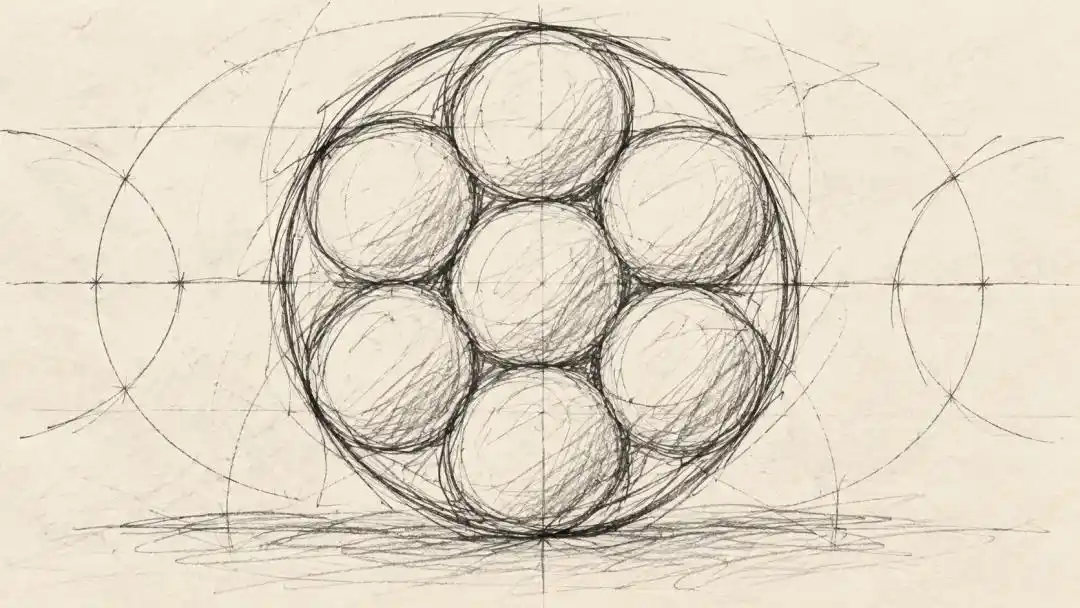
Given N disks of radius 1, how do you pack them into a large circle so that the radius of the large circle is as small as possible?
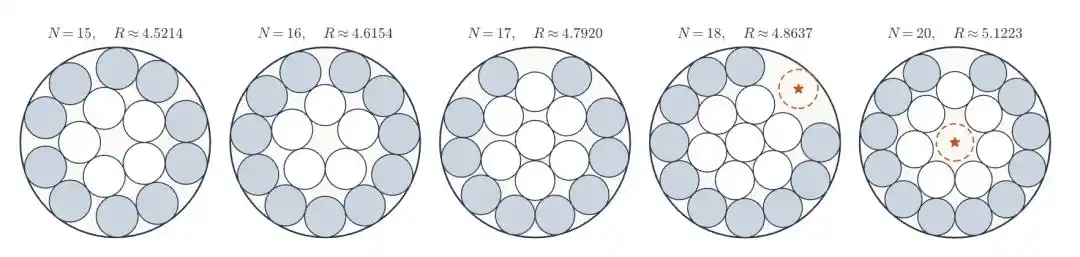
In fact, mathematicians did come up with beautiful packing arrangements back in 1969, but...... for 57 years, no one has been able to rigorously prove that they are the optimal solutions.

So this time, math enthusiast "nor" pulled out GPT-6 Astra...... and in one go, provided rigorous proofs for the 5 remaining cases for N≤20: namely N=15, 16, 17, 18, and 20......

Previously, only cases for N≤14 and N=19 had been verified.

Oh, and reaching N=20 is not the AI's limit; it's just that nor didn't intend to prove further cases......

A Proof Stalled for Half a Century

Let's first formalize this problem in a more mathematical way.

Assume there are N disks, each of radius 1, and a large circle of radius R.

Requirements:

All small disks must lie entirely inside the large circle; they can be tangent to the large circle's boundary but cannot extend beyond it.

Any two small disks cannot overlap internally, but they are allowed to be tangent to each other.

The small disks can be moved and arranged arbitrarily within the large circle, with no restrictions on the arrangement.

The question is: For a given positive integer N, what is the smallest possible radius R for the large circle?

It looks like a simple olympiad-style problem, but in reality, finding the optimal arrangement is just the first layer. The true difficulty lies in rigorously proving mathematically that the arrangement has reached its limit and that no better packing exists.

In 1968, American mathematician Ronald Graham proved the cases for N≤7.

In 1969, researcher Udo Pirl pushed the proven range to 10 disks and further studied packing schemes for 11-19 disks.

But it wasn't until around 2003 that cases for N≤14 and N=19 were rigorously proven.
nor is a technical writer who has long been involved in research on mathematics, machine learning, and optimization algorithms, and has frequently participated publicly in AI-assisted mathematics research.

He personally started following this problem over a decade ago, and indeed, there hasn't been much progress on it in the past ten-plus years......

So what else is there to say? Might as well toss it to GPT-6 Astra (bushi).

nor took a step-by-step approach: first had GPT-6 Astra handle the N=15 case; after the model solved it, he had it extend the same method to 16, 17, as well as 18 and 20...... GPT-6 Astra successfully provided proof results for all of them.

It's just that......

The proof process is, as always, obscure and difficult to understand.

Simply put, the core idea of GPT-6 Astra is:

Instead of directly searching for the optimal solution, it uses geometric constraints to reduce the infinite number of possible arrangements to a finite set of cases, then uses a computer to eliminate them one by one, ultimately rigorously proving that the classic arrangement is optimal.

The proof process consists of 5 steps:

Push outer disks towards the boundary. Proves that under specific conditions, disks near the outer circle can be pushed outward without causing overlap. This divides the disks into a group on the boundary and a group in the interior.

Use angular relations to eliminate many arrangements. Since disks cannot overlap, they must maintain a certain angular separation. If a certain arrangement requires a total angular sum exceeding 360°, it can be directly eliminated.

Let the computer enumerate remaining possibilities. Instead of searching for the specific coordinates of each disk, it checks the distance intervals of the disks from the center and their cyclic order.

Use geometric rigidity to prove precise optimality. The previous search can only prove that all feasible arrangements are very close to the known classic arrangement. Next, using contact constraints between disks, it proves that these arrangements cannot undergo permissible tiny deformations, thus elevating "very close" to "strictly identical". The case for 15 disks uses another odd-cycle argument.

Restore the original arrangement. Finally, it proves that in the original arrangement, at least one disk must be in contact with the outer circle's boundary. This means it's impossible to pack all disks into an outer circle with a smaller radius, thus completing the optimality proof.

It's worth emphasizing that it's not like nor gave a single prompt and Astra immediately proved everything in one go.

In his blog post, nor writes that his contributions as a human in this work included:

Determining problem feasibility, guiding the model, battling the buggy web user interface, enduring poor copywriting, fixing subtle issues, repeatedly refining explanations, manually verifying validity, and re-checking everything using Astra and Opus 5.5.

One More Thing

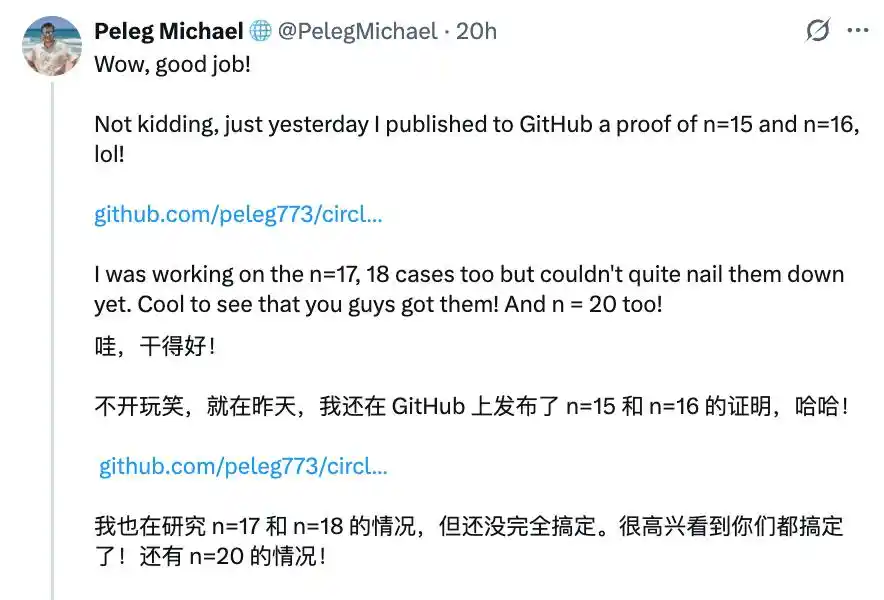
A rather interesting thing is that once nor posted the results, he found quite a few fellow travelers using AI to research the same problem.

Some netizens also commented that AI's breakthroughs are making mathematics easier to understand, "I had no idea the math community could have such a strong exploratory atmosphere."
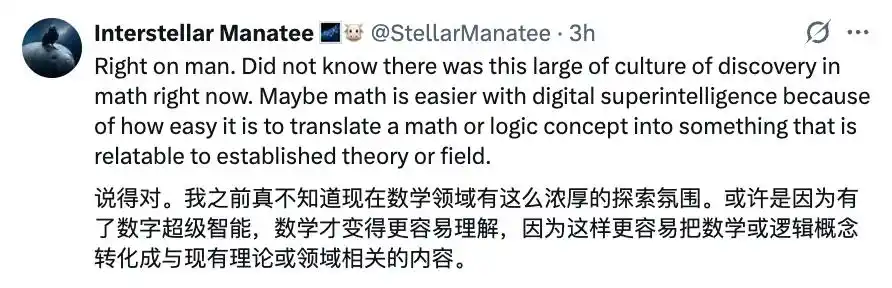
From the perspective of math enthusiasts, it's also a new phenomenon in the era of Mathematics 2.0.

Original links:

[1]https://nor-blog.pages.dev/posts/2026-10-11-circle-in-circle-packing-15-20/

[2]https://x.com/norxornor/status/2109078411251454017

This article is from the WeChat public account "QbitAI", author: Focus on Frontier Technology

Related Questions

QWhat is the main achievement described in the article regarding the use of GPT-6 Astra?

AThe article describes that a math enthusiast, using GPT-6 Astra, has successfully provided rigorous mathematical proofs for the optimal packing of N unit circles into a larger circle for the previously unproven cases of N = 15, 16, 17, 18, and 20, thereby advancing a 57-year-old mathematical problem.

QWhat is the 'circle packing' problem mentioned in the article?

AThe problem involves packing N unit circles (radius 1) into a larger circle of radius R. The goal is to find the smallest possible R such that all small circles lie completely inside the large circle without overlapping each other, though they can be tangent. The challenge is not only to find good arrangements but to mathematically prove they are optimal.

QWhat was the state of the problem before this AI-assisted proof?

ABefore this work, rigorous proofs existed only for N ≤ 14 and N = 19. The optimal arrangements for N = 15, 16, 17, 18, and 20, though conjectured, had not been formally proven to be the best possible for over five decades.

QWhat core strategy did GPT-6 Astra employ in its proof, according to the article?

AThe core strategy was to avoid a direct search for the optimal solution. Instead, GPT-6 Astra used geometric constraints to reduce the infinite set of possible arrangements to a finite number of cases. These remaining cases were then systematically eliminated using computer enumeration and geometric rigidity arguments to show the known classic arrangement must be optimal.

QWhat role did the human researcher 'nor' play in this project, as stated in the article?

AAccording to the article, 'nor' contributed by assessing the problem's feasibility, guiding the AI model, battling a buggy web interface, fixing subtle issues, repeatedly refining explanations, manually verifying the AI's output, and using both Astra and Opus 5.5 to double-check all the results.

Related Reads

WasabiCard Launches "Global Card Issuance Solution" to Help Businesses Launch Local Card Programs in 100+ Markets

WasabiCard has launched its "WasabiCard Local Issuing Solution," enabling businesses to quickly establish and manage local card issuing programs in over 100 markets through a single API, while meeting regulatory compliance requirements, offering competitive rates, and supporting stablecoin settlement in USDT, USDC, and Open USD (OUSD). CEO Ray Yang noted that companies expanding globally previously had to issue cards from one market and hope the model worked elsewhere, which increased friction around compliance, payment acceptance, and fees. The new solution lets businesses use one API to build local card programs across 100+ markets while flexibly choosing stablecoin settlement, branded experiences, and familiar payment methods. Built on WasabiCard's underlying infrastructure and partnerships with local financial institutions, the solution lets businesses use regional BINs and build card programs around local issuing systems. Local issuing helps reduce cross-border and FX costs and improves the payment experience. After a single API integration, businesses can issue and manage cards across markets, control card lifecycles, and set program rules. Following KYB, compliance, and partner review, accounts can be opened in as little as 24 hours. Businesses can choose corporate or individual BINs, support virtual and physical cards via Apple Pay and Google Pay, and opt for white-label services. The solution combines stablecoin settlement with familiar card payment experiences, offering Visa and Mastercard commercial and individual card options. Compliance checks begin before deposited funds can be spent: on-chain data is cross-verified to understand funding sources and identify links to fraud or stolen assets. Directly high-risk funds are rejected, while indirect links trigger further review. Use cases span global payroll and payouts to Web3 teams, contractors, and partners; creator and commission payouts for content and livestream platforms; digital advertising and AI service subscriptions; and corporate procurement and employee expense management. WasabiCard serves over 700 enterprise clients, with more than 700,000 cards issued and over $1 billion in transaction volume, covering 200+ countries and regions and supporting 70+ card BINs. WasabiCard is a global payment infrastructure platform providing card issuing, global payouts, and cross-border payment capabilities through stablecoin-driven financial infrastructure, serving advertising, AI and SaaS subscriptions, global payroll, treasury management, and digital finance use cases.

marsbit23m ago

WasabiCard Launches "Global Card Issuance Solution" to Help Businesses Launch Local Card Programs in 100+ Markets

marsbit23m ago

Jensen Huang Caught in Another Affair with Subordinate, Probability of Departing NVIDIA by Month's End Nears 90%

NVIDIA CEO Jensen Huang is facing escalating scandal after reports of a second extramarital affair. Following earlier allegations involving Alice Huang, an executive at Singapore data center company Megaspeed, The New York Times reported that Huang also had an affair with Kimberly Powell, a married NVIDIA vice president of healthcare and one of roughly 60 executives reporting directly to him. Powell, 48, joined NVIDIA in 2008 and has led its healthcare business since 2017. NVIDIA's code of conduct prohibits private relationships that could create conflicts of interest. NVIDIA's earlier statement that the matter would not affect Huang's role as CEO has reportedly been withdrawn. The Wall Street Journal reported that the board is considering meeting to discuss Huang's future, potentially appointing an interim leader while searching for a new CEO with outside firms. Polymarket odds of Huang leaving before November 30, 2026 have risen to 88%, and to 93% before March 31, 2027. Elon Musk, responding to a suggestion that he hire Huang, said it "would be an honor." The news triggered sharp stock moves: NVIDIA closed up 2.87% but fell as much as 10% after hours, shedding over $300 billion in market value and dragging down other AI stocks including Intel and Dell. A key concern is succession: NVIDIA has no clear plan, and Huang's unusual management structure—with dozens of direct reports and few layers—makes him the central node of the company. While executives like CFO Colette Kress could handle operations, none can quickly replace Huang's industry influence and role as NVIDIA's public face. Neither Huang nor NVIDIA has confirmed or denied the second affair.

Odaily星球日报48m ago

Jensen Huang Caught in Another Affair with Subordinate, Probability of Departing NVIDIA by Month's End Nears 90%

Odaily星球日报48m ago

Ethereum Plans to Move Post-Quantum and Anti-AI Upgrades Forward to 2027: Ethlabs Proposes Restructuring the Hegotá Hard Fork Plan

Ethlabs, a non-profit Ethereum R&D lab, has submitted the pqai27 community proposal to the Ethereum community forum, calling for 2027 to be the target year for achieving quantum resistance and AI resistance on Ethereum. With Ethereum's on-chain TVL exceeding $41.16 billion as of November 12, the proposal argues that Ethereum should leverage its existing hash-based cryptography and formal verification foundations to reinforce its position as the global value settlement layer as AI evolves rapidly and quantum timelines accelerate. The direct motivation is the compression of external timelines: the U.S. government has moved its quantum-resistance target from 2035 to 2030, and Google plans to complete its full cryptographic migration by 2029. AI attack capabilities are also advancing—OpenAI has used frontier models to find and patch roughly 1,000 Linux vulnerabilities and solve hundreds of math problems. "AI resistance" means relying on minimal hash primitives, formal verification, and client diversity to harden the base layer. The roadmap splits 2027 into two stages. The baseline "pqai-ready" stage requires quantum resistance at the consensus layer and ensures users can migrate to quantum-resistant accounts via the Frames account abstraction proposal EIP-8141; if existing cryptography fails early, the network can degrade to calldata to keep running. The advanced "pqai-scaled" stage targets full-capacity operation, introducing EIP-8288 for quantum-resistant signature aggregation and EIP-8479 for quantum-resistant data availability, so quantum-resistant transactions and blobs can regain normal throughput after scaling. To this end, Ethlabs recommends restructuring the scope of the Hegotá hard fork, stripping out non-critical upgrades and reassessing the impact of the FOCIL anti-censorship proposal (EIP-7805) on progress and compatibility; if the execution layer is decoupled from the consensus layer, Frames could ship independently first. The consensus layer must choose between retrofitting the existing Gasper implementation for quantum resistance and moving to decoupled consensus. Ethlabs announced it is withdrawing its push for Quick Slots (EIP-8198) in Hegotá, deferring it to 2028, while Glamsterdam and its scaling plans proceed as normal. The roadmap remains an Ethlabs community initiative; any Hegotá fork restructuring or consensus-layer switch requires further discussion and agreement among Ethereum's All Core Devs. Ethlabs notes that AI is also accelerating formal verification and zero-knowledge proof benchmark optimization, and that advancing pqai27 aims to consolidate Ethereum and ETH's role as the trust root for global value settlement during extreme security cycles.

marsbit1h ago

Ethereum Plans to Move Post-Quantum and Anti-AI Upgrades Forward to 2027: Ethlabs Proposes Restructuring the Hegotá Hard Fork Plan

marsbit1h ago

Former OpenAI Researcher Changes His Tune: Super AI Researcher Could Arrive as Early as Next Year

Former OpenAI researcher Daniel Kokotajlo and the AI Futures Project have revised their timelines, now predicting superhuman AI researchers (SARs) could arrive as early as 2027 rather than 2029. The key driver is a METR assessment of Anthropic, which found that since October 2025, the benchmark score growth rate of Anthropic's internal models reached about 1.9x the previous pace (95% CI: 1.5–2.8x) — roughly two years' worth of progress in one year. METR estimates that by October 2026, about 80% of the extra acceleration may come from AI itself, though this is a subjective guess with high uncertainty. AI is already helping researchers write experiment code, run tests, and try out more ideas. Using METR's estimates, the team calculated that by early November 2026, AI-driven acceleration alone could push overall model progress to 1.7x the historical rate — a speed that, in the original AI 2027 scenario, wouldn't be reached until around April 2027, about five months later. Notably, METR says most of the evidence underpinning its core conclusions was redacted from the public report at Anthropic's request, to avoid helping competitors; only the benchmark curves are publicly verifiable. Depending on the method used, SAR arrival estimates range from February 2027 to mid-2028. If acceleration compounds across model generations, superintelligence could arrive sooner than expected.

marsbit1h ago

Former OpenAI Researcher Changes His Tune: Super AI Researcher Could Arrive as Early as Next Year

marsbit1h ago

Aave V3.8 Officially Launches: Covering 15 Public Chains, $15.2 Billion Liquidity Pool, Introducing Low-Gas-Cost Reentrancy Protection

Aave has launched V3.8 across 15 active V3 markets, following approval by the Aave DAO and development by Aave Labs. According to DeFiLlama, Aave's total value locked exceeds $16.4 billion, with active V3 markets holding over $15.23 billion. The upgrade was deployed via AIP #541, completing a 22-day governance process that began with a forum proposal on October 21 and a Snapshot vote on October 27. V3.8 covers active instances on Ethereum (Core and Lido), Plasma, Avalanche, BNB Chain, Monad, Base, and Arbitrum, along with Mantle, X Layer, Polygon, Linea, Optimism, Gnosis, MegaETH, and Celo. Legacy markets that were frozen with zero caps were deliberately skipped. The release introduces kernel-level reentrancy protection for external callback operations on liquidity pools. Traditionally, preventing cross-function reentrancy requires writing a lock flag before state changes, but after EIP-3529 capped SSTORE refunds at 20%, maintaining persistent locks in high-frequency lending pools became gas-intensive. V3.8 instead uses EIP-1153 transient storage, where TSTORE and TLOAD cost only 100 gas per read or write and automatically clear at transaction end, providing reentrancy hardening at minimal cost. Aave Labs addressed developer concerns that the lock might block liquidation composability within flash loan callbacks. The flashLoan and flashLoanSimple entry points only check the lock status without setting it, creating asymmetric isolation: users can still compose liquidations, deposits, or repayments inside a flash loan callback, but attempts to initiate a flash loan from within a regular pool operation callback are rejected and reverted. Security verification included Certora formal verification and independent external audits before the AIP vote. The new contract code is published in the official Aave V3 repository under the Business Source License. Developers also noted that downstream integrators reading view functions such as account health factors or reserve data during callbacks should account for intermediate ledger states and ensure peripheral risk controls remain compatible.

marsbit1h ago

Aave V3.8 Officially Launches: Covering 15 Public Chains, $15.2 Billion Liquidity Pool, Introducing Low-Gas-Cost Reentrancy Protection

marsbit1h ago

Trading

Spot
活动图片