ChatGPT Might Be Disappearing Soon

marsbitPublicado a 2026-06-03Actualizado a 2026-06-03

Resumen

OpenAI announced at its "Intelligence at Work" event that its coding assistant, Codex, will be fully integrated into the ChatGPT app within weeks. This move marks a strategic shift from a conversational AI (Chat) towards a unified "agentic" platform capable of execution. Codex, originally launched to compete with Anthropic's Claude Code, has grown rapidly to 5 million weekly active users, with 20% being non-developers like analysts and designers. Its enterprise revenue now constitutes 40% of OpenAI's total. The integration is the first step in creating a super-app combining ChatGPT (interface), Codex (execution engine), and the Atlas browser (web access). OpenAI also unveiled new Codex features: specialized Agent plugins for six professional roles, an "Annotations" tool for direct document editing, and a "Sites" function to turn work into shareable web apps. Internally, this reflects a power shift; the Codex team now leads core product strategy. While the ChatGPT brand remains for its vast user base, the platform's future is focused on autonomous agents that perform tasks, not just chat. The article notes that competition with Claude Code pushed OpenAI's development, with Codex competing on cost-effectiveness and accessibility rather than raw coding quality. It concludes that the essence of "ChatGPT" is evolving from a chatbot into an AI agent platform, with the name potentially becoming a legacy symbol of its original function.

OpenAI's super app has finally 'taken shape'.

It's still called ChatGPT, but its core is about to gain a new member: Codex.

And ChatGPT is essentially just a shell now.

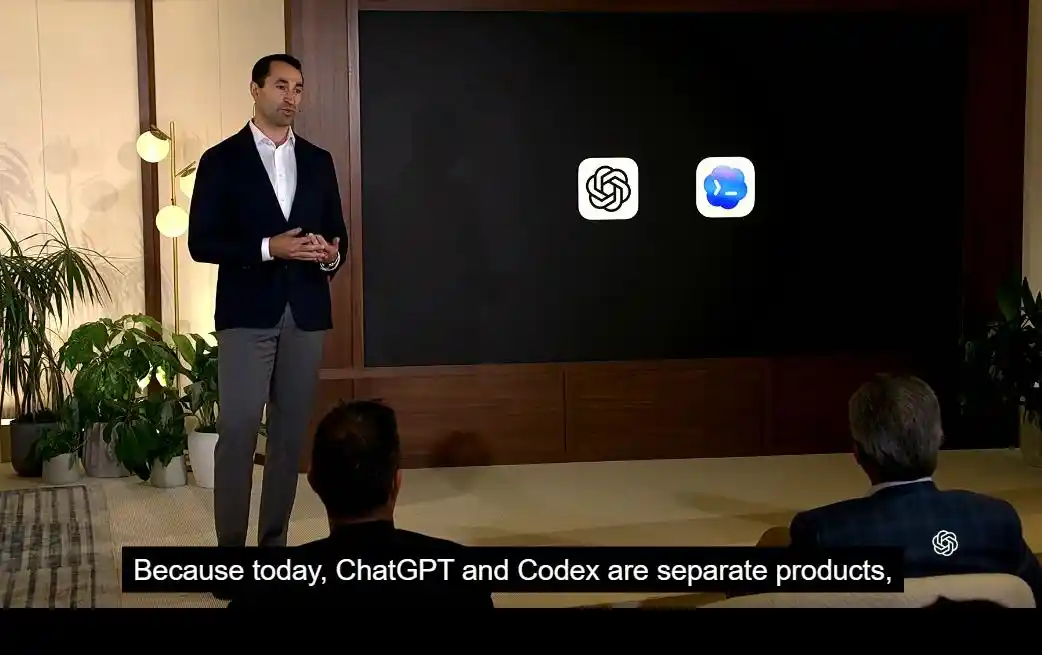
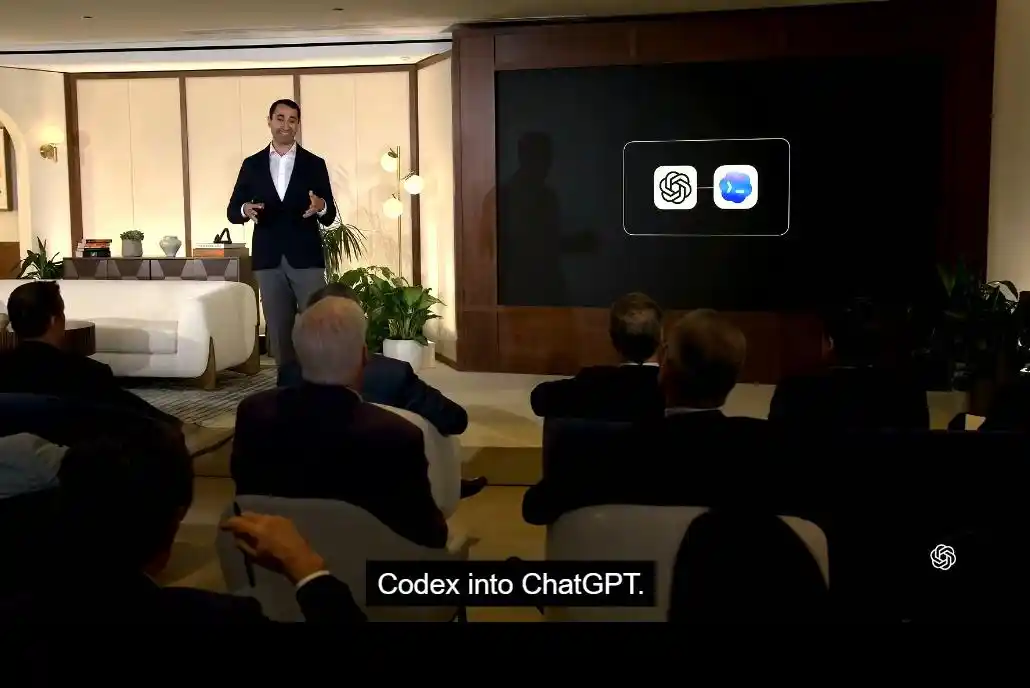
At the Intelligence at Work launch event just held by OpenAI, the company officially announced that Codex will be integrated into ChatGPT in the coming weeks.

Initially, this news was a bit confusing? Wasn't there always a Codex option in ChatGPT?

Only when I clicked on it today did I realize it was 'fake'—it prompts you to further download the Codex app, you can't use it directly within ChatGPT.

So, once the integration happens, chatting and working can be done within a single app, no need to switch between apps anymore.
But, did you think that's the end of the story?

At least from OpenAI's perspective, Codex might just be the beginning.

And through this launch event, we finally got a clear picture of the entire vision for the super app.

So Codex Was Just the First Step

The launch event lasted a full hour, packed with information, but it can be summarized into three key things.

1. ChatGPT will merge with Codex because times are changing.

2. Codex will continue to evolve, so three major updates were announced.

3. Codex is catching up to Claude Code, and GPT-5.5's 'efficiency' is a key factor.

Let's quickly go through them:

First, the somewhat surprising merger. Why is ChatGPT choosing to merge with Codex now?

One reason is that Codex, initially launched to catch up with Claude Code, can now speak for itself with results.

Codex weekly active users have surpassed 5 million, skyrocketing 6 times since the desktop version launched in February.

More crucially, 20% are not programmers at all, but knowledge workers like analysts, designers, and investment banking professionals, and this group is growing 3 times faster than developers.

This indicates Codex is achieving significant breakout momentum.

Regarding revenue, which OpenAI values highly (they followed Claude Code partly because they were envious of its revenue), OpenAI itself revealed that enterprise revenue currently accounts for 40% of OpenAI's total revenue, projected to reach 50% by year-end.
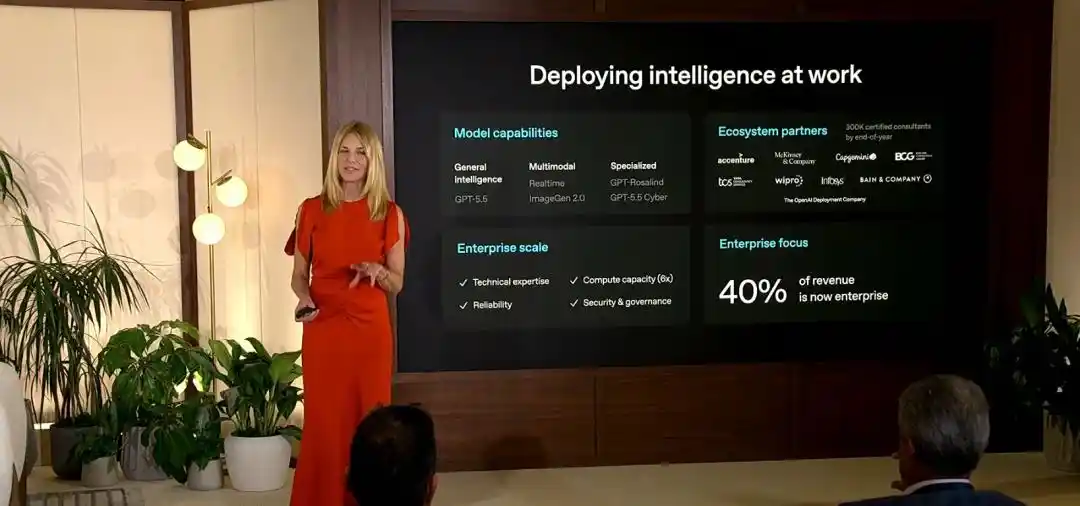
In short, Codex now has rapid user growth, broad user coverage, and is genuinely making money for OpenAI.

All signs seem to be telling OpenAI it's time to consider the next step.

And the direction of the next step, at least for now, seems very clear—from Chat to Agent, from conversation to execution.

Alexander Embiricos, OpenAI's Head of Product, said this during the launch:

You might not work 24/7, but your Agent in the cloud will.

A single line encapsulates the ultimate appeal of a super app. In the future, users truly won't need to switch between apps. You give an instruction, ChatGPT helps you understand it, and then Codex can call upon various Agents to execute for you.

So this integration is essentially OpenAI's first step toward a super app.

What's the next step? You might have guessed—Browser.

The browser is the final piece of this integration, providing the entry point for AI into the web world. It allows users to simply speak in ChatGPT, and Codex can automatically perform tasks like searching, operating backends, and handling work within the browser—everything that previously required manual clicks.

Thus, ChatGPT + Codex + Atlas browser, OpenAI finally has the potential to achieve execution across all scenarios through a single APP.

But for today, let's stick to talking about Codex.

To equip Codex with more 'soldiers' capable of doing work, OpenAI unveiled three more updates in one go:

Six Professional Role Agent Plugins, covering data analysis, sales, creative production, product design, equity investment, and investment banking, directly integrating 62 enterprise apps like Snowflake, Figma, and Salesforce, and embedding 110 automation skills.

Annotations feature, allowing direct annotation and modification on the original text of documents, eliminating the need to regenerate entire pieces. Developers are already using this capability to modify code, Markdown files, and websites generated by Codex.

Now, it extends to content creation scenarios like documents, spreadsheets, and presentations.
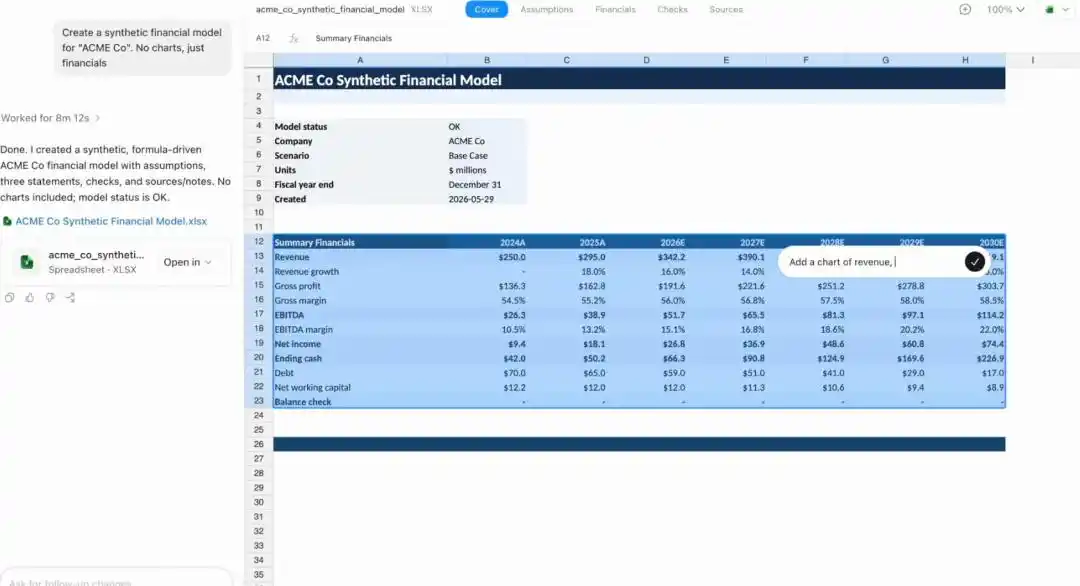
Sites feature, enabling Codex to turn your work results into interactive web applications with one click, generating URLs to share directly with teams.

This feature feels quite practical. Previously, when developing a project, non-technical people could only vaguely describe their needs. Now, anyone can generate a clear, intuitive, visualizable demo, significantly reducing team communication costs.

This feature is currently in preview for Business and Enterprise customers.
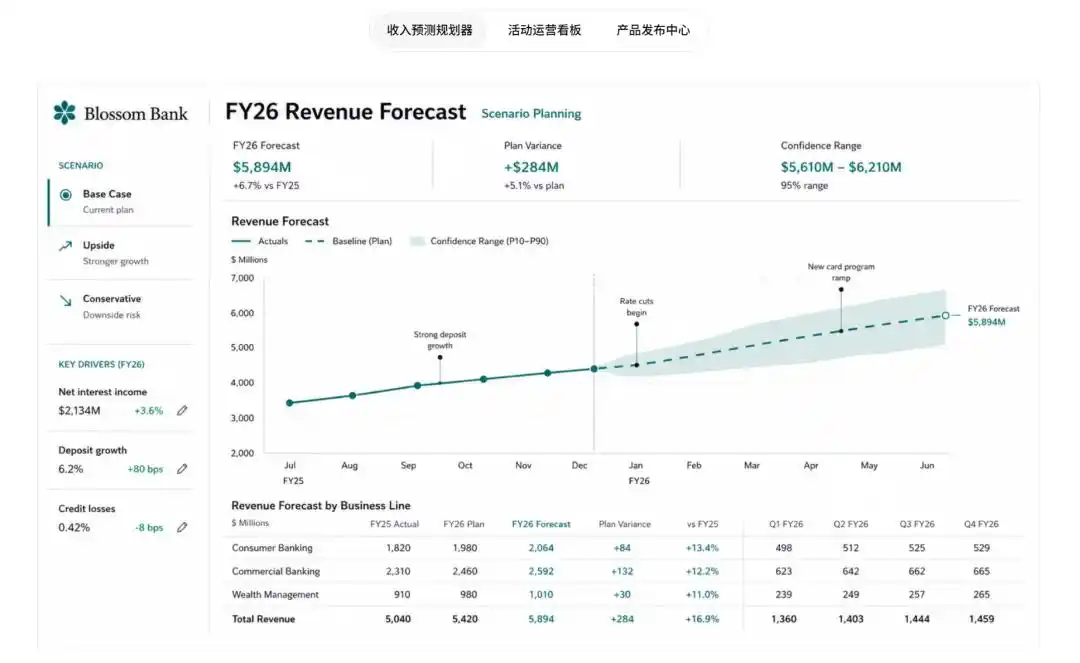
See, OpenAI is betting that in the future, more and more ordinary people will shift from conversation to execution.

Some might ask, why isn't Codex absorbing ChatGPT instead?

It can be said that, superficially, this appears to be ChatGPT absorbing Codex, but piecing together a few details, the direction might be the exact opposite.

In the May organizational restructuring, Thibault Sottiaux, who built Codex into what it is, was promoted to Head of Core Product and Platform, overseeing consumer, enterprise, and developer lines. Nick Turley, who grew ChatGPT to 900 million weekly actives, was moved to the enterprise product line.

So now, it's the Codex team managing ChatGPT, not the other way around.

Furthermore, the wording in Brockman's internal memo is worth pondering—

He didn't write 'upgrade ChatGPT,' but 'invest in a unified agentic platform.'

Therefore, this merger is less about product integration and more about a strategic shift: from conversation to execution, from chat to Agent.

ChatGPT provides the massive user base of 1 billion, Codex provides the growth engine and future narrative.

The shell belongs to ChatGPT, but the soul belongs to Codex.

However, in the end, Codex's existence was forced by competitor Anthropic.

Even the GPT-5.5 mentioned during the launch can almost be considered a product born from this pressure.

Codex Was Forced Out by Anthropic

Looking back, if it weren't for Anthropic, Codex might still just be an inconspicuous auxiliary feature in ChatGPT today.

Let's rewind to the release of Claude Code's preview version last year.

Claude Code was an immediate success upon its debut, its annualized revenue breaking $2.5 billion by February this year, reaching $1 billion in just 6 months from launch, making it one of the fastest-growing commercial software products in history.

About 4% of global GitHub public commits come from it, and users spend an average of 20 hours per week on it.

It was the explosion of Claude Code that made OpenAI realize internally: they were already falling behind in the coding domain.

How to catch up? Just chase.

The default narrative in the AI industry had always been Anthropic following in OpenAI's footsteps—GPT releases first, Claude follows; ChatGPT becomes popular first, Claude emulates.

But on the Code front, the script was completely rewritten.

Claude Code launched in February last year, and OpenAI only released the competing Codex two months later; Anthropic made a desktop version first, OpenAI chased after it; Anthropic launched Cowork for knowledge workers, OpenAI later caught up with Plugins.

This time, OpenAI was following in Anthropic's footsteps.

But the chase was indeed rapid. Looking at the timeline: 14 months, from zero to 5 million weekly actives.

Codex Cloud preview went online in April last year;

Launched desktop App and dedicated model GPT-5.3-Codex in February this year;

Announced super App merger and acquisition of Python tool company Astral in March;

Launched ChatGPT Pro at $100/month to attract developers in April;

Released mobile version in May;

Officially integrated into ChatGPT in June.

It could be said that almost every step here has the shadow of Claude Code.

But to be honest, Codex didn't stage a comeback by directly competing on code quality.

After all, blind test data shows Claude Code still has a 67% win rate, and most programmers admit its outputs are more robust.

However, Claude Code's usage limits are simply too strict, and it's more expensive than Codex.

A discussion thread on Reddit involving over 500 developers condensed into one consensus:

Claude Code is smarter, but the limits are too strict for daily use; Codex is a bit worse but actually usable.
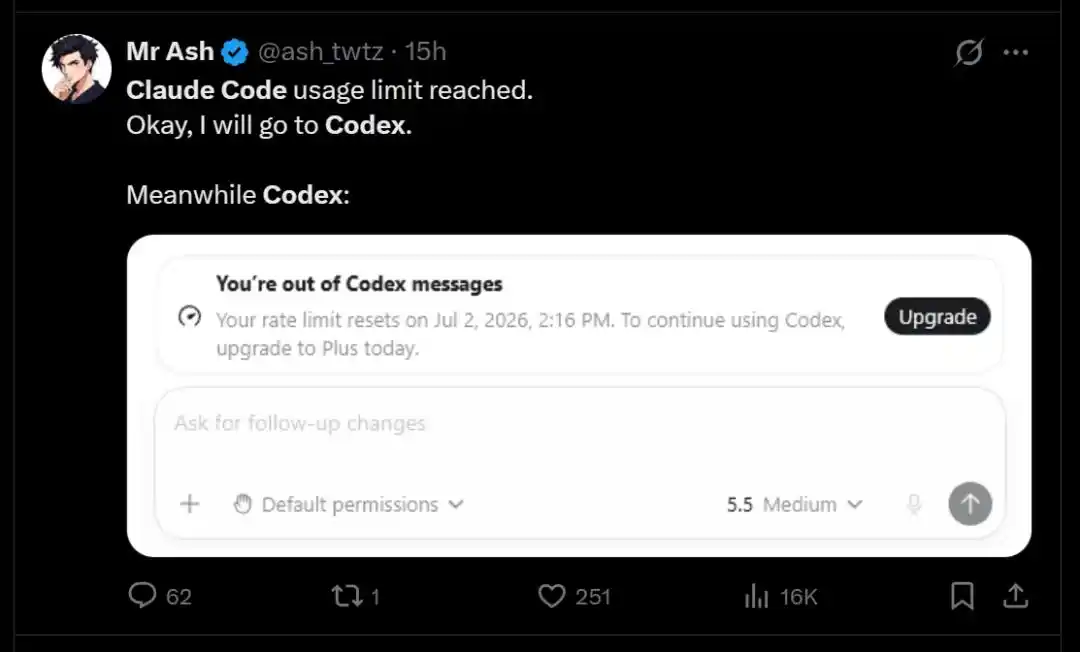
A smarter model that often gets tasks stuck midway and is more expensive, versus a slightly less intelligent but more affordable model.

Which would you choose? (doge)

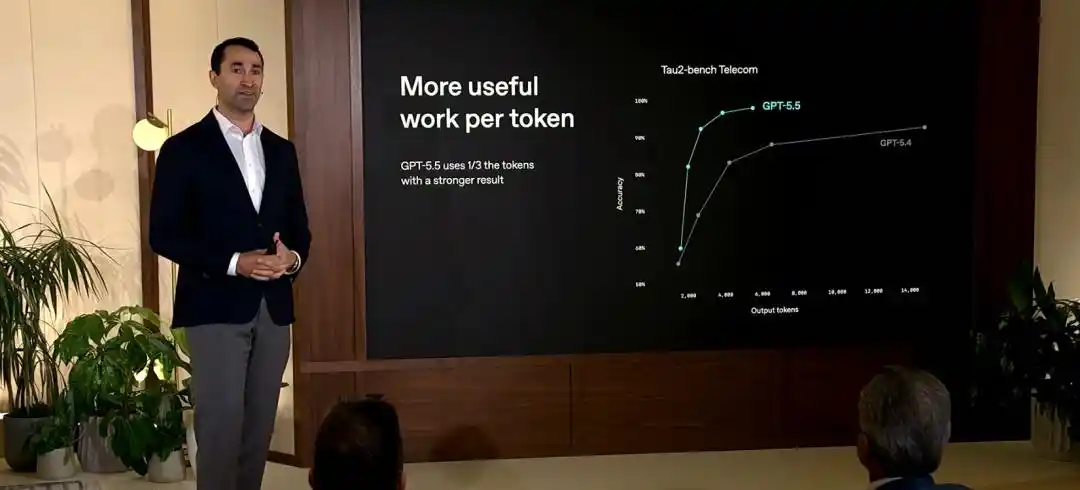
Interestingly, during the launch, OpenAI's Head of Product Alexander also said this golden line:

The one thing GPT-5.5 hates most is wasting tokens.

Using Codex with GPT-5.5 achieves the same quality output using only one-third of the tokens.

In short, on the path to catching up with Claude Code, Codex is making 'more intelligence with fewer tokens' its new guiding principle.
Undeniably, the AI programming field is now a duopoly.

One represents the strongest coding capability, the other the strongest productization capability.

But if we look further ahead, what Claude Code and Codex are competing for is no longer just the programming tools market.

As more and more ordinary people start using Agents as daily work partners, the entry point is actually the most important thing.

And this precisely presents a new opportunity for Chinese players—because in the Agent era, victory may not solely depend on model capability, but also on scenario, ecosystem, application connectivity, and understanding of local enterprise workflows.

In fact, major Chinese tech companies have already entered the field.

Among them, some are targeting developer entry points, some enterprise internal office entry points, and others full-process intelligent Agent platforms.

But regardless of the path, the goal is largely consistent—seize the core entry point of the Agent era.

Everyone understands clearly that how to leverage the time window of local scenarios to establish real competitive barriers at the Agent infrastructure level is the true urgent task.

So, next, let's see who will be the first to break through, running out China's versions of Claude Code and Codex?

And more crucially, who will become the new super entry point in China for the Agent era?

One More Thing

Returning to this merger event.

Considering Codex's current development momentum and the industry environment, I'm inclined to make a bold statement:

Rather than continuing to call the merged application ChatGPT, it would be better to directly call it Codex.

Think about it: ChatGPT sounds like an old relic from the 'Chat' era, but OpenAI's current bet is precisely no longer on Chat.

The people managing the product are from Codex, the internal memo mentions an agentic platform, the fastest-growing scenarios are execution-oriented, and none of the new features are related to chatting.

Is 'ChatGPT' usable? Yes. But is it accurate? No.

Of course, OpenAI likely won't rename it. After all, the three letters 'ChatGPT' have become synonymous with AI, brand assets of immeasurable value.

But not changing the name doesn't mean the essence hasn't changed.

Perhaps soon, when you open ChatGPT, what greets you won't be a dialog box waiting for your question, but an Agent that has already finished the work for you.

By then, whether it's 'Chat' or not will no longer be important.

In other words, ChatGPT might just be a spiritual symbol in the future...

References:

[1]https://www.techmeme.com/260602/p14#a260602p14

[2]https://openai.com/index/codex-for-every-role-tool-workflow/

[3]https://www.theinformation.com/articles/inside-openais-decision-combine-codex-chatgpt

This article is from the WeChat public account 'QbitAI', author: Focus on Frontier Technology

Preguntas relacionadas

QWhat is the main announcement made by OpenAI in the article?

AOpenAI announced at its 'Intelligence at Work' event that Codex will be integrated into the ChatGPT app within the coming weeks.

QWhat is the primary strategic shift indicated by the integration of Codex into ChatGPT?

AThe integration signals a strategic shift from a focus on conversational AI (Chat) towards an agentic platform capable of executing tasks (Action/Agent).

QWhich competitor's product is cited as the primary reason for OpenAI's accelerated development of Codex?

AThe article states that the development of Codex was primarily accelerated in response to the success of Anthropic's product, Claude Code.

QWhat new functionality does the 'Annotations' update to Codex provide?

AThe 'Annotations' feature allows users to directly edit or comment on parts of a document (like code or text) without regenerating the entire content, extending this capability from code to documents, spreadsheets, and presentations.

QAccording to the author, why might the combined app not be accurately named 'ChatGPT' in the future?

AThe author suggests that since the core focus and capabilities are shifting from chat to task execution via agents, the name 'ChatGPT' no longer accurately represents the product's primary function, though the brand name will likely be retained for its value.

Lecturas Relacionadas

AI Relay Stations Spark Heated Debate on Zhihu: Behind Cheap Tokens, What Are Users Really Worried About?

A discussion on Zhihu about "AI relay stations" shifted the niche developer topic of "cheap tokens" into broader user awareness. Users moved beyond simply questioning the legitimacy of these services to focus on practical concerns: Where do cheap tokens truly come from? Is the model being accessed the real one? Can relay stations see prompts, code, and API keys? For occasional users, are the risks worth it? The core debate centered less on price and more on trust. A primary worry is model authenticity—the risk of "model swapping," where users paying for a premium model might be routed to a cheaper one, creating an information asymmetry. Others argued that cost comparisons matter; while cheaper than official pay-as-you-go APIs, relay stations may not be the lowest-cost option versus subscriptions, domestic models, or free tiers, making user needs assessment crucial. Speculation about token sources ranged from legitimate bulk discounts to gray-area methods like account sharing or exploiting regional pricing. This opacity makes risk assessment difficult for users. Data security emerged as a critical concern, especially for enterprise use. When processing sensitive information like code, contracts, or client data, the inability to verify a relay station's data handling, retention, or access policies poses significant compliance and confidentiality risks. The evolving consensus suggests relay stations can be used cautiously for low-sensitivity, disposable tasks (e.g., summarizing public info, simple translation). However, they should not be the default for sensitive, professional, or production workflows involving proprietary data, Agents, or automated systems. Recommendations include avoiding large prepayments, not relying on a single service, using test prompts to monitor quality, anonymizing data where possible, and keeping official channels as backups. Ultimately, the discussion framed tokens not just as a billing unit but as a measure of real cost encompassing price, model integrity, data security, and service stability. The popularity of relay stations highlights user demand for affordable access, but the debate underscores a key trade-off: the savings from cheap tokens may come at the price of trust, transparency, and control over one's data and AI experience.

marsbitHace 4 min(s)

AI Relay Stations Spark Heated Debate on Zhihu: Behind Cheap Tokens, What Are Users Really Worried About?

marsbitHace 4 min(s)

In-Depth Research Report on TradFi: The Convergence Wave of Crypto and Traditional Finance

In 2026, the crypto industry is undergoing a profound infrastructure-level transformation—TradFi assets are migrating on-chain at an unprecedented pace. According to CoinGecko's Q1 2026 report, the total value locked (TVL) of tokenized real-world assets (RWA) has surpassed $31 billion, a nearly 4x increase from $7.8 billion at the beginning of 2025, with the sector’s aggregate market capitalization reaching $19.3 billion. Among these, the market cap of tokenized stocks surged from $2 million to $486 million, with Q1 spot trading volume reaching $15.1 billion—a single quarter already surpassing the entire second half of 2025. RWA perpetual contract Q1 trading volume reached a staggering $524.8 billion, far exceeding the $313 billion for all of 2025. Meanwhile, BlackRock's BUIDL fund has reached $2.3 billion in scale and has filed for two new tokenized funds, signaling that the world's largest asset manager's tokenization strategy is evolving from pilot to product suite expansion. HTX, as a core participant in the crypto exchange sector, officially launched TradFi perpetual futures products including NVDA, AAPL, MSFT, META, and SPY in 2026, enabling crypto users to gain 24/7 trading access to core U.S. equities. Boston Consulting Group predicts that global tokenized asset scale could reach $16 trillion by 2030, while McKinsey offers a conservative estimate of approximately $2 trillion. The on-chain migration of TradFi assets is no longer a "future narrative" but a structural transformation unfolding in real time, as crypto exchanges evolve from single crypto asset trading platforms toward "multi-asset-class trading infrastructure."

HTX LearnHace 6 min(s)

In-Depth Research Report on TradFi: The Convergence Wave of Crypto and Traditional Finance

HTX LearnHace 6 min(s)

Blocked Its Own Treasure, WeChat AI Steps Up

Tencent's stock surged over 10% on June 2nd amid reports that WeChat, with 1.43 billion monthly users, is finalizing tests for a native AI Agent. The reported feature, accessible by swiping right from the main interface, allows users to issue commands in natural language. The AI then decomposes tasks and automatically calls upon relevant Mini Programs within WeChat to complete actions like ordering food, booking tickets, or making payments, creating a closed-loop service execution system. This strategic shift follows the internal conflict and subsequent "blocking" of Tencent's standalone AI app, Yuanbao, by WeChat for violating sharing rules during a 2026 Spring Festival promotion. The incident highlighted a lack of internal consensus and exposed the weakness of competing in the standalone AI assistant arena against rivals like ByteDance's Doubao (345M MAU) and Alibaba's Qianwen. The new WeChat AI Agent aims to leverage WeChat's unique assets—its massive user base, standardized Mini Program APIs, WeChat Pay, and identity system—to move from simple content generation to actual task execution. Analysts note this changes the competitive landscape from model benchmarks to which AI can connect to more real-world services. However, success depends on key variables: the capability of Tencent's underlying Hunyuan model, managing massive inference costs, and redesigning incentives for Mini Program developers whose traffic might be bypassed. The move is seen as an attempt to keep user service intent within WeChat's ecosystem as AI begins to redefine how users access services.

marsbitHace 1 hora(s)

Blocked Its Own Treasure, WeChat AI Steps Up

marsbitHace 1 hora(s)

ByteDance Adopts Arm CPUs, Jensen Huang: So Sad I Didn't Buy Arm

**Summary:** At Computex 2026, Arm CEO Rene Haas announced that ByteDance and Oracle have adopted Arm's self-designed Arm AGI data center CPU. The company expects significant revenue growth from this product, projecting $20 billion in demand for the 2027/2028 fiscal years. Haas noted that restricting AI-capable CPUs from the US to China is nearly impossible due to their widespread applications. Arm's stock has surged dramatically this year, notably rising 16% after NVIDIA's Arm-based Vera CPU and RTX Spark announcements. A highlight was the informal, humorous on-stage conversation between Haas and NVIDIA CEO Jensen Huang. Huang joked about NVIDIA's failed attempt to acquire Arm and playfully lamented selling his Arm shares. Both executives showed a clear sense of camaraderie and shared regret over the missed merger. Key technical topics were discussed: 1. **AI PC Design:** Huang explained NVIDIA's RTX Spark superchip (with a 20-core Arm CPU) is designed for future AI agents that will autonomously run and use tools on PCs, blending local and cloud processing. 2. **Agent vs. OS:** Huang emphasized the operating system remains crucial, as AI agents rely on its APIs and tools to function. 3. **Growth Constraints:** He identified the shift to "useful AI" that generates profitable tokens as a primary driver for immense, almost limitless, computational demand. Haas outlined Arm's strategy across PC and data centers. For PCs, Arm collaborates with partners like NVIDIA and MediaTek, offering its compute subsystem (CSS) for custom SoCs. In data centers, its Arm AGI CPU (built on TSMC's 3nm process) has gained major partners including OpenAI, Meta, and now ByteDance and Oracle. Arm presented a multi-year roadmap for its in-house CPU line. The article concludes that while GPUs dominated the AI training race, the explosion of AI agents is shifting significant focus to CPUs for inference, state management, and tool orchestration. The industry is trending towards vertical integration, with companies like cloud providers designing chips and chip/IP firms offering full solutions, all competing to deliver more efficient computing per watt.

marsbitHace 1 hora(s)

ByteDance Adopts Arm CPUs, Jensen Huang: So Sad I Didn't Buy Arm

marsbitHace 1 hora(s)

Trading

Spot
Futuros

Artículos destacados

Qué es $S$

Entendiendo SPERO: Una Visión General Completa Introducción a SPERO A medida que el panorama de la innovación continúa evolucionando, la aparición de tecnologías web3 y proyectos de criptomonedas juega un papel fundamental en la configuración del futuro digital. Un proyecto que ha atraído la atención en este campo dinámico es SPERO, denotado como SPERO,$$s$. Este artículo tiene como objetivo reunir y presentar información detallada sobre SPERO, para ayudar a entusiastas e inversores a comprender sus fundamentos, objetivos e innovaciones dentro de los dominios web3 y cripto. ¿Qué es SPERO,$$s$? SPERO,$$s$ es un proyecto único dentro del espacio cripto que busca aprovechar los principios de descentralización y tecnología blockchain para crear un ecosistema que promueva la participación, la utilidad y la inclusión financiera. El proyecto está diseñado para facilitar interacciones de igual a igual de nuevas maneras, proporcionando a los usuarios soluciones y servicios financieros innovadores. En su esencia, SPERO,$$s$ tiene como objetivo empoderar a los individuos al proporcionar herramientas y plataformas que mejoren la experiencia del usuario en el espacio de las criptomonedas. Esto incluye habilitar métodos de transacción más flexibles, fomentar iniciativas impulsadas por la comunidad y crear caminos para oportunidades financieras a través de aplicaciones descentralizadas (dApps). La visión subyacente de SPERO,$$s$ gira en torno a la inclusividad, buscando cerrar brechas dentro de las finanzas tradicionales mientras aprovecha los beneficios de la tecnología blockchain. ¿Quién es el Creador de SPERO,$$s$? La identidad del creador de SPERO,$$s$ sigue siendo algo oscura, ya que hay recursos públicos limitados que proporcionan información de fondo detallada sobre su(s) fundador(es). Esta falta de transparencia puede derivarse del compromiso del proyecto con la descentralización, una ética que muchos proyectos web3 comparten, priorizando las contribuciones colectivas sobre el reconocimiento individual. Al centrar las discusiones en torno a la comunidad y sus objetivos colectivos, SPERO,$$s$ encarna la esencia del empoderamiento sin señalar a individuos específicos. Como tal, comprender la ética y la misión de SPERO sigue siendo más importante que identificar a un creador singular. ¿Quiénes son los Inversores de SPERO,$$s$? SPERO,$$s$ cuenta con el apoyo de una diversa gama de inversores que van desde capitalistas de riesgo hasta inversores ángeles dedicados a fomentar la innovación en el sector cripto. El enfoque de estos inversores generalmente se alinea con la misión de SPERO, priorizando proyectos que prometen avances tecnológicos sociales, inclusión financiera y gobernanza descentralizada. Estas fundaciones de inversores suelen estar interesadas en proyectos que no solo ofrecen productos innovadores, sino que también contribuyen positivamente a la comunidad blockchain y sus ecosistemas. El respaldo de estos inversores refuerza a SPERO,$$s$ como un contendiente notable en el dominio de proyectos cripto que evoluciona rápidamente. ¿Cómo Funciona SPERO,$$s$? SPERO,$$s$ emplea un marco multifacético que lo distingue de los proyectos de criptomonedas convencionales. Aquí hay algunas de las características clave que subrayan su singularidad e innovación: Gobernanza Descentralizada: SPERO,$$s$ integra modelos de gobernanza descentralizada, empoderando a los usuarios para participar activamente en los procesos de toma de decisiones sobre el futuro del proyecto. Este enfoque fomenta un sentido de propiedad y responsabilidad entre los miembros de la comunidad. Utilidad del Token: SPERO,$$s$ utiliza su propio token de criptomoneda, diseñado para servir diversas funciones dentro del ecosistema. Estos tokens permiten transacciones, recompensas y la facilitación de servicios ofrecidos en la plataforma, mejorando la participación y la utilidad general. Arquitectura en Capas: La arquitectura técnica de SPERO,$$s$ apoya la modularidad y escalabilidad, permitiendo la integración fluida de características y aplicaciones adicionales a medida que el proyecto evoluciona. Esta adaptabilidad es fundamental para mantener la relevancia en el cambiante paisaje cripto. Participación de la Comunidad: El proyecto enfatiza iniciativas impulsadas por la comunidad, empleando mecanismos que incentivan la colaboración y la retroalimentación. Al nutrir una comunidad sólida, SPERO,$$s$ puede abordar mejor las necesidades de los usuarios y adaptarse a las tendencias del mercado. Enfoque en la Inclusión: Al ofrecer tarifas de transacción bajas e interfaces amigables para el usuario, SPERO,$$s$ busca atraer a una base de usuarios diversa, incluyendo a individuos que anteriormente pueden no haber participado en el espacio cripto. Este compromiso con la inclusión se alinea con su misión general de empoderamiento a través de la accesibilidad. Cronología de SPERO,$$s$ Entender la historia de un proyecto proporciona información crucial sobre su trayectoria de desarrollo y hitos. A continuación se presenta una cronología sugerida que mapea eventos significativos en la evolución de SPERO,$$s$: Fase de Conceptualización e Ideación: Las ideas iniciales que forman la base de SPERO,$$s$ fueron concebidas, alineándose estrechamente con los principios de descentralización y enfoque comunitario dentro de la industria blockchain. Lanzamiento del Whitepaper del Proyecto: Tras la fase conceptual, se lanzó un whitepaper completo que detalla la visión, los objetivos y la infraestructura tecnológica de SPERO,$$s$ para generar interés y retroalimentación de la comunidad. Construcción de Comunidad y Primeras Interacciones: Se realizaron esfuerzos de divulgación activa para construir una comunidad de primeros adoptantes y posibles inversores, facilitando discusiones en torno a los objetivos del proyecto y obteniendo apoyo. Evento de Generación de Tokens: SPERO,$$s$ llevó a cabo un evento de generación de tokens (TGE) para distribuir sus tokens nativos a los primeros seguidores y establecer liquidez inicial dentro del ecosistema. Lanzamiento de la dApp Inicial: La primera aplicación descentralizada (dApp) asociada con SPERO,$$s$ se puso en marcha, permitiendo a los usuarios interactuar con las funcionalidades centrales de la plataforma. Desarrollo Continuo y Alianzas: Actualizaciones y mejoras continuas a las ofertas del proyecto, incluyendo alianzas estratégicas con otros actores en el espacio blockchain, han moldeado a SPERO,$$s$ en un jugador competitivo y en evolución en el mercado cripto. Conclusión SPERO,$$s$ se erige como un testimonio del potencial de web3 y las criptomonedas para revolucionar los sistemas financieros y empoderar a los individuos. Con un compromiso con la gobernanza descentralizada, la participación comunitaria y funcionalidades diseñadas de manera innovadora, allana el camino hacia un paisaje financiero más inclusivo. Como con cualquier inversión en el espacio cripto que evoluciona rápidamente, se anima a los posibles inversores y usuarios a investigar a fondo y participar de manera reflexiva con los desarrollos en curso dentro de SPERO,$$s$. El proyecto muestra el espíritu innovador de la industria cripto, invitando a una mayor exploración de sus innumerables posibilidades. Mientras el viaje de SPERO,$$s$ aún se desarrolla, sus principios fundamentales pueden, de hecho, influir en el futuro de cómo interactuamos con la tecnología, las finanzas y entre nosotros en ecosistemas digitales interconectados.

72 Vistas totalesPublicado en 2024.12.17Actualizado en 2024.12.17

Qué es $S$

Qué es AGENT S

Agent S: El Futuro de la Interacción Autónoma en Web3 Introducción En el paisaje en constante evolución de Web3 y las criptomonedas, las innovaciones están redefiniendo constantemente cómo los individuos interactúan con las plataformas digitales. Uno de estos proyectos pioneros, Agent S, promete revolucionar la interacción humano-computadora a través de su marco agente abierto. Al allanar el camino para interacciones autónomas, Agent S busca simplificar tareas complejas, ofreciendo aplicaciones transformadoras en inteligencia artificial (IA). Esta exploración detallada profundizará en las complejidades del proyecto, sus características únicas y las implicaciones para el dominio de las criptomonedas. ¿Qué es Agent S? Agent S se presenta como un marco agente abierto innovador, diseñado específicamente para abordar tres desafíos fundamentales en la automatización de tareas informáticas: Adquisición de Conocimiento Específico del Dominio: El marco aprende inteligentemente de diversas fuentes de conocimiento externas y experiencias internas. Este enfoque dual le permite construir un rico repositorio de conocimiento específico del dominio, mejorando su rendimiento en la ejecución de tareas. Planificación a Largo Plazo de Tareas: Agent S emplea planificación jerárquica aumentada por la experiencia, un enfoque estratégico que facilita la descomposición y ejecución eficiente de tareas complejas. Esta característica mejora significativamente su capacidad para gestionar múltiples subtareas de manera eficiente y efectiva. Manejo de Interfaces Dinámicas y No Uniformes: El proyecto introduce la Interfaz Agente-Computadora (ACI), una solución innovadora que mejora la interacción entre agentes y usuarios. Utilizando Modelos de Lenguaje Multimodal de Gran Escala (MLLMs), Agent S puede navegar y manipular diversas interfaces gráficas de usuario sin problemas. A través de estas características pioneras, Agent S proporciona un marco robusto que aborda las complejidades involucradas en la automatización de la interacción humana con las máquinas, preparando el terreno para una multitud de aplicaciones en IA y más allá. ¿Quién es el Creador de Agent S? Si bien el concepto de Agent S es fundamentalmente innovador, la información específica sobre su creador sigue siendo elusiva. El creador es actualmente desconocido, lo que resalta ya sea la etapa incipiente del proyecto o la elección estratégica de mantener a los miembros fundadores en el anonimato. Independientemente de la anonimidad, el enfoque sigue siendo en las capacidades y el potencial del marco. ¿Quiénes son los Inversores de Agent S? Dado que Agent S es relativamente nuevo en el ecosistema criptográfico, la información detallada sobre sus inversores y patrocinadores financieros no está documentada explícitamente. La falta de información disponible públicamente sobre las bases de inversión u organizaciones que apoyan el proyecto plantea preguntas sobre su estructura de financiamiento y hoja de ruta de desarrollo. Comprender el respaldo es crucial para evaluar la sostenibilidad del proyecto y su posible impacto en el mercado. ¿Cómo Funciona Agent S? En el núcleo de Agent S se encuentra una tecnología de vanguardia que le permite funcionar de manera efectiva en diversos entornos. Su modelo operativo se basa en varias características clave: Interacción Humano-Computadora Similar a la Humana: El marco ofrece planificación avanzada de IA, esforzándose por hacer que las interacciones con las computadoras sean más intuitivas. Al imitar el comportamiento humano en la ejecución de tareas, promete elevar las experiencias de los usuarios. Memoria Narrativa: Empleada para aprovechar experiencias de alto nivel, Agent S utiliza memoria narrativa para hacer un seguimiento de las historias de tareas, mejorando así sus procesos de toma de decisiones. Memoria Episódica: Esta característica proporciona a los usuarios una guía paso a paso, permitiendo que el marco ofrezca apoyo contextual a medida que se desarrollan las tareas. Soporte para OpenACI: Con la capacidad de ejecutarse localmente, Agent S permite a los usuarios mantener el control sobre sus interacciones y flujos de trabajo, alineándose con la ética descentralizada de Web3. Fácil Integración con APIs Externas: Su versatilidad y compatibilidad con varias plataformas de IA aseguran que Agent S pueda encajar sin problemas en ecosistemas tecnológicos existentes, convirtiéndolo en una opción atractiva para desarrolladores y organizaciones. Estas funcionalidades contribuyen colectivamente a la posición única de Agent S dentro del espacio cripto, ya que automatiza tareas complejas y de múltiples pasos con una intervención humana mínima. A medida que el proyecto evoluciona, sus posibles aplicaciones en Web3 podrían redefinir cómo se desarrollan las interacciones digitales. Cronología de Agent S El desarrollo y los hitos de Agent S pueden encapsularse en una cronología que resalta sus eventos significativos: 27 de septiembre de 2024: El concepto de Agent S fue lanzado en un documento de investigación integral titulado “Un Marco Agente Abierto que Usa Computadoras Como un Humano”, mostrando las bases del proyecto. 10 de octubre de 2024: El documento de investigación fue puesto a disposición del público en arXiv, ofreciendo una exploración profunda del marco y su evaluación de rendimiento basada en el benchmark OSWorld. 12 de octubre de 2024: Se lanzó una presentación en video, proporcionando una visión visual de las capacidades y características de Agent S, involucrando aún más a posibles usuarios e inversores. Estos marcadores en la cronología no solo ilustran el progreso de Agent S, sino que también indican su compromiso con la transparencia y la participación comunitaria. Puntos Clave Sobre Agent S A medida que el marco Agent S continúa evolucionando, varios atributos clave destacan, subrayando su naturaleza innovadora y potencial: Marco Innovador: Diseñado para proporcionar un uso intuitivo de las computadoras similar a la interacción humana, Agent S aporta un enfoque novedoso a la automatización de tareas. Interacción Autónoma: La capacidad de interactuar de manera autónoma con las computadoras a través de GUI significa un salto hacia soluciones informáticas más inteligentes y eficientes. Automatización de Tareas Complejas: Con su metodología robusta, puede automatizar tareas complejas y de múltiples pasos, haciendo que los procesos sean más rápidos y menos propensos a errores. Mejora Continua: Los mecanismos de aprendizaje permiten a Agent S mejorar a partir de experiencias pasadas, mejorando continuamente su rendimiento y eficacia. Versatilidad: Su adaptabilidad en diferentes entornos operativos como OSWorld y WindowsAgentArena asegura que pueda servir a una amplia gama de aplicaciones. A medida que Agent S se posiciona en el paisaje de Web3 y criptomonedas, su potencial para mejorar las capacidades de interacción y automatizar procesos significa un avance significativo en las tecnologías de IA. A través de su marco innovador, Agent S ejemplifica el futuro de las interacciones digitales, prometiendo una experiencia más fluida y eficiente para los usuarios en diversas industrias. Conclusión Agent S representa un audaz avance en la unión de la IA y Web3, con la capacidad de redefinir cómo interactuamos con la tecnología. Aunque aún se encuentra en sus primeras etapas, las posibilidades para su aplicación son vastas y atractivas. A través de su marco integral que aborda desafíos críticos, Agent S busca llevar las interacciones autónomas al primer plano de la experiencia digital. A medida que nos adentramos más en los reinos de las criptomonedas y la descentralización, proyectos como Agent S sin duda desempeñarán un papel crucial en la configuración del futuro de la tecnología y la colaboración humano-computadora.

470 Vistas totalesPublicado en 2025.01.14Actualizado en 2025.01.14

Qué es AGENT S

Cómo comprar S

¡Bienvenido a HTX.com! Hemos hecho que comprar Sonic (S) sea simple y conveniente. Sigue nuestra guía paso a paso para iniciar tu viaje de criptos.Paso 1: crea tu cuenta HTXUtiliza tu correo electrónico o número de teléfono para registrarte y obtener una cuenta gratuita en HTX. Experimenta un proceso de registro sin complicaciones y desbloquea todas las funciones.Obtener mi cuentaPaso 2: ve a Comprar cripto y elige tu método de pagoTarjeta de crédito/débito: usa tu Visa o Mastercard para comprar Sonic (S) al instante.Saldo: utiliza fondos del saldo de tu cuenta HTX para tradear sin problemas.Terceros: hemos agregado métodos de pago populares como Google Pay y Apple Pay para mejorar la comodidad.P2P: tradear directamente con otros usuarios en HTX.Over-the-Counter (OTC): ofrecemos servicios personalizados y tipos de cambio competitivos para los traders.Paso 3: guarda tu Sonic (S)Después de comprar tu Sonic (S), guárdalo en tu cuenta HTX. Alternativamente, puedes enviarlo a otro lugar mediante transferencia blockchain o utilizarlo para tradear otras criptomonedas.Paso 4: tradear Sonic (S)Tradear fácilmente con Sonic (S) en HTX's mercado spot. Simplemente accede a tu cuenta, selecciona tu par de trading, ejecuta tus trades y monitorea en tiempo real. Ofrecemos una experiencia fácil de usar tanto para principiantes como para traders experimentados.

927 Vistas totalesPublicado en 2025.01.15Actualizado en 2026.06.02

Cómo comprar S

Discusiones

Bienvenido a la comunidad de HTX. Aquí puedes mantenerte informado sobre los últimos desarrollos de la plataforma y acceder a análisis profesionales del mercado. A continuación se presentan las opiniones de los usuarios sobre el precio de S (S).

活动图片