By 2026, activity in blockchain has become highly specialized, and most blockchains will demonstrate a single, highly liquid use case. Specialization also means fewer artificial incentives and a potentially growing real user base.
Blockchain networks have moved beyond direct competition, and numerous networks have mastered highly efficient use cases and specialization. New blockchains no longer seek to compete with Ethereum but aim to attract a unique user base and excel in one specialized area.
According to Cryptorank, leading blockchain networks have already developed unique use cases that have formed over the past few years.
Most networks have occupied their niche thanks to the most successful applications and were not specifically designed to support any particular type of activity. In fact, the busiest networks were created for flexible use cases, not for specialized activities.
Robinhood Leads All Networks, Sparking a Real Meme Boom
Despite Solana's position as a powerful hub for memecoins, Robinhood is currently the most popular platform for memes. Over 50% of activity on Robinhood is related to the issuance and trading of memecoins.
According to a recent study by Cryptorank, Solana and $BNB Chain are better suited for memecoins and DeFi than for current meme launches. Solana also anticipates even greater stablecoin activity, as Circle has printed more $USDC and directed the largest share to the Solana network. Over the past week, $USDC worth $5 billion was printed.
As for Ethereum, it has become the infrastructure for consolidating all other blockchains and tokens. Most alternative blockchains still issue their tokens on Ethereum due to compatibility and the greatest available liquidity.
Consequently, Ethereum supports its own DeFi and stablecoin activities, but its primary task is to serve as a base layer for other networks.
Even Robinhood decided to become an Ethereum L2, using well-established technology to support its activities.
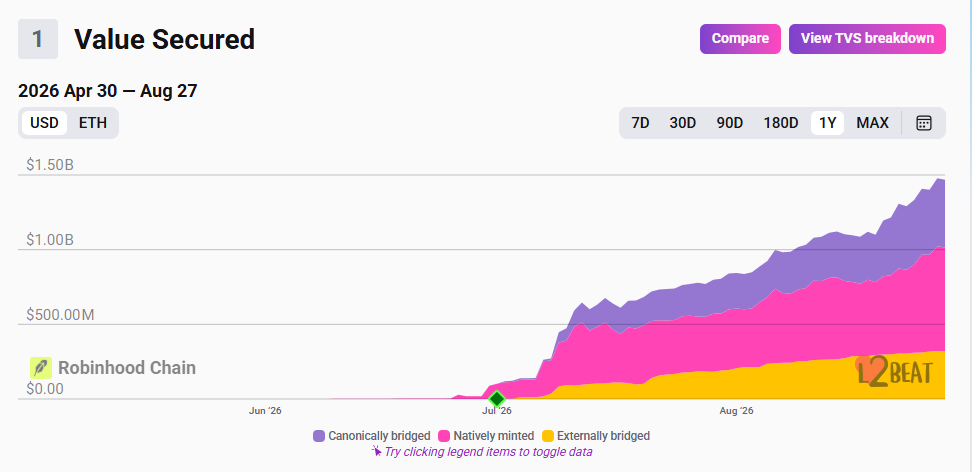
The value of Robinhood assets locked on the exchange grew from $4 million in June to over $1.4 billion as of August 27, indicating sustained demand for new networks if they offer viable strategies and can attract liquidity.
Activity Quickly Returns to Trading Chains with Bullish Signals
Blockchain activity and total value locked have shown that blockchains are highly responsive to bullish signals. Over the past month, following the recovery of blue-chip tokens and BTC, most blockchains have significantly increased their total value locked.
Robinhood remained the leader, showing a 93% increase in total asset value over the past month, but most networks increased their value by more than 20%.
Over the past month, Robinhood received over $125 million in net capital inflow. Robinhood led in this metric over the past month. As Cryptopolitan reported, Robinhood has also expanded its operations by launching its own brand of tokenized real-world assets.
Arbitrum led in capital inflow on a quarterly basis, adding $1.9 billion, primarily from tokenized real-world assets. Inflow and outflow data show that bridging infrastructure remains key, and liquidity quickly moves to new blockchains when there is an active concept or use case.
As of 2026, the overall Web3 development trend is not as active, but individual blockchain networks are gaining momentum due to their niche performance.
Regarding the number of daily active users, blockchains present a different picture. $BNB Chain remains the most popular, with over 3.5 million daily active wallets, comparable to TRON. Solana shows spikes in activity, recently reaching 5 million daily active addresses.