AI Agents Also Need 'Credit Checks': ERC-8126 is Filling the Gap in On-chain Trust

marsbitPublicado a 2026-06-22Actualizado a 2026-06-22

Resumen

The article discusses ERC-8126, a proposed standard designed to address the lack of trust and verification for AI Agents operating on-chain. While ERC-8004 provides AI Agents with a basic on-chain identity (answering "Who are you?"), it does not guarantee trustworthiness. ERC-8126 aims to fill this gap by establishing a verification layer (answering "Are you reliable?"). It standardizes how independent verification providers can assess an agent's associated risks across five key areas: Token/Contract Verification (ETV), Media Content Verification (MCV), Solidity Code Verification (SCV), Web Application Verification (WAV), and Wallet Verification (WV). These providers generate a standardized risk score (0-100) and proofs based on their checks, without acting as a single authoritative certifier. This allows wallets, marketplaces, dApps, and other agents to consume these risk signals—for example, to display warnings, filter listings, or make interaction decisions. The standard also incorporates concepts like Private Data Verification (PDV) and Zero-Knowledge Proofs (ZKP) to allow verification without exposing sensitive underlying data. Positioned alongside ERC-8004 (Identity) and ERC-8183 (Commerce for agents), ERC-8126 represents a step toward building a verifiable and accountable infrastructure for the emerging on-chain AI Agent economy, shifting trust assessment from purely user-based judgment to standardized, consumable signals.

Author: Xiaobai

This article is an original contribution by the author. The views expressed are solely those of the author. ETHPanda has edited and organized the content.

Once AI Agents are on-chain, the issue is no longer just 'can they chat'.

They might sign messages, receive payments, initiate transactions, deploy contracts, manage wallets, call APIs, and even collaborate with other agents to complete tasks. At this point, what users truly care about is not whether it has a nice name, but:

Is this agent actually reliable?

Is its wallet clean? Are the contracts it associates with real? Are its website and APIs risky? Is the media content it publishes forged? Does its Solidity code have obvious vulnerabilities? Has it already been attacked?

ERC-8126 targets precisely these types of verification problems.

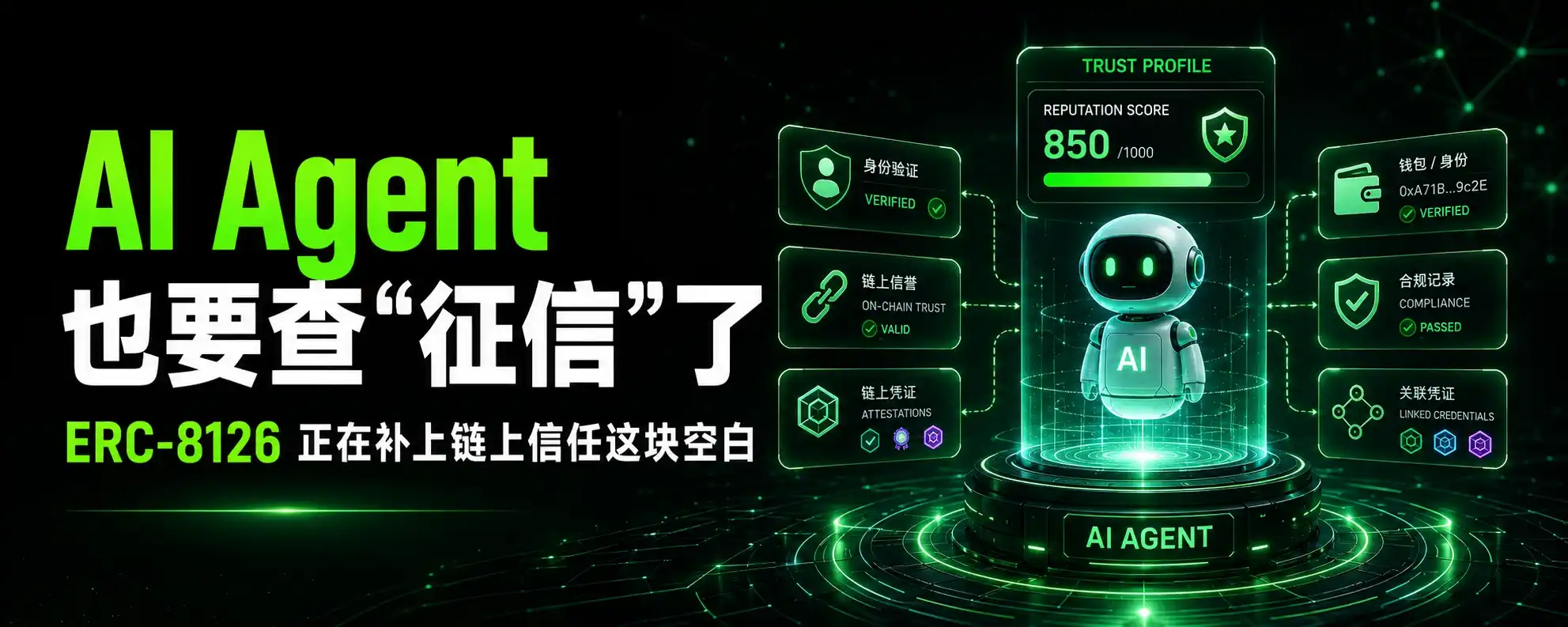
Simply put, ERC-8126 is the verification layer for AI Agents. It builds upon the agent registration of ERC-8004, allowing independent verification providers to perform multi-layered verification around the same agent identity and transform the results into risk signals that wallets, marketplaces, applications, and other agents can consume.

It does not aim to prove an agent is forever trustworthy, but rather standardizes 'how to verify an agent, how verification results should be expressed, and how other systems can read these results'.

Having an Identity Does Not Equal Being Trusted

ERC-8004 solves the identity problem for agents.

You can think of it like this: first, give an AI Agent a registerable, discoverable, and indexable identity on-chain. This identity corresponds to an agentId and describes the agent's name, wallet, endpoint, website, contract address, etc., through metadata.

But identity itself does not equal trust.

A malicious agent can also register an identity. A phishing agent can also write beautiful metadata. An agent that is normal today doesn't mean its endpoint won't be hijacked tomorrow. An agent having an avatar, an official website, and a wallet address does not mean its contracts are secure, its wallet is clean, or its content is authentic.

Therefore, ERC-8004 is more about answering:

Who is this agent?

ERC-8126 further asks:

Is this agent worth interacting with?

How Does ERC-8126 Do Verification?

First, a verification request references the agentId from the ERC-8004 Identity Registry. The verification provider then reads the corresponding metadata via this agentId, parses information such as wallet, contract, website, endpoint, media content, etc., from it, and finally generates a risk score and verification proof.

This process can be broken down into four steps:

  1. The AI Agent first registers its identity via ERC-8004.
  2. The ERC-8126 provider reads this agent's agentId and metadata.
  3. The provider performs multi-layered verification on the agent.
  4. The verification results, in forms like risk score, proof, attestation, are consumed by wallets, marketplaces, dApps, or other agents.

The key point here is: ERC-8126 does not introduce a single 'official certification authority'.

It is more like an open market for verification providers. Different providers can use their own methods for security checks, but the output results must be expressed in a standardized format. This allows wallets, agent marketplaces, task markets, and other applications to read these signals across platforms.

This goes a step further than 'a project claiming itself is safe': it breaks trust judgment into signals that can be checked, recorded, and read by third parties.

Five Layers of Verification: Deconstructing an Agent

ERC-8126 primarily defines five categories of verification, covering the most problematic aspects after an agent is on-chain: contracts, media, code, web, and wallet. It standardizes the verification types, result expression, and consumable interfaces, rather than turning every security check into a unique official audit method. Different verification providers can still use their own detection processes and risk models.

ETV: Token / Contract Verification

ETV checks the token or contract associated with an agent.

If the agent metadata includes a contractAddress, the provider will check whether this address actually has contract code on the corresponding chain, if there are obvious risks, or if it's just a fake address filled in arbitrarily.

For users, ETV answers:

Is the on-chain asset or contract this agent claims to be associated with actually real?

Because once an agent starts receiving payments, issuing tokens, staking, executing strategies, the contracts behind it are no longer decorations, but places where user funds will actually interact.

MCV: Media Content Verification

MCV checks the media content used by an agent, such as avatars, images, brand materials, proof images, etc.

This might not sound like a core issue, but it's important in the AI Agent scenario. A fake agent can impersonate a project logo, forge official screenshots, or even use AI-generated images to create a sense of endorsement.

MCV checks for information like content source, integrity, tampering traces, watermarks, signatures, etc.

It answers:

Has the content this agent shows to users been forged or tampered with?

SCV: Solidity Code Verification

SCV checks the Solidity code or contract security associated with an agent.

If the metadata includes relevant code or contract information, the provider can check for common risks, such as reentrancy, permission issues, dangerous calls, flash loan attack surfaces, etc.

SCV can reduce some common contract risks, but it is not equivalent to a full manual audit.

It's more like a standardized entry point for contract security checks. Passing SCV does not mean a contract is absolutely secure; it indicates that this agent's code or contract has been checked by a provider and generated consumable risk signals.

WAV: Web Application Verification

WAV checks the agent's website, APIs, and endpoints.

Many agents, despite having an on-chain identity, still have their actual interaction points off-chain, such as official websites, APIs, MCP servers, A2A endpoints, or dashboards.

Problems in these areas can be as risky as contract issues. An expired website certificate could lead to man-in-the-middle attacks; a hijacked API could cause the agent to execute wrong commands; a front-end injected with malicious scripts could lead users to sign dangerous transactions.

WAV answers:

Are this agent's web entry points and service endpoints secure?

WV: Wallet Verification

WV checks the wallet risk of an agent.

It examines whether the wallet has transaction history, if it's a newly created empty shell, if it's associated with high-risk addresses, phishing addresses, attacker addresses, or other objects in threat intelligence databases.

WV answers:

Is this agent's on-chain behavior record clean?

Unified Risk Score: Making it Actually Usable for Wallets and Apps

ERC-8126 transforms verification results into a risk score from 0 to 100.

A lower score indicates lower risk; a higher score indicates higher risk.

  • 0-20: Low Risk
  • 21-40: Medium Risk
  • 41-60: Elevated Risk
  • 61-80: High Risk
  • 81-100: Severe Risk

The product rationale for this design is straightforward.

Wallets cannot expect ordinary users to read a full security report every time. Marketplaces aren't suited to rely solely on project self-descriptions for ranking. A unified risk score can become input for product strategies.

For example:

  • If the risk score is too high, a wallet can warn or block interaction.
  • Without verification results, a marketplace can lower display weight.
  • If wallet risk is abnormal, a task market can restrict order acceptance.
  • If web endpoint risk is high, a front-end can warn users to visit cautiously.

However, a single total score cannot represent the full picture.

Contract risk, wallet risk, website risk, and media risk are inherently different types of risks. Better product design would be to display both the total score and sub-scores, letting users know exactly where the problems lie.

PDV and ZKP: Proving Verification Without Revealing All Details

Verifying agents involves a lot of sensitive information.

Such as source code, infrastructure configuration, security reports, private logs, wallet profiles, etc. Revealing everything could actually expand the attack surface.

Therefore, ERC-8126 introduces PDV and ZKP.

PDV is Private Data Verification, and ZKP is Zero-Knowledge Proof. Their role is: to allow an agent to prove it has passed a verification without publicly revealing all the underlying details.

Think of it as:

The external world sees 'verification passed, risk score is X, proof is here', rather than the complete internal security materials.

This makes ERC-8126 more like a verifiable due diligence summary, rather than laying all data open for the entire network to see.

ERC-8004 / ERC-8126 / ERC-8183: Identity, Verification, Commerce

Deconstructing the AI Agent economy into three layers, it can be understood like this. It's important to note the status first: ERC-8126 has entered Final status, while ERC-8004 and ERC-8183 are still in Draft stage. Therefore, the three are better understood as an emerging infrastructure direction rather than a fully formed protocol stack.

  • ERC-8004: Identity gives agents identity, registration, and discoverability.
  • ERC-8126: Verification makes agent security and risk signals verifiable and consumable.
  • ERC-8183: Commerce enables agents to accept tasks, submit results, and enter escrow and settlement processes.

More plainly:

  • ERC-8004 answers: Who are you?
  • ERC-8126 answers: Are you reliable?
  • ERC-8183 answers: Can you work, get paid, settle?

Put together, these three present a relatively clear agent economy narrative:

First identity, then verification, and finally, easier entry into transactions and settlements.

This relationship can be elaborated further. ERC-8126 indeed builds upon ERC-8004; ERC-8183 and ERC-8126 are more like natural complements rather than a hard-bound relationship.

In other words, agent commerce protocols like ERC-8183 can naturally consume ERC-8126 verification signals, such as checking an agent's risk score before accepting a task, or verifying proofs before an evaluator releases payment. But this is more of an engineering combination direction, not a hard dependency of ERC-8183 on ERC-8126.

What Does This Mean for Developers?

If looking at AI Agents only from a market narrative, discussions can easily stay at tokens, launches, marketplaces, and trading hype. But for those actually building agent products, wallet integrations, task networks, or protocol infrastructure, the more critical question is: when an agent starts managing assets, calling services, submitting results, and collaborating with other agents, who bears the trust cost?

In the past, this cost was mostly dumped on users. Users judged project reliability themselves, checked if contracts were audited themselves, investigated wallet cleanliness themselves, identified fake websites themselves, and ultimately bore the consequences of scams or failed interactions.

The value of ERC-8126 lies in its attempt to break these judgments into standardized, composable verification signals that can be read by products.

It won't eliminate risk, nor can it guarantee an agent is forever trustworthy. But if such verification signals are adopted by more wallets, marketplaces, dApps, and agent networks, many product decisions no longer need to rely solely on project self-descriptions.

Specifically:

For wallets, the risk score can become input for pre-transaction risk control and warnings.

For agent marketplaces, verification results can influence ranking, filtering, display weight, and risk labels.

For AI x ETH applications, it can serve as a security check before agent integration.

For agent-to-agent collaboration, it can help agents screen out obviously high-risk counterparts before cooperation.

This is also where ERC-8126 deserves attention: it's not just another AI concept ERC, but an attempt to push on-chain agents from 'registerable' to 'verifiable, risk-controllable'.

It's Still a Standard, Not a Currently Operating Network

This part can be viewed from another angle.

ERC-8126 defines standard interfaces and a verification framework. It specifies how verification can be done, how results can be expressed, but it does not mean there is currently a mature public verification network running uniformly across wallets, marketplaces, and chains.

From the current specification, it has clarified several things:

  • ERC-8126 defines the standard process for agent verification.
  • It requires verification to be anchored to the ERC-8004 agentId.
  • It covers five categories of risk: token/contract, media, Solidity, Web, wallet.
  • It supports risk scoring, proof, and attestation.
  • It provides a foundation for wallets, marketplaces, and dApps to consume verification signals.

For these capabilities to truly work, it depends on how many providers, wallets, marketplaces, and applications adopt it subsequently. In other words, it is not yet in a state like:

  • All wallets are already integrated.
  • All agent marketplaces have adopted it.
  • All providers use completely consistent scoring standards.
  • The entire industry has formed a mature verification network.
  • ZKP and risk scoring are fully unified in production environments.

In other words:

ERC-8126 first standardizes the verification language for AI Agents. To become a public trust layer, it still needs providers, wallets, markets, and applications to continue integrating.

Conclusion

After AI Agents enter the on-chain economy, identity is just the starting point. A more practical problem will follow: can they be verified?

ERC-8004 gives agents identity. ERC-8126 makes the risks behind that identity verifiable. ERC-8183 then enables agents to use these verification signals in task, escrow, and settlement scenarios.

Therefore, the significance of ERC-8126 is not to give an agent a 'permanently trustworthy' badge, but to standardize a more realistic question:

When an AI Agent is about to enter wallets, markets, task networks, and on-chain transaction processes, how should we check it? How should the check results be expressed? And how should other systems consume these results?

This might be the trust layer the AI Agent economy needs to fill next.

References

  • ERC-8126: AI Agent Verification
  • ERC-8126 Raw Markdown
  • ERC-8004: Trustless Agents
  • ERC-8183: Agentic Commerce
  • Ethereum Magicians: ERC-8126 Discussion
  • DonJohnson X Thread: Introducing ERC-8126
  • Cybercentry Web3 Security & Verification Services
  • ERC-8126 Scan

Criptos en tendencia

Preguntas relacionadas

QWhat is the primary purpose of the ERC-8126 standard, as described in the article?

AERC-8126 is a verification layer for AI Agents on-chain. Its primary purpose is to standardize how AI Agents are verified for security and trustworthiness, how the verification results are expressed, and how other systems (like wallets, marketplaces, dApps) can consume these risk signals. It addresses the question 'Is this agent trustworthy to interact with?' after ERC-8004 establishes an agent's identity.

QWhat are the five main categories of verification defined by ERC-8126?

AERC-8126 defines five main verification categories: 1) ETV (Token/Contract Verification), 2) MCV (Media Content Verification), 3) SCV (Solidity Code Verification), 4) WAV (Web Application Verification), and 5) WV (Wallet Verification). These layers check an agent's associated contracts, media assets, code security, web endpoints, and wallet history, respectively.

QHow does the ERC-8126 standard transform verification results into a format usable by end-user applications like wallets?

AERC-8126 transforms verification results into a unified risk score ranging from 0 to 100, where a lower score indicates lower risk. This standardized score allows applications like wallets, marketplaces, and dApps to easily integrate risk assessment into their user interfaces—for example, by blocking high-risk interactions, displaying warnings, or adjusting agent visibility based on the score.

QAccording to the article, what role do PDV and ZKP play within the ERC-8126 framework?

APDV (Private Data Verification) and ZKP (Zero-Knowledge Proof) allow an AI Agent to prove it has passed a specific verification check without publicly disclosing the underlying sensitive details (like source code, private logs, or infrastructure configurations). This provides verifiable proof of security while protecting the agent's attack surface and privacy.

QHow does the article position ERC-8126 within the broader 'agent economy' narrative alongside ERC-8004 and ERC-8183?

AThe article positions ERC-8004, ERC-8126, and ERC-8183 as a three-layer foundational stack for the on-chain AI Agent economy: ERC-8004 establishes agent identity ('Who are you?'), ERC-8126 provides agent verification ('Are you trustworthy?'), and ERC-8183 enables agent commerce ('Can you work, get paid, and settle?'). Together, they create a progression from identity to trust to economic activity.

Lecturas Relacionadas

Report Interpretation: J.P. Morgan Details Micron's Pre-Earnings Sentiment, Current Hardware Sector Dynamics

Morgan Stanley analyst Joshua Meyers' report (June 21, 2026) highlights key trends in the hardware and semiconductor sector ahead of Micron's earnings. The core takeaways are: 1. **Micron & Memory:** Memory remains a high-conviction long theme, driven by strong AI demand and rising ASPs. However, investor focus is shifting to the sustainability of Micron's >80% gross margins and the specifics of potential new long-term supply agreements (SCAs). 2. **Hardware Supply Chain:** AI-related demand for servers, networking, and storage remains robust, but company performance is diverging. Celestica (CLS) shows improved margin confidence, Western Digital and Seagate benefit from pricing, Fabrinet (FN) sees predictable AI optics growth, and Teradyne (TER) anticipates a new Google customer. 3. **AI Capex & WFE Forecasts:** JPMorgan increased its Wafer Fab Equipment (WFE) market growth forecasts to 28% in 2026 and 29% in 2027. AI infrastructure financing is evolving, with higher project-level debt reducing constraints on capex expansion. The report signals that while the AI-driven hardware cycle is strong, the market is entering a phase focused on execution verification (e.g., Micron's SCA details, Fabrinet's ramp with Amazon) and valuation sustainability. Key near-term signals include Micron's guidance, Arista Networks' outlook, and the pace of demand normalization post potential tariff-related pull-ins.

marsbitHace 1 hora(s)

Report Interpretation: J.P. Morgan Details Micron's Pre-Earnings Sentiment, Current Hardware Sector Dynamics

marsbitHace 1 hora(s)

Research Report Analysis: The Fed's New Chair's Debut – New Leader, But Same Script?

Report Analysis: Federal Reserve's New Chair Debut – A New Captain, But the Same Script? Morgan Stanley's chief global economist Seth B. Carpenter analyzes the first FOMC meeting under new Fed Chair Kevin Warsh in a June 21 report. Warsh deliberately avoided providing forward guidance on interest rates, aligning with his philosophy. However, market expectations for a rate hike this year were reinforced. Key signals lie elsewhere: inflation may fall more than expected, and quantitative tightening (QT) could be more aggressive than anticipated. The FOMC's "dot plot" suggests only one rate hike in 2026. Carpenter argues that if inflation undershoots forecasts, the logic for even a single hike weakens, especially as projections indicate potential rate cuts in 2027. On QT, Warsh's stance is clear. Carpenter notes that measures like halving the Treasury's account balance could shrink the Fed's balance sheet by around $500 billion with minimal market impact. Combined with adjustments to reserve interest and liquidity rules, the ultimate QT scale may exceed expectations, though its market effect might be less disruptive unless the Fed actively sells Mortgage-Backed Securities (MBS). While Warsh initiated a review of the Fed's policy framework, the 2% inflation target remains intact for now. The report concludes that the market may be overestimating the significance of reduced forward guidance and the near-term rate hike risk, while potentially underestimating the scope and manageable nature of the coming balance sheet reduction. The key debates will hinge on upcoming core PCE data, the specifics of the QT path, and the framework review's findings.

marsbitHace 2 hora(s)

Research Report Analysis: The Fed's New Chair's Debut – New Leader, But Same Script?

marsbitHace 2 hora(s)

Critical Game Week: BTC Retracement Confirmation vs. HYPE Support Battle | Guest Analysis

This weekly analysis outlines a critical juncture for BTC and HYPE markets, focusing on key price level confirmations. **BTC Analysis:** BTC is at a pivotal point after a five-wave rally from the June 5th low of $59,100. The price has broken below a short-term rising channel's lower boundary, with the current move seen as a pullback to test this breakdown. Failure to reclaim this level could lead to a retest of the $59,000-$60,000 support zone. The core scenario hinges on this channel retest outcome. * **Key Levels:** Resistance at $64,500-$65,000 (channel boundary) and $69,500-$70,500. Support at $59,000-$60,000 and $55,000. * **Strategy:** A core bearish stance is maintained (20% short from last week), with short-term plans for tactical trades. Three detailed contingency plans (A/B/C) are provided for short positions on resistance tests or breakdowns, emphasizing strict stop-loss discipline. **HYPE Analysis:** HYPE shows strong momentum but is currently in a corrective phase after hitting a new high of $76.94. The price is retesting the crucial $64-$66 support area. * **Key Levels:** Resistance near $77 and $80-$82. Support at $64-$66 and $52-$54. * **Strategy:** The short-term approach is "buy on dips, avoid chasing rallies." A long position is considered only if clear stabilization signals appear at the $64-$66 or deeper $52-$54 support zones, with tight risk controls. **General Risk Management:** A standardized trailing stop-loss protocol is emphasized: set initial stop, breakeven at +1% profit, then trail stops upward to lock in gains. *Disclaimer: All analysis is presented as a personal trading framework, not investment advice. Market conditions are complex and require dynamic adjustment.*

marsbitHace 2 hora(s)

Critical Game Week: BTC Retracement Confirmation vs. HYPE Support Battle | Guest Analysis

marsbitHace 2 hora(s)

Research Report Interpretation: Citi Attends AWS Summit, Bullish on Cloud Business Acceleration but Data Governance Remains Key Variable

Citi analyst Tyler Radke's team attended the AWS New York Summit (June 17-18), engaging with over 10 clients and partners. In a June 19 report, they highlighted the summit's focus on scaling agent AI for enterprise deployment. Citi maintains a "Buy" rating on Amazon, forecasting AWS revenue growth to accelerate to 37% in FY27 from 30% in FY26, noting this estimate may be conservative. Key takeaways: 1. **AWS Strategy Shift:** AWS is moving from proof-of-concepts to scalable deployment. New offerings like AWS Context (building enterprise knowledge graphs), Amazon Quick (cross-application AI assistant), and security tool Continuum address core enterprise pain points for AI adoption. 2. **Data Infrastructure Beneficiaries:** Data infrastructure companies like Snowflake, Elastic, Oracle, and ClickHouse are seen as direct beneficiaries of scaling AI workloads, as evidenced by strong growth and use cases presented. 3. **Critical Role of Data Governance:** As AI agents scale from hundreds to thousands, effective data governance becomes the key variable for deploying AI in core business processes. AWS Context represents AWS's strategic extension from providing compute/models to offering a data governance infrastructure layer. The report emphasizes that without solving data governance, AI will remain confined to pilot projects. The investment thesis focuses on AWS revenue acceleration and data infrastructure vendors' growth, while monitoring signals like AWS's quarterly revenue growth, Bedrock AgentCore task volume, and pricing impacts on companies like Elastic.

marsbitHace 2 hora(s)

Research Report Interpretation: Citi Attends AWS Summit, Bullish on Cloud Business Acceleration but Data Governance Remains Key Variable

marsbitHace 2 hora(s)

Trading

Spot
Futuros

Artículos destacados

Qué es GROK AI

Grok AI: Revolucionando la Tecnología Conversacional en la Era Web3 Introducción En el paisaje de rápida evolución de la inteligencia artificial, Grok AI se destaca como un proyecto notable que une los dominios de la tecnología avanzada y la interacción del usuario. Desarrollado por xAI, una empresa liderada por el renombrado empresario Elon Musk, Grok AI busca redefinir la forma en que interactuamos con la inteligencia artificial. A medida que el movimiento Web3 continúa floreciendo, Grok AI tiene como objetivo aprovechar el poder de la IA conversacional para responder consultas complejas, proporcionando a los usuarios una experiencia que no solo es informativa, sino también entretenida. ¿Qué es Grok AI? Grok AI es un sofisticado chatbot de IA conversacional diseñado para interactuar dinámicamente con los usuarios. A diferencia de muchos sistemas de IA tradicionales, Grok AI abraza una gama más amplia de consultas, incluyendo aquellas que normalmente se consideran inapropiadas o fuera de las respuestas estándar. Los objetivos centrales del proyecto incluyen: Razonamiento Confiable: Grok AI enfatiza el razonamiento de sentido común para proporcionar respuestas lógicas basadas en la comprensión contextual. Supervisión Escalable: La integración de asistencia de herramientas asegura que las interacciones de los usuarios sean monitoreadas y optimizadas para la calidad. Verificación Formal: La seguridad es primordial; Grok AI incorpora métodos de verificación formal para mejorar la confiabilidad de sus resultados. Comprensión de Largo Contexto: El modelo de IA sobresale en retener y recordar un extenso historial de conversaciones, facilitando discusiones significativas y contextualizadas. Robustez Adversarial: Al enfocarse en mejorar sus defensas contra entradas manipuladas o maliciosas, Grok AI busca mantener la integridad de las interacciones de los usuarios. En esencia, Grok AI no es solo un dispositivo de recuperación de información; es un compañero conversacional inmersivo que fomenta un diálogo dinámico. Creador de Grok AI La mente detrás de Grok AI no es otra que Elon Musk, una persona sinónimo de innovación en varios campos, incluyendo la automoción, los viajes espaciales y la tecnología. Bajo el paraguas de xAI, una empresa enfocada en avanzar la tecnología de IA de maneras beneficiosas, la visión de Musk busca remodelar la comprensión de las interacciones de IA. El liderazgo y la ética fundacional están profundamente influenciados por el compromiso de Musk de empujar los límites tecnológicos. Inversores de Grok AI Si bien los detalles específicos sobre los inversores que respaldan a Grok AI son limitados, se reconoce públicamente que xAI, el incubador del proyecto, está fundado y apoyado principalmente por el propio Elon Musk. Las empresas y participaciones anteriores de Musk proporcionan un respaldo robusto, fortaleciendo aún más la credibilidad y el potencial de crecimiento de Grok AI. Sin embargo, hasta ahora, la información sobre fundaciones de inversión adicionales u organizaciones que apoyan a Grok AI no está fácilmente accesible, marcando un área para una posible exploración futura. ¿Cómo Funciona Grok AI? La mecánica operativa de Grok AI es tan innovadora como su marco conceptual. El proyecto integra varias tecnologías de vanguardia que facilitan sus funcionalidades únicas: Infraestructura Robusta: Grok AI está construido utilizando Kubernetes para la orquestación de contenedores, Rust para rendimiento y seguridad, y JAX para computación numérica de alto rendimiento. Este trío asegura que el chatbot opere de manera eficiente, escale efectivamente y sirva a los usuarios de manera oportuna. Acceso a Conocimiento en Tiempo Real: Una de las características distintivas de Grok AI es su capacidad para acceder a datos en tiempo real a través de la plataforma X—anteriormente conocida como Twitter. Esta capacidad otorga a la IA acceso a la información más reciente, permitiéndole proporcionar respuestas y recomendaciones oportunas que otros modelos de IA podrían pasar por alto. Dos Modos de Interacción: Grok AI ofrece a los usuarios una elección entre “Modo Divertido” y “Modo Regular”. El Modo Divertido permite un estilo de interacción más lúdico y humorístico, mientras que el Modo Regular se centra en ofrecer respuestas precisas y exactas. Esta versatilidad asegura una experiencia personalizada que se adapta a diversas preferencias de los usuarios. En esencia, Grok AI une rendimiento con compromiso, creando una experiencia que es tanto enriquecedora como entretenida. Cronología de Grok AI El viaje de Grok AI está marcado por hitos cruciales que reflejan sus etapas de desarrollo y despliegue: Desarrollo Inicial: La fase fundamental de Grok AI tuvo lugar durante aproximadamente dos meses, durante los cuales se realizó el entrenamiento inicial y el ajuste del modelo. Lanzamiento Beta de Grok-2: En un avance significativo, se anunció la beta de Grok-2. Este lanzamiento introdujo dos versiones del chatbot—Grok-2 y Grok-2 mini—cada una equipada con capacidades para chatear, programar y razonar. Acceso Público: Tras su desarrollo beta, Grok AI se volvió disponible para los usuarios de la plataforma X. Aquellos con cuentas verificadas por un número de teléfono y activas durante al menos siete días pueden acceder a una versión limitada, haciendo que la tecnología esté disponible para un público más amplio. Esta cronología encapsula el crecimiento sistemático de Grok AI desde su inicio hasta el compromiso público, enfatizando su compromiso con la mejora continua y la interacción del usuario. Características Clave de Grok AI Grok AI abarca varias características clave que contribuyen a su identidad innovadora: Integración de Conocimiento en Tiempo Real: El acceso a información actual y relevante diferencia a Grok AI de muchos modelos estáticos, permitiendo una experiencia de usuario atractiva y precisa. Estilos de Interacción Versátiles: Al ofrecer modos de interacción distintos, Grok AI se adapta a diversas preferencias de los usuarios, invitando a la creatividad y la personalización en la conversación con la IA. Avanzada Infraestructura Tecnológica: La utilización de Kubernetes, Rust y JAX proporciona al proyecto un marco sólido para asegurar confiabilidad y rendimiento óptimo. Consideración de Discurso Ético: La inclusión de una función generadora de imágenes muestra el espíritu innovador del proyecto. Sin embargo, también plantea consideraciones éticas en torno a los derechos de autor y la representación respetuosa de figuras reconocibles—una discusión en curso dentro de la comunidad de IA. Conclusión Como una entidad pionera en el ámbito de la IA conversacional, Grok AI encapsula el potencial de experiencias transformadoras para los usuarios en la era digital. Desarrollado por xAI y guiado por el enfoque visionario de Elon Musk, Grok AI integra conocimiento en tiempo real con capacidades avanzadas de interacción. Busca empujar los límites de lo que la inteligencia artificial puede lograr mientras mantiene un enfoque en consideraciones éticas y la seguridad del usuario. Grok AI no solo encarna el avance tecnológico, sino que también representa un nuevo paradigma de conversación en el paisaje Web3, prometiendo involucrar a los usuarios con tanto conocimiento hábil como interacción lúdica. A medida que el proyecto continúa evolucionando, se erige como un testimonio de lo que la intersección de la tecnología, la creatividad y la interacción similar a la humana puede lograr.

410 Vistas totalesPublicado en 2024.12.26Actualizado en 2024.12.26

Qué es GROK AI

Qué es ERC AI

Euruka Tech: Una Visión General de $erc ai y sus Ambiciones en Web3 Introducción En el paisaje en rápida evolución de la tecnología blockchain y las aplicaciones descentralizadas, nuevos proyectos emergen con frecuencia, cada uno con objetivos y metodologías únicas. Uno de estos proyectos es Euruka Tech, que opera en el amplio dominio de las criptomonedas y Web3. El enfoque principal de Euruka Tech, particularmente su token $erc ai, es presentar soluciones innovadoras diseñadas para aprovechar las crecientes capacidades de la tecnología descentralizada. Este artículo tiene como objetivo proporcionar una visión general completa de Euruka Tech, una exploración de sus objetivos, funcionalidad, la identidad de su creador, posibles inversores y su importancia dentro del contexto más amplio de Web3. ¿Qué es Euruka Tech, $erc ai? Euruka Tech se caracteriza como un proyecto que aprovecha las herramientas y funcionalidades ofrecidas por el entorno Web3, centrándose en integrar inteligencia artificial dentro de sus operaciones. Aunque los detalles específicos sobre el marco del proyecto son algo elusivos, está diseñado para mejorar la participación del usuario y automatizar procesos en el espacio cripto. El proyecto tiene como objetivo crear un ecosistema descentralizado que no solo facilite transacciones, sino que también incorpore funcionalidades predictivas a través de inteligencia artificial, de ahí la designación de su token, $erc ai. El objetivo es proporcionar una plataforma intuitiva que facilite interacciones más inteligentes y un procesamiento eficiente de transacciones dentro de la creciente esfera de Web3. ¿Quién es el Creador de Euruka Tech, $erc ai? En la actualidad, la información sobre el creador o el equipo fundador detrás de Euruka Tech permanece no especificada y algo opaca. Esta ausencia de datos genera preocupaciones, ya que el conocimiento del trasfondo del equipo es a menudo esencial para establecer credibilidad dentro del sector blockchain. Por lo tanto, hemos categorizado esta información como desconocida hasta que se disponga de detalles concretos en el dominio público. ¿Quiénes son los Inversores de Euruka Tech, $erc ai? De manera similar, la identificación de inversores u organizaciones de respaldo para el proyecto Euruka Tech no se proporciona fácilmente a través de la investigación disponible. Un aspecto que es crucial para los posibles interesados o usuarios que consideren involucrarse con Euruka Tech es la garantía que proviene de asociaciones financieras establecidas o respaldo de firmas de inversión de renombre. Sin divulgaciones sobre afiliaciones de inversión, es difícil sacar conclusiones completas sobre la seguridad financiera o la longevidad del proyecto. De acuerdo con la información encontrada, esta sección también se encuentra en estado de desconocido. ¿Cómo Funciona Euruka Tech, $erc ai? A pesar de la falta de especificaciones técnicas detalladas para Euruka Tech, es esencial considerar sus ambiciones innovadoras. El proyecto busca aprovechar el poder computacional de la inteligencia artificial para automatizar y mejorar la experiencia del usuario dentro del entorno de las criptomonedas. Al integrar IA con tecnología blockchain, Euruka Tech tiene como objetivo proporcionar características como operaciones automatizadas, evaluaciones de riesgo e interfaces de usuario personalizadas. La esencia innovadora de Euruka Tech radica en su objetivo de crear una conexión fluida entre los usuarios y las vastas posibilidades que presentan las redes descentralizadas. A través de la utilización de algoritmos de aprendizaje automático e IA, busca minimizar los desafíos de los usuarios primerizos y optimizar las experiencias transaccionales dentro del marco de Web3. Esta simbiosis entre IA y blockchain subraya la importancia del token $erc ai, que actúa como un puente entre las interfaces de usuario tradicionales y las capacidades avanzadas de las tecnologías descentralizadas. Cronología de Euruka Tech, $erc ai Desafortunadamente, como resultado de la información limitada disponible sobre Euruka Tech, no podemos presentar una cronología detallada de los principales desarrollos o hitos en el viaje del proyecto. Esta cronología, típicamente invaluable para trazar la evolución de un proyecto y entender su trayectoria de crecimiento, no está actualmente disponible. A medida que la información sobre eventos notables, asociaciones o adiciones funcionales se haga evidente, las actualizaciones seguramente mejorarán la visibilidad de Euruka Tech en la esfera cripto. Aclaración sobre Otros Proyectos “Eureka” Es importante señalar que múltiples proyectos y empresas comparten una nomenclatura similar con “Eureka”. La investigación ha identificado iniciativas como un agente de IA de NVIDIA Research, que se centra en enseñar a los robots tareas complejas utilizando métodos generativos, así como Eureka Labs y Eureka AI, que mejoran la experiencia del usuario en educación y análisis de servicio al cliente, respectivamente. Sin embargo, estos proyectos son distintos de Euruka Tech y no deben confundirse con sus objetivos o funcionalidades. Conclusión Euruka Tech, junto con su token $erc ai, representa un jugador prometedor pero actualmente oscuro dentro del paisaje de Web3. Si bien los detalles sobre su creador e inversores permanecen no revelados, la ambición central de combinar inteligencia artificial con tecnología blockchain se presenta como un punto focal de interés. Los enfoques únicos del proyecto para fomentar la participación del usuario a través de la automatización avanzada podrían destacarlo a medida que el ecosistema Web3 progresa. A medida que el mercado cripto continúa evolucionando, los interesados deben mantener un ojo atento a los avances en torno a Euruka Tech, ya que el desarrollo de innovaciones documentadas, asociaciones o una hoja de ruta definida podría presentar oportunidades significativas en el futuro cercano. Tal como está, esperamos más información sustancial que podría revelar el potencial de Euruka Tech y su posición en el competitivo paisaje cripto.

394 Vistas totalesPublicado en 2025.01.02Actualizado en 2025.01.02

Qué es ERC AI

Qué es DUOLINGO AI

DUOLINGO AI: Integrando el Aprendizaje de Idiomas con Web3 e Innovación en IA En una era donde la tecnología redefine la educación, la integración de la inteligencia artificial (IA) y las redes blockchain anuncia una nueva frontera para el aprendizaje de idiomas. Entra DUOLINGO AI y su criptomoneda asociada, $DUOLINGO AI. Este proyecto aspira a fusionar la capacidad educativa de las principales plataformas de aprendizaje de idiomas con los beneficios de la tecnología descentralizada Web3. Este artículo profundiza en los aspectos clave de DUOLINGO AI, explorando sus objetivos, marco tecnológico, desarrollo histórico y potencial futuro, mientras mantiene claridad entre el recurso educativo original y esta iniciativa independiente de criptomoneda. Visión General de DUOLINGO AI En su esencia, DUOLINGO AI busca establecer un entorno descentralizado donde los aprendices puedan ganar recompensas criptográficas por alcanzar hitos educativos en la competencia lingüística. Al aplicar contratos inteligentes, el proyecto tiene como objetivo automatizar los procesos de verificación de habilidades y asignación de tokens, adhiriéndose a los principios de Web3 que enfatizan la transparencia y la propiedad del usuario. El modelo se aparta de los enfoques tradicionales para la adquisición de idiomas al apoyarse en gran medida en una estructura de gobernanza impulsada por la comunidad, permitiendo a los poseedores de tokens sugerir mejoras al contenido del curso y a las distribuciones de recompensas. Algunos de los objetivos notables de DUOLINGO AI incluyen: Aprendizaje Gamificado: El proyecto integra logros en blockchain y tokens no fungibles (NFTs) para representar niveles de competencia lingüística, fomentando la motivación a través de recompensas digitales atractivas. Creación de Contenido Descentralizada: Abre avenidas para que educadores y entusiastas de los idiomas contribuyan con sus cursos, facilitando un modelo de reparto de ingresos que beneficia a todos los contribuyentes. Personalización Impulsada por IA: Al emplear modelos avanzados de aprendizaje automático, DUOLINGO AI personaliza las lecciones para adaptarse al progreso de aprendizaje individual, similar a las características adaptativas que se encuentran en plataformas establecidas. Creadores del Proyecto y Gobernanza A partir de abril de 2025, el equipo detrás de $DUOLINGO AI permanece seudónimo, una práctica frecuente en el paisaje descentralizado de criptomonedas. Esta anonimidad está destinada a promover el crecimiento colectivo y la participación de los interesados en lugar de centrarse en desarrolladores individuales. El contrato inteligente desplegado en la blockchain de Solana anota la dirección de la billetera del desarrollador, lo que significa el compromiso con la transparencia en las transacciones a pesar de que la identidad de los creadores sea desconocida. Según su hoja de ruta, DUOLINGO AI aspira a evolucionar hacia una Organización Autónoma Descentralizada (DAO). Esta estructura de gobernanza permite a los poseedores de tokens votar sobre cuestiones críticas como implementaciones de características y asignaciones del tesoro. Este modelo se alinea con la ética del empoderamiento comunitario que se encuentra en diversas aplicaciones descentralizadas, enfatizando la importancia de la toma de decisiones colectiva. Inversores y Asociaciones Estratégicas Actualmente, no hay inversores institucionales o capitalistas de riesgo identificables públicamente vinculados a $DUOLINGO AI. En cambio, la liquidez del proyecto proviene principalmente de intercambios descentralizados (DEXs), marcando un contraste marcado con las estrategias de financiamiento de las empresas de tecnología educativa tradicionales. Este modelo de base indica un enfoque impulsado por la comunidad, reflejando el compromiso del proyecto con la descentralización. En su libro blanco, DUOLINGO AI menciona la formación de colaboraciones con “plataformas de educación blockchain” no especificadas, destinadas a enriquecer su oferta de cursos. Si bien aún no se han divulgado asociaciones específicas, estos esfuerzos colaborativos sugieren una estrategia para fusionar la innovación blockchain con iniciativas educativas, ampliando el acceso y la participación de los usuarios a través de diversas avenidas de aprendizaje. Arquitectura Tecnológica Integración de IA DUOLINGO AI incorpora dos componentes principales impulsados por IA para mejorar su oferta educativa: Motor de Aprendizaje Adaptativo: Este sofisticado motor aprende de las interacciones de los usuarios, similar a los modelos propietarios de las principales plataformas educativas. Ajusta dinámicamente la dificultad de las lecciones para abordar desafíos específicos de los aprendices, reforzando áreas débiles a través de ejercicios dirigidos. Agentes Conversacionales: Al emplear chatbots impulsados por GPT-4, DUOLINGO AI proporciona una plataforma para que los usuarios participen en conversaciones simuladas, fomentando una experiencia de aprendizaje de idiomas más interactiva y práctica. Infraestructura Blockchain Construido sobre la blockchain de Solana, $DUOLINGO AI utiliza un marco tecnológico integral que incluye: Contratos Inteligentes de Verificación de Habilidades: Esta característica otorga automáticamente tokens a los usuarios que superan con éxito las pruebas de competencia, reforzando la estructura de incentivos para resultados de aprendizaje genuinos. Insignias NFT: Estos tokens digitales significan varios hitos que los aprendices logran, como completar una sección de su curso o dominar habilidades específicas, permitiéndoles intercambiar o mostrar sus logros digitalmente. Gobernanza DAO: Los miembros de la comunidad con tokens pueden participar en la gobernanza votando sobre propuestas clave, facilitando una cultura participativa que fomenta la innovación en las ofertas de cursos y características de la plataforma. Línea de Tiempo Histórica 2022–2023: Conceptualización Los cimientos de DUOLINGO AI comienzan con la creación de un libro blanco, destacando la sinergia entre los avances en IA en el aprendizaje de idiomas y el potencial descentralizado de la tecnología blockchain. 2024: Lanzamiento Beta Un lanzamiento beta limitado introduce ofertas en idiomas populares, recompensando a los primeros usuarios con incentivos en tokens como parte de la estrategia de participación comunitaria del proyecto. 2025: Transición a DAO En abril, se produce un lanzamiento completo de la red principal con la circulación de tokens, lo que provoca discusiones comunitarias sobre posibles expansiones a idiomas asiáticos y otros desarrollos de cursos. Desafíos y Direcciones Futuras Obstáculos Técnicos A pesar de sus ambiciosos objetivos, DUOLINGO AI enfrenta desafíos significativos. La escalabilidad sigue siendo una preocupación constante, particularmente en equilibrar los costos asociados con el procesamiento de IA y mantener una red descentralizada y receptiva. Además, garantizar la creación y moderación de contenido de calidad en medio de una oferta descentralizada plantea complejidades en el mantenimiento de estándares educativos. Oportunidades Estratégicas Mirando hacia adelante, DUOLINGO AI tiene el potencial de aprovechar asociaciones de micro-certificación con instituciones académicas, proporcionando validaciones verificadas en blockchain de habilidades lingüísticas. Además, la expansión entre cadenas podría permitir que el proyecto acceda a bases de usuarios más amplias y a ecosistemas blockchain adicionales, mejorando su interoperabilidad y alcance. Conclusión DUOLINGO AI representa una fusión innovadora de inteligencia artificial y tecnología blockchain, presentando una alternativa centrada en la comunidad a los sistemas tradicionales de aprendizaje de idiomas. Si bien su desarrollo seudónimo y su modelo económico emergente traen ciertos riesgos, el compromiso del proyecto con el aprendizaje gamificado, la educación personalizada y la gobernanza descentralizada ilumina un camino hacia adelante para la tecnología educativa en el ámbito de Web3. A medida que la IA continúa avanzando y el ecosistema blockchain evoluciona, iniciativas como DUOLINGO AI podrían redefinir cómo los usuarios se involucran con la educación lingüística, empoderando comunidades y recompensando la participación a través de mecanismos de aprendizaje innovadores.

437 Vistas totalesPublicado en 2025.04.11Actualizado en 2025.04.11

Qué es DUOLINGO AI

Discusiones

Bienvenido a la comunidad de HTX. Aquí puedes mantenerte informado sobre los últimos desarrollos de la plataforma y acceder a análisis profesionales del mercado. A continuación se presentan las opiniones de los usuarios sobre el precio de AI (AI).

活动图片