Research Report Analysis: Is Intel Making a Comeback with Apple? Bernstein's Calculations Show the Right Direction, but the Price Is Already Overvalued

marsbitPublicado a 2026-06-22Actualizado a 2026-06-22

Resumen

Bernstein analyst Stacy A. Rasgon published a report on June 18 regarding Intel, assessing the potential impact of recent political support for a US-based PC chip design and manufacturing collaboration between Apple and Intel. The report views this as a significant signal for the foundry landscape shift but concludes the initial financial contribution would be minimal. Key conclusions: 1) An Apple deal is seen as a small-scale "proof of concept." Even if Intel wins 40% of Apple's premium notebook chip orders (~5 million units/year), Bernstein estimates it would generate only about $500M in annual revenue and ~$0.03 EPS, negligible against Intel's ~$55B revenue. 2) Political encouragement is not equivalent to enforceable mandates. Winning orders ultimately depends on Intel demonstrating competitive technology (like its 18A node), cost, and reliable supply. 3) The path from validation to large-scale production involves significant challenges, capital investment, and time. Due to these uncertainties, Bernstein maintains a Market-Perform (Hold) rating with a $100 price target, implying potential downside from the ~$121.10 price at the report date. The analysis highlights the tension between near-term validation value—serving as a crucial trust signal for Intel's foundry ambitions and US supply chain resilience—and the long-term opportunity to attract larger cloud and AI chip customers. The investment thesis hinges on successful 18A execution and sustained policy support, not on...

Author: Tide Research

By: Rita

Tide Research Guide

Bernstein analyst Stacy A. Rasgon released a research report on Intel on June 18, assessing Trump's recent statements supporting Apple and Intel collaborating on PC chip design and manufacturing in the U.S. The report views this as a turning point signal for the chip manufacturing landscape, but with limited initial scale—more a proof-of-concept than an immediate profit opportunity. Bernstein maintains its "Market-Perform" rating and $100 price target for Intel, signaling a positive direction but insufficient momentum for further stock price gains. This report is suitable for investors focusing on U.S. chip manufacturing policy trends, Intel's capacity layout, and government subsidy policies.

Three Key Conclusions

1. Apple's Entry into Intel's Foundry is a "Small-scale Trial," with Negligible Short-term Revenue Contribution

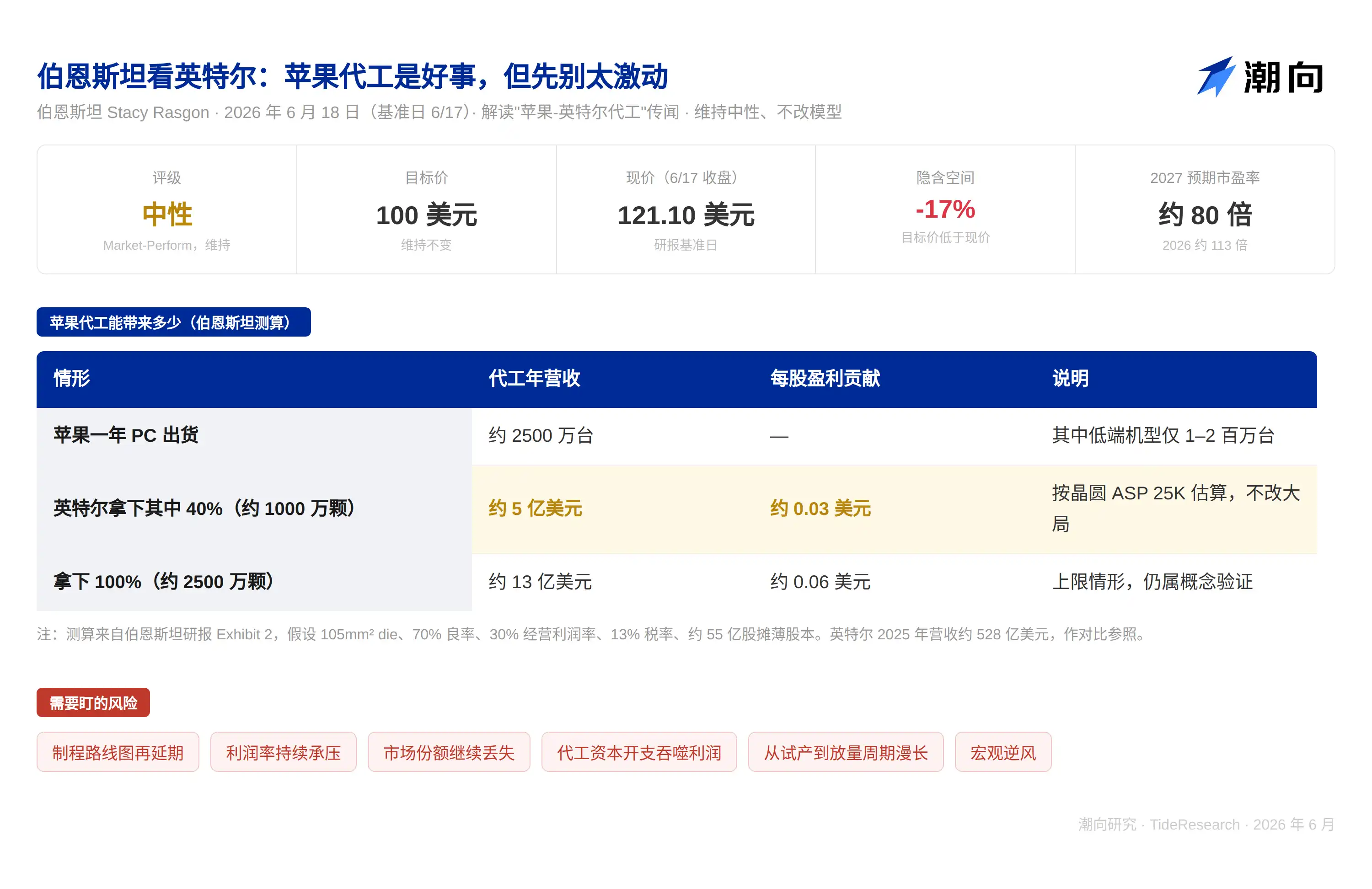
According to Bernstein's data, Apple shipped approximately 23.68 million laptops in the past 12 months, with high-end models (priced above $700) accounting for about 22.15 million units. If Intel ultimately wins 40% of these orders as an initial target, the corresponding annual PC chip foundry volume would be around 5 million sets. Based on Bernstein's assumptions, if the average selling price per wafer is $25,000, this business would generate only about $500 million in annual revenue, contributing roughly $0.03 per share in earnings.

Compared to Intel's annual revenue of approximately $55 billion and annual EPS of about $1.50, this potential contract is almost negligible at the financial level.

The report emphasizes that the value of this order lies not in its current revenue scale but in the endorsement it represents—U.S. client trust in Intel's manufacturing capabilities.

2. The Temperature of Trump's Promoted Policy Needs a Question Mark

Trump recently publicly encouraged Apple and Intel to design and manufacture chips in the U.S., but Bernstein notes that this encouragement is not "enforcement." The analysis suggests that clients will not be "forced" to adopt a particular supplier unless the supplier can prove three conditions: the ability to produce according to specifications, a competitive cost structure, and stable, reliable supply. Intel is currently in the risk production stage for its 18A process, demonstrating credible technological progress, but mature capacity and cost competitiveness still require observation.

In other words, policy encouragement is a plus but cannot replace market competitiveness.

3. The "Transition Challenge" from Proof-of-Concept to Mass Production Persists, Bernstein Does Not Upgrade Rating Accordingly

Bernstein's report repeatedly emphasizes "there is still a lot of wood to chop here," meaning that moving from small-scale proof-of-concept to large-scale mass production still requires significant work, considerable time, and substantial capital investment.

In other words, for Intel to truly cross this stage, it must simultaneously address several issues: investing tens of billions of dollars to expand capacity, passing complex and rigorous customer qualification processes, and proving its cost and yield advantages in the intense foundry price competition.

Precisely due to this uncertainty, while Bernstein acknowledges the positive significance of this collaboration, it maintains a Market-Perform (Hold) rating and does not upgrade to Outperform (Outperform). Its given target price is approximately $100, implying some downside potential compared to the stock price of about $121.10 (as of the report's base date).
The Geopolitical Logic Behind Chip Supply Diversification

Apple has long adopted a supplier diversification strategy to reduce reliance on any single foundry. Historically, this diversification was mainly reflected in choices among different foundry systems and process nodes like TSMC, Samsung, and Intel.

However, in recent years, geopolitical factors have become a new core variable. The U.S. government, through the CHIPS and Science Act, has invested massive subsidies to promote the reshoring of critical chip manufacturing. In this context, Apple shifting some of its high-end PC chip orders to Intel's U.S. factories not only aligns with policy direction but also helps enhance supply chain resilience and mitigate over-reliance risks on a single region (especially Taiwan).

For Intel, this collaboration is more like a crucial market confidence test. Having previously lost Apple's foundry trust due to lagging process technology, re-entering Apple's supply chain for design collaboration and manufacturing cooperation now inherently signifies that its 18A process has reached a certain level of usability. This signal may also have spillover effects on other potential clients (such as data center CPU or AI accelerator manufacturers).

The Tension Between Short-Term Validation and Long-Term Vision

The core of Bernstein's analysis is to reveal a structural contradiction: the vast gap between short-term scale and the long-term narrative.

In the model assumptions, even if Intel secures about 40% of Apple's PC chip orders, the annual shipment volume would only be around 100,000 to 150,000 sets. Within Intel's overall foundry business plan, this still falls under the "pilot validation" or "proof-of-concept" stage, with very limited revenue contribution—only equivalent to a few hundred million dollars—impacting EPS by mere cents, insufficient to materially alter the company's overall growth trajectory.

However, in the long term, this "small-scale entry" holds significant path-dependent value. If Intel can leverage the Apple order to prove its process stability and delivery capabilities, it may subsequently compete for larger-scale foundry orders in areas like cloud computing chips, AI accelerators, and communication chips. The total market size for these segments far exceeds that of PC chips, offering substantial long-term expansion potential.

Bernstein's report does not quantify this "option-like long-term value" but merely notes its existence, while emphasizing that realizing it remains highly dependent on subsequent customer acquisition and continuous process improvement.

Investment Thesis: What to Bet On? What Not to Bet On? What to Watch?

Bet On:

  • Intel's 18A process progress not falling significantly below market expectations
  • Continuity of U.S. policy support for semiconductor manufacturing localization

Do Not Bet On:

  • The Apple collaboration significantly improving Intel's financial performance in the short term
  • Government subsidies directly and rapidly boosting Intel's overall profit margins

Key Signals to Monitor:

  • Revenue recognition and gross margin changes for Intel's foundry business in the next quarterly earnings report
  • The pace of yield improvement and cost reduction curve for the 18A process
  • Whether other major clients besides Apple formally adopt Intel's foundry services
  • The actual fulfillment pace and scale of CHIPS Act-related subsidies

This article is Tide Research's compilation and interpretation of a third-party brokerage research report. The cited ratings, target prices, earnings forecasts, and related judgments are the views of that brokerage analyst, representing only the stance of their institution. They do not represent Tide Research's views and do not constitute any investment advice.

When reading, please note three points: First, target prices are analysts' expectations for approximately the next 12 months—they are forecasts, not promises, and are subject to repeated adjustments based on performance and market conditions. Second, sell-side research reports are inherently bullish, and some covered companies may have business relationships with the brokerage. Third, the value of research reports lies in their core logic and underlying assumptions, not just a single target price. Focus on the logic, not just the price.

The market carries risks; decisions should be made independently. This article should not serve as the basis for trading any securities.

Data Source: Bernstein Research Report (Stacy Rasgon, June 18, 2026) · Intel Historical Financial Data (SEC)

Tide Research · TideResearch · June 2026

Preguntas relacionadas

QWhat are the three key conclusions from Bernstein's report on Intel and Apple's potential cooperation?

A1. Apple entering Intel's foundry is a 'small test' with minimal short-term revenue contribution. Bernstein estimates it would only add about $0.03 to EPS. 2. The political encouragement from the Trump administration is not a mandate; market competitiveness in technology, cost, and supply reliability remains key for Intel. 3. There is a significant 'transition gap' from proof-of-concept to mass production, requiring substantial time and capital. Hence, Bernstein maintains a 'Market-Perform' rating and a $100 price target, seeing positive direction but insufficient for a higher rating.

QAccording to Bernstein's analysis, why is the potential Apple-Intel deal significant despite its small initial financial impact?

AThe significance lies not in immediate financials but in the strategic validation it provides. It represents a key vote of confidence from a major US customer (Apple) in Intel's manufacturing capabilities, specifically its 18A process. This endorsement could help Intel rebuild market trust and potentially attract other large customers like data center CPU or AI accelerator manufacturers, serving as a crucial step in its foundry business strategy.

QWhat is Bernstein's rating and price target for Intel, and how does it compare to the current stock price mentioned in the report?

ABernstein maintains a 'Market-Perform' (Hold) rating for Intel with a price target of $100. This target price implies a potential downside from the reported current price of approximately $121.10 (as of the report's baseline date), suggesting the analyst sees the stock as somewhat overvalued based on the current prospects.

QWhat major challenge does Bernstein identify for Intel in transitioning the Apple collaboration from concept to large-scale production?

ABernstein highlights the 'transition gap' or 'a lot of wood to chop.' The major challenge is scaling from small proof-of-concept volumes to cost-competitive, high-yield mass production. This requires hundreds of billions in capital investment for capacity expansion, navigating complex customer qualification processes, and proving cost and yield advantages in the fiercely competitive foundry market.

QFrom an investment perspective, what are the key signals investors should watch regarding Intel's foundry business, according to the article's summary of the report?

AInvestors should focus on: 1. Revenue recognition and gross margin changes for the foundry business in Intel's quarterly earnings. 2. The pace of yield improvement and cost reduction for the 18A process. 3. Whether other major clients besides Apple formally adopt Intel's foundry services. 4. The actual disbursement pace and scale of subsidies related to the CHIPS Act.

Lecturas Relacionadas

Deciphering the Ethereum Foundation's New Structure: Reaffirming Self-Sovereignty Amid Institutionalization Trends

Summary: The Ethereum Foundation (EF) has announced a major restructuring, laying off 20% of its staff and introducing a new five-layer operational framework. This move aims to clarify the EF's mission and reaffirm Ethereum's core principle of self-sovereignty amidst growing institutionalization in the crypto space. The five layers are: 1. **Protocol Layer**: Focuses on maintaining Ethereum's foundational "CROPS" values—Censorship-resistant, Robust, Open, Private, and Secure. This involves core technical work like secure hard forks and mitigating toxic MEV. 2. **Access Layer**: Ensures users can practically exercise self-sovereignty through actions like reading the chain and making transactions. A key principle is the "zero option," meaning a trusted, non-intermediated path must always exist as an alternative to any centralized service. 3. **User Layer**: Bridges the protocol and access layers by grounding EF's work in the real needs of users and organizations. This is seen as crucial for moving beyond a purely research-driven approach and ensuring development effectively serves the ecosystem. 4. **Community Layer**: Responsible for building and maintaining consensus around Ethereum's core values both internally and externally. This involves guarding against centralization, upholding technological neutrality, and preventing short-term commercial interests from undermining CROPS principles. 5. **Institutional Layer**: Manages EF's engagement with institutions, but with the precondition of self-sovereignty. The goal is not to make it easier for institutions to control users, but to demonstrate how Ethereum's technology can enable better integrations. The article argues that while institutional adoption brings legitimacy, it also risks diluting crypto's foundational ethos of decentralization. The new structure represents EF's effort to navigate this tension, upholding its core mission while actively engaging with a broader, more complex ecosystem.

marsbitHace 12 min(s)

Deciphering the Ethereum Foundation's New Structure: Reaffirming Self-Sovereignty Amid Institutionalization Trends

marsbitHace 12 min(s)

OpenRouter: How Did This 'AI Model Relay Station' Achieve a $10 Billion Valuation?

OpenRouter: The Model Router Building a $10B+ Company This article explores OpenRouter, a platform that aggregates access to over 400 AI models from 70+ providers (like OpenAI, Claude, Gemini) through a single API. It has grown into a unicorn with a $1.3B valuation by 2026, processing massive scale—reaching 100 trillion tokens monthly. Its core value isn't just being a "model supermarket." For developers building real-world AI applications, managing multiple models for different tasks (e.g., cheap models for titles, powerful ones for long articles) is complex. OpenRouter acts as a critical "model scheduling layer," handling routing, failover between providers, cost optimization, and enterprise features like zero-data-retention policies and budget controls. OpenRouter's business model is a "toll fee": it charges a small platform fee (5.5%) on purchased credits while passing model costs directly to users. Its revenue scales with the tokens flowing through its system, which saw explosive growth as AI apps evolved. Key growth drivers include: 1) The explosion of specialized models, increasing choice complexity; 2) AI apps shifting focus from performance to cost optimization; 3) The rise of AI agents that require more reliable, multi-step model calls. However, risks remain. Large enterprises or cloud providers (AWS, Google Cloud) could build similar internal gateways. Its position between model suppliers and developers could also create future tension over pricing and data control. To stay ahead, OpenRouter must deepen its enterprise features and prove it's more than just a request forwarder.

marsbitHace 32 min(s)

OpenRouter: How Did This 'AI Model Relay Station' Achieve a $10 Billion Valuation?

marsbitHace 32 min(s)

Bitcoin Falls Below $60,000 Again; After 20 Months, We've Reached a New Low

Bitcoin Drops Below $60,000, Hitting a 20-Month Low Bitcoin fell below the key $60,000 psychological level again, reaching a low of $59,023—its lowest point in approximately 20 months, dating back to October 2024. While it later recovered slightly to around $60,600, this marks its third significant breach of $60,000 this year. The downturn is attributed to two primary factors. First, U.S. spot Bitcoin ETFs are experiencing their longest streak of net outflows since launch, with nearly $5.94 billion withdrawn over 30 days. This creates sustained selling pressure as Authorized Participants sell Bitcoin to meet redemptions. Second, shifting macroeconomic expectations are adding pressure. Strong U.S. job data and hawkish remarks from Fed officials have increased market pricing for potential rate hikes, reversing the earlier liquidity-driven bullish sentiment and prompting a shift away from risk assets like Bitcoin. Analyst views are mixed. 21Shares maintains a bullish long-term outlook, expecting prices to recover towards $100,000, citing historical post-halving cycles and substantial ETF holdings as a base. In contrast, Arthur Hayes predicts a potential bottom around $40,000 within six months due to persistent Fed hawkishness. CryptoQuant suggests, based on on-chain data, that the market may not find a bottom until prices fall below the average investor cost basis around $53,000, potentially extending the bearish phase into late 2026 or early 2027. The immediate focus is on upcoming U.S. inflation data and Fed signals. Lower-than-expected CPI could offer relief, but confirmation of sticky inflation or continued ETF outflows may lead to further downside pressure. Bitcoin's ability to hold above $60,000 remains a critical test for the near-term market direction.

Odaily星球日报Hace 1 hora(s)

Bitcoin Falls Below $60,000 Again; After 20 Months, We've Reached a New Low

Odaily星球日报Hace 1 hora(s)

Trading

Spot
Futuros
活动图片