Ethereum Q1 2026 Report: Fees Decline, Users and Transaction Volume Hit New Highs

marsbitPublicado a 2026-06-20Actualizado a 2026-06-20

Resumen

Ethereum Q1 2026 Report: Fees Down, Users & Transactions Hit New Highs Token Terminal's Q1 2026 report on Ethereum presents a pivotal development: the network achieved record highs in monthly active users (13.2M, +85.9% YoY), total transactions (200.4M, +81.5% YoY), and throughput (25.78 TPS), while transaction fees on the mainnet plummeted by 47.9% quarter-over-quarter. This shift is attributed to the network's strategic move into a "low fees for scale" phase, exemplified by the Fusaka upgrade which increased data capacity and lowered block space costs, releasing pent-up demand (a manifestation of Jevons's Paradox). The report highlights a core narrative shift for Ethereum: from a DeFi-centric blockchain to a global financial settlement layer. It maintains a dominant position in tokenized assets, holding majority market shares among top chains in stablecoins (61.8%), tokenized funds (73.0%), and tokenized commodities (84.0%). Growth in tokenized funds (+73.1% YoY) and commodities (+325.9% YoY) was particularly strong, driven by institutions like BlackRock and JPMorgan entering the space. Contrasting these usage gains, several USD-denominated value metrics declined in Q1: fully diluted market cap fell 30.3% QoQ, total value locked (TVL) dropped 11.0%, and ecosystem transaction volume decreased 24.0%. The report interprets this as Ethereum prioritizing long-term network expansion and cementing its role as the default settlement layer for finance over short-term fee capture....

Editor's Note: This Q1 2026 report on Ethereum from Token Terminal presents a set of seemingly contradictory yet crucial data points: while the number of users, transaction count, and throughput on the Ethereum mainnet all reached new historical highs simultaneously, transaction fees, TVL, trading volume, and ETH's fully diluted market cap saw quarter-over-quarter declines.

Ethereum is proactively entering a phase of "low fees for scale." Following the Fusaka upgrade which increased data capacity, block space has become cheaper, accelerating growth in users and transactions while temporarily suppressing fee capture. The report interprets this phenomenon as the Jevons Paradox: as the cost of using a resource falls, demand for the network may be further unleashed.

More significantly, Ethereum's core narrative is shifting from that of a DeFi-centric public blockchain to a global financial settlement layer. The report shows Ethereum still maintains dominance in tokenized assets: stablecoins, tokenized funds, tokenized commodities, and tokenized equities have all achieved scale on its network, with notable growth in funds and gold-related assets. The continued entry of institutions like BlackRock, JPMorgan, and Fidelity is also moving "institutional onboarding" from concept to product issuance and settlement practice.

The core value of this report lies not in proving how the ETH price might change in the short term, but in illustrating Ethereum's structural position as financial infrastructure: it is sacrificing short-term fee revenue through scaling on one hand, while on the other, attempting to solidify its network effects in stablecoins, tokenized funds, on-chain credit, and institutional settlement. For investors and industry observers, the key questions to focus on are: as more financial assets migrate on-chain, who will become the default settlement layer, and how will this settlement demand ultimately translate into value capture for ETH.

Below is the original text:

1) Executive Summary

Ethereum ($ETH) is a public, permissionless blockchain that provides global settlement and compute capacity for financial applications in an open economy. It runs a shared ledger that anyone can build on and no single party can shut down, using its native asset ETH to pay for transaction fees; simultaneously, through its staking mechanism, ETH is also used to secure the network.

The activities Ethereum facilitates have historically been constrained by the cost and throughput limitations of traditional financial infrastructure: settlements taking days, multiple intermediary layers adding friction, and counterparty risk at each hop. Tokenization and stablecoins are on-chain solutions emerging to address these frictions. As their regulatory frameworks matured through 2025 and into 2026, the conditions for institutional-scale on-chain activity moved from theory to reality.

Ethereum's role in this transition is that of the foundational settlement layer. Stablecoins, tokenized funds, tokenized commodities, and increasingly, tokenized equities, are being issued and settled on Ethereum; meanwhile, Layer 2 networks are responsible for scaling throughput and ultimately settling transactions back to Layer 1. As the asset that secures and pays for this settlement activity, ETH accrues value from it, and the staking market reflects how much of the ETH supply is committed to this role.

From a market positioning perspective, Ethereum remains the primary venue with the largest market capitalization for tokenized assets. On a cross-chain basis, Ethereum holds majority shares in categories like stablecoins, tokenized funds, commodities, and equities. Ethereum is developed by the Ethereum Foundation alongside a broad, independent community of client teams and researchers; concurrently, organizations like Etherealize help traditional finance better understand the network.

Q1 2026 can be clearly divided into two main narratives. On one hand, usage reached historical highs: monthly active users, transaction count, and throughput all set new records. On the other hand, value and fee metrics denominated in USD saw compression: fully diluted market cap, total value locked, trading volume, and both fee metrics declined quarter-over-quarter. Key events shaping the quarter impacted both narratives: the second Blob Parameters Only (BPO #2) fork within the Fusaka upgrade cycle in January increased data capacity; ERC-8004 went live on the mainnet in February, establishing a standard for AI Agent identity and reputation; the Ethereum Foundation finalized its 2026 Protocol Cluster priorities—scaling, improving user experience, and strengthening Layer 1; furthermore, events like the Institutional Ethereum Forum in March reflected growing institutional engagement.

Key Metrics (Q1 2026)

Ecosystem Total Value Locked: $316.2B (QoQ -11.0%, YoY +22.8%)

Ecosystem Active Loans: $21.8B (QoQ -16.6%, YoY +39.0%)

Ecosystem Trading Volume: $134.5B (QoQ -24.0%, YoY -31.2%)

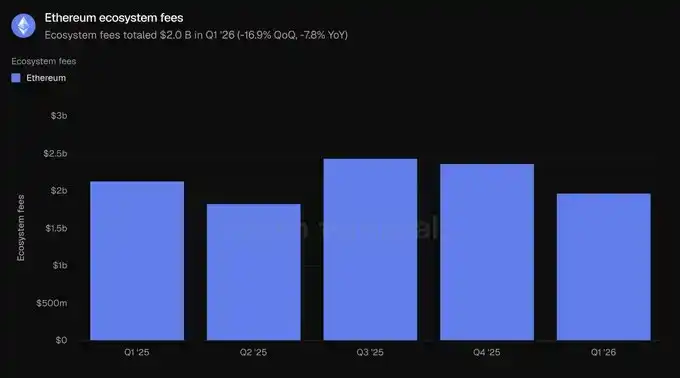
Ecosystem Fees: $2.0B (QoQ -16.9%, YoY -7.8%)

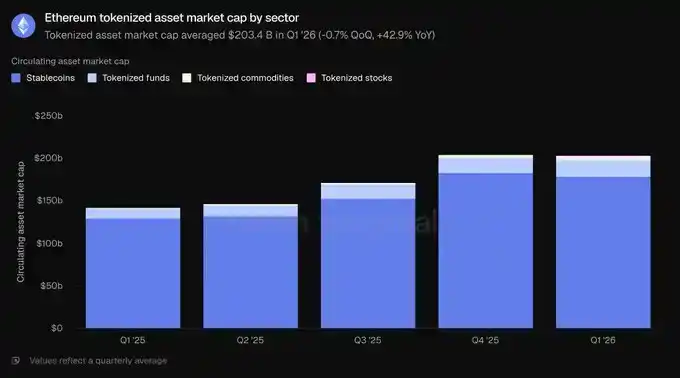
Tokenized Asset Market Cap: $203.4B (QoQ -0.7%, YoY +42.9%)

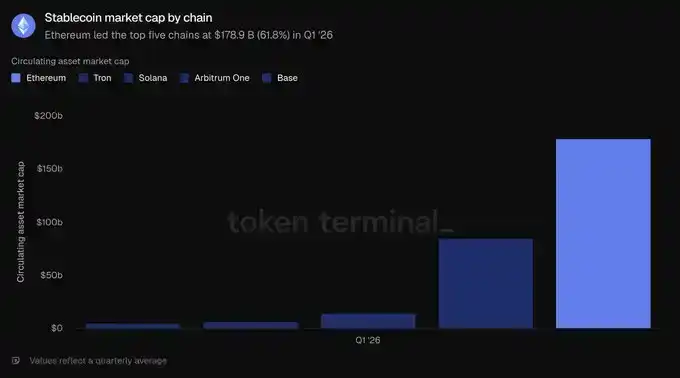
Stablecoins: $178.9B (QoQ -2.3%, YoY +37.6%)

Tokenized Funds: $19.4B (QoQ +4.9%, YoY +73.1%)

Tokenized Commodities: $4.7B (QoQ +60.0%, YoY +325.9%)

Tokenized Equities: $365.1M (QoQ +16.5%)

Monthly Active Users: 13.2M (QoQ +53.5%, YoY +85.9%)

Transactions: 200.4M (QoQ +38.0%, YoY +81.5%)

Transactions Per Second: 25.78 (QoQ +41.2%, YoY +81.7%)

Fees: $39.9M (QoQ -47.9%, YoY -81.9%)

Fully Diluted Market Cap: $290.0B (QoQ -30.3%, YoY -9.9%)

Stake Ratio: 0.31x (QoQ +0.03x, YoY +0.03x)

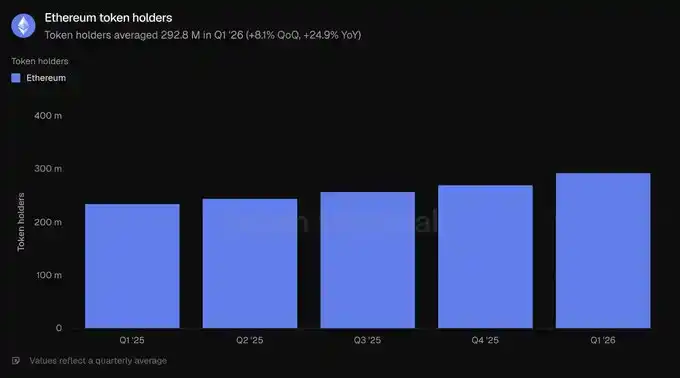
Token Holder Count: 292.8M (QoQ +8.1%, YoY +24.9%)

This report covers the Ethereum Layer 1 network, i.e., the mainnet. Layer 2 networks are treated as independent chains and are not included in Ethereum's own data.

2) Ecosystem

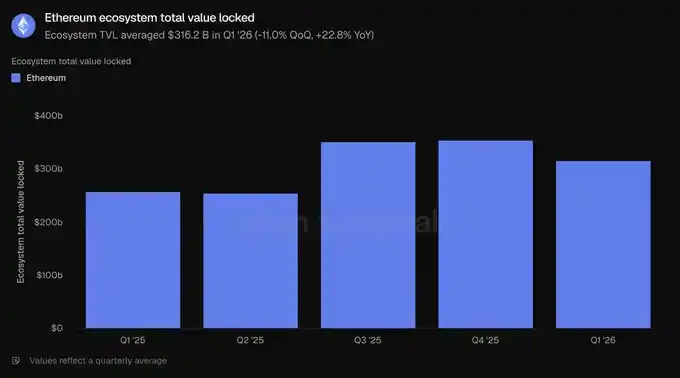
Total Value Locked (TVL) measures the value of assets deposited into various applications on a chain and is a leading indicator for revenue-generating activities like lending, trading, and staking. This statistic measures the capital deposited within the Ethereum ecosystem; depositors can typically withdraw these funds at any time.

On this basis, the average ecosystem TVL in Q1 2026 was $316.2 billion, a quarter-over-quarter decrease of 11.0% but a year-over-year increase of 22.8%. The quarterly decline aligns with a broad pullback in asset prices, while the annual growth indicates the Ethereum ecosystem remains significantly larger than a year ago.
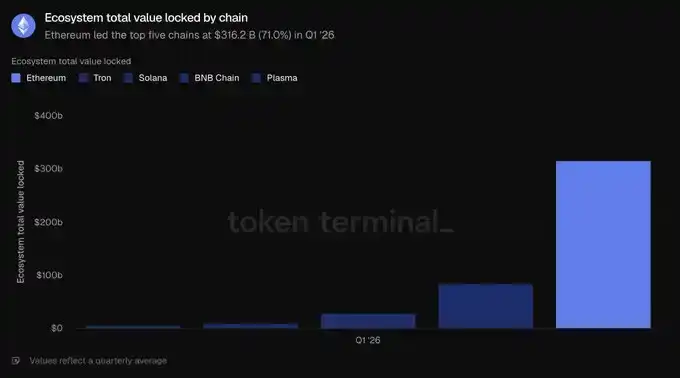
Among the top five chains, Ethereum leads significantly with $316.2B, exceeding the combined TVL of Tron ($84.5B), Solana ($28.8B), BNB Chain ($10.3B), and Plasma ($5.7B), accounting for 71.0% of the top five chains' total. The largest pools of this capital are concentrated in liquid staking, represented by projects like Lido, and lending, represented by projects like Aave. Restaking projects EigenLayer and ether.fi, along with synthetic dollar issuers Ethena and Sky, also rank among the largest applications by scale. Capital concentration remains Ethereum's clearest structural advantage.
Active Loans measures the portion of deposits that have been lent to borrowers and are therefore generating interest; this metric is typically correlated with lending revenue. On Ethereum, it reflects the outstanding loans across all lending applications in the ecosystem.

In Q1 2026, the average ecosystem active loans were $21.8 billion, down 16.6% quarter-over-quarter but up 39.0% year-over-year. The loan balance contracted alongside TVL, consistent with reduced risk appetite, yet remained substantially higher than a year ago.
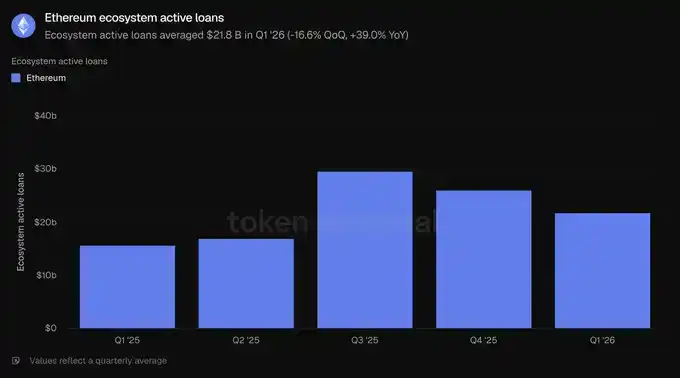
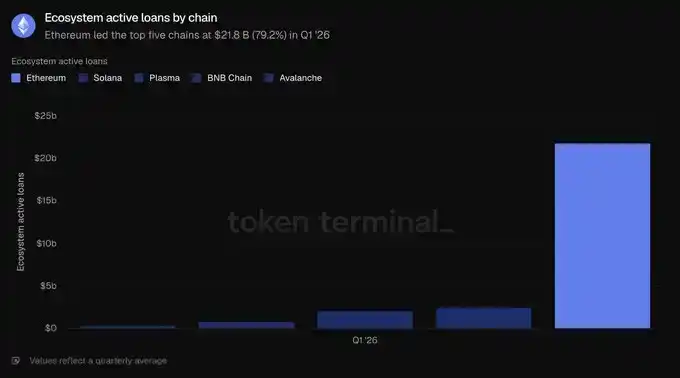
Lending activity on Ethereum is concentrated in a handful of money markets, with Aave dominating. At quarter-end, Aave's active loans were approximately $13.5B, accounting for the majority of the ecosystem total; followed by Morpho (~$1.9B), Sky's Spark (~$1.0B), and Maple (~$840M). The quarterly contraction was primarily driven by Aave, whose loan book shrank about 24% during the quarter as prices fell and borrowing demand cooled. Among the top five chains, Ethereum's $21.8B far exceeds Solana ($2.5B), Plasma ($2.1B), BNB Chain ($760.8M), and Avalanche ($392.4M), representing 79.2% of the top five chains' total. This is Ethereum's highest share across all metrics in this section.
Trading Volume measures the total value of trades executed on decentralized spot exchanges. As traders pay fees, this metric is typically correlated with the fees generated by these venues. This statistic measures the total DEX trading volume within the Ethereum ecosystem.

In Q1 2026, the total ecosystem trading volume was $134.5 billion, down 24.0% quarter-over-quarter and 31.2% year-over-year. Volume declined more sharply than locked capital, indicating a reduction in risk appetite during the quarter's pullback.
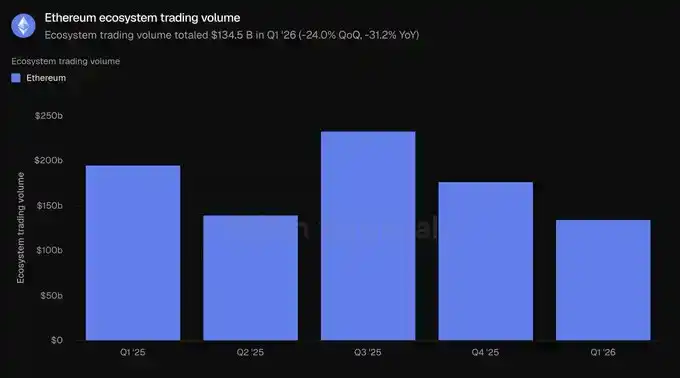
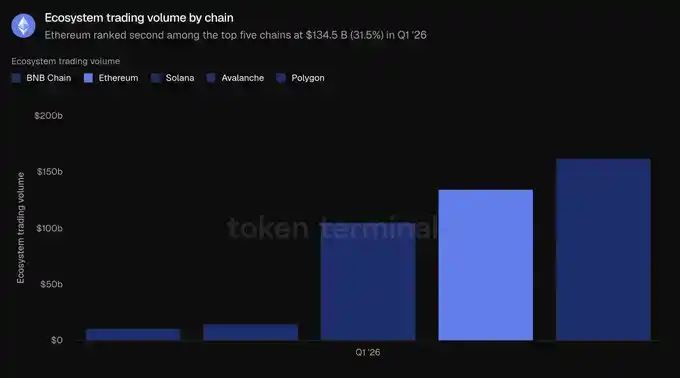
DEX activity on Ethereum is concentrated in a few deep liquidity venues. Uniswap processed approximately $85.5B in volume in Q1, accounting for about two-thirds of the ecosystem's trading volume; followed by Curve (~$22.1B) and CoW Swap (~$12.4B). Trading volume is the only metric in this section where Ethereum does not lead on a cross-chain basis: BNB Chain's volume of $162.5B was higher than Ethereum's $134.5B; Solana followed with $104.9B; then Avalanche ($14.5B) and Polygon ($10.7B). Ethereum's share of the top five chains' trading volume was 31.5%, ranking second behind BNB Chain's 38.0%.
Fees measure the total value users pay to utilize a project's applications, such as interest paid by borrowers or trading fees paid by traders, reflecting the amount of economic value generated. This metric aggregates fees generated by applications within the Ethereum ecosystem.

In Q1 2026, total ecosystem fees were $2.0 billion, down 16.9% quarter-over-quarter and 7.8% year-over-year, consistent with weaker trading and lending activity.
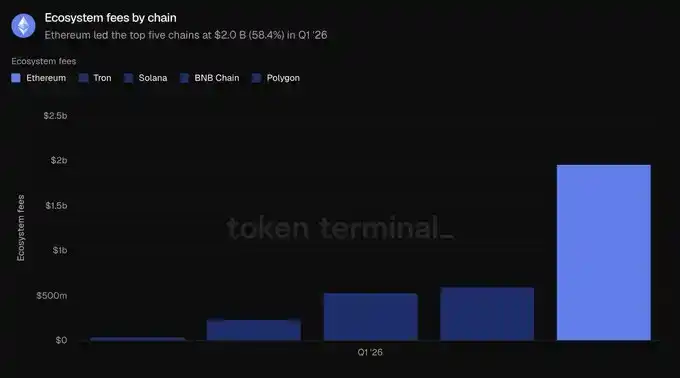
Ethereum generated $2.0B in fees, significantly more than Tron ($599.3M), Solana ($532.5M), BNB Chain ($231.9M), and Polygon ($38.8M), accounting for 58.4% of the top five chains' total fees. Despite the decline, Ethereum remains the single largest source of application fees. Overall, in this section, Ethereum leads in locked capital, credit, and fees, lagging only in trading volume.
3) Tokenized Assets

Circulating Asset Market Cap measures the total value of an asset after it has been tokenized on-chain, calculated as the circulating supply multiplied by the end-of-day price. For stablecoins, it refers to the outstanding supply; for tokenized funds, it refers to Assets Under Management (AUM) on-chain; for tokenized equities, it refers to the value of equities issued on-chain. This statistic measures assets issued on Ethereum.

In Q1 2026, the average market cap of tokenized assets on Ethereum was $203.4 billion, essentially flat quarter-over-quarter (-0.7%) but up 42.9% year-over-year. Stablecoins constituted the largest portion, representing 87.9% of the total, with the remainder composed of funds, commodities, and equities.
In Q1 2026, the average stablecoin market cap on Ethereum was $178.9 billion, down 2.3% quarter-over-quarter but up 37.6% year-over-year, making it the only sub-segment to decline during the quarter. Two issuers dominate: at quarter-end, Tether's USDT stood at $94.1B, and Circle's USDC at $54.5B, together accounting for the majority of the network's stablecoin market cap. They were followed by Sky's USDS ($12.4B), Ethena's USDe ($5.9B), and PayPal's PYUSD ($2.9B). Newer regulated entrants like Ripple's RLUSD ($1.1B) have also launched. Among the top five chains, Ethereum leads with $178.9B, exceeding Tron ($84.5B), Solana ($14.5B), Arbitrum One ($6.8B), and Base ($4.7B), accounting for 61.8% of the top five chains' total.
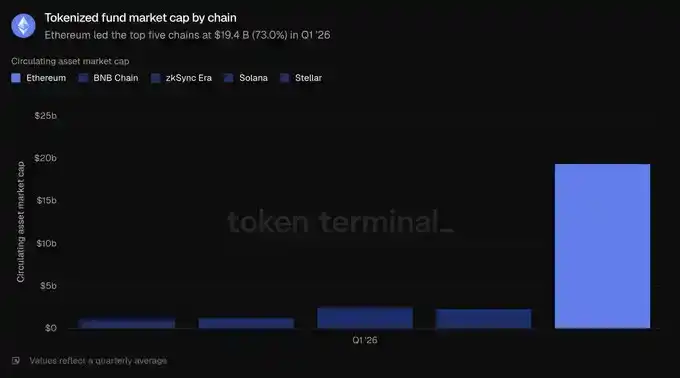
In Q1 2026, the average market cap of tokenized funds on Ethereum was $19.4 billion, up 4.9% quarter-over-quarter and 73.1% year-over-year. This segment can be divided into two parts: one is the interest-bearing on-chain USD category led by Sky's sUSDS (~$6.4B) and Ethena's sUSDe (~$3.5B); the other is regulated funds underpinning the institutional narrative, which have achieved scale growth, including BlackRock's BUIDL (issued via Securitize, ~$1.0B), WisdomTree's Government Money Market Fund (~$815M), and Superstate's USTB (~$620M), with Ondo's OUSG (~$320M) also following closely. Among the top five chains, Ethereum's $19.4B ranks first, ahead of zkSync Era ($2.5B), BNB Chain ($2.3B), Solana ($1.3B), and Stellar ($1.1B), accounting for 73.0% of the top five chains' total. This is the second-highest concentration among all asset categories in this section.
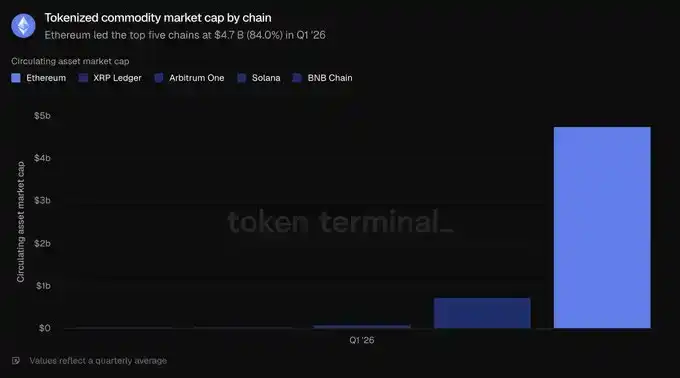
In Q1 2026, the average market cap of tokenized commodities on Ethereum was $4.7 billion, up 60.0% quarter-over-quarter and 325.9% year-over-year, making it the fastest-growing tokenized asset category. This category is almost entirely composed of gold: Tether Gold (XAUT, ~$2.6B) and Paxos' PAX Gold (PAXG, ~$2.4B) together constitute nearly the entire segment. Among the top five chains, Ethereum's $4.7B far exceeds the XRP Ledger ($736.6M), Arbitrum One ($95.9M), BNB Chain ($38.4M), and Solana ($29.8M), accounting for 84.0% of the top five chains' total. This is Ethereum's strongest lead in this section.
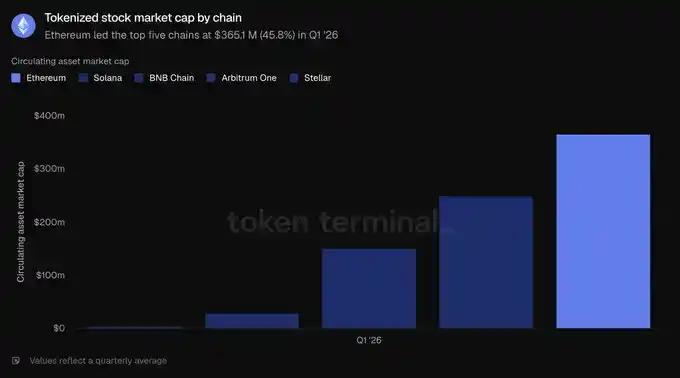
Tokenized equities remain the smallest category. In Q1 2026, the average market cap of tokenized equities on Ethereum was $365.1 million, a significant increase from a nearly negligible base a year ago, and up 16.5% quarter-over-quarter. This category is almost entirely dominated by Ondo Finance. Ondo's on-chain equities and ETFs, covering broad-based index funds like the S&P 500 and NASDAQ 100, as well as dozens of individual stocks, constitute the majority of the tokenized equity market cap on Ethereum. Among the top five chains, Ethereum leads with $365.1M, followed by Solana ($249.0M), BNB Chain ($150.5M), Arbitrum One ($29.0M), and Stellar ($4.2M). However, Ethereum's share of the top five chains' total is only 45.8%, its narrowest lead and the only tokenized category where Ethereum does not hold a clear majority.
Overall, the quarter shows Ethereum's leadership in fund and commodity tokenization, even as stablecoin balances temporarily stagnated.

4) Usage

Monthly Active Users measures the number of unique addresses that have interacted with the network via revenue-generating transactions within a one-month window. On Ethereum, it counts distinct addresses transacting on the Layer 1 network.

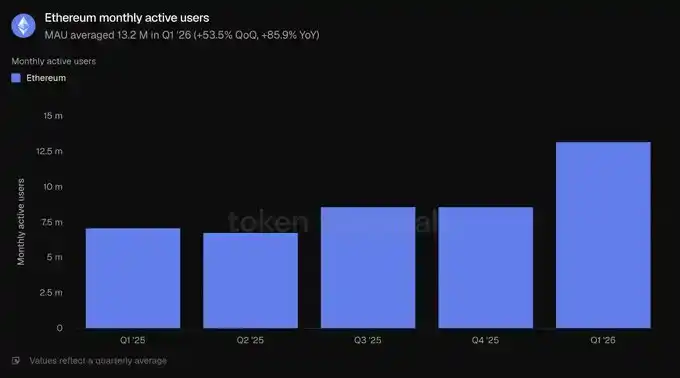
In Q1 2026, the average monthly active users were 13.2 million, up 53.5% quarter-over-quarter and 85.9% year-over-year, setting a new historical high. After several quarters of relatively modest growth, user growth accelerated markedly.
Transactions measures the number of transactions confirmed and added to the blockchain, reflecting user activity on the network; Transactions Per Second is the average rate at which these confirmed transactions are processed, measuring throughput and real-time usage. Both are measured here for the Ethereum Layer 1 network.

In Q1 2026, the total number of transactions was 200.4 million, up 38.0% quarter-over-quarter and 81.5% year-over-year; throughput increased to 25.78 transactions per second, up 41.2% quarter-over-quarter. Both metrics set new historical highs, confirming that user growth translated into substantial increases in on-chain activity.
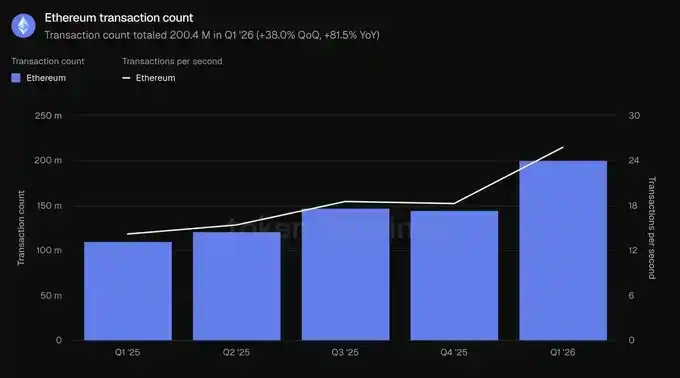
Fees here refer to the transaction fees users pay to conduct transactions on the Ethereum Layer 1 network, i.e., the cost of using the base layer. This is distinct from the ecosystem-level application fees in Section 2.

On this basis, total fees in Q1 2026 were $39.9 million, down 47.9% quarter-over-quarter and 81.9% year-over-year. This contrasts sharply with usage metrics and represents the quarter's most critical data point: while transaction count grew 38.0%, total fees fell 47.9%, meaning the average cost per transaction decreased significantly as data capacity increased and block space prices fell.
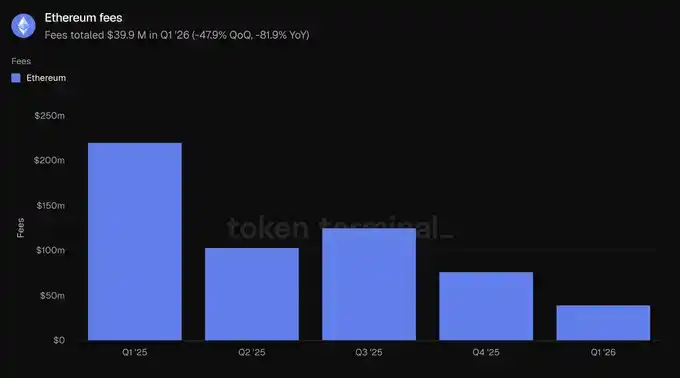
This section presents a scaling story: more users, more transactions, completed at a lower total cost. As throughput grows faster than demand, increased activity and decreased fees can coexist.

5) ETH

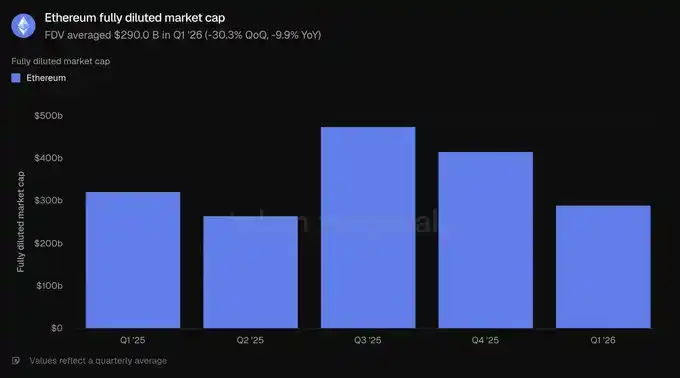
Fully Diluted Market Cap measures the valuation of ETH under a fully diluted assumption, calculated as the token price multiplied by the total supply under the current token economics, including circulating, locked, unvested, and future issuable tokens.

In Q1 2026, the average fully diluted market cap was $290.0 billion, down 30.3% quarter-over-quarter and 9.9% year-over-year. The quarterly decline is the largest among valuation metrics in this report and drove the decline in other USD-denominated metrics.
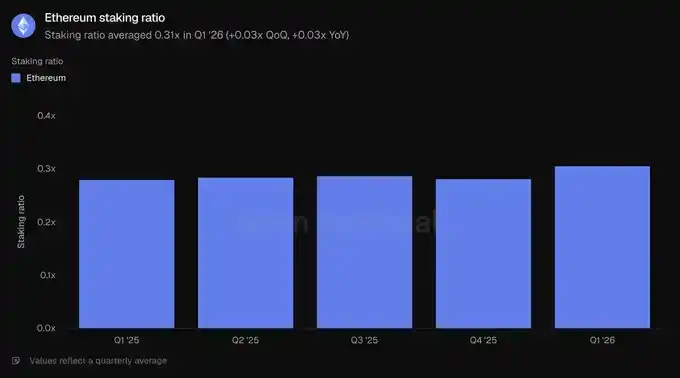
Stake Ratio measures the value of ETH committed to helping secure the proof-of-stake network relative to the total market cap of ETH. A reading of 0.31x means roughly 31% of the value is staked.

In Q1 2026, the average stake ratio was 0.31x, higher than the 0.28x in the previous quarter and a year ago. Even as ETH's market cap fell, the share of ETH dedicated to network security increased, indicating stable staking participation during the price retreat.
Token Holder Count measures the number of distinct addresses holding the network's native token. On Ethereum, it counts addresses holding ETH.

In Q1 2026, the average token holder count was 292.8 million, up 8.1% quarter-over-quarter and 24.9% year-over-year, continuing a steady upward trend over the past five quarters. Even as the fully diluted market cap declined, the holder base expanded, suggesting ETH ownership became more widespread during the price pullback.
6) Etherealize Team Commentary

"The most prominent tension this quarter is that Ethereum mainnet usage hit an all-time high while transaction fees declined. Ethereum is deliberately scaling the network at the expense of short-term fee capture, betting that cheaper block space will unlock more demand and ultimately generate more network revenue in the long run.

Token Terminal's 'Ethereum Q1 2026 Report' shows this bet is working. On a year-over-year basis, monthly active users grew 85.9%, transactions grew 81.5%, and throughput grew 81.7%. This is the Jevons Paradox in action. We expect the increase in total network demand to be sufficient to offset the impact of lower fees, similar to how the semiconductor industry today generates orders of magnitude more revenue than in 1975, when Intel co-founder Gordon Moore observed that the number of transistors on a microchip doubled roughly every two years. Furthermore, the returns from scaling lie ahead: the Glamsterdam upgrade, scheduled for Q3, plans to increase the gas limit by more than 3x, and Ethereum's roadmap points to achieving 10,000 TPS by 2029 and a 'fast Layer 1' network with second-level finality.

We agree with BlackRock CEO Larry Fink's assessment from last December. He wrote, 'Tokenization today is roughly where the internet was in 1996—when Amazon sold just $16 million worth of books.' The consensus back then was that Amazon was just a money-losing online bookstore propped up by the dot-com bubble. However, Jeff Bezos saw that the internet would reshape retail and prioritized optimizing for network effects and economies of scale over short-term profits. Ethereum is making a similar trade-off to cement its position as the global financial settlement layer.

Another lesson from the internet is that open, permissionless networks tend to win over closed networks. In 1995, Bill Gates published *The Road Ahead*, predicting digital commerce would run on proprietary corporate networks he called the 'information superhighway,' not the open internet. Microsoft was building MSN at the time. AOL, CompuServe, and Prodigy operated walled gardens with millions of paying subscribers. France's Minitel, as late as the end of 1996, still had more users than the entire World Wide Web. They all lost. No serious company wants to build on a network controlled by a competitor; perhaps more importantly, no company can keep pace with permissionless innovation indefinitely. We've seen this play out repeatedly: Linux surpassing proprietary Unix, open networks replacing corporate walled gardens, Wikipedia replacing Britannica. Each time, proprietary solutions started with an advantage—more focused product, stronger marketing, better business development teams—but each time, that lead eroded once the open system crossed the threshold of accumulated contributions, tooling maturity, and credible neutrality.

Now, we're seeing the same themes play out in financial infrastructure, and the data in this report show Ethereum has crossed that threshold and holds dominant market share across all key metrics. Institutions building tokenized finance choose Ethereum not out of ideology, but because the liquidity, composability, and institutional precedents are already there. As this report highlights, among the top five chains, Ethereum holds 79.2% of active DeFi loans, 61.8% of stablecoins, 73.0% of tokenized funds, and 84.0% of tokenized commodities. Each new tokenized asset deepens liquidity, attracting the next one; and the neutral base layer is the only sustainable equilibrium because large participants will never agree to settle on a competitor's infrastructure. Moreover, institutions are realizing that privacy, permissioning, KYC, and transfer restrictions can all be achieved on Ethereum through privacy-preserving environments and permissioned token standards without sacrificing access to public liquidity; conversely, grafting public liquidity and open application ecosystems onto a closed chain is impossible.

If anything, institutional momentum has accelerated further after the quarter ended. In May alone, BlackRock filed for two more tokenized funds; JPMorgan launched its second tokenized money market fund, JLTXX, on Ethereum; Fidelity International launched FILQ, a Moody's AAA-rated US dollar liquidity fund issued as an ERC-20 token. In the stablecoin space, the Japan Blockchain Foundation's yen stablecoin EJPY will launch on Ethereum; a consortium of twelve European banks, including BNP Paribas, ING, UniCredit, and BBVA, is also preparing to launch a regulated euro stablecoin.

The internet looked impossible in 1990 and inevitable by 2005. If Fink is right about where tokenization is in its lifecycle, the coming years could be among the most exciting in Ethereum's history. As we argued in our 'Productive Money' report, network fees provide a floor of intrinsic value for ETH, and the bull case is ETH absorbing the $30+ trillion monetary premium held by gold and Bitcoin because ETH has superior monetary properties. ETH doesn't need to rely on high fees to win."

7) Definitions

Metrics:

Ecosystem Total Value Locked: The USD value of assets deposited into applications within a chain's ecosystem, reported as the period average.

Ecosystem Active Loans: The USD value of outstanding loans within lending applications in the ecosystem, reported as the period average.

Ecosystem Trading Volume: The USD value of trades executed on decentralized exchanges within the ecosystem, reported as the period total.

Ecosystem Fees: The total fees paid by users to applications within the ecosystem, reported as the period total.

Circulating Asset Market Cap: The circulating USD value of a tokenized asset category, calculated as the circulating supply multiplied by the end-of-day price, reported as the period average.

Monthly Active Users: The number of distinct addresses interacting with Ethereum via revenue-generating transactions, reported as the average of monthly figures for the period.

Transactions: The number of transactions confirmed and settled on the Ethereum Layer 1 network, reported as the period total.

Transactions Per Second: The average rate at which the Ethereum Layer 1 network confirmed transactions during the period.

Fees: The total transaction fees paid on the Ethereum Layer 1 network, reported as the period total.

Fully Diluted Market Cap: ETH price multiplied by the total supply under the current token economics, reported as the period average.

Stake Ratio: The value of ETH staked to secure the network relative to the total market cap of ETH, reported as the period average.

Token Holder Count: The number of distinct addresses holding ETH, reported as the period average.

8) About This Report

This report is published quarterly and produced using Token Terminal's end-to-end on-chain data infrastructure. All metrics are sourced directly from blockchain data. The charts and datasets referenced in the report can be viewed in the corresponding Ethereum Q1 2026 report dashboard on Token Terminal.


Criptos en tendencia

Preguntas relacionadas

QAccording to the report, what was the paradoxical data trend observed for Ethereum in Q1 2026?

AThe report highlighted a paradoxical trend where Ethereum's mainnet user count, transaction volume, and throughput all reached all-time highs, while key financial metrics like transaction fees, Total Value Locked (TVL), trading volume, and ETH's fully diluted market capitalization declined quarter-over-quarter.

QWhat is the 'Jevons Paradox' and how is it applied to explain Ethereum's current strategy as described in the report?

AThe Jevons Paradox is an economic principle stating that as the cost of using a resource decreases, demand for that resource can actually increase. The report uses this to explain Ethereum's strategy of reducing transaction fees through the Fusaka upgrade (which increased data capacity) to stimulate user and transaction growth, sacrificing short-term fee capture for long-term network expansion.

QHow is Ethereum's primary narrative shifting according to the analysis, and what data supports this shift?

AEthereum's primary narrative is shifting from being a DeFi-focused blockchain to a global financial settlement layer. This is supported by data showing Ethereum's dominant market share in tokenized assets among major chains: 61.8% of stablecoins, 73.0% of tokenized funds, 84.0% of tokenized commodities, and the growth in institutional adoption by firms like BlackRock, JPMorgan, and Fidelity launching tokenized products on Ethereum.

QWhich single key metric showed a significant decrease (47.9% QoQ) that contrasted sharply with the increase in usage metrics (users and transactions), and what was the primary reason for this decrease?

ALayer 1 transaction fees on the Ethereum mainnet decreased by 47.9% quarter-over-quarter, contrasting sharply with the 53.5% increase in monthly active users and 38.0% increase in transaction count. The primary reason was the Fusaka upgrade's increase in data capacity, which made block space cheaper, dramatically reducing the average cost per transaction.

QWhat historical analogy does the Etherealize team comment use to frame Ethereum's current strategic choices regarding fees and scale?

AThe Etherealize team comment draws an analogy to Amazon in 1996 and the early internet. It compares Ethereum's choice to prioritize scaling and network effects over short-term fee capture (profit) to Jeff Bezos's strategy of prioritizing long-term market dominance in retail over immediate profitability when Amazon was just an online bookstore.

Lecturas Relacionadas

The "Impossible Triad" Is Fundamentally a Pseudo-Problem

The article argues that blockchain's fundamental limitation is not the scalability trilemma (decentralization, scalability, security), which has been largely solved, but the lack of **privacy** and, until recently, clear **legitimacy**. Blockchain is described as a slow, expensive, globally shared computer whose core value is censorship resistance and verifiability. While ideal for native digital assets like money (e.g., stablecoins), its default transparency acts as a **tax**, exposing all transactions and enabling MEV extraction, which deters serious institutional capital. Simultaneously, its permissionless nature created regulatory ambiguity. The piece contends that **privacy** is the missing critical feature. It rejects the false choice between total transparency and complete anonymity. Modern cryptography (like zero-knowledge proofs) enables **compliant privacy**: users can prove facts (solvency, KYC status, compliance) without revealing the underlying sensitive data (specific holdings, identities). This preserves auditability for regulators and eliminates the leak of financial information. With recent regulatory progress (e.g., the GENIUS Act) addressing legitimacy, adding default, provably compliant privacy becomes a pure upgrade. It transforms blockchain from a costly, public ledger into a confidential settlement layer, finally bridging the gap to mainstream institutional and individual adoption of on-chain finance.

链捕手Hace 5 hora(s)

The "Impossible Triad" Is Fundamentally a Pseudo-Problem

链捕手Hace 5 hora(s)

Optical Chips: Collective Capacity Expansion

The global optical chip industry is experiencing a massive wave of expansion driven by surging AI data center demand. Major players across the US, Japan, Europe, and China are aggressively investing to ramp up production capacity. In the US, Coherent is expanding its 6-inch Indium Phosphide (InP) semiconductor fab in Texas, supported by CHIPS Act funding and a $2 billion strategic investment from NVIDIA. Lumentum is building a new factory for InP optical devices, and Nokia is scaling its advanced photonic chip packaging and testing capabilities. NVIDIA's investments aim to secure future supply of critical lasers and optical interconnect products for AI infrastructure. Japan's JX Advanced Metals, a leading InP substrate supplier, plans a multi-billion yen investment to increase its capacity 7-10 times, strengthening its grip on the crucial upstream materials market. In Europe, IQE and Tower Semiconductor settled a patent dispute and signed a multi-year InP epitaxial wafer supply agreement, highlighting that next-generation silicon photonics platforms will integrate high-performance InP components. STMicroelectronics and Sivers Semiconductors are also expanding silicon photonics production and partnerships. China is rapidly building out its domestic supply chain. Dongshan Precision's subsidiary, Source Photonics, announced a $12 billion project to expand optical chip and module production. Companies like Sanan Optoelectronics and Yunnan Germanium are scaling up InP chip manufacturing and substrate production, moving towards vertical integration from materials to modules. While debate continues around the exact future architecture—whether CPO (Co-Packaged Optics), NPO, or pluggables will dominate—analysts like Morgan Stanley argue the underlying driver is unchangeable: the explosive growth in bandwidth demand. This will inevitably increase the volume of optical engines, lasers, and related content per GPU, regardless of the final technical path. The competition for "more light" in the AI era has intensified into a global, full-chain capacity race.

marsbitHace 7 hora(s)

Optical Chips: Collective Capacity Expansion

marsbitHace 7 hora(s)

Stablecoins Finally Find Real Yield: An In-Depth Look at On-Chain Reinsurance Re | A Conversation with Re Founder Karan Saroya

Stablecoin Real Yield Found: A Deep Dive into On-Chain Reinsurance with Re's Karan Saroya As stablecoin supply exceeds $170 billion, the search for sustainable, non-speculative yield intensifies. Re, an on-chain reinsurance platform, provides an answer: connecting stablecoin capital to the trillion-dollar traditional reinsurance market. Re operates as a regulated reinsurer, accepting stablecoin deposits as collateral to back US insurance companies. These insurers pay premiums, generating yield that flows back to on-chain depositors. Currently supporting 35 insurers and underwriting $500 million, Re projects scaling to over $1 billion soon. Key insights from a Bankless podcast with founder Karan Saroya and investor Avichal of Electric Capital: 1. **Uncorrelated, Real-World Yield:** Re offers stablecoin holders access to reinsurance returns (targeting 12-14%+), an asset class entirely separate from crypto or equity markets. 2. **Operational Efficiency via Smart Contracts:** Re replaces traditional, labor-intensive capital fundraising with smart contracts, allowing a ~12-person team to compete with industry giants. 3. **Regulatory Leverage:** For every $1 of collateral, regulations allow backing $5-7 in written premiums. This leverage amplifies returns from the underlying risk-free rate. 4. **DeFi Integration:** Depositors receive receipt tokens, which can be used in protocols like Morpho for "looping," potentially pushing yields to 18-20%+. 5. **The "DeFi Mullet" Model:** A compliant front-end (regulated reinsurer) paired with a decentralized back-end (smart contracts, DeFi capital markets). 6. **RE Governance Token:** Modeled on Lloyd's of London, the token governs the central capital pool's allocation, counterparty acceptance, and parameters. 7. **Real Economic Impact:** Capital funds real-world productivity (factories, clinics, businesses) via insurance, moving beyond crypto's internal loops. The discussion highlights a pivotal moment: DeFi's supply-side infrastructure is now met by real demand for productive yield, potentially kickstarting a flywheel where vast on-chain stablecoin capital seeks these real-world returns.

链捕手Hace 9 hora(s)

Stablecoins Finally Find Real Yield: An In-Depth Look at On-Chain Reinsurance Re | A Conversation with Re Founder Karan Saroya

链捕手Hace 9 hora(s)

1996 or 1999? Walsh's First Test is 'How to View AI'

"1996 or 1999? Wall's First Big Test Is 'How to View AI'" Federal Reserve Chairman Wall's initial challenge is not whether to raise or cut rates, but a more fundamental judgment: what kind of boom is the current AI boom? This will determine the Fed's policy path and define his legacy. Economics is split between two opposing views, according to reporter Nick Timiraos. One sees imminent productivity gains that will increase supply and cool inflation, allowing the Fed to hold steady. The other argues that while productivity benefits are distant, demand shocks are here now, and waiting for data confirmation risks missing the intervention window, forcing sharper rate hikes later. Wall has signaled a leaning toward the first view, echoing 1996-era Alan Greenspan, who embraced strong, productivity-driven growth without fear of inflation. However, Wall faces a different macro environment than Greenspan did, with tariff pressures, expanding fiscal deficits, and diminishing globalization benefits, which could force more significant inflation pressures even if AI benefits materialize. Wall's logic, expressed before taking office, is that AI-driven productivity gains won't show in official data for years. If the Fed waits for confirmation, it might mistakenly tighten policy and choke off the very growth that could suppress inflation. This argues for using forward-looking narratives over lagging data. Chicago Fed President Austan Goolsbee presents a key counter-argument. He distinguishes between expected and unexpected productivity booms. A widely anticipated boom, like the current AI wave, can cause people to spend future wealth gains in advance, overheating the economy before productivity actually rises, thus requiring preemptive rate hikes. He cites rising costs for AI data centers as evidence of such overheating. Fed Governor Christopher Waller offers a rebuttal to Goolsbee, noting the "expected spending" mechanism only works if people can borrow against future income, which many households cannot do due to borrowing constraints. Wall also faces a paradox related to his desire to reduce the Fed's use of "forward guidance" (pre-announcing policy moves). This practice was established in 1999 when Greenspan began signaling hikes to avoid market shocks. If the economy follows a less optimistic path, Wall may be forced to choose between using the guidance he wants to abolish or risking market volatility by staying silent. The ultimate question defining Wall's first major test remains: Is this 1996 or 1999?

marsbitHace 10 hora(s)

1996 or 1999? Walsh's First Test is 'How to View AI'

marsbitHace 10 hora(s)

Trading

Spot
Futuros

Artículos destacados

Qué es ETH 2.0

ETH 2.0: Una Nueva Era para Ethereum Introducción ETH 2.0, conocido ampliamente como Ethereum 2.0, marca una actualización monumental para la blockchain de Ethereum. Esta transición no es solo una mejora superficial; busca mejorar fundamentalmente la escalabilidad, seguridad y sostenibilidad de la red. Con un cambio del mecanismo de consenso intensivo en energía Prueba de Trabajo (PoW) a una Prueba de Participación (PoS) más eficiente, ETH 2.0 promete un enfoque transformador para el ecosistema blockchain. ¿Qué es ETH 2.0? ETH 2.0 es un conjunto de actualizaciones interconectadas y distintivas centradas en optimizar las capacidades y el rendimiento de Ethereum. La reestructuración está diseñada para abordar desafíos críticos que el mecanismo actual de Ethereum ha enfrentado, particularmente en lo que respecta a la velocidad de transacción y la congestión de la red. Objetivos de ETH 2.0 Los objetivos principales de ETH 2.0 giran en torno a mejorar tres aspectos clave: Escalabilidad: Con el objetivo de aumentar significativamente el número de transacciones que la red puede manejar por segundo, ETH 2.0 busca superar la limitación actual de aproximadamente 15 transacciones por segundo, potencialmente alcanzando miles. Seguridad: Las medidas de seguridad mejoradas son fundamentales para ETH 2.0, particularmente a través de una mejor resistencia contra ciberataques y la preservación del ethos descentralizado de Ethereum. Sostenibilidad: El nuevo mecanismo PoS está diseñado no solo para mejorar la eficiencia, sino también para reducir drásticamente el consumo de energía, alineando el marco operativo de Ethereum con consideraciones ambientales. ¿Quién es el Creador de ETH 2.0? La creación de ETH 2.0 se puede atribuir a la Fundación Ethereum. Esta organización sin fines de lucro, que desempeña un papel crucial en el apoyo al desarrollo de Ethereum, es liderada por el notable cofundador Vitalik Buterin. Su visión de un Ethereum más escalable y sostenible ha sido la fuerza motriz detrás de esta actualización, involucrando contribuciones de una comunidad global de desarrolladores y entusiastas dedicados a mejorar el protocolo. ¿Quiénes son los Inversores de ETH 2.0? Si bien los detalles sobre los inversores de ETH 2.0 no se han hecho públicos, se sabe que la Fundación Ethereum recibe apoyo de varias organizaciones e individuos en el ámbito de blockchain y tecnología. Estos socios incluyen firmas de capital de riesgo, compañías tecnológicas y organizaciones filantrópicas que comparten un interés mutuo en apoyar el desarrollo de tecnologías descentralizadas e infraestructura blockchain. ¿Cómo Funciona ETH 2.0? ETH 2.0 se distingue por introducir una serie de características clave que lo diferencian de su predecesor. Prueba de Participación (PoS) La transición a un mecanismo de consenso PoS es uno de los cambios más destacados de ETH 2.0. A diferencia de PoW, que se basa en la minería intensiva en energía para la verificación de transacciones, PoS permite a los usuarios validar transacciones y crear nuevos bloques de acuerdo con la cantidad de ETH que apuestan en la red. Esto conduce a una mayor eficiencia energética, reduciendo el consumo en aproximadamente un 99.95%, convirtiendo a Ethereum 2.0 en una alternativa considerablemente más verde. Cadenas Shard Las cadenas shard son otra innovación crítica de ETH 2.0. Estas cadenas más pequeñas operan en paralelo con la cadena principal de Ethereum, lo que permite que múltiples transacciones sean procesadas simultáneamente. Este enfoque mejora la capacidad general de la red, abordando las preocupaciones de escalabilidad que han afectado a Ethereum. Cadena Beacon En el núcleo de ETH 2.0 se encuentra la Cadena Beacon, que coordina la red y gestiona el protocolo PoS. Funciona como un organizador de cierta manera: supervisa a los validadores, asegura que los shards permanezcan conectados a la red y monitorea la salud general del ecosistema blockchain. Cronología de ETH 2.0 El viaje de ETH 2.0 ha estado marcado por varios hitos clave que trazan la evolución de esta importante actualización: Diciembre 2020: El lanzamiento de la Cadena Beacon marcó la introducción de PoS, preparándose para la migración hacia ETH 2.0. Septiembre 2022: La finalización de “La Fusión” representa un momento crucial en el que la red Ethereum se trasladó exitosamente de un marco PoW a uno PoS, anunciando una nueva era para Ethereum. 2023: El lanzamiento esperado de cadenas shard tiene como objetivo mejorar aún más la escalabilidad de la red Ethereum, consolidando a ETH 2.0 como una plataforma robusta para aplicaciones y servicios descentralizados. Características Clave y Beneficios Escalabilidad Mejorada Una de las ventajas más significativas de ETH 2.0 es su escalabilidad mejorada. La combinación de PoS y cadenas shard permite que la red expanda su capacidad, permitiendo acomodar un volumen mucho mayor de transacciones en comparación con el sistema heredado. Eficiencia Energética La implementación de PoS representa un gran paso hacia la eficiencia energética en la tecnología blockchain. Al reducir drásticamente el consumo de energía, ETH 2.0 no solo disminuye los costos operativos, sino que también se alinea más estrechamente con los objetivos de sostenibilidad global. Seguridad Mejorada Los mecanismos actualizados de ETH 2.0 contribuyen a mejorar la seguridad en toda la red. El despliegue de PoS, junto con las medidas de control innovadoras establecidas a través de cadenas shard y la Cadena Beacon, asegura un mayor grado de protección contra posibles amenazas. Costos Más Bajos para los Usuarios A medida que la escalabilidad mejora, los efectos sobre los costos de transacción también serán evidentes. Se espera que una mayor capacidad y una menor congestión se traduzcan en tarifas más bajas para los usuarios, haciendo que Ethereum sea más accesible para transacciones cotidianas. Conclusión ETH 2.0 marca una evolución significativa en el ecosistema blockchain de Ethereum. A medida que aborda problemas fundamentales como la escalabilidad, el consumo de energía, la eficiencia en las transacciones y la seguridad general, la importancia de esta actualización no puede ser subestimada. La transición a la Prueba de Participación, la introducción de cadenas shard y el trabajo fundamental de la Cadena Beacon son indicativos de un futuro donde Ethereum puede satisfacer las crecientes demandas del mercado descentralizado. En una industria impulsada por la innovación y el progreso, ETH 2.0 se erige como un testimonio de las capacidades de la tecnología blockchain para allanar el camino hacia una economía digital más sostenible y eficiente.

171 Vistas totalesPublicado en 2024.04.04Actualizado en 2024.12.03

Qué es ETH 2.0

Qué es ETH 3.0

ETH3.0 y $eth 3.0: Un Examen Profundo del Futuro de Ethereum Introducción En el paisaje en rápida evolución de las criptomonedas y la tecnología blockchain, ETH3.0, a menudo denotado como $eth 3.0, ha surgido como un tema de considerable interés y especulación. El término abarca dos conceptos principales que merecen aclaración: Ethereum 3.0: Esto representa una posible actualización futura destinada a aumentar las capacidades de la blockchain existente de Ethereum, enfocándose particularmente en mejorar la escalabilidad y el rendimiento. ETH3.0 Meme Token: Este proyecto de criptomoneda distinto busca aprovechar la blockchain de Ethereum para crear un ecosistema centrado en memes, promoviendo la participación dentro de la comunidad de criptomonedas. Comprender estos aspectos de ETH3.0 es esencial no solo para los entusiastas de las criptomonedas, sino también para aquellos que observan tendencias tecnológicas más amplias en el espacio digital. ¿Qué es ETH3.0? Ethereum 3.0 Ethereum 3.0 se presenta como una actualización propuesta para la red de Ethereum ya establecida, que ha sido la columna vertebral de muchas aplicaciones descentralizadas (dApps) y contratos inteligentes desde su inicio. Las mejoras previstas se concentran principalmente en la escalabilidad, integrando tecnologías avanzadas como sharding y pruebas de conocimiento cero (zk-proofs). Estas innovaciones tecnológicas tienen como objetivo facilitar un número sin precedentes de transacciones por segundo (TPS), potencialmente alcanzando millones, abordando así una de las limitaciones más significativas que enfrenta la tecnología blockchain actual. La mejora no es meramente técnica, sino también estratégica; está destinada a preparar la red de Ethereum para su adopción generalizada y utilidad en un futuro marcado por una mayor demanda de soluciones descentralizadas. ETH3.0 Meme Token En contraste con Ethereum 3.0, el ETH3.0 Meme Token se aventura en un ámbito más ligero y juguetón al combinar la cultura de memes de internet con la dinámica de las criptomonedas. Este proyecto permite a los usuarios comprar, vender e intercambiar memes en la blockchain de Ethereum, proporcionando una plataforma que fomenta la participación comunitaria a través de la creatividad y los intereses compartidos. El ETH3.0 Meme Token tiene como objetivo demostrar cómo la tecnología blockchain puede intersectarse con la cultura digital, creando casos de uso que son tanto entretenidos como financieramente viables. ¿Quién es el Creador de ETH3.0? Ethereum 3.0 La iniciativa hacia Ethereum 3.0 es impulsada principalmente por un consorcio de desarrolladores e investigadores dentro de la comunidad de Ethereum, incluyendo notablemente a Justin Drake. Conocido por sus ideas y contribuciones a la evolución de Ethereum, Drake ha sido una figura prominente en las discusiones sobre la transición de Ethereum a una nueva capa de consenso, denominada “Beam Chain.” Este enfoque colaborativo para el desarrollo significa que Ethereum 3.0 no es el producto de un creador singular, sino más bien una manifestación de ingenio colectivo centrado en avanzar la tecnología blockchain. ETH3.0 Meme Token Los detalles sobre el creador del ETH3.0 Meme Token son actualmente inidentificables. La naturaleza de los tokens de memes a menudo conduce a una estructura más descentralizada y dirigida por la comunidad, lo que podría explicar la falta de atribución específica. Esto se alinea con la ética de la comunidad cripto más amplia, donde la innovación a menudo surge de esfuerzos colaborativos en lugar de individuales. ¿Quiénes son los Inversores de ETH3.0? Ethereum 3.0 El apoyo a Ethereum 3.0 proviene principalmente de la Fundación Ethereum junto con una entusiasta comunidad de desarrolladores e inversores. Esta asociación fundamental proporciona un grado significativo de legitimidad y mejora la perspectiva de una implementación exitosa, ya que aprovecha la confianza y credibilidad construidas a lo largo de años de operaciones en la red. En el clima cambiando rápidamente de las criptomonedas, el apoyo de la comunidad juega un papel crucial en impulsar el desarrollo y la adopción, posicionando a Ethereum 3.0 como un contendiente serio para futuros avances en blockchain. ETH3.0 Meme Token Si bien las fuentes actualmente disponibles no proporcionan información explícita sobre las fundaciones o organizaciones de inversión que respaldan el ETH3.0 Meme Token, es indicativo del modelo de financiamiento típico para tokens de memes, que a menudo depende del apoyo de base y la participación comunitaria. Los inversores en tales proyectos suelen consistir en individuos motivados por el potencial de innovación impulsada por la comunidad y el espíritu de cooperación que se encuentra dentro de la comunidad cripto. ¿Cómo Funciona ETH3.0? Ethereum 3.0 Las características distintivas de Ethereum 3.0 radican en su implementación propuesta de sharding y tecnología zk-proof. Sharding es un método de particionamiento de la blockchain en piezas más pequeñas y manejables o “shards,” que pueden procesar transacciones de manera concurrente en lugar de secuencial. Esta descentralización del procesamiento ayuda a prevenir la congestión y asegura que la red permanezca receptiva incluso bajo una carga pesada. La tecnología de prueba de conocimiento cero (zk-proof) contribuye con otra capa de sofisticación al permitir la validación de transacciones sin revelar los datos subyacentes involucrados. Este aspecto no solo mejora la privacidad, sino que también aumenta la eficiencia general de la red. También se habla de incorporar una Máquina Virtual de Ethereum de conocimiento cero (zkEVM) en esta actualización, amplificando aún más las capacidades y utilidad de la red. ETH3.0 Meme Token El ETH3.0 Meme Token se distingue al capitalizar la popularidad de la cultura de memes. Establece un mercado para que los usuarios participen en el comercio de memes, no solo por entretenimiento sino también por el posible beneficio económico. Al integrar características como staking, provisión de liquidez y mecanismos de gobernanza, el proyecto fomenta un entorno que incentiva la interacción y participación de la comunidad. Al ofrecer una mezcla única de entretenimiento y oportunidad económica, el ETH3.0 Meme Token tiene como objetivo atraer a una audiencia diversa, que abarca desde entusiastas de las criptomonedas hasta conocedores casuales de memes. Línea de Tiempo de ETH3.0 Ethereum 3.0 11 de noviembre de 2024: Justin Drake insinúa la próxima actualización de ETH 3.0, centrada en mejoras de escalabilidad. Este anuncio significa el comienzo de las discusiones formales sobre la futura arquitectura de Ethereum. 12 de noviembre de 2024: Se espera que la propuesta anticipada para Ethereum 3.0 se desvele en Devcon en Bangkok, preparando el escenario para una mayor retroalimentación de la comunidad y posibles próximos pasos en el desarrollo. ETH3.0 Meme Token 21 de marzo de 2024: El ETH3.0 Meme Token se lista oficialmente en CoinMarketCap, marcando su incursión en el dominio público de las criptomonedas y mejorando la visibilidad de su ecosistema basado en memes. Puntos Clave En conclusión, Ethereum 3.0 representa una evolución significativa dentro de la red de Ethereum, enfocándose en superar las limitaciones en términos de escalabilidad y rendimiento a través de tecnologías avanzadas. Sus actualizaciones propuestas reflejan un enfoque proactivo hacia las demandas y la usabilidad futura. Por otro lado, el ETH3.0 Meme Token encapsula la esencia de la cultura impulsada por la comunidad en el espacio de las criptomonedas, aprovechando la cultura de memes para crear plataformas atractivas que fomentan la creatividad y participación del usuario. Comprender los distintos propósitos y funcionalidades de ETH3.0 y $eth 3.0 es fundamental para cualquiera interesado en los desarrollos en curso dentro del espacio cripto. Con ambas iniciativas abriendo caminos únicos, subrayan colectivamente la naturaleza dinámica y multifacética de la innovación en blockchain.

188 Vistas totalesPublicado en 2024.04.04Actualizado en 2024.12.03

Qué es ETH 3.0

Cómo comprar ETH

¡Bienvenido a HTX.com! Hemos hecho que comprar Ethereum (ETH) sea simple y conveniente. Sigue nuestra guía paso a paso para iniciar tu viaje de criptos.Paso 1: crea tu cuenta HTXUtiliza tu correo electrónico o número de teléfono para registrarte y obtener una cuenta gratuita en HTX. Experimenta un proceso de registro sin complicaciones y desbloquea todas las funciones.Obtener mi cuentaPaso 2: ve a Comprar cripto y elige tu método de pagoTarjeta de crédito/débito: usa tu Visa o Mastercard para comprar Ethereum (ETH) al instante.Saldo: utiliza fondos del saldo de tu cuenta HTX para tradear sin problemas.Terceros: hemos agregado métodos de pago populares como Google Pay y Apple Pay para mejorar la comodidad.P2P: tradear directamente con otros usuarios en HTX.Over-the-Counter (OTC): ofrecemos servicios personalizados y tipos de cambio competitivos para los traders.Paso 3: guarda tu Ethereum (ETH)Después de comprar tu Ethereum (ETH), guárdalo en tu cuenta HTX. Alternativamente, puedes enviarlo a otro lugar mediante transferencia blockchain o utilizarlo para tradear otras criptomonedas.Paso 4: tradear Ethereum (ETH)Tradear fácilmente con Ethereum (ETH) en HTX's mercado spot. Simplemente accede a tu cuenta, selecciona tu par de trading, ejecuta tus trades y monitorea en tiempo real. Ofrecemos una experiencia fácil de usar tanto para principiantes como para traders experimentados.

4.2k Vistas totalesPublicado en 2024.12.10Actualizado en 2026.06.02

Cómo comprar ETH

Discusiones

Bienvenido a la comunidad de HTX. Aquí puedes mantenerte informado sobre los últimos desarrollos de la plataforma y acceder a análisis profesionales del mercado. A continuación se presentan las opiniones de los usuarios sobre el precio de ETH (ETH).

活动图片