After Tokenization of Assets, How to Exit?

marsbitPublicado a 2026-06-16Actualizado a 2026-06-16

Resumen

Title: How to Exit After Asset Tokenization? Author: Symbiotic Compiled by: Hu Tao, ChainCatcher Summary: Tokenization addresses how assets go on-chain but largely leaves the redemption question unresolved. While tokenized assets can settle instantly, the underlying redemption for assets like treasuries, private credit, or real estate can take from T+1 to 180 days. This gap hinders DeFi adoption of Real World Assets (RWAs). Three emerging models aim to provide instant exit liquidity, differing primarily in their capital structure and efficiency: 1. **Balance Sheet Model (e.g., Grove Basin):** A single entity (like Sky) provides immediate liquidity from its balance sheet, acting as a bridge during the settlement period. It offers simplicity and deep initial liquidity but is constrained by a single entity's capacity and risk appetite. 2. **Asset-Specific Vault Model (e.g., Upshift Clear):** Independent liquidity providers fund dedicated vaults for each supported asset, earning fees. It decentralizes capital sources but isolates liquidity and capital per asset, leading to potential fragmentation. 3. **Shared Liquidity Layer Model (e.g., Symbiotic Liquid Lane):** A shared capital pool supports multiple RWA types simultaneously. Funds remain productive between redemptions (e.g., earning yield in lending markets). Exits are settled via a competitive RFQ market. This model aims for higher capital efficiency, scalability across assets, and serves longer-duration assets like priva...

Author: Symbiotic

Compiled by: Hu Tao, ChainCatcher

 
Summary:
  • All three methods allow holders to exit immediately, so their speeds are comparable. The real difference lies in the capital structure behind the exit.

  • The key distinction is how each model handles redemption capital: Grove Basin uses a single balance sheet, Upshift Clear sets up a dedicated vault for each asset, while Symbiotic's Liquid Lane settles through a public market via a shared liquidity layer.

  • Grove Basin provides instant liquidity for tokenized vaults, with capital from Sky's balance sheet, launched in partnership with institutional collaborators. Upshift Clear extends this model to independent liquidity provider (LP) capital, with each supported asset having a dedicated vault.

  • Launched by Symbiotic, Liquid Lane is built on shared capital that can support multiple assets simultaneously, continues to earn yield from multiple sources between redemptions, and settles through an open RFQ marketplace where qualified market makers compete.

  • The result is higher capital efficiency per deposit, and the capacity of the liquidity layer grows with increased market participation, precisely where reliable exit mechanisms are hardest to provide and most valuable.


Exit is the Unresolved Half of the Tokenization Problem

Tokenization solves how assets get on-chain, but barely addresses how holders redeem them. A tokenized treasury or private credit fund can be issued, transferred, and distributed efficiently on-chain, while the underlying redemption process still takes approximately T+1 day for a treasury and 60 to 180 days for private credit, real estate, and structured products. The time gap between a token settling in one block and a fund settling in months is the crux of this long-standing issue.

This gap is crucial because DeFi markets need confidence that tokenized assets can be converted into liquid value when needed. With reliable liquidity infrastructure, RWAs can move beyond simple asset representation to become efficient financial primitives: they can serve as credit collateral, leverage backing, debt coverage, and assets underwriting risk in on-chain markets.


Emerging Instant Liquidity Architectures

Three models have emerged aiming to provide immediate exit pathways for tokenized real-world assets, but they differ in their sources and structuring of capital:

  1. Balance Sheet Model. In this model, a well-capitalized single entity provides liquidity immediately from its own reserves when an eligible holder redeems for stablecoins, then waits in the background for the underlying settlement. Grove’s Basin is an example, funded from Sky’s balance sheet.

  2. Dedicated Vault Model. Independent liquidity providers fund separate pools for each supported asset, earning the redemption spread. Upshift Clear, initially launched in partnership with Superstate, adopts this model.

  3. Shared Liquidity Layer Model. Independent capital providers fund a common capital base that supports multiple assets simultaneously, settling through an open, competitive market. Symbiotic’s Liquid Lane is built on this model.

The question worth exploring is which architecture is best suited for liquidity that must scale across assets, issuers, and risk profiles while remaining capital efficient.


How to Evaluate a Liquidity Layer for Tokenized Assets

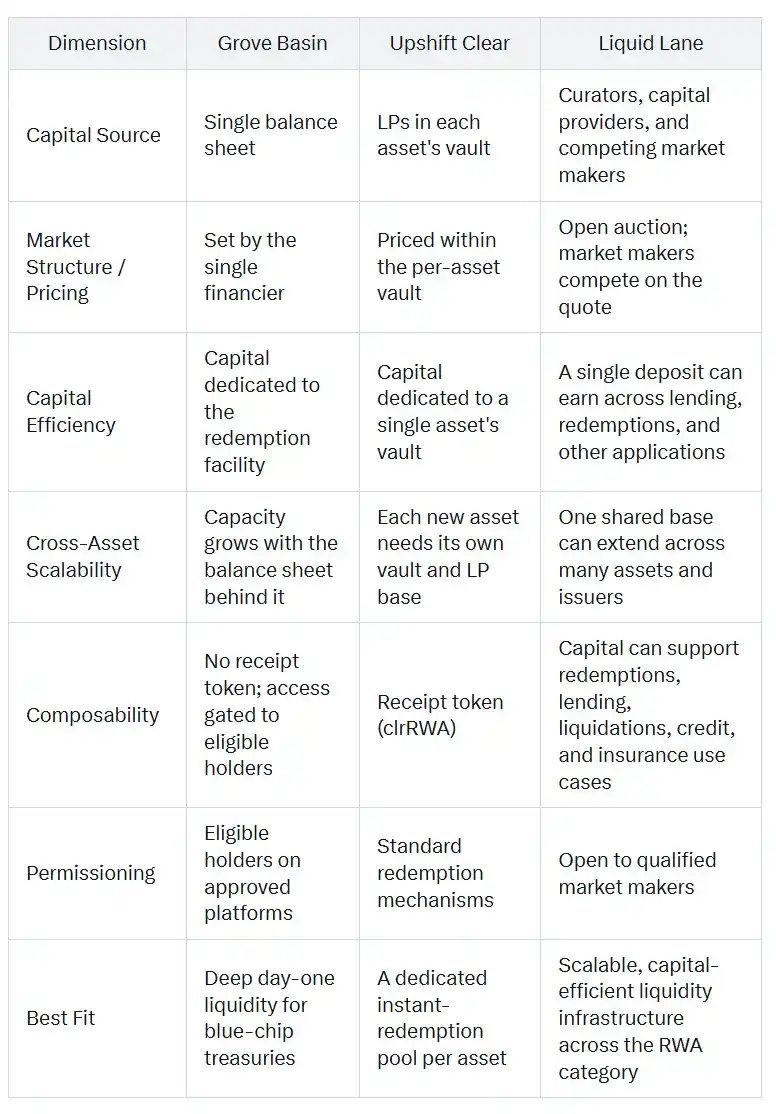
Exit speed itself is nearly uniform and tells little. The meaningful comparison is everything that happens in the five-dimensional space behind the exit.

  1. Who supplies the capital and bears the risk? Where does the liquidity come from? Who bears the duration and credit risk of the underlying asset during the redemption settlement?

  2. Redemption Pricing. The mechanism that determines the discount a holder pays for early redemption—whether it's a single provider's quote, fixed parameters of a dedicated pool, or bidding among multiple participants.

  3. Capital Efficiency and Cost of Supply. How much committed capital a model requires to support redemptions and the opportunity cost of tying up that capital for settlement events. This cost ultimately reflects in the spread holders pay and whether liquidity providers can sustain the model.

  4. How does the model scale to different asset types? What is required to extend coverage to new assets and issuers as the market grows?

  5. Composability. Whether and how holders' claims and providers' funds can be used elsewhere in on-chain finance. This determines if liquidity is siloed in a single venue or can support other uses.

These five categories describe how robust and scalable a liquidity model is as the tokenization market grows in size and variety. The next sections apply them to each model in turn.


Balance Sheet Liquidity for Tokenized Treasuries and Credit

Grove Basin provides instant stablecoin liquidity for RWAs by prefunding when an eligible holder initiates an approved redemption via a supported tokenization platform. Grove Basin serves as a programmable credit facility against pending settlements.

Strengths of this design:

  • Immediate balance sheet depth. Since Basin is funded by an existing reserve base, it can provide considerable liquidity from day one.

  • Simple user experience. Basin operates through supported tokenization platforms, so eligible holders can exit faster while the traditional redemption process continues in the background.

  • An ideal solution for bonds and money market funds with short settlement cycles. These typically settle in T+1 to T+2, making the balance sheet bridge efficient for bridging the gap.

These trade-offs stem from the same design choices:

  • Capacity depends on a single balance sheet. The liquidity ceiling is ultimately tied to the size and risk appetite of the funding balance sheet. This means capacity growth relies on a single reserve base, not a broader capital market forming around the opportunity.

  • Access is restricted. Basin is only available to eligible holders, approved transactions, and supported platforms. This allows the model to control how liquidity scales but also limits how widely it can be accessed and reused across the broader market.

  • First application is for the most liquid part of the market. Tokenized T-bills and money market funds have inherently shorter settlement cycles.

Grove Basin is a powerful, vertically integrated solution to improve exit mechanisms for tokenized treasuries. Its main drawback is that liquidity depth, risk allocation, and economic benefits are tied to a single balance sheet model.


Upshift Clear: Asset-Specific Vaults for Instant Liquidity

Upshift Clear, initially launched with Superstate, applies the instant redemption model to independent USDC liquidity providers through dedicated vaults. LPs deposit USDC into a vault to back RWAs, receiving a composable receipt token clrRWA and earning fees from the redemption spread.

Strengths of this model:

  • Independent capital. Liquidity comes from LPs who opt in, so capacity can grow with the market, independent of any single institution's reserves.

  • General-purpose design. The platform aims to support any RWA with a standard redemption mechanism, providing issuers with a repeatable path to instant redemptions.

  • Clear, voluntarily assumed risk. Upshift Clear prices the settlement spread as a yield opportunity LPs knowingly take on, achieving a clear risk-reward match.

  • Composable receipts. The clrRWA token can circulate in DeFi, so LP positions aren't confined to the vault itself.

Where the model is more constrained:

  • Capital siloed by asset. Each supported asset has its own dedicated funding pool, so each new asset must attract its own liquidity. As coverage expands, the number of pools grows with the number of assets, potentially fragmenting market liquidity coordination.

  • Capital serves one asset at a time. Funds within a specific vault are committed to that specific asset, limiting what each dollar can do between redemption events.

  • The launch asset tests a more specific liquidity problem. Superstate's USCC is a ~$267M crypto arbitrage fund, advantaged by instant exit, but its liquidity challenges differ from longer-duration private credit or structured assets. It provides a solid starting point for the model, while raising a broader question: how well does the same design perform for less liquid, longer-duration assets?

Upshift Clear offers a flexible option for issuers looking to set up dedicated instant redemption pools for specific assets. Its main drawback is that liquidity, risk, and capital efficiency are allocated on an asset-by-asset basis.

Liquid Lane: Shared, Efficient, Cross-Asset Liquidity

Symbiotic Liquid Lane is a shared liquidity layer for tokenized assets. Redemption funding comes from Symbiotic vaults, which can support multiple tokenized assets simultaneously, rather than being tied to a single balance sheet or isolated in pools dedicated to a single asset. Between settlement events, these funds continue to earn yield from multiple sources and are ready when holders need to exit.

Vault managers decide how to deploy the capital. They choose which issuers and assets to support, set risk parameters, and develop vault strategies based on asset type, redemption patterns, and yield opportunities. This makes the liquidity layer configurable, not one-size-fits-all: different managers can build different strategies on the same shared infrastructure.

When a holder wants to redeem, qualified market makers bid on the redemption discount via a request-for-quote layer. Once a quote is accepted, vault funds settle the redemption atomically on-chain immediately, while the issuer's redemption process proceeds in the background.

The resulting model has four structural advantages:

  • Shared capital across multiple assets. A single vault can support redemptions for multiple RWA types. New assets tap into the same capital base, so liquidity capacity grows with market participation, not fragmented asset-by-asset.

  • Funds earn yield between redemptions. Collateral isn't idle waiting for redemption demand. It can earn underlying lending yields in whitelisted lending markets like Morpho and Aave, earn redemption spreads when settling redemptions, and back financial obligations in other Symbiotic applications (e.g., credit and insurance). Thus, a single deposit generates yield from multiple sources, maximizing capital efficiency and DeFi composability.

  • Configurable risk and yield strategies. Managers can tailor vault strategies by choosing supported assets, issuers, limits, and risk parameters. This means liquidity can be deployed according to different risk appetites and market views, rather than forcing all assets into the same pool design.

  • Open, competitive settlement. Liquid Lane uses a competitive request-for-quote (RFQ) marketplace where qualified market makers bid to settle exit trades. The redemption discount is set by market competition, and the yield is split among makers, capital providers, and managers.

This design aims to serve the part of the market where providing reliable exit is hardest and thus most valuable: tokenized private credit, structured assets, and other products with lengthy redemption windows. These can have windows of 60 to 180 days, and reliable exit infrastructure would transform how assets are held, financed, and used on-chain.

Initial integrations for Liquid Lane include Fasanara (first vault manager) and Midas (first issuer via mGLOBAL and mF-ONE), alongside additional vault managers such as Avantgarde Finance, Barter, and Kpk.


Side-by-Side Comparison

Conclusion: From Liquidity Patches to Shared Infrastructure

Tokenized assets need reliable exit mechanisms to achieve broad adoption. The question is whether these exits are built as one-off solutions or as infrastructure that can scale with the market.

If each asset requires its own liquidity pool, each issuer its own financing channel, or each exit relies on a separate reserve, the market gets faster exits but not truly scalable liquidity. A sustainable liquidity model is different: it is shared, efficient, and flexible—growing with market participation without fragmenting capital each time coverage expands.

That is what Symbiotic Liquid Lane aims to be. It turns redemption liquidity from a single-purpose mechanism into a shared layer for the tokenized market: a single capital base that can support multiple assets, multiple obligations, and multiple yield sources.

For issuers, this means increased demand, distribution, and assets under management (AUM), as tokenized assets become easier to hold and use as collateral. For market makers, it means participating in RWA settlement without needing to hold idle inventory upfront. For capital providers, it means a single deposit earning across lending, redemption, and Symbiotic applications.

Liquid Lane is the shared liquidity infrastructure for RWAs: cross-asset, capital-efficient, T+0.


Preguntas relacionadas

QWhat is the core challenge addressed in the article regarding tokenized real-world assets (RWAs)?

AThe article identifies 'exit' or redemption as the core, unsolved challenge for tokenized RWAs. While assets can be efficiently issued and transferred on-chain, the underlying redemption process remains slow (e.g., T+1 day for treasuries, 60-180 days for private credit), creating a critical gap with the speed of blockchain settlements.

QAccording to the article, what are the three emerging models for providing instant exit liquidity for tokenized RWAs?

AThe three models are: 1) The Balance Sheet Model (e.g., Grove Basin), where a single, well-capitalized entity provides immediate liquidity from its own reserves. 2) The Dedicated Vault Model (e.g., Upshift Clear), where independent liquidity providers fund separate vaults for each supported asset. 3) The Shared Liquidity Layer Model (e.g., Symbiotic's Liquid Lane), where shared capital from multiple providers supports multiple assets simultaneously via a competitive settlement market.

QWhat are the five key dimensions the article uses to evaluate and compare the different liquidity layer models?

AThe five key dimensions are: 1) Source of capital and who bears the risk. 2) Mechanism for pricing redemptions. 3) Capital efficiency and cost of supply. 4) Scalability across different asset types. 5) Composability (whether the capital and claims can be reused elsewhere in DeFi).

QWhat is the main structural advantage of Symbiotic's Liquid Lane model compared to the others?

AIts main structural advantage is the use of a shared liquidity pool where a single vault can support redemptions for multiple tokenized assets. This shared capital base is more efficient, can earn yield from multiple sources (like lending, other Symbiotic apps) between redemptions, and scales liquidity capacity with overall market participation rather than requiring separate pools per asset.

QWhat asset types does the article suggest are the primary target for the most valuable exit infrastructure?

AThe article suggests that the most valuable and challenging application for reliable exit infrastructure is for tokenized private credit, structured assets, and other products with long redemption windows (60-180 days), as opposed to short-duration assets like tokenized treasuries. Reliable exit mechanisms for these longer-term assets would fundamentally change how they are held, financed, and used on-chain.

Lecturas Relacionadas

Dalio's Latest Warning: Don't Get Carried Away by AI, Real Returns on US Stocks in the Next 5-10 Years Could Be -5% to -10%

Ray Dalio, founder of Bridgewater Associates, warns investors against excessive concentration in AI stocks. He argues the current market, dominated by a few AI giants, mirrors historical patterns where revolutionary new technologies lead to high risk, volatility, and uncertainty. While acknowledging AI's transformative potential, Dalio emphasizes that most investors fail at this stage of the cycle by over-concentrating in a handful of leading companies. He cites inherent risks: companies cannot accurately forecast investment needs or external shocks (e.g., monetary policy, geopolitics, taxes), face potential disruption from future technologies and international competition (notably from China), and experience significant price swings. Dalio's core advice is diversification, calling it his "Holy Grail of Investing." He presents a mathematical case that a well-diversified portfolio of 15-20 uncorrelated, good bets offers a superior risk-adjusted return compared to a concentrated position. Dalio also offers a cautious outlook, suggesting U.S. stocks may deliver real returns of -5% to -10% over the next 5-10 years based on valuation and bubble indicators. He concludes that in the face of high uncertainty, the prudent strategy is not to avoid betting entirely, but to avoid large, concentrated bets where one lacks sufficient informational edge. Instead, investors should build a strategically balanced, diversified portfolio.

marsbitHace 21 min(s)

Dalio's Latest Warning: Don't Get Carried Away by AI, Real Returns on US Stocks in the Next 5-10 Years Could Be -5% to -10%

marsbitHace 21 min(s)

Rain Valuation Approaches $20 Billion: The Battle for U-Cards Extends to Rewards Systems

Rain, a stablecoin payments infrastructure company, is shifting the competitive focus for U Cards from simple issuance to user retention and repeated usage. On June 15, Rain launched "Rain Rewards," an embedded loyalty program capability within its card-issuing infrastructure. This allows partner businesses—like fintech platforms and neobanks—to configure branded loyalty points, earning rules, redemptions, and merchant promotions directly within their card products. The system, built from the 2025 acquisition of Uptop, ensures points are only issued upon final transaction settlement, preventing liabilities from refunds. Trials, such as with Avalanche Card, reportedly boosted spending by 25% among enrolled users. Founded by Farooq Malik and Charles Yoo-Naut, Rain evolved from a tool for managing Web3 company expenses into a full-stack enterprise platform. It is a Principal Member of Visa and Mastercard, enabling partners to issue stablecoin-backed cards and wallets while leveraging traditional payment networks. Notably, the popular U Card Plasma One is issued by Rain under Visa's authority. Rain also integrates with Visa's stablecoin settlement pilot, using USDC for network settlement. Rain's rapid funding reflects growing institutional interest in stablecoin payment infrastructure. It raised a $245 million Series A in March 2025, a $58 million Series B in August 2025, and a $250 million Series C in January of this year, reaching a $19.5 billion valuation. Annualized transaction volume exceeds $3 billion, serving over 200 partners including Western Union and Nuvei. Beyond cards, Rain is expanding into programmable payments. Its June 2026 "Agent Control Layer" allows businesses to set spending rules—like merchant categories, amounts, and frequency—for AI agents before transactions occur. This positions Rain not as a single product but as an operating system for stablecoin payments, handling everything from card issuance and wallet management to rewards, on/off-ramps, and automated compliance. The goal is to enable seamless, often invisible, real-world spending of on-chain assets.

Foresight NewsHace 24 min(s)

Rain Valuation Approaches $20 Billion: The Battle for U-Cards Extends to Rewards Systems

Foresight NewsHace 24 min(s)

Google TPU Shipments Revised Up by 50%

Recent industry research indicates a significant upward revision in the shipments of Google's TPU (Tensor Processing Unit) chips. Previous expectations for 2027 were set at around 10 million units, but new estimates now point to 15 million units, a 50% increase. This substantial boost directly translates to higher demand across the entire supporting supply chain. Google's TPU clusters utilize a standardized all-optical interconnect architecture. Consequently, key hardware components are deeply integrated and scaled in fixed ratios with the chips. The 15 million TPU target will drive corresponding demand increases for NPO optical engines (roughly a 1:1 match), 1.6T optical modules, OCS optical switches, high-end server power supplies, fiber optics & MPO connectors, and liquid cooling solutions. Among these, liquid cooling is highlighted as the sector experiencing the most significant transformation and offering the most stable potential for excess returns. As next-generation TPU chips reach power levels where traditional air cooling is insufficient, liquid cooling becomes essential. 2026 is forecasted as the first year of substantial adoption for Google's liquid cooling solutions. This shift, coupled with delivery and capacity bottlenecks faced by incumbent overseas manufacturers, is creating a prime window for domestic Chinese suppliers to enter and secure Google's core supply chain. The market size for Google-specific liquid cooling is projected to potentially triple from a baseline of hundreds of billions to around 300 billion units by 2028. The logic for the fiber optic sector is also being rewritten. Once considered a cyclical commodity tied to telecom operator procurement, fiber is now a strategic and scarce resource for AI Data Centers (AIDC). A severe supply-demand imbalance, driven by the long lead time for preform production (18-24 months) and surging demand from cloud giants, is supporting strong performance. Chinese fiber manufacturers are well-positioned to capture a significant share of global AIDC demand, with exports potentially reaching 200-300 million core kilometers in 2026. Overall, the investment focus within the AI computing industry is shifting from pure "chip performance speculation" towards the more certain incremental growth in computing infrastructure and its supporting ecosystem. The upward revision in Google TPU shipments, along with the potential for further doubling by 2028, is seen as solidifying performance visibility for the entire supporting supply chain over the next two years.

marsbitHace 2 hora(s)

Google TPU Shipments Revised Up by 50%

marsbitHace 2 hora(s)

What Wall Street Really Wants After the Crypto Story Recedes

The tide of speculative crypto narratives has receded, revealing Wall Street's true objective: building a controlled, yield-generating, and compliant financial pipeline on distributed ledgers. They are migrating core functions onto blockchains, not for decentralization, but for efficiency and new revenue streams. Key developments include BlackRock's BUIDL fund, a tokenized treasury fund acting as a foundational reserve asset, and the rise of Securitize, which is going public and partnering with the NYSE to build a 24/7 digital securities trading and settlement system. This signals a major shift of securities clearing to blockchain technology. To make volatile assets like Bitcoin palatable for institutional investors, firms like BlackRock and Goldman Sachs are creating "covered call" ETFs (e.g., BITA). These products systematically sell options on Bitcoin holdings, transforming price volatility into stable monthly income, effectively repackaging crypto as a yield-bearing asset. Stablecoins are being positioned not as speculative tools but as efficient payment rails. Companies like Stripe and Mastercard are integrating them for instant, low-cost merchant settlements and cross-border card payments, respectively. Critically, new legislation like the GENIUS Act shapes them as non-interest-bearing, heavily regulated extensions of the US dollar system. In summary, Wall Street is quietly constructing a parallel, blockchain-based financial infrastructure featuring tokenized traditional assets, structured crypto yields, and programmable dollar pipelines—all under its control and fully integrated with existing regulatory and credit frameworks.

marsbitHace 2 hora(s)

What Wall Street Really Wants After the Crypto Story Recedes

marsbitHace 2 hora(s)

Trading

Spot
Futuros
活动图片