Original | Odaily Planet Daily (@OdailyChina)
Author | Wenser(@wenser 2010 )
In 2026, the "baseline" for domestic college students' internship salaries is a median monthly salary of 5,000 yuan. If you add a technical position in a first-tier city, it can reach 10,000 yuan.
Having long accepted the setting of the era's dividends and acknowledged my poor choice of major, I wasn't feeling too sour, until I came across—
An intern at an AI company earning over 5,000 yuan a day...... A day? 5,000 yuan?
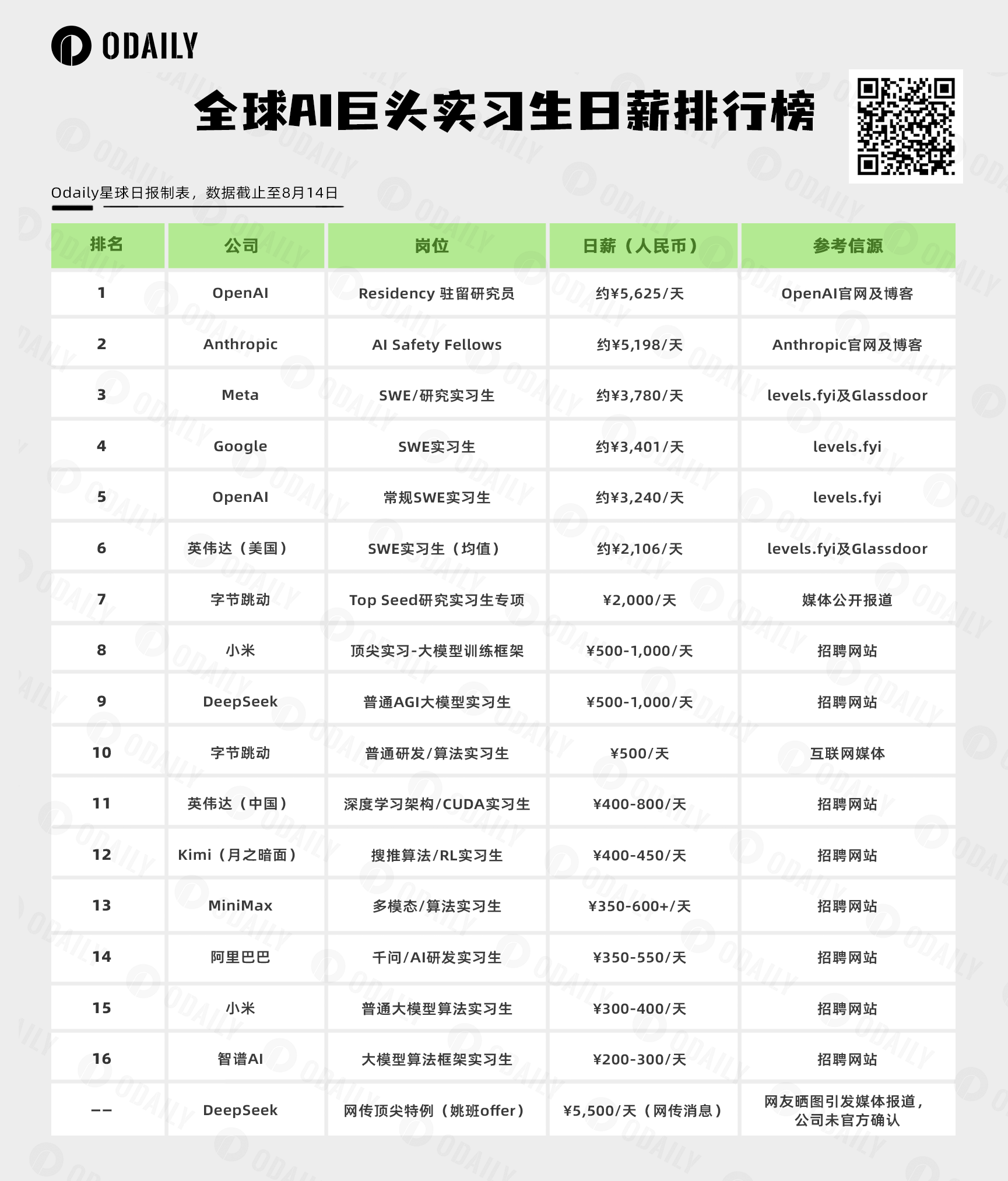
Too painful. I took the initiative to dig into the daily salaries of interns at 12 global AI giants, from OpenAI and Anthropic to ByteDance and DeepSeek. I sourced information from official recruitment pages, websites like levels.fyi and Glassdoor (Odaily Planet Daily Note: Salary query websites, similar to the US version of Boss Zhipin + Maimai), and employee leaks on domestic social media, and cross-verified them.
I found that such high salaries are not limited to just one company. It can only be said: The war for AI talent has entered a white-hot stage.
Next, I'll rank domestic and international AI giants together, categorized from "explosive" to "small explosive" (there is no "bad" tier here), which may completely颠覆 your impression of the word "intern."
Ceiling: This Isn't an Intern Workhorse, This is the Esteemed AI Researcher
First, let's look at the two most elite "immortal positions," where daily salaries have all broken through the 5,000 yuan barrier.
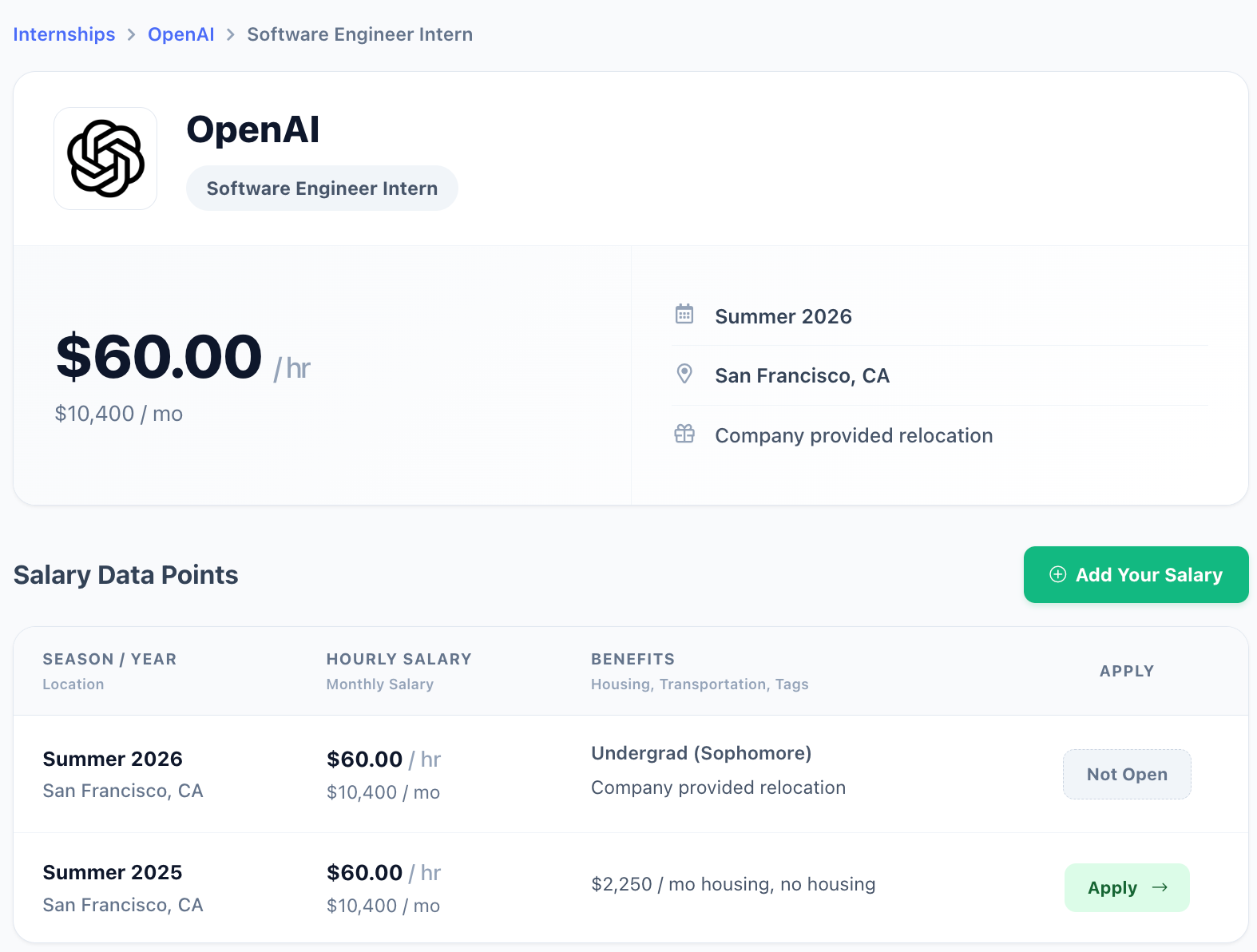
First place, OpenAI Residency, daily salary approximately 5,625 yuan.
Monthly salary is 18,333 USD, converted to over 120,000 RMB. OpenAI's official website clearly states it across multiple language pages, absolutely certain.
This is a 6-month full-time research program. Participants are directly assigned to core teams working on large models, reinforcement learning, alignment, safety, etc., working alongside full-time researchers. They can convert to full-time roles after the program ends.
In essence, this is OpenAI's "young genius reserve," cultivating the future pillars of the AI field, those who will shine for the AGI cause. Regarding the work environment, you work directly at OpenAI's San Francisco headquarters, requiring at least 3 days in-office per week, with treatment almost equivalent to that of internal OpenAI researchers.
Of course, such researchers are the "top students" selected from the best of the best. OpenAI recently also launched a short-term "Safety Internship" training program similar to Anthropic's top intern program, scheduled to run from September 14, 2026, to February 5, 2027.
Second place, Anthropic AI Safety Fellows, daily salary approximately 5,198 yuan.
Weekly salary is 3,850 USD. Anthropic's official website and official alignment blog clearly list this price, making it one of the most credible data points in this survey.
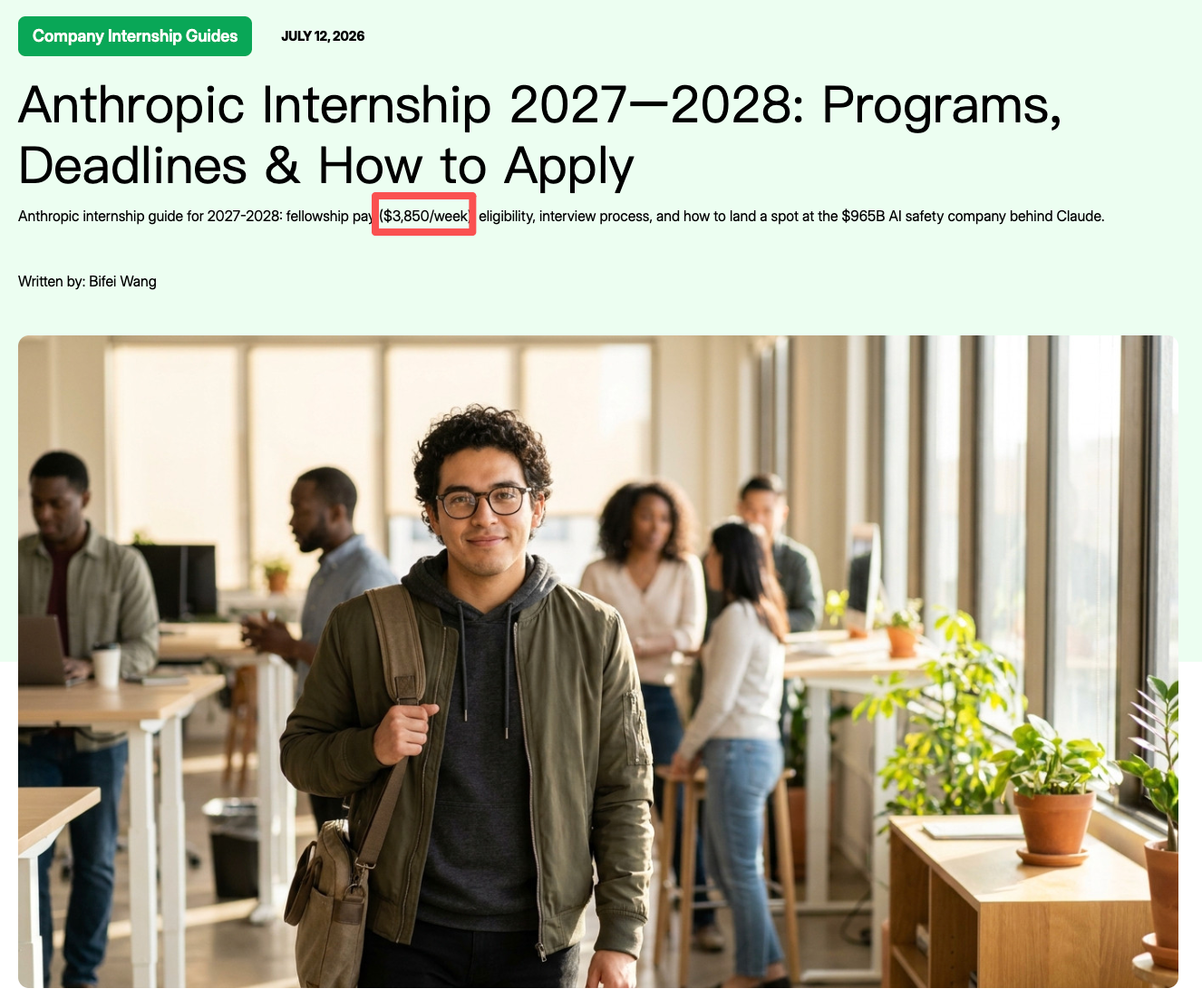
It's a 4-month program, 40 hours of work per week. In addition to the salary, each person receives a monthly compute budget of 15,000 USD—yes, you read that right, a compute budget, fifteen thousand dollars a month, for you to use as you please. This counts as a special perk of AI giants, achieving a stage of "Token freedom."
What was the caliber of the first cohort? Over 80% published papers, over 40% converted directly to full-time. Even more astonishing is the salary increase: the weekly salary for the first cohort in 2024 was only 2,100 USD, jumping directly to 3,850 in 2026, an increase of over 80% in two years. How scarce top AI talent truly is becomes clear just by looking at this increase.
These two positions share a common characteristic: extremely high barriers to entry, very few spots, essentially "pre-hiring"—using the intern banner to snatch future top researchers.
Explosive Level: US Giant Interns, Weekly Salaries Exceeding Ordinary People's Monthly Salaries
After seeing the ceiling, let's look at regular interns at US tech giants. Note, these are "regular," not special talent programs.
Meta, daily salary approximately 3,780 yuan. Hourly wage 70 USD, corroborated by both levels.fyi and Glassdoor, one reporting 70, the other 56 to 82 (average 67), roughly similar. The official JD lists a monthly salary range of 7,188~12,134 USD, plus about 2,600 USD in monthly housing stipend.
Google, daily salary approximately 3,400 yuan. Hourly wage 62.98 USD, equivalent annual salary for undergraduate roles is 92k to 122k USD, for PhD roles 113k to 150k USD. Varies by region, roughly 56.73 USD per hour at the Mountain View HQ, around 50 in Seattle.
NVIDIA US, daily salary approximately 2,106 yuan. This is the average, 39 USD per hour, but NVIDIA's official JD range is broad: undergraduate SWE from 20 to 71 USD, PhD research roles from 30 to 94 USD—if you're a PhD, with an upper limit of 94 USD per hour, the daily salary directly surges above 5,000 yuan.
OpenAI non-technical intern, daily salary approximately 1,944 yuan. GTM Strategy Intern, hourly wage only 36 USD. Compared to technical interns' hourly wages, it's only about 60% of the latter, but still belongs to the second tier in the tech field.
Notice something? Being an ordinary technical intern at a US tech giant means you can earn more in a week than what many white-collar professionals in China earn in a month.
Upper Echelon Level: Domestic Tech Giants Catching Up Fast, ByteDance Offers 2,000 Yuan Per Day
After discussing the US, let's look domestically.
The investment by Chinese tech giants in top talent is rapidly catching up to that of US AI giants.
ByteDance Top Seed Research Internship Program, daily salary 2,000 yuan.
Yes, you read that correctly, 2,000 yuan per day, comparable to the "masses'" monthly salary.
The original quote from media reports was: "Compared to the 500 yuan per day intern salary offered by DeepSeek, ByteDance raised the standard to 2,000 yuan per day." This figure was subsequently repeatedly confirmed by more internet media. Calculated based on 20 working days per month, the monthly salary is 40,000 yuan.
What kind of people does this program recruit? Top-tier master's and PhD students. Inside, they can set their own research topics, have the same access as full-time employees, and the mentor roster includes Research Vice President Wu Yonghui, who was poached from Google DeepMind in February 2025.
Some people put it bluntly: ByteDance's unified standard for ordinary interns of 500 yuan per day "does not include high-precision talent programs like Jindouyun and TopSeed. Salaries for such projects are generally higher."
Xiaomi Top Intern - Large Model Training Framework, daily salary 500 to 1,000 yuan; Agent Researcher - MiMo, daily salary 1,000-1,100 yuan.
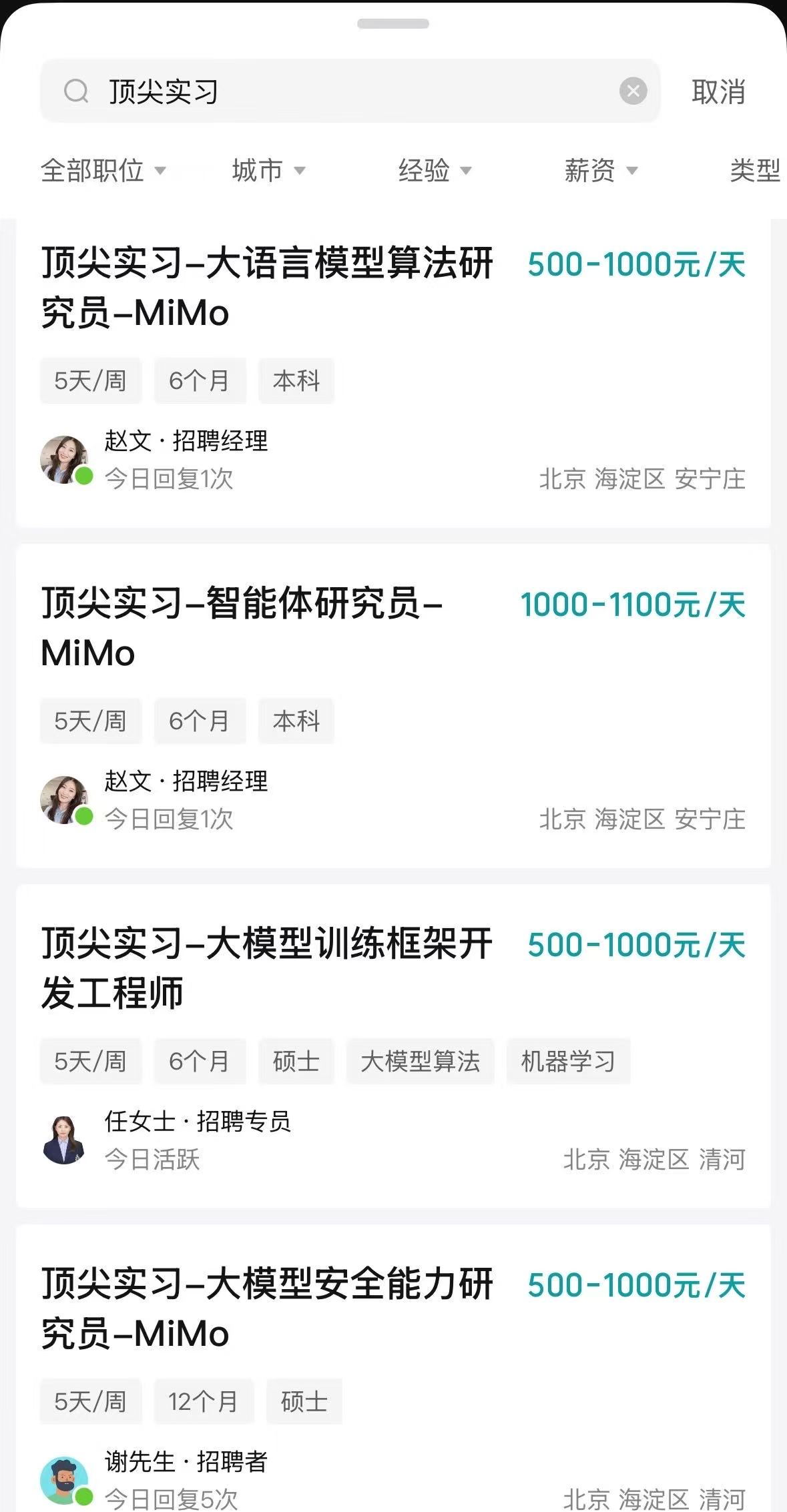
Positions listed on recruitment websites, mainly targeting master's degree students. Work involves participating in the development of trillion-parameter large model training engines, agent research, etc.
For comparison, ordinary large model algorithm interns at Xiaomi only get 300 to 400 yuan per day—within the same company, the difference is more than double.
This is the current reality of the domestic AI industry: ordinary positions still follow market rates, but if you're "top talent," money is not a problem.
NPC Level: The "AI Four Little Dragons" with Unlimited Potential, Kimi, Zhipu, Still Working Hard
The above discussion is a game for a minority of elites. What is the actual salary level for the vast majority of AI interns?
Odaily Planet Daily picks a few of the currently hottest "representative AI companies" to discuss.
DeepSeek (Hangzhou DeepSeek), ordinary AGI Large Model Intern, daily salary 500 to 1,000 yuan. This figure has been confirmed by numerous media reports and is also publicly available information on DeepSeek's recruitment platforms. Out-of-town interns receive an additional 3,000 yuan monthly housing allowance. Based on 22 days, the monthly salary ranges from 11,000 to 22,000 yuan.
By the way, full-time Deep Learning Researchers at DeepSeek have monthly salaries ranging from 80,000 to 110,000 yuan, with 14 months' pay, resulting in an annual salary up to 1.54 million yuan—there's an order of magnitude difference between interns and full-time employees.
Additionally, the previously leaked figure on social media platforms of "DeepSeek Tsinghua Yao Class intern pre-tax daily salary 5,500 yuan" is clearly an extreme, one-in-ten-thousand case, which we won't discuss in detail for now, but will touch on later.
ByteDance ordinary R&D/Algorithm Intern, daily salary 500 yuan. Starting January 1st this year, ByteDance unified the daily intern salary for technical and product positions to 500 yuan, justifying it as "increasing talent investment, improving salary competitiveness, and enhancing stock option incentives," "to ensure employee compensation competitiveness and incentive rewards lead the top level in all global markets."
Of course, as is customary for internet giants, they also provide three meals, housing allowance, and some AI positions can reach 550 yuan.
MiniMax, Multimodal/Algorithm Intern, daily salary 350 to 600+ yuan. Technical positions generally range from 350 to 500, master's SP can reach over 600; operations and non-technical positions are only 150 to 200. MiniMax has a characteristic incentive of a startup: nearly universal employee stock ownership, with almost all 385 employees having shares. So, despite the cash not being the highest, the overall compensation isn't necessarily poor.
Alibaba Qwen AI R&D, daily salary 350 to 550 yuan. Undergraduate 350, Master's 400, plus a monthly 2,000 yuan housing allowance; AI Agent development positions can reach 450 to 600, AI R&D Engineer 500 to 550. There's also a benefit of one week of free accommodation for those relocating.
NVIDIA China, Deep Learning Architecture/CUDA Intern, daily salary 400 to 800 yuan. Positions on recruitment websites, ordinary testing positions are only 250 to 300.
Kimi (Moonshot AI), Search/Recommendation Algorithm/RL Intern positions, daily salary 400 to 450 yuan. Product operation positions have daily salaries of 250 to 350. Although Kimi gained significant confidence after the K3 release, with impressive external development and company financing, intern salaries are indeed not high—but the company has also prepared a "Traversal Program" for top 2027 graduates, offering stock options directly. Furthermore, over 90% of the company's open positions offer monthly salaries above 30,000 yuan, with an average master's salary exceeding 44,000 yuan, so the treatment for full-time employees is relatively good.
Xiaomi ordinary Large Model Algorithm Intern, daily salary 300 to 400 yuan. This is the position mentioned earlier, which differs by more than double from the "Top Intern" positions. However, in the current job market, this is still considered an upper-echelon level.
Zhipu AI, Large Model Algorithm Framework Intern, daily salary 200 to 300 yuan. The cash salary is the lowest tier in this survey. But don't rush to feel sorry for them—Zhipu's employee stock ownership ratio exceeds 51%, with 452 out of 883 employees holding equity. When the market cap was 323.2 billion HKD, core backbone employees had paper net worths exceeding 100 million, and ordinary equity-holding employees had tens of millions. Low cash, compensated by options—it depends on whether the interns are willing to bet on the future.
The Truth Behind DeepSeek's 5,500 Yuan Daily Intern Salary: Don't Mistake Geniuses for Turnips
Here, we must specifically discuss the widely circulated figure of DeepSeek's 5,500 yuan/day.
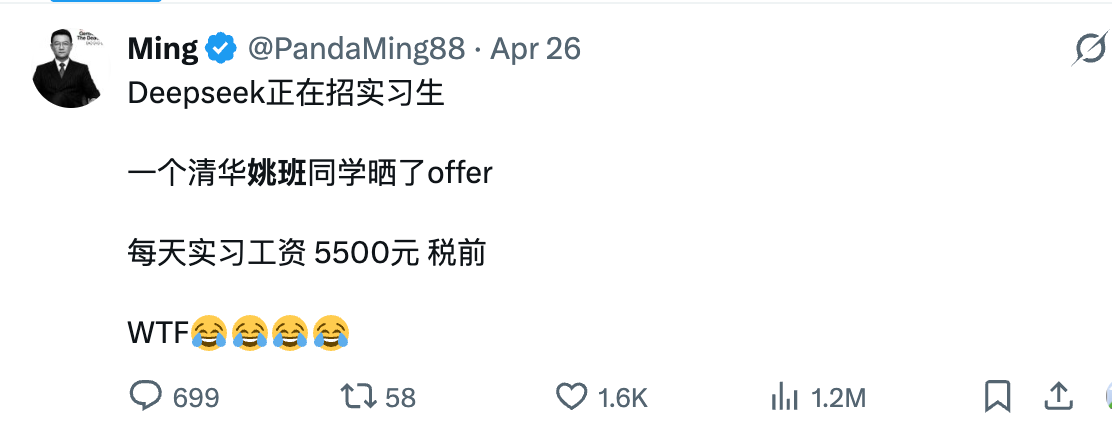
The story originated from a post on platform X, where the blogger claimed, "A Tsinghua Yao Class student shared a DeepSeek offer, with an intern salary of 5,500 yuan pre-tax per day." Once the news broke, the entire AI circle was in an uproar over this number—based on 22 working days, an intern could earn a monthly salary of 120,000 yuan, an annual salary exceeding 1.3 million yuan, ranking globally ahead of OpenAI and Anthropic.
However, based on comprehensive public information online and media reports, our conclusion is: "DeepSeek company has not provided official confirmation; this is merely an extreme, exceptional treatment circulating privately within the AI circle."
Therefore, we did not include this exceptional daily salary of 5,500 yuan in the ranking of the chart, only displaying it as a side note. DeepSeek's officially public standard is 500 to 1,000 yuan per day, which is the reliable figure verified through cross-checking sources.
Yes, there's one more thing worth mentioning separately—DeepSeek, to prevent top interns' salaries from being too high and causing salary inversion with senior employees, implemented a "senior employee scoring system"—how much a newcomer earns is determined by senior employee scores. This also indicates from the side that high-salary exceptions do exist in the AI industry, but they are absolutely not a common phenomenon.
More Truths
After digging through the intern salary data of these dozen-plus AI companies, several impressions are particularly strong.
First, the "wealth gap" in AI industry salaries is much more severe than imagined. On the same day, in the same industry, someone earns 5,000 yuan per day, someone else earns 200 yuan per day—a difference of 25 times. The worlds of top talent and ordinary practitioners are completely separate.
Second, the salary gap between Chinese and US AI giants remains enormous. Ordinary interns at US giants earn 2,000 to nearly 4,000 yuan daily, while ordinary positions at Chinese giants earn 350 to 550 yuan daily—a difference of 6 to 8 times. There are factors like exchange rates and cost of living differences, but people are mobile, especially young people.
Third, Chinese AI companies are desperately trying to catch up to overseas giants in talent density using "special programs." ByteDance's Top Seed program at 2,000 yuan per day is a clear signal—for top talent, Chinese companies are willing to pay prices close to US levels. But this only covers a tiny minority; most positions remain as before.
Fourth, cash is only part of the picture; stock options are the real heavyweight. Zhipu has the lowest cash but the highest stock ownership ratio, MiniMax has near-universal employee ownership, Kimi uses options to retain people. In an industry like AI, which could produce the next trillion or even multi-trillion dollar market cap company at any moment, the value of options might exceed a year's salary.
Do you remember your daily salary during your internship? If it was 200 yuan per day, don't be disheartened, Zhipu's interns also start at 200, though they might hold millions in potential options. If it was 500, don't be too proud either, ByteDance's ordinary interns also earn 500 per day, but Top Seed program interns already have their待遇 quadrupled......
The hot AI industry, currently advancing at breakneck speed, has no shortage of wealth creation miracles. What it lacks most are the people who can create these miracles time and time again.
Which company's intern daily salary data surprised you the most? Or do you know of any other real cases? Welcome to share!