How Risky is the "Death Spiral" of MSTR and STRC?

Foresight NewsPublicado a 2026-06-05Actualizado a 2026-06-05

Resumen

Summary: This article explores the perceived "death spiral" risk between MicroStrategy (MSTR), its Bitcoin holdings, and its perpetual preferred stock (STRC), drawing comparisons to the LUNA-UST collapse. While both systems feature price anchors, high yields for holders, and potential feedback loops, their core mechanisms differ fundamentally. The MSTR-STRC structure relies on continuous financing to sustain its high dividend payouts, primarily through stock ATM offerings. A negative feedback cycle could occur: falling MSTR stock price makes raising equity capital harder, increasing pressure to sell Bitcoin, which undermines STRC confidence and further depresses MSTR. However, unlike LUNA-UST's automated, direct linkage, the MSTR-STRC loop is weaker and has brakes: STRC dividends can be deferred or rates lowered, and STRC holders have a $100/share liquidation preference in bankruptcy, providing a price floor. The company's sustainability hinges on its ability to continue financing. Its current ~$900 million USD reserves cover only about 6.3 months of its ~$1.71 billion annual interest/dividend burden. The next six months are critical, aligning with both the potential bottom in Bitcoin's four-year cycle and the depletion timeline of its reserves. While a LUNA-style catastrophic collapse is deemed highly unlikely due to structural differences, the key question is whether MicroStrategy can navigate this period through healthy deleveraging to restart its capital engine.


Author: @100y_eth (Four Pillars)

Compiled by: AididiaoJP, Foresight News


MicroStrategy (MSTR) recently sold 32 bitcoins (worth only $2.5 million), which triggered a market cap evaporation of over $100 billion in Bitcoin. STRC (its perpetual preferred stock) fell from a reference price of $100 to $94, and MSTR's stock price also dropped from $150 to $123.


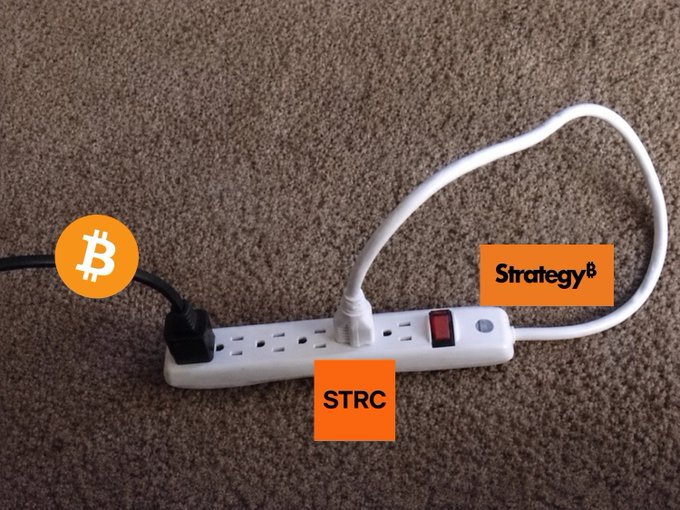
MSTR, BTC, and STRC are deeply intertwined. In a bullish market, this structure is a powerful capital engine, allowing Strategy (MicroStrategy) to aggressively accumulate Bitcoin; but once the market deteriorates, as it has recently, the three form a vicious cycle of mutual negative feedback.


This reminds people of the LUNA-UST incident from years past. So, is the MSTR-STRC structure truly sustainable?


Key Takeaways


UST and STRC appear similar on the surface: their prices are anchored to a specific reference value, holders can obtain high yields, and both carry death spiral risks. However, they are fundamentally different in their price stabilization mechanisms, legal recourse rights, interest/dividend payment methods, and internal operational structures.


For Strategy to maintain sustainability, it must continuously raise funds. This relies on both market confidence and its own creditworthiness. In the worst-case scenario, even if it cannot continue financing, it will not experience a direct "death spiral" like LUNA-UST.


Strategy's current net leverage ratio is about 11%, with an amplification factor of approximately 42%. Even if MSTR and STRC enter a negative feedback loop, as long as the Bitcoin price remains above about $26,000, preferred shareholders still have a high probability of preserving their principal; and as long as Bitcoin does not fall below about $8,000, the probability of bankruptcy due to debt is very low.


The next six months will be a critical period. According to Bitcoin's four-year cycle theory, a bottom could be seen in the second half of this year, and Strategy's US dollar reserves are only sufficient to last about six months. The core question is: can Strategy restart its capital engine through healthy deleveraging within these six months?


LUNA-UST Quick Recap


The LUNA-UST collapse was four years ago. Let's quickly review its operating mechanism.


Price Stabilization Mechanism
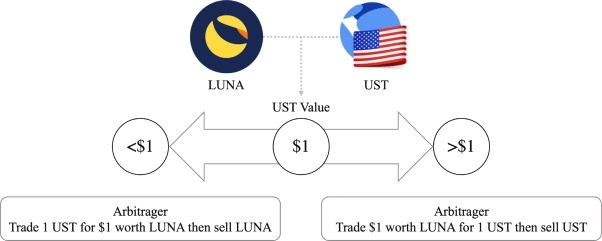


UST was an algorithmic stablecoin with no collateral, maintaining its $1 peg through an algorithm. The core rule was: 1 UST could always be exchanged for $1 worth of LUNA.


  • When UST < $1: Users could burn UST worth less than $1 to receive $1 worth of LUNA. The arbitrage opportunity pushed the UST price back up while reducing UST supply.
  • When UST > $1: Users could provide $1 worth of LUNA to receive more valuable UST. Arbitrage pushed the UST price down while increasing UST supply.


Vicious Cycle Scenario


The more UST issued, the less LUNA supply, which should have been a positive driver for LUNA's price. Terraform Labs indeed amplified this effect by aggressively expanding UST use cases.
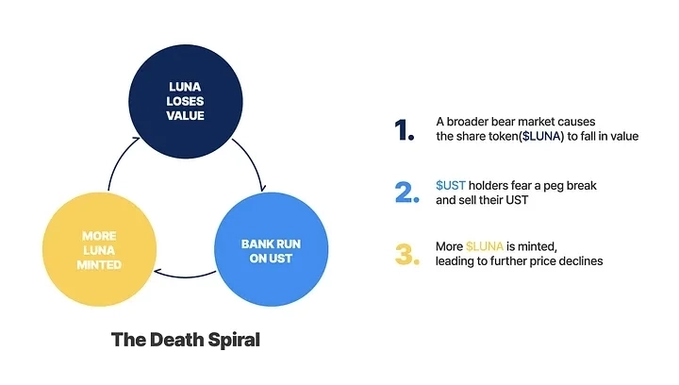


However, once confidence collapsed, the same mechanism reversed into a death spiral:


LUNA price drops → UST confidence collapses → UST price drops → LUNA massively increases supply → LUNA price drops further...


The LUNA-UST Collapse


The direct trigger for the collapse was a loss of confidence. At the time, Terraform Labs was migrating UST liquidity on Curve from the 3pool to the 4pool, thinning liquidity in the 3pool. An attacker sold $85 million worth of UST, breaking the peg and triggering panic.


A large amount of UST was withdrawn from Anchor Protocol (which offered about 20% APY for deposits), instantly overwhelming the market with selling pressure. Before the crash, 71% of UST was deposited in Anchor. When the unsustainability of the 20% yield was exposed, even a $450 million injection by the Luna Foundation Guard was powerless to stop it.
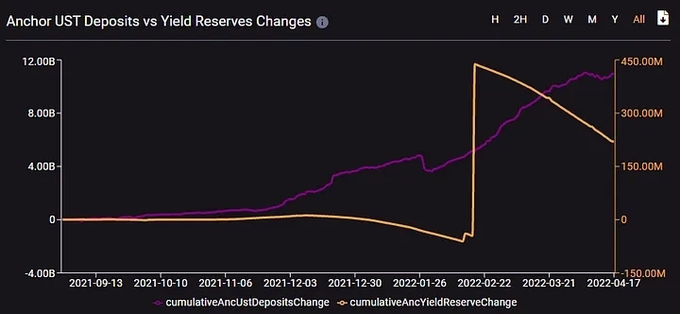


Ultimately, LUNA supply exploded from about 350 million tokens to 65 trillion tokens (a 17,000-fold increase), with its price approaching zero.


Detailed Analysis of the MSTR-STRC Structure


Strategy's core goal is to increase BPS (Bitcoin per Share). To achieve this, it raises funds through various financial engineering tools like convertible bonds, perpetual preferred stock, and ordinary share ATM offerings, then uses the raised capital to accumulate more Bitcoin.


Financing Methods


  • Ordinary Share ATM Offerings: Issuing small amounts of MSTR Class A ordinary shares for sale on the market. This causes ADSO (assuming fully diluted shares outstanding) dilution, but when mNAV > 1.22, it can actually increase BPS.
  • Convertible Bonds: Low-interest borrowing with conversion options, but carries principal repayment pressure.
  • Perpetual Preferred Stock: Dividends and liquidation priority are higher than ordinary shares but lower than creditors. No principal repayment pressure, but dividend burden is close to 10%. Current series include STRF, STRC, STRE, STRK, STRD, etc. Only STRK is convertible preferred stock; the others are non-convertible. Non-convertible preferred stock does not dilute ADSO and is Strategy's preferred financing method.


Strategy currently needs to pay about $1.712 billion in annual interest and dividends, primarily funded from its US dollar reserves, which are mainly replenished through ordinary share ATM offerings. Recently, it also paid dividends by selling 32 BTC, drawing market attention.


STRC Price Stabilization Mechanism


STRC is designed with a $100 reference price.


  • When STRC > $100: Strategy can lower the dividend rate to depress the price, or issue more STRC to increase supply. It also holds the right to redeem at $101/share, effectively capping STRC's upside.
  • When STRC < $100: Strategy can increase the dividend rate to push the price up. Simultaneously, STRC has a $100/share liquidation preference, providing price support.


Currently, STRC's annualized dividend rate is 11.50% (based on the $100 reference price).


Vicious Cycle Scenario


MSTR and STRC influence each other, forming a self-reinforcing feedback loop. A deteriorating market can lead to a vicious cycle:


MSTR price drops → mNAV decreases → Difficulty of ordinary share ATM financing increases → Pressure to sell BTC rises → STRC confidence drops → STRC price drops → MSTR price drops further...


However, the key difference is: Strategy is not obligated to pay STRC dividends in cash monthly. Cash payments require a board declaration and sufficient funds; otherwise, dividends can accumulate. Additionally, Strategy can theoretically lower the dividend rate to SOFR (Secured Overnight Financing Rate). In extreme cases, it can gradually reduce the dividend rate and defer payments until conditions improve.


LUNA-UST vs MSTR-STRC: Fundamental Differences
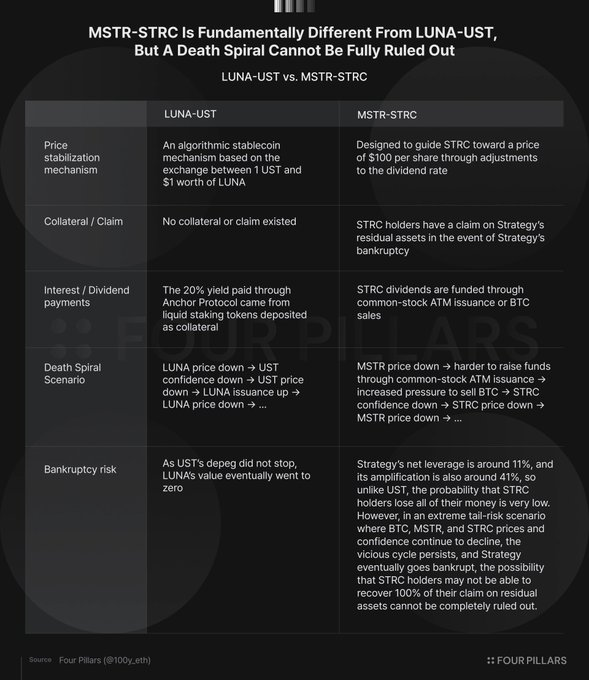


UST and STRC share three apparent similarities: price anchored to a specific level, holders can obtain high yields, and both carry death spiral risks. However, their internal operating mechanisms are entirely different.


Price Stabilization Mechanism


UST stabilized by adjusting LUNA supply; STRC stabilizes by adjusting its own dividend rate. UST's peg mechanism directly affected LUNA's price and supply, while STRC's mechanism does not directly affect MSTR's price and supply.


However, since STRC dividends are primarily funded by MSTR ATM offerings, if MSTR's value falls causing mNAV to drop below 1.22, Strategy's ability to maintain dividends would be questioned.


Collateral / Recourse Rights


UST was completely uncollateralized, and its price could go to zero; STRC, as preferred stock, is also uncollateralized, but in case of company bankruptcy, STRC holders have priority recourse rights to remaining assets (liquidation preference of $100/share).


Interest / Dividend Source


UST itself did not generate interest; the 20% yield came from Anchor Protocol's lending interest and staking rewards (natural market demand).


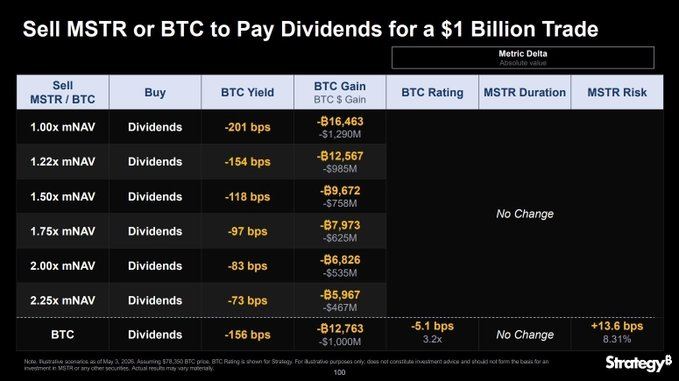
STRC dividends are primarily funded by ordinary share ATM offerings; in extreme cases, selling BTC is also possible. From a BPS perspective, ATM offerings are beneficial when mNAV > 1.22, while selling BTC is preferable when below 1.22. Overall, however, the "naturalness" of STRC's dividend source is weaker than Anchor's lending + staking rewards.


Death Spiral Differences


The LUNA-UST death spiral was direct and automatic: UST drop → LUNA supply increase → LUNA further drop.


The MSTR-STRC death spiral is more complex and has two major braking mechanisms: First, the direct linkage is weaker; MSTR does not automatically increase supply like a protocol to pay STRC dividends. Second, there are legal recourse rights; even in bankruptcy, STRC holders have recourse to remaining assets, providing downside price support.


The common catalyst for both remains "confidence." As long as investors maintain confidence in MSTR (or LUNA back then), the structure can operate; once confidence collapses, real problems emerge. MSTR selling 32 BTC is not a major event rationally, but emotionally, it could become the trigger for a loss of confidence.


Is the MSTR-STRC Structure Sustainable?


Sustained Fundraising Ability is Core
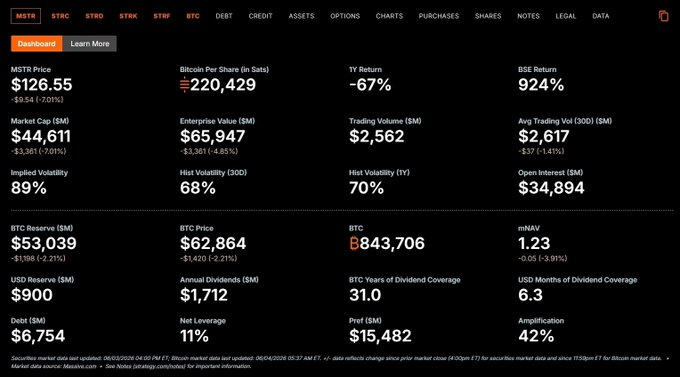


Strategy's current US dollar reserves are $900 million, with annual interest + dividend obligations of $1.712 billion. Without additional fundraising, reserves alone can sustain about 6.3 months.

If reserves are depleted, it could continue financing by issuing more shares / preferred stock, or sell BTC (theoretically sustainable for 31 years). However, the recent sale of just 32 BTC triggered a severe market reaction; the side effects of selling BTC are far greater than imagined.


Financing conditions are clear:


  • MSTR ATM offerings require mNAV > 1.22; otherwise, they reduce BPS.
  • STRC issuance requires the price to be maintained near $99-100; otherwise, financing costs become too high.


Both are highly dependent on market confidence: investors must believe in BTC's long-term appreciation and that Strategy can create value beyond simple holding. In the current market environment, raising funds through shares / preferred stock is difficult in the short term. Strategy can only rely on existing dollar reserves and wait for the market and confidence to recover.


What Happens in Bankruptcy?


Strategy's net leverage ratio is only 11% ((Debt - USD Reserves) / Bitcoin Reserves). The amplification factor including preferred stock is about 42%.


As long as the Bitcoin price does not fall below approximately $26,300 (the price corresponding to the total value of debt + preferred stock), preferred shareholders can preserve their principal through recourse to remaining assets. This is the biggest difference from LUNA-UST.


Convertible Bond Maturity Pressure
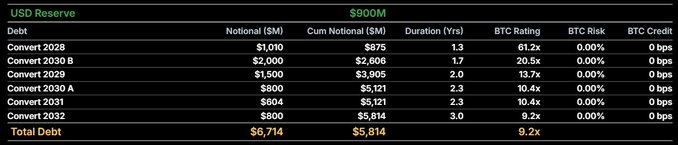


Strategy has no principal repayment obligation for perpetual preferred stock, but convertible bonds require principal repayment at maturity (current total debt $6.714 billion). Maturities begin in 2028. With current USD reserves of only $900 million, if unable to raise funds, it may need to sell BTC to repay debt. However, with a low net leverage ratio, the probability of bankruptcy due to debt is extremely low.


The Next Six Months are the Lifeline
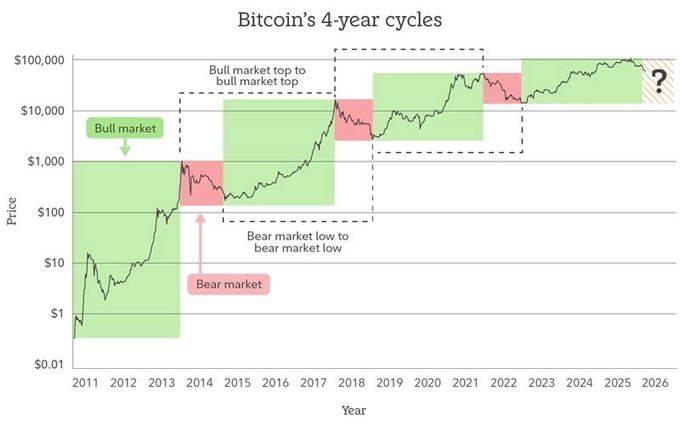


If Bitcoin's four-year cycle theory still holds, a bottom could be seen in the second half of this year, and Strategy's dollar reserves happen to be sufficient for only about six months.


Within these six months, whether Strategy can restart its capital engine through healthy deleveraging will determine its future fate.


Although the title and images are somewhat sensational, the MSTR-STRC and LUNA-UST mechanisms are fundamentally different. The probability of a similar catastrophic collapse is extremely low.


The real question is: Can Strategy survive the challenging next six months, restart its capital engine through healthy deleveraging, or will it merely become an interesting experiment in Bitcoin's history?

Preguntas relacionadas

QWhat is the core mechanism behind the potential negative feedback loop between MSTR, BTC, and STRC as described in the article?

AThe potential negative feedback loop is triggered when the market worsens. It starts with MSTR's stock price falling, which lowers its mNAV (market-adjusted Net Asset Value). This makes ATM (At-The-Market) equity issuance less effective or counterproductive for raising funds. This difficulty in financing increases the pressure to sell BTC to cover expenses. Selling BTC can weaken market confidence in STRC, causing its price to drop below its $100 reference. Falling STRC prices further undermine confidence in MicroStrategy's overall financial structure, putting additional downward pressure on the MSTR stock price, thus perpetuating the cycle.

QWhat are the two key 'braking mechanisms' that differentiate a potential MSTR-STRC crisis from the LUNA-UST death spiral?

AThe two key braking mechanisms are: 1) No Direct, Automatic Linkage: MSTR does not automatically issue more shares to pay STRC dividends like the LUNA protocol minted new tokens to redeem UST. Dividend payments can be deferred or the rate can be lowered. 2) Legal Recourse Rights: STRC is a corporate preferred stock. In a bankruptcy scenario, STRC holders have a legal claim on the company's remaining assets (with a $100 per share liquidation preference), providing a fundamental floor for its value, unlike UST which had zero collateral and could go to zero.

QAccording to the article, what is the most critical factor for the sustainability of MicroStrategy's capital structure?

AThe most critical factor is its ongoing ability to raise capital. The structure relies on continuous financing (via ATM equity sales, issuing new preferred shares like STRC, or convertible bonds) to cover the substantial annual interest and dividend payments (approx. $1.71 billion). This financing ability is heavily dependent on market confidence in Bitcoin's long-term appreciation and in MicroStrategy's ability to add value beyond simple holding. If this confidence erodes and financing dries up, the company must rely on its dollar reserves or sell BTC, which carries significant negative market sentiment risks.

QWhat specific condition must be met for MicroStrategy to effectively use ATM (At-The-Market) issuance of its common stock to strengthen its financial position?

AFor ATM issuance of MSTR common stock to be effective in increasing the Bitcoin-per-share (BPS) metric, the mNAV (market-adjusted Net Asset Value) must be greater than 1.22. When mNAV is above this threshold, issuing new shares at a premium to the underlying Bitcoin value actually accretes value per share. If mNAV falls below 1.22, issuing new equity would be dilutive to BPS and therefore counterproductive.

QWhy does the article identify the next six months as a critical period for MicroStrategy's strategy?

AThe next six months are critical due to a confluence of two timelines: 1) Financial Runway: MicroStrategy's current dollar reserves ($900 million) are only sufficient to cover its annual interest and dividend obligations for approximately 6.3 months without additional financing. 2) Market Cycle: The article references the Bitcoin four-year cycle theory, suggesting a potential market bottom could occur in the second half of the year. Therefore, the company must navigate this period of high financial obligation with limited reserves, aiming to 'healthily deleverage' and restart its capital engine before its reserves run out and (hopefully) as the market begins to recover.

Lecturas Relacionadas

Huang Xiaoming, Li Bin, Lei Jun, Liang Wenfeng... Who Are the Biggest Winners in the CXMT IPO Feast?

Changxin Technology, a leading Chinese memory chip manufacturer, successfully listed on the Shanghai Stock Exchange's STAR Market (科创板) on July 8, 2026. Its share price surged from the IPO price of 8.66 yuan to close at 49 yuan on the first day, catapulting its market capitalization to 3.28 trillion yuan, making it the most valuable A-share company and triggering a massive wealth creation event. The biggest winners were the company's founder, Zhu Yiming, and its employees. Zhu Yiming's family wealth skyrocketed nearly 300% to approximately $13.9 billion, with his direct stake in Changxin valued at around 80 billion yuan. Additionally, over 6700 employees benefited from stock ownership plans, creating at least 237 new millionaires (in CNY). Zhu also pledged to donate 768 million shares, worth over 37.6 billion yuan, for future employee incentives over a ten-year period. Several prominent investors and corporate clients also reaped significant paper gains from the IPO. Notable figures include: * **Liang Wenfeng**, founder of DeepSeek, whose funds netted a paper profit of approximately 827 million yuan. * **Kong Jianping**, founder of Nano Labs, saw his indirect holdings valued at roughly 940 million yuan. * **Li Bin**, founder of Nio, whose company's strategic investment of 158 million yuan is now worth about 740 million yuan. * **Lei Jun**, founder of Xiaomi, whose subsidiary holds shares currently showing a paper gain of over 736 million yuan. Xiaomi clarified this is a corporate investment, not direct personal wealth. The article notes that while this IPO created immense wealth for insiders and large investors, retail investors who were lucky enough to win an allotment in the lottery typically profited by around 20,000 yuan. The listing solidifies Changxin's position as China's premier domestic memory chipmaker.

marsbitHace 10 min(s)

Huang Xiaoming, Li Bin, Lei Jun, Liang Wenfeng... Who Are the Biggest Winners in the CXMT IPO Feast?

marsbitHace 10 min(s)

IOSG: From Hot Storage to Cold Memory – Decentralized Storage in the AI Era's Storage Boom

This article explores the stark contrast between the booming AI storage sector and the currently undervalued decentralized storage market. It argues their core value propositions differ fundamentally: AI storage is a "hot data efficiency" system designed to maximize computational throughput, GPU utilization, and business monetization by accelerating data flow into processors. In contrast, decentralized storage represents a "cold data trust" system, prioritizing data immutability, censorship resistance, and the preservation of long-term human memory. The analysis details the multi-layered AI storage architecture, from high-bandwidth memory (HBM) and enterprise SSDs for high-performance needs to data lakes for capacity. It highlights how AI has repositioned storage from a cost center to a critical efficiency engine. Decentralized storage, exemplified by Filecoin and Arweave, is examined for its distinct philosophies and current challenges, including product-market fit, retrieval latency, and enterprise adoption hurdles. Despite its current quiet phase, the article posits that decentralized storage holds unique future value for AI data provenance, public dataset archiving, compliance, and safeguarding civilizational records against censorship. The conclusion suggests that while the market currently rewards efficiency, the need for trusted, permanent data layers may eventually lead to a revaluation of decentralized storage's role.

marsbitHace 14 min(s)

IOSG: From Hot Storage to Cold Memory – Decentralized Storage in the AI Era's Storage Boom

marsbitHace 14 min(s)

Exploring ChangXin Technology's Hefei Headquarters: The Rising Campus Ignites Changgang CBD, Grassroots Employees 'Witness' Wealth Creation Myth

"On-the-Ground Visit to CXMT's Hefei Headquarters: Campus Boom Ignites Changgang 'CBD,' While Rank-and-File Employees Watch Wealth Creation Myth from the Sidelines." Following CXMT's (ChangXin Memory Technologies Inc., 688825.SH) explosive stock market debut on July 27, where its share price surged over fivefold, a site visit to its Hefei headquarters reveals a stark contrast. While the company's市值 soared, making it A-share's most valuable firm,基层员工 indicate the wealth creation has largely bypassed them. Employees reveal that股权激励 is restricted to managerial levels (Grade 9科长 and above), with most普通员工 at Grades 11 or 12. Salaries, while considered high for Hefei at around 200,000 RMB annually, fall short of the millions speculated online. Work routines remain demanding, with long hours, phone confiscation in sensitive areas, and strict保密 protocols forbidding unauthorized external communication. Simultaneously, CXMT's expansion is visibly transforming the once-rural Changgang area. Ongoing construction includes multiple new phases, with an industrial chain of supporting companies集聚 around the campus. This growth has spurred local development: housing prices initially skyrocketed, and a vibrant commercial district dubbed "Changgang CBD" now thrives, catering to the潮汐效应 of shift workers. The area has evolved from construction sites to a bustling hub, though the company's stringent安保, including high-voltage perimeter fencing, underscores its sensitive nature. The report concludes that while CXMT's rise fuels regional economic activity, the immediate financial rewards of its上市 are not shared by its frontline workforce.

marsbitHace 15 min(s)

Exploring ChangXin Technology's Hefei Headquarters: The Rising Campus Ignites Changgang CBD, Grassroots Employees 'Witness' Wealth Creation Myth

marsbitHace 15 min(s)

Huang Xiaoming, Li Bin, Lei Jun, Liang Wenfeng... Changxin IPO Feast, Who's the Biggest Winner?

Changxin Technology's IPO on the Shanghai STAR Market created significant wealth for its stakeholders. Founder Zhu Yiming and his family saw their wealth surge nearly 300%, with his stake in Changxin alone valued at approximately 80 billion RMB. Over 6700 employees benefited, creating at least 237 new millionaires. Several prominent figures also profited. Liang Wenfeng, founder of Deepseek, saw a paper gain of 827 million RMB through his funds' participation. Kong Jianping, founder of Nano Labs, holds an indirect stake worth around 940 million RMB, representing a roughly 44x return on his 2020 investment. Former Midea executive Huang Xiaoming gained approximately 503 million RMB. Strategic investors included industry partners. Nio, represented by founder William Li, pledged 158 million RMB for shares now showing a paper gain of about 740 million RMB. Similarly, a Xiaomi subsidiary acquired shares resulting in an over 736 million RMB gain, though the company clarified this is a corporate investment, not directly attributable to founder Lei Jun's personal wealth. Founder Zhu Yiming further plans to donate shares worth over 37.6 billion RMB for future employee incentives. The IPO solidified Changxin's position as a leading domestic memory chip maker, triggering a widespread wealth creation event for its network of founders, employees, and investors.

Odaily星球日报Hace 30 min(s)

Huang Xiaoming, Li Bin, Lei Jun, Liang Wenfeng... Changxin IPO Feast, Who's the Biggest Winner?

Odaily星球日报Hace 30 min(s)

Aave's Stable Vault

This article explores Aave's recently launched "Stable Vaults," a product designed to bridge the gap between traditional finance users and DeFi yield. It argues that while DeFi offers transparency and potentially higher returns, its complexity and volatility are major barriers for mainstream adoption. The core problem is that users pay for convenience and simplicity, often accepting lower returns to avoid decision-making and technical hurdles. Stable Vaults allow fintech apps, neobanks, or payment platforms (operators) to integrate with Aave's lending markets once and offer their users a "savings account" with a fixed, predictable yield (e.g., 4%). The operator absorbs the underlying market volatility; if Aave's pool pays 6%, the operator pockets the 2% difference, but if it pays only 2%, the operator covers the shortfall to maintain the promised 4% for users. The piece analyzes this model from three perspectives: 1. **The User:** Gains simplicity, a fixed rate, and familiar app features (customer support, account recovery). However, they lose potential upside, accept a lower fixed yield, and take on new counterparty risks from the operator and its proprietary backend systems. 2. **The Operator (e.g., a neobank):** Can monetize idle user balances easily, generating significant fee income (the spread between the fixed rate and the actual yield) with minimal integration effort, turning a cost center into revenue. 3. **Aave:** Gains "sticky," loyalty-based deposits that are less likely to flee during minor yield fluctuations, securing a stable revenue stream crucial for its tokenomics (like buybacks). It becomes a back-end infrastructure provider for the broader consumer finance ecosystem. The author acknowledges that while sophisticated users can access higher yields directly on Aave, most people prefer convenience and security over optimization. They reference behavioral studies showing that too many choices lead to inaction. Therefore, Stable Vaults represent an acceptance of human nature—prioritizing safety, predictability, and ease—and a strategic move for Aave to capture stable, large-scale deposits from mainstream finance applications. Examples like Rise (payroll) and Kraken are already using similar embedded yield models.

marsbitHace 35 min(s)

Aave's Stable Vault

marsbitHace 35 min(s)

Trading

Spot
活动图片