Data Inflation, Is ETH's Fundamental Still There?

比推Publicado a 2026-03-06Actualizado a 2026-03-06

Resumen

The report by Culper Research argues that Ethereum's fundamentals have been severely damaged following the December 2025 Fusaka upgrade. The upgrade increased the gas limit, causing a 90% drop in gas fees—far more than the 10-30% predicted—and led to a surplus of cheap block space. This has enabled a surge in "address poisoning" or "dusting" attacks, which now account for 95% of new wallet creation and over 22.5% of all ETH transactions. The authors claim these attacks artificially inflate on-chain activity metrics, such as active addresses and transaction volume, which are mistakenly cited by bulls like Tom Lee as evidence of organic growth. Additionally, the report states that lower transaction fees have reduced validator earnings, weakening staking incentives and undermining Ethereum’s token economics. It highlights that Vitalik Buterin has been selling significant amounts of ETH, suggesting insider awareness of these issues. The authors also note competitive threats from Solana, which is gaining developer momentum and institutional adoption. Culper Research concludes that Ethereum’s economic model is broken and maintains a bearish outlook on ETH.

Author: Culper Research(@CulperResearch)

Compiled by: Deep Tide TechFlow

Original title: Culper Research: Why We Are Firmly Shorting ETH


Deep Tide Introduction: Culper Research is a well-known short-selling institution on Wall Street that has accurately targeted several high-profile companies. This report directly addresses the core issue: the Fusaka upgrade in December 2025 brought a large amount of cheap block space, but real organic demand has not kept up—the "prosperous" on-chain data is actually fabricated by address poisoning attacks. Vitalik himself is selling a large amount of ETH, while Tom Lee, Ethereum's most staunch bull advocate, is still defending it with incorrect data. This article is not a prediction; it is a short-selling thesis with data and verification, worth reading carefully for every ETH holder.

We are shorting Ethereum and ETH-linked securities, including BMNR.

We believe that the Fusaka upgrade in December 2025 has severely damaged Ethereum's token economic model. Vitalik himself knows this and is continuously selling; while Tom Lee, ETH's most steadfast bull, is pouring good money into a bad bet.

$ETH will continue to fall.

Tom Lee's Defense: Active Addresses and Transaction Volume Are Rising

Tom Lee's $BMNR defends ETH, claiming that "ETH is not entering a death spiral because utility is rising." He cites the surge in ETH active addresses and transaction volume after Fusaka as evidence of "strengthening fundamentals" and institutional adoption.

Lee's logic is wrong.
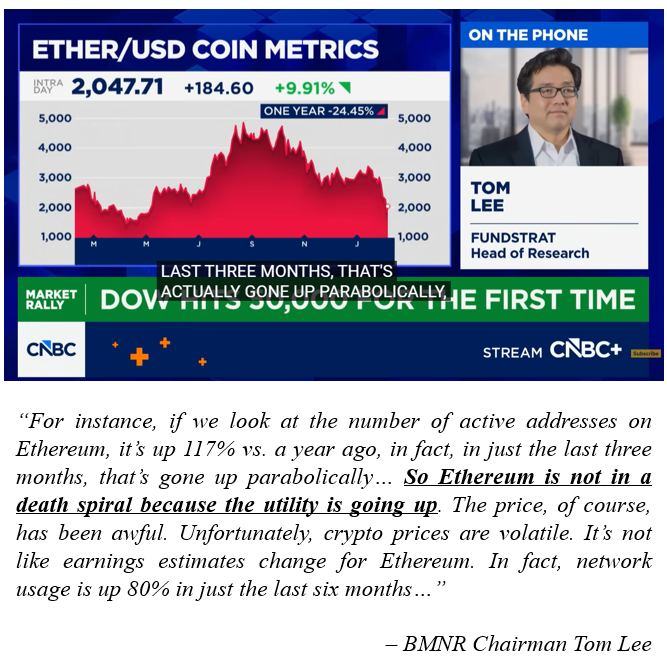
By his own logic, if ETH's on-chain activity does not reflect real utility value growth, then ETH is heading toward a death spiral.

Our research shows that this is exactly what is happening.

The full report and disclosure information are now available at culperresearch.com.

The Truth About On-Chain Data: 95% of New Wallets Are Poisoning Attacks

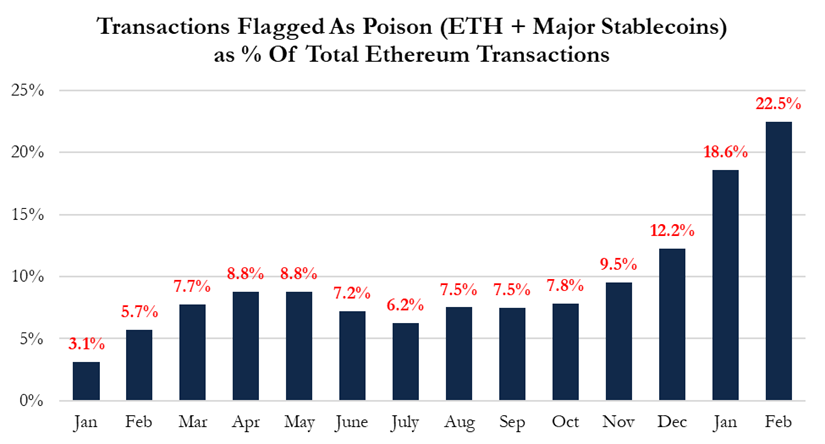
Our comprehensive analysis of on-chain data from January 2025 to February 2026 shows: The "institutional adoption" data cited by Tom Lee is actually explained by large-scale low-value address poisoning/wallet dusting attacks triggered by the block space surplus brought by Fusaka.
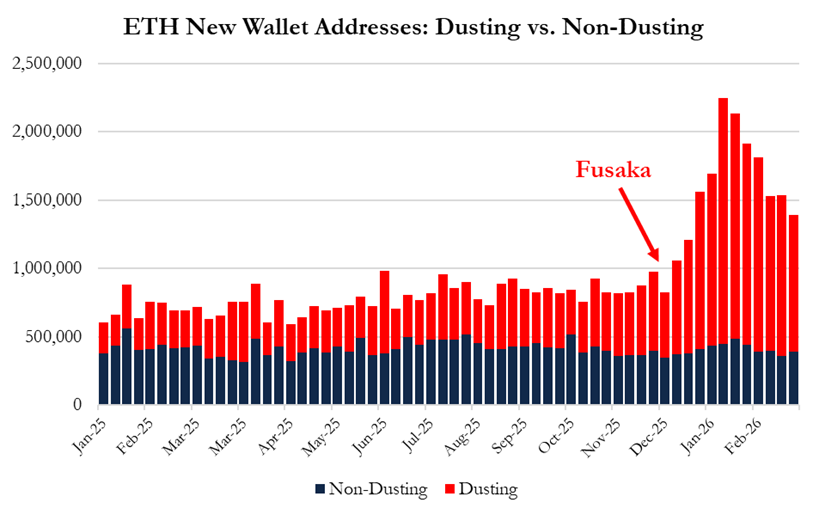
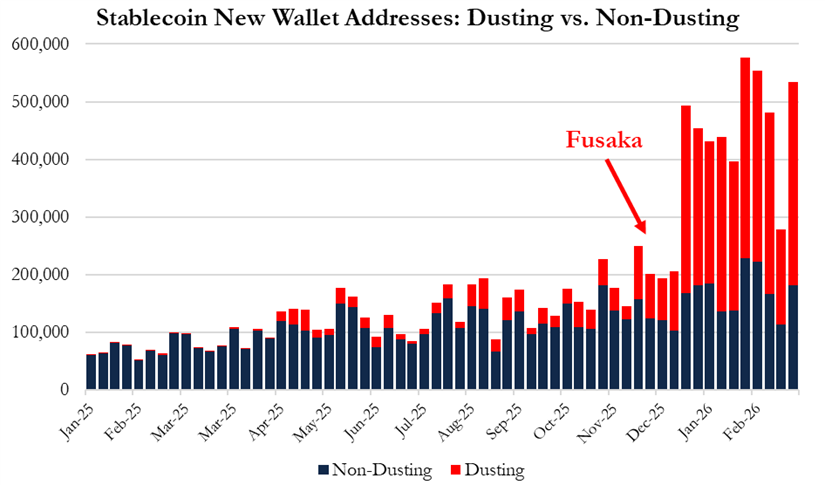
Specific data after Fusaka:

  • 95% of new wallet growth is explained by newly created "poisoned" wallets

  • Address poisoning attacks have increased by more than 3 times

  • Poisoning attacks explain more than 50% of ETH transaction volume growth

  • Poisoning attacks now account for 22.5% of all ETH transactions
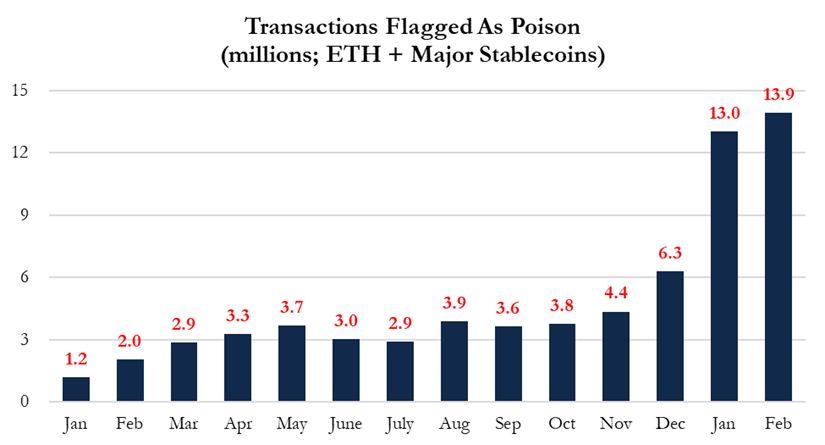
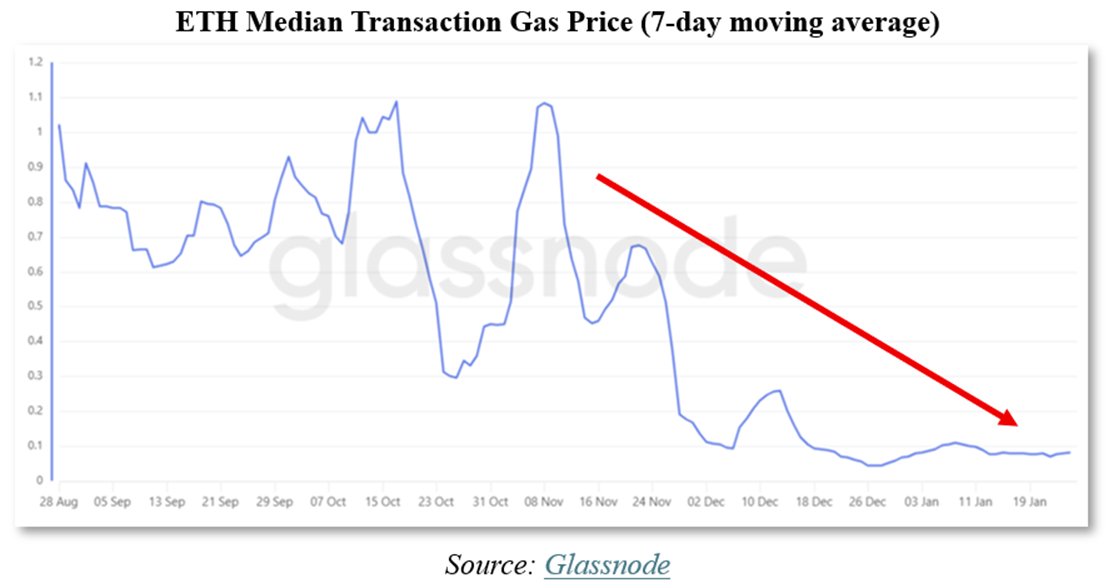
Fusaka Upgrade: Gas Fees Collapsed by 90%, 3-9 Times Worse Than Expected

Fusaka increased the gas limit from 45 million to 60 million, aiming to scale Ethereum L1. Vitalik and PTG estimated that gas fees would drop by 10-30%.

Reality: Gas fees dropped by about 90%.

Vitalik and the validators severely underestimated L1 demand elasticity, with an error of 3-9 times—using outdated mathematical models from before EIP-1559 and before L2s emerged.

Vitalik Is Selling Like Crazy

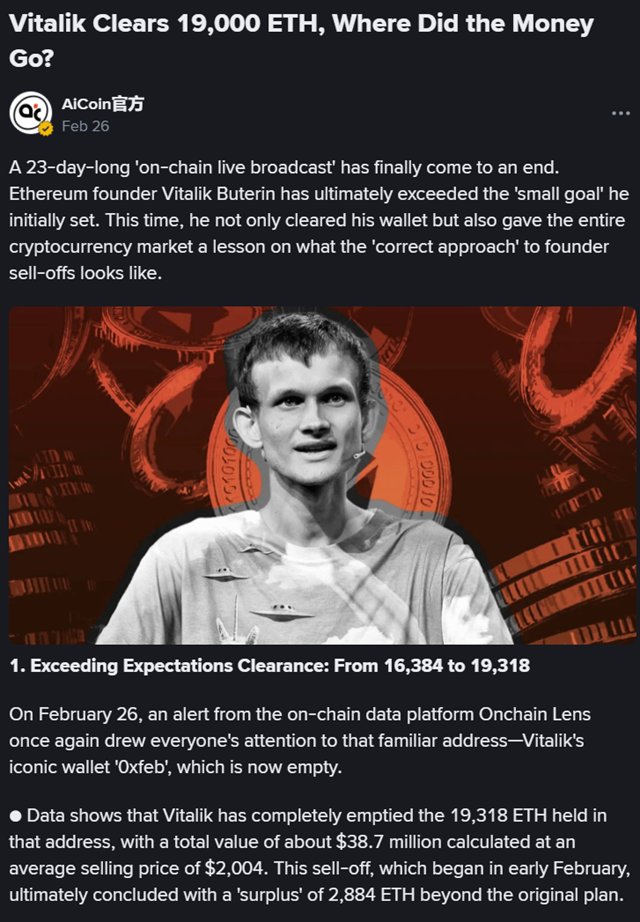
This is why we believe Vitalik is selling ETH heavily. On January 30, he announced he would sell 16,384 ETH to fund the Ethereum Foundation's "austerity period." Since then, he has sold over 19,300 ETH and is still continuing.

He knows what Tom Lee does not: ETH's token economic model has collapsed.
We Personally Verified the Address Poisoning Attack

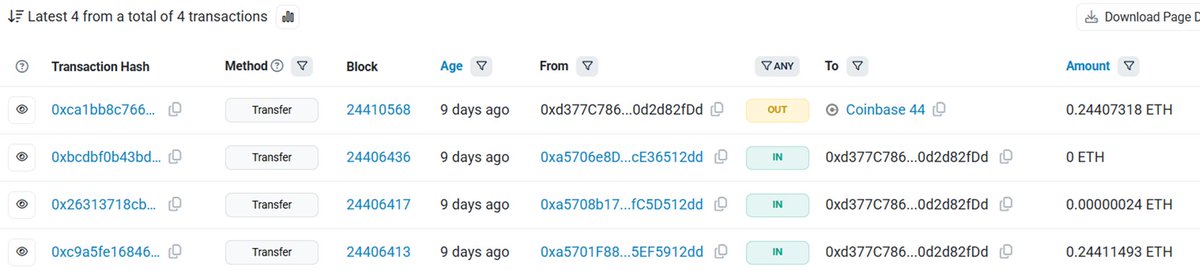
We documented the ETH address poisoning process firsthand: We created two new wallets, initiated a transfer between them, and were targeted by a poisoning attack within 5 minutes.

We encourage readers to verify this themselves.

Losses from poisoning attacks have grown at a rate more than 8 times faster than before Fusaka.
The Validator Flywheel Is Reversing

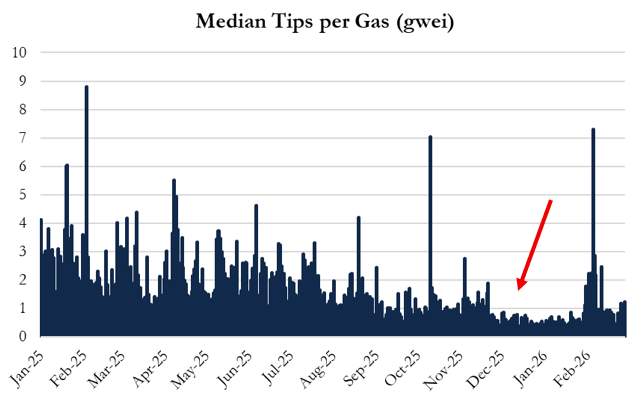
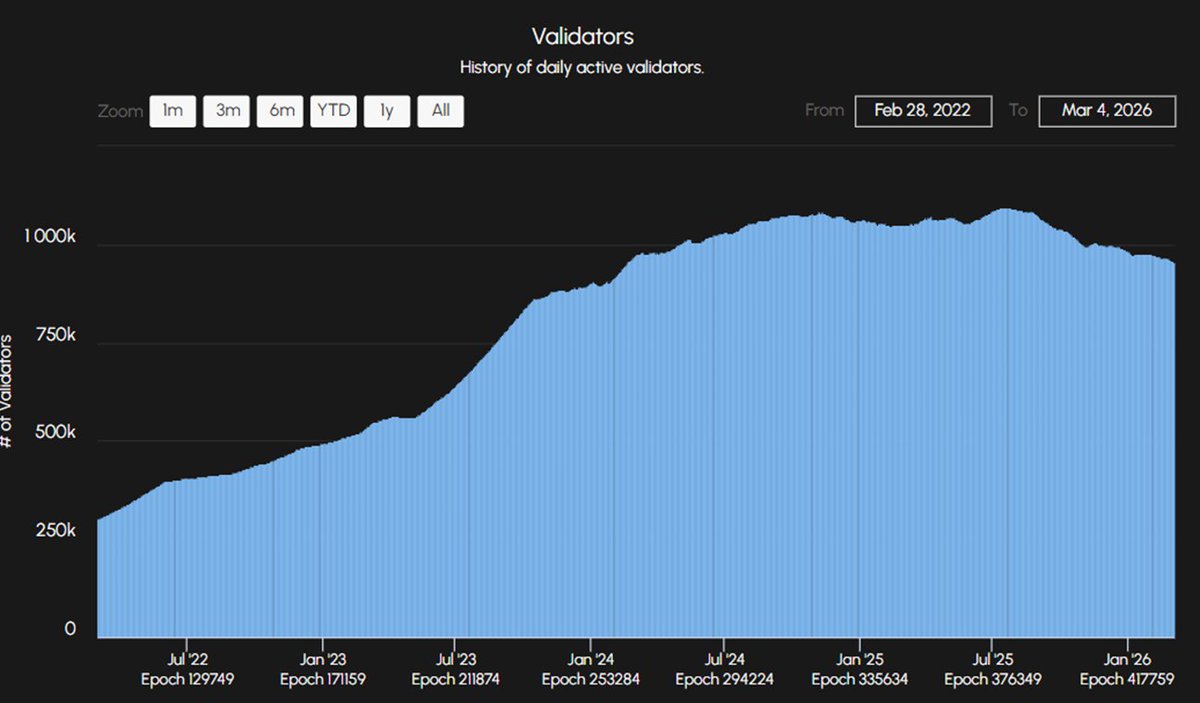
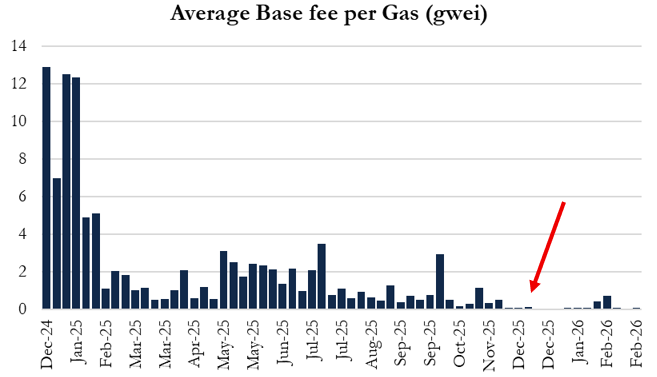
Additionally, the gas limit increase has severely hit ETH validators, who now see a 40-50% drop in tips per unit of gas. Lower returns reduce staking demand and high-value activity, thereby weakening the foundation for institutional adoption.

The flywheel is now spinning in reverse.
Ethereum Is Losing to Solana and Its Own L2s

Meanwhile, ETH continues to cede share:

  • Solana developers grew by 29% in 2025, while Ethereum only 6%; talent is draining away

  • Visa and Citigroup chose Solana to build DeFi applications

  • Solana DEX trading volume is now more than double that of Ethereum

Conclusion: The Next Nokia

During the internet bubble era, Netscape and Nokia dominated the market for over a decade, but ultimately, Google and Apple reaped the rewards.

We view ETH in the same light.

We believe the token economic model has collapsed, Tom Lee is in over his head, and $ETH will continue to decline.


Twitter:https://twitter.com/BitpushNewsCN

Bitpush TG Discussion Group:https://t.me/BitPushCommunity

Bitpush TG Subscription: https://t.me/bitpush

Original link:https://www.bitpush.news/articles/7617441

Preguntas relacionadas

QWhat is the main argument of Culper Research's report on Ethereum?

ACulper Research argues that Ethereum's tokenomics have been severely damaged by the Fusaka upgrade, which the increased block space led to a 90% drop in gas fees, but real organic demand did not keep up. They claim that the apparent surge in active addresses and transactions is largely due to address poisoning attacks, not genuine adoption, and that this has broken Ethereum's economic model.

QHow does Culper Research explain the increase in Ethereum's active addresses and transaction volume post-Fusaka?

ACulper Research attributes the increase in active addresses and transaction volume to address poisoning (wallet dusting) attacks, which account for 95% of new wallet growth and over 50% of the transaction volume increase. They argue that these attacks exploit the cheap block space created by Fusaka, creating artificial activity rather than reflecting real utility or adoption.

QWhat evidence does Culper Research provide to support their claim that Vitalik Buterin is selling ETH?

ACulper Research states that Vitalik Buterin announced on January 30 that he would sell 16,384 ETH to fund the Ethereum Foundation during a 'tightening period,' and has since sold over 19,300 ETH. They interpret this as evidence that he is aware of the broken tokenomics and is divesting accordingly.

QHow did the Fusaka upgrade affect gas fees and validator incentives according to the report?

AThe Fusaka upgrade increased the gas limit from 45 million to 60 million, intended to scale Ethereum L1. However, gas fees dropped by approximately 90%, far more than the estimated 10-30% decline. This reduction in fees decreased validator tips by 40-50%, undermining validator rewards and potentially reducing staking demand and high-value activity.

QWhat competitive threats to Ethereum does Culper Research highlight in their report?

ACulper Research highlights that Ethereum is losing market share to Solana and its own L2 solutions. They note that Solana developer growth was 29% in 2025 compared to Ethereum's 6%, that Visa and Citigroup are building DeFi applications on Solana, and that Solana DEX trading volume is now more than double that of Ethereum.

Lecturas Relacionadas

The $290 Million Deficit: A Three-Way Game Between Aave, L0, and Kelp—Who Should Foot the Bill?

An incident involving the theft of 116,500 rsETH (worth approximately $290 million) from Kelp DAO’s cross-chain bridge contract has triggered a complex dispute over responsibility and compensation among Kelp DAO, LayerZero, and Aave. The attack occurred due to a compromised RPC provider used by LayerZero’s Decentralized Verifier Network (DVN). Since Kelp DAO’s bridge used a 1/1 DVN configuration—a single point of failure—the attacker successfully forged a cross-chain message, leading to the unauthorized release of rsETH tokens from the mainnet. These genuine tokens were then deposited into Aave and other lending platforms to borrow WETH, enabling the attacker to exit with the funds. Responsibility is attributed primarily to Kelp DAO for its risky 1/1 DVN setup. LayerZero bears secondary responsibility for permitting such a vulnerable configuration in its protocol layer. Aave also shares indirect blame for over-collateralizing rsETH and other Liquid Restaking Token (LRT) assets without adequate ongoing risk oversight. Kelp DAO lacks sufficient funds to cover the loss, shifting focus to the deeper-pocketed players: LayerZero, whose cross-chain ecosystem and reputation are at risk, and Aave, which faces massive bad loans and declining Total Value Locked (TVL). Aave has asserted that mainnet rsETH remains fully backed, implying it expects Kelp DAO to allow redemption of underlying ETH. This approach would preserve Aave’s mainnet positions but invalidate Layer2 rsETH, damaging LayerZero’s cross-chain credibility. Potential solutions include: - A universal 18.5% haircut on all rsETH holders, causing significant Aave bad debt. - Writing off Layer2 rsETH entirely, protecting Aave mainnet but harming LayerZero and Kelp DAO. - Negotiating a bounty with the hacker for partial fund return. - A joint bailout, possibly led by LayerZero’s ecosystem fund, given its long-term stake in the cross-chain ecosystem. The situation remains unresolved as the parties negotiate, but prolonged delay risks broader DeFi instability, including potential liquidity crises and loss of confidence in LRT and cross-chain infrastructures.

Odaily星球日报Hace 12 min(s)

The $290 Million Deficit: A Three-Way Game Between Aave, L0, and Kelp—Who Should Foot the Bill?

Odaily星球日报Hace 12 min(s)

Bitcoin's Bull-Bear Range Battle Continues, HYPE Faces Critical Test of Wave V Support | Exclusive Analysis

This market analysis covers Bitcoin (BTC) and HYPE, highlighting key levels and trading strategies for the week. HYPE is currently testing a critical support level at $40.17. A hold above this level could lead to consolidation between $40.17–$45.76, while a break below it may signal the end of its current V-wave uptrend from the April 2 low. The short-term strategy is to look for long entries near $40.17 if support holds, using 30% leverage and strict stop-loss discipline. Bitcoin is interpreted to be in a larger D-wave rebound from the February 6 low of $60,000, currently trading within a $73,500–$79,000 range. Key resistance lies at $79,000–$80,600 and $83,500–$84,500, with supports at $73,500, $69,500, and $65,000–$66,000. The medium-term strategy maintains a 60% short position from $89,000. Short-term tactics include selling into rallies near $76,500–$79,000 (Scenario A) or breaking below $73,500 (Scenario B), using 30% leverage. Last week, a 1x leveraged long trade in HYPE yielded a 6.80% gain, and the BTC short from $89,000 is currently up approximately 17.08%. Risk management is emphasized: set stop-losses at entry, move to breakeven at +1% profit, and trail stops to lock in gains thereafter. All views are based on technical analysis and are not investment advice. Traders are urged to exercise caution and adapt to market changes.

marsbitHace 43 min(s)

Bitcoin's Bull-Bear Range Battle Continues, HYPE Faces Critical Test of Wave V Support | Exclusive Analysis

marsbitHace 43 min(s)

Bitcoin's Bull-Bear Range Battle Continues, HYPE Faces Critical Test of Wave V Support | Invited Analysis

The market is experiencing directional uncertainty with both opportunities and risks. HYPE's daily V-wave structure is at a critical juncture, with the $40.17 support level being pivotal for its future trajectory. A break below this level, followed by an inability to surpass the recent high of $45.76, could signal the end of the current upward structure. The short-term strategy for HYPE is to "follow the trend and buy on dips," using a 30% position size and a 30/60-minute trading cycle, entering long upon confirmed support holds with model signals. Bitcoin's market structure is reinterpreted, with the rally from the $60,000 low now considered a larger D-wave rebound within a medium-term correction, facing a key test between $73,500 and $79,000. A break above the upper bound may lead to limited upside, while a drop below could see a decline toward $69,500. Core resistance lies at $79,000–$80,600 and $83,500–$84,500, with support at $73,500, $69,500, and $65,000–$66,000. The medium-term strategy maintains a 60% short position from $89,000, to be exited if price stabilizes above the multi-empty band. Short-term tactics involve 30% positions for "spread" opportunities, with two scenarios: selling on rallies near $76,500–$79,000 (Scheme A) or shorting on a breakdown below $73,500 (Scheme B), both with strict stop-losses. A复盘 of HYPE's recent short trade showed a 6.80% gain from a long entry at $41.59 (based on model buy signals) and exit at $44.42 (triggered by top signals). Key reminders include setting initial stops at entry, moving to breakeven at +1% profit, and trailing stops thereafter. All views are for reference only; market conditions change rapidly, and caution is advised.

Odaily星球日报Hace 50 min(s)

Bitcoin's Bull-Bear Range Battle Continues, HYPE Faces Critical Test of Wave V Support | Invited Analysis

Odaily星球日报Hace 50 min(s)

On the Same Day Aave Introduced rsETH, Why Did Spark Choose to Exit?

On April 18, Kelp DAO's cross-chain bridge was exploited, resulting in the malicious minting of 116,500 unbacked rsETH. The attacker deposited these into Aave and borrowed WETH, creating a potential bad debt of approximately $195 million. Aave’s Guardian quickly froze the market, but the protocol’s insurance could only cover about 25% of the loss. In contrast, SparkLend, a lending protocol in the MakerDAO ecosystem, suffered no direct losses. This was not due to superior foresight but rather a preemptive governance decision. On January 29, Spark executed a governance action to discontinue new rsETH supply, citing low usage and high concentration from a single wallet. The same day, Aave expanded its rsETH market by enabling E-Mode with a 93% LTV to attract more deposits. Spark’s risk management framework is designed to remove assets with low usage or poor risk-adjusted returns, regardless of external security concerns. Aave’s decision was growth-oriented, aiming to boost WETH utilization and attract capital. Spark also employs additional safeguards: rate-limited supply and borrow caps that would have limited the scale of such an attack, and a robust oracle system using the median of three price feeds. These mechanisms systemically contain the maximum exposure to any single risk event, demonstrating a fundamentally different approach to risk than Aave’s growth-first model.

marsbitHace 50 min(s)

On the Same Day Aave Introduced rsETH, Why Did Spark Choose to Exit?

marsbitHace 50 min(s)

Strategy's 'Money Printer': Is STRC Bitcoin's Savior or Destroyer?

Bitcoin's recent price movement is being heavily influenced by Michael Saylor and his company, MicroStrategy, through a new financial instrument: STRC (Variable Rate Series A Perpetual Stretch Preferred Stock). This Nasdaq-listed perpetual preferred stock offers an 11.5% annual dividend, attracting significant capital. Crucially, funds raised from STRC are used to purchase Bitcoin, with a 3x leverage effect—for every $1 from STRC, MicroStrategy adds $2 from MSTR equity to buy $3 worth of BTC. This creates a powerful "flywheel": more STRC sales fuel massive BTC buying, supporting its price and improving MicroStrategy's credit, which in turn makes STRC more attractive to investors. However, this mechanism introduces risks. A significant "ex-dividend arbitrage" pattern has emerged, where traders buy STRC before its monthly dividend, collect the payout, and quickly sell, causing price volatility and potentially driving up Bitcoin's cost basis for MicroStrategy. In response, Saylor has proposed shifting STRC to a semi-monthly dividend to smooth out these effects. Furthermore, STRC's high yield is being integrated into DeFi protocols like Apyx Protocol and Saturn Credit, offering new on-chain yield opportunities. The central concern remains: as MicroStrategy aggressively accumulates over 3.5% of all BTC, it challenges Bitcoin's foundational principle of decentralization, creating a system where a single public company significantly influences the market.

marsbitHace 58 min(s)

Strategy's 'Money Printer': Is STRC Bitcoin's Savior or Destroyer?

marsbitHace 58 min(s)

Trading

Spot
Futuros
活动图片