New Chair, Old Inflation, Better-Than-Expected Jobs: How Are Global Assets Repriced After Wash's Debut?

marsbitPublicado a 2026-06-24Actualizado a 2026-06-24

Resumen

New Fed Chairman Kevin Wash's first FOMC meeting delivered a "hold" decision, keeping rates at 3.50%-3.75%. The key signal was a major shift in communication: the policy statement was shortened, and forward guidance was removed. Wash emphasized the Fed will no longer pre-commit to future actions, instead refocusing markets on economic data itself. The updated "dot plot" revealed a hawkish tilt, with the median forecast for the policy rate rising to 3.8% by year-end, suggesting a potential 25-basis-point hike in 2026. PCE inflation forecasts were also significantly raised. This reflects the Fed's current dilemma: a resilient job market (May nonfarm payrolls beat expectations) coupled with persistent inflation (PCE remains well above 2%) makes rate cuts unlikely and hikes a possibility. Wash inherits a deeply divided committee and a challenging macro environment reminiscent of 1994—strong growth with latent stagflation risks. His primary test is balancing inflation control against economic stability. Markets are repricing assets accordingly. The dollar strengthened on higher rate expectations. Treasury ETFs face pressure from potential hikes but may attract haven flows if growth fears emerge. Gold's role is more as a hedge amid conflicting forces. AI infrastructure stocks face valuation compression from higher rates, but the sector's fundamental demand logic remains intact if cloud CapEx holds. Defense stocks offer some resilience due to long-term government contracts. Look...

Last week, new Federal Reserve Chair Kevin Wash delivered his first monetary policy report card after taking office.

The Federal Open Market Committee decided to keep the target range for the federal funds rate unchanged at 3.50%-3.75%. All 12 voting members were in favor, with no dissenting votes (Extended Reading: "On the Eve of Wash's Debut: More Important Than a Rate Cut, How Will the Fed Reshape Expectations?"). It was a rather uneventful decision to "stand pat."

However, at the same time, this policy statement was compressed into three paragraphs and about a hundred words, significantly shorter than those of previous meetings. Phrases previously used to describe risk balance, future policy adjustments, and data dependence were directly deleted, and the "forward guidance" the market had grown accustomed to over many years also disappeared.

Wash explicitly stated at the press conference that the new statement is "shorter, simpler, and removes some of the old language." In his view, having lived through the most intense phase of the 2008 financial crisis, the current environment is changing too rapidly. The Fed should not promise too early what it will do in the future; instead, it should refocus the market's attention on the economic data itself.

This is perhaps the real signal released by the June FOMC meeting: the Fed under Wash's leadership is no longer trying to reduce uncertainty for the market but is preparing to hand some of that uncertainty back to the market.

A new communication framework has begun.

I. The Rate Stayed the Same, But the Fed's Policy Language Changed

For many investors, Wash is still a relatively unfamiliar name.

But he is not a newcomer to the Fed. From 2006 to 2011, Wash served as a Fed Governor, personally experiencing the 2008 financial crisis and the subsequent quantitative easing process. After leaving the Fed, he has long criticized the excessive expansion of central bank balance sheets, the proliferation of forward guidance, and the excessive intervention of monetary policy in financial markets.

Therefore, compared to reducing market volatility through repeated policy hints, Wash believes more in price signals and emphasizes monetary discipline more. His core idea can be summarized as "the central bank should make its objectives clear, but it doesn't need to tell the market every step of its operations in advance."

This thinking has been fully embodied in his first FOMC meeting.

Besides eliminating forward guidance, Wash also refused to submit his own interest rate path in this round of economic projections. He believes the current version of the dot plot is easily misunderstood by the market as a policy commitment, but in reality, each dot is only a conditional forecast made by officials based on the information available at that time.

He even described officials submitting their forecasts as if they were using "a big pencil with a large eraser"—once data changes, the forecast can be erased and rewritten at any time.

However, even though Wash tried to downplay the importance of the dot plot, the market still saw a very clear shift from it. Among the 18 participants who submitted forecasts this time, 9 expected at least one rate hike before the end of 2026, 8 expected rates to remain unchanged, and only 1 expected a rate cut.

More notably, among the 9 expecting hikes, 3 expected one hike, 5 expected two hikes, and 1 expected three hikes. The median policy rate at year-end also rose from the 3.4% predicted in March to 3.8%. This means that under the median scenario, the Fed will not only not cut rates this year but might actually raise them by 25 basis points.

Meanwhile, the Fed significantly raised its 2026 PCE inflation forecast from 2.7% in March to 3.6%, and the core PCE forecast from 2.7% to 3.3%.

In other words, the message from the June meeting is not complicated: the economy isn't weak enough to need rescue, but inflation is already strong enough that discussion of rate cuts must stop. This is also why the much-anticipated "Wash cut trade" quickly faded after his debut.

Additionally, when Trump nominated Wash, the market widely speculated that the new Chair might be more willing to cut rates than his predecessor. However, during the hearings, Wash made it clear that the President had never asked him to pre-commit to any interest rate decisions, and even if such a request were made, he would not accept it.

It seems now that Wash is not in a hurry to prove whether he is a hawk or a dove. First and foremost, he wants to prove that the Fed still has the ability to say no to inflation.

II. What Kind of "Hot Potato" Has Wash Inherited?

Objectively speaking, Wash's first major challenge is still inflation.

U.S. headline PCE rose 3.8% year-over-year in April, and core PCE rose 3.3% year-over-year, still a significant distance from the Fed's long-term 2% target.

What's more troublesome is that the current inflation doesn't stem entirely from a single factor.

On one hand, energy prices and geopolitical tensions continue to affect upstream costs; on the other hand, supply chains, tariffs, and service prices are still generating broader transmission pressures. Once energy price increases further spread to transportation, manufacturing, and household consumption, what the Fed will need to handle is no longer just a short-term shock, but the risk of inflation expectations re-emerging.

At the same time, the job market is much stronger than the market previously anticipated. The U.S. May jobs report released on June 5th showed non-farm payrolls increased by 172,000, about twice market expectations; the unemployment rate remained at 4.3%.

Under normal circumstances, this is data worth welcoming. But in the current environment, "good economic news" has been translated by the market into "bad monetary policy news." On the day the jobs data was released, the Nasdaq Composite Index fell 4.18%, its largest single-day drop in over a year. Semiconductor and high-valuation technology stocks were hit hardest, while bond yields rose significantly.

Trump subsequently posted on Truth Social, writing in bewilderment: "With such a good jobs report, stocks should go up, not down. It's been that way for the past 200 years."

This precisely reveals the most contradictory aspect of the current market. What Wash has inherited is not an economy on its last legs like during the pandemic, one in desperate need of central bank rescue and unlimited easing to stay alive, but rather an economy with a robust pulse on the surface, akin to 1994, yet carrying the hidden danger of stagflation, one that could lose momentum at any moment due to a single monetary policy misstep.

Now, raising rates risks stifling the recovery; cutting rates risks an inflation resurgence. This is precisely his most difficult situation.

This is also why what Wash truly faces is not a binary choice of "hike or cut," but a test of precise policy timing.

It's worth noting that in April this year, the Fed saw four dissenting votes, the first large-scale internal dissent since 1992, and this split did not appear suddenly. Over the past two years, cracks within the Fed have long been accumulating: Doves believe the job market has already cooled and rate cuts should be initiated soon to prevent a hard landing; Hawks insist that inflation is not truly tamed and cutting rates would only undo all the progress.

The unexpected 50-basis-point sharp rate cut in September 2024 sparked fierce internal debate. Then-Governor Michelle Bowman cast a dissenting vote, becoming the first Fed Governor in nearly two decades to publicly oppose the Chair on a rate decision. Trump appointing new members and pressuring Fed independence has made this political dimension seep into monetary policy discussions at a visible pace.

Therefore, Wash has taken over a team deeply divided on policy direction. Now the chair has a new occupant, but those accumulated divisions have not dissipated with the change. Wash hasn't just taken over a position; he's taken over a powder keg that could explode at any public meeting.

Building internal consensus itself is Wash's first test.

III. How Are Global Assets Being Repriced?

For the market, the hawkish tone of this FOMC has become a bellwether for stocks.

First and foremost are the dollar and U.S. Treasuries, the most direct rate trades.

Translated to the asset level, the logic for the dollar-bullish ETF UUP.M is relatively straightforward. After all, the higher the market's expectations for the policy rate, the greater the interest rate advantage of U.S. assets compared to other currency-denominated assets typically becomes. Therefore, the dollar index rose about 0.5% after the June FOMC, a result of the market repricing for a potential rate hike.

The environment for the intermediate-term Treasury ETF IEF.M is more complex. As is well known, bond prices move inversely to yields. So if inflation forecasts continue to be revised upward and the market further bets on rate hikes, intermediate-term Treasury yields may remain high, putting pressure on IEF.M.

But this doesn't mean U.S. Treasuries only have a one-way downside logic. If employment or consumption data suddenly weakens, reigniting recession fears, safe-haven funds could quickly flow back into Treasuries. Therefore, what affects U.S. Treasuries is not just whether the Fed will hike next, but also how the market judges the growth outlook after any hike.

Gold ETFs like GLD.M and IAU.M are relatively tricky assets to position currently. High real rates theoretically suppress gold, but geopolitical risks in the Middle East and ongoing gold purchases by global central banks provide another source of support. Therefore, when these two forces pull against each other, gold is better understood as a hedge rather than an offensive allocation.

Silver ETFs SLV.M and SIVR.M have an additional industrial logic compared to gold. The demand pull from AI infrastructure on power infrastructure and industrial metals gives silver independent demand support beyond its monetary properties. This provides it with an extra layer of cushion under the same macro pressures compared to gold.
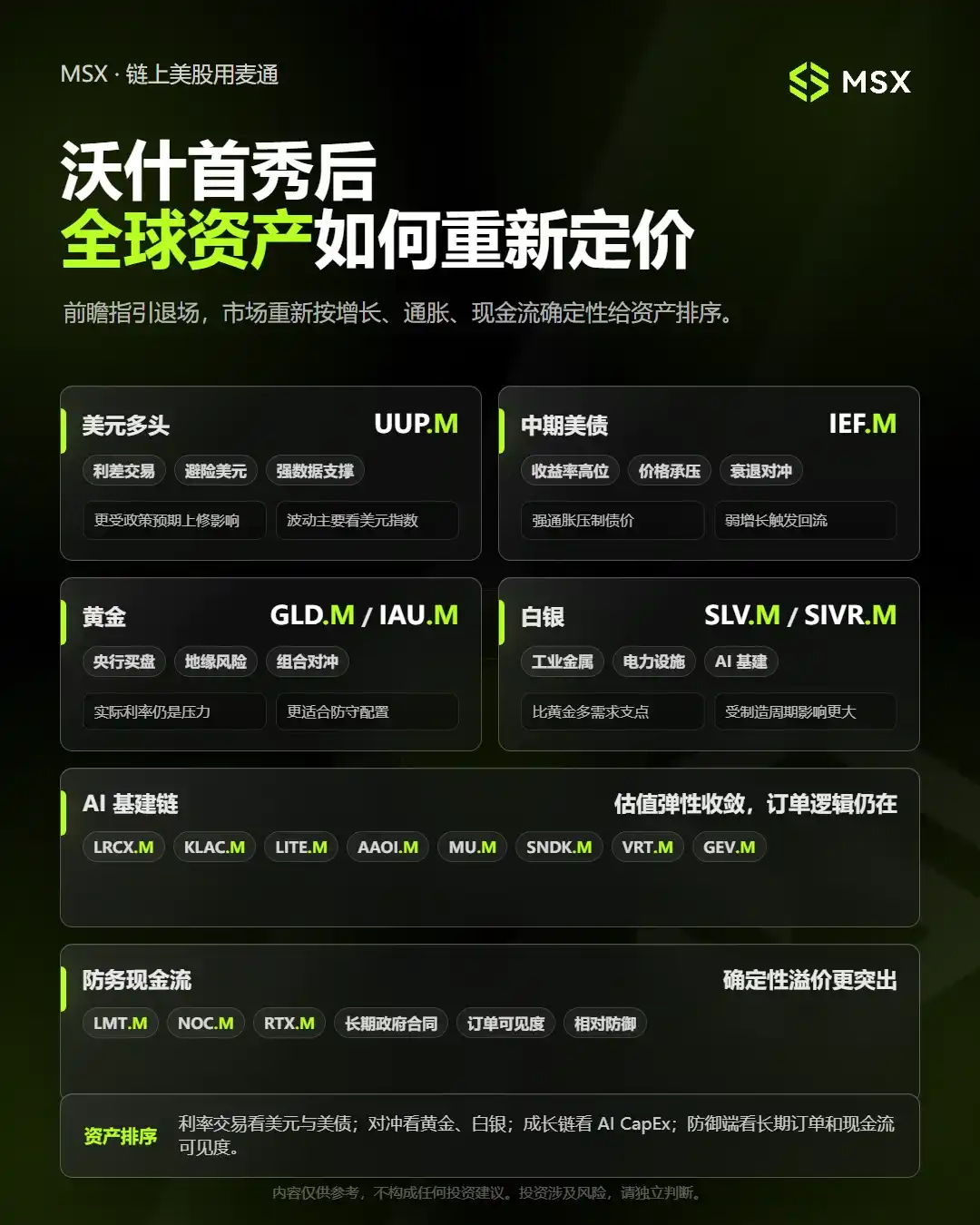
As for the impact of high rates on the AI infrastructure theme, it operates on two levels; one cannot simply say, "If rates rise, AI infrastructure is finished":

  • First is valuation pressure: Stocks like semiconductor equipment makers LRCX.M and KLAC.M, optical communication stocks like LITE.M and AAOI.M, memory stocks like MU.M and SNDK.M, and power infrastructure stocks like VRT.M and GEV.M. These companies' valuations are built on revenues expected to materialize over the coming years. The higher the interest rate, the higher the discount rate, and the lower the present value of future cash flows.
  • The second layer is capital expenditure risk: Cloud providers' AI CapEx is the lifeblood of the entire chain. In a high-rate environment with rising financing costs, might cloud providers shrink their budgets? Currently, it appears that Microsoft, Google, and Amazon's CapEx are still expanding; the demand-side logic hasn't changed due to rate hikes. Furthermore, rates pressure valuations; the number of orders hasn't decreased. As long as cloud provider CapEx shows no contraction, the industrial logic for AI infrastructure still holds, it's just that the space for valuation expansion is compressed. Reviewing Google's performance in Q1 2026 can lead to this conclusion.

The defense sector also possesses certain defensive attributes.

Companies like LMT.M, NOC.M, and RTX.M derive their revenue mainly from long-term government contracts, with order and cash flow visibility typically higher than that of high-valuation growth stocks. During periods of high interest rates and market preference for certain cash flows, defense assets may gain a relative advantage.

However, this doesn't mean defense stocks are completely immune to interest rates. Rising yields can still pressure their valuations. What truly provides support is the policy certainty of defense budgets and long-term orders, not absolute immunity to interest rate risk.

IV. Looking Ahead, What Should the Market Really Watch?

Wash's first FOMC has given a preliminary answer: the Fed is not prepared to continue planning every step of the policy path for the market; future volatility will be more driven by the data itself.

But this is still just the beginning. Over the next few months, several key nodes are worth investors' continued attention.

First is the June Non-Farm Payrolls on July 2nd. This is the first full-month employment report under Wash's tenure and the most important labor market signal he will receive before the July meeting. If employment remains strong, the window for rate cuts closes further, and the discussion of hikes will shift from expectation to reality. If the data weakens significantly, the market's expectations for the monetary policy path will loosen again, at which point the logic for cuts will have space for repricing.

Therefore, this single data point will likely directly determine the tone of the July meeting.
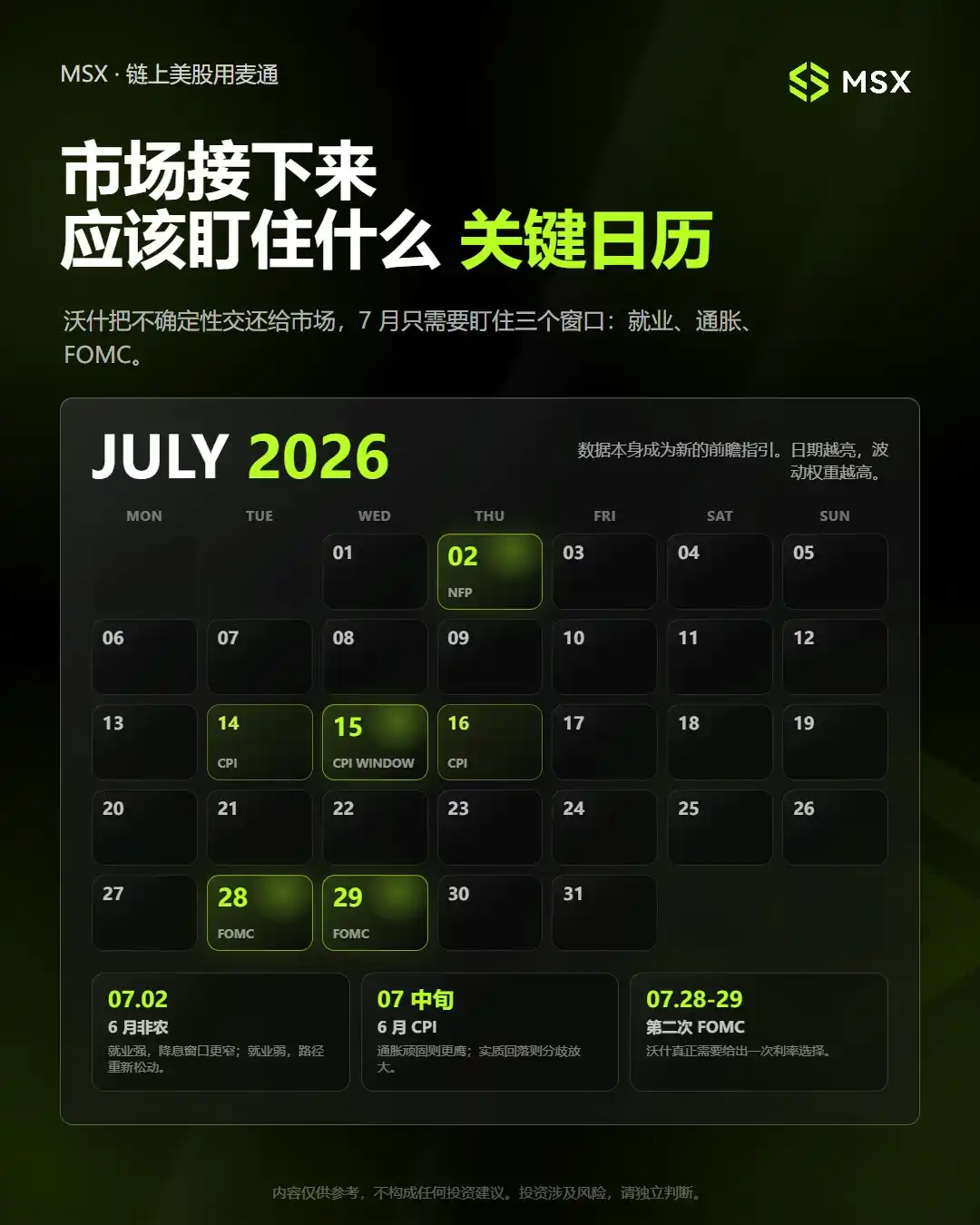
Next is the June CPI in mid-July, the most unignorable data point between two FOMC meetings. Wash made it very clear at the press conference: price stability is the current primary objective. If CPI remains stubborn, his stance at the July meeting will only be more hawkish. If inflation shows substantial easing, the market will diverge in its judgment of his next move. Regardless of the outcome, this data will trigger significant volatility on its release day.

Finally, the second FOMC meeting on July 28-29 might be the first true rate decision belonging to Wash. For the July meeting, with the accumulated data from Non-Farm Payrolls and CPI, he will need to make a real policy choice. By then, the market's understanding of his judgment will be clearer, and the outline of the direction will be more complete.

Of course, the midterm elections in the second half of the year are undoubtedly a variable on a longer time dimension. As the election approaches, the tension between the White House and the Fed is destined to intensify again. Trump's desire for rate cuts will not disappear, and Wash's statement at the hearings, "I won't promise that," will be tested repeatedly every time political pressure heats up.

The proposition of monetary policy independence will continue to be background noise for the market throughout the second half of the year.


Criptos en tendencia

Preguntas relacionadas

QWhat were the key changes in communication style introduced by new Fed Chair Kevin Warsh during his first FOMC meeting?

AKevin Warsh's first FOMC meeting featured significant changes in communication style. The policy statement was shortened to about a hundred words across three paragraphs, removing forward guidance and language describing risk balance, future policy adjustments, and data dependence. Warsh explicitly stated that the Fed should not make premature promises about future actions but rather refocus market attention on economic data itself, signaling a shift towards less market hand-holding and a return of uncertainty to the markets.

QAccording to the June FOMC meeting's economic projections (dot plot), what is the Fed's median expectation for the policy interest rate by the end of the year, and what does this signal?

AAccording to the June FOMC meeting's economic projections (dot plot), the median expectation for the policy interest rate by the end of the year was revised upwards to 3.8% from 3.4% in March. This signals that, in the median scenario, the Fed does not expect to cut rates this year and instead sees a possibility of a 25 basis point rate hike, reflecting a more hawkish stance due to persistent inflation.

QWhat are the two main conflicting pressures that Fed Chair Kevin Warsh faces in setting monetary policy, as described in the article?

AFed Chair Kevin Warsh faces two main conflicting pressures: the risk of stifling the economic recovery by raising interest rates and the risk of fueling a resurgence of inflation by cutting rates. The economy shows strong signs like robust employment but carries underlying stagflation risks, making precise timing of policy adjustments his primary challenge.

QHow did the article describe the potential impact of high interest rates on the AI infrastructure investment theme?

AThe article describes the impact of high interest rates on the AI infrastructure theme in two layers. First, it creates valuation pressure on companies (e.g., semiconductor, optical communication, storage, power infrastructure) by increasing the discount rate, which lowers the present value of future cash flows. Second, it raises capital expenditure (CapEx) risks for cloud providers, the main source of investment. However, as long as cloud provider CapEx (e.g., from Microsoft, Google, Amazon) does not contract, the industrial logic for AI infrastructure remains intact, though valuation expansion space is compressed.

QWhat are the key upcoming data points and events that the article suggests market participants should closely monitor following Warsh's first FOMC meeting?

AFollowing Warsh's first FOMC, key upcoming data and events to monitor are: 1) The July 2nd release of the June Non-Farm Payrolls report, which will heavily influence the July FOMC tone. 2) The mid-July release of the June CPI data, crucial for gauging inflation persistence. 3) The second FOMC meeting on July 28-29, which will represent Warsh's first substantive policy decision with more data. 4) The broader political context, especially the upcoming midterm elections and associated pressures on Fed independence.

Lecturas Relacionadas

Google Starts Selling TPUs, Big Tech Aims to Produce "Low-Cost Tokens" with AI Chips

Google has begun selling its proprietary TPU chips and AI computing hardware directly to third-party data centers and clients, marking a strategic shift. Previously only accessible via cloud rentals, TPUs are specialized processors designed for the matrix and tensor operations central to AI models. By combining thousands into supercomputing clusters managed by CPUs, Google achieves high-efficiency AI processing. This move enables Google’s Gemini AI to offer competitive token pricing, challenging rivals like OpenAI. It also signals a broader industry trend where AI compute is becoming a commoditized resource like electricity. While NVIDIA remains dominant with its CUDA ecosystem and high-performance GPUs, the focus is shifting from raw power to cost efficiency and system integration. Google’s approach mirrors NVIDIA’s by selling an entire ecosystem—hardware, software, and data center expertise—rather than just chips. This threatens NVIDIA’s grip on the mid-range inference market, where lower-cost, efficient solutions are increasingly demanded. Similarly, cloud providers like Huawei Cloud and Alibaba Cloud in China are developing their own AI chip ecosystems (e.g., Ascend, Zhenwu), packaging chips, clusters, and tools into full-stack solutions. They aim to reduce token costs and capture market share through integrated systems. In summary, the AI infrastructure race is evolving from a competition for the strongest chips to a contest for the most efficient and cost-effective systems. Google’s TPU sales highlight this transition, emphasizing that future success lies in delivering affordable, scalable AI compute as a foundational service.

marsbitHace 9 min(s)

Google Starts Selling TPUs, Big Tech Aims to Produce "Low-Cost Tokens" with AI Chips

marsbitHace 9 min(s)

Trading

Spot
Futuros

Artículos destacados

Qué es $S$

Entendiendo SPERO: Una Visión General Completa Introducción a SPERO A medida que el panorama de la innovación continúa evolucionando, la aparición de tecnologías web3 y proyectos de criptomonedas juega un papel fundamental en la configuración del futuro digital. Un proyecto que ha atraído la atención en este campo dinámico es SPERO, denotado como SPERO,$$s$. Este artículo tiene como objetivo reunir y presentar información detallada sobre SPERO, para ayudar a entusiastas e inversores a comprender sus fundamentos, objetivos e innovaciones dentro de los dominios web3 y cripto. ¿Qué es SPERO,$$s$? SPERO,$$s$ es un proyecto único dentro del espacio cripto que busca aprovechar los principios de descentralización y tecnología blockchain para crear un ecosistema que promueva la participación, la utilidad y la inclusión financiera. El proyecto está diseñado para facilitar interacciones de igual a igual de nuevas maneras, proporcionando a los usuarios soluciones y servicios financieros innovadores. En su esencia, SPERO,$$s$ tiene como objetivo empoderar a los individuos al proporcionar herramientas y plataformas que mejoren la experiencia del usuario en el espacio de las criptomonedas. Esto incluye habilitar métodos de transacción más flexibles, fomentar iniciativas impulsadas por la comunidad y crear caminos para oportunidades financieras a través de aplicaciones descentralizadas (dApps). La visión subyacente de SPERO,$$s$ gira en torno a la inclusividad, buscando cerrar brechas dentro de las finanzas tradicionales mientras aprovecha los beneficios de la tecnología blockchain. ¿Quién es el Creador de SPERO,$$s$? La identidad del creador de SPERO,$$s$ sigue siendo algo oscura, ya que hay recursos públicos limitados que proporcionan información de fondo detallada sobre su(s) fundador(es). Esta falta de transparencia puede derivarse del compromiso del proyecto con la descentralización, una ética que muchos proyectos web3 comparten, priorizando las contribuciones colectivas sobre el reconocimiento individual. Al centrar las discusiones en torno a la comunidad y sus objetivos colectivos, SPERO,$$s$ encarna la esencia del empoderamiento sin señalar a individuos específicos. Como tal, comprender la ética y la misión de SPERO sigue siendo más importante que identificar a un creador singular. ¿Quiénes son los Inversores de SPERO,$$s$? SPERO,$$s$ cuenta con el apoyo de una diversa gama de inversores que van desde capitalistas de riesgo hasta inversores ángeles dedicados a fomentar la innovación en el sector cripto. El enfoque de estos inversores generalmente se alinea con la misión de SPERO, priorizando proyectos que prometen avances tecnológicos sociales, inclusión financiera y gobernanza descentralizada. Estas fundaciones de inversores suelen estar interesadas en proyectos que no solo ofrecen productos innovadores, sino que también contribuyen positivamente a la comunidad blockchain y sus ecosistemas. El respaldo de estos inversores refuerza a SPERO,$$s$ como un contendiente notable en el dominio de proyectos cripto que evoluciona rápidamente. ¿Cómo Funciona SPERO,$$s$? SPERO,$$s$ emplea un marco multifacético que lo distingue de los proyectos de criptomonedas convencionales. Aquí hay algunas de las características clave que subrayan su singularidad e innovación: Gobernanza Descentralizada: SPERO,$$s$ integra modelos de gobernanza descentralizada, empoderando a los usuarios para participar activamente en los procesos de toma de decisiones sobre el futuro del proyecto. Este enfoque fomenta un sentido de propiedad y responsabilidad entre los miembros de la comunidad. Utilidad del Token: SPERO,$$s$ utiliza su propio token de criptomoneda, diseñado para servir diversas funciones dentro del ecosistema. Estos tokens permiten transacciones, recompensas y la facilitación de servicios ofrecidos en la plataforma, mejorando la participación y la utilidad general. Arquitectura en Capas: La arquitectura técnica de SPERO,$$s$ apoya la modularidad y escalabilidad, permitiendo la integración fluida de características y aplicaciones adicionales a medida que el proyecto evoluciona. Esta adaptabilidad es fundamental para mantener la relevancia en el cambiante paisaje cripto. Participación de la Comunidad: El proyecto enfatiza iniciativas impulsadas por la comunidad, empleando mecanismos que incentivan la colaboración y la retroalimentación. Al nutrir una comunidad sólida, SPERO,$$s$ puede abordar mejor las necesidades de los usuarios y adaptarse a las tendencias del mercado. Enfoque en la Inclusión: Al ofrecer tarifas de transacción bajas e interfaces amigables para el usuario, SPERO,$$s$ busca atraer a una base de usuarios diversa, incluyendo a individuos que anteriormente pueden no haber participado en el espacio cripto. Este compromiso con la inclusión se alinea con su misión general de empoderamiento a través de la accesibilidad. Cronología de SPERO,$$s$ Entender la historia de un proyecto proporciona información crucial sobre su trayectoria de desarrollo y hitos. A continuación se presenta una cronología sugerida que mapea eventos significativos en la evolución de SPERO,$$s$: Fase de Conceptualización e Ideación: Las ideas iniciales que forman la base de SPERO,$$s$ fueron concebidas, alineándose estrechamente con los principios de descentralización y enfoque comunitario dentro de la industria blockchain. Lanzamiento del Whitepaper del Proyecto: Tras la fase conceptual, se lanzó un whitepaper completo que detalla la visión, los objetivos y la infraestructura tecnológica de SPERO,$$s$ para generar interés y retroalimentación de la comunidad. Construcción de Comunidad y Primeras Interacciones: Se realizaron esfuerzos de divulgación activa para construir una comunidad de primeros adoptantes y posibles inversores, facilitando discusiones en torno a los objetivos del proyecto y obteniendo apoyo. Evento de Generación de Tokens: SPERO,$$s$ llevó a cabo un evento de generación de tokens (TGE) para distribuir sus tokens nativos a los primeros seguidores y establecer liquidez inicial dentro del ecosistema. Lanzamiento de la dApp Inicial: La primera aplicación descentralizada (dApp) asociada con SPERO,$$s$ se puso en marcha, permitiendo a los usuarios interactuar con las funcionalidades centrales de la plataforma. Desarrollo Continuo y Alianzas: Actualizaciones y mejoras continuas a las ofertas del proyecto, incluyendo alianzas estratégicas con otros actores en el espacio blockchain, han moldeado a SPERO,$$s$ en un jugador competitivo y en evolución en el mercado cripto. Conclusión SPERO,$$s$ se erige como un testimonio del potencial de web3 y las criptomonedas para revolucionar los sistemas financieros y empoderar a los individuos. Con un compromiso con la gobernanza descentralizada, la participación comunitaria y funcionalidades diseñadas de manera innovadora, allana el camino hacia un paisaje financiero más inclusivo. Como con cualquier inversión en el espacio cripto que evoluciona rápidamente, se anima a los posibles inversores y usuarios a investigar a fondo y participar de manera reflexiva con los desarrollos en curso dentro de SPERO,$$s$. El proyecto muestra el espíritu innovador de la industria cripto, invitando a una mayor exploración de sus innumerables posibilidades. Mientras el viaje de SPERO,$$s$ aún se desarrolla, sus principios fundamentales pueden, de hecho, influir en el futuro de cómo interactuamos con la tecnología, las finanzas y entre nosotros en ecosistemas digitales interconectados.

87 Vistas totalesPublicado en 2024.12.17Actualizado en 2024.12.17

Qué es $S$

Qué es AGENT S

Agent S: El Futuro de la Interacción Autónoma en Web3 Introducción En el paisaje en constante evolución de Web3 y las criptomonedas, las innovaciones están redefiniendo constantemente cómo los individuos interactúan con las plataformas digitales. Uno de estos proyectos pioneros, Agent S, promete revolucionar la interacción humano-computadora a través de su marco agente abierto. Al allanar el camino para interacciones autónomas, Agent S busca simplificar tareas complejas, ofreciendo aplicaciones transformadoras en inteligencia artificial (IA). Esta exploración detallada profundizará en las complejidades del proyecto, sus características únicas y las implicaciones para el dominio de las criptomonedas. ¿Qué es Agent S? Agent S se presenta como un marco agente abierto innovador, diseñado específicamente para abordar tres desafíos fundamentales en la automatización de tareas informáticas: Adquisición de Conocimiento Específico del Dominio: El marco aprende inteligentemente de diversas fuentes de conocimiento externas y experiencias internas. Este enfoque dual le permite construir un rico repositorio de conocimiento específico del dominio, mejorando su rendimiento en la ejecución de tareas. Planificación a Largo Plazo de Tareas: Agent S emplea planificación jerárquica aumentada por la experiencia, un enfoque estratégico que facilita la descomposición y ejecución eficiente de tareas complejas. Esta característica mejora significativamente su capacidad para gestionar múltiples subtareas de manera eficiente y efectiva. Manejo de Interfaces Dinámicas y No Uniformes: El proyecto introduce la Interfaz Agente-Computadora (ACI), una solución innovadora que mejora la interacción entre agentes y usuarios. Utilizando Modelos de Lenguaje Multimodal de Gran Escala (MLLMs), Agent S puede navegar y manipular diversas interfaces gráficas de usuario sin problemas. A través de estas características pioneras, Agent S proporciona un marco robusto que aborda las complejidades involucradas en la automatización de la interacción humana con las máquinas, preparando el terreno para una multitud de aplicaciones en IA y más allá. ¿Quién es el Creador de Agent S? Si bien el concepto de Agent S es fundamentalmente innovador, la información específica sobre su creador sigue siendo elusiva. El creador es actualmente desconocido, lo que resalta ya sea la etapa incipiente del proyecto o la elección estratégica de mantener a los miembros fundadores en el anonimato. Independientemente de la anonimidad, el enfoque sigue siendo en las capacidades y el potencial del marco. ¿Quiénes son los Inversores de Agent S? Dado que Agent S es relativamente nuevo en el ecosistema criptográfico, la información detallada sobre sus inversores y patrocinadores financieros no está documentada explícitamente. La falta de información disponible públicamente sobre las bases de inversión u organizaciones que apoyan el proyecto plantea preguntas sobre su estructura de financiamiento y hoja de ruta de desarrollo. Comprender el respaldo es crucial para evaluar la sostenibilidad del proyecto y su posible impacto en el mercado. ¿Cómo Funciona Agent S? En el núcleo de Agent S se encuentra una tecnología de vanguardia que le permite funcionar de manera efectiva en diversos entornos. Su modelo operativo se basa en varias características clave: Interacción Humano-Computadora Similar a la Humana: El marco ofrece planificación avanzada de IA, esforzándose por hacer que las interacciones con las computadoras sean más intuitivas. Al imitar el comportamiento humano en la ejecución de tareas, promete elevar las experiencias de los usuarios. Memoria Narrativa: Empleada para aprovechar experiencias de alto nivel, Agent S utiliza memoria narrativa para hacer un seguimiento de las historias de tareas, mejorando así sus procesos de toma de decisiones. Memoria Episódica: Esta característica proporciona a los usuarios una guía paso a paso, permitiendo que el marco ofrezca apoyo contextual a medida que se desarrollan las tareas. Soporte para OpenACI: Con la capacidad de ejecutarse localmente, Agent S permite a los usuarios mantener el control sobre sus interacciones y flujos de trabajo, alineándose con la ética descentralizada de Web3. Fácil Integración con APIs Externas: Su versatilidad y compatibilidad con varias plataformas de IA aseguran que Agent S pueda encajar sin problemas en ecosistemas tecnológicos existentes, convirtiéndolo en una opción atractiva para desarrolladores y organizaciones. Estas funcionalidades contribuyen colectivamente a la posición única de Agent S dentro del espacio cripto, ya que automatiza tareas complejas y de múltiples pasos con una intervención humana mínima. A medida que el proyecto evoluciona, sus posibles aplicaciones en Web3 podrían redefinir cómo se desarrollan las interacciones digitales. Cronología de Agent S El desarrollo y los hitos de Agent S pueden encapsularse en una cronología que resalta sus eventos significativos: 27 de septiembre de 2024: El concepto de Agent S fue lanzado en un documento de investigación integral titulado “Un Marco Agente Abierto que Usa Computadoras Como un Humano”, mostrando las bases del proyecto. 10 de octubre de 2024: El documento de investigación fue puesto a disposición del público en arXiv, ofreciendo una exploración profunda del marco y su evaluación de rendimiento basada en el benchmark OSWorld. 12 de octubre de 2024: Se lanzó una presentación en video, proporcionando una visión visual de las capacidades y características de Agent S, involucrando aún más a posibles usuarios e inversores. Estos marcadores en la cronología no solo ilustran el progreso de Agent S, sino que también indican su compromiso con la transparencia y la participación comunitaria. Puntos Clave Sobre Agent S A medida que el marco Agent S continúa evolucionando, varios atributos clave destacan, subrayando su naturaleza innovadora y potencial: Marco Innovador: Diseñado para proporcionar un uso intuitivo de las computadoras similar a la interacción humana, Agent S aporta un enfoque novedoso a la automatización de tareas. Interacción Autónoma: La capacidad de interactuar de manera autónoma con las computadoras a través de GUI significa un salto hacia soluciones informáticas más inteligentes y eficientes. Automatización de Tareas Complejas: Con su metodología robusta, puede automatizar tareas complejas y de múltiples pasos, haciendo que los procesos sean más rápidos y menos propensos a errores. Mejora Continua: Los mecanismos de aprendizaje permiten a Agent S mejorar a partir de experiencias pasadas, mejorando continuamente su rendimiento y eficacia. Versatilidad: Su adaptabilidad en diferentes entornos operativos como OSWorld y WindowsAgentArena asegura que pueda servir a una amplia gama de aplicaciones. A medida que Agent S se posiciona en el paisaje de Web3 y criptomonedas, su potencial para mejorar las capacidades de interacción y automatizar procesos significa un avance significativo en las tecnologías de IA. A través de su marco innovador, Agent S ejemplifica el futuro de las interacciones digitales, prometiendo una experiencia más fluida y eficiente para los usuarios en diversas industrias. Conclusión Agent S representa un audaz avance en la unión de la IA y Web3, con la capacidad de redefinir cómo interactuamos con la tecnología. Aunque aún se encuentra en sus primeras etapas, las posibilidades para su aplicación son vastas y atractivas. A través de su marco integral que aborda desafíos críticos, Agent S busca llevar las interacciones autónomas al primer plano de la experiencia digital. A medida que nos adentramos más en los reinos de las criptomonedas y la descentralización, proyectos como Agent S sin duda desempeñarán un papel crucial en la configuración del futuro de la tecnología y la colaboración humano-computadora.

497 Vistas totalesPublicado en 2025.01.14Actualizado en 2025.01.14

Qué es AGENT S

Cómo comprar S

¡Bienvenido a HTX.com! Hemos hecho que comprar Sonic (S) sea simple y conveniente. Sigue nuestra guía paso a paso para iniciar tu viaje de criptos.Paso 1: crea tu cuenta HTXUtiliza tu correo electrónico o número de teléfono para registrarte y obtener una cuenta gratuita en HTX. Experimenta un proceso de registro sin complicaciones y desbloquea todas las funciones.Obtener mi cuentaPaso 2: ve a Comprar cripto y elige tu método de pagoTarjeta de crédito/débito: usa tu Visa o Mastercard para comprar Sonic (S) al instante.Saldo: utiliza fondos del saldo de tu cuenta HTX para tradear sin problemas.Terceros: hemos agregado métodos de pago populares como Google Pay y Apple Pay para mejorar la comodidad.P2P: tradear directamente con otros usuarios en HTX.Over-the-Counter (OTC): ofrecemos servicios personalizados y tipos de cambio competitivos para los traders.Paso 3: guarda tu Sonic (S)Después de comprar tu Sonic (S), guárdalo en tu cuenta HTX. Alternativamente, puedes enviarlo a otro lugar mediante transferencia blockchain o utilizarlo para tradear otras criptomonedas.Paso 4: tradear Sonic (S)Tradear fácilmente con Sonic (S) en HTX's mercado spot. Simplemente accede a tu cuenta, selecciona tu par de trading, ejecuta tus trades y monitorea en tiempo real. Ofrecemos una experiencia fácil de usar tanto para principiantes como para traders experimentados.

1.0k Vistas totalesPublicado en 2025.01.15Actualizado en 2026.06.02

Cómo comprar S

Discusiones

Bienvenido a la comunidad de HTX. Aquí puedes mantenerte informado sobre los últimos desarrollos de la plataforma y acceder a análisis profesionales del mercado. A continuación se presentan las opiniones de los usuarios sobre el precio de S (S).

活动图片