The Ethereum Foundation Has Perished, Long Live a Plurality of Ethereum Organizations

Odaily星球日报Publicado a 2026-07-10Actualizado a 2026-07-10

Resumen

The Ethereum Foundation (EF) has entered a period of significant upheaval, marked by major organizational restructuring and a shift towards a more decentralized leadership model. The EF's Protocol Support Team has officially disbanded, part of what is described as its largest-ever round of layoffs, cutting 20% of its staff. This follows the high-profile resignation of Executive Director Aya Wang and the departure of at least eight senior figures this year. This internal transformation coincides with the rise of new, independent non-profit organizations like Ethlabs and Ethereum Institutional, founded by former EF researchers. These entities aim to take on roles in research, development, and institutional adoption that were previously associated with the EF, signaling a fragmentation of the ecosystem's central guiding body. Simultaneously, the EF's security team is evolving its approach by deploying specialized AI agents to perform red-team testing on the Ethereum network, a process that has already identified real vulnerabilities. While the EF states AI complements rather than replaces human researchers, this technological shift presents further questions about the foundation's future structure and staffing. Criticism of the EF's centralized decision-making and market influence has been growing within the community. Faced with these internal reforms, external competition, and technological changes, the article suggests the Ethereum Foundation may be transitioning from a ce...

Original | Odaily Planet Daily (@OdailyChina)

Author | Wenser (@wenser 2010)
Last evening, the Ethereum Foundation's Protocol Support Team officially announced that the team has been formally dissolved. Previously, Wang Xiaowei, the co-executive director of the Ethereum Foundation, who was seen as "one of the representative figures of EF organizational reform," has also formally resigned. So far this year, at least 8 senior personnel have left the Ethereum Foundation.

On the other side of organizational and personnel changes are the encroachment and functional replacement of the Ethereum Foundation organization by non-profit independent institutions such as EthLabs and Ethereum Institutional; it is also technological progress like the recent adoption of AI agents for red-team testing of the ETH network by the Ethereum Foundation security team, which discovered real vulnerabilities.

As the ETH price faces wave after wave of industry scrutiny, what lies before the Ethereum Foundation are the more complex and diverse contradictions and tests following internal reforms. Related to this is the divisive transformation that Ethereum's leading body is now directly confronting.

The Era of Decline for the Ethereum Foundation: Rise of Contenders, Brain Drain, and the AI Shift

The Ethereum Foundation (hereinafter referred to as EF) has long been criticized for its rigid system, decision-making by a minority, organizational value, and market-influencing sell-offs. Criticisms within the Ethereum community are particularly fierce. Not long ago, Bankless founder David Hoffman even went so far as to "sell his last ETH holdings" to express his dissatisfaction with EF, calling on the Ethereum community to build the ecosystem in their own way.

Now, the formal dissolution of EF's Protocol Support Team has exposed the organization's internal conflicts and crisis of division like a thunderclap to all. It is noteworthy that this round of organizational changes is particularly different from the organizational changes initiated by Ethereum founder Vitalik last year—this is a thorough personnel purge, also seen as 'the largest round of layoffs since EF's founding,' rather than previous partial leadership changes.

When the Ethereum Ecosystem Leader Chooses to Sever Its Tail to Survive: The Whole Story of EF's Major Layoffs

Everything begins with the official announcement "New EF Structure" formally released by EF on June 23.

In this lengthy article spanning thousands of words, EF differentiated the new organizational structure into protocol layer, access layer, user layer, community layer, and institutional layer. It subsequently stated that "this organizational restructuring involves laying off 54 people, accounting for 20% of EF's members." What's even more disheartening is the beginning of the announcement: "Through this process, we have gained the structure, activities, and personnel needed to execute the critical tasks we will soon face." In other words, the laid-off personnel and departments were eliminated, unnecessary, and without value.

It must be said that EF, which has always presented itself as a research organization and ecosystem leader with a scholarly demeanor, has for the first time revealed the cold side of its organizational management.
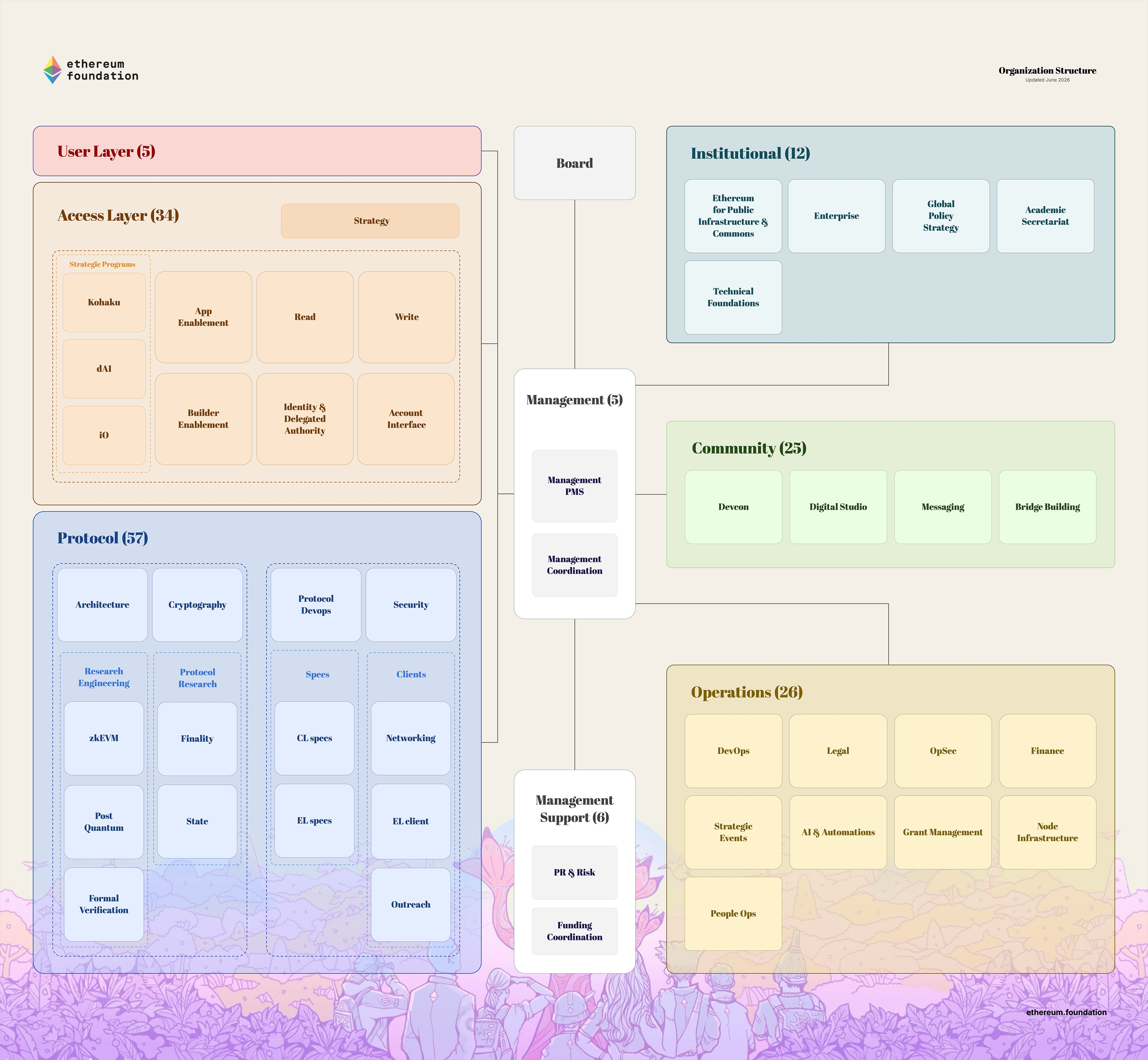
Schematic diagram of the new EF structure

The Dissolution of EF's Protocol Support Department Marks a Key Sign of EF's Organizational Split

It's worth mentioning that the work of EF's Protocol Support department leaned towards infrastructure construction, mainly responsible for coordinating the Ethereum protocol development process, including organizing and coordinating core developer meetings, tracking Ethereum network upgrades, supporting EIP advancement, and running the Ethereum protocol. Now, its main functions have been allocated to the protocol layer part of EF.

Coincidentally, on the same day EF announced its new structure, Ethlabs, a non-profit R&D lab co-founded by five former EF researchers, was officially announced. This organization aims to advance Ethereum as a settlement layer for the global economy and has received support from a series of investment institutions, Ethereum ecosystem projects, independent individuals, and EF foundation members, including Ethereum co-founder Joe Lubin (Chairman of Sharplink, founder of Consensys), ETH treasury company BitMine (Tom Lee's Ethereum treasury company), Sharplink, and crypto investment firm SNZ.

ETHLabs Community Participant List (Source: Official Account)

On July 1st, Ethereum Institutional, co-founded by former EF members David Walsh, Marius Smith, and Matthew Dawson, was officially unveiled.

This organization's main concept is "the institutional finance application plan for Ethereum," dedicated to promoting the institutionalization and institutional-grade application of Ethereum, its secondary nodes, applications, and the entire ecosystem. The organization also emphasizes collaboration with Ethlabs, Etherealize, and the Enterprise Ethereum Alliance, taking charge of institutional demand connection and explaining Ethereum's value proposition to banks; Ethlabs focuses on translating related demands into technical products. As a non-profit independent institution, Ethereum Institutional will provide free Ethereum application-related consulting to banks and asset management companies.

A week later, Ethereum Institutional announced the start of core team recruitment. In the coming weeks, the focus will be on hiring roles such as Institutional Business Development (Institutional GTM), Marketing & Community Operations, as well as technical positions like Solution Architect and Technical Project Lead.

Thus, the EF layoff storm officially concluded with the emergence of two major non-profit independent organizations and the dissolution of the Protocol Support department, drawing an imperfect full stop to the "internal organizational transformation" personally promoted by Vitalik last year. Beyond organizational-level fragmentation and the loss of high-level talent like Executive Director Wang Xiaowei, EF also faces the impact of AI technology.

The Era of AI Offense and Defense Begins, EF Security Team Upgrades Testing

Yesterday, researchers from the EF Protocol Security Team stated in a blog post that they have deployed a series of AI agents to test software relied upon by the Ethereum ecosystem, searching for vulnerabilities in cryptographic systems, protocol code, and smart contracts.

The vulnerabilities discovered by the AI agents include a remotely triggerable panic issue in the libp2p gossipsub peer-to-peer layer used by Ethereum consensus clients. This issue has been fixed and disclosed on GitHub as CVE-2026-34219.

The researchers stated that the AI agents were organized into specialized roles such as reconnaissance, search, patching, and verification, used to find potential attack paths, reproduce failures, and verify their applicability to production code. EF stated that AI has not replaced security researchers but has changed the way they work, enabling the team to cover a far greater scope than manual review. However, it requires researchers to make more cautious judgments on a large number of seemingly credible conclusions.

Considering today's news of the official launch of the GPT-5.6 model, subsequent maintenance of Ethereum protocol security may be jointly handled by AI models and EF security researchers. Moreover, although EF now mentions "AI has not replaced researchers," with the continuous development and evolution of AI models, personnel within the EF security team and perhaps the entire organization may be further reduced in the future. In other words, EF will also face the test of AI models on its organizational structure and the execution of its own functions.

Summary: EF Organizational Transformation Reaches a Staged Conclusion, May Become an Ecosystem Mascot in the Future?

In January of last year, we provided a systematic analysis of EF's organizational transformation in the article "Vitalik Fires the First Shot of 'Reform,' Where is the Ethereum Foundation Headed?" Back then, Vitalik was ambitiously and forcefully pushing for EF organizational change. In May this year, after more than a year of organizational innovation, Vitalik's tune changed, stating that "the Ethereum Foundation should not be the center of the ETH ecosystem and will shift towards a smaller, long-termism route."

It must be said that after ETH has grown into an asset with a market cap in the hundreds of billions, EF, the official ecosystem organization founded nearly a decade ago, has also entered the awkward situation of being "a large ship hard to turn." No wonder Vitalik previously even remarked—"I will no longer write regular blog posts, I have decided to try writing some science fiction on the topic of decentralized governance."

As former EF researcher and Ethlabs member Ansgar Dietrichs said on a podcast earlier this month, "After five years of failing to break through $5,000, ETH still lacks a clear value narrative."

Currently, it seems that EF is already struggling to shoulder the banner of "revitalizing the Ethereum ecosystem and driving ETH price breakthroughs." Future large-scale adoption and institutional investment may have to rely on organizations like Ethlabs, Ethereum Institutional, and Etherealize.

Perhaps, in the near future, playing the role of an "ecosystem mascot" would be more suitable for EF.

Recommended Reading

Ethereum Enters a "Mid-Life Crisis," Analyzing Development Performance from a Data Perspective

Given: ETH = Nokia, Find: Ethereum = iOS?

Ethereum Is "Sick," Are These Three Remedies Appropriate?

Where Lies the Path? A Brief Analysis of the Three Major Abstract Problems Facing the Ethereum Ecosystem Today

Enumerating the Seven Deadly Sins of Ethereum, Who Can Play Its "Salvation Oratorio"?

Where Lies the Orthodoxy of Ethereum? A Detailed Explanation of the "Cryptocurrency Masterpiece" in Vitalik's Heart

Ethereum's Tenth Anniversary: Revisiting ETH's Change of Ownership Journey, The Resurgence of Token Centralization

Are L2s a Detour for Ethereum?

Bankless Founder Liquidates ETH Holdings, Collective Disillusionment with Ethereum Faith

Criptos en tendencia

Preguntas relacionadas

QWhat was the major announcement regarding the Ethereum Foundation's Protocol Support Team, and why is it significant?

AThe Ethereum Foundation's Protocol Support Team has officially disbanded. This is significant as it represents the largest round of layoffs in the EF's history, affecting 20% of its staff, and is seen as a major indicator of the organization's internal restructuring and fragmentation.

QWhat are two new non-profit independent organizations that emerged following the Ethereum Foundation's restructuring?

ATwo new non-profit independent organizations that emerged are Ethlabs, founded by five former EF researchers, and Ethereum Institutional, co-founded by former EF members. These organizations aim to take over functions related to R&D and institutional adoption of Ethereum, respectively.

QHow is the Ethereum Foundation's security team incorporating AI technology into its work?

AThe EF's security team has deployed a series of AI agents to test Ethereum's ecosystem software. These AI agents are organized into specialized roles to find potential attack paths, identify vulnerabilities (such as the CVE-2026-34219 issue), and verify fixes. The team states AI augments rather than replaces researchers, allowing them to cover much more ground.

QAccording to the article, what is one of the major criticisms faced by the Ethereum Foundation from within the community?

AOne major criticism from within the community is directed at the EF's perceived rigid structure, decision-making by a small group, questions about its organizational value, and its market-influencing ETH sell-offs. Bankless founder David Hoffman's public criticism and divestment from ETH is cited as an example of this discontent.

QWhat future role does the article suggest might be most suitable for the Ethereum Foundation?

AThe article suggests that, given its challenges in driving large-scale adoption and ETH price growth, the Ethereum Foundation's most suitable future role might be that of an 'ecological mascot' or a symbolic figurehead, while newer organizations lead practical development and institutional outreach.

Lecturas Relacionadas

WEEX TradFi Trading Competition Kicks Off, 50,000 USDT Prize Pool First-Come, First-Served, Open a Position and Get 5 U

WEEX Exchange Launches "TradFi Trading Competition" with a 50,000 USDT Prize Pool Amidst a crypto market downturn, WEEX Exchange highlights the growth of tokenized traditional finance (TradFi) assets as a key trend, allowing users to trade stocks, ETFs, and commodities using crypto. The platform has launched a "TradFi Trading Competition" from July 9th to 23rd, featuring a 50,000 USDT prize pool. The campaign offers three reward tiers: 1. **New User Bonus (25,000 USDT pool):** New users depositing ≥100 USDT, completing a specified spot trade, and one TradFi contract trade (margin ≥10 USDT) receive 200 USDT. 2. **Volume-Based Rewards (20,000 USDT pool):** All users can earn tiered bonuses for achieving TradFi contract trading volumes of 5,000 USDT (3 USDT), 20,000 USDT (10 USDT), and 100,000 USDT (50 USDT). Rewards are stackable. 3. **Participation Reward:** Any user opening a TradFi contract trade during the event receives 5 USDT instantly. The article promotes WEEX's TradFi features, which include trading tokenized shares of companies like NVIDIA and Tesla using USDT, 24/7 trading, fractional share investing starting from $5, and high leverage up to 100x for hedging. It positions these features as solutions to traditional investing barriers like high fees, strict trading hours, and high share prices. The summary concludes by encouraging users to join the competition and leverage WEEX's platform to access global TradFi markets.

marsbitHace 1 hora(s)

WEEX TradFi Trading Competition Kicks Off, 50,000 USDT Prize Pool First-Come, First-Served, Open a Position and Get 5 U

marsbitHace 1 hora(s)

Switching Chains for Another Shot at Success: Can It Really 'Change One's Destiny'?

Recent months have witnessed a wave of established blockchain projects migrating to new public chains, notably Base and Arbitrum, coupled with strategic pivots in their business models—essentially "re-starting" elsewhere. Examples include Sophon (moving from ZKsync to Base to cut $3M+ annual costs and focus on consumer apps), Moonbeam (shifting from Polkadot to Base to pursue decentralized AI), and Secret Network (planning a move from Cosmos to Arbitrum to explore privacy-AI integrations, though its token price plunged 30% post-announcement). A common thread is that these migrating projects are primarily layer-1 or layer-2 chains now seeking relevance in AI and real-world consumer applications. This trend highlights the relative stagnation of ecosystems like Polkadot and Cosmos, which are seeing significant outflows. However, the community remains skeptical about whether such chain-hopping truly enables a turnaround. Historical cases like y00ts NFTs (which moved from Solana to Polygon and back to Ethereum) and Synthetix (which retreated from a multi-chain strategy) show that migration often fails to deliver expected benefits and can add complexity. In today's more rational market, devoid of easy narrative or airdrop红利, simply changing chains is unlikely to be a silver bullet. For both migrating projects and destination chains, the real challenge lies not in attracting projects but in developing actual use cases that retain users.

marsbitHace 1 hora(s)

Switching Chains for Another Shot at Success: Can It Really 'Change One's Destiny'?

marsbitHace 1 hora(s)

Trading

Spot

Artículos destacados

Qué es ETH 2.0

ETH 2.0: Una Nueva Era para Ethereum Introducción ETH 2.0, conocido ampliamente como Ethereum 2.0, marca una actualización monumental para la blockchain de Ethereum. Esta transición no es solo una mejora superficial; busca mejorar fundamentalmente la escalabilidad, seguridad y sostenibilidad de la red. Con un cambio del mecanismo de consenso intensivo en energía Prueba de Trabajo (PoW) a una Prueba de Participación (PoS) más eficiente, ETH 2.0 promete un enfoque transformador para el ecosistema blockchain. ¿Qué es ETH 2.0? ETH 2.0 es un conjunto de actualizaciones interconectadas y distintivas centradas en optimizar las capacidades y el rendimiento de Ethereum. La reestructuración está diseñada para abordar desafíos críticos que el mecanismo actual de Ethereum ha enfrentado, particularmente en lo que respecta a la velocidad de transacción y la congestión de la red. Objetivos de ETH 2.0 Los objetivos principales de ETH 2.0 giran en torno a mejorar tres aspectos clave: Escalabilidad: Con el objetivo de aumentar significativamente el número de transacciones que la red puede manejar por segundo, ETH 2.0 busca superar la limitación actual de aproximadamente 15 transacciones por segundo, potencialmente alcanzando miles. Seguridad: Las medidas de seguridad mejoradas son fundamentales para ETH 2.0, particularmente a través de una mejor resistencia contra ciberataques y la preservación del ethos descentralizado de Ethereum. Sostenibilidad: El nuevo mecanismo PoS está diseñado no solo para mejorar la eficiencia, sino también para reducir drásticamente el consumo de energía, alineando el marco operativo de Ethereum con consideraciones ambientales. ¿Quién es el Creador de ETH 2.0? La creación de ETH 2.0 se puede atribuir a la Fundación Ethereum. Esta organización sin fines de lucro, que desempeña un papel crucial en el apoyo al desarrollo de Ethereum, es liderada por el notable cofundador Vitalik Buterin. Su visión de un Ethereum más escalable y sostenible ha sido la fuerza motriz detrás de esta actualización, involucrando contribuciones de una comunidad global de desarrolladores y entusiastas dedicados a mejorar el protocolo. ¿Quiénes son los Inversores de ETH 2.0? Si bien los detalles sobre los inversores de ETH 2.0 no se han hecho públicos, se sabe que la Fundación Ethereum recibe apoyo de varias organizaciones e individuos en el ámbito de blockchain y tecnología. Estos socios incluyen firmas de capital de riesgo, compañías tecnológicas y organizaciones filantrópicas que comparten un interés mutuo en apoyar el desarrollo de tecnologías descentralizadas e infraestructura blockchain. ¿Cómo Funciona ETH 2.0? ETH 2.0 se distingue por introducir una serie de características clave que lo diferencian de su predecesor. Prueba de Participación (PoS) La transición a un mecanismo de consenso PoS es uno de los cambios más destacados de ETH 2.0. A diferencia de PoW, que se basa en la minería intensiva en energía para la verificación de transacciones, PoS permite a los usuarios validar transacciones y crear nuevos bloques de acuerdo con la cantidad de ETH que apuestan en la red. Esto conduce a una mayor eficiencia energética, reduciendo el consumo en aproximadamente un 99.95%, convirtiendo a Ethereum 2.0 en una alternativa considerablemente más verde. Cadenas Shard Las cadenas shard son otra innovación crítica de ETH 2.0. Estas cadenas más pequeñas operan en paralelo con la cadena principal de Ethereum, lo que permite que múltiples transacciones sean procesadas simultáneamente. Este enfoque mejora la capacidad general de la red, abordando las preocupaciones de escalabilidad que han afectado a Ethereum. Cadena Beacon En el núcleo de ETH 2.0 se encuentra la Cadena Beacon, que coordina la red y gestiona el protocolo PoS. Funciona como un organizador de cierta manera: supervisa a los validadores, asegura que los shards permanezcan conectados a la red y monitorea la salud general del ecosistema blockchain. Cronología de ETH 2.0 El viaje de ETH 2.0 ha estado marcado por varios hitos clave que trazan la evolución de esta importante actualización: Diciembre 2020: El lanzamiento de la Cadena Beacon marcó la introducción de PoS, preparándose para la migración hacia ETH 2.0. Septiembre 2022: La finalización de “La Fusión” representa un momento crucial en el que la red Ethereum se trasladó exitosamente de un marco PoW a uno PoS, anunciando una nueva era para Ethereum. 2023: El lanzamiento esperado de cadenas shard tiene como objetivo mejorar aún más la escalabilidad de la red Ethereum, consolidando a ETH 2.0 como una plataforma robusta para aplicaciones y servicios descentralizados. Características Clave y Beneficios Escalabilidad Mejorada Una de las ventajas más significativas de ETH 2.0 es su escalabilidad mejorada. La combinación de PoS y cadenas shard permite que la red expanda su capacidad, permitiendo acomodar un volumen mucho mayor de transacciones en comparación con el sistema heredado. Eficiencia Energética La implementación de PoS representa un gran paso hacia la eficiencia energética en la tecnología blockchain. Al reducir drásticamente el consumo de energía, ETH 2.0 no solo disminuye los costos operativos, sino que también se alinea más estrechamente con los objetivos de sostenibilidad global. Seguridad Mejorada Los mecanismos actualizados de ETH 2.0 contribuyen a mejorar la seguridad en toda la red. El despliegue de PoS, junto con las medidas de control innovadoras establecidas a través de cadenas shard y la Cadena Beacon, asegura un mayor grado de protección contra posibles amenazas. Costos Más Bajos para los Usuarios A medida que la escalabilidad mejora, los efectos sobre los costos de transacción también serán evidentes. Se espera que una mayor capacidad y una menor congestión se traduzcan en tarifas más bajas para los usuarios, haciendo que Ethereum sea más accesible para transacciones cotidianas. Conclusión ETH 2.0 marca una evolución significativa en el ecosistema blockchain de Ethereum. A medida que aborda problemas fundamentales como la escalabilidad, el consumo de energía, la eficiencia en las transacciones y la seguridad general, la importancia de esta actualización no puede ser subestimada. La transición a la Prueba de Participación, la introducción de cadenas shard y el trabajo fundamental de la Cadena Beacon son indicativos de un futuro donde Ethereum puede satisfacer las crecientes demandas del mercado descentralizado. En una industria impulsada por la innovación y el progreso, ETH 2.0 se erige como un testimonio de las capacidades de la tecnología blockchain para allanar el camino hacia una economía digital más sostenible y eficiente.

191 Vistas totalesPublicado en 2024.04.04Actualizado en 2024.12.03

Qué es ETH 2.0

Qué es ETH 3.0

ETH3.0 y $eth 3.0: Un Examen Profundo del Futuro de Ethereum Introducción En el paisaje en rápida evolución de las criptomonedas y la tecnología blockchain, ETH3.0, a menudo denotado como $eth 3.0, ha surgido como un tema de considerable interés y especulación. El término abarca dos conceptos principales que merecen aclaración: Ethereum 3.0: Esto representa una posible actualización futura destinada a aumentar las capacidades de la blockchain existente de Ethereum, enfocándose particularmente en mejorar la escalabilidad y el rendimiento. ETH3.0 Meme Token: Este proyecto de criptomoneda distinto busca aprovechar la blockchain de Ethereum para crear un ecosistema centrado en memes, promoviendo la participación dentro de la comunidad de criptomonedas. Comprender estos aspectos de ETH3.0 es esencial no solo para los entusiastas de las criptomonedas, sino también para aquellos que observan tendencias tecnológicas más amplias en el espacio digital. ¿Qué es ETH3.0? Ethereum 3.0 Ethereum 3.0 se presenta como una actualización propuesta para la red de Ethereum ya establecida, que ha sido la columna vertebral de muchas aplicaciones descentralizadas (dApps) y contratos inteligentes desde su inicio. Las mejoras previstas se concentran principalmente en la escalabilidad, integrando tecnologías avanzadas como sharding y pruebas de conocimiento cero (zk-proofs). Estas innovaciones tecnológicas tienen como objetivo facilitar un número sin precedentes de transacciones por segundo (TPS), potencialmente alcanzando millones, abordando así una de las limitaciones más significativas que enfrenta la tecnología blockchain actual. La mejora no es meramente técnica, sino también estratégica; está destinada a preparar la red de Ethereum para su adopción generalizada y utilidad en un futuro marcado por una mayor demanda de soluciones descentralizadas. ETH3.0 Meme Token En contraste con Ethereum 3.0, el ETH3.0 Meme Token se aventura en un ámbito más ligero y juguetón al combinar la cultura de memes de internet con la dinámica de las criptomonedas. Este proyecto permite a los usuarios comprar, vender e intercambiar memes en la blockchain de Ethereum, proporcionando una plataforma que fomenta la participación comunitaria a través de la creatividad y los intereses compartidos. El ETH3.0 Meme Token tiene como objetivo demostrar cómo la tecnología blockchain puede intersectarse con la cultura digital, creando casos de uso que son tanto entretenidos como financieramente viables. ¿Quién es el Creador de ETH3.0? Ethereum 3.0 La iniciativa hacia Ethereum 3.0 es impulsada principalmente por un consorcio de desarrolladores e investigadores dentro de la comunidad de Ethereum, incluyendo notablemente a Justin Drake. Conocido por sus ideas y contribuciones a la evolución de Ethereum, Drake ha sido una figura prominente en las discusiones sobre la transición de Ethereum a una nueva capa de consenso, denominada “Beam Chain.” Este enfoque colaborativo para el desarrollo significa que Ethereum 3.0 no es el producto de un creador singular, sino más bien una manifestación de ingenio colectivo centrado en avanzar la tecnología blockchain. ETH3.0 Meme Token Los detalles sobre el creador del ETH3.0 Meme Token son actualmente inidentificables. La naturaleza de los tokens de memes a menudo conduce a una estructura más descentralizada y dirigida por la comunidad, lo que podría explicar la falta de atribución específica. Esto se alinea con la ética de la comunidad cripto más amplia, donde la innovación a menudo surge de esfuerzos colaborativos en lugar de individuales. ¿Quiénes son los Inversores de ETH3.0? Ethereum 3.0 El apoyo a Ethereum 3.0 proviene principalmente de la Fundación Ethereum junto con una entusiasta comunidad de desarrolladores e inversores. Esta asociación fundamental proporciona un grado significativo de legitimidad y mejora la perspectiva de una implementación exitosa, ya que aprovecha la confianza y credibilidad construidas a lo largo de años de operaciones en la red. En el clima cambiando rápidamente de las criptomonedas, el apoyo de la comunidad juega un papel crucial en impulsar el desarrollo y la adopción, posicionando a Ethereum 3.0 como un contendiente serio para futuros avances en blockchain. ETH3.0 Meme Token Si bien las fuentes actualmente disponibles no proporcionan información explícita sobre las fundaciones o organizaciones de inversión que respaldan el ETH3.0 Meme Token, es indicativo del modelo de financiamiento típico para tokens de memes, que a menudo depende del apoyo de base y la participación comunitaria. Los inversores en tales proyectos suelen consistir en individuos motivados por el potencial de innovación impulsada por la comunidad y el espíritu de cooperación que se encuentra dentro de la comunidad cripto. ¿Cómo Funciona ETH3.0? Ethereum 3.0 Las características distintivas de Ethereum 3.0 radican en su implementación propuesta de sharding y tecnología zk-proof. Sharding es un método de particionamiento de la blockchain en piezas más pequeñas y manejables o “shards,” que pueden procesar transacciones de manera concurrente en lugar de secuencial. Esta descentralización del procesamiento ayuda a prevenir la congestión y asegura que la red permanezca receptiva incluso bajo una carga pesada. La tecnología de prueba de conocimiento cero (zk-proof) contribuye con otra capa de sofisticación al permitir la validación de transacciones sin revelar los datos subyacentes involucrados. Este aspecto no solo mejora la privacidad, sino que también aumenta la eficiencia general de la red. También se habla de incorporar una Máquina Virtual de Ethereum de conocimiento cero (zkEVM) en esta actualización, amplificando aún más las capacidades y utilidad de la red. ETH3.0 Meme Token El ETH3.0 Meme Token se distingue al capitalizar la popularidad de la cultura de memes. Establece un mercado para que los usuarios participen en el comercio de memes, no solo por entretenimiento sino también por el posible beneficio económico. Al integrar características como staking, provisión de liquidez y mecanismos de gobernanza, el proyecto fomenta un entorno que incentiva la interacción y participación de la comunidad. Al ofrecer una mezcla única de entretenimiento y oportunidad económica, el ETH3.0 Meme Token tiene como objetivo atraer a una audiencia diversa, que abarca desde entusiastas de las criptomonedas hasta conocedores casuales de memes. Línea de Tiempo de ETH3.0 Ethereum 3.0 11 de noviembre de 2024: Justin Drake insinúa la próxima actualización de ETH 3.0, centrada en mejoras de escalabilidad. Este anuncio significa el comienzo de las discusiones formales sobre la futura arquitectura de Ethereum. 12 de noviembre de 2024: Se espera que la propuesta anticipada para Ethereum 3.0 se desvele en Devcon en Bangkok, preparando el escenario para una mayor retroalimentación de la comunidad y posibles próximos pasos en el desarrollo. ETH3.0 Meme Token 21 de marzo de 2024: El ETH3.0 Meme Token se lista oficialmente en CoinMarketCap, marcando su incursión en el dominio público de las criptomonedas y mejorando la visibilidad de su ecosistema basado en memes. Puntos Clave En conclusión, Ethereum 3.0 representa una evolución significativa dentro de la red de Ethereum, enfocándose en superar las limitaciones en términos de escalabilidad y rendimiento a través de tecnologías avanzadas. Sus actualizaciones propuestas reflejan un enfoque proactivo hacia las demandas y la usabilidad futura. Por otro lado, el ETH3.0 Meme Token encapsula la esencia de la cultura impulsada por la comunidad en el espacio de las criptomonedas, aprovechando la cultura de memes para crear plataformas atractivas que fomentan la creatividad y participación del usuario. Comprender los distintos propósitos y funcionalidades de ETH3.0 y $eth 3.0 es fundamental para cualquiera interesado en los desarrollos en curso dentro del espacio cripto. Con ambas iniciativas abriendo caminos únicos, subrayan colectivamente la naturaleza dinámica y multifacética de la innovación en blockchain.

214 Vistas totalesPublicado en 2024.04.04Actualizado en 2024.12.03

Qué es ETH 3.0

Cómo comprar ETH

¡Bienvenido a HTX.com! Hemos hecho que comprar Ethereum (ETH) sea simple y conveniente. Sigue nuestra guía paso a paso para iniciar tu viaje de criptos.Paso 1: crea tu cuenta HTXUtiliza tu correo electrónico o número de teléfono para registrarte y obtener una cuenta gratuita en HTX. Experimenta un proceso de registro sin complicaciones y desbloquea todas las funciones.Obtener mi cuentaPaso 2: ve a Comprar cripto y elige tu método de pagoTarjeta de crédito/débito: usa tu Visa o Mastercard para comprar Ethereum (ETH) al instante.Saldo: utiliza fondos del saldo de tu cuenta HTX para tradear sin problemas.Terceros: hemos agregado métodos de pago populares como Google Pay y Apple Pay para mejorar la comodidad.P2P: tradear directamente con otros usuarios en HTX.Over-the-Counter (OTC): ofrecemos servicios personalizados y tipos de cambio competitivos para los traders.Paso 3: guarda tu Ethereum (ETH)Después de comprar tu Ethereum (ETH), guárdalo en tu cuenta HTX. Alternativamente, puedes enviarlo a otro lugar mediante transferencia blockchain o utilizarlo para tradear otras criptomonedas.Paso 4: tradear Ethereum (ETH)Tradear fácilmente con Ethereum (ETH) en HTX's mercado spot. Simplemente accede a tu cuenta, selecciona tu par de trading, ejecuta tus trades y monitorea en tiempo real. Ofrecemos una experiencia fácil de usar tanto para principiantes como para traders experimentados.

4.3k Vistas totalesPublicado en 2024.12.10Actualizado en 2026.06.02

Cómo comprar ETH

Discusiones

Bienvenido a la comunidad de HTX. Aquí puedes mantenerte informado sobre los últimos desarrollos de la plataforma y acceder a análisis profesionales del mercado. A continuación se presentan las opiniones de los usuarios sobre el precio de ETH (ETH).

活动图片