In the Name of Charity, For the Benefit of the Family: How the Trump Family Turns Philanthropy into Profit?

marsbitPublicado a 2026-06-17Actualizado a 2026-06-17

Resumen

Charity for Profit: How the Trump Family Turned Philanthropy into Personal Gain Amid a recent controversy over misleading claims about his cryptocurrency company American Bitcoin, Eric Trump invoked his children's cancer charity as evidence of his good intentions. While his Curetivity foundation (formerly the Eric Trump Foundation) has donated over $25 million to St. Jude Children's Research Hospital, an investigation reveals a pattern of self-dealing and opaque practices that benefited the Trump family business. Internal documents show that from 2011 to 2016, over $500,000 from the charity was funneled back to Trump-owned properties for event costs, transactions often omitted from tax filings. This created clear conflicts of interest, with figures like former club manager and current White House aide Dan Scavino involved on both sides. Public claims of "one of the lowest expense ratios" were contradicted by records showing significant spending on entertainment, auctions, and transportation. Facing scrutiny in 2017, Eric Trump distanced himself from the board and rebranded the foundation. After a state investigation shifted focus to compliance rather than enforcement, he returned as the public face. Fundraising events, now less transparent, continue at Trump venues. Estimates suggest these events have directed over $1 million to the Trump Organization over two decades. The same playbook of optimistic claims and obscured financial realities is now evident in Eric Trump's r...

Author: Chloe, ChainCatcher

Last month, just hours before attending a state banquet with King Charles III, Donald Trump's second son, Eric Trump, posted a five-paragraph defense on X. The trigger was a controversy surrounding a company under his name: he had been telling investors that the publicly traded cryptocurrency company "American Bitcoin," in which he was involved, could mine Bitcoin at about half the market price, a claim debunked by a Forbes report.

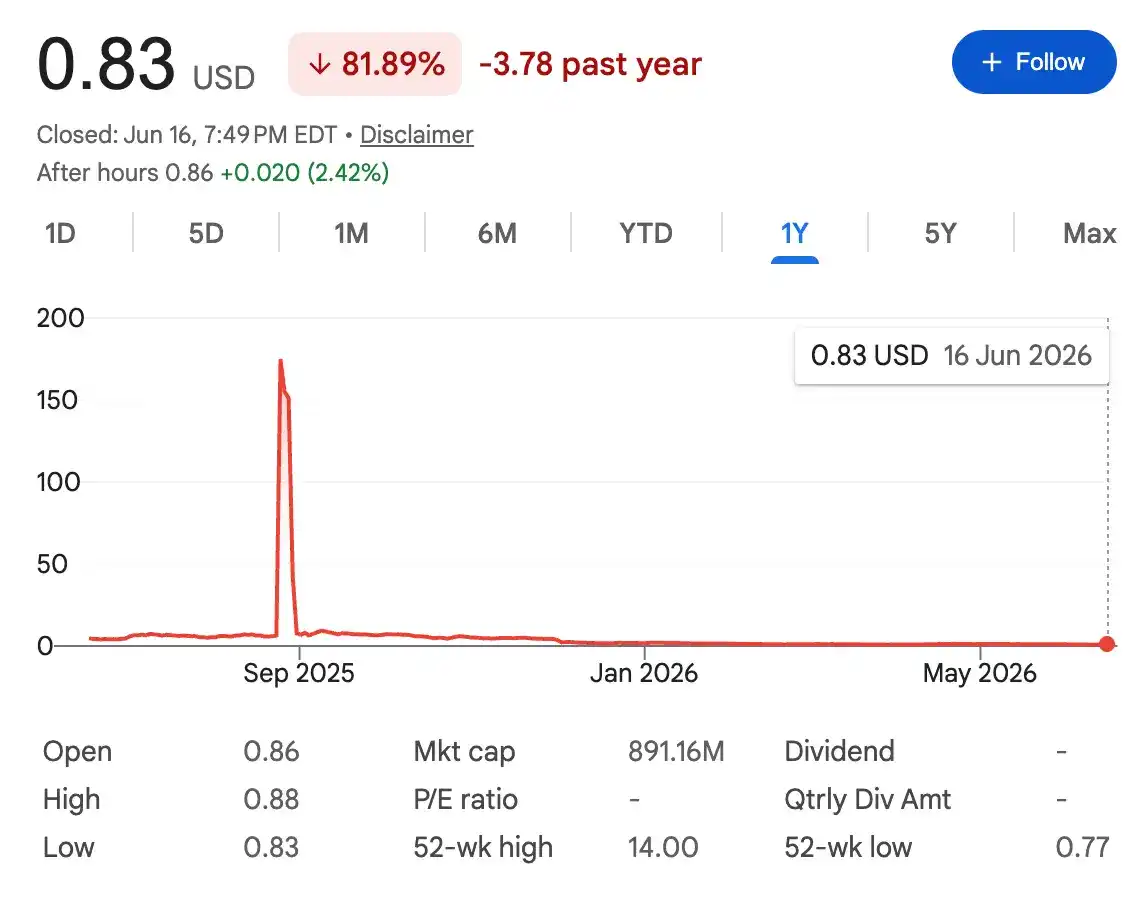
As of June 17, 2026, the stock price of American Bitcoin (Nasdaq: ABTC) had fallen to about $0.83, a crash of about 90% from its peak of around $175 last year and its IPO price of $14.
Then, in his post, Eric pivoted to another matter that has weighed on him for nearly a decade: a 2017 Forbes investigation into the children's cancer charity foundation he founded. He wrote that the attacks were "madness," portraying his younger self as simply a young man "dedicated to saving dying children."

There's no denying he did some good. Over the years, this foundation has donated over $25 million to St. Jude Children's Research Hospital in Tennessee. Its operations were streamlined, focusing on fundraising while leaving the complex execution to others. However, its other side revealed misleading rhetoric, sloppy accounting, a board entangled in conflicts of interest, and unabashed loyalty to Trump—and the same tactics are now appearing in the crypto industry.

The Trump Family Always Emerges Unscathed from Scandals

Through Freedom of Information Act requests, Forbes obtained thousands of pages of documents. They revealed that between 2011 and 2016, his foundation directed at least $500,000 in charitable funds back into family businesses through a series of transactions, most of which never appeared on tax filings.

These files also explain why the Trump family always gets away. Their playbook: first, counterattack loudly on TV or social media; then, use lawyers to bury paper trails; next, adjust practices just enough to satisfy regulators and avoid punishment, while changing nothing substantial. Once the dust settles, they re-emerge unabashedly as victims, asking the public for trust again—and there are always plenty willing to believe.

Eric's foundation is a case study of this script from start to finish. Nine years after the scandal, the renamed entity is still operating, expanding its fundraising year by year, spending over $500,000 annually, and holding events almost exclusively at Trump-branded venues.

Conflicts of Interest Were Obvious, Even the White House Was Involved

The foundation's origin was indeed well-intentioned. It began with Eric and his wealthy friends wanting to do good. The 2007 IRS application even stated, "Our family owns three golf courses in New York and New Jersey that can be used." It promised not to sign leases with any company controlled by its leaders. For the first three years, it held true, spending about $50,000 annually and raising hundreds of thousands.

But starting in 2010, Trump Organization employees joined the board, and expenses surged to $142,000 the following year. Former club manager Ian Gillule pointed the finger directly at Trump himself: In the early days, the foundation used venues for free, and bills often vanished. Trump was displeased, not with "helping for free," but with donating so much without leaving any paper trail or credit. He ordered that everyone, including his own son, be charged.

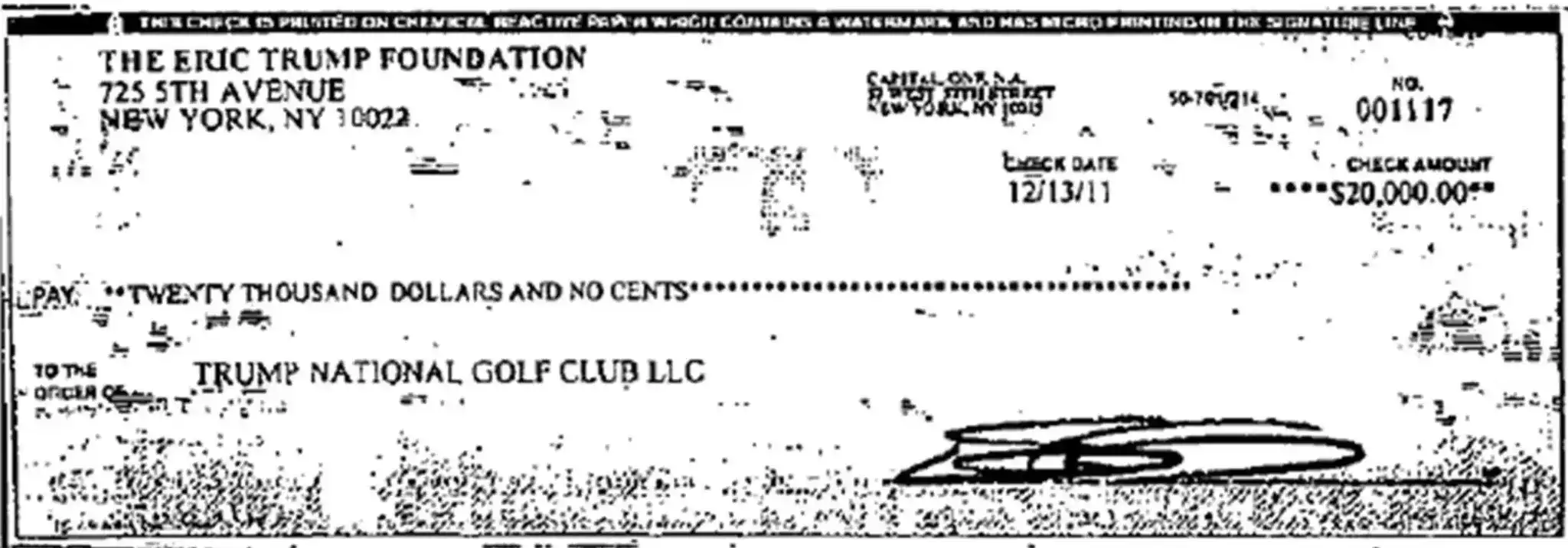
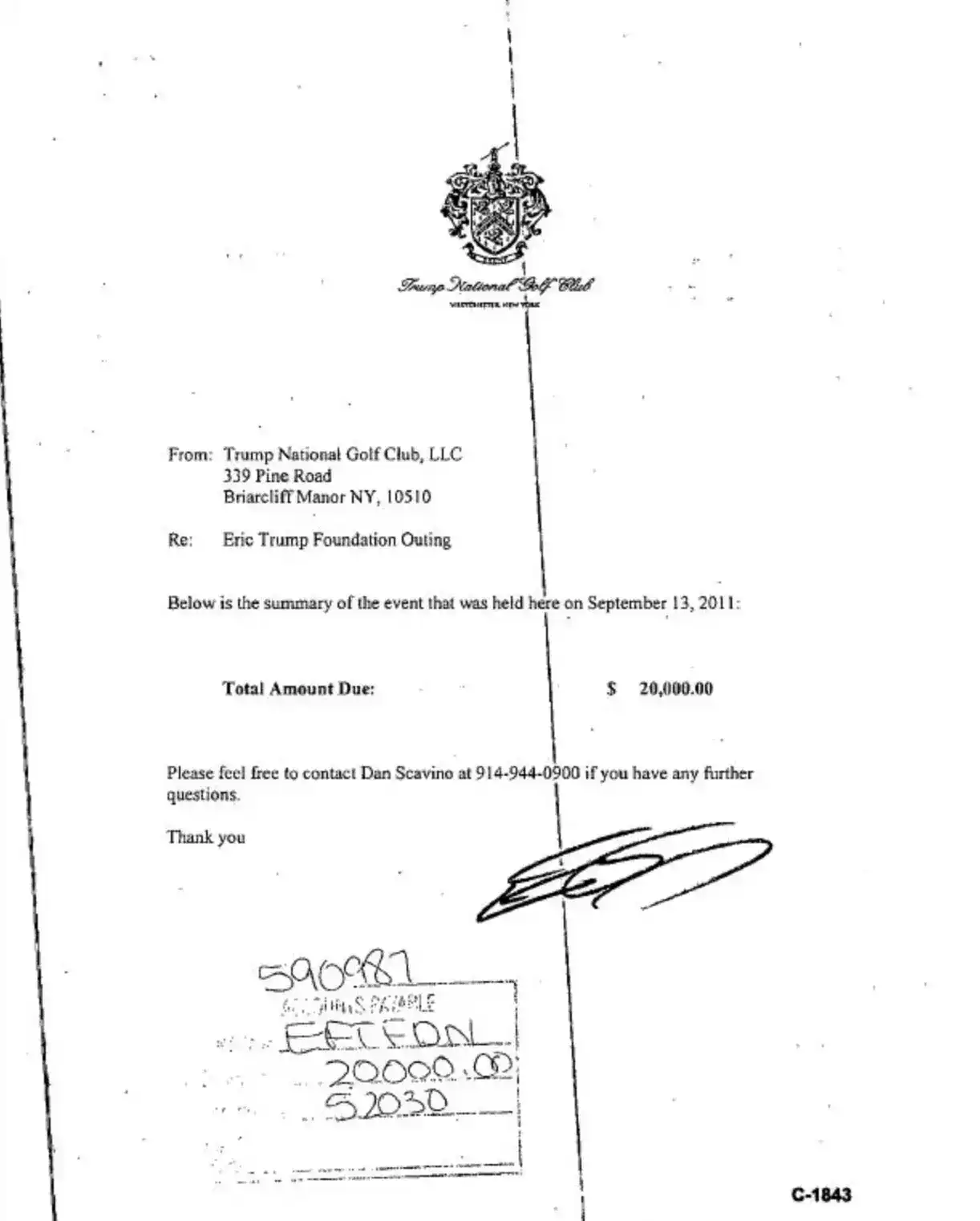
So, everyone got charged. After a 2011 event, Trump National Golf Club billed the foundation $20,000. A copy obtained by Forbes bore a note: "For questions, call Dan Scavino." The conflict of interest was glaring. Dan Scavino, now White House Deputy Chief of Staff, was then both the club's general manager and a foundation board member. The invoice bore Eric's signature at the bottom, though it's unclear in which capacity he signed. Bills kept coming: the club charged $100,000 in 2013, $99,000 in 2016, with Trump Soho Hotel and Mar-a-Lago also getting a cut.
Poisonous Candy Wrapped in Pretty Sugar

"Dear friends," Eric wrote in the 2014 gala program, the foundation has "one of the lowest expense ratios in the world," insisting on using only Trump-owned venues, full-time volunteers, donated catering, and celebrities performing for free, so that St. Jude received nearly all the funds.

But the books didn't match the rhetoric. The gala featured Hooters waitresses and mini Eric bobblehead dolls. Performers were mostly celebrities from "The Celebrity Apprentice." "They all performed for free," Eric claimed, yet he personally signed performance fee checks exceeding $90,000. Auction items "were all donated," but the foundation spent at least $65,000 procuring them. In 2012, it even bought an item for $6,040 that sold for only $3,310. Transportation was another expense, with Sunny's alone charging over $35,000.

Additionally, hundreds of thousands went to other charities, some with ties more direct to family interests than to childhood cancer; at least three also held fundraisers at Trump golf courses. In 2013, Eric even spent $1,600 of foundation money to buy a decorative copper still and an antique bottle washer near his family's winery. Of course, the foundation did donate large sums to St. Jude, from $220,000 in 2007 to $2.9 million in 2016, the year Trump was first elected.

Eric as Victim, Feeling 'No Good Deed Goes Unpunished'

Politics soon thrust the foundation into the spotlight. In late 2016, the Daily Beast and AP exposed its dealings with Trump clubs. The New York Times reported that an investment manager bid nearly $60,000 at a fundraiser auction just for coffee with Ivanka Trump. The problem wasn't just PR: under New York State and federal law, such related-party transactions required board votes, documentation, and disclosure on tax forms.

So, Eric decided to restructure, distancing it from the family: all Trump Organization employees left the board, including himself. He said his father's administration required avoiding "perception problems," so he wouldn't personally fundraise until after the term. The foundation was renamed Curetivity, pledging all donations would go to St. Jude. On the surface, it seemed a return to the original intent. But Eric remained defiant, telling Forbes a month after the board changes, "We get the use of the best facilities in the world 100% free of charge, which is why our expense ratio is the lowest in history."

The day the article was published, he went on Fox News, framing the scrutiny as a political witch hunt and casting himself as the victim. "I raised tens of millions of dollars and got hate in return."

Two days later, the Attorney General's office sent a letter requesting the books. The investigation hurt the foundation: donations in 2017 plummeted by over two-thirds, falling below $1 million, while administrative and legal expenses soared from nearly zero to about $50,000 annually. At year's end, the AG wrote again, highlighting multiple issues: financial reports not conforming to accounting standards, ignoring related-party transaction rules, misleading marketing, and threatening to revoke its fundraising license.

Thereafter, the accounts grew increasingly opaque. After Eric left the board, the occasional "related-party transaction" notes disappeared. The "rent/venue fees" line was consistently left blank. Fundraising expenses dropped from $384,000 in 2016 to $111,000 in 2017. By the end of 2018, when the AG's office indicated the investigation was shifting towards compliance rather than enforcement, Eric re-emerged in promotional materials, eventually being credited as the "founder" of Curetivity. Fundraising expenses rebounded, hitting a new high of $392,000 in 2019. How much flowed back to the Trump Organization became impossible to discern from the murky accounts.

Today, fundraisers continue to be held one after another at Trump-branded venues: in 2020 at Mar-a-Lago, costing $309,000; in recent years at Trump golf courses in North Carolina and Jupiter, Florida. If the fees are similar to the past, Curetivity alone could bring about $200,000 annually into Trump's business empire, accumulating over a million in two decades.

The Same Playbook Moved to the Crypto Industry

This playbook of "pretty words, value flowing back to insiders" didn't stop with the charity foundation; it has now been almost entirely transplanted into American Bitcoin.

Previously, Eric packaged this company as a "money-printing machine," publicly claiming it could mine Bitcoin at a 53% discount to spot prices, with a cost per Bitcoin around $57,000. It sounded remarkably similar to the foundation's "lowest expense ratio in the world." But just like with the charity, the books didn't match up.

The investigator this time was the same Forbes reporter, Dan Alexander, who exposed the foundation nine years ago. He found that about 70% of the company's Bitcoin wasn't mined; it was acquired by constantly issuing new shares and buying them on the open market. Factoring in depreciation and overhead, the all-in cost per coin was actually close to $90,000, far above Eric's claimed $57,000.

Now, the stock price has collapsed about 90% from its late-2025 peak of around $175 and its $14 IPO price. Retail investors are estimated to have lost about $5 billion cumulatively. Financially, it's bleeding, with a net loss of about $81.8 million in Q1 2026. On the insider side, the view is completely different.

The founders initially received shares at near-zero cost. Even with the 90% stock crash, Eric's personal stake is still worth about $70 million; during the same period, his net worth is estimated to have grown to about $300 million. The aftermath script also feels familiar. Facing questions, Eric didn't directly address Forbes' calculated costs and dilution. Instead, he countered with impressive numbers like quarterly revenue growth and holding over 7,000 Bitcoins. On X, he railed against Forbes as a political weapon and a disgrace to journalism.

Last September, Eric stood at the center of a party at the Westchester Country Club, hosting the 19th Curetivity fundraiser, surrounded by several important business partners. Since his father's re-election, his net worth has exploded from an estimated $40 million in 2024 to $300 million today.


Preguntas relacionadas

QWhat were the main findings of the Forbes investigation into Eric Trump's cancer charity foundation?

AThe Forbes investigation found that between 2011 and 2016, Eric Trump's foundation funneled at least $500,000 in charitable donations back to Trump family businesses. These transactions, many of which were not disclosed on tax returns, involved paying for the use of Trump-owned venues like golf clubs and hotels for charity events. The investigation also revealed misleading statements about the foundation's low overhead, unaccounted expenses for performers and auction items, and a board riddled with conflicts of interest involving Trump Organization employees.

QHow did Eric Trump and his family typically respond to scandals, according to the article?

AAccording to the article, the Trump family's typical playbook involved a three-step response: 1) A loud public rebuttal on television or social media, 2) Using lawyers to bury paper trails and adjust practices just enough to satisfy regulators and avoid punishment without making fundamental changes, and 3) Once the scrutiny faded, presenting themselves as victims to regain public trust and continue their operations with little substantive change.

QWhat similarities does the article draw between Eric Trump's charity and his crypto company, American Bitcoin?

AThe article draws parallels in the use of misleading marketing, financial discrepancies, and the funneling of value back to insiders. Eric Trump promoted both his charity as having 'one of the lowest expense ratios in the world' and his crypto company as being able to mine Bitcoin at a 53% discount. In both cases, the financial records did not support these claims. Just as charity funds flowed to Trump properties, the crypto venture's operations benefited insiders—Eric's stake was worth tens of millions despite the company's massive losses and 90% stock price drop for public investors.

QWhat actions did Eric Trump's foundation take after coming under investigation by the New York Attorney General's office?

AAfter the investigation began in 2017, the foundation, later renamed Curetivity, took several steps: Eric Trump and all other Trump Organization employees stepped down from the board. The foundation promised all donations would go directly to St. Jude Children's Research Hospital. Financial reporting became less transparent, with categories like 'related-party transactions' disappearing. Initially, fundraising expenses dropped sharply, but they rebounded after the Attorney General's office indicated a focus on compliance over enforcement, and Eric Trump eventually resumed a prominent public role with the organization.

QWhat was the financial impact of the American Bitcoin venture on public investors and on Eric Trump personally?

AFor public investors, the venture was disastrous. The company's stock price collapsed by about 90% from its peak and IPO price, resulting in an estimated cumulative loss of approximately $5 billion for retail investors. The company was also hemorrhaging money, with an $81.8 million net loss in Q1 2026. In contrast, Eric Trump personally benefited significantly. His founders' shares, acquired at near-zero cost, were still worth an estimated $70 million despite the stock crash. His overall net worth was estimated to have risen to $300 million since his father's re-election.

Lecturas Relacionadas

The DeepSeek Fundraising Story

"The DeepSeek Funding Story: Insights from the $2.15 Billion Round" This article details behind-the-scenes narratives from DeepSeek's recent massive funding round. Key highlights include the legendary four-hour online investor meeting where CEO Liang Wenfeng, despite not being a charismatic speaker, impressed attendees with his focus on AGI and team stability. He emphasized the philosophy of "ordinary people doing extraordinary things" and a steadfast commitment to solely advancing intelligence. The fundraising process, initiated in April, saw initial demands for a minimum investment of 5 billion RMB, no syndication, and a pure RMB structure. These terms were later adjusted to a 1.5 billion RMB minimum to accommodate more investors. A notable absence was the lack of participation from major VC firms Sequoia China and Hillhouse Capital, despite early rumors, making IDG the only established VC in the final lineup. The investor list, while showing 10 entities, actually involved nearly 100 underlying institutions and individuals upon closer examination. Significant participants included Monolith Capital, which doubled its commitment to 3 billion RMB, and Zhenxingu Capital, an unexpected entrant. Liang Wenfeng's paramount condition for all investors was a strict agreement not to poach DeepSeek employees. The article reflects on DeepSeek's unexpected openness to funding and the mix of strategies—synergy, insight, brand alignment, and persistence—that secured investors a stake. The overarching sentiment among participants is one of pride and a shared belief in DeepSeek's potential to become a landmark Chinese company, driven by a profound sense of purpose in the AGI race.

marsbitHace 2 min(s)

The DeepSeek Fundraising Story

marsbitHace 2 min(s)

DAT Companies Take on Side Businesses

The article details the strategic shifts of Digital Asset Treasury (DAT) companies amid a prolonged market downturn. Initially popularized by firms like MicroStrategy, the DAT model—where companies hold cryptocurrencies on their balance sheets—has faced significant pressure as crypto ETFs eroded their investment thesis and bear markets strained finances. Key players are adapting in several ways. Some, like ETHzilla, have abandoned the model entirely. Others are pivoting towards becoming active, revenue-generating participants in the crypto ecosystem rather than passive holders. This evolution is taking two main paths: 1. **Transformation into Institutional Crypto Asset Managers:** Companies like SharpLink Gaming and GameSquare are leveraging their holdings to generate yield, moving beyond simple storage. They employ strategies like 100% ETH staking or using machine learning to optimize DeFi yields, positioning themselves as platforms offering institutional-grade crypto yield products. 2. **Becoming Blockchain Infrastructure Operators:** This is prominent in the Solana ecosystem. Firms like DeFi Development and SOL Strategies are acquiring validator businesses, issuing liquid staking tokens (e.g., dfdvSOL, fwdSOL), and integrating them into DeFi protocols. They generate fee-based revenue from these operations, building network effects. The article notes that successful转型 hinges on building operational expertise and defensible business models around crypto assets, such as technical advantages or deep ecosystem integration. However, these new paths carry risks like smart contract vulnerabilities or ecosystem dependence. Ultimately, this collective shift signals a maturation phase for the DAT movement. It highlights that in crypto, sustainable value is increasingly tied to active participation, cash flow generation, and providing real utility, rather than speculative capital allocation alone.

Foresight NewsHace 5 min(s)

DAT Companies Take on Side Businesses

Foresight NewsHace 5 min(s)

The Fate of Digital Banks: A Fancy App Can't Match a Banking License

**Title:** The Fate of Digital Banks: A Fancy App is No Match for a Banking License **Summary:** The article argues that digital-only "neobanks" have struggled to achieve profitability, with 76% still operating at a loss. Their core mistake was focusing on offering low-fee checking accounts, which generate minimal revenue from interchange fees. The fundamental profit engine of banking is **credit**—lending money and earning interest—a business largely restricted to licensed entities. Successful neobanks like **Nubank** and **Revolut** only became profitable by pivoting to become full-scale lenders, using their sleek apps as mere customer acquisition tools. Others, like **Chime**, suffered for years relying solely on transaction fees before embracing lending. The piece highlights the systemic risks of depending on third-party infrastructure, exemplified by the **Synapse** bankruptcy which froze millions in user funds. The only reliable safeguard is a **banking license**, which provides direct regulatory oversight and control over assets. This realization is now dawning in the cryptocurrency sector. Major firms like Paxos, Circle, and Crypto.com are actively seeking **national trust charters** from the OCC to legitimize their operations and escape dependency on traditional banking partners. Companies like **SoFi** have completed the evolution from fintech to licensed bank to stablecoin issuer. While DeFi has grown in secured lending, **unsecured lending** remains minuscule due to the lack of real-world identity and legal recourse for defaults on blockchain. Truly scaling credit likely requires a banking license. The conclusion is stark: despite promises of disruption, surviving digital banks have simply replicated the age-old banking model—profiting from interest on loans. A user-friendly interface changes the experience, but not the essential economics. In the end, a banking license is not an option but a necessity for sustainable operation.

marsbitHace 15 min(s)

The Fate of Digital Banks: A Fancy App Can't Match a Banking License

marsbitHace 15 min(s)

A Country That Has Been Mining Bitcoin for 8 Years Establishes Its Own Dedicated Crypto Bank

Bhutan, a small Himalayan nation known for prioritizing Gross National Happiness over GDP, has established a dedicated crypto bank after eight years of Bitcoin mining. The DK Bank, located in the Gelephu Mindfulness City (GMC) Special Administrative Region, aims to fill the persistent banking gap for the crypto industry. Unlike traditional banks that often reject crypto firms or only handle their fiat transactions, DK Bank offers integrated multi-currency accounts where users can manage both fiat currencies and stablecoins like USDT and USDC, alongside services such as Bitcoin-backed loans. The bank operates under a unique "one country, two systems" governance model in GMC, which is designed to become a financial hub for South Asia. Its regulatory framework is modeled on Singapore's common law and Abu Dhabi Global Market's (ADGM) rules, offering a fast-track licensing process for firms already licensed in those jurisdictions. DK Bank and GMC authorities emphasize stringent, real-time on-chain and off-chain transaction monitoring to mitigate risks associated with anonymity in crypto. This move is part of Bhutan's longer-term strategic pivot toward institutional crypto services—including mining, custody, and asset management—rather than retail-focused speculative tokens. Officials stress diversification within the blockchain ecosystem to hedge against volatility in assets like Bitcoin. The development of supporting infrastructure, including an international airport managed by Singapore's Changi operator, is ongoing, with completion targeted for 2029. The initiative represents Bhutan's attempt to position itself at the forefront of the shift of global financial services on-chain, leveraging its early experience and a stated ethos of orderly and mindful progress.

marsbitHace 37 min(s)

A Country That Has Been Mining Bitcoin for 8 Years Establishes Its Own Dedicated Crypto Bank

marsbitHace 37 min(s)

Trading

Spot
Futuros
活动图片