Ethereum network sees 62% drop in fees: Is ETH price at risk?

cointelegraphPublished on 2025-12-09Last updated on 2025-12-09

Abstract

Ethereum's network fees have dropped 62% over 30 days, significantly more than other major blockchains, indicating cooling base layer activity despite ETH's price rally to a three-week high near $3,400. While decentralized exchange volumes and DApp revenues on Ethereum have declined, layer-2 networks like Base and Polygon show substantial growth in transactions. The Fusaka upgrade may have contributed to lower fees. Derivatives data showing neutral funding rates and Ethereum's maintained dominance in Total Value Locked (TVL) suggest no immediate bearish pressure, with the ecosystem's shift to layer-2 scaling viewed as a sustainable growth model.

Key takeaways:

  • Ethereum’s base layer activity has cooled, with fees and TVL dropping, showing slower demand despite the recent price recovery.

  • Layer-2 networks are growing rapidly, helping to support Ethereum even as base layer usage weakens and traders remain cautious.

Ether (ETH) rallied to a three-week high near $3,400 on Tuesday after weak United States job market data reinforced expectations that US monetary policy could become less restrictive sooner than previously thought.

Even with the 11.2% weekly gains, traders still worry that sluggish Ethereum network activity and limited demand for bullish leverage may curb the short-term upside.
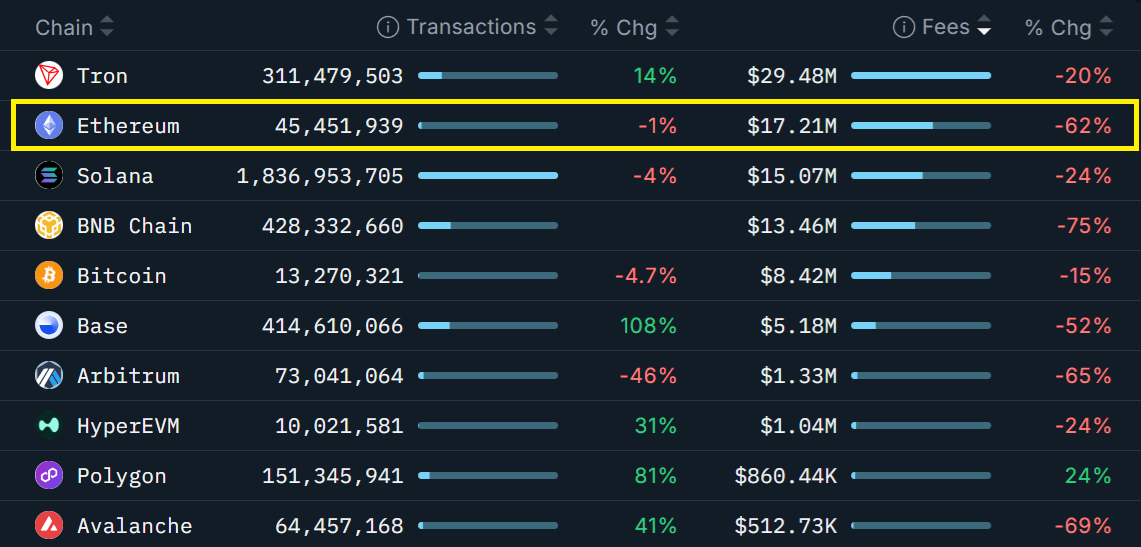
Blockchains ranked by 7-day network fees, USD. Source: Nansen

Nansen data shows that Ethereum’s 30-day network fees dropped by 62%, a far deeper pullback than the roughly 22% decline observed on Tron, Solana and HyperEVM during the same window.

Some activity, however, stood out: transactions on Base rose 108%, while Polygon recorded an 81% increase, suggesting continued momentum across Ethereum’s expanding layer-2 ecosystem.

The Ethereum Fusaka upgrade on Dec. 3 introduced changes designed to improve rollup efficiency, which may have contributed to the lower network fees noted throughout the month.
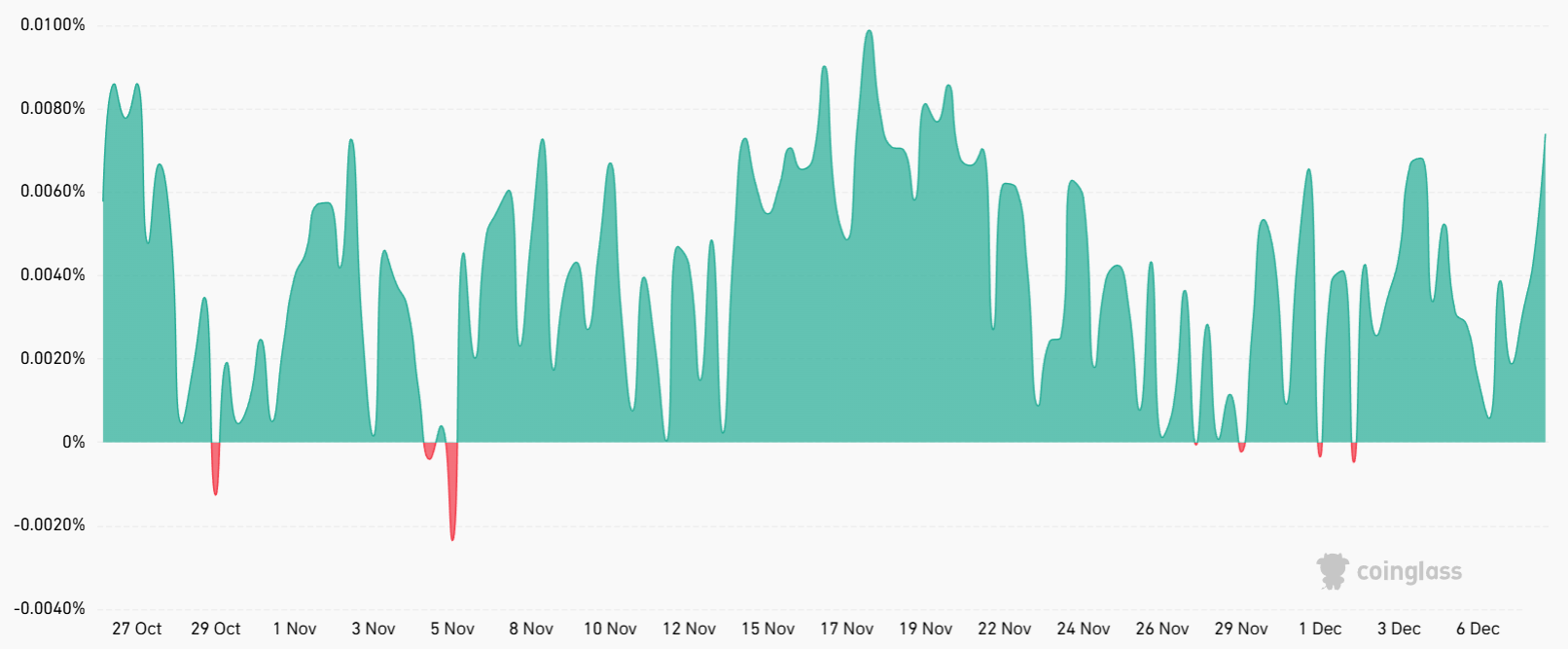
ETH perpetual futures 8-hour funding rate. Source: CoinGlass

On Tuesday, the annualized funding rate for ETH perpetual futures held near 9%, reflecting a fairly even distribution of leveraged positions between buyers (longs) and sellers (shorts). Under normal market conditions, this indicator tends to oscillate between 6% and 12% to account for capital costs; levels above that range usually signal stronger bullish positioning.

Traders turned more defensive after the US Bureau of Labor Statistics reported 1.85 million layoffs in October, the highest figure since 2023. Markets are now pricing in a 0.25% interest rate cut by the US Federal Reserve on Wednesday, while attention shifts to Fed Chair Jerome Powell’s comments following the Committee meeting.

Ethereum’s layer-2 growth offsets base layer fee declines

Despite the recent bullish momentum, Ether still trades 32% below its all-time high of $4,597 from August. To gauge whether demand for the Ethereum network is genuinely declining, it’s useful to look at the impact on decentralized applications (DApps).
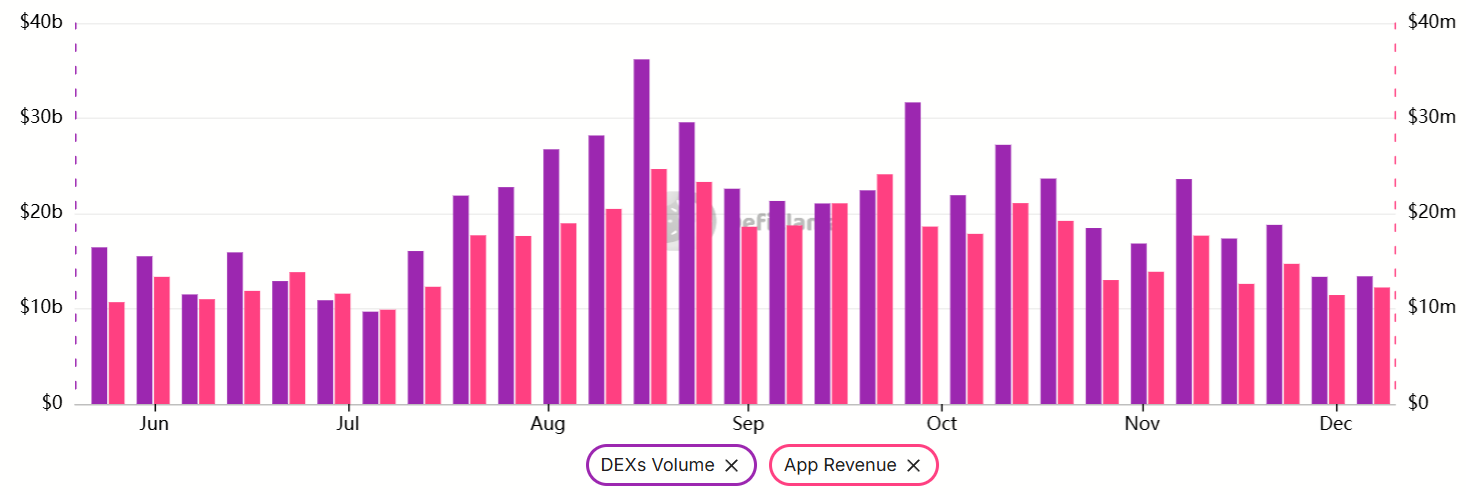
Ethereum network 7-day DEX volumes (left) vs. DApps revenue (right). Source: DefiLlama

Volumes on Ethereum-based decentralized exchanges fell to $13.4 billion over seven days, down from $23.6 billion four weeks earlier. Likewise, decentralized application revenues reached a five-month low of $12.3 million during the same period. Overall, demand for Ethereum’s base layer processing has been slipping since it peaked in late August.
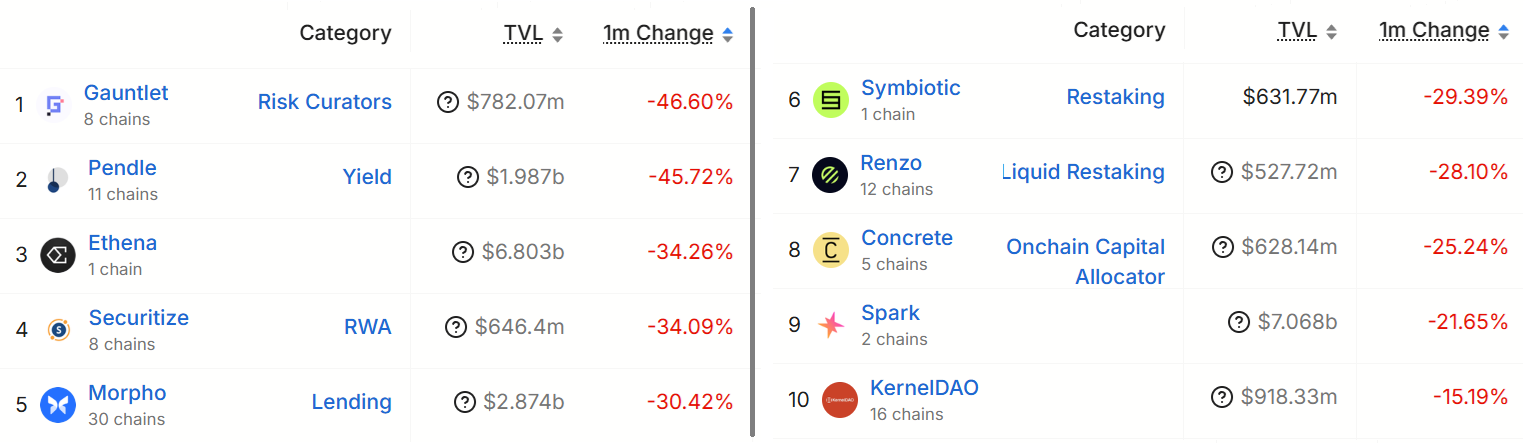
Ethereum DApps with $500 million or higher in TVL. Source: DefiLlama

Some of Ethereum’s leading DApps saw a sharp drop in total value locked (TVL), including Pendle, Athena, Morpho and Spark. Aggregate TVL on the Ethereum base layer fell to $76 billion from $100 billion two months earlier. Even so, Ethereum’s dominance remains intact with a 68% market share, while runner-up Solana holds under 10%.

Ether bulls argue that the network’s strong incentives for layer-2 scalability offer a more sustainable model compared with the heavier load and centralized coordination required by competing blockchains. Ethereum is positioned to capture a significant share of future growth in decentralized finance (DeFi).

Related: US Treasurys lead tokenization wave as CoinShares predicts 2026 growth

US Securities and Exchange Commission Paul Atkins reportedly said in a FOX Business interview that tokenization of the US market could occur in “a couple of years,” adding that blockchain offers “huge benefits” such as predictability and transparency. Atkins said the US should “embrace this new technology, bring it onshore where it can work under American rules.”

While Ethereum’s base layer fees have seen a sharp decline, along with the drop in TVL, activity across the layer-2 ecosystem continues to expand. Currently, neither onchain nor derivatives data indicate a meaningful weakness in ETH price dynamics.

This article is for general information purposes and is not intended to be and should not be taken as legal or investment advice. The views, thoughts, and opinions expressed here are the author’s alone and do not necessarily reflect or represent the views and opinions of Cointelegraph.

Related Reads

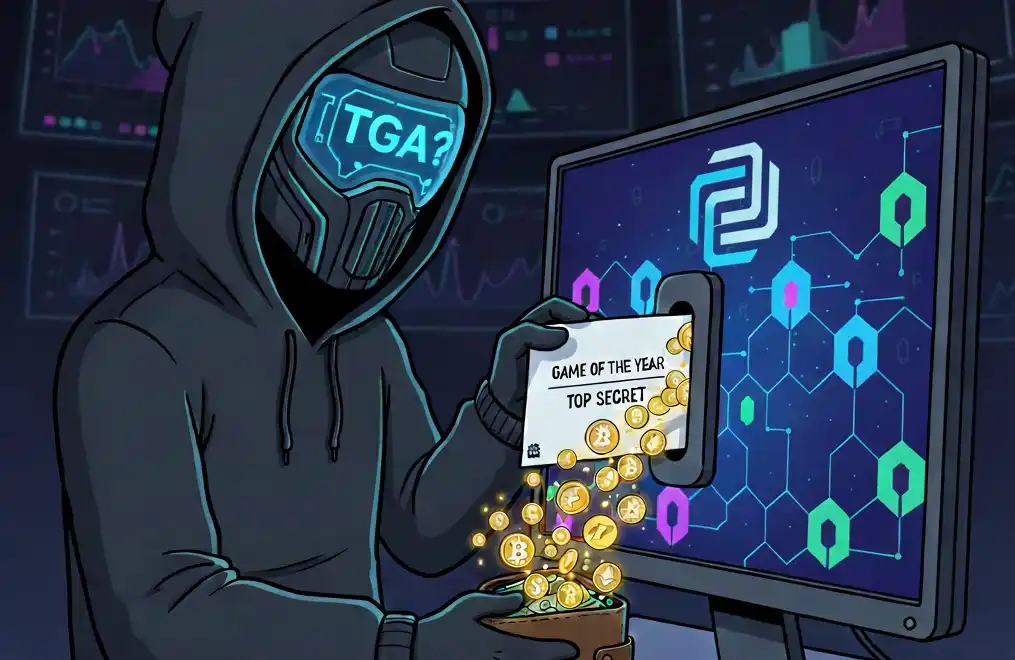
They Knew the TGA Game of the Year Winner in Advance and Made Tens of Thousands of Dollars

Summary: The 2025 TGA (The Game Awards) ceremony concluded with the indie game "Light & Shadow: Expedition 33" making history by winning both "Best Independent Game" and the coveted "Game of the Year (GOTY)" award, breaking a long-standing TGA curse. Prior to the event, the prediction market platform Polymarket had already listed the topic, with "Light & Shadow's" probability of winning GOTY consistently above 80% for over a month. Several traders, including users DieselDiesel, trumpnogo, and kasae, placed unusually large, concentrated bets on this outcome weeks in advance, a move that would have resulted in massive losses if wrong. Their bets appeared to be "all-in" convictions rather than calculated risks. Just three hours before the GOTY announcement, after the "Best Indie" award was given to the same game, a mysterious user (bobo9997) deposited $10,000 and bet it all on "Yes" for "Light & Shadow" winning GOTY at a price of $0.98 per share—a bet that would yield less than $200 in profit if correct. The final award confirmed the predictions. The early traders realized significant profits, with their winnings from this single event representing a large percentage of their total historical earnings on the platform (e.g., 176% for DieselDiesel). The article suggests these traders likely had insider knowledge of the results, using the prediction market as a anonymous, low-risk method to monetize their confidential information, turning a guaranteed outcome into thousands of dollars with virtually no risk.

marsbitHace 10 min(s)

They Knew the TGA Game of the Year Winner in Advance and Made Tens of Thousands of Dollars

marsbitHace 10 min(s)

Weekly Review and Outlook | Circle Issues 500 Million USDC on Solana; Japan Plans to Include Crypto Assets in Securities Regulatory Framework; Gemini Approved by CFTC to Establish Prediction Market; Fed Cuts Benchmark Rate by 25 Basis Points

This week in crypto and financial markets was marked by significant developments and regulatory shifts. Circle issued an additional 500 million USDC on the Solana network, reflecting strong demand for the stablecoin, with trading volume exceeding $11.9 billion within 24 hours. Dubai Customs partnered with Binance to explore crypto payments for trade and logistics, aiming to enhance efficiency and reduce costs. Twenty One Capital, backed by Tether and Bitfinex, began trading on the NYSE, though its stock fell 20% on the first day. Strive launched a $500 million ATM financing plan, partly to acquire more BTC, while American Bitcoin increased its holdings to 4,783 BTC. Japan's FSA proposed bringing crypto assets and IEOs under securities regulations, requiring stricter disclosures and cracking down on insider trading. Jupiter announced its own stablecoin, JUP USD, and acquired RainFi to offer peer-to-peer lending services. Gemini received CFTC approval to launch a blockchain-based prediction market, potentially expanding into crypto derivatives. The Federal Reserve cut interest rates by 25 basis points to 3.50%-3.75%, responding to slowing economic growth. Looking ahead, HashKey Group plans to raise up to HK$1.67 billion in its Hong Kong IPO on December 17. Several tokens, including Starknet, Arbitrum, and LayerZero, are scheduled for unlocks next week, which may influence market liquidity.

cointelegraph_中文Hace 24 min(s)

Weekly Review and Outlook | Circle Issues 500 Million USDC on Solana; Japan Plans to Include Crypto Assets in Securities Regulatory Framework; Gemini Approved by CFTC to Establish Prediction Market; Fed Cuts Benchmark Rate by 25 Basis Points

cointelegraph_中文Hace 24 min(s)

Trading

Spot
Futures
活动图片