How to Understand the CFTC's Regulation of Prediction Markets?

marsbitPublished on 2026-10-13Last updated on 2026-10-13

Abstract

On October 9, the U.S. Commodity Futures Trading Commission (CFTC) released two conflicting documents concerning event contracts in prediction markets. A proposal seeks to classify contracts on sports, politics, and other events as "swaps" under CFTC jurisdiction, while a separate interim rule explicitly excludes licensed sports betting and casino games from the swap definition. This creates a regulatory split where bets on the same NFL game could be regulated as state-level gambling if placed at a Las Vegas sportsbook, but as a federally regulated swap if traded on a CFTC-registered exchange like Kalshi. CFTC Chairman Michael Selig argues these event contracts are commodity derivatives for hedging, speculation, and price discovery. However, the move faces legal challenges. The NFL and 39 states oppose the CFTC's stance, arguing these contracts create new gambling risks rather than hedging existing ones. Federal appeals courts are divided: the Third Circuit ruled such contracts are swaps, while the Sixth and Ninth Circuits concluded they are not. This circuit split has prompted New Jersey to petition the Supreme Court for review. The proposed rules are not yet in effect, pending publication and a comment period. The ultimate outcome hinges on court decisions and the future composition of the CFTC commission. The core conflict remains whether event contracts on prediction markets fall under federal derivatives regulation or state gambling laws.

Author: Huohuo, The Block

On October 9th, the U.S. Commodity Futures Trading Commission (CFTC) released two documents with opposing directions on the same day. One proposal aims to include event contracts for sports, politics, culture, weather, etc., found in prediction markets, within the definition of a swap, while another interim final rule explicitly excludes licensed sports betting and casino games from the definition of a swap.

In plain terms, a swap is a contract where payments are determined by an outcome. Under U.S. derivatives law, once a certain type of contract is classified as a swap, it typically falls under the exclusive regulatory oversight of the CFTC, preempting state gambling licenses and state taxes. This is federal preemption.

Therefore, the core issue of contention is: who writes the rules for the same NFL game? If placed at a Vegas counter or in the DraftKings app, it is state-regulated gambling; if turned into an event contract and placed on a federally registered exchange like Kalshi, the CFTC argues it is a swap.

CFTC Chairman Michael Selig is the only sitting commissioner among the five-member commission. He stated directly that Americans use event contracts to hedge, speculate, and obtain information, and these products fall within the category of commodity derivatives under the CFTC's exclusive jurisdiction. Casino-style products, however, are not derivatives.

The trading volume is the backdrop for this round of actions. The CFTC reported that event contract volume on U.S. registered exchanges (DCMs) reached approximately $1.5 billion in August, with about $1.2 billion related to sports. Market estimates are much larger. For example, Kalshi and Polymarket combined traded roughly $85.6 billion over a weekend in October, with sports contracts being the primary driver of this surge in volume.
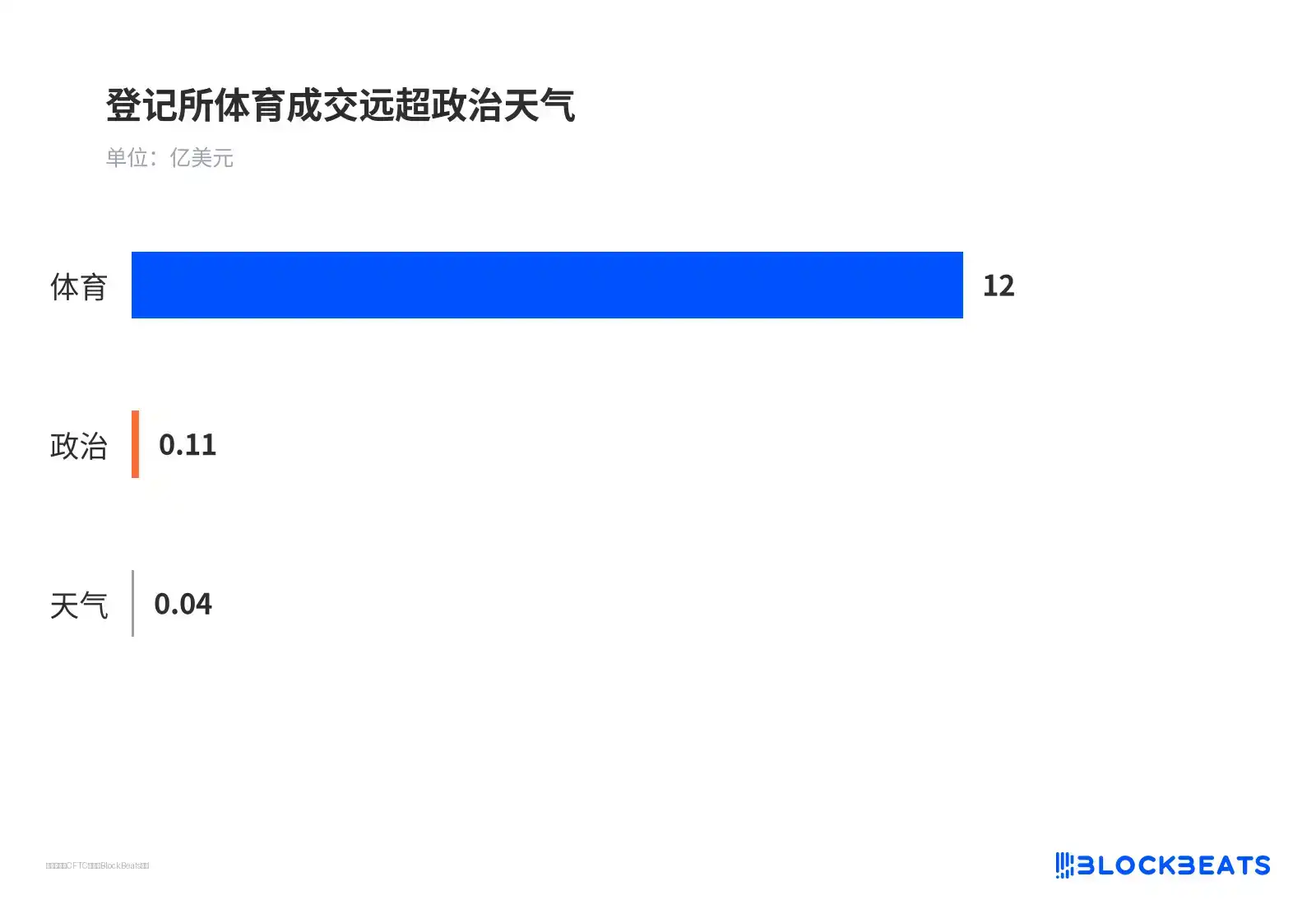
Trading volume for registered sports contracts far exceeds that for politics and weather

One inclusion, one exclusion: Two directions being written into the swap definition

The proposal answers what counts as a swap, while the interim final rule answers what does not. The latter uses two tests to define the boundary. Only wagers offered by licensed state or tribal gaming operators and that are not matched on a multilateral exchange platform are excluded. Both conditions must be met to be considered a casino-style wager.

Combining these two boundaries essentially splits sports betting in half—one half remains with the states, the other is handed over to the federal government. The same sports bet, if placed at a counter in Las Vegas, is gambling; if placed on a federally registered exchange like Kalshi, it becomes a swap.
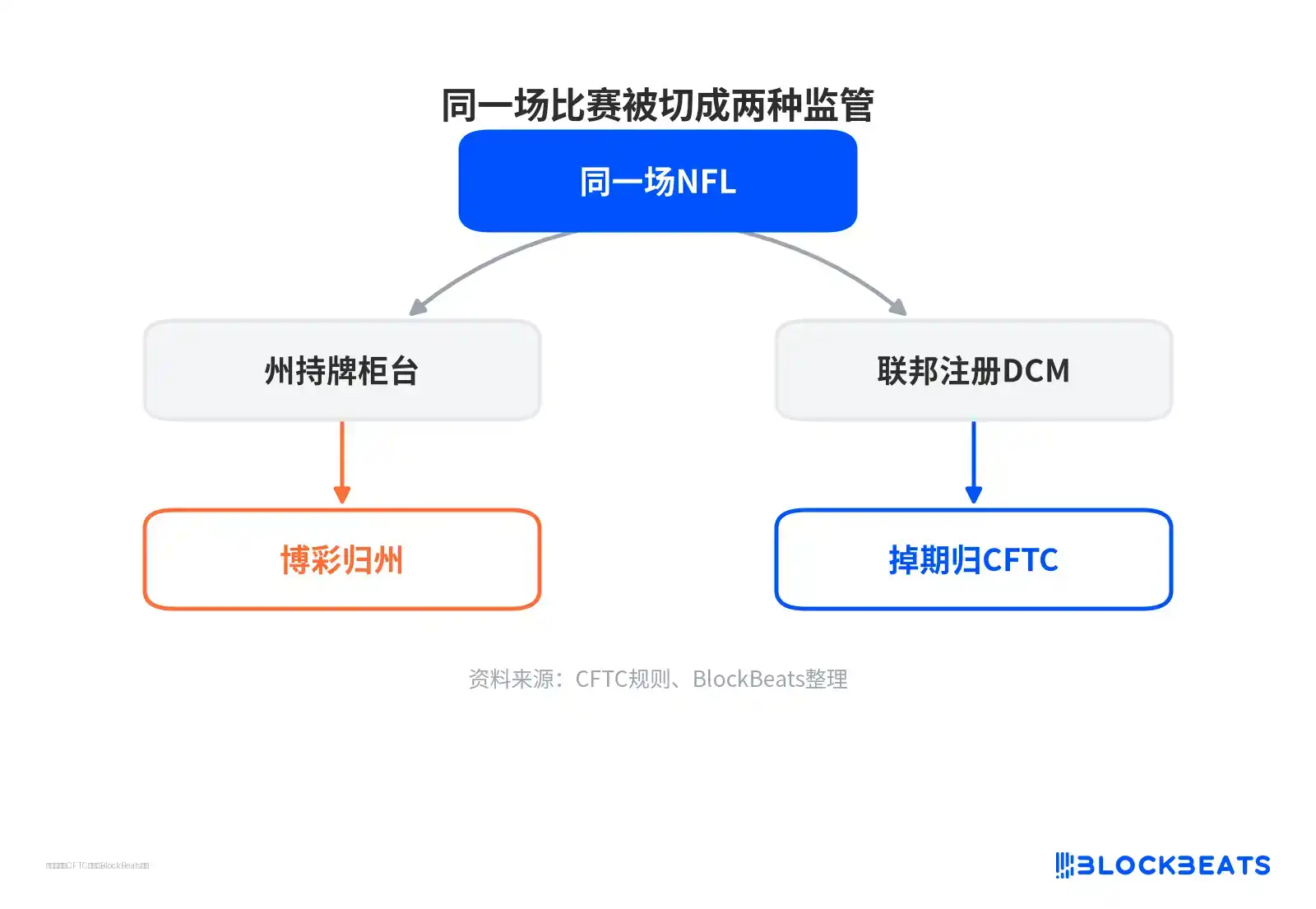
The same game is being cut into two types of regulation

Similar questions appear in the court brief filed by the American Gaming Association: if a sports bet is considered a swap, should bets placed at Las Vegas counters also have to be on a DCM?

TD Cowen policy analyst Jaret Seiberg offers another interpretation. States have repeatedly argued in lawsuits that the CFTC's definition of event contracts as swaps is too broad, potentially making wagers at state and tribal casinos federally illegal.

The interim final rule, by first carving out casino games, is precisely meant to dismantle this line of attack in court. Seiberg's judgment is that this move is mainly to improve the CFTC's legal position; whether it will be effective is another matter.

If this classification fails to hold up in court, states could potentially use the casino line to pull event contracts back under state law.

The NFL and 39 States: Who should set the rules for the same game?

A clear judicial split has already formed. New Jersey has petitioned the Supreme Court over its jurisdictional dispute with Kalshi. The NFL and 39 states plus Washington, D.C., have filed amicus briefs supporting New Jersey.

The NFL argues that sports event contracts create new risk for gambling, rather than hedging existing risk like a swap, and points out that the CFTC does not prohibit easily manipulated betting lines, nor does it cover lines related to player injuries, referees, or enforce a minimum age of 21. On the first Sunday of this season, prediction markets traded approximately $3.3 billion, with $1.8 billion related to football.

U.S. federal appeals courts are divided into circuits. Different circuit courts can issue contradictory rulings on the same legal question. When such a circuit split occurs, the Supreme Court is more likely to intervene. Three federal appellate circuits have already reached opposite conclusions this year:

Third Circuit (April this year): Held that sports contracts on DCMs are swaps and can preempt state law.

Sixth Circuit (September) and Ninth Circuit (August): Reached the opposite conclusion, holding that these contracts are not swaps and state law applies.
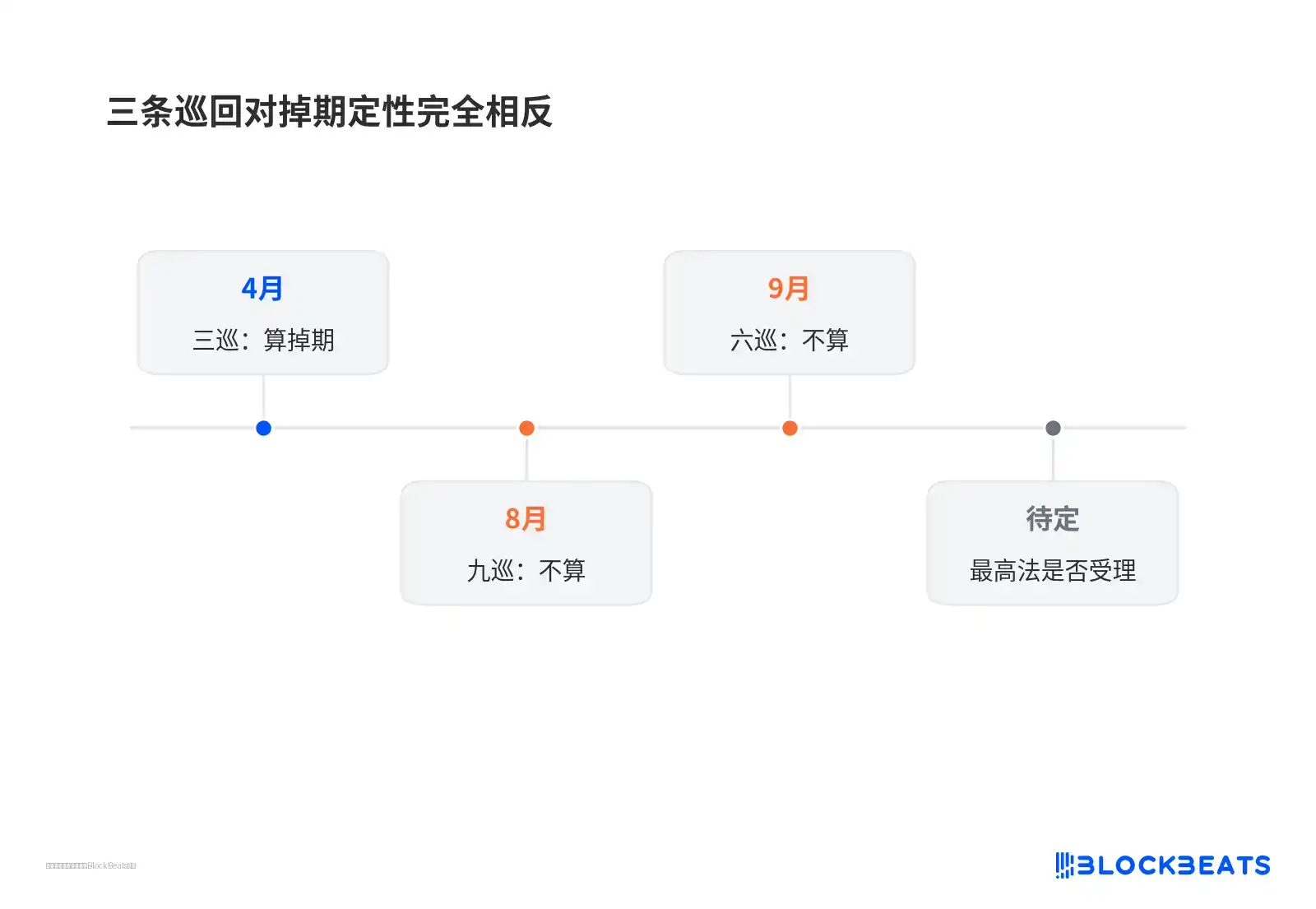
Three circuits hold completely opposite views on swap classification

With the three circuits at odds, the same contract could receive contradictory classifications in different jurisdictions. This is precisely why New Jersey wants to bring the issue to the Supreme Court. Kalshi's response deadline is November 9th, and the Supreme Court has not yet decided whether to hear the case.

Rules Not Yet in Effect; Variables Lie with Courts and Commissioner Seats

As of now, neither document has been published in the Federal Register. The comment period for the proposal begins from the publication date and lasts 30 days. The interim final rule also only takes effect upon publication. Calling them "already entered into consultation" or "already in effect" at this stage is inaccurate.

A more critical variable lies with the courts. New Jersey's petition has placed the split between the Third Circuit and the Sixth/Ninth Circuits before the nine Supreme Court justices. There is no news yet on whether they will hear the case. Administrative rules can strengthen arguments for the Third Circuit's template, but the ultimate authority to interpret the law rests with the judges.

Selig is the only sitting commissioner among the five-member commission. Pushing rules forward under a short-staffed commission may be legally tenable, but the oversight is thin. Once the commission is fully staffed, or if the courts do not adopt this definition, today's protective measures could be rewritten.

In this round of contention, the regulated parties themselves have remained quiet; Kalshi and Polymarket have yet to make any public, on-the-record statements.


Related Questions

QWhat are the two main actions taken by the CFTC on October 9th regarding event contracts, and what are their intended effects?

AThe CFTC issued two documents. One is a proposal to include event contracts for sports, politics, culture, and weather within the definition of a 'swap.' The other is an Interim Final Rule explicitly excluding licensed sports wagering and casino games from the swap definition. The intended effect is to carve out a regulatory boundary: similar sports bets offered on federally registered exchanges like Kalshi would be regulated as swaps under CFTC jurisdiction, while bets placed at state-licensed sportsbooks in places like Las Vegas would remain under state gambling law.

QWhat is the core legal and regulatory conflict at the heart of the CFTC's recent actions on prediction markets?

AThe core conflict is jurisdictional preemption. Under U.S. derivatives law, if a contract is defined as a 'swap,' it falls under the exclusive jurisdiction of the CFTC (federal preemption), overriding state gambling laws and taxes. The dispute centers on who gets to set the rules for the same event (e.g., an NFL game): state regulators for traditional sports betting or the CFTC for event contracts traded on federally registered exchanges.

QWhat contradictory rulings have emerged from U.S. federal appeals courts regarding the classification of sports event contracts, and why is this significant?

AThree U.S. Circuit Courts of Appeals have issued contradictory rulings in 2024: The Third Circuit (April) ruled that sports contracts on Designated Contract Markets (DCMs) are swaps and can preempt state law. The Sixth (September) and Ninth (August) Circuits reached the opposite conclusion, stating these contracts are not swaps and state law applies. This 'circuit split' is significant because it creates legal uncertainty, with the same contract having different statuses in different jurisdictions, making the issue ripe for potential review by the U.S. Supreme Court.

QAccording to analysts cited in the article, what is a strategic reason behind the CFTC's Interim Final Rule that excludes licensed casinos?

AAnalyst Jaret Seiberg suggests a key strategic reason is to improve the CFTC's position in ongoing court battles. State opponents argued that the CFTC's broad definition of 'swap' for event contracts would render state and tribal casino wagers federally illegal. By explicitly carving out licensed casino games via the Interim Final Rule, the CFTC aims to defuse this specific legal attack and strengthen its argument that event contracts are distinct from traditional gambling.

QWhat are the current procedural and political variables that could change the outcome of the CFTC's proposed regulatory framework for prediction markets?

AKey variables include: 1) The courts: The Supreme Court has not yet decided whether to hear New Jersey's petition highlighting the circuit split. Judicial interpretation will ultimately decide the rules. 2) The CFTC Commission: Currently, only Chairman Rostin Behnam is seated on the five-member commission. Future decisions by a fully staffed commission could rewrite or reverse the current proposals. 3) The rulemaking process: The proposals are not yet final. The comment period for the proposal and the effective date for the Interim Final Rule only begin once they are published in the Federal Register.

Related Reads

CPI and AI Earnings Dominate Market Rhythm: This Week's Hot Assets Preview | WEEX VIP Weekly Report (November 2 – November 8, 2026)

The article discusses market developments for the week of November 2–8, 2026, highlighting how CPI data and AI earnings dominate market节奏. Last week, Democratic midterm election gains triggered concerns over tighter AI regulation and data center policies, causing a sharp tech selloff—the Nasdaq fell over 5% in a single day and entered technical correction. Crypto markets moved in tandem with cross-asset risk aversion: Bitcoin briefly dropped below $76,000 before showing resilience, with BTC and ETH posting weekly losses of about 4.5% and 6.5% respectively. Spot ETFs saw significant outflows, and the Fear & Greed Index stayed in "fear" territory for six days. Total crypto market cap fell from about $2.7 trillion to $2.54 trillion. In traditional markets, the 10-year Treasury yield hovered at 4.84%–4.95%, gold rebounded above $4,000, while oil plunged over 11%. Tech and semiconductor stocks were hit hard—the Philadelphia Semiconductor Index fell 12% in one day, with AMD down over 17% and Nvidia down over 9%. Defensive sectors outperformed. This week's focus is Tuesday's October CPI release, with headline CPI expected at 3.3%–3.5% and core CPI at 3.1%–3.2%. PPI, Fed speakers, and earnings from AMAT and CSCO are also key. Crypto token unlocks include RAIN (~$121 million), ALLO, JCT, and AZTEC. Investors are advised to maintain defensive positioning, reduce high-beta tech exposure, and wait for inflation data and AI earnings signals before adjusting risk allocations.

marsbit40m ago

CPI and AI Earnings Dominate Market Rhythm: This Week's Hot Assets Preview | WEEX VIP Weekly Report (November 2 – November 8, 2026)

marsbit40m ago

SEC Greenlights On-Chain US Stocks: Five-Year Regulatory Exemption, Uniswap v4 Targets $79 Trillion Market

The SEC's innovation exemption, effective September 17, 2026, creates a new category called Tokenized Securities Venues (TSVs), granting qualifying venues a five-year exemption from registration as exchanges or ATSs, provided they trade tokenized NMS stocks through permissioned liquidity pools on public blockchains. Liquidity providers meeting the order's conditions would also avoid dealer registration. Over $20 billion in tokenized stocks has already traded on Uniswap, and the US equity market represents $79 trillion. AMMs automate much of the work of professional market makers, letting anyone supply liquidity via smart contracts, broadening participation and competition. Pools run 24/7, support trading pairs beyond USD (e.g., NVIDIA paired with tokenized S&P 500 funds), and reach global distribution through thousands of frontends. On TSVs, trading and settlement occur atomically on-chain without a central counterparty, and listed companies must receive 30-day notice with an opportunity to object. To meet compliance requirements such as fee disclosure, access controls, listing and volume limits, and trading halts, Uniswap v4 hooks—especially Permissioned Pools—provide the infrastructure. Uniswap has processed over $4.5 trillion across 30+ chains without core contract exploits. Uniswap Labs invites TSV operators, asset issuers, and LPs to collaborate, while noting it does not operate any TSV and that the exemption is temporary and conditional.

marsbit51m ago

SEC Greenlights On-Chain US Stocks: Five-Year Regulatory Exemption, Uniswap v4 Targets $79 Trillion Market

marsbit51m ago

Polkadot’s first batch of parachain champions can’t hold on either: Acala and Karura plan to halt their chains in February next year

Acala, the flagship DeFi parachain on Polkadot, has submitted governance referendum Acala #195 proposing to shut down the network, with sister chain Karura launching Karura #137 in parallel. If passed, both chains will stop producing blocks on February 10, 2027. In a letter to the community, the team said Polkadot's multi-parachain architecture has deeply fragmented ecosystem funds, leaving DeFi liquidity severely insufficient, with node and network maintenance costs persistently exceeding actual revenue. The exit of a flagship network after seven years of building and operation raises direct questions about application sustainability under the multi-chain vision. The shutdown plan sets clear cross-chain withdrawal deadlines. Holders must move DOT, KSM, and bridged assets such as USDT and USDC to other networks before February 10, 2027. Native assets ACA and KAR cannot be exported cross-chain and will remain permanently in their respective ledgers after the shutdown. Liquid staking products have staggered unbonding deadlines: Polkadot's standard unbonding takes 28 days, and LDOT bound to specific validators requires an additional 28 days, so applications must be filed by December 16, 2026; the unbonding deadlines for regular LDOT and LKSM are January 12 and February 2, 2027, respectively. The early clearing window is driven by technical security concerns: after the shutdown, network code and historical state ledgers will be public, and any third party could recompile and restart the chain. With AI-assisted code audit tools becoming widespread, legacy systems lacking ongoing maintenance are prone to exposing governance vulnerabilities, so clearing retained assets early can block potential theft of stranded funds. Looking back at Polkadot's first parachain auction in November 2021, Acala won the network's first slot, attracting over 81,000 on-chain addresses to participate in the crowdloan and locking more than 32.5 million DOT. The 96-week lease term secured shared security from the relay chain but also caused massive funds to sit idle for long periods, constraining capital turnover efficiency. Five years later, most of the first batch of winning projects have exited or stalled. Moonbeam stopped producing blocks around July 31, 2026 and migrated GLMR to Base; Parallel Finance closed its products after a security incident; Clover also left its original parachain identity, leaving only Astar still actively maintained and upgraded. The multi-chain structure and separate cross-chain wallet interactions worsen the fragmented experience, and scarce on-chain liquidity is continually diluted. Although Polkadot has now shifted to the elastic coretime model described in its Agile Coretime documentation and is advancing the parallel computing upgrade outlined in the JAM protocol gray paper, early ecosystem funds that flowed out are unlikely to return in the short term. The shutdown plan is currently at the signaling vote stage. Subsquare on-chain data shows Acala Referendum #195 has about 23.1 million ACA in favor and Karura Referendum #137 about 1.28 million KAR in favor, with zero opposing votes so far. After the signaling vote passes, the team will initiate an on-chain execution proposal to implement the shutdown. The team pledges to maintain node operation and coretime availability before the shutdown; external assets not withdrawn by the deadline will be returned to the corresponding Asset Hub addresses on a best-effort basis without a full guarantee, while treasury external assets are planned to be donated to the corresponding relay chain treasury.

marsbit1h ago

Polkadot’s first batch of parachain champions can’t hold on either: Acala and Karura plan to halt their chains in February next year

marsbit1h ago

Trading

Spot
活动图片