Trump's Reversal in Words and Deeds: The So-Called 'Deal Is Near' Is Merely a Smoke Screen for War

marsbitPublicado a 2026-06-11Actualizado a 2026-06-11

Resumen

This article critically analyzes the Trump administration's policy reversals and use of "imminent deal" rhetoric following a military incident with Iran. After a US Apache helicopter crashed near the Strait of Hormuz, Trump initially downplayed the event. However, within 24 hours, he claimed Iran "shot down" the helicopter and ordered retaliatory strikes on Iranian coastal targets. The article argues these strikes, which reportedly disrupted water supplies for 20,000 people, triggered further Iranian missile attacks on US bases in the region. The core critique is that this military escalation contradicts a constant stream of administration claims, spanning over 100 days of conflict, that a deal to reopen the Strait of Hormuz was "very close" or "days away." The author frames these repeated "imminent deal" announcements as a "smokescreen" for political theater and military action, not genuine diplomacy. Despite the blockade and strikes, the Strait remains closed, oil prices are up, and no agreement has been reached. The conclusion urges skepticism, suggesting that when officials claim a deal is near, the rational assumption should be the opposite.

Editor's Note: This article revolves around the airstrike carried out by U.S. forces against targets near the Strait of Hormuz in Iran in the early morning of June 10, Beijing time. Dean Blundell, in a tone of strong irony, criticizes the Trump administration's policy reversals on Iran: A U.S. Army AH-64 Apache helicopter crashed near the Strait of Hormuz, with two pilots rescued; the cause of the incident remains disputed. Trump initially called it "no big deal," but later on Truth Social characterized it as Iran "shooting down" a U.S. helicopter, using this as a justification to launch strikes against Iran's coastal air defense, radar, and ground control facilities.

The article's true critique is not merely this military response, but rather the Trump administration's repeated creation of the public opinion smoke screen that a "deal is about to be reached." While claiming negotiations are in the "final stages" and an agreement could be signed "in two or three days," it escalates military actions and publicly humiliates Iran. The so-called diplomatic negotiations resemble a political performance serving the news cycle. Meanwhile, the U.S. military's so-called "proportional response" further provokes retaliatory strikes by Iran against American regional bases. The Strait of Hormuz still fails to return to normal, with oil prices and market pressure persisting. The author reminds readers that when "very close" repeatedly replaces real progress, perhaps the most rational response is not to believe, but to record it, and assume reality is likely the exact opposite.

The original text follows:

Let's start with the timeline, because this timeline itself is the core of the entire deception.

Monday night, a U.S. Army AH-64 Apache attack helicopter crashed in the Strait of Hormuz off the coast of Oman. Both pilots survived and were unharmed—they were rescued by an unmanned vessel within two hours. It must be admitted, that was a pretty cool piece of military hardware, the only part of the whole story that actually worked properly.

But there's a detail Trump won't write into those all-caps social media posts: A U.S. official told The Associated Press that the Apache crashed after colliding with an Iranian drone, and it's currently unclear if the collision was intentional. Trump himself also told The Wall Street Journal that the whole thing was "no big deal," and that "the pilots are fine."

So, please remember this first: no big deal. The pilots are fine. The cause is still under investigation. Maybe it was just an accident.

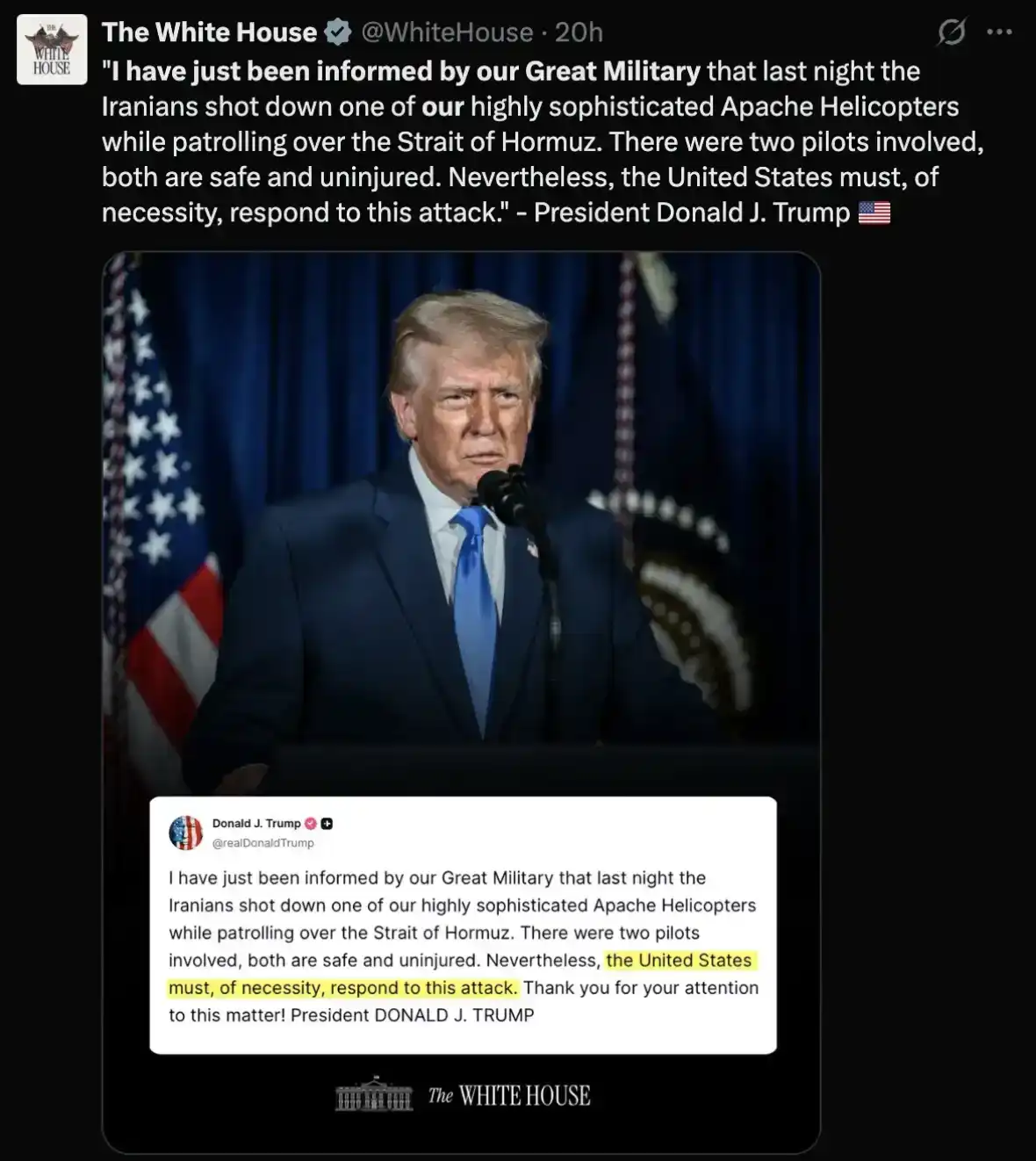
Tuesday morning, the same person, a different mood. He went on Truth Social again and wrote: "I have just been informed by our great military that last night, Iranians shot down one of our highly advanced Apache helicopters while patrolling the skies over the Strait of Hormuz...... America must respond to this attack. Thank you all for your attention on this matter!"

From "no big deal" to "must respond" in less than one news cycle. This person reversed his own statement in under 24 hours, and we are somehow still expected to nod along as if facing some art of statecraft.
Late Tuesday night into early Wednesday morning, U.S. Central Command began launching strikes against coastal areas in Iran. The operation lasted from Tuesday 22:00 GMT to nearly 01:00 Wednesday, targeting about 20 sites including air defense systems, ground control stations, and surveillance radar stations. Locations spanned Qeshm Island, Goruk, Bandar Abbas, Jask, Sirik, and Minab, stretching along the Strait of Hormuz and deep into the strait. The Pentagon's justification: "Self-defense strikes," a "proportionate response" to "Iran's unprovoked aggression."

According to Iranian state television, the result of this so-called "proportionate response" on the ground was: Two water reservoirs near Sirik were struck, disrupting the drinking water supply for about 20,000 people in the Bamani area. Next time you hear the term "surgical strike," remember this scene.

The same night, Iran retaliated. Iran's Revolutionary Guard Corps claimed they launched 21 strikes against American targets in the region—drone attacks hit the U.S. Fifth Fleet in Bahrain and the Ali Al Salem base in Kuwait, while long-range missiles targeted the Azraq airbase in Jordan; they claimed to have destroyed an F-35 hangar there. Jordan stated it had shot down five missiles. Iranian Foreign Minister Araghchi, using a deterrent tone Trump likely wishes he had, said: "If you want security, leave our region." Iranian Parliament Speaker Ghalibaf said: "We prefer to use the language of diplomacy, but other languages, we speak more fluently."

Wednesday morning. And then—right here—the real key moment appeared. Trump was back on Truth Social, the "chief dealmaker" taking off the mask completely:

"The Iranian military is in complete disarray. Most of their forces, like their navy and air force, don't even exist anymore—they have been completely defeated. Iran talks, but doesn't act. The Middle East bully is dead!!! They took too long to negotiate a deal that was incredibly good for them, and now they have to pay the price!!!"

"They took too long to negotiate."

Too long. The same person who, just the morning before, claimed the deal was in the "final stages" and could be signed in "two or three days." The same person who, after leaving the NBA Finals on Monday night, said both sides were in the final stages of a "very, very good deal" that would "immediately" reopen the Strait of Hormuz once signed.

The "Two or Three Days" Industrial Complex

I want you to really think about something. Throughout this war, Trump has been telling us: The deal is coming. By Sunday, this war had lasted over 100 days. By my count—yes, I've recorded each one, because someone has to do it—since this conflict erupted in late February, Trump has promised an imminent, shiny, just-around-the-corner deal over thirty times.
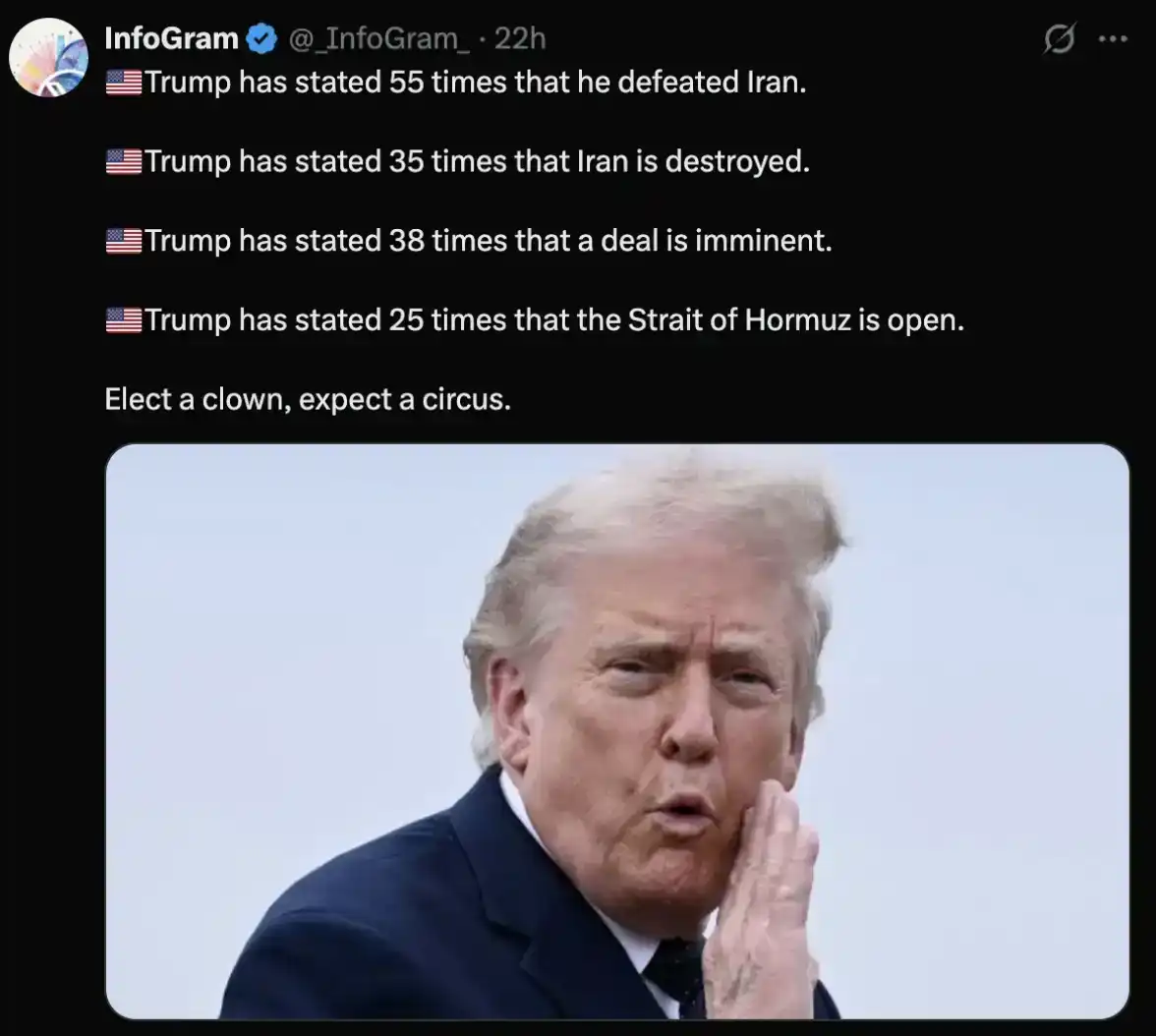
A few receipts pulled from the "receipt drawer":

March 23: Announced "very good and productive conversations" and postponed the threatened power plant strikes by five days. Iran's response? They flatly denied any talks happened. Oil prices fell initially, then bounced back after Tehran debunked his claim.

Late March: Threatened to "destroy" Iran's power plants within 48 hours if they didn't open the strait. They didn't open. He didn't act.

April: Announced a "10-day pause on energy facility destruction period." A ceasefire was declared. Negotiations followed in Pakistan, mainly brokered by Islamabad, ending in failure.

This week: "Final stages." "Two or three days." "Open immediately upon signing."

Wednesday: "They took too long. Must pay the price."

This isn't negotiation. This is a slot machine that only spits out media exposure. Every pull of the lever, the same three cherries pop up on the screen: deal is almost done, the other side is weak, trust me.

And each time, JD Vance stands beside him to back him up—on Sunday, he told CBS the administration was "very close" to a deal. Very close. Probably the two most abused words in this administration, barely beaten out by "perfect call."

Let's Take the Mask Off

Behind the so-called "trust me, bro" lie these things.

If you're truly in control of negotiations, you don't need to blow up water reservoirs to prove you're winning. If you're truly in control of negotiations, the other side won't fire 21 missiles at three of your bases the same night. If you're truly in control of negotiations, your diplomatic posture doesn't shift like a mood ring from "very, very good deal" to "the Middle East bully is dead" in 18 hours—a shift whose only discernible external trigger seems to be his mood about the cable news coverage.

The blockade he keeps bragging about—in his own words, "the most successful blockade in naval history"—hasn't stopped Iran from launching attacks across the region, hasn't reopened the Strait of Hormuz, and hasn't produced any deal. A shopkeeper in Tehran even told CBS this week his store shelves remain full. But sure, it can still be "the most successful ever." He actually wrote "praise Allah"—I have many questions about that, but that's for another article.

The real tell is here: The Strait remains closed. The war's only stated concrete objective—reopening the passage for a fifth of the world's oil supply—remains unmet after 100+ days. Dozens of "imminent" deals, a naval blockade, and now a new round of strikes later. Oil is up nearly 2%. Markets are down. And the man at the center of it all is still posting in all caps declaring a "bully" dead.

This isn't leverage. This is a guy who lost control of the car sometime around March and has spent three months insisting he always meant to drift it into the guardrail.

The Bottom Line

It's a good thing, of course, that the two pilots are safe and sound; that's the only clean outcome in this whole affair. But tonight, 20,000 people in southern Iran have no drinking water, three U.S. allies have been hit by missiles, a Jordanian F-35 hangar might be a smoldering ruin, and the man responsible has handled the whole thing like a pro-wrestling promo.

Every "two or three days" is either a lie or a delusion. And by now, the difference between the two doesn't matter. You can't say Tuesday the deal is in the "final stages," Wednesday say "they took too long," and then expect anyone with functioning memory to keep trusting your read on Thursday's situation.

So, next time you hear "we're very close," whether it's Trump saying it, Vance saying it, or any of them, please do the only semi-sane thing left.

Count it. Record it. Then assume the exact opposite is true.

Because "trust me, bro" stopped being foreign policy somewhere around the twelfth promise of a deal. We're well past thirty now.

That, it seems, is worth remembering.

Preguntas relacionadas

QWhat was the initial incident that triggered the military escalation described in the article?

AThe initial incident was the crash of a US Army AH-64 Apache helicopter near the Strait of Hormuz. While early reports, including from the President, suggested it was 'no big deal' and the pilots were safe, the narrative later shifted to the helicopter being 'shot down' by Iran, justifying a military response.

QWhat is the author's primary criticism of the Trump administration's approach to Iran, beyond the military strikes?

AThe author's primary criticism is the administration's repeated use of 'a deal is imminent' rhetoric as a smokescreen. They argue that while constantly claiming negotiations are in the 'final stages' and a deal is 'two or three days' away, the government simultaneously escalates military actions and publicly humiliates Iran, making the diplomacy seem like a political performance for the news cycle rather than a genuine effort.

QAccording to the article, what was one specific, on-the-ground consequence of the US's 'proportional response' strikes in Iran?

AOne specific consequence was that two water reservoirs near Sirik were struck, reportedly cutting off drinking water supplies for approximately 20,000 people in the Bamani area.

QWhat contradiction in President Trump's public statements does the author highlight as evidence of the unserious nature of the negotiations?

AThe author highlights the contradiction between Trump stating on a Tuesday that a deal with Iran was in the 'final stage' and could be signed in 'two or three days,' followed by his statement on Wednesday that 'They spent too long negotiating' and 'must pay the price.' This rapid shift from imminent agreement to blaming Iran for delay occurred within roughly 24 hours.

QWhat does the author suggest is the most rational reaction when hearing officials claim a deal with Iran is 'very close'?

AThe author suggests the most rational reaction is to count the instance, record it, and assume the opposite is true, because such promises have been made over thirty times without materializing and have lost all credibility.

Lecturas Relacionadas

After the Passage of the GENIUS Act and the CLARITY Act, What Is the Correct Architecture for On-Chain Yield?

The article discusses the evolution of on-chain credit, distinguishing three markets: overcollateralized crypto lending, unsecured lending (largely unsuccessful), and asset-backed credit (ABC). ABC, backed by identifiable real-world collateral with legal recourse, is identified as the fastest-growing category and the only one credibly addressing adverse selection—the core problem in credit where the riskiest borrowers self-select. Current growth in on-chain Real World Assets (RWAs), particularly tokenized private credit funds (e.g., Maple Finance, Centrifuge), is substantial but often merely "wraps" existing fund structures, inheriting their risks rather than solving adverse selection at the protocol level. The regulatory landscape is a key driver, with the US GENIUS Act (prohibiting stablecoin issuers from paying yield) and the proposed CLARITY Act (closing loopholes on indirect yield) set to redefine permissible yield-bearing products. This makes vaults (like ERC-4626) the critical architecture—they become the primary compliant vehicle for delivering yield, functioning as issuance, disclosure, distribution, and recovery mechanisms. The author's thesis is that the correct post-GENIUS/CLARITY architecture involves building ABC solutions where credit assessment, structure, and recovery are encoded directly into the smart contract vault layer, moving beyond mere tokenized fund wrappers to solve adverse selection fundamentally and ensure regulatory compliance.

Foresight NewsHace 21 min(s)

After the Passage of the GENIUS Act and the CLARITY Act, What Is the Correct Architecture for On-Chain Yield?

Foresight NewsHace 21 min(s)

TechFlow Intelligence Bureau: Anthropic's New Model Fable Sparks Controversy by Restricting Biosafety Research, US CPI Soars to 4.2%, a Three-Year High

**Summary of TechFlow Intelligence Report:** The newsletter covers several key tech and finance developments. In AI, Anthropic's new Fable model faced backlash for secretly limiting biomedical research capabilities and enforcing a 30-day data retention policy, prompting the company to promise more transparent adjustments. In a related story, Anthropic's founder revealed his departure from OpenAI was due to dishonesty from Sam Altman, not safety concerns. Meanwhile, OpenAI is considering significant price cuts to compete with Anthropic, potentially sparking a price war. In crypto/Web3, BlackRock filed a new amendment for a yield-generating Bitcoin ETF, while Bank of America's CEO warned that stablecoin yields could drain trillions from traditional banks. U.S. Senator Cynthia Lummis advocated for the U.S. to officially accumulate Bitcoin reserves. In hardware, Nvidia released the DiffusionGemma-2-6B image model optimized for efficient inference, and AMD promoted its unified memory architecture to challenge Nvidia's dominance. TSMC's CFO hinted at possible price increases due to soaring AI chip demand. A major legal ruling in Germany held Google legally responsible for inaccurate information generated by its AI Overviews feature. Google Chrome also moved to fully block ad-blocker workarounds like uBlock Origin. Macroeconomic headlines included U.S. CPI rising to 4.2% (a 3-year high) and Iran's complete closure of the Strait of Hormuz, raising oil price and inflation fears. South Korean markets saw continued volatility with massive foreign capital outflow. Other notable stories: Microsoft expanded its Copilot AI assistant "Mico" globally; a study found r/wallstreetbets users' stock picks outperformed Wall Street; a fully autonomous drone killed a human soldier for the first time, raising AI ethics concerns; and a Chinese hospital used brain-computer interface technology to help a blind person "see." The overarching theme connects debates over AI boundaries and responsibility (Anthropic's restrictions, Google's liability, lethal autonomous drones) with real-world economic and geopolitical turmoil (inflation, Strait of Hormuz closure, market instability), highlighting the tense interplay between technological advancement and global chaos.

marsbitHace 34 min(s)

TechFlow Intelligence Bureau: Anthropic's New Model Fable Sparks Controversy by Restricting Biosafety Research, US CPI Soars to 4.2%, a Three-Year High

marsbitHace 34 min(s)

Alibaba's Yet Another New Business Division: What Signal Does It Send?

Alibaba has established a new "Token Foundry" business unit, merging its Tongyi large model division and Future Life Lab. Led directly by Group CEO Wu Yongming, this marks the company's third significant AI organizational reshuffle in 2026, following the creation of the Alibaba Token Hub (ATH) and a Group Technology Committee. The move signals a strategic shift from consolidating AI resources to accelerating productization and commercialization. The "Token Foundry" name reflects Alibaba's ambition to become a foundational supplier in the AI era, focusing on model development and commercial application. Key teams, including those behind the high-performing HappyHorse video generation model, have been integrated into the new unit. Concurrently, Zhou Jingren, architect of the Qwen model series, has been appointed Group Chief Scientist to lead a new AI Future Research Institute, focusing on long-term technological breakthroughs like Agent capabilities. This restructuring creates a clear four-layer AI architecture within Alibaba: the research institute for frontier exploration, Token Foundry for core models and commercialization, MaaS for platform services, and business units like Qianwen (C端) and Wukong (B端) for end-user applications. The adjustments align with a global trend among tech giants like Google and Microsoft to centralize AI leadership under the CEO and deeply integrate research with business units. The urgency is driven by a narrowing competitive window. Alibaba has announced its AI business is now entering a commercialization phase, with AI-related revenue seeing triple-digit growth for eleven consecutive quarters. The company faces intense competition in the MaaS (Model-as-a-Service) sector from rivals like ByteDance and Tencent. The Token Foundry initiative represents Alibaba's effort to streamline execution and enhance competitiveness in this critical, fast-evolving landscape.

marsbitHace 58 min(s)

Alibaba's Yet Another New Business Division: What Signal Does It Send?

marsbitHace 58 min(s)

From Return to Resignation: Chen Hang's 437 Days at DingTalk

The 437-Day Return and Departure of Chen Hang at DingTalk This article chronicles the 437-day period from March 31, 2025, to June 11, 2026, when Chen Hang (also known as "No Move") returned as CEO of DingTalk, the enterprise communication platform he originally founded, only to later step down. Chen Hang, the creator of DingTalk in 2015, was brought back by Alibaba in 2025 after the company acquired his subsequent startup, HHO. His return was driven by Alibaba's renewed focus on AI and DingTalk's strategic role as its key to-B AI application. However, his aggressive management style, marked by strict work policies like mandatory clock-ins and extended hours, quickly caused internal friction and was criticized as being at odds with Alibaba's culture. Despite the internal turmoil, Chen Hang drove significant product launches. In August 2025, he unveiled "AI DingTalk 1.0," featuring new products like the AI-native entry point "DingTalk ONE." By March 2026, he announced "Wukong," touted as the world's first enterprise-grade AI-native work platform, representing a fundamental rebuild of DingTalk's architecture. The turning point came in early June 2026. A detailed internal post criticizing DingTalk's work culture went viral, followed by a public critique from a former executive. This prompted an unprecedented public rebuke from the Alibaba Partners Committee, which stated such management was not aligned with company values. One day later, on June 11, Alibaba announced Chen Hang's departure. He was succeeded by Chen Yusen, a 32-year-old technical expert known for founding cybersecurity firm Changting Technology. While Chen Hang's tenure laid the technical foundation for DingTalk's AI transformation with "Wukong," his leadership style ultimately led to his replacement as the company seeks a new direction under younger leadership.

marsbitHace 1 hora(s)

From Return to Resignation: Chen Hang's 437 Days at DingTalk

marsbitHace 1 hora(s)

Trading

Spot
Futuros

Artículos destacados

Qué es $S$

Entendiendo SPERO: Una Visión General Completa Introducción a SPERO A medida que el panorama de la innovación continúa evolucionando, la aparición de tecnologías web3 y proyectos de criptomonedas juega un papel fundamental en la configuración del futuro digital. Un proyecto que ha atraído la atención en este campo dinámico es SPERO, denotado como SPERO,$$s$. Este artículo tiene como objetivo reunir y presentar información detallada sobre SPERO, para ayudar a entusiastas e inversores a comprender sus fundamentos, objetivos e innovaciones dentro de los dominios web3 y cripto. ¿Qué es SPERO,$$s$? SPERO,$$s$ es un proyecto único dentro del espacio cripto que busca aprovechar los principios de descentralización y tecnología blockchain para crear un ecosistema que promueva la participación, la utilidad y la inclusión financiera. El proyecto está diseñado para facilitar interacciones de igual a igual de nuevas maneras, proporcionando a los usuarios soluciones y servicios financieros innovadores. En su esencia, SPERO,$$s$ tiene como objetivo empoderar a los individuos al proporcionar herramientas y plataformas que mejoren la experiencia del usuario en el espacio de las criptomonedas. Esto incluye habilitar métodos de transacción más flexibles, fomentar iniciativas impulsadas por la comunidad y crear caminos para oportunidades financieras a través de aplicaciones descentralizadas (dApps). La visión subyacente de SPERO,$$s$ gira en torno a la inclusividad, buscando cerrar brechas dentro de las finanzas tradicionales mientras aprovecha los beneficios de la tecnología blockchain. ¿Quién es el Creador de SPERO,$$s$? La identidad del creador de SPERO,$$s$ sigue siendo algo oscura, ya que hay recursos públicos limitados que proporcionan información de fondo detallada sobre su(s) fundador(es). Esta falta de transparencia puede derivarse del compromiso del proyecto con la descentralización, una ética que muchos proyectos web3 comparten, priorizando las contribuciones colectivas sobre el reconocimiento individual. Al centrar las discusiones en torno a la comunidad y sus objetivos colectivos, SPERO,$$s$ encarna la esencia del empoderamiento sin señalar a individuos específicos. Como tal, comprender la ética y la misión de SPERO sigue siendo más importante que identificar a un creador singular. ¿Quiénes son los Inversores de SPERO,$$s$? SPERO,$$s$ cuenta con el apoyo de una diversa gama de inversores que van desde capitalistas de riesgo hasta inversores ángeles dedicados a fomentar la innovación en el sector cripto. El enfoque de estos inversores generalmente se alinea con la misión de SPERO, priorizando proyectos que prometen avances tecnológicos sociales, inclusión financiera y gobernanza descentralizada. Estas fundaciones de inversores suelen estar interesadas en proyectos que no solo ofrecen productos innovadores, sino que también contribuyen positivamente a la comunidad blockchain y sus ecosistemas. El respaldo de estos inversores refuerza a SPERO,$$s$ como un contendiente notable en el dominio de proyectos cripto que evoluciona rápidamente. ¿Cómo Funciona SPERO,$$s$? SPERO,$$s$ emplea un marco multifacético que lo distingue de los proyectos de criptomonedas convencionales. Aquí hay algunas de las características clave que subrayan su singularidad e innovación: Gobernanza Descentralizada: SPERO,$$s$ integra modelos de gobernanza descentralizada, empoderando a los usuarios para participar activamente en los procesos de toma de decisiones sobre el futuro del proyecto. Este enfoque fomenta un sentido de propiedad y responsabilidad entre los miembros de la comunidad. Utilidad del Token: SPERO,$$s$ utiliza su propio token de criptomoneda, diseñado para servir diversas funciones dentro del ecosistema. Estos tokens permiten transacciones, recompensas y la facilitación de servicios ofrecidos en la plataforma, mejorando la participación y la utilidad general. Arquitectura en Capas: La arquitectura técnica de SPERO,$$s$ apoya la modularidad y escalabilidad, permitiendo la integración fluida de características y aplicaciones adicionales a medida que el proyecto evoluciona. Esta adaptabilidad es fundamental para mantener la relevancia en el cambiante paisaje cripto. Participación de la Comunidad: El proyecto enfatiza iniciativas impulsadas por la comunidad, empleando mecanismos que incentivan la colaboración y la retroalimentación. Al nutrir una comunidad sólida, SPERO,$$s$ puede abordar mejor las necesidades de los usuarios y adaptarse a las tendencias del mercado. Enfoque en la Inclusión: Al ofrecer tarifas de transacción bajas e interfaces amigables para el usuario, SPERO,$$s$ busca atraer a una base de usuarios diversa, incluyendo a individuos que anteriormente pueden no haber participado en el espacio cripto. Este compromiso con la inclusión se alinea con su misión general de empoderamiento a través de la accesibilidad. Cronología de SPERO,$$s$ Entender la historia de un proyecto proporciona información crucial sobre su trayectoria de desarrollo y hitos. A continuación se presenta una cronología sugerida que mapea eventos significativos en la evolución de SPERO,$$s$: Fase de Conceptualización e Ideación: Las ideas iniciales que forman la base de SPERO,$$s$ fueron concebidas, alineándose estrechamente con los principios de descentralización y enfoque comunitario dentro de la industria blockchain. Lanzamiento del Whitepaper del Proyecto: Tras la fase conceptual, se lanzó un whitepaper completo que detalla la visión, los objetivos y la infraestructura tecnológica de SPERO,$$s$ para generar interés y retroalimentación de la comunidad. Construcción de Comunidad y Primeras Interacciones: Se realizaron esfuerzos de divulgación activa para construir una comunidad de primeros adoptantes y posibles inversores, facilitando discusiones en torno a los objetivos del proyecto y obteniendo apoyo. Evento de Generación de Tokens: SPERO,$$s$ llevó a cabo un evento de generación de tokens (TGE) para distribuir sus tokens nativos a los primeros seguidores y establecer liquidez inicial dentro del ecosistema. Lanzamiento de la dApp Inicial: La primera aplicación descentralizada (dApp) asociada con SPERO,$$s$ se puso en marcha, permitiendo a los usuarios interactuar con las funcionalidades centrales de la plataforma. Desarrollo Continuo y Alianzas: Actualizaciones y mejoras continuas a las ofertas del proyecto, incluyendo alianzas estratégicas con otros actores en el espacio blockchain, han moldeado a SPERO,$$s$ en un jugador competitivo y en evolución en el mercado cripto. Conclusión SPERO,$$s$ se erige como un testimonio del potencial de web3 y las criptomonedas para revolucionar los sistemas financieros y empoderar a los individuos. Con un compromiso con la gobernanza descentralizada, la participación comunitaria y funcionalidades diseñadas de manera innovadora, allana el camino hacia un paisaje financiero más inclusivo. Como con cualquier inversión en el espacio cripto que evoluciona rápidamente, se anima a los posibles inversores y usuarios a investigar a fondo y participar de manera reflexiva con los desarrollos en curso dentro de SPERO,$$s$. El proyecto muestra el espíritu innovador de la industria cripto, invitando a una mayor exploración de sus innumerables posibilidades. Mientras el viaje de SPERO,$$s$ aún se desarrolla, sus principios fundamentales pueden, de hecho, influir en el futuro de cómo interactuamos con la tecnología, las finanzas y entre nosotros en ecosistemas digitales interconectados.

72 Vistas totalesPublicado en 2024.12.17Actualizado en 2024.12.17

Qué es $S$

Qué es AGENT S

Agent S: El Futuro de la Interacción Autónoma en Web3 Introducción En el paisaje en constante evolución de Web3 y las criptomonedas, las innovaciones están redefiniendo constantemente cómo los individuos interactúan con las plataformas digitales. Uno de estos proyectos pioneros, Agent S, promete revolucionar la interacción humano-computadora a través de su marco agente abierto. Al allanar el camino para interacciones autónomas, Agent S busca simplificar tareas complejas, ofreciendo aplicaciones transformadoras en inteligencia artificial (IA). Esta exploración detallada profundizará en las complejidades del proyecto, sus características únicas y las implicaciones para el dominio de las criptomonedas. ¿Qué es Agent S? Agent S se presenta como un marco agente abierto innovador, diseñado específicamente para abordar tres desafíos fundamentales en la automatización de tareas informáticas: Adquisición de Conocimiento Específico del Dominio: El marco aprende inteligentemente de diversas fuentes de conocimiento externas y experiencias internas. Este enfoque dual le permite construir un rico repositorio de conocimiento específico del dominio, mejorando su rendimiento en la ejecución de tareas. Planificación a Largo Plazo de Tareas: Agent S emplea planificación jerárquica aumentada por la experiencia, un enfoque estratégico que facilita la descomposición y ejecución eficiente de tareas complejas. Esta característica mejora significativamente su capacidad para gestionar múltiples subtareas de manera eficiente y efectiva. Manejo de Interfaces Dinámicas y No Uniformes: El proyecto introduce la Interfaz Agente-Computadora (ACI), una solución innovadora que mejora la interacción entre agentes y usuarios. Utilizando Modelos de Lenguaje Multimodal de Gran Escala (MLLMs), Agent S puede navegar y manipular diversas interfaces gráficas de usuario sin problemas. A través de estas características pioneras, Agent S proporciona un marco robusto que aborda las complejidades involucradas en la automatización de la interacción humana con las máquinas, preparando el terreno para una multitud de aplicaciones en IA y más allá. ¿Quién es el Creador de Agent S? Si bien el concepto de Agent S es fundamentalmente innovador, la información específica sobre su creador sigue siendo elusiva. El creador es actualmente desconocido, lo que resalta ya sea la etapa incipiente del proyecto o la elección estratégica de mantener a los miembros fundadores en el anonimato. Independientemente de la anonimidad, el enfoque sigue siendo en las capacidades y el potencial del marco. ¿Quiénes son los Inversores de Agent S? Dado que Agent S es relativamente nuevo en el ecosistema criptográfico, la información detallada sobre sus inversores y patrocinadores financieros no está documentada explícitamente. La falta de información disponible públicamente sobre las bases de inversión u organizaciones que apoyan el proyecto plantea preguntas sobre su estructura de financiamiento y hoja de ruta de desarrollo. Comprender el respaldo es crucial para evaluar la sostenibilidad del proyecto y su posible impacto en el mercado. ¿Cómo Funciona Agent S? En el núcleo de Agent S se encuentra una tecnología de vanguardia que le permite funcionar de manera efectiva en diversos entornos. Su modelo operativo se basa en varias características clave: Interacción Humano-Computadora Similar a la Humana: El marco ofrece planificación avanzada de IA, esforzándose por hacer que las interacciones con las computadoras sean más intuitivas. Al imitar el comportamiento humano en la ejecución de tareas, promete elevar las experiencias de los usuarios. Memoria Narrativa: Empleada para aprovechar experiencias de alto nivel, Agent S utiliza memoria narrativa para hacer un seguimiento de las historias de tareas, mejorando así sus procesos de toma de decisiones. Memoria Episódica: Esta característica proporciona a los usuarios una guía paso a paso, permitiendo que el marco ofrezca apoyo contextual a medida que se desarrollan las tareas. Soporte para OpenACI: Con la capacidad de ejecutarse localmente, Agent S permite a los usuarios mantener el control sobre sus interacciones y flujos de trabajo, alineándose con la ética descentralizada de Web3. Fácil Integración con APIs Externas: Su versatilidad y compatibilidad con varias plataformas de IA aseguran que Agent S pueda encajar sin problemas en ecosistemas tecnológicos existentes, convirtiéndolo en una opción atractiva para desarrolladores y organizaciones. Estas funcionalidades contribuyen colectivamente a la posición única de Agent S dentro del espacio cripto, ya que automatiza tareas complejas y de múltiples pasos con una intervención humana mínima. A medida que el proyecto evoluciona, sus posibles aplicaciones en Web3 podrían redefinir cómo se desarrollan las interacciones digitales. Cronología de Agent S El desarrollo y los hitos de Agent S pueden encapsularse en una cronología que resalta sus eventos significativos: 27 de septiembre de 2024: El concepto de Agent S fue lanzado en un documento de investigación integral titulado “Un Marco Agente Abierto que Usa Computadoras Como un Humano”, mostrando las bases del proyecto. 10 de octubre de 2024: El documento de investigación fue puesto a disposición del público en arXiv, ofreciendo una exploración profunda del marco y su evaluación de rendimiento basada en el benchmark OSWorld. 12 de octubre de 2024: Se lanzó una presentación en video, proporcionando una visión visual de las capacidades y características de Agent S, involucrando aún más a posibles usuarios e inversores. Estos marcadores en la cronología no solo ilustran el progreso de Agent S, sino que también indican su compromiso con la transparencia y la participación comunitaria. Puntos Clave Sobre Agent S A medida que el marco Agent S continúa evolucionando, varios atributos clave destacan, subrayando su naturaleza innovadora y potencial: Marco Innovador: Diseñado para proporcionar un uso intuitivo de las computadoras similar a la interacción humana, Agent S aporta un enfoque novedoso a la automatización de tareas. Interacción Autónoma: La capacidad de interactuar de manera autónoma con las computadoras a través de GUI significa un salto hacia soluciones informáticas más inteligentes y eficientes. Automatización de Tareas Complejas: Con su metodología robusta, puede automatizar tareas complejas y de múltiples pasos, haciendo que los procesos sean más rápidos y menos propensos a errores. Mejora Continua: Los mecanismos de aprendizaje permiten a Agent S mejorar a partir de experiencias pasadas, mejorando continuamente su rendimiento y eficacia. Versatilidad: Su adaptabilidad en diferentes entornos operativos como OSWorld y WindowsAgentArena asegura que pueda servir a una amplia gama de aplicaciones. A medida que Agent S se posiciona en el paisaje de Web3 y criptomonedas, su potencial para mejorar las capacidades de interacción y automatizar procesos significa un avance significativo en las tecnologías de IA. A través de su marco innovador, Agent S ejemplifica el futuro de las interacciones digitales, prometiendo una experiencia más fluida y eficiente para los usuarios en diversas industrias. Conclusión Agent S representa un audaz avance en la unión de la IA y Web3, con la capacidad de redefinir cómo interactuamos con la tecnología. Aunque aún se encuentra en sus primeras etapas, las posibilidades para su aplicación son vastas y atractivas. A través de su marco integral que aborda desafíos críticos, Agent S busca llevar las interacciones autónomas al primer plano de la experiencia digital. A medida que nos adentramos más en los reinos de las criptomonedas y la descentralización, proyectos como Agent S sin duda desempeñarán un papel crucial en la configuración del futuro de la tecnología y la colaboración humano-computadora.

480 Vistas totalesPublicado en 2025.01.14Actualizado en 2025.01.14

Qué es AGENT S

Cómo comprar S

¡Bienvenido a HTX.com! Hemos hecho que comprar Sonic (S) sea simple y conveniente. Sigue nuestra guía paso a paso para iniciar tu viaje de criptos.Paso 1: crea tu cuenta HTXUtiliza tu correo electrónico o número de teléfono para registrarte y obtener una cuenta gratuita en HTX. Experimenta un proceso de registro sin complicaciones y desbloquea todas las funciones.Obtener mi cuentaPaso 2: ve a Comprar cripto y elige tu método de pagoTarjeta de crédito/débito: usa tu Visa o Mastercard para comprar Sonic (S) al instante.Saldo: utiliza fondos del saldo de tu cuenta HTX para tradear sin problemas.Terceros: hemos agregado métodos de pago populares como Google Pay y Apple Pay para mejorar la comodidad.P2P: tradear directamente con otros usuarios en HTX.Over-the-Counter (OTC): ofrecemos servicios personalizados y tipos de cambio competitivos para los traders.Paso 3: guarda tu Sonic (S)Después de comprar tu Sonic (S), guárdalo en tu cuenta HTX. Alternativamente, puedes enviarlo a otro lugar mediante transferencia blockchain o utilizarlo para tradear otras criptomonedas.Paso 4: tradear Sonic (S)Tradear fácilmente con Sonic (S) en HTX's mercado spot. Simplemente accede a tu cuenta, selecciona tu par de trading, ejecuta tus trades y monitorea en tiempo real. Ofrecemos una experiencia fácil de usar tanto para principiantes como para traders experimentados.

974 Vistas totalesPublicado en 2025.01.15Actualizado en 2026.06.02

Cómo comprar S

Discusiones

Bienvenido a la comunidad de HTX. Aquí puedes mantenerte informado sobre los últimos desarrollos de la plataforma y acceder a análisis profesionales del mercado. A continuación se presentan las opiniones de los usuarios sobre el precio de S (S).

活动图片