Reframing Ethereum's Valuation: Why the Fee Model is Wrong, and the 'Treasury Logic' is the Future?

marsbitPublicado a 2026-05-28Actualizado a 2026-05-28

Resumen

"Rethinking Ethereum's Value: The 'Vault Logic' Framework" Traditional valuation models incorrectly treat Ethereum as a company, valuing ETH based on transaction fees ("revenue"). This is flawed. Fees are network friction; a successful network aims to reduce them to zero. Ethereum's average fee has dropped from over $50 in 2021 to around $0.20 today, while transaction volume has tripled. Instead, view Ethereum as a digital vault securing ~$250 billion in on-chain assets (stablecoins, RWAs, L2 bridged funds, wBTC, etc.). Post-merge, Ethereum's security is directly purchased with its own asset: ETH. To attack the network, an attacker must acquire and control staked ETH. Therefore, the vault's security level is intrinsically tied to ETH's market value. Currently, the value of all staked ETH is only ~$72B, protecting ~$250B in assets—a dangerous imbalance. For robust security, the staked ETH securing the network should be valued significantly *higher* than the total value it protects. Applying a conservative security multiplier suggests ETH's fair value should be closer to ~$6,900 (vs. ~$2,070 currently). As on-chain asset value grows into the trillions, ETH's price must rise proportionally to maintain this security budget. Comparisons to free infrastructure like Linux or low-margin utilities like the DTCC are misguided. Their security is provided externally (community, law, banks). Ethereum's security is internal and must be purchased in the open market using ETH. ETH is not...

Author: Tom Dunleavy, Head of Venture Capital at Varys Capital

Compilation: Yuliya, PANews

Editor's Note: The market currently commonly views Ethereum as a traditional enterprise, calculating its price-to-earnings ratio based on the fees it generates and concluding it is overvalued. However, Tom Dunleavy proposes a completely different framework: fees are not revenue but network friction; Ethereum is not a company but a "treasury" safeguarding hundreds of billions of dollars in assets, with ETH itself being the lock. The following is a compilation of the original text:

TLDR

  • Stop focusing on fees to value Ethereum. Fees are a stumbling block; a successful network will inevitably strive to reduce fees to zero. ETH fees have dropped from over $50 at their peak in 2021 to around $0.20 now, while transaction volume has more than tripled. Plummeting fees signify network success, not failure.

  • After transitioning to Proof-of-Stake (PoS), ETH became the lock protecting the asset treasury. To attack Ethereum, you must control the staked ETH. Controlling one-third can paralyze the network; controlling two-thirds can falsify records. Either way, the cost of malicious action is calculated in ETH, and upon acting maliciously, this ETH is directly burned by the system. This tightly binds ETH's value to the network's security. No network operated this way before the staking mechanism existed.

  • Currently, there are about $250 billion in assets on the Ethereum chain (including stablecoins, tokenized assets, L2 network cross-chain funds, etc.), but the total value of staked ETH protecting these assets is only about $72 billion. This is like using a cheap, flimsy lock to protect a safe full of gold bars. Logically, ETH's fair price should be around $6,900 (currently only $2,070). If on-chain assets grow to trillions in the future, ETH's price must rise to tens of thousands to match its security responsibility.

  • Statements like "Ethereum is like the free Linux system" or "like DTCC (Depository Trust & Clearing Corporation)" are incorrect. The security of Linux and DTCC is provided externally (e.g., the open-source community's goodwill or the legal backing of governments and banks). But Ethereum's security is purchased using its own token, ETH. Therefore, ETH must be valuable, while Linux does not need to be.

  • If ETH fails, Crypto will likely fail as well.

Fees Are Not Revenue, But Friction

Last week, Bankless founder David Hoffman said he finally sold all his ETH, causing a stir in the crypto community. While I respect David's decision, I believe the way people evaluate ETH and other PoS public chains is long outdated. I've discussed my new framework with many people on podcasts, but it seems it hasn't sunk in (perhaps due to my explanation), so today I'll lay it all out clearly at once.

New things require new perspectives. Here's introducing a brand new ETH valuation model.

Many view Ethereum as a company, treating the fees collected as its operating revenue. Seeing fees decrease, they think this "company" is failing and the token is overpriced. This is completely backward; once you understand it, you'll never see it that way again.

In reality, fees are like taxes; the higher they are, the less willing people are to use the network. Lower fees encourage more people to participate, leading to more applications and capital on-chain. The data doesn't lie: the fee per transaction has dropped from over $50 in 2021 to around $0.20 now, but transaction volume has hit new highs, more than triple that of 2021, with L2s handling about 85% of transactions now. It's cheaper to use, and more people are using it. A successful settlement network should aim to reduce tolls to zero.
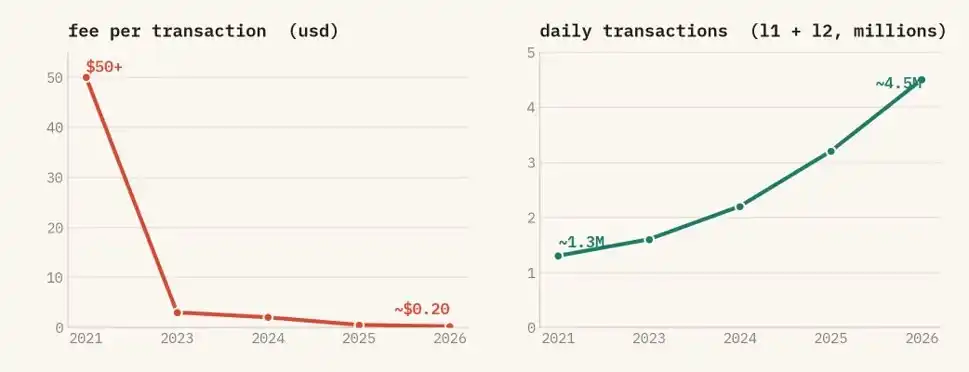
Ethereum's fees have plummeted, yet transaction volume is at a record high. It's become cheaper, and more people are using it. L2s now handle roughly 85% of the throughput.

So, if fees are the wrong metric, what is the right one?

Ethereum Is a Grand Treasury, ETH Is the Lock

Stop viewing Ethereum as a company; think of it as a massive treasury. This treasury holds approximately $160 billion in stablecoins, $20 billion in RWAs (like U.S. Treasuries, money market funds, and private credit), $35 billion in L2 cross-chain assets (with L2 networks inheriting Ethereum's consensus by design). Additionally, there's about $12 billion in wrapped Bitcoin and around $20 billion distributed across DeFi positions, NFTs, and on-chain treasuries. That totals roughly $250 billion in on-chain assets, growing each quarter.

The safety of the treasury depends entirely on that lock. And everyone has miscalculated the value of this lock. On Ethereum, this lock is forged from ETH.

In the old Proof-of-Work (PoW) system, you used mining hardware to secure the network. The lock was bought externally; its cost wasn't tied to the token's value. But now, with staking (PoS), everything has changed. To attack Ethereum now, you must buy and control the staked ETH. The lock is made from the token itself. This means the treasury's security level and the token's market price become one and the same. You can't separate them.

The Current State: A Lock Cheaper Than the Safe

This is the issue the market is ignoring. Today, the total value of all staked ETH protecting Ethereum is only $72 billion. But the assets it protects are worth $250 billion. The money in the safe is worth over twice as much as the lock protecting it.
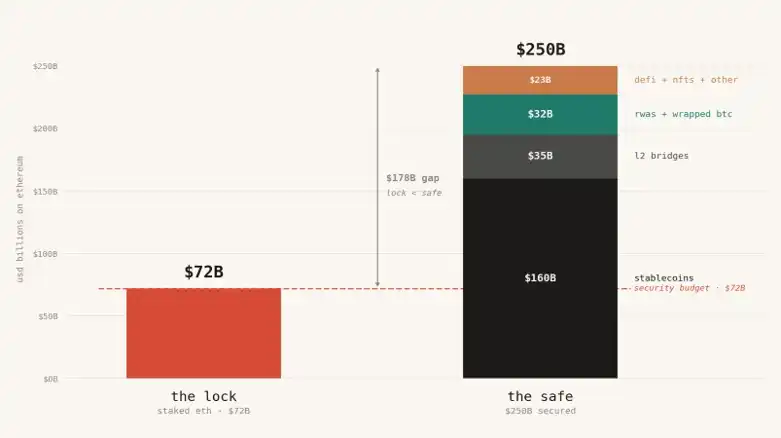
This is extremely dangerous. If what you're protecting is worth more than the cost of attacking it, your treasury is fundamentally insecure. For Ethereum to securely protect this $250 billion, the defensive staked capital must be greater than $250 billion, not less than one-third of it.

Currently, only about 30% of ETH is staked. So, simply to make this 30% stake equal the on-chain assets, ETH's total market capitalization would need to be over three times the on-chain assets (1 divided by 0.30). Currently, ETH's market cap is roughly equal to the assets it protects (around 1x). But by my logic, it should be over 3x. Calculating with the current $250 billion, ETH's fair price should be around $6,900, not the current $2,070. That is, even without a single new dollar entering, based solely on the assets it currently protects, ETH's price should more than triple. This aligns directionally with the model of BitMine Chairman Tom Lee.

"But Circle can freeze USDC, so it doesn't need ETH's protection at all."

Every time I say this, someone jumps in with this rebuttal, but it's fundamentally wrong. Here's why:

People think that if Ethereum is attacked, Circle, the issuer of USDC, can just freeze the attacker's address and reissue the tokens. So those hundreds of billions shouldn't count toward Ethereum's security responsibility.

But consider: Circle's freezing mechanism operates based on smart contracts; it executes on Ethereum and relies on Ethereum's ledger. If Ethereum's consensus is broken, there is no universally agreed-upon honest chain, and the freeze mechanism cannot function.

Furthermore, Circle could have chosen not to use Ethereum, opting for a private database instead. They chose Ethereum precisely for its neutrality, deep liquidity, and compatibility with other projects. Since they enjoy these benefits, the trade-off is: USDC's lifeline is tied to Ethereum's security. You want the benefits, you bear the dependency risk.

Moreover, people always assume the attacker wants to steal USDC. That's not it at all. If Ethereum collapses, that $150+ billion isn't stolen; it becomes trapped on a chain with no consensus, unable to be redeemed, with all loans and trades based on it thrown into chaos. The value of these assets isn't taken by a thief; it's destroyed. And that destroyed value is precisely the important factor for security considerations.

An attacker doesn't even need to steal money to profit. They can short ETH, short the entire ecosystem, or they could simply be a hostile actor profiting from paralyzing the network. The more money on-chain, the greater their incentive to cause destruction. Therefore, our security budget must grow alongside the total on-chain assets, not just guard against the small change a thief might steal.

As long as you put money on Ethereum, you consume its security, regardless of whether you have a "freeze" button. All the money must be counted.

"Ethereum is just Linux" or "Ethereum is DTCC."

Another rebuttal favored by the intellectually inclined.

  • First argument: Ethereum is like the Linux system. It's underlying infrastructure, powering the internet, but as an asset, it's worthless. Open-source infrastructure is a free public good; the money is made by the applications running on top, not the underlying protocol. So ETH will be the same: immensely important, yet utterly worthless.

  • Second argument: Ethereum is like DTCC (Depository Trust & Clearing Corporation), the infrastructure behind almost all U.S. securities transactions. DTCC processed $370 trillion in transactions in 2024, with revenues of about $2.5 billion but profits under $500 million. It's critically important, heavily regulated, but its value is only a tiny fraction of the transaction volume. Infrastructure is cheap; even if you can't live without it, even if Ethereum processes endless future transactions, it will only capture meager utility profits, nothing more.

Both arguments fail in the same place.

The security of Linux and DTCC is borrowed externally. Linux relies on the open-source community, reputation, and decades of code review. DTCC relies on U.S. law, federal regulators, and the backing of major banks with dollars and treasuries. Their security guarantees are outside the system. This is precisely why DTCC can settle massive wealth while capturing almost no value itself. It's a member-owned utility designed to operate at cost; it doesn't need a valuable token because trust is provided by the government and banks.

Ethereum has no such external shelter. No government enforces it. No member banks back it. No law can reverse stolen settlements. The only barrier between Ethereum and an attacker is the market value of the staked ETH used to secure it. Ethereum must purchase security for every block, in the open market, with its own asset.

This is the fundamental difference. Linux is software; no one is required to own a scarce asset to run it. DTCC provides collateral in dollars, external to itself. Ethereum's collateral is ETH, internal to itself. You cannot commoditize it to zero because security is not a line of code; it's a quantum of value that must be locked up and put at risk. Strip ETH of its value, and you haven't built a leaner Linux. You've built a chain with no collateral, one no one would trust with a single dollar.

So, stop comparing Ethereum to Linux or DTCC. You should compare it to the dollars and treasuries backing DTCC. No one values the dollar based on how many fees DTCC earns. You'd evaluate the clearing house's fees separately and evaluate the dollars and treasuries serving as the system's collateral—its monetary base—valued in trillions. ETH is not the clearing house. ETH is the collateral building the clearing house. That's the asset you're buying.

Linux never needed a treasury. Ethereum's security budget *is* a treasury, and it's denominated in ETH.

Looking Ahead and Market Dynamics

Following this line of thought. This model doesn't look at fees or market hype at all. It focuses on one core question: How much money will be settled on Ethereum in the future? To protect that money, how much must ETH be worth?

Stablecoins are poised to break $1 trillion in the coming years. RWA tokenization could reach several trillion by 2030. Add in various on-chain applications, and the assets Ethereum protects could soar from the current $250 billion to several trillion. Maintaining that "over 3x" security ratio constant, you can calculate how high ETH's price must rise as capital grows.
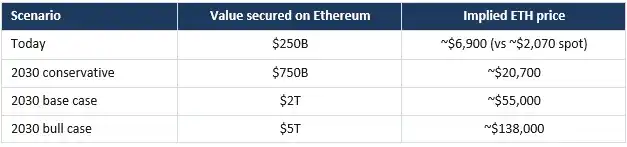
Even if you're more pessimistic and lower the security ratio a bit, it doesn't matter. On-chain capital is growing (that's the variable), and the security ratio (that's the leverage)—no matter how you calculate it, the trend is upward.

"This is blind optimism. The market will never price it this way."

This is the most pertinent rebuttal. Indeed, I'm saying what ETH "should" be worth, not what the market will price it at immediately. There's no forced arbitrage mechanism to close the gap. And my logic of "ETH should rise" has indeed been contradicted by its price performance over the past few years. Let's address each point.

  • About what bridges the gap: Ethereum is not an arbitrage; it's demand for the asset that prices the entire system. As value settles on Ethereum, ETH is used as collateral, paired trading asset, and staked to earn the network's base yield. This demand grows with the activity it supports. Reserve assets aren't priced on revenue; they're priced by how desperately the surrounding system needs to hold them. Gold is worth over $18 trillion without generating any cash flow. ETH is the reserve asset of on-chain finance, and this framework merely measures how large that reserve must be.

  • About the staking multiplier: My mental model treats the staking multiplier as a range, not a fixed target. At the current staking rate, parity (staked ETH equals protected value) is around 3.3x. A reasonable range spans from a lenient 1.7x to a strict 5x, where the cost to attack via a two-thirds stake equals the entire protected value. Price tracks protected value at some multiplier within this band. Fixing it to a specific number undermines rigor; this is also where rational people can disagree without breaking the model.

  • About reflexivity: The model does have more than one equilibrium, and nothing definitively selects the highest one. Today, Ethereum is secure enough with below-threshold coverage because acquiring a one-third stake is illiquid, slashing is brutally punitive, and the social layer can fork out an attacker. This is real. But these defenses determine whether an attack succeeds, not whether coverage is sufficient as risks escalate. Thin coverage may be tolerable when protecting $250 billion. When it involves two or five trillion in regulated institutional capital, coverage is no longer an academic question. The gradient to close the gap increases monotonically with adoption.

Finally, the most contradictory aspect is ETH's price over the past 5 years. Logically it should rise, but it has consistently fallen. I think the main reason is: previously, there wasn't enough money on-chain for people to see security as a major issue. When there was only $50 billion on-chain, nobody worried; when it grew to $175 billion, people started feeling uneasy; when it reaches $1 trillion, the first question large institutions ask before entering will undoubtedly be: "Is this chain secure?" And the answer to that question depends entirely on ETH's price. My model can't predict the exact day it will rise, but it tells you that as on-chain capital grows, this upward pressure will intensify. And "on-chain capital is growing" is a point even bears cannot deny.

Some counter with Bitcoin, saying Bitcoin's security budget is negligible compared to its market cap. But Bitcoin primarily protects itself. Ethereum protects other people's dollars and various assets—a far greater responsibility! And the trend is clear: more ETH is being staked, compliant products are continuously buying ETH, and as on-chain activity grows, the burn mechanism is constantly destroying ETH. All of this corroborates the demand growth I describe.

Those who only focus on fees and cash flow will continue shouting that ETH is overvalued. They've completely reversed cause and effect. On-chain activity comes first, and then security is needed. ETH must be valuable to secure the entire ecosystem. Fees are stumbling blocks you should strive to eliminate, not the chips you use to value ETH.

Preguntas relacionadas

QAccording to the article, why is it wrong to value Ethereum based on transaction fees?

AThe article argues that viewing transaction fees as revenue, akin to a company's income, is a flawed approach. Instead, fees are considered 'friction' or a 'tax' on the network. A successful settlement network aims to minimize this friction to encourage usage, not maximize it. The data shows that while average transaction fees have dropped significantly since 2021, transaction volume has tripled, indicating success, not failure.

QWhat is the central metaphor used to describe Ethereum's role and ETH's value in the new valuation framework?

AThe central metaphor is that Ethereum is a 'vault' or 'treasury' securing valuable assets, and ETH is the 'lock' on that vault. The security of the entire network is intrinsically linked to the market value of the staked ETH, which acts as the collateral that must be controlled or attacked to compromise the system.

QHow does the author justify the claim that Ethereum's current security budget (staked ETH value) is insufficient?

AThe author compares the total value of assets secured on Ethereum (estimated at $250 billion, including stablecoins, RWAs, L2 bridged funds, etc.) to the total value of staked ETH securing it (approximately $72 billion). This creates a dangerous imbalance where the 'lock' is cheaper than the contents of the 'vault.' For the network to be adequately secure, the defensive capital (staked ETH value) should be a multiple of the total value it protects.

QWhy does the author argue that comparing Ethereum to Linux or the DTCC is fundamentally incorrect?

AThe author states that both Linux and the DTCC derive their security and trust from external sources (open-source community reputation/government backing and legal/regulatory frameworks with bank guarantees, respectively). Ethereum has no such external backing; its only security is the market value of the staked ETH itself. Therefore, ETH cannot be commoditized to zero value because the network must 'buy' its security in the open market using its native asset.

QWhat is the primary driver for ETH's future price appreciation according to the 'treasury logic' framework presented?

AThe primary driver is the projected growth in the total value of assets settled and secured on the Ethereum network (e.g., stablecoins reaching trillions, tokenized RWAs). As this protected value increases, the market value of ETH must rise proportionally to maintain a sufficient security budget (the 'lock' must be valuable enough to protect the growing 'vault'). This creates a direct, non-speculative link between on-chain economic activity and ETH's valuation.

Lecturas Relacionadas

a16z: RWA Has Passed the Proof of Concept, but the Real Challenges Are Just Beginning

a16z highlights that the tokenized real-world asset (RWA) market, excluding stablecoins, has grown tenfold in under two years to roughly $340 billion. This surge is primarily driven by US Treasury bonds and gold, offering investors yield on idle stablecoins and providing institutions with more efficient settlement and collateral flows. However, the core insight is that most tokenized assets today are simply digital certificates for off-chain holdings—used for ownership and transfer but not deeply integrated into DeFi as composable financial building blocks. For instance, only about 5% of tokenized bonds ($8B) are actively used in DeFi protocols. Smaller categories like reinsurance tokens show much higher DeFi utilization (84%), indicating they were designed for on-chain composability from the start. The market remains concentrated, with US Treasuries and commodities comprising two-thirds of the total. Gold dominates the commodities segment. While Ethereum holds over half the market, activity is spreading across multiple chains like BNB Chain and Solana. Predictions for the market's future size vary widely (from $2 trillion to over $30 trillion by 2030/2034), reflecting different definitions of what constitutes tokenization. All agree on significant growth. The current market is minuscule compared to traditional finance (e.g., tokenized bonds are 0.01% of the global bond market). The key takeaway is that the initial "proof-of-concept" phase for moving familiar assets on-chain is proving successful. The next, harder challenge is moving more complex financial instruments onto blockchains and enabling true on-chain composability, where these assets become programmable components within a native digital financial system, rather than just digitized records.

marsbitHace 29 min(s)

a16z: RWA Has Passed the Proof of Concept, but the Real Challenges Are Just Beginning

marsbitHace 29 min(s)

The Wind of 'Proactive' AI Blows into Silicon Valley: Hark Secures $700 Million in Funding

Hark, an AI startup founded in late 2025, has raised $700 million in Series A funding at a $6 billion valuation. Led by Parkway Venture Capital with participation from NVIDIA, AMD Ventures, Intel Capital, Qualcomm Ventures, and Salesforce Ventures, the company aims to develop next-generation human-computer interfaces using a combination of proprietary foundational models and custom-built AI-native hardware. Founded by serial entrepreneur Brett Adcock, Hark envisions a system of multimodal devices equipped with agentic capabilities, end-to-end voice models, and personalized memory. This "active" AI approach seeks to move beyond passive chatbots, creating collaborative companions that anticipate needs and interact naturally within the real world. Adcock's experience with Figure, a humanoid robotics company, informs this hardware-focused venture. The article argues that while current AI is powerful, it remains confined to screens and traditional interfaces like chat. The next paradigm shift requires dedicated hardware that is always-on, possesses persistent memory, and enables intuitive interaction, potentially rivaling the impact of the iPhone. Hark is assembling a team with talent from Apple, Meta, Google, and Tesla to tackle this complex engineering challenge across models, hardware, and interaction design. Finally, the piece suggests Chinese startups may have an advantage in this "active" AI hardware space due to strong manufacturing ecosystems, a vast domestic market, and supportive government policies, framing the competition as one that requires integrated progress in models, operating systems, and devices.

marsbitHace 33 min(s)

The Wind of 'Proactive' AI Blows into Silicon Valley: Hark Secures $700 Million in Funding

marsbitHace 33 min(s)

Competitors Going Public, Kimi Can't Sit Still

Competitors Go Public, Kimi Feels the Pressure Yue Zhi An Mian (Moonshot AI), the company behind the AI assistant Kimi, has begun dismantling its VIE and red-chip structure, clearing a key obstacle for a potential Hong Kong IPO. This marks a significant shift from six months ago when founder Yang Zhilin stated the company was in "no hurry" to list. The move comes as rivals like Zhipu AI and MiniMax have successfully listed on the Hong Kong Stock Exchange in early 2026, experiencing massive surges in market value. This has reset valuation logic for AI companies, turning "going public" from an end goal into a competitive necessity. Analysts suggest Kimi is both seizing a favorable market window and responding to competitive pressure. Kimi's valuation has skyrocketed from around $3 billion at its 2023 founding to over $20 billion by May 2026. Capital is betting on its potential as a future AI platform and gateway, though some caution this "emotional valuation" depends on sustained technological leadership and successful commercialization. Traditionally focused on core model R&D over user growth, Kimi has recently pivoted strategy. While its monthly active users declined through 2025, it shifted focus to Agent development and reducing marketing spend. The release of its K2.5 model in early 2026 reportedly generated substantial revenue, with annual recurring revenue reaching $200 million by April, driven by subscriptions and API services. A $2 billion D-round financing in May signaled investor approval of this commercial shift. However, listing will bring new pressures. Experts predict a listed Kimi would face stricter scrutiny on financial controls, compliance, and R&D efficiency. The narrative must evolve from pure technological breakthroughs to demonstrating clear commercialization paths, sustainable income, and a defensible valuation, balancing model superiority with business performance.

marsbitHace 53 min(s)

Competitors Going Public, Kimi Can't Sit Still

marsbitHace 53 min(s)

Trading

Spot
Futuros

Artículos destacados

Qué es ETH 2.0

ETH 2.0: Una Nueva Era para Ethereum Introducción ETH 2.0, conocido ampliamente como Ethereum 2.0, marca una actualización monumental para la blockchain de Ethereum. Esta transición no es solo una mejora superficial; busca mejorar fundamentalmente la escalabilidad, seguridad y sostenibilidad de la red. Con un cambio del mecanismo de consenso intensivo en energía Prueba de Trabajo (PoW) a una Prueba de Participación (PoS) más eficiente, ETH 2.0 promete un enfoque transformador para el ecosistema blockchain. ¿Qué es ETH 2.0? ETH 2.0 es un conjunto de actualizaciones interconectadas y distintivas centradas en optimizar las capacidades y el rendimiento de Ethereum. La reestructuración está diseñada para abordar desafíos críticos que el mecanismo actual de Ethereum ha enfrentado, particularmente en lo que respecta a la velocidad de transacción y la congestión de la red. Objetivos de ETH 2.0 Los objetivos principales de ETH 2.0 giran en torno a mejorar tres aspectos clave: Escalabilidad: Con el objetivo de aumentar significativamente el número de transacciones que la red puede manejar por segundo, ETH 2.0 busca superar la limitación actual de aproximadamente 15 transacciones por segundo, potencialmente alcanzando miles. Seguridad: Las medidas de seguridad mejoradas son fundamentales para ETH 2.0, particularmente a través de una mejor resistencia contra ciberataques y la preservación del ethos descentralizado de Ethereum. Sostenibilidad: El nuevo mecanismo PoS está diseñado no solo para mejorar la eficiencia, sino también para reducir drásticamente el consumo de energía, alineando el marco operativo de Ethereum con consideraciones ambientales. ¿Quién es el Creador de ETH 2.0? La creación de ETH 2.0 se puede atribuir a la Fundación Ethereum. Esta organización sin fines de lucro, que desempeña un papel crucial en el apoyo al desarrollo de Ethereum, es liderada por el notable cofundador Vitalik Buterin. Su visión de un Ethereum más escalable y sostenible ha sido la fuerza motriz detrás de esta actualización, involucrando contribuciones de una comunidad global de desarrolladores y entusiastas dedicados a mejorar el protocolo. ¿Quiénes son los Inversores de ETH 2.0? Si bien los detalles sobre los inversores de ETH 2.0 no se han hecho públicos, se sabe que la Fundación Ethereum recibe apoyo de varias organizaciones e individuos en el ámbito de blockchain y tecnología. Estos socios incluyen firmas de capital de riesgo, compañías tecnológicas y organizaciones filantrópicas que comparten un interés mutuo en apoyar el desarrollo de tecnologías descentralizadas e infraestructura blockchain. ¿Cómo Funciona ETH 2.0? ETH 2.0 se distingue por introducir una serie de características clave que lo diferencian de su predecesor. Prueba de Participación (PoS) La transición a un mecanismo de consenso PoS es uno de los cambios más destacados de ETH 2.0. A diferencia de PoW, que se basa en la minería intensiva en energía para la verificación de transacciones, PoS permite a los usuarios validar transacciones y crear nuevos bloques de acuerdo con la cantidad de ETH que apuestan en la red. Esto conduce a una mayor eficiencia energética, reduciendo el consumo en aproximadamente un 99.95%, convirtiendo a Ethereum 2.0 en una alternativa considerablemente más verde. Cadenas Shard Las cadenas shard son otra innovación crítica de ETH 2.0. Estas cadenas más pequeñas operan en paralelo con la cadena principal de Ethereum, lo que permite que múltiples transacciones sean procesadas simultáneamente. Este enfoque mejora la capacidad general de la red, abordando las preocupaciones de escalabilidad que han afectado a Ethereum. Cadena Beacon En el núcleo de ETH 2.0 se encuentra la Cadena Beacon, que coordina la red y gestiona el protocolo PoS. Funciona como un organizador de cierta manera: supervisa a los validadores, asegura que los shards permanezcan conectados a la red y monitorea la salud general del ecosistema blockchain. Cronología de ETH 2.0 El viaje de ETH 2.0 ha estado marcado por varios hitos clave que trazan la evolución de esta importante actualización: Diciembre 2020: El lanzamiento de la Cadena Beacon marcó la introducción de PoS, preparándose para la migración hacia ETH 2.0. Septiembre 2022: La finalización de “La Fusión” representa un momento crucial en el que la red Ethereum se trasladó exitosamente de un marco PoW a uno PoS, anunciando una nueva era para Ethereum. 2023: El lanzamiento esperado de cadenas shard tiene como objetivo mejorar aún más la escalabilidad de la red Ethereum, consolidando a ETH 2.0 como una plataforma robusta para aplicaciones y servicios descentralizados. Características Clave y Beneficios Escalabilidad Mejorada Una de las ventajas más significativas de ETH 2.0 es su escalabilidad mejorada. La combinación de PoS y cadenas shard permite que la red expanda su capacidad, permitiendo acomodar un volumen mucho mayor de transacciones en comparación con el sistema heredado. Eficiencia Energética La implementación de PoS representa un gran paso hacia la eficiencia energética en la tecnología blockchain. Al reducir drásticamente el consumo de energía, ETH 2.0 no solo disminuye los costos operativos, sino que también se alinea más estrechamente con los objetivos de sostenibilidad global. Seguridad Mejorada Los mecanismos actualizados de ETH 2.0 contribuyen a mejorar la seguridad en toda la red. El despliegue de PoS, junto con las medidas de control innovadoras establecidas a través de cadenas shard y la Cadena Beacon, asegura un mayor grado de protección contra posibles amenazas. Costos Más Bajos para los Usuarios A medida que la escalabilidad mejora, los efectos sobre los costos de transacción también serán evidentes. Se espera que una mayor capacidad y una menor congestión se traduzcan en tarifas más bajas para los usuarios, haciendo que Ethereum sea más accesible para transacciones cotidianas. Conclusión ETH 2.0 marca una evolución significativa en el ecosistema blockchain de Ethereum. A medida que aborda problemas fundamentales como la escalabilidad, el consumo de energía, la eficiencia en las transacciones y la seguridad general, la importancia de esta actualización no puede ser subestimada. La transición a la Prueba de Participación, la introducción de cadenas shard y el trabajo fundamental de la Cadena Beacon son indicativos de un futuro donde Ethereum puede satisfacer las crecientes demandas del mercado descentralizado. En una industria impulsada por la innovación y el progreso, ETH 2.0 se erige como un testimonio de las capacidades de la tecnología blockchain para allanar el camino hacia una economía digital más sostenible y eficiente.

166 Vistas totalesPublicado en 2024.04.04Actualizado en 2024.12.03

Qué es ETH 2.0

Qué es ETH 3.0

ETH3.0 y $eth 3.0: Un Examen Profundo del Futuro de Ethereum Introducción En el paisaje en rápida evolución de las criptomonedas y la tecnología blockchain, ETH3.0, a menudo denotado como $eth 3.0, ha surgido como un tema de considerable interés y especulación. El término abarca dos conceptos principales que merecen aclaración: Ethereum 3.0: Esto representa una posible actualización futura destinada a aumentar las capacidades de la blockchain existente de Ethereum, enfocándose particularmente en mejorar la escalabilidad y el rendimiento. ETH3.0 Meme Token: Este proyecto de criptomoneda distinto busca aprovechar la blockchain de Ethereum para crear un ecosistema centrado en memes, promoviendo la participación dentro de la comunidad de criptomonedas. Comprender estos aspectos de ETH3.0 es esencial no solo para los entusiastas de las criptomonedas, sino también para aquellos que observan tendencias tecnológicas más amplias en el espacio digital. ¿Qué es ETH3.0? Ethereum 3.0 Ethereum 3.0 se presenta como una actualización propuesta para la red de Ethereum ya establecida, que ha sido la columna vertebral de muchas aplicaciones descentralizadas (dApps) y contratos inteligentes desde su inicio. Las mejoras previstas se concentran principalmente en la escalabilidad, integrando tecnologías avanzadas como sharding y pruebas de conocimiento cero (zk-proofs). Estas innovaciones tecnológicas tienen como objetivo facilitar un número sin precedentes de transacciones por segundo (TPS), potencialmente alcanzando millones, abordando así una de las limitaciones más significativas que enfrenta la tecnología blockchain actual. La mejora no es meramente técnica, sino también estratégica; está destinada a preparar la red de Ethereum para su adopción generalizada y utilidad en un futuro marcado por una mayor demanda de soluciones descentralizadas. ETH3.0 Meme Token En contraste con Ethereum 3.0, el ETH3.0 Meme Token se aventura en un ámbito más ligero y juguetón al combinar la cultura de memes de internet con la dinámica de las criptomonedas. Este proyecto permite a los usuarios comprar, vender e intercambiar memes en la blockchain de Ethereum, proporcionando una plataforma que fomenta la participación comunitaria a través de la creatividad y los intereses compartidos. El ETH3.0 Meme Token tiene como objetivo demostrar cómo la tecnología blockchain puede intersectarse con la cultura digital, creando casos de uso que son tanto entretenidos como financieramente viables. ¿Quién es el Creador de ETH3.0? Ethereum 3.0 La iniciativa hacia Ethereum 3.0 es impulsada principalmente por un consorcio de desarrolladores e investigadores dentro de la comunidad de Ethereum, incluyendo notablemente a Justin Drake. Conocido por sus ideas y contribuciones a la evolución de Ethereum, Drake ha sido una figura prominente en las discusiones sobre la transición de Ethereum a una nueva capa de consenso, denominada “Beam Chain.” Este enfoque colaborativo para el desarrollo significa que Ethereum 3.0 no es el producto de un creador singular, sino más bien una manifestación de ingenio colectivo centrado en avanzar la tecnología blockchain. ETH3.0 Meme Token Los detalles sobre el creador del ETH3.0 Meme Token son actualmente inidentificables. La naturaleza de los tokens de memes a menudo conduce a una estructura más descentralizada y dirigida por la comunidad, lo que podría explicar la falta de atribución específica. Esto se alinea con la ética de la comunidad cripto más amplia, donde la innovación a menudo surge de esfuerzos colaborativos en lugar de individuales. ¿Quiénes son los Inversores de ETH3.0? Ethereum 3.0 El apoyo a Ethereum 3.0 proviene principalmente de la Fundación Ethereum junto con una entusiasta comunidad de desarrolladores e inversores. Esta asociación fundamental proporciona un grado significativo de legitimidad y mejora la perspectiva de una implementación exitosa, ya que aprovecha la confianza y credibilidad construidas a lo largo de años de operaciones en la red. En el clima cambiando rápidamente de las criptomonedas, el apoyo de la comunidad juega un papel crucial en impulsar el desarrollo y la adopción, posicionando a Ethereum 3.0 como un contendiente serio para futuros avances en blockchain. ETH3.0 Meme Token Si bien las fuentes actualmente disponibles no proporcionan información explícita sobre las fundaciones o organizaciones de inversión que respaldan el ETH3.0 Meme Token, es indicativo del modelo de financiamiento típico para tokens de memes, que a menudo depende del apoyo de base y la participación comunitaria. Los inversores en tales proyectos suelen consistir en individuos motivados por el potencial de innovación impulsada por la comunidad y el espíritu de cooperación que se encuentra dentro de la comunidad cripto. ¿Cómo Funciona ETH3.0? Ethereum 3.0 Las características distintivas de Ethereum 3.0 radican en su implementación propuesta de sharding y tecnología zk-proof. Sharding es un método de particionamiento de la blockchain en piezas más pequeñas y manejables o “shards,” que pueden procesar transacciones de manera concurrente en lugar de secuencial. Esta descentralización del procesamiento ayuda a prevenir la congestión y asegura que la red permanezca receptiva incluso bajo una carga pesada. La tecnología de prueba de conocimiento cero (zk-proof) contribuye con otra capa de sofisticación al permitir la validación de transacciones sin revelar los datos subyacentes involucrados. Este aspecto no solo mejora la privacidad, sino que también aumenta la eficiencia general de la red. También se habla de incorporar una Máquina Virtual de Ethereum de conocimiento cero (zkEVM) en esta actualización, amplificando aún más las capacidades y utilidad de la red. ETH3.0 Meme Token El ETH3.0 Meme Token se distingue al capitalizar la popularidad de la cultura de memes. Establece un mercado para que los usuarios participen en el comercio de memes, no solo por entretenimiento sino también por el posible beneficio económico. Al integrar características como staking, provisión de liquidez y mecanismos de gobernanza, el proyecto fomenta un entorno que incentiva la interacción y participación de la comunidad. Al ofrecer una mezcla única de entretenimiento y oportunidad económica, el ETH3.0 Meme Token tiene como objetivo atraer a una audiencia diversa, que abarca desde entusiastas de las criptomonedas hasta conocedores casuales de memes. Línea de Tiempo de ETH3.0 Ethereum 3.0 11 de noviembre de 2024: Justin Drake insinúa la próxima actualización de ETH 3.0, centrada en mejoras de escalabilidad. Este anuncio significa el comienzo de las discusiones formales sobre la futura arquitectura de Ethereum. 12 de noviembre de 2024: Se espera que la propuesta anticipada para Ethereum 3.0 se desvele en Devcon en Bangkok, preparando el escenario para una mayor retroalimentación de la comunidad y posibles próximos pasos en el desarrollo. ETH3.0 Meme Token 21 de marzo de 2024: El ETH3.0 Meme Token se lista oficialmente en CoinMarketCap, marcando su incursión en el dominio público de las criptomonedas y mejorando la visibilidad de su ecosistema basado en memes. Puntos Clave En conclusión, Ethereum 3.0 representa una evolución significativa dentro de la red de Ethereum, enfocándose en superar las limitaciones en términos de escalabilidad y rendimiento a través de tecnologías avanzadas. Sus actualizaciones propuestas reflejan un enfoque proactivo hacia las demandas y la usabilidad futura. Por otro lado, el ETH3.0 Meme Token encapsula la esencia de la cultura impulsada por la comunidad en el espacio de las criptomonedas, aprovechando la cultura de memes para crear plataformas atractivas que fomentan la creatividad y participación del usuario. Comprender los distintos propósitos y funcionalidades de ETH3.0 y $eth 3.0 es fundamental para cualquiera interesado en los desarrollos en curso dentro del espacio cripto. Con ambas iniciativas abriendo caminos únicos, subrayan colectivamente la naturaleza dinámica y multifacética de la innovación en blockchain.

178 Vistas totalesPublicado en 2024.04.04Actualizado en 2024.12.03

Qué es ETH 3.0

Cómo comprar ETH

¡Bienvenido a HTX.com! Hemos hecho que comprar Ethereum (ETH) sea simple y conveniente. Sigue nuestra guía paso a paso para iniciar tu viaje de criptos.Paso 1: crea tu cuenta HTXUtiliza tu correo electrónico o número de teléfono para registrarte y obtener una cuenta gratuita en HTX. Experimenta un proceso de registro sin complicaciones y desbloquea todas las funciones.Obtener mi cuentaPaso 2: ve a Comprar cripto y elige tu método de pagoTarjeta de crédito/débito: usa tu Visa o Mastercard para comprar Ethereum (ETH) al instante.Saldo: utiliza fondos del saldo de tu cuenta HTX para tradear sin problemas.Terceros: hemos agregado métodos de pago populares como Google Pay y Apple Pay para mejorar la comodidad.P2P: tradear directamente con otros usuarios en HTX.Over-the-Counter (OTC): ofrecemos servicios personalizados y tipos de cambio competitivos para los traders.Paso 3: guarda tu Ethereum (ETH)Después de comprar tu Ethereum (ETH), guárdalo en tu cuenta HTX. Alternativamente, puedes enviarlo a otro lugar mediante transferencia blockchain o utilizarlo para tradear otras criptomonedas.Paso 4: tradear Ethereum (ETH)Tradear fácilmente con Ethereum (ETH) en HTX's mercado spot. Simplemente accede a tu cuenta, selecciona tu par de trading, ejecuta tus trades y monitorea en tiempo real. Ofrecemos una experiencia fácil de usar tanto para principiantes como para traders experimentados.

4.1k Vistas totalesPublicado en 2024.12.10Actualizado en 2025.03.21

Cómo comprar ETH

Discusiones

Bienvenido a la comunidad de HTX. Aquí puedes mantenerte informado sobre los últimos desarrollos de la plataforma y acceder a análisis profesionales del mercado. A continuación se presentan las opiniones de los usuarios sobre el precio de ETH (ETH).

活动图片