Why Chainlink’s $32.6M whale move could shape LINK’s push toward $9

ambcryptoPublicado a 2026-07-20Actualizado a 2026-07-20

Resumen

A transfer of 3.89 million Chainlink (LINK) tokens worth $32.58 million from a Coinbase Institutional wallet to an unknown address drew significant attention, sparking speculation about strategic accumulation by large holders. This coincided with Chainlink's spot exchange netflows turning positive after a prolonged period of outflows, indicating a slight increase in tokens moving to exchanges. However, the overall selling pressure remained limited. Despite improving spot market activity and a price recovery to around $8.35, derivatives data revealed persistent bearish sentiment among futures traders, creating uncertainty. Technically, LINK faces resistance near $8.35. A successful break above this level could target $9, while a rejection might lead to a retest of support near $8.18. The article concludes that while institutional activity and spot buying are supportive, cautious futures positioning continues to challenge the recovery.

A transfer involving 3.89 million Chainlink [LINK] worth $32.58 million drew fresh attention to Chainlink after Whale Alert flagged the transaction. The tokens moved from a Coinbase Institutional wallet to an unknown wallet, encouraging speculation about strategic positioning among large holders rather than immediate exchange selling.

Such transfers often reflect changes in custody or portfolio management rather than outright distribution. However, the movement still highlighted growing institutional participation around LINK.

Large transactions frequently influence market sentiment because traders monitor them for signs of accumulation or distribution. As a result, the transfer placed Chainlink back on investors’ watchlists while the market assessed whether whale activity would support the ongoing recovery.

Exchange inflows returned after months of out flows

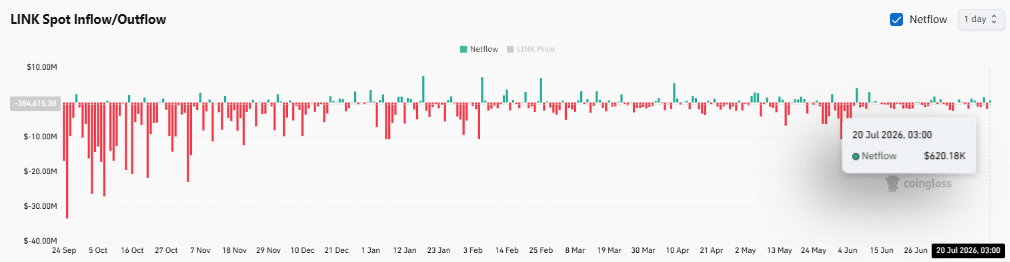
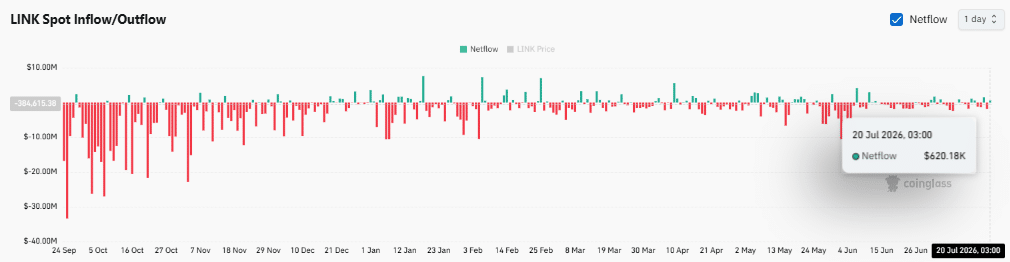
Chainlink’s spot netflows shifted into positive territory after recording an inflow of approximately $620.18K.

The change marked a notable departure from the prolonged period of exchange outflows that had previously reduced available selling supply. Positive netflows indicate that more tokens reached exchanges than left them during the latest session.

However, the relatively modest inflow suggested that exchange-bound supply remained limited instead of overwhelming the market. Even so, the latest reading reflected a change in short-term market behavior, making exchange activity an important metric for assessing LINK’s next directional move.
Source: CoinGlass

Can bearish futures sentiment derail LINK’s recovery?

Derivatives traders maintained a cautious stance despite improving activity in the spot market.

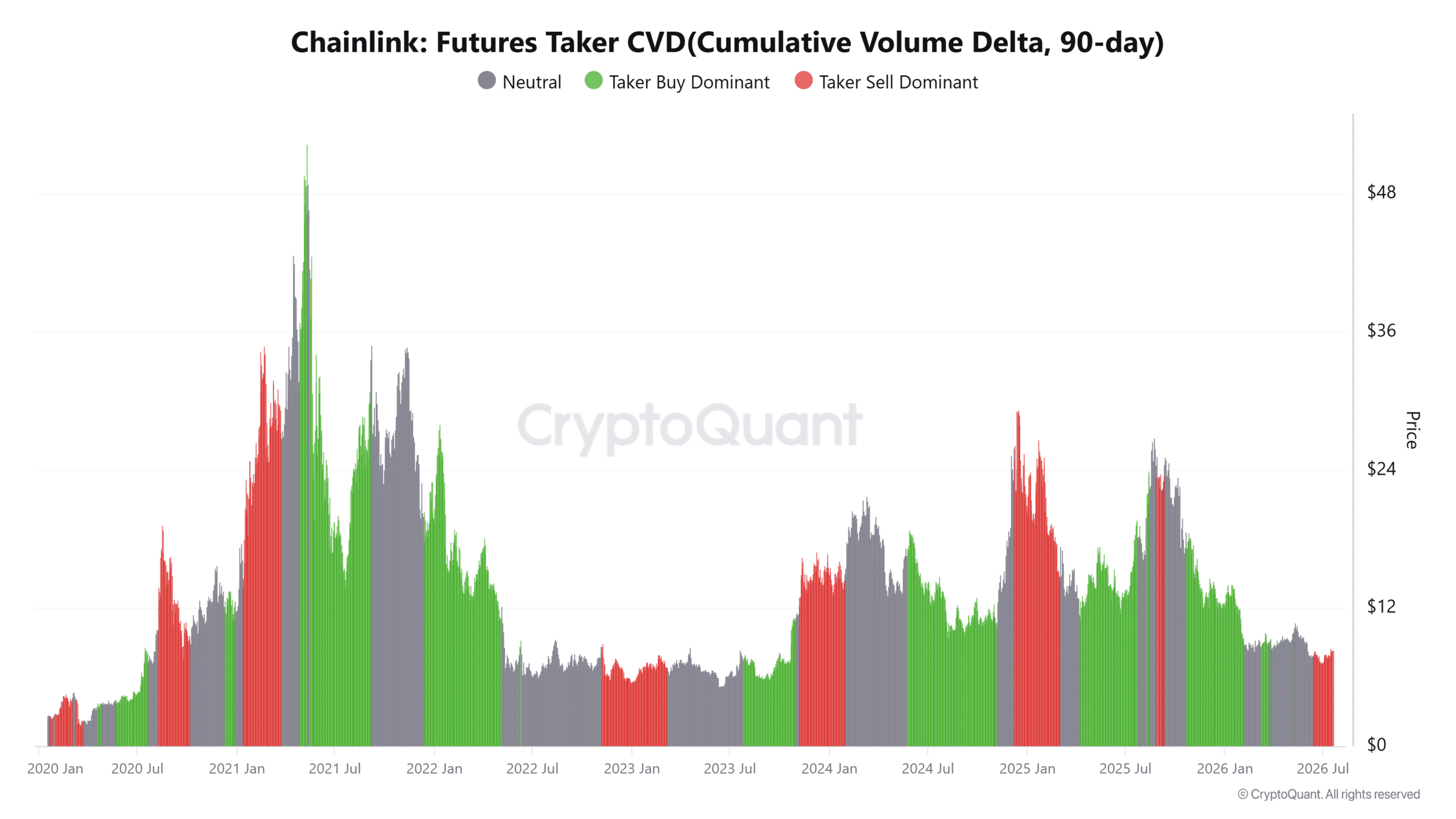
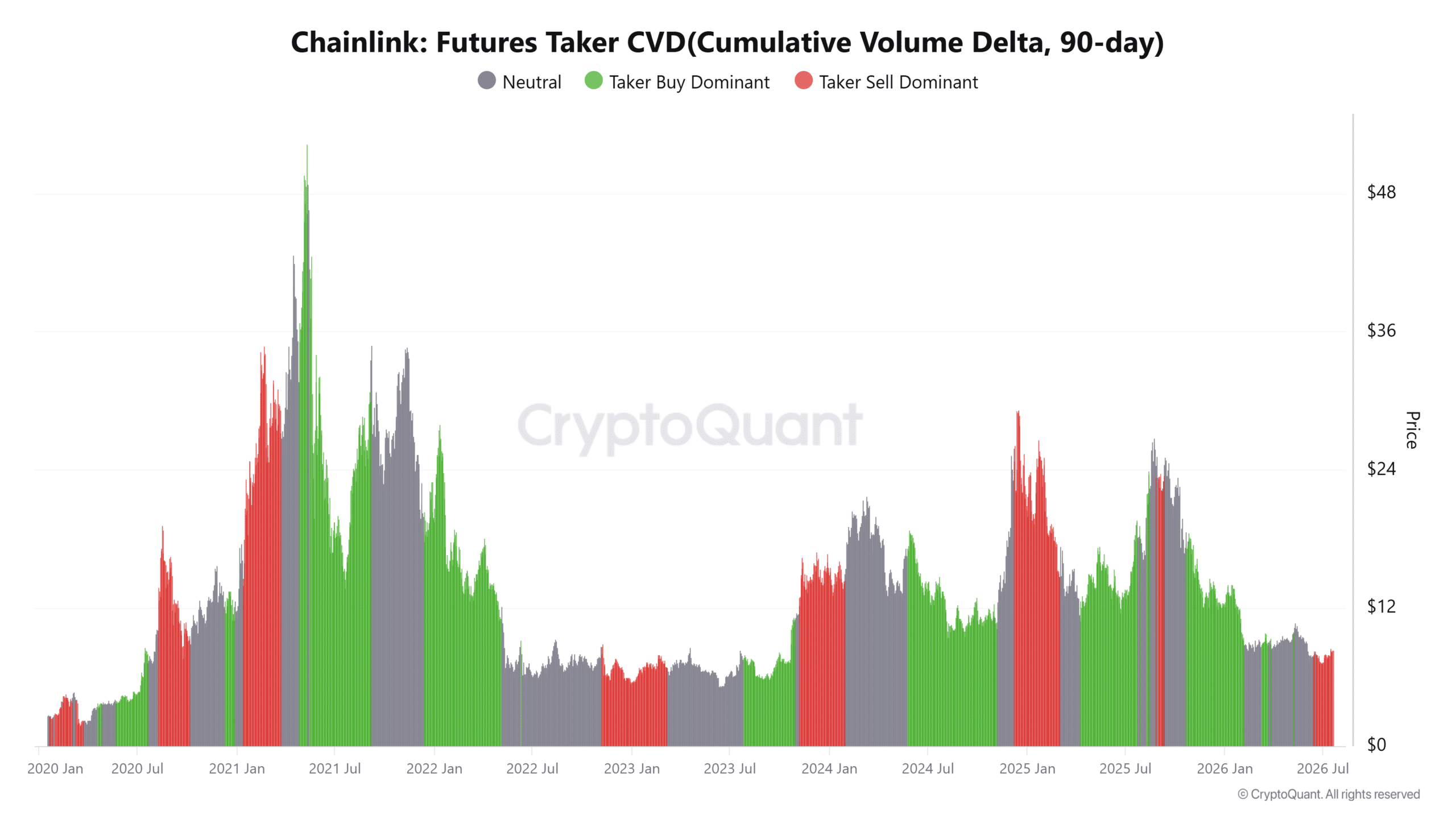
At press time, the 90-day Futures Taker CVD remained seller-dominant, indicating that aggressive market participants continued executing more sell orders than buy orders.

This imbalance suggested bearish conviction persisted among leveraged traders even as institutional wallet activity attracted attention. However, the divergence between spot positioning and futures activity created uncertainty around LINK’s short-term outlook.

Spot participants appeared willing to absorb supply, while futures traders continued favoring downside exposure. Such contrasting behavior often preceded stronger volatility because either buyers eventually overwhelmed sellers or derivatives sentiment pulled prices lower.
Source: CryptoQuant

Chainlink tests resistance as RSI continues improving

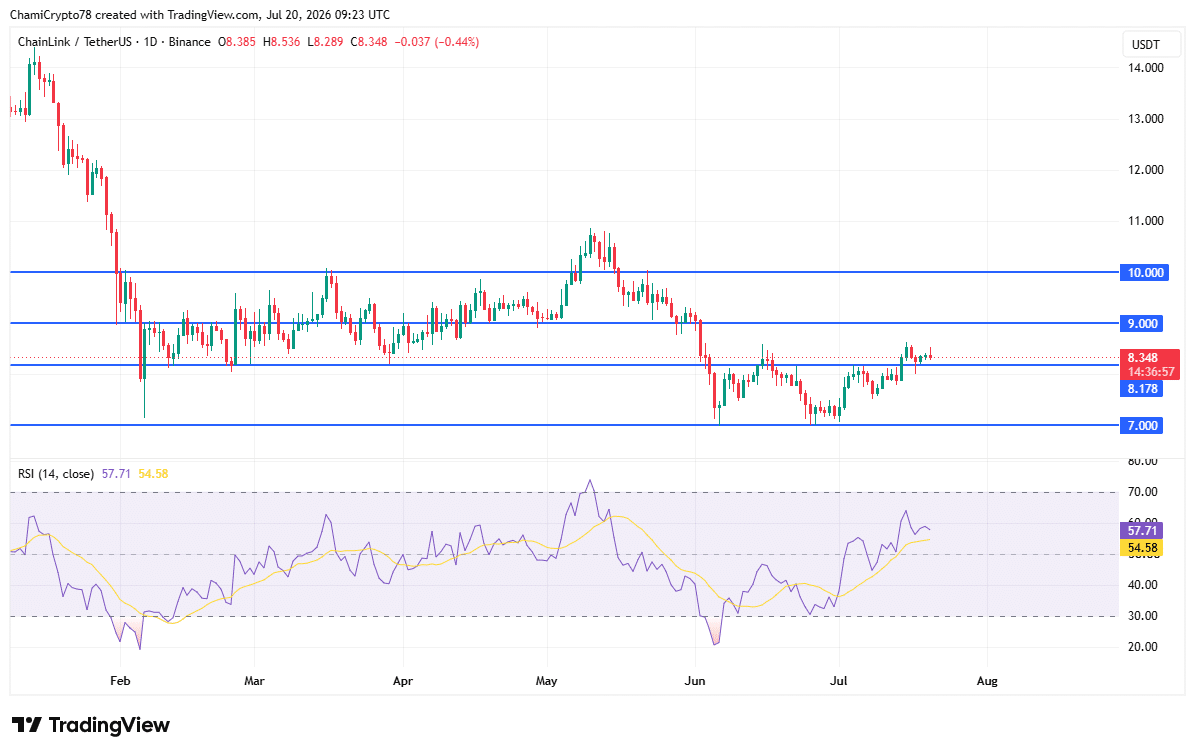
At the time of press, Chainlink [LINK] traded around $8.35 after extending its recovery from the $7.00 support region.

Buyers reclaimed the $8.18 level and pushed the price toward immediate resistance near $8.35, although that area continued limiting further advances.

A successful break above this zone would likely expose $9.00, while sustained buying could later bring $10.00 into focus. However, rejection at current levels could encourage another retest of $8.18 before buyers attempted another advance.

Meanwhile, the Relative Strength Index (RSI) climbed to 57.71 as of writing, remaining above its Moving Average near 54.58. The indicator reflected strengthening buying pressure without entering overbought territory.

As a result, the technical structure favored continued recovery, provided buyers reclaim nearby resistance with stronger participation.
Source: TradingView

To conclude, institutional wallet activity increased attention around Chainlink, while spot netflows shifted back into positive territory. However, seller-dominant futures positioning continued to signal caution.

If buyers clear the $8.35 resistance, LINK would likely challenge $9.00 next. Otherwise, another pullback toward $8.18 would remain the more likely short-term outcome.


Final Summary

  • Institutional wallet activity increased, while positive netflows reflected more LINK returning to exchanges.
  • LINK approached a key resistance, but bearish futures traders continued limiting the recovery.

Criptos en tendencia

Preguntas relacionadas

QWhat was the significance of the $32.58 million Chainlink (LINK) transfer flagged by Whale Alert?

AThe transfer of 3.89 million LINK from a Coinbase Institutional wallet to an unknown wallet drew attention to growing institutional participation. It encouraged speculation about strategic positioning by large holders rather than immediate selling pressure, influencing market sentiment.

QHow did Chainlink's spot netflows change according to the article, and what does it indicate?

AChainlink's spot netflows shifted into positive territory with an inflow of approximately $620.18K. This marked a departure from a prolonged period of outflows. While positive netflows indicate more tokens reached exchanges than left them, the modest size suggests the supply increase was limited and not overwhelming the market.

QWhat does the seller-dominant 90-day Futures Taker CVD indicate about market sentiment?

AThe seller-dominant 90-day Futures Taker CVD indicates that aggressive leveraged traders executed more sell orders than buy orders. This shows bearish conviction persisted among futures traders, creating uncertainty and contrasting with more positive spot market activity.

QWhat key price levels are discussed for Chainlink (LINK) in the technical analysis?

ALINK was trading around $8.35, having reclaimed the $8.18 support. Immediate resistance was near $8.35. A break above this zone could expose $9.00 and later $10.00. A rejection could lead to a retest of $8.18.

QWhat was the state of the Relative Strength Index (RSI) for LINK, and what does it suggest?

AThe RSI climbed to 57.71, remaining above its Moving Average at 54.58. This indicates strengthening buying pressure without the asset entering overbought territory, which favored a continued recovery provided buyers can overcome nearby resistance with stronger participation.

Lecturas Relacionadas

L2 'Recalibration': When L1 Becomes Its Own Rollup, What Is Ethereum's Endgame?

The article discusses the evolving relationship between Ethereum's Layer 1 (L1) and Layer 2 (L2) solutions, moving beyond the initial "L2 for scaling" model. As Ethereum L1 itself scales (increasing Gas Limit, statelessness, zkEVM), the unique value proposition of L2s shifts from merely providing cheap execution to offering differentiated features like application-specific optimization, privacy, and flexible governance. The piece explores three key themes: 1. **L2's New Role:** L2s are transitioning from a pure scaling technology to a spectrum of execution environments with varying degrees of security inheritance from Ethereum L1. 2. **Interoperability as State Trust:** Solving L2 fragmentation is less about cross-chain bridges and more about enabling faster, trust-minimized state verification between environments. This involves initiatives like faster L1 finality, intent-based architectures (Open Intents Framework), and native account abstraction. 3. **Blurring Layers:** With the potential integration of zk-proofs into L1 validation (making L1 akin to its own "Rollup") and the concept of "Native Rollups," the rigid boundary between L1 and L2 may fade. The future could be a unified system with multiple execution domains (for DeFi, gaming, privacy, etc.) sharing a common security, settlement, and state framework. In conclusion, Ethereum's goal is not to abandon L2s or re-centralize everything on L1, but to re-integrate the fragmented user experience—liquidity, accounts, applications—while preserving the scaling benefits of a multi-environment ecosystem. The endgame is a cohesive "one chain" feeling for users, powered by diverse but securely interconnected execution layers.

marsbitHace 8 min(s)

L2 'Recalibration': When L1 Becomes Its Own Rollup, What Is Ethereum's Endgame?

marsbitHace 8 min(s)

The Encryption Bill Clarity's Challenge: A Thorny Path of Bipartisan Compromise in the U.S.

U.S. lawmakers are attempting to advance the Clarity Act, a significant crypto market structure bill, but its path is fraught with partisan hurdles. The process has been rocky since January, when a prior bipartisan deal in the Senate Banking Committee was upended. A key compromise in May on "yield" issues allowed the bill to move forward in committee, but only with the conditional support of two Democratic senators, Angela Alsobrooks and Ruben Gallego. They emphasized that their final vote depends on reaching an agreement on ethics provisions for elected officials. Ultimately, the Senate Agriculture Committee passed its version along party lines without Democratic support. As Republicans push for a full Senate vote in July, the demand for strong ethics language has expanded beyond Democrats. Additional controversies surround provisions related to yields (aligning some Republicans with large banks) and developer protections (opposed by enforcement agencies). Core concerns about illicit finance and consumer protection remain central to the debate. Despite consensus on the need for legislation, achieving the necessary bipartisan compromise is proving difficult. While momentum exists—including recent meetings between senators and White House officials—a reconciled bill text faces skepticism. Senator Gallego has stated that without ethics terms acceptable to Democrats, they will not provide the needed votes. The immediate goals for the crypto community in Congress are unclear: a symbolic Senate vote before the August recess, eventual passage into law by 2026, or forging a final compromise framework. The arduous, vote-by-vote effort to build bipartisan support continues, mirroring the traditional legislative grind the industry must now navigate.

Foresight NewsHace 59 min(s)

The Encryption Bill Clarity's Challenge: A Thorny Path of Bipartisan Compromise in the U.S.

Foresight NewsHace 59 min(s)

Trading

Spot

Artículos destacados

Cómo comprar MOVE

¡Bienvenido a HTX.com! Hemos hecho que comprar Movement (MOVE) sea simple y conveniente. Sigue nuestra guía paso a paso para iniciar tu viaje de criptos.Paso 1: crea tu cuenta HTXUtiliza tu correo electrónico o número de teléfono para registrarte y obtener una cuenta gratuita en HTX. Experimenta un proceso de registro sin complicaciones y desbloquea todas las funciones.Obtener mi cuentaPaso 2: ve a Comprar cripto y elige tu método de pagoTarjeta de crédito/débito: usa tu Visa o Mastercard para comprar Movement (MOVE) al instante.Saldo: utiliza fondos del saldo de tu cuenta HTX para tradear sin problemas.Terceros: hemos agregado métodos de pago populares como Google Pay y Apple Pay para mejorar la comodidad.P2P: tradear directamente con otros usuarios en HTX.Over-the-Counter (OTC): ofrecemos servicios personalizados y tipos de cambio competitivos para los traders.Paso 3: guarda tu Movement (MOVE)Después de comprar tu Movement (MOVE), guárdalo en tu cuenta HTX. Alternativamente, puedes enviarlo a otro lugar mediante transferencia blockchain o utilizarlo para tradear otras criptomonedas.Paso 4: tradear Movement (MOVE)Tradear fácilmente con Movement (MOVE) en HTX's mercado spot. Simplemente accede a tu cuenta, selecciona tu par de trading, ejecuta tus trades y monitorea en tiempo real. Ofrecemos una experiencia fácil de usar tanto para principiantes como para traders experimentados.

303 Vistas totalesPublicado en 2024.12.13Actualizado en 2026.06.02

Cómo comprar MOVE

Discusiones

Bienvenido a la comunidad de HTX. Aquí puedes mantenerte informado sobre los últimos desarrollos de la plataforma y acceder a análisis profesionales del mercado. A continuación se presentan las opiniones de los usuarios sobre el precio de MOVE (MOVE).

活动图片