Bitcoin Hits 20-Month Low as Largest Bull Suffers $15 Billion Paper Loss

Foresight NewsPublicado a 2026-06-26Actualizado a 2026-06-26

Resumen

Bitcoin Hits 20-Month Low as Major Bull Loses $15 Billion On June 25th, Bitcoin fell below $60,000, hitting a low of $58,030—its lowest level since October 2024. The sell-off triggered over $1 billion in leveraged liquidations in 24 hours, with longs accounting for $788 million. This marks a more than 53% decline from the October 2025 all-time high of $126,198. A critical factor in the downturn is the weakening position of MicroStrategy, the largest corporate Bitcoin holder. With 847,363 BTC at an average cost of $75,651, the company now faces over $14.6 billion in unrealized losses. Its core financing flywheel—raising capital to buy Bitcoin—is stalling. Its variable-rate preferred shares (STRC), a key fundraising tool, have fallen 25% below their $100 target. This raises doubts about its ability to continue providing steady institutional demand for Bitcoin. Simultaneously, U.S. spot Bitcoin ETFs are experiencing significant outflows, with a single-day net outflow of $469 million on June 24th. This represents the most severe sustained capital flight since their launch. The macroeconomic backdrop remains restrictive, with persistent inflation delaying expected Fed rate cuts. Analysts note a shift in capital allocation, with institutional funds moving away from crypto towards AI infrastructure stocks. Immediate pressure comes from approximately $10 billion worth of Bitcoin options expiring on June 26th, which could increase market volatility. The combined effect of these fa...


By: ChandlerZ, Foresight News


On June 25, Bitcoin officially broke below the $60,000 level, hitting an intraday low of $58,030, marking its lowest point since October 2024. ETH fell in sync to $1,519, SOL traded at $65.99, with major assets across the board under pressure.


Data from Coinglass shows that over $1 billion in leveraged positions were liquidated in the past 24 hours, with long positions accounting for $788 million. The Fear & Greed Index dropped to 15, entering the Extreme Fear zone.
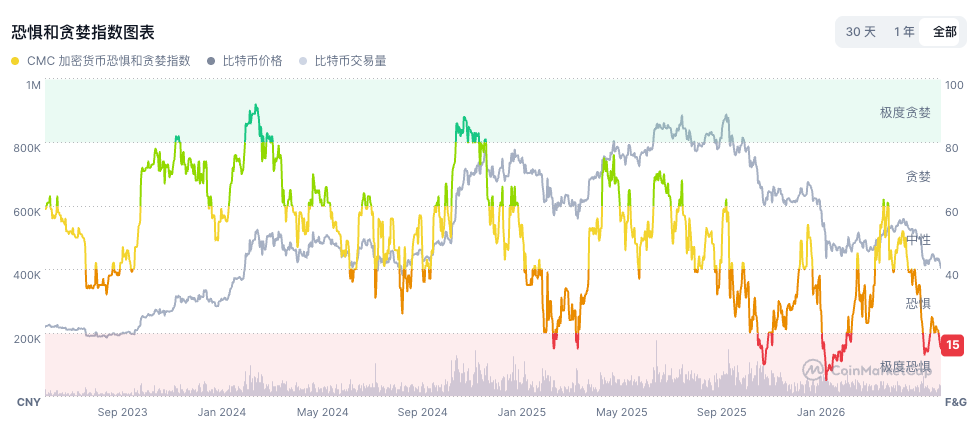


From its all-time high of $126,198 in October 2025, Bitcoin has now retreated more than 53%, with the bear market extending into its 8th month.


The bullish logic for Bitcoin over the past two years rested on two key pillars. First, the flywheel model represented by companies like Strategy continuously buying Bitcoin through securities financing. Second, the influx of large-scale institutional capital following the launch of US spot ETFs. These two channels together built the demand foundation for Bitcoin's last bull run. The current problem is that both pillars are simultaneously weakening.


Strategy's Financing Flywheel Continues to Lose Momentum


The most noteworthy variable in this decline is Strategy, the world's largest corporate holder of Bitcoin.


As of June 21, Strategy holds 847,363 bitcoins with an average cost basis of approximately $75,651, resulting in a paper loss exceeding $14.6 billion at current prices. Over the past few years, the company's core strategy has been to raise funds through issuing equity and preferred shares to continuously purchase Bitcoin. This cycle of "issuing securities, buying Bitcoin, pushing up the price, supporting the stock price, and issuing more securities" made it one of the most stable sources of institutional buying in the Bitcoin market and once propelled MSTR's stock price above $457 in 2024.


However, the key gears of this flywheel are slipping. In July 2025, Strategy completed a $2.5 billion IPO for a variable-rate preferred stock, STRC, designed to trade anchored to its $100 face value, with the company able to adjust the dividend rate monthly to maintain the peg. STRC was positioned as a financing product for the mass market, aiming to attract ordinary investors to participate indirectly in Bitcoin investment with lower volatility.


Since its debut, STRC has been consistently weak, falling to a historic low of about $75 on June 25, a 25% discount to its face value. According to its terms, if STRC falls below $95, it automatically triggers a 0.5% interest rate increase; its current annualized dividend yield has climbed to about 11.5%, increasing annual dividend expenses by approximately $53 million. The company's cash reserve is about $1.4 billion, sufficient to cover just over a year of dividend payments.


Andreja Cobeljic, Head of Derivatives Trading at Amina Bank, analyzed that while the direct cause of Bitcoin's current decline is a weakening market cycle, the deeper driver is the impact on the credibility of Strategy's strategy. If STRC continues to fail to return to its face value, Strategy's ability to raise funds through this channel to buy Bitcoin will be severely weakened, potentially cutting off what has been the most important incremental funding source for the Bitcoin market over the past two years.
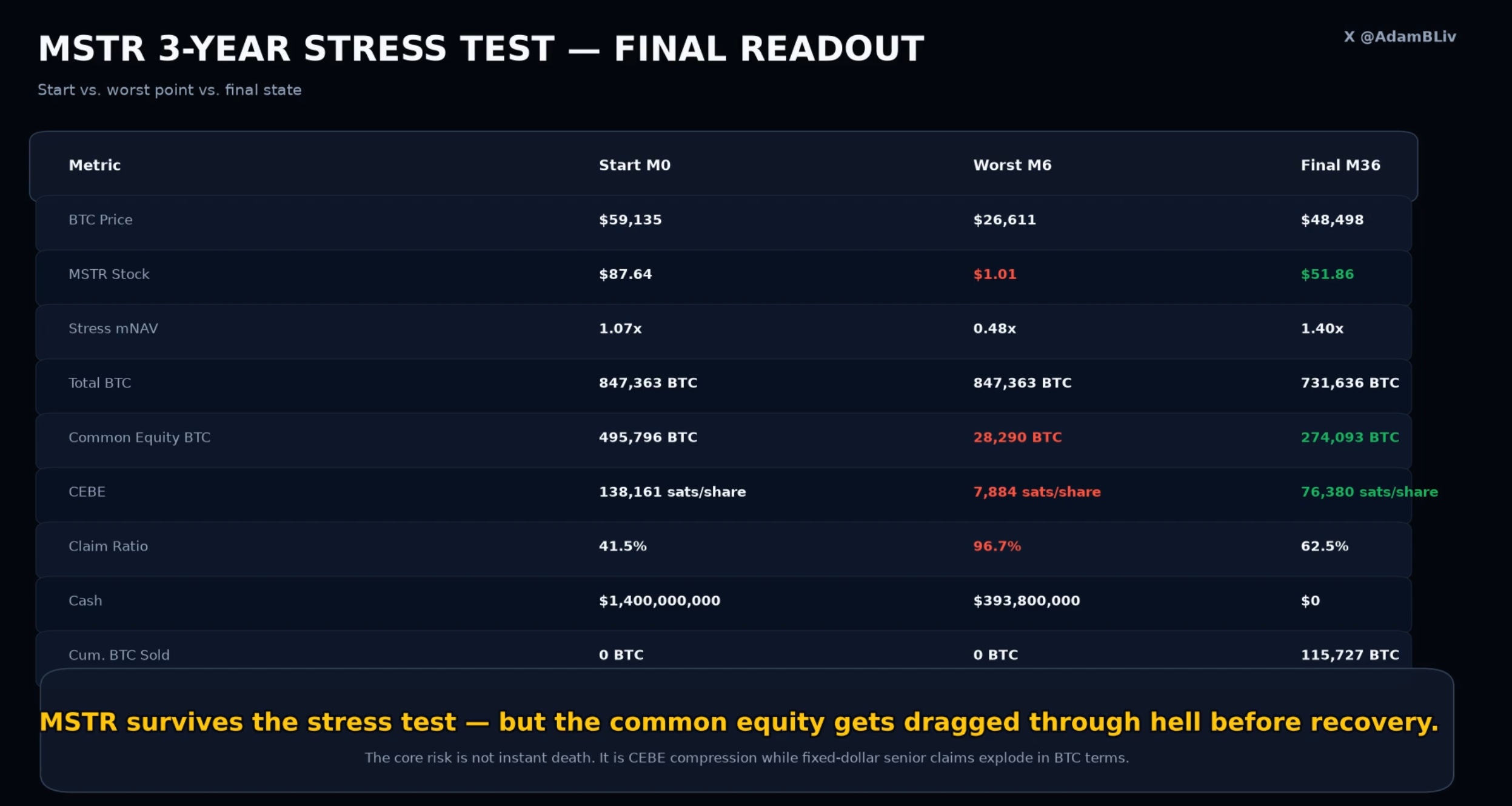


Analyst Adam Livingston conducted a three-year stress test on MSTR starting from current data, simulating an extreme scenario. The model assumes Bitcoin crashes 55% to $26,611 by month 6, while capital markets completely shut down, preventing Strategy from issuing new equity, new debt, or continuing to buy Bitcoin.


In this scenario, Strategy's priority debt structure quickly becomes perilous. Both preferred shares and bonds represent fixed-dollar claims; when the Bitcoin price collapses, their BTC-equivalent claims inflate dramatically. The model shows the BTC-equivalent claims of priority debt surging from 350,000 BTC to 819,000 BTC, accounting for 96.7% of total holdings and almost swallowing the entire Bitcoin inventory. The equity remaining for common shareholders collapses from 496,000 BTC to 28,000 BTC, with the MSTR stock price simulated to fall to $1.01. Meanwhile, monthly fixed expenses of $167.7 million (preferred dividends plus debt interest) continue to deplete cash. By month 9, cash runs out, forcing the company to start selling Bitcoin to service its debt obligations, cumulatively selling about 116,000 BTC over three years.


However, the model's conclusion is that Strategy survives. Assuming Bitcoin recovers to $48,498 in three years, the company would still hold 732,000 BTC, the MSTR stock price would return to $51.86, and the market-adjusted NAV (mNAV) ratio would recover to 1.40x. Livingston's assessment is that the real risk is not the "immediate bankruptcy" shouted by bears, but rather that priority debt, when measured in BTC, temporarily devours almost all common equity value during a price crash. Nevertheless, the model ultimately does not conclude with a "death spiral."


Institutional Retreat, Macro Tightening, Capital Shifts to AI


Strategy's issues are part of a larger picture of capital withdrawal.


US spot Bitcoin ETFs saw a single-day net outflow of $469 million on June 24, with BlackRock's IBIT accounting for $239 million, marking its fifth consecutive day of net outflows. Cumulative outflows for June total approximately $2.8 billion to $3.5 billion, constituting the most severe sustained capital flight since the products were approved in January 2024.


Bloomberg ETF analyst Eric Balchunas recently stated that Bitcoin's excessive reliance on the ETF and Strategy (MSTR) narratives should not be seen as the main value proposition for Bitcoin. He believes they should be the icing on the cake, not the whole cake. When Strategy's buying slows and the ETF channel simultaneously bleeds, Bitcoin's demand side loses its two most critical incremental sources.


Old money is leaving, and new money isn't coming in either, as the macro environment continues to tighten. The May PCE price index released on June 25 showed a year-over-year increase of 4.1%, the fastest pace in over three years. The Fed kept interest rates unchanged at 3.50%-3.75%, with expectations for a rate cut this year pushed further out. On the same day, US stocks initially rose but then fell. Apple announced global price hikes (up to $300) for multiple product lines due to memory chip shortages, causing its stock to plunge 5.1% and dragging the Nasdaq down from a 2.1% intraday gain to a loss of over 1%. Stubbornly high inflation implies persistently high funding costs, directly pressuring crypto assets that rely on liquidity expectations.


Deutsche Bank notes that a key difference in this downturn compared to previous cycles is the near absence of new retail buying, with institutional capital shifting en masse towards AI. On June 25, as Bitcoin fell below $60k and Apple tumbled, memory chip stocks rose across the board. Micron gained 8.6%, SanDisk rose 10.6%, and SK Hynix surged over 10% at one point on plans for a US listing. Capital made a directional choice between AI infrastructure and crypto assets.


Capital outflows, lack of new buy-side demand, and macro pressure all converged in the same week, culminating in a concentrated assault on the $60,000 support level.


~$10 Billion in Options Expire Today, Volatility May Persist


Beyond the aforementioned pressures, there is an immediate catalyst on June 26: Deribit will see approximately $10 billion in notional value of Bitcoin options expire, accounting for about 37% of current open interest. The put-to-call ratio is 0.83, indicating bullish bets still outnumber bearish ones. However, most call options are now out-of-the-money, while put options are concentrated in the $60,000-$65,000 and $70,000-$75,000 strike ranges, meaning bearish bets are more likely to be profitable.


Jean-David Pequignot, Chief Commercial Officer at Deribit, stated that this was an option structure positioned for mid-term higher prices and is now facing the test of declining spot prices.


Adam Haeems, Head of Asset Management at Tesseract Group, pointed out that quarter-end liquidity is typically thin, so prices might initially overshoot in either direction before mean-reverting after market makers hedge and close positions. However, a more significant test will arrive in the first week of July with quarterly contract settlements and leverage reductions.


Criptos en tendencia

Preguntas relacionadas

QAccording to the article, what were the two key pillars of Bitcoin's demand base during the last bull market, and why are they now considered to be weakening?

AThe two key pillars were: 1) The flywheel model of companies like MicroStrategy continuously buying Bitcoin through securities financing. 2) Large-scale institutional capital inflows following the launch of U.S. spot ETFs. They are now weakening because MicroStrategy's financing product (STRC) is trading significantly below its target price, threatening its ability to raise new funds for Bitcoin purchases, and U.S. spot Bitcoin ETFs are experiencing their worst sustained outflows since launch in January 2024.

QBased on the analyst's extreme stress test model, what is the main risk MicroStrategy faces in a deep Bitcoin price crash scenario, and what was the model's ultimate conclusion about the company's survival?

AThe main risk is that MicroStrategy's priority debt (fixed-dollar claims from bonds and preferred stock) would balloon in BTC-equivalent terms, temporarily swallowing almost all the equity value for common shareholders. However, the model's ultimate conclusion was that MicroStrategy would survive the scenario, not spiral into bankruptcy, and its share price could eventually recover if Bitcoin's price later rebounded.

QWhat three broader factors does the article identify as contributing to the current concentrated pressure on Bitcoin's price support at $60,000?

AThe three broader factors are: 1) Capital outflows (from ETFs and potential slowdown from MicroStrategy). 2) An absence of new retail buying. 3) Macroeconomic tightening (persistent high inflation leading to high funding costs and delayed Fed rate cuts).

QHow is the current market dynamic regarding capital allocation different from previous cycles, according to Deutsche Bank's analysis cited in the article?

ADeutsche Bank's analysis indicates a key difference: while new retail buying for crypto has almost dried up, institutional capital is now making a directional shift and moving on a large scale towards AI (Artificial Intelligence) infrastructure investments instead.

QWhat immediate market event is noted for June 26th, and what does the put/call ratio suggest about market positioning?

AThe immediate event is the expiry of approximately $100 billion in notional value of Bitcoin options on Deribit, representing about 37% of current open interest. The put/call ratio of 0.83 suggests bullish bets (calls) still slightly outnumber bearish ones (puts), but a significant portion of the call options are now out-of-the-money, while put options are concentrated at strike prices near or above the current spot price, indicating the bearish bets are more likely to be profitable.

Lecturas Relacionadas

Stablecoins Becoming the Next Policy Challenge for the Fed's Walsh Version

Fed Governor Christopher Waller's speech at the June 22 conference on the U.S. dollar's international role signifies a notable policy shift: stablecoins like USDT and USDC are now being formally considered as potential channels for transmitting U.S. dollar liquidity globally. With their combined market cap surpassing $250 billion and high transaction volumes, these digital assets are moving from the periphery of crypto policy to the core of monetary system research. The key concern for policymakers is how stablecoin flows interact with traditional dollar infrastructure. Their growth could affect bank deposits, demand for short-term Treasury securities (like T-bills), and global access to dollars, depending on whether demand originates overseas or substitutes for domestic bank balances. Issuers' reserve management—holding assets in banks, money market funds, or Treasuries—links stablecoin activity directly to these core markets. The Fed's research agenda now examines whether stablecoins, by combining payment and balance-holding functions on digital rails, could complicate monetary policy implementation or transmit liquidity stress to banks. While current Treasury holdings by issuers are under 1% of the total market, their concentrated demand could marginally impact yields, especially during periods of stress. Consequently, stablecoins are evolving from mere crypto trading tools into a private-layer dollar transmission system with public policy implications, prompting closer regulatory scrutiny of their reserve robustness, redemption mechanisms, and systemic integration.

marsbitHace 45 min(s)

Stablecoins Becoming the Next Policy Challenge for the Fed's Walsh Version

marsbitHace 45 min(s)

A 380% Soar, Shenzhen’s 100-Billion-Yuan IPO Rings the Bell

HKC Holdings, a major Chinese display panel manufacturer, has successfully listed on the Shenzhen Stock Exchange's main board. The company's shares surged over 380% on its debut, pushing its market capitalization to around 350 billion yuan (formerly reaching 500 billion yuan). Founded by Wang Zhiyong in Shenzhen's Huaqiangbei electronics market nearly three decades ago, HKC evolved from assembling monitors to becoming a global top-tier supplier of semiconductor display panels for TVs, monitors, and smartphones. The IPO marks a significant milestone for HKC and its backers. The company's growth into the capital-intensive panel manufacturing sector was supported through partnerships with state-owned capital from regions like Chongqing, Mianyang, and Chuzhou. Its shareholder list also includes BOE Technology's investment arm. In recent years, HKC reported strong financials, with core panel business contributing over 70% of revenue and clients including Samsung, TCL, and Xiaomi. This listing is seen as part of a broader trend in Shenzhen's evolving tech landscape. Beyond established giants, the city is nurturing clusters of leading companies in specialized sectors like robotics—exemplified by the "Shenzhen Robot Valley"—and storage chips, where a group of firms dubbed the "Storage Five Tigers" has achieved a combined trillion-yuan market valuation. Shenzhen's strategic focus on emerging industries such as AI terminals, low-altitude economy, and humanoid robotics aims to build new industrial depth and foster the next generation of tech champions.

marsbitHace 57 min(s)

A 380% Soar, Shenzhen’s 100-Billion-Yuan IPO Rings the Bell

marsbitHace 57 min(s)

Trading

Spot
Futuros

Artículos destacados

Qué es BITCOIN

Entendiendo HarryPotterObamaSonic10Inu (ERC-20) y Su Posición en el Espacio Cripto En los últimos años, el mercado de criptomonedas ha sido testigo de un aumento en la popularidad de las monedas meme, capturando el interés no solo de los comerciantes, sino también de aquellos que buscan compromiso comunitario y valor de entretenimiento. Entre estos tokens únicos se encuentra HarryPotterObamaSonic10Inu (ERC-20), un proyecto intrigante que mezcla referencias culturales en el tejido de las criptomonedas. Este artículo profundiza en los aspectos clave de HarryPotterObamaSonic10Inu, explorando sus mecanismos, ethos impulsado por la comunidad y su relación con el paisaje cripto más amplio. ¿Qué es HarryPotterObamaSonic10Inu (ERC-20)? Como su nombre sugiere, HarryPotterObamaSonic10Inu es una moneda meme construida sobre la blockchain de Ethereum, clasificada bajo el estándar ERC-20. A diferencia de las criptomonedas tradicionales que pueden enfatizar la utilidad práctica o el potencial de inversión, este token prospera en el valor de entretenimiento y la fuerza de su comunidad. El proyecto tiene como objetivo fomentar un entorno donde los usuarios comprometidos puedan reunirse, compartir ideas y participar en actividades inspiradas por diversos fenómenos culturales. Una característica notable de HarryPotterObamaSonic10Inu es su cero impuestos en las transacciones. Este atractivo elemento tiene como objetivo incentivar el comercio y la participación comunitaria, sin cargos adicionales que puedan disuadir a los comerciantes de pequeña escala. El suministro total de la moneda está establecido en mil millones de tokens, una cifra que marca su intención de mantener una circulación sustancial dentro de la comunidad. Creador de HarryPotterObamaSonic10Inu (ERC-20) Los orígenes de HarryPotterObamaSonic10Inu están algo envueltos en misterio; los detalles sobre el creador siguen siendo desconocidos. El desarrollo de este token carece de un equipo identificable o de un plan explícito, lo cual no es inusual dentro del sector de monedas meme. En cambio, el proyecto ha surgido de manera orgánica, con su progreso muy dependiente del entusiasmo y la participación de su comunidad. Inversores de HarryPotterObamaSonic10Inu (ERC-20) En cuanto a inversiones externas y respaldo, HarryPotterObamaSonic10Inu también sigue siendo ambiguo. El token no lista ninguna fundación de inversión conocida o apoyo organizacional significativo. En cambio, la savia del proyecto es su comunidad de base, que informa su crecimiento y sostenibilidad a través de la acción colectiva y el compromiso en el espacio cripto. ¿Cómo Funciona HarryPotterObamaSonic10Inu (ERC-20)? Como una moneda meme, HarryPotterObamaSonic10Inu opera principalmente fuera de los marcos tradicionales que a menudo rigen el valor de los activos. Hay varios aspectos distintivos que definen cómo funciona el proyecto: Transacciones Sin Impuestos: Sin tarifas impositivas en las transacciones, los usuarios pueden comprar y vender el token libremente sin preocuparse por costos ocultos. Compromiso Comunitario: El proyecto prospera en la interacción comunitaria, aprovechando plataformas de redes sociales para crear entusiasmo y facilitar la participación. Las discusiones, el intercambio de contenido y el compromiso son elementos cruciales que ayudan a expandir su alcance y fomentar la lealtad entre los seguidores. Sin Utilidad Práctica: Cabe señalar que HarryPotterObamaSonic10Inu no ofrece utilidad concreta dentro del ecosistema financiero. Más bien, se clasifica como un token principalmente para actividades de entretenimiento y comunitarias. Referencia Cultural: El token incorpora astutamente elementos de la cultura popular para atraer interés, conectando con entusiastas de los memes y seguidores de las criptomonedas por igual. HarryPotterObamaSonic10Inu ejemplifica cómo las monedas meme operan de manera diferente a los proyectos de criptomonedas más tradicionales, ingresando al mercado como construcciones sociales innovadoras en lugar de activos utilitarios. Cronología de HarryPotterObamaSonic10Inu (ERC-20) La historia de HarryPotterObamaSonic10Inu está marcada por varios hitos notables: Creación: El token surgió de un meme viral, capturando la imaginación de muchos entusiastas de las criptomonedas. Las fechas específicas de creación no están disponibles, subrayando su ascenso orgánico. Listado en Exchanges: HarryPotterObamaSonic10Inu ha llegado a varios exchanges, permitiendo un acceso y comercio más fácil por parte de la comunidad. Iniciativas de Compromiso Comunitario: Actividades continuas destinadas a mejorar la interacción comunitaria, incluyendo concursos, campañas en redes sociales y generación de contenido por parte de fanáticos y defensores. Planes de Expansión Futuros: La hoja de ruta del proyecto incluye el lanzamiento de una colección de NFT, mercancía y un sitio de comercio electrónico relacionado con sus temas culturales, involucrando aún más a la comunidad e intentando añadir más dimensiones a su ecosistema. Puntos Clave Sobre HarryPotterObamaSonic10Inu (ERC-20) Naturaleza Impulsada por la Comunidad: El proyecto prioriza la participación colectiva y la creatividad, asegurando que la involucración de los usuarios esté a la vanguardia de su desarrollo. Clasificación como Moneda Meme: Representa la epítome de las criptomonedas basadas en el entretenimiento, diferenciándose de los vehículos de inversión tradicionales. Sin Afiliación Directa con Bitcoin: A pesar de la similitud en el nombre del ticker, HarryPotterObamaSonic10Inu es distinto y no tiene relación con Bitcoin u otras criptomonedas establecidas. Enfoque en la Colaboración: HarryPotterObamaSonic10Inu está diseñado para crear un espacio para la colaboración y el intercambio de historias entre sus poseedores, proporcionando una vía para la creatividad y el vínculo comunitario. Perspectivas Futuras: La ambición de expandirse más allá de su premisa inicial hacia NFTs y mercancías describe un camino para que el proyecto potencialmente ingrese a avenidas más tradicionales dentro de la cultura digital. A medida que las monedas meme continúan capturando la imaginación de la comunidad de criptomonedas, HarryPotterObamaSonic10Inu (ERC-20) se destaca debido a sus lazos culturales y su enfoque centrado en la comunidad. Si bien puede no encajar en el molde típico de un token impulsado por la utilidad, su esencia radica en la alegría y la camaradería fomentadas entre sus seguidores, destacando la naturaleza en evolución de las criptomonedas en una era cada vez más digital. A medida que el proyecto continúa desarrollándose, será importante observar cómo las dinámicas comunitarias influyen en su trayectoria en el cambiante paisaje de la tecnología blockchain.

1.8k Vistas totalesPublicado en 2024.04.01Actualizado en 2024.12.03

Qué es BITCOIN

Cómo comprar BTC

¡Bienvenido a HTX.com! Hemos hecho que comprar Bitcoin (BTC) sea simple y conveniente. Sigue nuestra guía paso a paso para iniciar tu viaje de criptos.Paso 1: crea tu cuenta HTXUtiliza tu correo electrónico o número de teléfono para registrarte y obtener una cuenta gratuita en HTX. Experimenta un proceso de registro sin complicaciones y desbloquea todas las funciones.Obtener mi cuentaPaso 2: ve a Comprar cripto y elige tu método de pagoTarjeta de crédito/débito: usa tu Visa o Mastercard para comprar Bitcoin (BTC) al instante.Saldo: utiliza fondos del saldo de tu cuenta HTX para tradear sin problemas.Terceros: hemos agregado métodos de pago populares como Google Pay y Apple Pay para mejorar la comodidad.P2P: tradear directamente con otros usuarios en HTX.Over-the-Counter (OTC): ofrecemos servicios personalizados y tipos de cambio competitivos para los traders.Paso 3: guarda tu Bitcoin (BTC)Después de comprar tu Bitcoin (BTC), guárdalo en tu cuenta HTX. Alternativamente, puedes enviarlo a otro lugar mediante transferencia blockchain o utilizarlo para tradear otras criptomonedas.Paso 4: tradear Bitcoin (BTC)Tradear fácilmente con Bitcoin (BTC) en HTX's mercado spot. Simplemente accede a tu cuenta, selecciona tu par de trading, ejecuta tus trades y monitorea en tiempo real. Ofrecemos una experiencia fácil de usar tanto para principiantes como para traders experimentados.

5.2k Vistas totalesPublicado en 2024.12.12Actualizado en 2026.06.02

Cómo comprar BTC

Qué es $BITCOIN

ORO DIGITAL ($BITCOIN): Un Análisis Integral Introducción al ORO DIGITAL ($BITCOIN) ORO DIGITAL ($BITCOIN) es un proyecto basado en blockchain que opera en la red Solana, cuyo objetivo es combinar las características de los metales preciosos tradicionales con la innovación de las tecnologías descentralizadas. Aunque comparte un nombre con Bitcoin, a menudo referido como “oro digital” debido a su percepción como un refugio de valor, ORO DIGITAL es un token separado diseñado para crear un ecosistema único dentro del paisaje Web3. Su meta es posicionarse como un activo digital alternativo viable, aunque los detalles sobre sus aplicaciones y funcionalidades aún están en desarrollo. ¿Qué es ORO DIGITAL ($BITCOIN)? ORO DIGITAL ($BITCOIN) es un token de criptomoneda diseñado explícitamente para su uso en la blockchain de Solana. A diferencia de Bitcoin, que proporciona un papel de almacenamiento de valor ampliamente reconocido, este token parece centrarse en aplicaciones y características más amplias. Aspectos notables incluyen: Infraestructura Blockchain: El token está construido sobre la blockchain de Solana, conocida por su capacidad para manejar transacciones de alta velocidad y bajo costo. Dinámicas de Suministro: ORO DIGITAL tiene un suministro máximo limitado a 100 cuatrillones de tokens (100P $BITCOIN), aunque los detalles sobre su suministro circulante no se han divulgado actualmente. Utilidad: Si bien las funcionalidades precisas no están delineadas explícitamente, hay indicios de que el token podría ser utilizado para diversas aplicaciones, potencialmente involucrando aplicaciones descentralizadas (dApps) o estrategias de tokenización de activos. ¿Quién es el Creador de ORO DIGITAL ($BITCOIN)? En la actualidad, la identidad de los creadores y el equipo de desarrollo detrás de ORO DIGITAL ($BITCOIN) sigue siendo desconocida. Esta situación es típica entre muchos proyectos innovadores dentro del espacio blockchain, particularmente aquellos alineados con las finanzas descentralizadas y fenómenos de monedas meme. Si bien tal anonimato puede fomentar una cultura impulsada por la comunidad, intensifica las preocupaciones sobre la gobernanza y la responsabilidad. ¿Quiénes son los Inversores de ORO DIGITAL ($BITCOIN)? La información disponible indica que ORO DIGITAL ($BITCOIN) no tiene patrocinadores institucionales conocidos ni inversiones destacadas de capital de riesgo. El proyecto parece operar en un modelo de peer-to-peer centrado en el apoyo y la adopción de la comunidad en lugar de rutas de financiamiento tradicionales. Su actividad y liquidez se sitúan principalmente en intercambios descentralizados (DEX), como PumpSwap, en lugar de plataformas de trading centralizadas establecidas, lo que resalta aún más su enfoque de base. Cómo Funciona ORO DIGITAL ($BITCOIN) Los mecanismos operativos de ORO DIGITAL ($BITCOIN) pueden elaborarse en función de su diseño blockchain y atributos de red: Mecanismo de Consenso: Al aprovechar el único proof-of-history (PoH) de Solana combinado con un modelo de proof-of-stake (PoS), el proyecto asegura una validación de transacciones eficiente que contribuye al alto rendimiento de la red. Tokenómica: Si bien los mecanismos deflacionarios específicos no se han detallado extensamente, el vasto suministro máximo de tokens implica que podría atender microtransacciones o casos de uso nicho que aún están por definirse. Interoperabilidad: Existe el potencial de integración con el ecosistema más amplio de Solana, incluyendo varias plataformas de finanzas descentralizadas (DeFi). Sin embargo, los detalles sobre integraciones específicas permanecen no especificados. Cronología de Eventos Clave Aquí hay una cronología que destaca hitos significativos relacionados con ORO DIGITAL ($BITCOIN): 2023: El despliegue inicial del token ocurre en la blockchain de Solana, marcado por su dirección de contrato. 2024: ORO DIGITAL gana visibilidad al estar disponible para trading en intercambios descentralizados como PumpSwap, permitiendo a los usuarios comerciar contra SOL. 2025: El proyecto presencia actividad de trading esporádica y potencial interés en compromisos liderados por la comunidad, aunque no se han documentado asociaciones notables o avances técnicos hasta el momento. Análisis Crítico Fortalezas Escalabilidad: La infraestructura subyacente de Solana soporta altos volúmenes de transacciones, lo que podría mejorar la utilidad de $BITCOIN en varios escenarios de transacción. Accesibilidad: El potencial bajo precio de trading por token podría atraer a inversores minoristas, facilitando una participación más amplia debido a oportunidades de propiedad fraccionada. Riesgos Falta de Transparencia: La ausencia de patrocinadores, desarrolladores o un proceso de auditoría conocidos públicamente puede generar escepticismo sobre la sostenibilidad y confiabilidad del proyecto. Volatilidad del Mercado: La actividad de trading depende en gran medida del comportamiento especulativo, lo que puede resultar en una volatilidad de precios significativa y en incertidumbre para los inversores. Conclusión ORO DIGITAL ($BITCOIN) surge como un proyecto intrigante pero ambiguo dentro del ecosistema de Solana en rápida evolución. Si bien intenta aprovechar la narrativa del “oro digital”, su alejamiento del papel establecido de Bitcoin como refugio de valor subraya la necesidad de una diferenciación más clara de su utilidad y estructura de gobernanza previstas. La aceptación y adopción futura dependerán probablemente de abordar la actual opacidad y de definir sus estrategias operativas y económicas de manera más explícita. Nota: Este informe abarca información sintetizada disponible hasta octubre de 2023, y pueden haber ocurrido desarrollos más allá del período de investigación.

97 Vistas totalesPublicado en 2025.05.13Actualizado en 2025.05.13

Qué es $BITCOIN

Discusiones

Bienvenido a la comunidad de HTX. Aquí puedes mantenerte informado sobre los últimos desarrollos de la plataforma y acceder a análisis profesionales del mercado. A continuación se presentan las opiniones de los usuarios sobre el precio de BTC (BTC).

活动图片