Decoding Unitree's IPO Prospectus: The True Picture of the Robot Market

marsbitPublicado a 2026-05-25Actualizado a 2026-05-25

Resumen

Unitree Robotics's IPO prospectus reveals a profitable and rapidly growing company, dominating the global humanoid robot market by shipment volume (5,500 units in 2025). A key shift is that humanoids now constitute over half of its revenue, up from just 1.9% in 2023. However, the current market reality is stark: 74% of humanoid sales are for academic research, 17% for commercial "display" purposes, and only 9% for genuine industrial applications. In contrast, its quadruped robots see more mature industrial use (e.g., inspection). Financially, Unitree is strong with 335% revenue growth to ~$252M in 2025, ~60% gross margins (bolstered by deep vertical integration of key components like motors), and GAAP profitability since 2024. The company plans to invest nearly half of its $620M IPO proceeds into AI and "embodied" large model development, signaling a strategic push beyond hardware into the critical software layer for future differentiation. Unitree's story highlights that while advanced, cost-effective hardware exists, widespread commercial and industrial adoption awaits more capable AI models.

Author:Tanay Jaipuria

Compiled by: Deep Tide TechFlow

Deep Tide Guide: Unitree robotics is about to conduct an IPO on the Shanghai Stock Exchange's Sci-Tech Innovation Board, raising $620 million. The prospectus reveals for the first time the complete financial data of a profitable robot company. The company shipped 5,500 humanoid robots in 2025, ranking first globally, but 74% were sold to universities for research, with genuine industrial applications accounting for only 9%—this is the current reality of the robotics industry: hardware is ready, but commercialization is waiting for AI models to catch up.

Unitree Robotics recently submitted an IPO application to the Shanghai Stock Exchange's Sci-Tech Innovation Board, planning to raise $620 million. This prospectus is quite interesting because it gives us a clear view of the current state of the robot market.

Unitree is already profitable, growing rapidly, and leads in global humanoid robot shipments.

This article will discuss:

  • What Unitree produces
  • The shift in revenue structure towards humanoid robots
  • Who is buying robots (and why)
  • The vertical integration strategy
  • Financial status
  • Ambitions at the model layer

1. What Unitree Produces

Unitree was founded in 2016 and is based in Hangzhou. Its founder, Wang Xingxing, is a self-taught robotics expert who built the first quadruped robot in his own apartment. The company currently has 480 employees, with about 175 engaged in R&D.
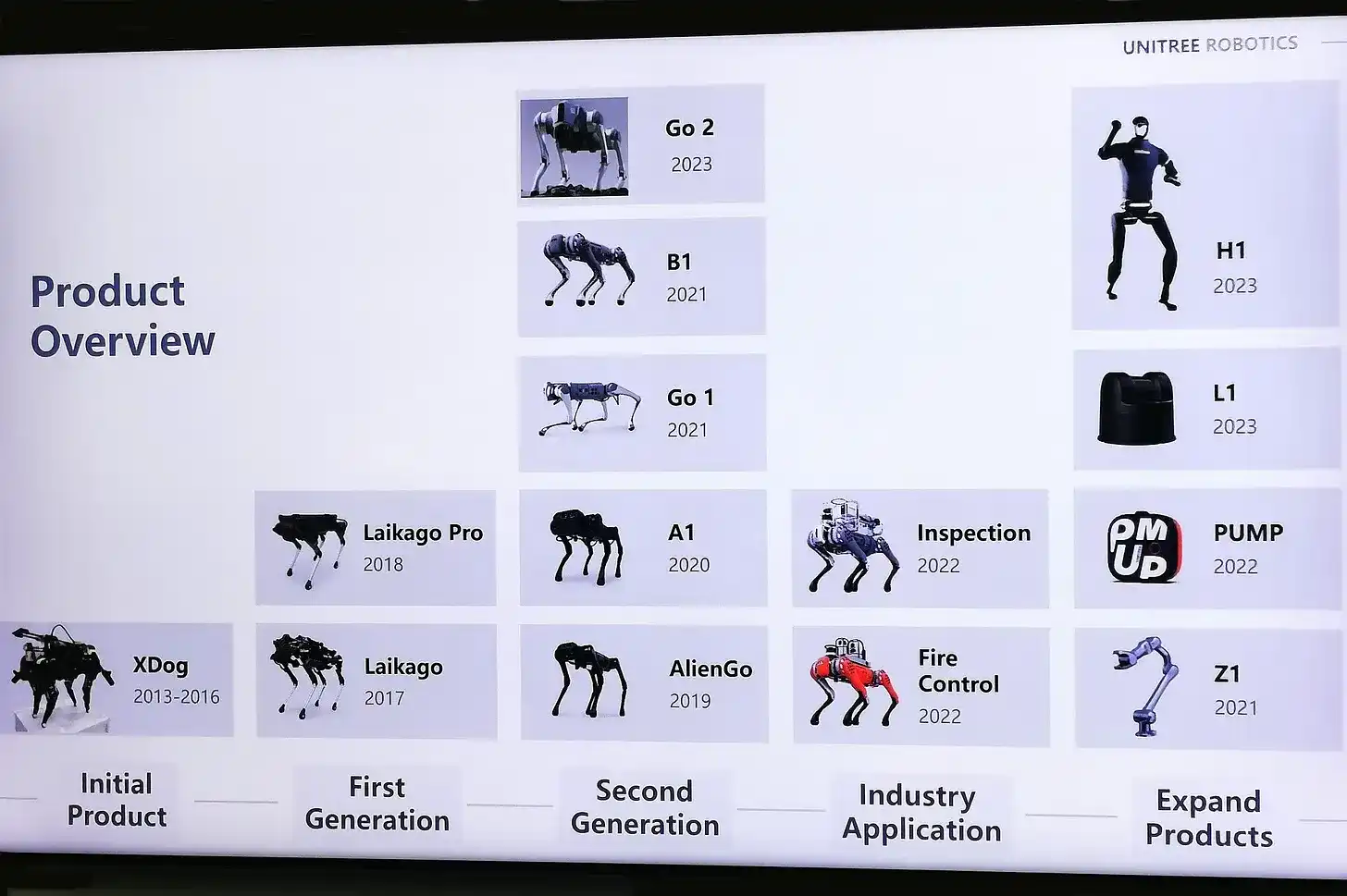
The company sells two product lines:

Quadruped Robots: Go2 (consumer and research grade), B2 (industrial grade), and A2

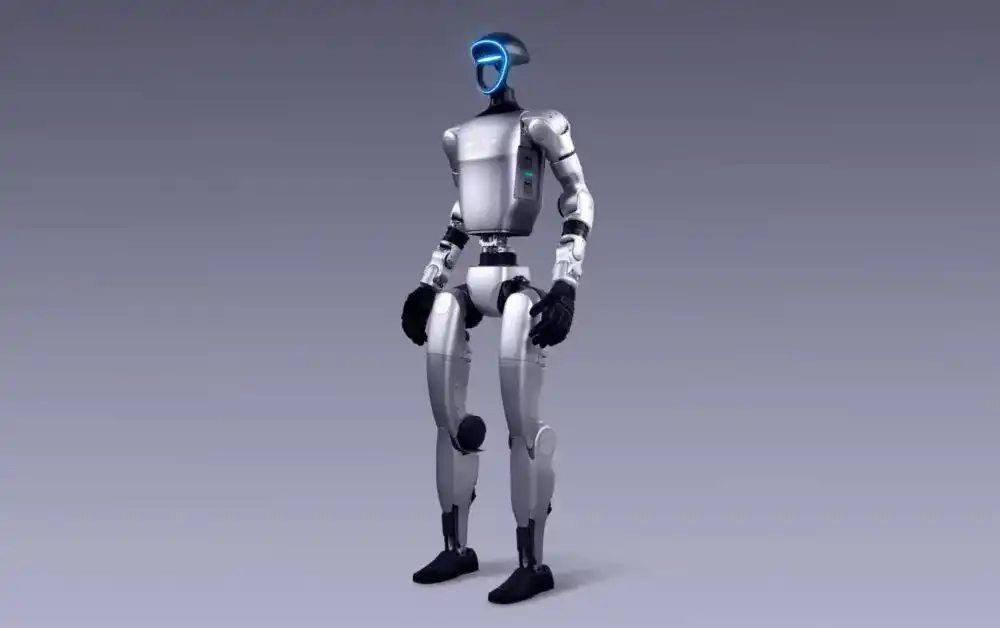
Humanoid Robots: H1, H2, G1, and R1. The G1 is the one you might have seen in viral videos, standing 1.32 meters tall and weighing 35 kg.
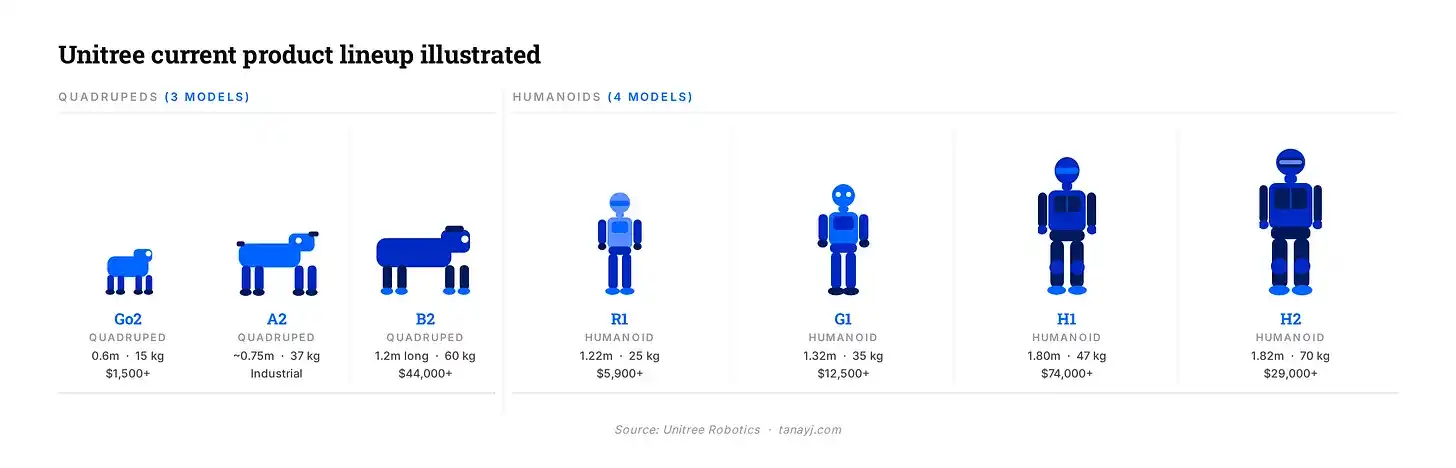
The company began international sales in 2018. Over 35% of revenue comes from outside China, including a significant number of academic customers in the US.

2. The Shift in Revenue Structure Towards Humanoid Robots

Two years ago, Unitree was essentially a robot dog company, primarily selling quadruped robots. Humanoid robots accounted for only 1.9% of revenue in 2023.

By the first three quarters of 2025, humanoid robots already accounted for over half of core revenue.
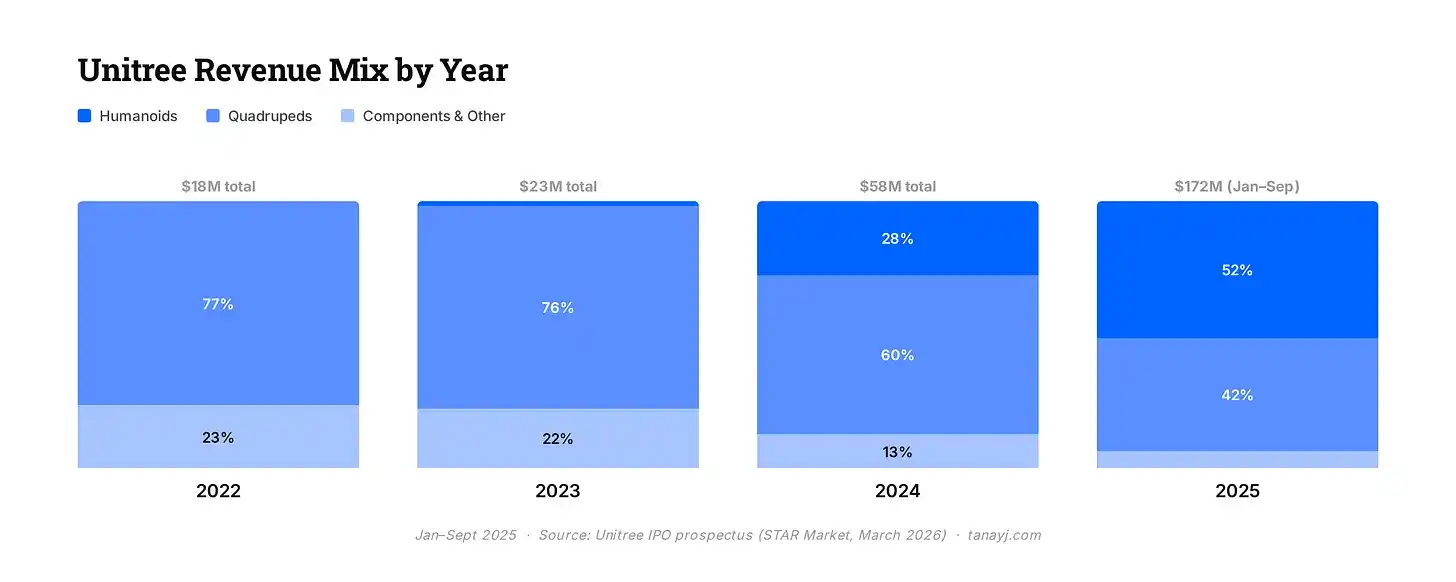
This shift was driven by improved product-market fit and aggressive marketing. The company's humanoid robots have appeared on CCTV's Spring Festival Gala for two consecutive years, one of the most-watched programs globally. Jensen Huang brought Unitree robots on stage at the 2024 GTC conference.

This brand exposure translated into commercial and research demand, something most Chinese hardware companies have never truly achieved.

The shipment data for humanoid robots is particularly impressive. Unitree shipped about 5,500 humanoid robots in 2025, making it the world's largest manufacturer of humanoid robots by shipment volume. China's Zhiyuan Robotics comes closest to this number. In contrast, well-known US companies like Figure AI and Agility Robotics have only shipped in the hundreds.
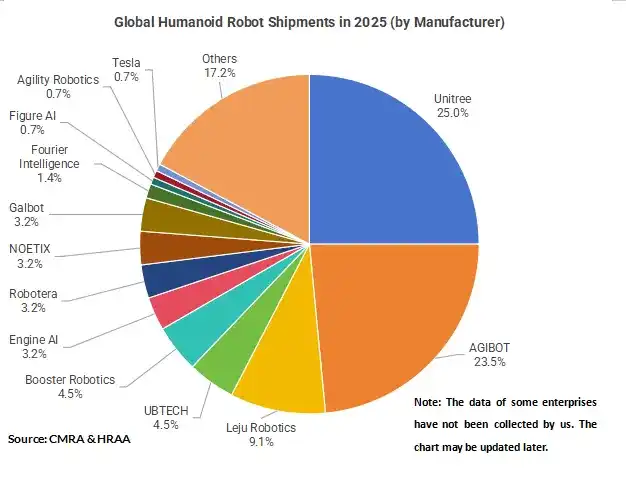
The 5-year target in the prospectus is an annual production capacity of 75,000 humanoid robots and 115,000 quadruped robots. This is about 14 times the humanoid robot shipments in 2025. The goal is aggressive but also highlights how early stage we still are.

3. Who is Really Buying Robots

The prospectus categorizes buyers into three types: Research & Education, Commercial & Consumer, and Industrial Applications.

The reality is that most current demand for humanoid robots comes from research and education purposes.
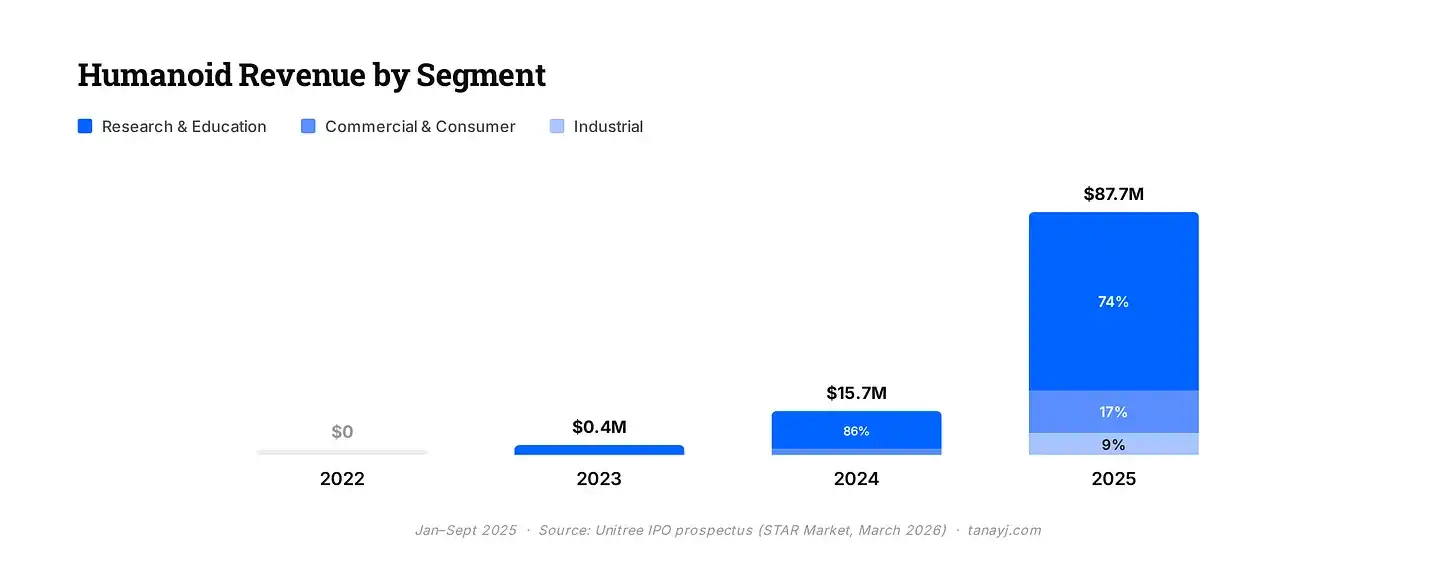
1/ Research & Education accounts for 74% of humanoid robot revenue/shipments. Academic buyers have been Unitree's core support since at least 2022 and remain the company's largest revenue source.

2/ Commercial & Consumer accounts for 17% of humanoid robot shipments. Non-academic consumers who buy these robots mainly use them for "showcasing": acting as eye-catching promoters in retail stores, tourist spots, performances, and exhibitions. Consumer revenue grew nearly fourfold year-on-year in the first nine months of 2025, which sounds impressive, but the base was actually very small. In reality, the practical use of a $25,000 humanoid robot today is to stand at the entrance of a store in Shenzhen attracting tourists.

3/ Industrial Applications account for only 9% of humanoid robot shipments. Unitree acknowledges that industrial deployment is more limited because the technology is not yet mature enough, which illustrates the current technological state. Within this 9% of shipments, about 50-70% are used in scenarios like corporate reception and guiding tours. So overall, only 3-4% of humanoid robot shipments are genuinely used for work like corporate reception and inspection.

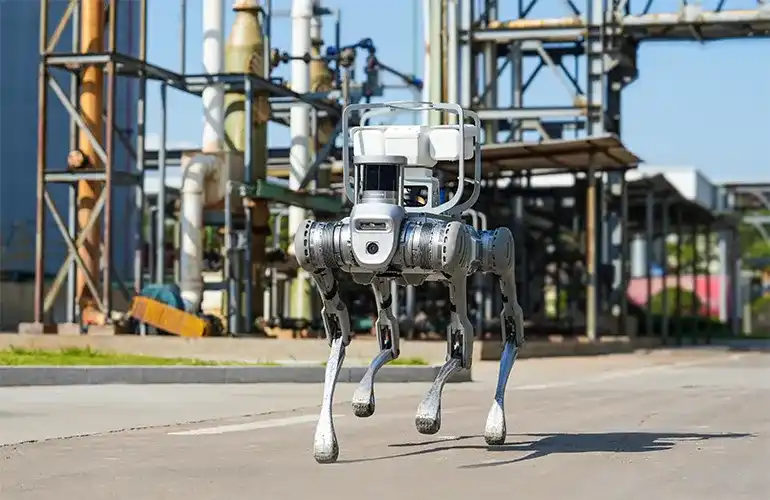
For quadruped robots, the situation is better: only about one-third of revenue comes from research, over 40% from commercial use, and the rest from industrial use. Productive use cases there are relatively more mature. Clients include State Grid, Southern Grid, PetroChina, Sinopec, Baowu Group, and JD.com (Unitree's largest customer). These companies use quadruped robots for real inspection scenarios in chemical plants, substations, coal mines, pipelines, etc.
4. Vertical Integration Strategy

A unique aspect of Unitree is that it independently designs and manufactures most of its key components: high-torque motors, precision reducers, encoders, joint modules, intelligent controllers, high-precision sensors, dexterous hands, lidars, and cameras. According to McKinsey data, the drive system (motors, reducers, and the joint systems that actually make the robot move) typically accounts for 40-60% of the total BOM cost of a humanoid robot.

Most companies in this field source these components externally, but Unitree manufactures them itself. Outsourced components account for only about 14-18% of the total cost. What it outsources are only generic parts like batteries, flash memory, and differentiated parts like the core computing board.

The unit manufacturing cost for quadruped robots has decreased from about $3,300 in 2022 to about $1,800 in mid-2025, a 46% reduction. Humanoid robot costs have also decreased, from about $10,800 to $9,200 over the same period.

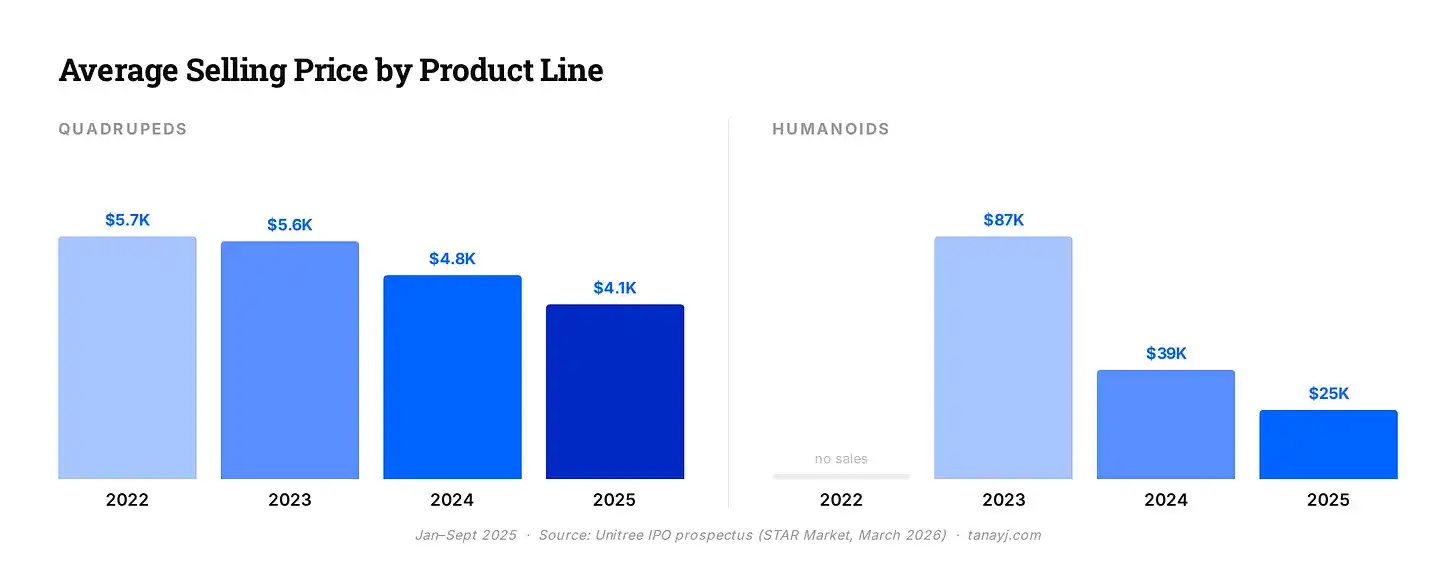
Interestingly, as shown in the chart below, the average selling prices for both quadruped and humanoid robots have also dropped significantly year by year. However, gross margins have actually expanded over the period, rising from the low 40s in 2022-2023 to nearly 60% in 2025, largely due to their vertical integration strategy.
5. Financial Status

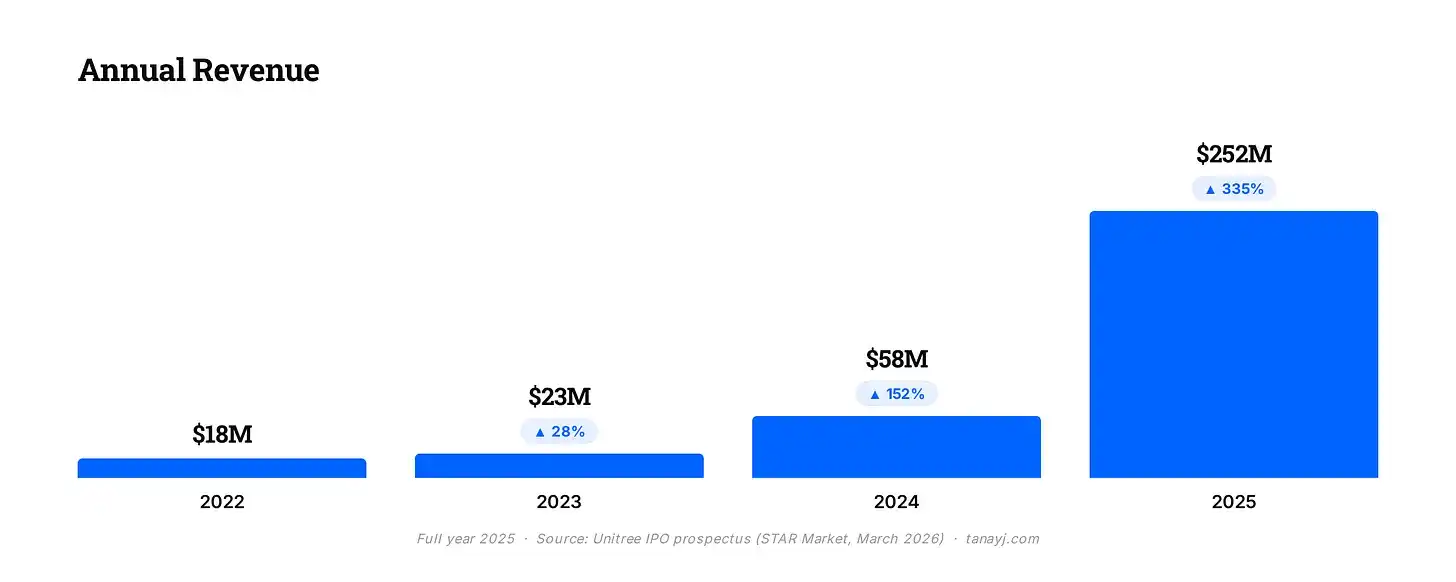
Revenue grew from $58 million in 2024 to an estimated ~$252 million in 2025, a 335% increase, primarily driven by strong performance in humanoid robots. For most of the company's history, international sales accounted for over 55% of revenue. In 2025, the domestic Chinese market surpassed exports for the first time, although the absolute value of export revenue still more than doubled year-on-year.
Gross margins are close to 60% and have been expanding over the years.
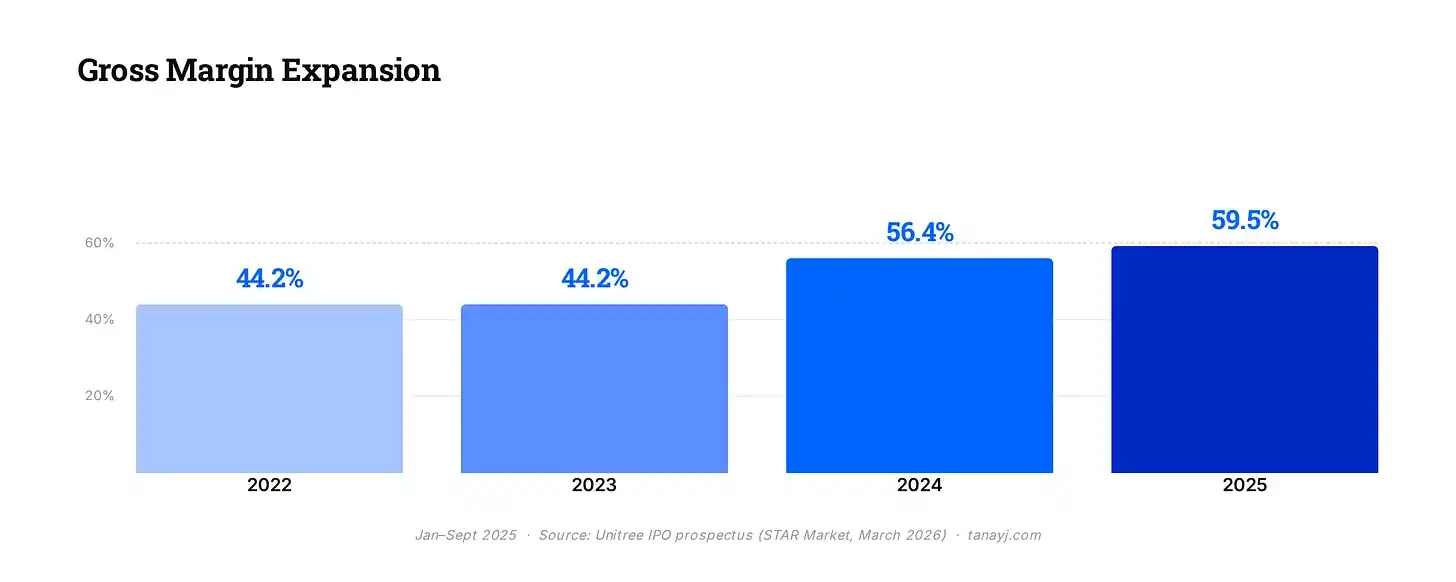
For comparison: Most hardware companies have gross margins of 30-40%. Software companies typically achieve 70-80%. For a company selling physical robots, Unitree's gross margins are relatively high, benefiting from their vertical integration strategy and currently relatively differentiated products.

The company became profitable on a GAAP basis in 2024, with a profit margin of about 18%, and close to 35% on an adjusted basis.
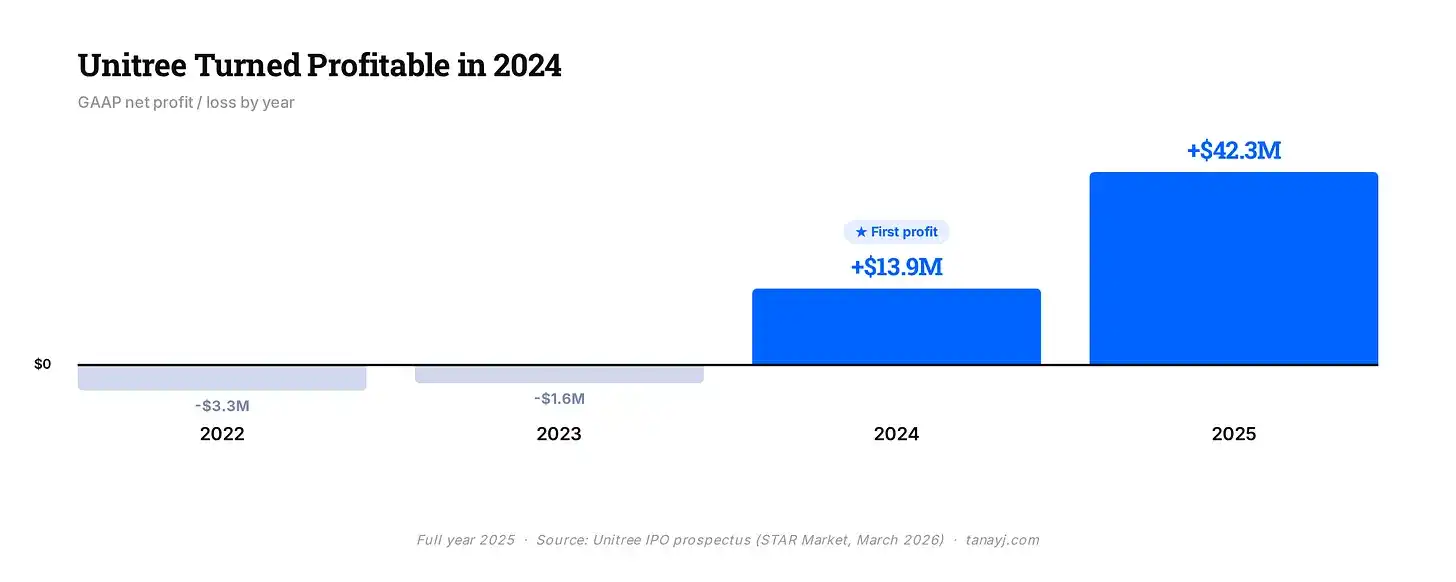
Unitree's IPO target valuation is approximately $6-7 billion.

6. Ambitions at the Model Layer

Unitree plans to allocate nearly half of the IPO proceeds to software. Out of the $620 million raised, about $300 million will be used for AI model training over the next three years, with approximately $100 million invested annually in what the company calls the "Embodied Large Model."

The prospectus describes two parallel model architectures. The first is VLA (Vision-Language-Action): a model that directly maps visual and language inputs to motor commands, allowing the robot to generalize to unfamiliar tasks without manually coded instructions. The second is WMA (World Model + Action), which is their preferred direction. The WMA model builds an internal simulation of physical reality. The robot predicts what will happen before acting, rather than learning purely through trial and error.

They have already released initial versions of both. They open-sourced UnifoLM-WMA-0 in September 2025; UnifoLM-VLA-0 was released in January 2026.

They also detailed the approximate allocation of spending on the model side, as shown below:
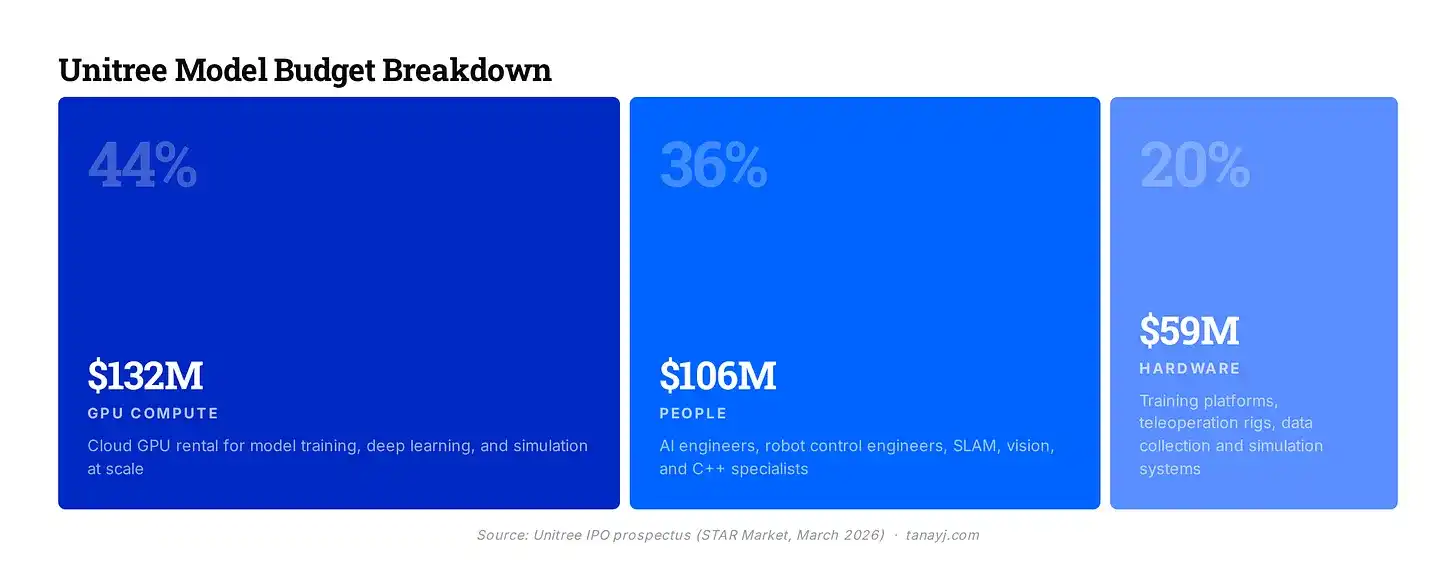
Unitree's current hardware leadership is real, but the company understands that lasting advantage in robotics may require control over the model layer: the systems that decide what the robot does and how it moves. Software ambition is also a hedge against commoditization. Unitree has built a moat in hardware manufacturing.

But if actuators and joint modules eventually become standard components like batteries in electric vehicles, then defensibility shifts to the model layer.

7. Summary

Unitree has a profitable hardware business, a genuine manufacturing moat, and ships more humanoid robots than anyone else, at prices others cannot match. But as the actual usage patterns of humanoid robots show, the story of widespread commercial application is still in its early stages. "Showcase" use cases dominate consumer demand, and industrial deployment is narrow.

Unitree gives us a glimpse of the current state of the robotics market; there is still much work to be done in models, hardware, and use cases. If you're building in robotics and embodied AI, feel free to reach out at tanay at wing.vc.

Preguntas relacionadas

QWhat were the key financial highlights and performance metrics revealed in Unitree Robotics' IPO prospectus?

AUnitree's prospectus shows rapid growth, with revenue expected to reach approximately $252 million in 2025, a 335% increase from 2024's $58 million. The company achieved GAAP profitability in 2024 with margins around 18% (nearly 35% on an adjusted basis). Gross margins are near 60%, which is high for a hardware company, largely due to its vertical integration strategy. The IPO aims to raise $620 million at a target valuation of $6-7 billion.

QWho are the primary customers for Unitree's humanoid robots, and what does this indicate about the current state of the market?

AAs of 2025, 74% of Unitree's humanoid robot shipments were for scientific research and education, 17% for commercial/consumer 'showcase' uses (like retail displays), and only 9% for industrial applications. Furthermore, within that 9%, 50-70% are used for enterprise reception and guided tours. This indicates that widespread commercial and industrial deployment is still in its early stages. The primary productive use for robots today remains in research and niche, non-autonomous applications, highlighting that hardware capabilities may be ahead of the AI models and software needed for complex tasks.

QWhat is Unitree's vertical integration strategy, and what benefits has it provided?

AUnitree's vertical integration strategy involves independently designing and manufacturing most of its robots' key components, including high-torque motors, precision reducers, encoders, joint modules, controllers, sensors, dexterous hands, LiDAR, and cameras. Only generic components like batteries and flash memory are outsourced. This strategy has reduced manufacturing costs (e.g., quadruped robot costs dropped 46% from ~$3300 in 2022 to ~$1800 in mid-2025) while allowing the company to expand its gross margins to nearly 60% despite falling average selling prices. It provides cost control, supply chain security, and a hardware moat.

QWhat are Unitree's ambitions in the AI model layer, and how does it plan to use funds from the IPO?

AUnitree plans to invest heavily in AI software development, allocating roughly $300 million (about half of the $620 million IPO proceeds) over the next three years for AI model training. The focus is on developing 'Embodied Large Models,' specifically two architectures: VLA (Vision-Language-Action) models for direct mapping from sensory input to action, and WMA (World Model + Action) models, which it favors. WMA models create an internal simulation of physical reality to predict outcomes before acting. The company has already released open-source versions of both. This investment is a strategic move to build a defensible advantage in the software layer as hardware components potentially become commoditized.

QHow has Unitree's product mix and market focus shifted in recent years?

AUnitree has undergone a significant shift from being primarily a quadruped robot company to a leader in humanoid robots. In 2023, humanoids accounted for only 1.9% of its revenue. By the first three quarters of 2025, humanoid robots constituted over half of its core revenue. This shift was driven by improved product-market fit and aggressive marketing (e.g., appearances on China's Spring Festival Gala and NVIDIA's GTC stage). The company shipped approximately 5,500 humanoid robots in 2025, making it the world's largest manufacturer by volume. Its ambitious 5-year goal is to produce 75,000 humanoids annually.

Lecturas Relacionadas

τ Scaling: Huawei's New Growth Engine Designed for the Post-Moore Era

**Tau Scaling: Huawei's New Growth Engine for the Post-Moore Era** For 60 years, progress in semiconductors was driven by Moore's Law – making transistors smaller, denser, and cheaper. This path has now stalled due to plummeting returns below 7nm, astronomical lithography costs, and rising per-transistor expenses. After six years and testing 381 production chips, Huawei’s semiconductor team proposes a fundamental shift: **stop competing on size, start competing on time**. This is the core of their "τ (Tau) Scaling" theory. It treats *time* as the key optimization metric, compressing characteristic delays (τ) across all levels – from transistor switching (picoseconds) to data center tasks (seconds), spanning 12 orders of magnitude. **What is τ Scaling?** It holistically minimizes delay/time constants (τ) across four layers: transistors (switching speed), circuits (signal delay), chips (compute/memory access), and systems (end-to-end communication). The goal is to align optimization from process and circuit design to architecture and systems using this unified metric. **Mobile Application: LogicFolding** Without advancing the process node, this technique vertically stacks chips using ultra-precision hybrid bonding, distributing critical paths across layers ("stacking floors"). Results include a 55% transistor density increase, 41% better energy efficiency, over 40% higher SRAM frequency, and a roadmap targeting 4GHz by 2029. **AI Data Center Application: Full-Link Latency Compression** With 80% of AI cluster energy and 70% cost spent on data movement, the focus is slashing communication time. Key innovations include: 1. **Unified Bus:** Cuts multi-layer protocols, reducing remote access latency from microseconds to ~100 nanoseconds – 500x faster. 2. **Hi-ONE Optical Interconnect:** Replaces copper with fiber, enabling 8Tb/s per module and scaling distances from 1m to 100m for 10,000-chip clusters. 3. **3D Folding:** Solves the "interface bottleneck" of 2.5D packaging by vertically integrating memory, power, and optical I/O alongside compute, predicting over 100x integration density gain by 2035. **Re-fusion of Logic and Memory** The AI era, where data movement is more critical than computation, demands tight 3D integration of logic and memory, shifting industry influence towards memory and advanced packaging. **Remaining Challenges** include adapting EDA tools for 3D design, optimizing wafer-to-wafer process variation and vertical interconnect losses, and establishing new energy efficiency and benchmarking standards. **Conclusion:** The era of scaling physical dimensions is over. The era of scaling time has begun. By leveraging 3D stacking, system architecture, and interconnect optimization—rather than solely chasing advanced lithography—performance and efficiency can continue to advance. This is poised to be the semiconductor industry's core roadmap for the next decade.

marsbitHace 1 min(s)

τ Scaling: Huawei's New Growth Engine Designed for the Post-Moore Era

marsbitHace 1 min(s)

NodeStrategy: The First Ordinals DAT Project, Bringing the Strategy Treasury Narrative to NFTs

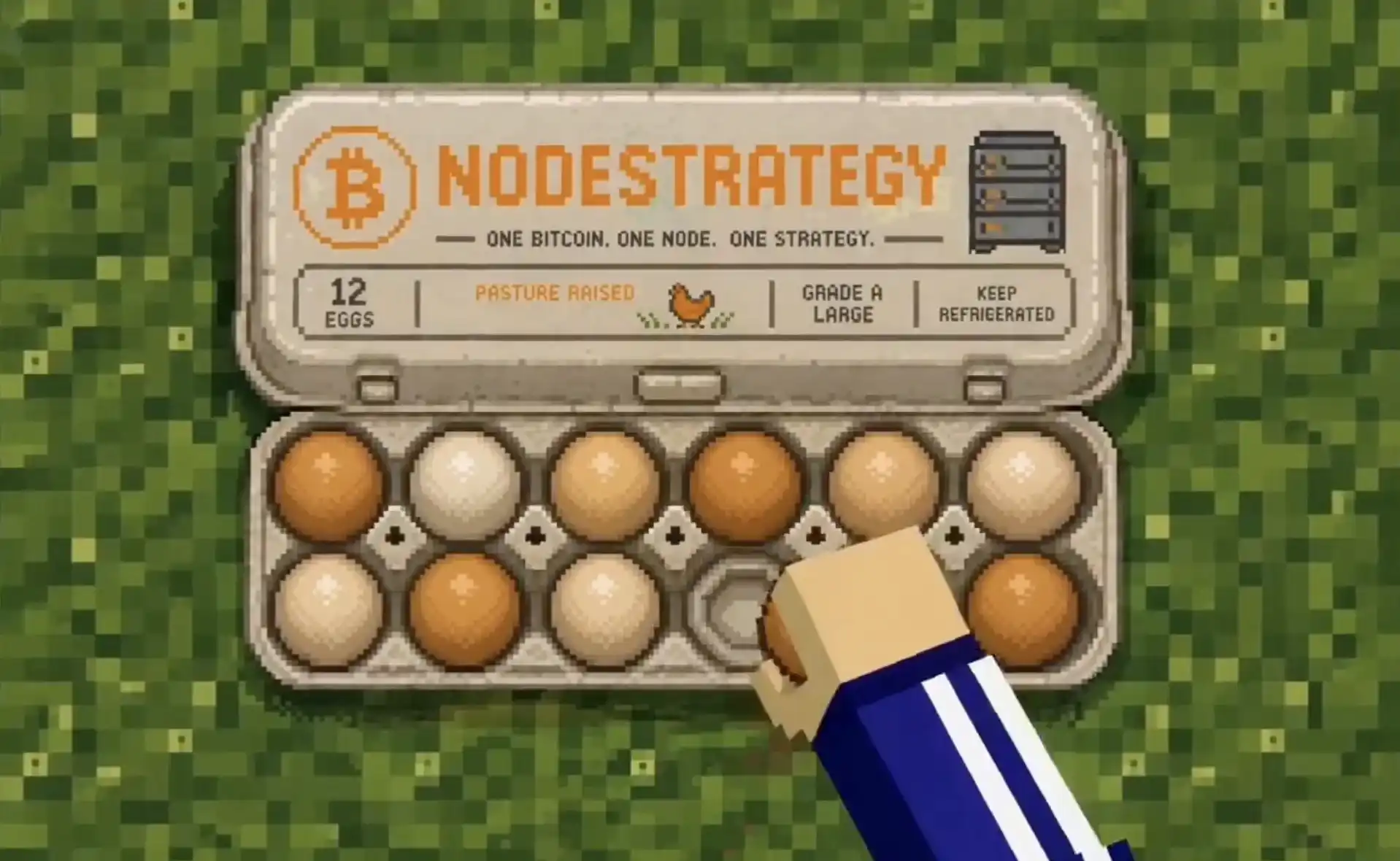
**Summary: The Fundamental Flaws of NodeStrategy, the 'First Ordinals DAT'** NodeStrategy presents itself as the first Ordinals Digital Asset Treasury (DAT) on Bitcoin. Its model mirrors MicroStrategy's treasury narrative but for NFTs, specifically targeting the NodeMonkes collection (not officially affiliated). The project's core mechanism is a four-step flywheel: a 10% fee on all trades (90% to treasury, 10% to radFi/Bound marketplace) is used to buy NodeMonkes. These NFTs are then listed for sale on Satflow, with 100% of the sale proceeds used to buy back and burn the project's token, NODESTRAT, aiming to create a perpetual value cycle. However, the design contains critical, self-defeating flaws: 1. **Platform Lock-In:** As a Bitcoin Rune, NODESTRAT lacks smart contract functionality and cannot natively enforce the 10% fee. The fee can only be collected on the radFi/Bound marketplace itself. This makes the entire flywheel dependent on a single platform. If liquidity moves elsewhere, fee revenue drops to zero, halting the mechanism. 2. **Self-Suffocating Economics:** The 10% fee acts both as the flywheel's fuel and a major drag on demand. A buy/sell roundtrip incurs a 20% cost, creating a massive hurdle for traders. This strangles the very trading volume needed to generate fees. 3. **Ineffective Value Support:** The flywheel is starved. Low daily volume (~$9K) generates minimal fees for NFT purchases. The NFT "ladder" sales are slow and unpredictable (only 39 total sold), meaning buybacks are infrequent. While 30.77% of the supply has been burned, this supply reduction cannot lift price without corresponding demand, which is suppressed by the high transaction tax. 4. **Meaningless NAV:** The Net Asset Value (NAV), currently at a 0.46x discount to market cap, is merely a marketing figure. There is no redemption mechanism for token holders to claim the underlying NodeMonkes assets. Price is set by market liquidity flows, not by this theoretical backing. In essence, NodeStrategy's design forces its revenue source (trading fees) to simultaneously cripple the demand and liquidity required for its own success, trapping the project in a stagnant state.

marsbitHace 7 min(s)

NodeStrategy: The First Ordinals DAT Project, Bringing the Strategy Treasury Narrative to NFTs

marsbitHace 7 min(s)

Agentic Design Patterns: A Book That Made Me Re-Understand "What Is an Agent, Really?"

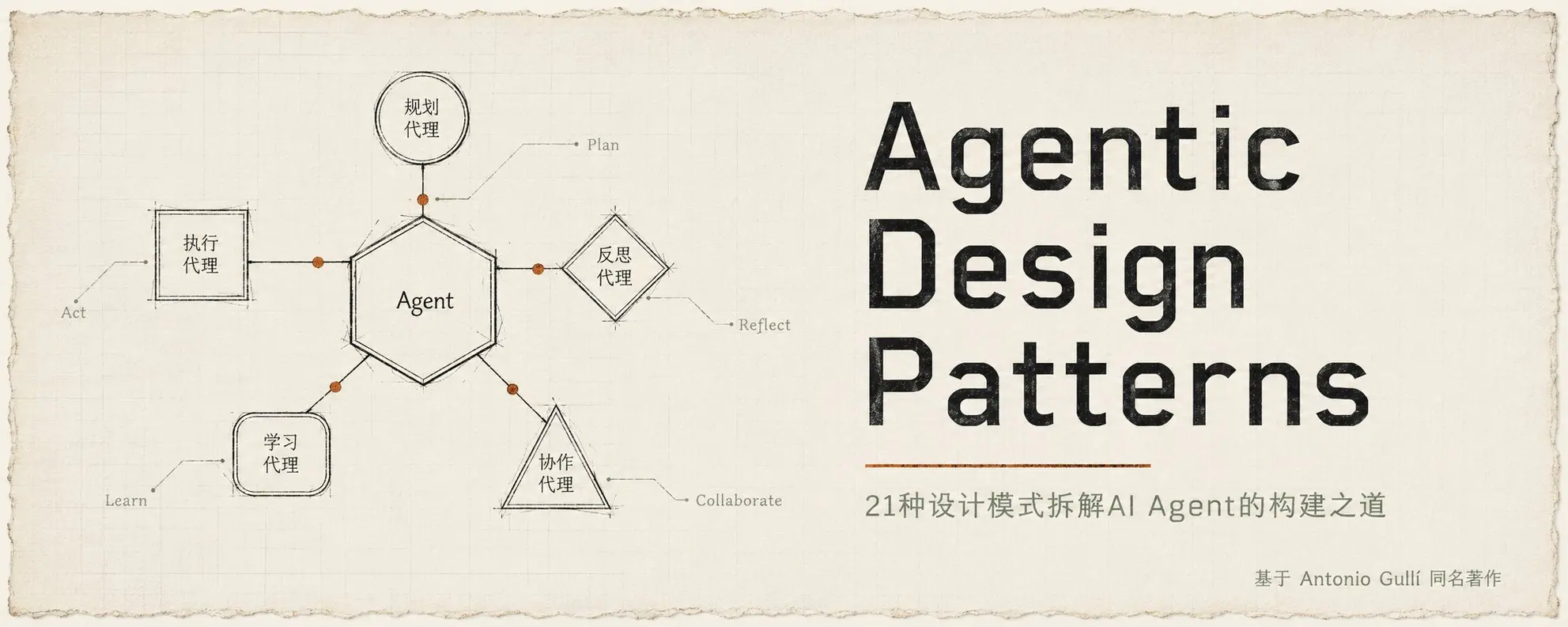
"Agentic Design Patterns" is a 2025 book by Antonio Gullí, a Google engineering director, which offers a systematic framework for AI Agent development through 21 design patterns. A core contribution is the "Four Levels of Agency": Level 0 (bare LLMs) are not true agents. Level 1 agents actively decide when and how to use tools. Level 2 agents engage in strategic planning, context engineering (curating and filtering information), and self-reflection. Level 3 involves multi-agent collaboration with defined communication topologies. The book introduces **Context Engineering** as a superset of prompt engineering, managing four layers of information for the agent: system prompts, external data, implicit context (user history, environment), and feedback loops for automated optimization. A key pattern is **Reflection (Producer-Critic)**, where two distinct agents with different prompts collaborate iteratively—one produces output, the other critiques it—until quality is satisfactory or a max iteration limit is reached. For **Memory**, a three-layer model is proposed: Session (ephemeral conversation context), State (temporary task data), and Memory (persistent, long-term storage). Regarding **Multi-Agent Systems**, the book advises against unnecessary complexity, recommending simple topologies like Supervisor or Peer-to-Peer based on task needs. It emphasizes perfecting a single Level 2 agent before moving to multi-agent setups. The author concludes with three actionable takeaways: 1) Add a Critic agent to existing workflows, 2) Practice Context Engineering beyond simple prompts, and 3) Avoid premature multi-agent complexity; first master a robust single agent. The book provides a practical map, codifying common challenges like reflection, memory, and coordination into reusable patterns, saving developers from reinventing foundational solutions.

链捕手Hace 53 min(s)

Agentic Design Patterns: A Book That Made Me Re-Understand "What Is an Agent, Really?"

链捕手Hace 53 min(s)

An AI Read SpaceX's Prospectus and Wrote This Investment Memo in 12 Minutes

An AI agent autonomously analyzed SpaceX's 226MB S-1 filing, purchased real-time market data on-chain for $1.87, and generated a comprehensive investment memo in 12 minutes. The memo concludes a "Hold" recommendation. Bull Thesis: SpaceX holds a near-monopoly in commercial launch (80% of global orbital mass since 2023), operates the profitable Starlink business (10.3M subscribers, $7.2B adj. EBITDA), and is vertically integrated from rockets to AI via the xAI acquisition. Starlink alone is a standout, high-margin business. Bear Thesis: The AI division is a massive cash burn ($6.4B operating loss on $3.2B revenue in 2025). True debt obligations approach ~$42B, not the headline $29B, due to bridge loans and X-related debt. Significant contingent liabilities exist, including a potential $10B fee from a Cursor option agreement. The company faces concentrated counterparty risk (e.g., a $45B Anthropic contract), slowing revenue growth, and complex governance as a controlled company with four share classes. Valuation anchors Starlink's standalone value at ~$84B (applying Iridium's 7.4x sales multiple), suggesting the current ~$500B+ IPO target prices in immense future execution risk for Starship and AI. Key risks include Starship delays, accelerating AI losses, and underwriter conflicts (the IPO's lead banks are also lenders on the $20B bridge loan it aims to refinance). Investment triggers: upgrade to "Overweight" if priced ≤$350B and Starship meets milestones; downgrade to "Pass" if priced >$510B or key risks materialize.

marsbitHace 1 hora(s)

An AI Read SpaceX's Prospectus and Wrote This Investment Memo in 12 Minutes

marsbitHace 1 hora(s)

Trading

Spot
Futuros

Artículos destacados

Qué es $S$

Entendiendo SPERO: Una Visión General Completa Introducción a SPERO A medida que el panorama de la innovación continúa evolucionando, la aparición de tecnologías web3 y proyectos de criptomonedas juega un papel fundamental en la configuración del futuro digital. Un proyecto que ha atraído la atención en este campo dinámico es SPERO, denotado como SPERO,$$s$. Este artículo tiene como objetivo reunir y presentar información detallada sobre SPERO, para ayudar a entusiastas e inversores a comprender sus fundamentos, objetivos e innovaciones dentro de los dominios web3 y cripto. ¿Qué es SPERO,$$s$? SPERO,$$s$ es un proyecto único dentro del espacio cripto que busca aprovechar los principios de descentralización y tecnología blockchain para crear un ecosistema que promueva la participación, la utilidad y la inclusión financiera. El proyecto está diseñado para facilitar interacciones de igual a igual de nuevas maneras, proporcionando a los usuarios soluciones y servicios financieros innovadores. En su esencia, SPERO,$$s$ tiene como objetivo empoderar a los individuos al proporcionar herramientas y plataformas que mejoren la experiencia del usuario en el espacio de las criptomonedas. Esto incluye habilitar métodos de transacción más flexibles, fomentar iniciativas impulsadas por la comunidad y crear caminos para oportunidades financieras a través de aplicaciones descentralizadas (dApps). La visión subyacente de SPERO,$$s$ gira en torno a la inclusividad, buscando cerrar brechas dentro de las finanzas tradicionales mientras aprovecha los beneficios de la tecnología blockchain. ¿Quién es el Creador de SPERO,$$s$? La identidad del creador de SPERO,$$s$ sigue siendo algo oscura, ya que hay recursos públicos limitados que proporcionan información de fondo detallada sobre su(s) fundador(es). Esta falta de transparencia puede derivarse del compromiso del proyecto con la descentralización, una ética que muchos proyectos web3 comparten, priorizando las contribuciones colectivas sobre el reconocimiento individual. Al centrar las discusiones en torno a la comunidad y sus objetivos colectivos, SPERO,$$s$ encarna la esencia del empoderamiento sin señalar a individuos específicos. Como tal, comprender la ética y la misión de SPERO sigue siendo más importante que identificar a un creador singular. ¿Quiénes son los Inversores de SPERO,$$s$? SPERO,$$s$ cuenta con el apoyo de una diversa gama de inversores que van desde capitalistas de riesgo hasta inversores ángeles dedicados a fomentar la innovación en el sector cripto. El enfoque de estos inversores generalmente se alinea con la misión de SPERO, priorizando proyectos que prometen avances tecnológicos sociales, inclusión financiera y gobernanza descentralizada. Estas fundaciones de inversores suelen estar interesadas en proyectos que no solo ofrecen productos innovadores, sino que también contribuyen positivamente a la comunidad blockchain y sus ecosistemas. El respaldo de estos inversores refuerza a SPERO,$$s$ como un contendiente notable en el dominio de proyectos cripto que evoluciona rápidamente. ¿Cómo Funciona SPERO,$$s$? SPERO,$$s$ emplea un marco multifacético que lo distingue de los proyectos de criptomonedas convencionales. Aquí hay algunas de las características clave que subrayan su singularidad e innovación: Gobernanza Descentralizada: SPERO,$$s$ integra modelos de gobernanza descentralizada, empoderando a los usuarios para participar activamente en los procesos de toma de decisiones sobre el futuro del proyecto. Este enfoque fomenta un sentido de propiedad y responsabilidad entre los miembros de la comunidad. Utilidad del Token: SPERO,$$s$ utiliza su propio token de criptomoneda, diseñado para servir diversas funciones dentro del ecosistema. Estos tokens permiten transacciones, recompensas y la facilitación de servicios ofrecidos en la plataforma, mejorando la participación y la utilidad general. Arquitectura en Capas: La arquitectura técnica de SPERO,$$s$ apoya la modularidad y escalabilidad, permitiendo la integración fluida de características y aplicaciones adicionales a medida que el proyecto evoluciona. Esta adaptabilidad es fundamental para mantener la relevancia en el cambiante paisaje cripto. Participación de la Comunidad: El proyecto enfatiza iniciativas impulsadas por la comunidad, empleando mecanismos que incentivan la colaboración y la retroalimentación. Al nutrir una comunidad sólida, SPERO,$$s$ puede abordar mejor las necesidades de los usuarios y adaptarse a las tendencias del mercado. Enfoque en la Inclusión: Al ofrecer tarifas de transacción bajas e interfaces amigables para el usuario, SPERO,$$s$ busca atraer a una base de usuarios diversa, incluyendo a individuos que anteriormente pueden no haber participado en el espacio cripto. Este compromiso con la inclusión se alinea con su misión general de empoderamiento a través de la accesibilidad. Cronología de SPERO,$$s$ Entender la historia de un proyecto proporciona información crucial sobre su trayectoria de desarrollo y hitos. A continuación se presenta una cronología sugerida que mapea eventos significativos en la evolución de SPERO,$$s$: Fase de Conceptualización e Ideación: Las ideas iniciales que forman la base de SPERO,$$s$ fueron concebidas, alineándose estrechamente con los principios de descentralización y enfoque comunitario dentro de la industria blockchain. Lanzamiento del Whitepaper del Proyecto: Tras la fase conceptual, se lanzó un whitepaper completo que detalla la visión, los objetivos y la infraestructura tecnológica de SPERO,$$s$ para generar interés y retroalimentación de la comunidad. Construcción de Comunidad y Primeras Interacciones: Se realizaron esfuerzos de divulgación activa para construir una comunidad de primeros adoptantes y posibles inversores, facilitando discusiones en torno a los objetivos del proyecto y obteniendo apoyo. Evento de Generación de Tokens: SPERO,$$s$ llevó a cabo un evento de generación de tokens (TGE) para distribuir sus tokens nativos a los primeros seguidores y establecer liquidez inicial dentro del ecosistema. Lanzamiento de la dApp Inicial: La primera aplicación descentralizada (dApp) asociada con SPERO,$$s$ se puso en marcha, permitiendo a los usuarios interactuar con las funcionalidades centrales de la plataforma. Desarrollo Continuo y Alianzas: Actualizaciones y mejoras continuas a las ofertas del proyecto, incluyendo alianzas estratégicas con otros actores en el espacio blockchain, han moldeado a SPERO,$$s$ en un jugador competitivo y en evolución en el mercado cripto. Conclusión SPERO,$$s$ se erige como un testimonio del potencial de web3 y las criptomonedas para revolucionar los sistemas financieros y empoderar a los individuos. Con un compromiso con la gobernanza descentralizada, la participación comunitaria y funcionalidades diseñadas de manera innovadora, allana el camino hacia un paisaje financiero más inclusivo. Como con cualquier inversión en el espacio cripto que evoluciona rápidamente, se anima a los posibles inversores y usuarios a investigar a fondo y participar de manera reflexiva con los desarrollos en curso dentro de SPERO,$$s$. El proyecto muestra el espíritu innovador de la industria cripto, invitando a una mayor exploración de sus innumerables posibilidades. Mientras el viaje de SPERO,$$s$ aún se desarrolla, sus principios fundamentales pueden, de hecho, influir en el futuro de cómo interactuamos con la tecnología, las finanzas y entre nosotros en ecosistemas digitales interconectados.

72 Vistas totalesPublicado en 2024.12.17Actualizado en 2024.12.17

Qué es $S$

Qué es AGENT S

Agent S: El Futuro de la Interacción Autónoma en Web3 Introducción En el paisaje en constante evolución de Web3 y las criptomonedas, las innovaciones están redefiniendo constantemente cómo los individuos interactúan con las plataformas digitales. Uno de estos proyectos pioneros, Agent S, promete revolucionar la interacción humano-computadora a través de su marco agente abierto. Al allanar el camino para interacciones autónomas, Agent S busca simplificar tareas complejas, ofreciendo aplicaciones transformadoras en inteligencia artificial (IA). Esta exploración detallada profundizará en las complejidades del proyecto, sus características únicas y las implicaciones para el dominio de las criptomonedas. ¿Qué es Agent S? Agent S se presenta como un marco agente abierto innovador, diseñado específicamente para abordar tres desafíos fundamentales en la automatización de tareas informáticas: Adquisición de Conocimiento Específico del Dominio: El marco aprende inteligentemente de diversas fuentes de conocimiento externas y experiencias internas. Este enfoque dual le permite construir un rico repositorio de conocimiento específico del dominio, mejorando su rendimiento en la ejecución de tareas. Planificación a Largo Plazo de Tareas: Agent S emplea planificación jerárquica aumentada por la experiencia, un enfoque estratégico que facilita la descomposición y ejecución eficiente de tareas complejas. Esta característica mejora significativamente su capacidad para gestionar múltiples subtareas de manera eficiente y efectiva. Manejo de Interfaces Dinámicas y No Uniformes: El proyecto introduce la Interfaz Agente-Computadora (ACI), una solución innovadora que mejora la interacción entre agentes y usuarios. Utilizando Modelos de Lenguaje Multimodal de Gran Escala (MLLMs), Agent S puede navegar y manipular diversas interfaces gráficas de usuario sin problemas. A través de estas características pioneras, Agent S proporciona un marco robusto que aborda las complejidades involucradas en la automatización de la interacción humana con las máquinas, preparando el terreno para una multitud de aplicaciones en IA y más allá. ¿Quién es el Creador de Agent S? Si bien el concepto de Agent S es fundamentalmente innovador, la información específica sobre su creador sigue siendo elusiva. El creador es actualmente desconocido, lo que resalta ya sea la etapa incipiente del proyecto o la elección estratégica de mantener a los miembros fundadores en el anonimato. Independientemente de la anonimidad, el enfoque sigue siendo en las capacidades y el potencial del marco. ¿Quiénes son los Inversores de Agent S? Dado que Agent S es relativamente nuevo en el ecosistema criptográfico, la información detallada sobre sus inversores y patrocinadores financieros no está documentada explícitamente. La falta de información disponible públicamente sobre las bases de inversión u organizaciones que apoyan el proyecto plantea preguntas sobre su estructura de financiamiento y hoja de ruta de desarrollo. Comprender el respaldo es crucial para evaluar la sostenibilidad del proyecto y su posible impacto en el mercado. ¿Cómo Funciona Agent S? En el núcleo de Agent S se encuentra una tecnología de vanguardia que le permite funcionar de manera efectiva en diversos entornos. Su modelo operativo se basa en varias características clave: Interacción Humano-Computadora Similar a la Humana: El marco ofrece planificación avanzada de IA, esforzándose por hacer que las interacciones con las computadoras sean más intuitivas. Al imitar el comportamiento humano en la ejecución de tareas, promete elevar las experiencias de los usuarios. Memoria Narrativa: Empleada para aprovechar experiencias de alto nivel, Agent S utiliza memoria narrativa para hacer un seguimiento de las historias de tareas, mejorando así sus procesos de toma de decisiones. Memoria Episódica: Esta característica proporciona a los usuarios una guía paso a paso, permitiendo que el marco ofrezca apoyo contextual a medida que se desarrollan las tareas. Soporte para OpenACI: Con la capacidad de ejecutarse localmente, Agent S permite a los usuarios mantener el control sobre sus interacciones y flujos de trabajo, alineándose con la ética descentralizada de Web3. Fácil Integración con APIs Externas: Su versatilidad y compatibilidad con varias plataformas de IA aseguran que Agent S pueda encajar sin problemas en ecosistemas tecnológicos existentes, convirtiéndolo en una opción atractiva para desarrolladores y organizaciones. Estas funcionalidades contribuyen colectivamente a la posición única de Agent S dentro del espacio cripto, ya que automatiza tareas complejas y de múltiples pasos con una intervención humana mínima. A medida que el proyecto evoluciona, sus posibles aplicaciones en Web3 podrían redefinir cómo se desarrollan las interacciones digitales. Cronología de Agent S El desarrollo y los hitos de Agent S pueden encapsularse en una cronología que resalta sus eventos significativos: 27 de septiembre de 2024: El concepto de Agent S fue lanzado en un documento de investigación integral titulado “Un Marco Agente Abierto que Usa Computadoras Como un Humano”, mostrando las bases del proyecto. 10 de octubre de 2024: El documento de investigación fue puesto a disposición del público en arXiv, ofreciendo una exploración profunda del marco y su evaluación de rendimiento basada en el benchmark OSWorld. 12 de octubre de 2024: Se lanzó una presentación en video, proporcionando una visión visual de las capacidades y características de Agent S, involucrando aún más a posibles usuarios e inversores. Estos marcadores en la cronología no solo ilustran el progreso de Agent S, sino que también indican su compromiso con la transparencia y la participación comunitaria. Puntos Clave Sobre Agent S A medida que el marco Agent S continúa evolucionando, varios atributos clave destacan, subrayando su naturaleza innovadora y potencial: Marco Innovador: Diseñado para proporcionar un uso intuitivo de las computadoras similar a la interacción humana, Agent S aporta un enfoque novedoso a la automatización de tareas. Interacción Autónoma: La capacidad de interactuar de manera autónoma con las computadoras a través de GUI significa un salto hacia soluciones informáticas más inteligentes y eficientes. Automatización de Tareas Complejas: Con su metodología robusta, puede automatizar tareas complejas y de múltiples pasos, haciendo que los procesos sean más rápidos y menos propensos a errores. Mejora Continua: Los mecanismos de aprendizaje permiten a Agent S mejorar a partir de experiencias pasadas, mejorando continuamente su rendimiento y eficacia. Versatilidad: Su adaptabilidad en diferentes entornos operativos como OSWorld y WindowsAgentArena asegura que pueda servir a una amplia gama de aplicaciones. A medida que Agent S se posiciona en el paisaje de Web3 y criptomonedas, su potencial para mejorar las capacidades de interacción y automatizar procesos significa un avance significativo en las tecnologías de IA. A través de su marco innovador, Agent S ejemplifica el futuro de las interacciones digitales, prometiendo una experiencia más fluida y eficiente para los usuarios en diversas industrias. Conclusión Agent S representa un audaz avance en la unión de la IA y Web3, con la capacidad de redefinir cómo interactuamos con la tecnología. Aunque aún se encuentra en sus primeras etapas, las posibilidades para su aplicación son vastas y atractivas. A través de su marco integral que aborda desafíos críticos, Agent S busca llevar las interacciones autónomas al primer plano de la experiencia digital. A medida que nos adentramos más en los reinos de las criptomonedas y la descentralización, proyectos como Agent S sin duda desempeñarán un papel crucial en la configuración del futuro de la tecnología y la colaboración humano-computadora.

455 Vistas totalesPublicado en 2025.01.14Actualizado en 2025.01.14

Qué es AGENT S

Cómo comprar S

¡Bienvenido a HTX.com! Hemos hecho que comprar Sonic (S) sea simple y conveniente. Sigue nuestra guía paso a paso para iniciar tu viaje de criptos.Paso 1: crea tu cuenta HTXUtiliza tu correo electrónico o número de teléfono para registrarte y obtener una cuenta gratuita en HTX. Experimenta un proceso de registro sin complicaciones y desbloquea todas las funciones.Obtener mi cuentaPaso 2: ve a Comprar cripto y elige tu método de pagoTarjeta de crédito/débito: usa tu Visa o Mastercard para comprar Sonic (S) al instante.Saldo: utiliza fondos del saldo de tu cuenta HTX para tradear sin problemas.Terceros: hemos agregado métodos de pago populares como Google Pay y Apple Pay para mejorar la comodidad.P2P: tradear directamente con otros usuarios en HTX.Over-the-Counter (OTC): ofrecemos servicios personalizados y tipos de cambio competitivos para los traders.Paso 3: guarda tu Sonic (S)Después de comprar tu Sonic (S), guárdalo en tu cuenta HTX. Alternativamente, puedes enviarlo a otro lugar mediante transferencia blockchain o utilizarlo para tradear otras criptomonedas.Paso 4: tradear Sonic (S)Tradear fácilmente con Sonic (S) en HTX's mercado spot. Simplemente accede a tu cuenta, selecciona tu par de trading, ejecuta tus trades y monitorea en tiempo real. Ofrecemos una experiencia fácil de usar tanto para principiantes como para traders experimentados.

870 Vistas totalesPublicado en 2025.01.15Actualizado en 2025.03.21

Cómo comprar S

Discusiones

Bienvenido a la comunidad de HTX. Aquí puedes mantenerte informado sobre los últimos desarrollos de la plataforma y acceder a análisis profesionales del mercado. A continuación se presentan las opiniones de los usuarios sobre el precio de S (S).

活动图片