What Is the American Reserve Monetary Assets (ARMA) Act and How Could It Affect the Market?

Foresight NewsPublicado a 2026-06-15Actualizado a 2026-06-15

Resumen

**Summary of the ARMA Act and Its Potential Market Impact** The American Retirement and Monetary Advancement (ARMA) Act, a legislative evolution from earlier proposals like the BITCOIN Act, represents a significant political compromise regarding a US strategic Bitcoin reserve. Initially, proposals in 2024-2025 called for the mandatory purchase of 1 million BTC over five years. However, facing opposition due to fiscal cost, concerns over dollar supremacy, and executive branch resistance, these ambitious acquisition plans were scaled back. ARMA, introduced in 2026, removes all mandatory purchase requirements. Its core provisions are twofold: it consolidates federally held Bitcoin (approx. 320,000 BTC from criminal and civil seizures) into a single Treasury-managed reserve and legally prohibits its sale for at least 20 years, with an exception only for debt repayment. This essentially codifies into law the holding policy established by a 2025 Trump executive order. Consequently, the bill's short-term market impact is expected to be limited. While it would eliminate the overhang of potential government selling, it creates no new direct demand from the Treasury. Its primary significance is strategic and long-term. By establishing a legal framework that formally recognizes Bitcoin as a national reserve asset, ARMA could pave the way for future, more substantive debates on mandatory acquisitions. The act is seen as a foundational step, increasing the political viability of eventu...


Written by: Tiger Research(@tiger_research_)

Compiled by: AididiaoJP, Foresight News


The topic of a U.S. strategic bitcoin reserve has circulated for nearly two years. The core of the original BITCOIN Act (introduced in 2024) was proactive government purchases, whereas the ARMA bill contains no such provisions. Whether the market should view this as positive remains an open question.


Key Takeaways


An executive order signed by Trump in March 2025 pledged not to sell federally held bitcoin but did not mandate new purchases. Market expectations were higher, and when the order's content became clear, the bitcoin price immediately fell by 5.7%.


Legislative efforts since 2024 have significantly softened over the past two years: from a bill requiring the purchase of 1 million BTC to a bill that merely contains custody obligations with no purchase requirements whatsoever.


The most likely to pass currently, the American Reserve Monetary Assets (ARMA) Act, is not a purchase bill. Instead, it prohibits the government from selling any of its currently held bitcoin for at least 20 years.


ARMA's short-term impact on the bitcoin market is limited. In the long run, however, legally establishing bitcoin's status as a national reserve asset could reopen the discussion on mandatory purchases, which would be positive for the market.


Background: What the U.S. Has and Hasn't Done


During the 2024 presidential campaign, Trump repeatedly promised to establish a bitcoin strategic reserve, which the market interpreted as the federal government becoming a direct buyer.


Post-election, on March 6, 2025, Trump signed an executive order designating bitcoin obtained through criminal investigations and civil forfeiture as a strategic reserve and directing its permanent retention. The order did not direct the acquisition of new bitcoin; it only promised not to sell what the government already owned. Once the order's content was clear, the bitcoin price dropped from around $92,000 to below $85,000.


At the time of signing, the federal government held approximately 190,000 BTC, about 0.9% of the total 21 million supply. All this bitcoin came from criminal and civil proceedings, not a single coin was purchased.


The situation remains unchanged. Beyond the executive order, nothing has been enacted into law.


Legislative History


Discussions beginning in 2021 produced the first concrete bill in 2024, which was reintroduced in 2025 and restructured into ARMA in 2026. The main theme of this evolution has been constant compromise with political reality: the mandated purchase amount has diminished from something to nothing. Each revision made passage more feasible but simultaneously reduced market impact.


2024: The Original Bill


Senator Lummis has publicly advocated for including bitcoin in the federal reserves since entering the Senate in 2021. There was no consensus in Congress at the time, and the crypto winter of 2022-2023, compounded by the FTX collapse, made the environment even less favorable.


The situation changed in 2024 as bitcoin broke $100,000 and spot ETFs received regulatory approval. In July of that year, Lummis introduced the first specific legislation: requiring the purchase of 1 million bitcoins within five years, to be held for at least 20 years, funded by a Federal Reserve surplus account.


One million BTC represents 4.76% of the total supply, surpassing MicroStrategy's reported holdings of about 840,000. The bill automatically expired at the end of that Congress.


2025: Reintroduction and Stalled Progress


In March 2025, the same month as the executive order, Lummis reintroduced the BITCOIN Act as Senate Bill S.954. The core structure remained unchanged: annual purchases of 200,000 BTC, totaling 1 million over five years, held for 20 years. The revised version removed certain exemptions from disposal bans, tightened holding obligations, and added four cosponsors.


Market reaction was generally positive, but the bill faced substantial resistance on three fronts:


  • Fiscal Cost: At the time, 1 million bitcoins were valued at trillions of won. Fiscal conservatives within the Republican Party viewed gold as a stable store of value and bitcoin as a speculative asset, opposing any mandatory purchase structure.
  • Dollar Primacy: Democratic critics led by Representative Maxine Waters argued that treating bitcoin as a reserve asset would weaken the U.S. dollar's status as the global reserve currency.
  • Treasury Secretary's Position: In August 2025, Treasury Secretary Bessent publicly stated the government would not pursue additional bitcoin purchases. As the official responsible for enforcing the law, he had already expressed opposition.


The bill has remained in the Senate Banking Committee ever since.


2026: ARMA as Legislative Compromise


In May 2026, Representative Nick Begich introduced the American Reserve Monetary Assets (ARMA) Act, with Democratic Representative Jared Golden joining as a cosponsor. The name change itself was strategic: aimed at distancing the bill from the associations that made previous legislation difficult to advance and broadening its coalition of supporters.


ARMA does two things: it consolidates all bitcoin currently held or forfeited by the federal government into a single reserve managed by the Treasury Department, and it prohibits the sale of this bitcoin for at least 20 years. The only exception to the disposal ban is its use for repaying the national debt.


The decisive difference from its predecessor is what ARMA does not contain. The BITCOIN Act mandated annual purchases of 200,000 BTC, while ARMA completely eliminates this obligation. Instead, it directs the Treasury and Commerce Departments to study and report within 180 days whether additional purchases can be achieved in a budget-neutral manner. The study is a task, not a purchase mandate.


ARMA is essentially a custody and hold bill, not an acquisition bill. Its structure is adjusted to achieve passage.


Short-Term Outlook: Limited Market Impact


Currently, two bills are moving through Congress in parallel. The BITCOIN Act (S.954) is in the Senate Banking Committee; ARMA is in the House. Their objectives differ: the BITCOIN Act is an acquisition bill, ARMA is a custody bill.


ARMA has a higher probability of passing. The BITCOIN Act has been stalled in committee for over a year, burdened by fiscal cost and exclusively Republican support. ARMA has Democratic support and imposes no purchase obligations, removing the most common objections.


Even so, ARMA's passage itself would not constitute a short-term positive for the bitcoin market. If ARMA were to take effect, the approximately 320,000 BTC currently held by the federal government would be legally barred from entering the market for at least 20 years. The pressure of potential government selling would disappear. But the issue is: with no purchase mandate, there is no new demand. The market wants direct government purchases of bitcoin, which ARMA does not provide. Its actual effect is closer to codifying the March 2025 executive order into statute.


The key lies in what might follow ARMA. Nick Begich, a bitcoin holder since 2013, was a House cosponsor of the BITCOIN Act in March 2025. He publicly supports bitcoin as a strategic asset. ARMA's structure suggests a phased approach rather than a one-step solution: first establish the legal framework, then build acquisition mandates upon it.


If ARMA passes, formally establishing bitcoin's legal status as a national reserve asset, the debate on mandatory purchases will likely reopen on a firmer foundation. The path to this outcome is longer than the market initially priced following Trump's campaign promises, but the direction has not changed.


In short, the impact of ARMA's passage on price is limited in the short term. In the long term, it remains a constructive factor for the market. If ARMA passes, the probability of eventual purchase legislation becomes more visible.


Preguntas relacionadas

QWhat is the American Retirement and Monetary Advancement (ARMA) Act, and how does it differ from the initial BITCOIN Act?

AThe American Retirement and Monetary Advancement (ARMA) Act is a legislative proposal from 2026. Its key provisions are to consolidate all federally held or forfeited Bitcoin into a single reserve managed by the Treasury and to prohibit the sale of those holdings for at least 20 years. The decisive difference from the initial BITCOIN Act (proposed in 2024 and 2025) is that ARMA contains no mandate for the government to purchase new Bitcoin. The BITCOIN Act required the acquisition of 1 million BTC over five years. ARMA is therefore a custody and holding bill, not an acquisition bill.

QWhat was the immediate market reaction to Trump's March 2025 executive order on Bitcoin, and why did it occur?

AThe immediate market reaction was negative, with the Bitcoin price dropping approximately 5.7% from around $92,000 to under $85,000. This occurred because the executive order only designated Bitcoin obtained through criminal and civil forfeiture as a strategic reserve and ordered its permanent holding. It did not instruct the government to acquire new Bitcoin. The market had previously interpreted campaign promises as implying federal purchases, so the lack of a buying mandate in the order led to disappointment and a sell-off.

QWhat are the main political and practical obstacles that prevented the original BITCOIN Act from advancing in Congress?

AThe main obstacles were: 1) Fiscal Cost: The cost of purchasing 1 million Bitcoin was seen as prohibitively high, drawing opposition from fiscal conservatives. 2) Dollar Hegemony: Critics, especially Democrats, argued that recognizing Bitcoin as a reserve asset could undermine the US dollar's status as the global reserve currency. 3) Treasury Secretary's Stance: In August 2025, Treasury Secretary Bessent publicly stated the government would not pursue additional Bitcoin purchases, creating an executive branch roadblock for a law mandating purchases.

QWhat is the primary short-term market impact expected if the ARMA Act is passed?

AThe primary short-term market impact of ARMA's passage is expected to be limited. While it would legally lock up the government's existing ~320,000 BTC holdings for at least 20 years, removing potential future selling pressure, it creates no new direct demand because it imposes no purchase obligations. Its effect would be largely to codify the status quo established by the 2025 executive order into law, without the new buyer the market was hoping for.

QHow does the article frame the potential long-term significance of the ARMA Act for the Bitcoin market?

AThe article frames ARMA's long-term significance as a constructive, foundational step. If passed, it would formally establish Bitcoin's legal status as a national reserve asset. This foundation could then reopen and reframe the debate about mandatory government purchases on a more solid legal and political basis. The path to eventual acquisition legislation would become longer but more visible, representing a phased approach rather than an immediate, politically infeasible mandate.

Lecturas Relacionadas

Gate Research Institute: Analysis of Chart Patterns and Breakout Trading Strategies

Gate Research Institute: Chart Pattern Analysis and Breakout Trading Strategies Chart patterns are crucial tools in technical analysis for observing market supply and demand shifts, trend continuations, and reversals. This analysis involves a comprehensive evaluation of trend, volume, support/resistance, time cycles, and breakout validity, not just rote pattern recognition. Patterns are broadly categorized into reversal patterns (e.g., Double Tops/Bottoms, Head and Shoulders) and continuation patterns (e.g., Flags, Triangles, Rectangles). An effective breakout, key for trading, requires clear support/resistance, prolonged consolidation, a prevailing trend backdrop, and volume confirmation. However, breakouts are not guaranteed, as false breakouts are common. Risk must be managed through position sizing, stop-loss orders, pullback confirmations, and profit-taking in stages. Key pattern types discussed include: * **Rectangle Patterns:** Indicate market indecision within parallel support and resistance, with breakouts projecting a move equal to the pattern's width. * **Flag & Pennant Patterns:** Short-term continuation patterns following sharp price moves ("flagpoles"). * **Triangle Patterns:** Symmetrical, Ascending (bullish bias), and Descending (bearish bias) triangles, representing consolidation before a directional move. * **Head and Shoulders Patterns:** Major reversal patterns signaling trend exhaustion. The article details breakout trading strategies, defining valid breakouts by price closing beyond a key level with increased volume and minimal immediate re-entry into the prior range. It contrasts range trading with breakout trading and outlines entry methods (immediate entry, pullback entry, scaling in), stop-loss placement (based on pattern failure), and profit-taking techniques (target-based, structure-based, trend-following). It further classifies breakout outcomes: 1. **Valid Breakouts:** Strong, sustained moves in the breakout direction. 2. **Pullback Breakouts:** Price breaks out, retests the breakout level as support/resistance, then resumes the trend—offering a lower-risk entry. 3. **False Breakouts:** Price briefly breaches a level but quickly reverses back into the prior range, a common risk managed by strict stop-losses. Key validation tools for breakouts include volume analysis, the principle of support/resistance role reversal, and momentum indicators like ATR, Moving Averages, Bollinger Bands, and RSI. In conclusion, while chart patterns and breakout analysis provide a structured framework, their effectiveness relies on multiple confirming factors—trend context, volume, and proper risk management. They should be integrated into a broader trading system rather than used as standalone signals.

marsbitHace 20 min(s)

Gate Research Institute: Analysis of Chart Patterns and Breakout Trading Strategies

marsbitHace 20 min(s)

Joseph Chalom: Ethereum is Becoming the "Settlement Layer of Trust" for Global Finance

In a speech titled "The Industrialization of Trust," Sharplink CEO Joseph Chalom (former BlackRock digital assets head) discussed the future transformation of global finance. Drawing from 20 years at BlackRock, where he led the launch of Bitcoin/ETH ETFs and tokenized funds, Chalom highlighted the immense hidden costs of establishing trust in traditional finance—estimated at over $9.3 trillion annually in the US alone due to fragmented systems, multi-day settlements, and countless reconciliations. He argued that Ethereum is emerging as the global financial "settlement layer for trust," with its robust, decentralized infrastructure securing over $300 billion in on-chain assets and most stablecoins and tokenized assets. The future, he stated, will be driven by three accelerating pillars: stablecoins (evolving beyond crypto gateways to become efficient cross-border payment rails), tokenized assets (enabling 24/7 trading and reshaping capital markets), and DeFi (providing automated, accessible financial services). A potential game-changer, Chalom added, is the fourth pillar: "Agentic Finance," where AI agents autonomously execute programmable financial transactions via smart contracts and stablecoins. He envisions individuals soon having AI-powered "CFOs in their pockets" to optimize idle capital and manage tokenized portfolios. This shift, facilitated by Ethereum's trustless settlement, could multiply on-chain transaction volume 1000x within a year, moving finance toward a seamless, digitized future.

marsbitHace 20 min(s)

Joseph Chalom: Ethereum is Becoming the "Settlement Layer of Trust" for Global Finance

marsbitHace 20 min(s)

STRC Severely Unpegged, What Risks Is the Market Pricing In?

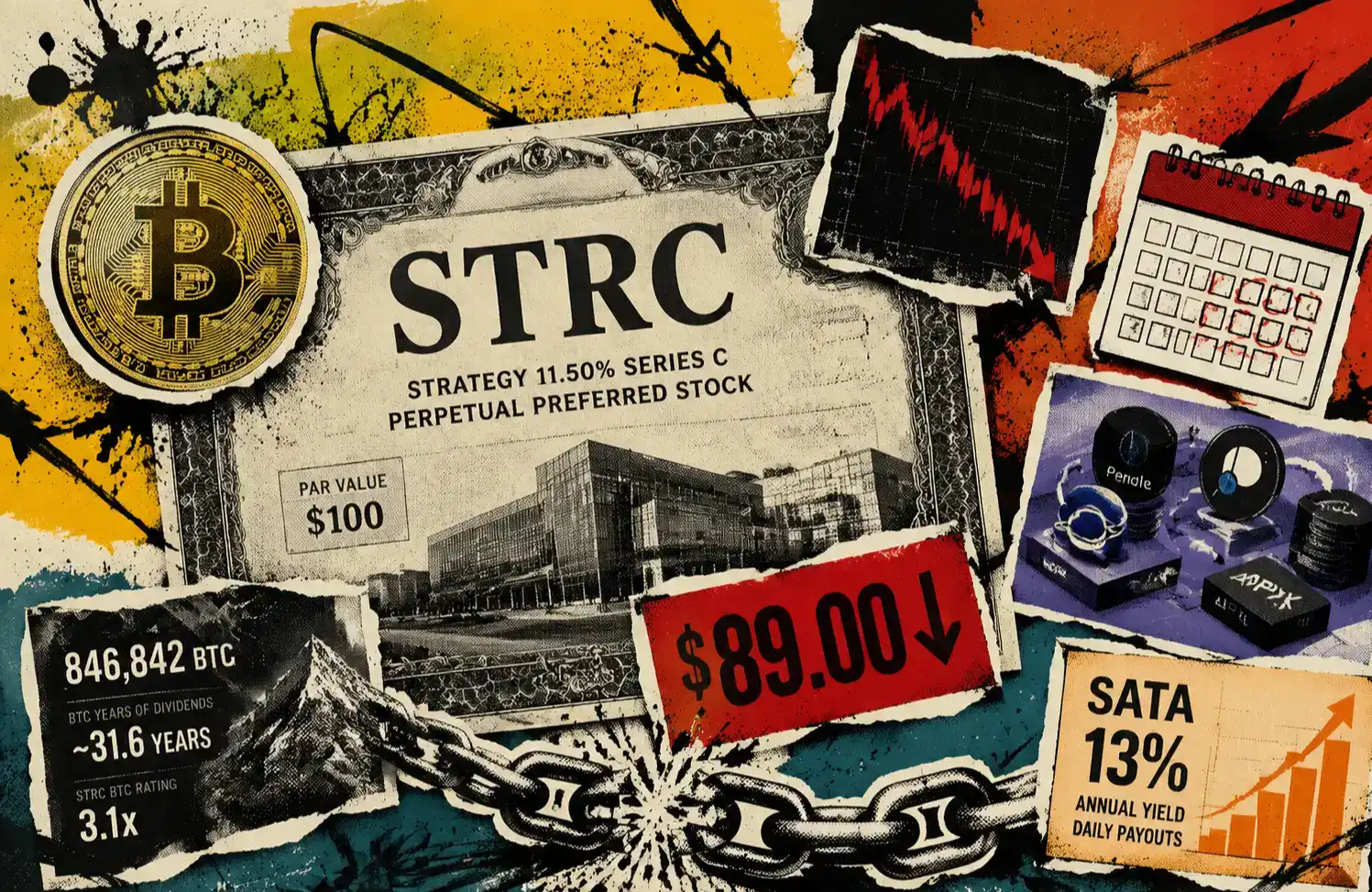
The article analyzes the recent significant de-pegging of Strategy's perpetual preferred stock, STRC, whose price fell to approximately $89, far below its $100 face value. This discount has pushed its simple yield to around 12.9%, creating a paradox. The stock was designed as a high-yield instrument trading near par, and Strategy maintains an 11.5% annual dividend, even recently switching to semi-monthly payments to support the price. The author explores several reasons why the high yield hasn't attracted enough buying pressure to restore the par value. A key factor is potential reverse deleveraging from carry trades, where leveraged investors may be forced to sell due to margin calls as the price falls, creating a self-reinforcing downward spiral. Additionally, the tokenization and integration of STRC into DeFi protocols (like Apyx, Saturn, Pendle) have introduced faster, more transparent, and potentially more volatile price adjustment mechanisms through leverage and yield-splitting products. The emergence of a competing product, Strive's SATA, offering a 13% yield with daily dividends, has also changed the yield benchmark, challenging STRC's unique high-yield narrative. Furthermore, the market is questioning the distinction between Strategy's substantial Bitcoin reserves, which provide long-term balance sheet coverage, and the certainty of stable near-term cash flow for dividends. Ultimately, the price dip represents a stress test for this type of BTC-backed, high-yield financing tool. The future path of STRC depends on whether Strategy acts to reinforce the $100 peg (e.g., by adjusting dividends), whether DeFi-related leverage unwinds further, and how investors ultimately price the risks of leverage, competition, and cash flow uncertainty against the offered yield.

marsbitHace 31 min(s)

STRC Severely Unpegged, What Risks Is the Market Pricing In?

marsbitHace 31 min(s)

LIT Token Hits Six-Month High: How Long Can the Buyback Flywheel Keep Burning Fuel?

The LIT token of decentralized perpetual exchange Lighter surged to a six-month high above $1.90 on June 18th, with a market cap of $425 million. After a price correction earlier this year, the recent rebound is attributed to its core "buyback flywheel" mechanism. All protocol fee revenue is used for programmatic, hourly market buybacks of LIT. Since its TGE in December 2025, approximately 15 million LIT (6% of circulating supply) has been repurchased for around $21 million. Additional price support comes from the LLP (Lighter Liquidity Pool), where providers must stake LIT worth 10% of their deposited USDC, locking significant token supply. However, challenges persist. Trading volume has declined amidst a sluggish market, with total volume at $1.68 trillion, significantly lower than leading competitor Hyperliquid's $4.37 trillion. While Lighter focuses on perpetual contracts, RWA, and Pre-IPO markets, Hyperliquid has expanded into prediction markets and boasts a U.S. spot ETF, attracting institutional investment and influencer endorsements like from Arthur Hayes. In contrast, LIT currently lacks similar high-profile backing. With 75% of LIT's total 1 billion supply still locked (team and investor tokens begin a 3-year linear unlock in December 2026), there is no immediate unlock selling pressure. The token's future performance hinges on sustaining trading volume growth, successful product iteration, and executing its transparent buyback strategy against a dominant competitor.

Foresight NewsHace 51 min(s)

LIT Token Hits Six-Month High: How Long Can the Buyback Flywheel Keep Burning Fuel?

Foresight NewsHace 51 min(s)

Trading

Spot
Futuros
活动图片