Ripple, Circle, Paxos Secure Path To National Banking Charters In The US

bitcoinistPublished on 2025-12-12Last updated on 2025-12-12

Abstract

The Office of the Comptroller of the Currency (OCC) has granted conditional approval for national trust bank charters to several major crypto firms, including Ripple, Circle, BitGo, Fidelity Digital Assets, and Paxos. Once fully approved, these charters will allow the companies to manage and hold digital assets on behalf of customers, enabling faster payment settlements. Currently, Anchorage Digital is the only other crypto firm with such a charter. Ripple’s CEO Brad Garlinghouse hailed the move as a significant step for the company’s stablecoin, RLUSD, and criticized banking lobbyists for "anti-competitive tactics." The OCC emphasized that each application underwent rigorous review and that these approvals modernize the financial system and expand access to innovative products.

On Friday, the Office of the Comptroller of the Currency (OCC) approved national trust charter applications from several key firms in the industry including Circle’s First National Digital Currency Bank, Ripple National Trust Bank, BitGo Bank & Trust, Fidelity Digital Assets, and Paxos Trust Company.

OCC’s Approval Of Digital Asset Trust Banks

Once finalized and full approval is reached, these national trust bank charters would empower the crypto companies to manage and hold assets on behalf of their customers, enabling faster payment settlements.

Currently, Anchorage Digital is the only digital asset company that holds a national trust bank charter from the OCC, which oversees a total of 60 such institutions.

Comptroller Jonathan Gould emphasized that each application underwent a thorough and rigorous review process, underscoring the necessity for each entity to meet additional conditions before gaining full operational status.

He explained that welcoming new entrants into the banking landscape aids in modernizing the system, diversifying offerings, and enhancing access to innovative financial products.

Ripple CEO Challenges Banking Lobbyists

Brad Garlinghouse, CEO of Ripple, commented on the approval via social media, highlighting it as a significant advancement for Ripple’s stablecoin, RLUSD. He stated that it sets a high standard for compliance under both federal and state regulation.

Garlinghouse also took a moment to address banking lobbyists who may have opposed this move, asserting that their “anti-competitive tactics” are evident.

The executive pointed out that while these lobbyists have argued that the crypto industry does not abide by the same regulations, the recent approvals demonstrate that the crypto sector is operating transparently under the supervision of the OCC.

Stuart Alderoty, Ripple’s Chief Legal Officer, noted that the firm is among the first entities to receive conditional approval following the enactment of the GENIUS legislation, ensuring the sustainability of Ripple’s stablecoin business for the long term.

The daily chart shows XRP’s price trading just below the key $2 resistance wall. Source: XRPUSDT on TradingView.com

Featured image from DALL-E, chart from TradingView.com
Related Reads

Stripe for Agents: From Protocol Stack to Payment Ecosystem - An Investment Map for Agents

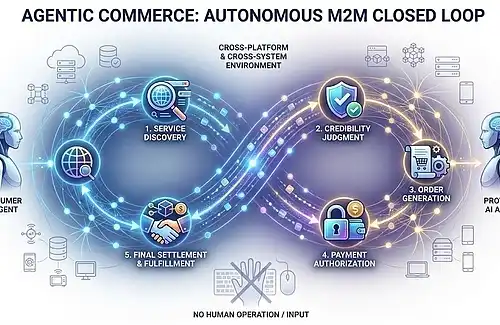
Agentic Commerce represents a transformative shift towards fully autonomous commercial systems where AI agents handle service discovery, trust verification, order generation, payment authorization, and settlement without human intervention. This machine-to-machine (M2M) economy relies on a dual-payment infrastructure: traditional fiat systems (e.g., Stripe, Visa) for regulated and high-value transactions, and stablecoin-based systems (e.g., USDC, x402) for digital-native, micro-payment scenarios like API calls, cross-border payments, and IoT transactions. The protocol stack enabling Agentic Commerce spans six layers: discovery (A2A, MCP), trust (ERC-8004), ordering (ACP), authorization (AP2), payment (AP2 for fiat, x402 for crypto), and fulfillment (still emerging). Key protocols include Google’s A2A for agent interoperability, Anthropic’s MCP for tool integration, OpenAI and Stripe’s ACP for structured ordering, Google’s AP2 for payment authorization, Ethereum’s ERC-8004 for on-chain identity/reputation, and Coinbase’s x402 for stablecoin-based API payments. The ecosystem features projects like Skyfire (identity and payment credentials), Payman (AI-native fund control), Catena Labs (agent identity standards), and Nevermined (micro-payment billing). x402’s Facilitators (e.g., Coinbase CDP, PayAI) are critical for executing on-chain settlements, though the space remains early and competitive. Long-term, Agentic Commerce will operate on two parallel tracks: fiat-based systems for traditional commerce and stablecoin-native protocols like x402 for M2M micro-transactions. Web3’s role is to provide verifiable identity, programmable settlement, and global stablecoin infrastructure, ultimately重构ing economic秩序 through trust, automation, and scalability.

marsbitHace 17 min(s)

Stripe for Agents: From Protocol Stack to Payment Ecosystem - An Investment Map for Agents

marsbitHace 17 min(s)

Trading

Spot
Futures
活动图片