Goldman Sachs, Bank of America, and 21 Other Giants Enter Stablecoin Market: Joining Forces to Launch a Coin, Attempting to Shake Up the Established Fortress of Tether and Circle?

marsbitPublicado a 2026-09-03Actualizado a 2026-09-03

Resumen

On September 1, a coalition of 21 major traditional financial institutions, including Goldman Sachs, Bank of America, and Citigroup, announced a rare alliance to launch a US dollar stablecoin by 2027. The move sent Circle's stock price down 6.35%, signaling a direct challenge to the dominant native incumbents, Tether and Circle. The coalition aims to later expand into euro and other G7 currency stablecoins, targeting cross-border payments and digital asset settlement markets. Notably, JPMorgan is absent from the alliance, likely due to its existing JPM Coin project. The primary motivation for this Wall Street push is the lucrative, low-risk profit model of stablecoins. Issuers earn substantial revenue by investing user deposits in high-yield assets like US Treasuries without paying interest to holders—a model traditional banks now seek to capture. However, the path for "bank-issued" stablecoins appears challenging. A cautionary example is Societe Generale's USDCV, which, despite the bank's strong credibility, has achieved a circulation of only $12.6 million nearly a year after launch. Tether and Circle have built deep liquidity moats within the crypto-native ecosystem, making integration into DeFi protocols and exchange trading pairs a significant hurdle for new entrants. A stablecoin offering only "better compliance" risks remaining a tool for internal settlement among traditional institutions. The coalition faces a tight timeline, with a key US regulatory deadline for no...

Author: Claude, Deep Tide TechFlow

Deep Tide Guide: On September 1st, 21 traditional financial giants including Goldman Sachs, Bank of America, and Citigroup formed a rare alliance, announcing plans to launch a US dollar stablecoin by 2027. The news caused Circle's stock price to fall by 6.35%. However, can Wall Street's 'regular army' truly shake the established fortress of the crypto-native market? Looking back at Societe Generale's high-profile entry earlier, its issued USDCV has been live for nearly a year, yet its circulating supply remains a dismal $12.6 million. Facing the extremely high barriers of the crypto market and the battle over compliance nodes, this seemingly luxurious financial alliance might end up being all talk and little action.
21 Institutions Ally to Issue a Coin: Why Is JPMorgan Missing?

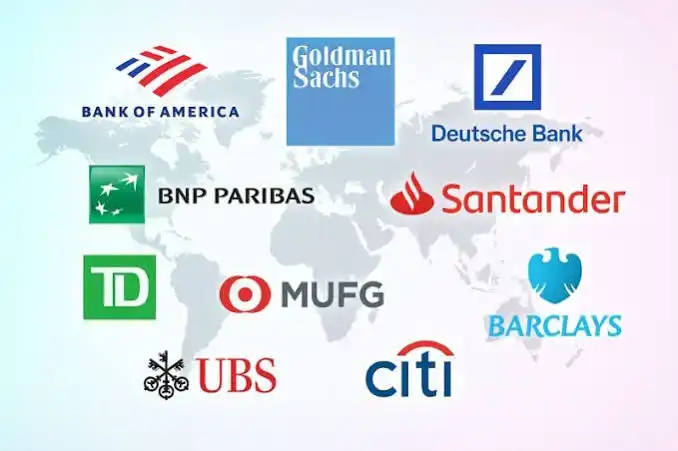
On September 1st, a joint statement released by Brunswick Group dropped a bombshell in both traditional finance and crypto circles: 21 top-tier financial institutions have decided to join forces, planning to establish a joint venture specifically for issuing stablecoins in the second half of 2026.

According to the current blueprint, the alliance's first product is a US dollar stablecoin slated for release in the first half of 2027, with plans to extend its reach to G7 currencies like the Euro thereafter, targeting cross-border payments and digital asset settlement markets. It's noteworthy that in this list of giants spanning five regions—including Goldman Sachs, Citi, UBS, and Deutsche Bank—the king of Wall Street, JPMorgan, is conspicuously absent. Considering that JPM Coin is already operational within its internal settlement network, JPMorgan clearly isn't keen on sharing its pie with this massive consortium.

Sniper on 'Interest-Free Capital': The Stablecoin Printing Press That Wall Street Covets

Why are traditional banking giants forming such a dense alliance now? The answer lies within the terrifying balance sheets of Tether and Circle.

Under the current stablecoin business model, issuers take users' fiat currency as reserves, invest it in high-interest Treasury markets, yet pay almost no interest to the users holding the stablecoins. This 'legally interest-free money' has evolved, in the current high-interest environment, into a profit-generating machine with astonishing, virtually risk-free returns. Watching stablecoin issuers, with minimal manpower, rake in net profits surpassing those of many Wall Street investment banks, these 21 financial giants clearly can no longer remain bystanders. They aim to seize this most lucrative profit territory through alliance.

Grim Precedent: Can the Compliance Alliance Shake the Native Fortress?

However, does entering with a Wall Street halo guarantee buying liquidity in the crypto market?

Looking back at the first report card for 'banking stablecoins,' the reality is starkly unforgiving. Previously, Societe Generale had high-profile launched its stablecoin USDCV. Despite the credit backing of a top-tier European bank, its circulating supply was a dismal $12.6 million nearly a year after launch. In the trading habits of crypto natives, Tether (USDT) and Circle (USDC) have long built deep liquidity moats. Faced with the integration inertia of DeFi protocols and the trading pair dominance of exchanges, a compliant stablecoin issued by Wall Street, if it's merely 'more compliant,' will most likely become an internal settlement tool for traditional institutions to amuse themselves.

The Decisive Battle: July 2028 – The Final Window Before a Major Reshuffle

Time is not plentiful for this alliance. According to the current regulatory countdown, July 18, 2028, will be a critical juncture for U.S. platforms to collectively clean up a batch of non-compliant stablecoins.
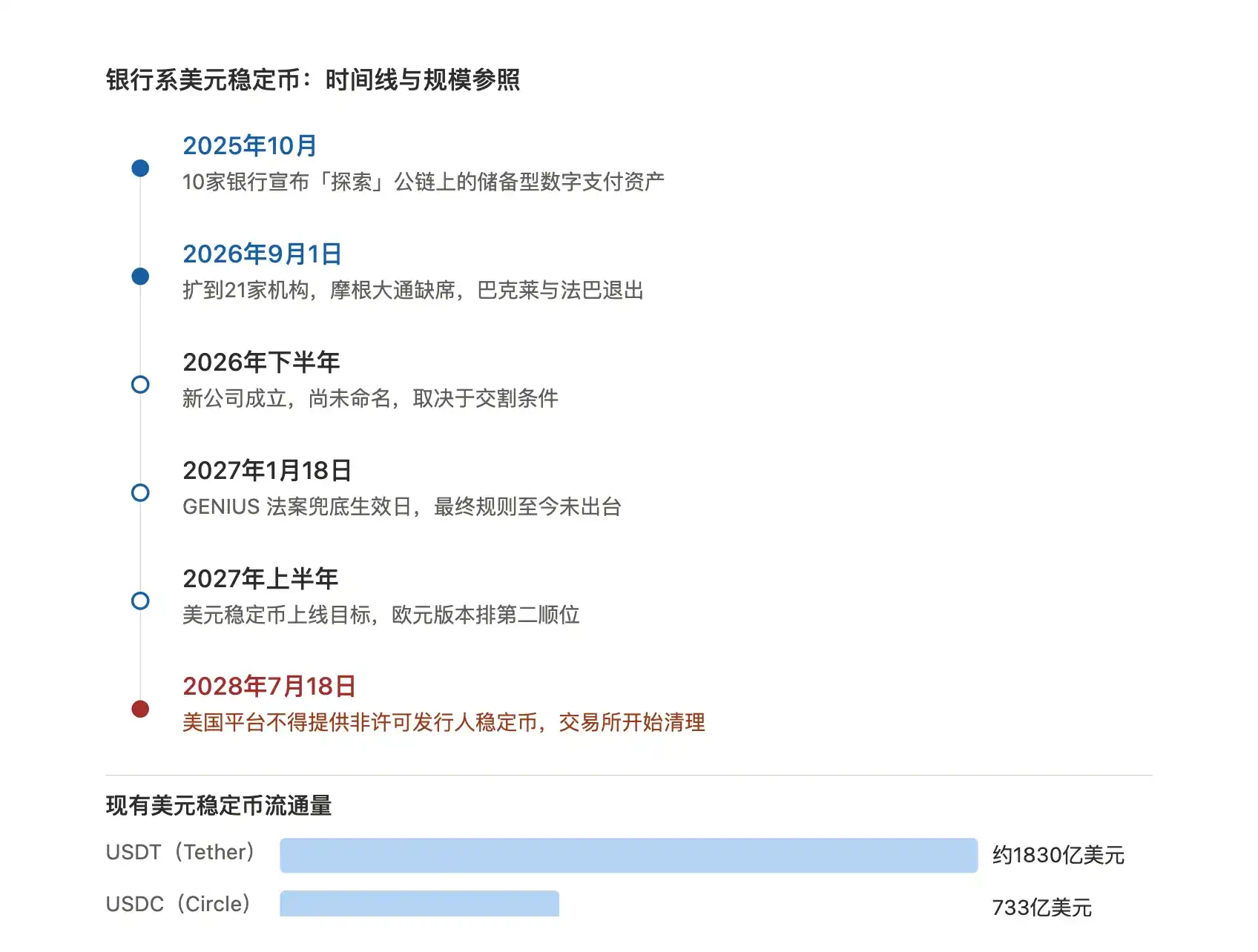
From the dismal $12.6 million pilot test to the massive size of the entire stablecoin market exceeding $100 billion, what lies between is not just the compliance test of July 2028, but also a close-quarters battle between traditional finance and Web3 native capital. When the 21 giants truly launch their product to the market in 2027, they will face a red ocean already carved up by native giants and characterized by extremely concentrated liquidity. Will this high-profile alliance be the game-changer that reshapes the stablecoin landscape, or just another traditional financial experiment struggling to adapt? The market will soon price in the answer.

Criptos en tendencia

Preguntas relacionadas

QWhy are 21 traditional financial giants, including Goldman Sachs and Bank of America, forming an alliance to launch a stablecoin?

AThe alliance aims to enter the profitable stablecoin market, which currently allows issuers like Tether and Circle to generate significant profits by investing user deposits in high-yield instruments like U.S. Treasuries without paying interest to users. These traditional institutions seek to capture a share of this lucrative business.

QWhich major U.S. bank is notably absent from the 21-member financial alliance to issue a stablecoin, and why?

AJPMorgan Chase is absent from the alliance. This is likely because JPMorgan already has its own internal settlement solution, JPM Coin, and may not want to share its market or technology with a competing consortium.

QWhat does the example of Societe Generale's USDCV stablecoin indicate about the challenge for traditional banks entering the stablecoin market?

ASociete Generale's USDCV stablecoin has achieved only a meager circulation of $12.6 million after nearly a year, despite the bank's strong reputation. This indicates that having traditional financial credibility alone is insufficient to break into a market where native players like Tether (USDT) and Circle (USDC) have deep liquidity moats and strong integration with DeFi protocols and exchanges.

QWhat is the significance of the July 18, 2028 deadline mentioned in the article for the stablecoin market?

AJuly 18, 2028, is presented as a key regulatory deadline by which U.S. platforms are expected to clear out a batch of non-compliant stablecoins. This creates a window of opportunity and pressure for new, compliant entrants like the financial alliance to establish themselves before the market potentially undergoes a significant reshuffle.

QAccording to the article, what is the primary potential obstacle for the new alliance's stablecoin, beyond just being 'more compliant'?

AThe primary potential obstacle is overcoming the entrenched liquidity and user habits in the crypto-native market. Stablecoins like USDT and USDC have deep integration with DeFi ecosystems and dominate trading pairs on exchanges. A new stablecoin that offers only better compliance risks becoming a tool only for internal settlement among the traditional institutions themselves, failing to gain widespread adoption.

Lecturas Relacionadas

CertiK Announces Brand Upgrade, Committed to Building Trust Infrastructure for the Digital Economy

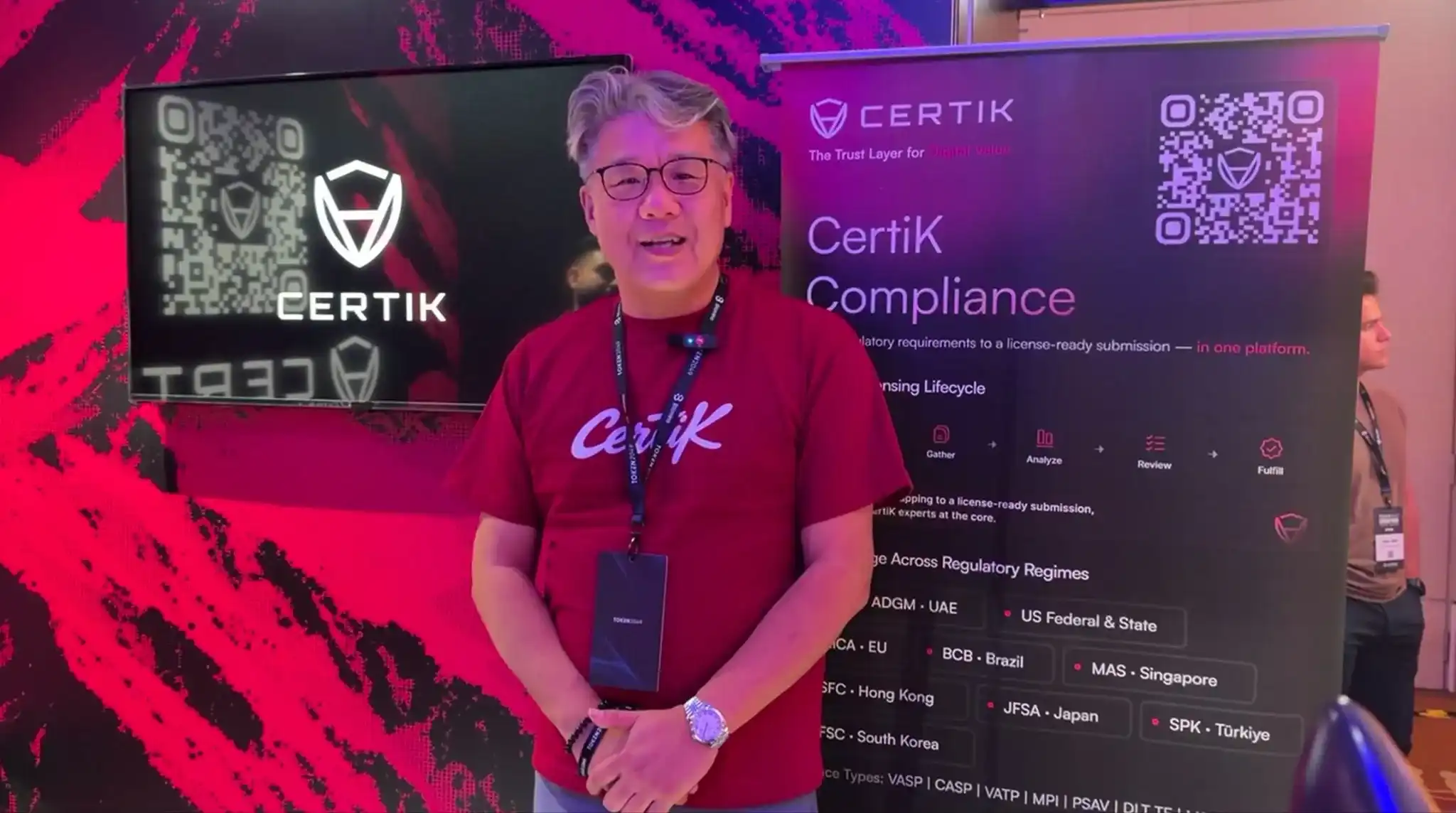
On October 7th, at the TOKEN2049 Singapore conference, CertiK announced a major brand upgrade, positioning itself as "The Trust Layer for Digital Value." This new direction underscores the company's mission to build trust infrastructure for the digital economy. Originating as a smart contract auditor, CertiK has grown into the world's largest Web3 security company. The rebranding reflects its expansion towards serving financial institutions, regulators, and enterprises within the digital asset ecosystem, focusing on integrated security and risk management solutions. Jason Jiang, Chief Business Officer, stated that as digital assets transform value flow, institutions and regulators require combined security, compliance, and clear risk visibility. CertiK's upgraded vision aims to address these needs as a foundational trust layer. To support this broader mission, CertiK offers a suite of products including Skynet (continuous monitoring), CertiK Compliance, CertiK Supervision, and the AI Auditor. Its services encompass smart contract audits, formal verification, penetration testing, proof of reserves, and node validation. This combination helps clients evaluate system security and monitor digital asset risks continuously. Furthermore, CertiK provides technical support for digital asset policy in key jurisdictions like the U.S., Hong Kong, Singapore, and the UAE. It bridges technical security assessments with the practical requirements of regulated digital asset markets through collaboration with regulators and enterprises. Founded in 2017 by professors from Yale and Columbia University, CertiK leverages formal verification expertise. To date, it has served over 5,500 clients across 150+ regions, identifying more than 119,000 code vulnerabilities and helping to safeguard over $600 billion in digital assets. This brand upgrade clearly charts CertiK's next phase: extending its Web3 security expertise into the broader digital economy. By supporting both builders and regulators of digital asset systems, CertiK continues its mission of establishing foundational trust for the digital economy.

marsbitHace 2 hora(s)

CertiK Announces Brand Upgrade, Committed to Building Trust Infrastructure for the Digital Economy

marsbitHace 2 hora(s)

Trading

Spot

Artículos destacados

Qué es $BANK

Banco AI: Un Paso Revolucionario en el Futuro de la Banca Introducción En una era marcada por avances rápidos en tecnología, Banco AI se sitúa en la intersección de la inteligencia artificial (IA) y los servicios bancarios. Este proyecto innovador busca redefinir el panorama financiero, mejorando la eficiencia operativa, las medidas de seguridad y las experiencias del cliente a través del poder de la IA. Al embarcarnos en esta exploración de Banco AI, profundizaremos en lo que implica el proyecto, sus dinámicas operativas, su contexto histórico y hitos significativos. ¿Qué es Banco AI? En su esencia, Banco AI representa una iniciativa transformadora destinada a integrar la inteligencia artificial en varias operaciones bancarias. Este proyecto aprovecha las capacidades de la IA para automatizar procesos, mejorar los protocolos de gestión de riesgos y mejorar la interacción con los clientes a través de servicios personalizados. Los objetivos principales de Banco AI incluyen: Automatización de Funciones Bancarias: Al aprovechar las tecnologías de IA, Banco AI tiene como objetivo automatizar tareas rutinarias, reduciendo la carga sobre los recursos humanos y mejorando la eficiencia. Mejora en la Gestión de Riesgos: El proyecto utiliza algoritmos de IA para predecir e identificar riesgos, fortaleciendo así las medidas de seguridad contra fraudes y otras amenazas. Personalización de Servicios Bancarios: Banco AI se centra en ofrecer productos y servicios financieros a medida al analizar datos y comportamientos de los clientes. Mejoramiento de la Experiencia del Cliente: La implementación de soluciones impulsadas por IA, como chatbots y asistentes virtuales, tiene como objetivo proporcionar a los usuarios interacciones más humanas, revolucionando la forma en que los clientes se relacionan con los bancos. Con estos objetivos, Banco AI se posiciona como un jugador crucial para hacer que la banca sea más eficiente, segura y centrada en el usuario. ¿Quién es el Creador de Banco AI? Los detalles sobre el creador de Banco AI siguen siendo desconocidos. Como tal, no se ha identificado a ninguna persona u organización específica en la información disponible. El anonimato que rodea el inicio del proyecto plantea preguntas, pero no resta valor a su ambiciosa visión y objetivos. ¿Quiénes Son los Inversores de Banco AI? Al igual que con el creador del proyecto, no se ha divulgado información específica sobre los inversores u organizaciones que apoyan a Banco AI. Sin esta información, es un desafío delinear el respaldo financiero y el apoyo institucional que podrían estar impulsando el proyecto hacia adelante. No obstante, la importancia de contar con una sólida base de inversión es fundamental para sostener el desarrollo en un campo tan innovador. ¿Cómo Funciona Banco AI? Banco AI opera en múltiples frentes innovadores, centrándose en factores únicos que lo diferencian de los marcos bancarios tradicionales. A continuación, se presentan las características operativas clave: Automatización: Al aplicar algoritmos de aprendizaje automático, Banco AI automatiza varios procesos manuales dentro de los bancos. Esto resulta en la reducción de costos operativos y permite que los trabajadores humanos redirijan sus esfuerzos hacia actividades más estratégicas. Gestión Avanzada de Riesgos: La integración de la IA en las prácticas de gestión de riesgos equipa a los bancos con herramientas para predecir con precisión amenazas potenciales como el fraude, garantizando que la información y los activos de los clientes permanezcan seguros. Recomendaciones Financieras Personalizadas: A través del aprendizaje continuo a partir de las interacciones con los clientes, los sistemas de IA desarrollan una comprensión matizada de las necesidades del usuario, lo que les permite ofrecer consejos adaptados sobre decisiones financieras. Interacciones Mejoradas con los Clientes: Al utilizar chatbots y asistentes virtuales impulsados por IA, Banco AI permite una experiencia más atractiva para el cliente, permitiendo a los usuarios resolver sus consultas rápidamente, reduciendo así los tiempos de espera y mejorando los niveles de satisfacción. En conjunto, estas características operativas posicionan a Banco AI como un pionero en el sector bancario, estableciendo nuevos parámetros para la entrega de servicios y la excelencia operativa. Línea de Tiempo de Banco AI Entender la trayectoria de Banco AI requiere mirar su contexto histórico. A continuación, se presenta una línea de tiempo que destaca hitos y desarrollos importantes: Inicios de 2010: La conceptualización de la integración de la IA en los servicios bancarios comenzó a ganar atención a medida que las instituciones bancarias reconocieron los posibles beneficios. 2018: Se produjo un aumento notable en la implementación de tecnologías de IA cuando los bancos comenzaron a utilizar herramientas de IA como chatbots para el servicio al cliente básico y sistemas de gestión de riesgos para mejorar la seguridad. 2023: La sofisticación de la IA continuó avanzando, con la introducción de IA generativa para tareas más complejas como el procesamiento de documentos y análisis de inversiones en tiempo real. Este año marcó un salto significativo en las capacidades que la tecnología de IA otorgó a los bancos. 2024-Estatus Actual: A partir de este año, Banco AI se encuentra en una trayectoria ascendente, con investigaciones y desarrollos en curso que pronto mejorarán las capacidades en las operaciones bancarias. La continua exploración de las aplicaciones de IA sugiere emocionantes desarrollos aún por venir. Puntos Clave Sobre Banco AI Integración de la IA en la Banca: Banco AI se centra en adoptar inteligencia artificial para optimizar los procesos bancarios y mejorar la experiencia del usuario. Enfoque en Automatización y Gestión de Riesgos: El proyecto enfatiza fuertemente estas áreas, con el objetivo de desplazar la carga de tareas rutinarias mientras mejora los marcos de seguridad a través de análisis predictivos. Soluciones Bancarias Personalizadas: Al aprovechar los datos de los clientes, Banco AI permite servicios bancarios adaptados a las necesidades individuales de los usuarios. Compromiso con el Desarrollo: Banco AI se mantiene comprometido con esfuerzos de investigación y desarrollo continuos, asegurando su adaptabilidad y relevancia continua a medida que la tecnología sigue evolucionando. Conclusión En resumen, Banco AI ejemplifica un paso crucial hacia adelante en la industria bancaria, aprovechando la inteligencia artificial para redefinir los paradigmas operativos, mejorar la seguridad y promover la satisfacción del cliente. A pesar de las lagunas en la información sobre el creador y los inversores, los objetivos claros y los mecanismos funcionales de Banco AI proporcionan una sólida base para su evolución continua. A medida que la tecnología de IA sigue avanzando y fusionándose con el sector bancario, Banco AI está bien posicionado para impactar significativamente el futuro de los servicios financieros, mejorando la forma en que entendemos e interactuamos con la banca.

498 Vistas totalesPublicado en 2024.04.06Actualizado en 2024.12.03

Qué es $BANK

Cómo comprar BANK

¡Bienvenido a HTX.com! Hemos hecho que comprar Lorenzo Protocol (BANK) sea simple y conveniente. Sigue nuestra guía paso a paso para iniciar tu viaje de criptos.Paso 1: crea tu cuenta HTXUtiliza tu correo electrónico o número de teléfono para registrarte y obtener una cuenta gratuita en HTX. Experimenta un proceso de registro sin complicaciones y desbloquea todas las funciones.Obtener mi cuentaPaso 2: ve a Comprar cripto y elige tu método de pagoTarjeta de crédito/débito: usa tu Visa o Mastercard para comprar Lorenzo Protocol (BANK) al instante.Saldo: utiliza fondos del saldo de tu cuenta HTX para tradear sin problemas.Terceros: hemos agregado métodos de pago populares como Google Pay y Apple Pay para mejorar la comodidad.P2P: tradear directamente con otros usuarios en HTX.Over-the-Counter (OTC): ofrecemos servicios personalizados y tipos de cambio competitivos para los traders.Paso 3: guarda tu Lorenzo Protocol (BANK)Después de comprar tu Lorenzo Protocol (BANK), guárdalo en tu cuenta HTX. Alternativamente, puedes enviarlo a otro lugar mediante transferencia blockchain o utilizarlo para tradear otras criptomonedas.Paso 4: tradear Lorenzo Protocol (BANK)Tradear fácilmente con Lorenzo Protocol (BANK) en HTX's mercado spot. Simplemente accede a tu cuenta, selecciona tu par de trading, ejecuta tus trades y monitorea en tiempo real. Ofrecemos una experiencia fácil de usar tanto para principiantes como para traders experimentados.

1.3k Vistas totalesPublicado en 2025.05.09Actualizado en 2026.06.02

Cómo comprar BANK

Discusiones

Bienvenido a la comunidad de HTX. Aquí puedes mantenerte informado sobre los últimos desarrollos de la plataforma y acceder a análisis profesionales del mercado. A continuación se presentan las opiniones de los usuarios sobre el precio de BANK (BANK).

活动图片