- The last week of September and the first week of October were characterized by opposite vectors.
- In the outgoing week, Bitcoin paradoxically received a short-term impulse for growth.
The last week of September and the beginning of October unfolded under the sign of a struggle between two opposing forces. Expensive oil and a sell-off in government bonds supported inflationary risks and increased the cost of capital, while a weakening US labor market forced investors to reconsider the likelihood of a new Fed rate hike.
As a result, US stocks ended the week with no single direction, Bitcoin practically returned to its starting point after an intra-week surge above $87,000, and gold fell noticeably.
Bonds Became the Main Market of the Week
Monday, September 28, immediately set a nervous tone. Brent oil closed on September 28 at $105.28 per barrel, while the yield on 10-year US Treasury bonds rose to approximately 5.25%. The S&P 500 lost 0.8%, Nasdaq — 0.9%, and Dow Jones — 0.7%. The rise in oil prices heightened fears that an energy shock would hinder further inflation reduction and force the Fed to keep rates high for longer.
By October 1, the yield on 10-year US Treasury bonds had managed to rise to 5.34%, a high since 2002. For the markets, this was more important than most individual corporate news: the higher the risk-free yield, the more expensive the financing and the stronger the competition of bonds with stocks, gold, and cryptocurrencies.
At the same time, American inflation did not give the market a reason to completely abandon concerns. According to data published on September 30, the PCE index rose 3.4% year-on-year in August, and the core measure excluding food and energy — 3.0%. Real consumer spending increased 0.6% month-on-month, meaning demand remained fairly resilient.
The picture changed on Friday after the employment report. In September, the US economy created only 29,000 jobs, the unemployment rate was 4.2%, and data for July and August were revised downward by a total of 60,000 jobs. Average hourly earnings rose only 0.1% month-on-month and 3.0% year-on-year.
The market immediately recalculated the likelihood of further policy tightening. According to Reuters, the probability of a Fed rate hike in October fell to approximately 22.7% from 64.2% a week earlier. On Friday, the S&P 500 added 0.73%, Nasdaq — 1.19%, but this was not enough for an overall weekly increase of all indices: the S&P 500 lost 0.27%, Dow Jones — 1.26%, while Nasdaq grew by 0.45%.
Thus, the main paradox of the week emerged: weak employment data became good news for stocks because it reduced the risk of another rate hike. So far, investors perceive the cooling labor market as an argument for a Fed pause, not as the beginning of a serious economic downturn.
AI Sector Helped Nasdaq Withstand Rate Pressure
The resilience of the technology index was explained not only by Fed expectations. Corporate news once again showed that the investment cycle around artificial intelligence remains a separate source of market support.
On September 28, Nvidia increased the authorized volume of its share buyback program by another $150 billion, bringing the remaining limit to $235 billion. The company plans to implement the program until the 2028 fiscal year.
Two days later, Micron reported record quarterly revenue of $54.23 billion versus $11.32 billion a year earlier. For the first quarter of fiscal 2027, the memory manufacturer forecasts approximately $61.5 billion in revenue with a deviation range of $1.5 billion.
These results help explain the gap between Nasdaq and the rest of the market. High bond yields reduce the value of future cash flows of technology companies, but at the same time, the largest participants in the AI cycle are demonstrating such rapid revenue and cash flow growth that investors are not yet ready to completely exit the sector.
Bitcoin Ended a Strong Quarter Almost Flat
The cryptocurrency market is also tied to US interest rates. Bitcoin started on September 28 in the $84,500 zone, then fell below $83,000, and on October 2, after expectations for a rate hike weakened, it rose above $87,100. By the end of October 3, the price returned to the $84,700–84,800 range, meaning there was no significant movement during the period under review.
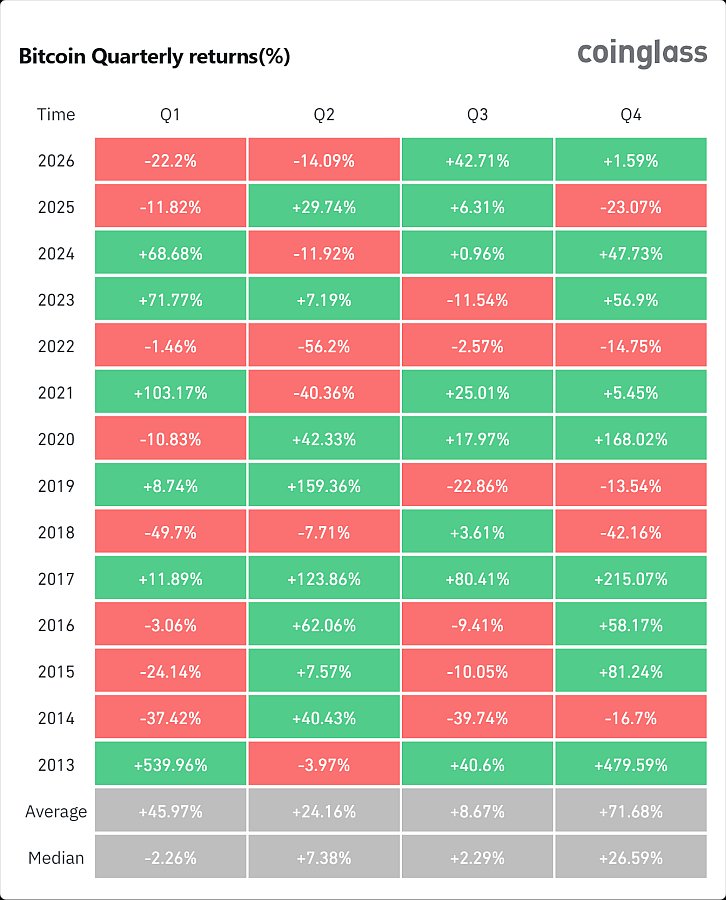
The calm week followed a significantly stronger quarter. According to CoinGlass, in the third quarter, Bitcoin added about 44%, showing the best quarterly result since the beginning of 2024. Ethereum rose 70.9%, which was its best quarter since the first quarter of 2021.
Source: CoinGlass
Institutional demand persisted. US spot Bitcoin ETFs received about $2.65 billion in net inflows in September, and Ethereum funds — $832.43 million. These figures relate to all of September, not just the week in question, and help understand the backdrop against which the crypto market entered the fourth quarter.
A more fundamental event occurred on October 1. The SEC proposed a new regime for the custody of crypto assets for registered investment advisers and regulated funds. The draft allows, under certain conditions, self-custody of crypto assets and the use of state trust companies as custodians. For now, this is a regulator's proposal, not existing rules.
For the short-term price of Bitcoin this week, Treasury yields turned out to be more important than regulatory changes. But in a longer horizon, the formation of a clear custody regime for institutional participants could have a more sustainable significance than another BTC move of a few percent.
Oil Remained Above $100, but the Main Shortage Shifted to Fuel
On the commodity market, oil once again demonstrated maximum volatility. After Brent closed at $105.28 on Monday, quotes reacted sharply for several days to news about supplies and the situation in the Middle East. On October 1, Brent jumped more than 4% to $102.31 when geopolitical risks intensified simultaneously and reports emerged of China suspending oil product exports.
However, pressure eased on Friday after G7 countries decided to tap emergency oil and diesel reserves. Brent ended the week at $102.25, virtually unchanged for the week, while WTI closed at $91.11, losing about 1.6%.
Here, a shift within the energy crisis itself is important. The restoration of some crude oil flows reduced fears about a physical shortage of raw materials, but the problem is increasingly shifting towards diesel and refining. Limited availability of oil products means that even with sufficient crude oil, consumers may continue to face high fuel prices.
This also explains why oil could not sustainably move significantly above $100, despite an extremely tense geopolitical backdrop — the market is receiving signals about shortages and about governments' readiness to use strategic reserves.
Gold Lost to High Yields
One of the most indicative movements of the week was the fall in gold.
The spot price of the metal ended Friday around $4,140 per ounce, losing approximately 3.4% over the week. On Monday, the decline was about 3.6% in a single session.
At first glance, this looks unusual for a week with an oil shock and high geopolitical tension. But the mechanism was quite logical: rising oil prices fueled inflation expectations, they pushed bond yields higher, and an expensive dollar and Treasury bonds with yields above 5% increased the opportunity cost of holding gold, which itself does not generate interest income.
Even weak data on non-farm payrolls on Friday initially supported the metal, but the initial rise did not hold. Defensive demand turned out to be weaker than the pressure of high rates.
Turkey: Stock Crisis Became More Important Than Rate
In Turkey, the main market event of the week was a crisis almost unrelated to US statistics.
The BIST 100 ended September with a 16.65% drop, the worst monthly result since 2008. By the end of the month, the index was more than 20% below the May 11 high, formally entering a bear market. Stocks of companies outside the top hundred suffered even more: the corresponding index lost about 35% in September.
The source of pressure was a problem with investment funds that had significant positions in illiquid securities. When share redemptions began, some managers had to sell more liquid assets, spreading pressure to the broader market.
The Turkish regulator officially announced that it had decided to liquidate 131 funds of seven management companies. According to the Central Registry Agency, these funds held funds of 455,758 unique investors.
On October 1, the regulator announced interim payments to investors of some liquidated funds. The payment amount is determined by the confirmed net investment sum but is limited at this stage to 1 million lira per investor in each fund.
Against the backdrop of this story, the Central Bank of Turkey made a slight easing in macroprudential rules: the limit on lending growth to small and medium-sized businesses was increased from 4.5% to 5%, and requirements for blocking mandatory reserves in lira were reduced. This does not mean a reversal of monetary policy, as the key rate remains at 37%.
The information on the site is solely for informational and educational purposes and is not investment advice or financial guidance. Cryptocurrencies and digital assets are associated with a high level of risk, including possible capital loss. The editorial team is not responsible for decisions made based on published materials. It is recommended to conduct your own research (DYOR) before making investment decisions. Familiarize yourself with the editorial policy at https://happycoin.news/about/