This Year's Graduates, Trapped in Countless 'Online Assessments'

marsbitPublicado a 2026-08-20Actualizado a 2026-08-20

Resumen

This Year's Graduates, Trapped in Endless "Online Assessments" After years of standardized exams, new graduates face a new hurdle: a seemingly endless series of online evaluations to enter the job market. Over 60% of large and mid-sized companies now incorporate online tests into their campus recruitment, increasingly using AI for screening and even initial interviews. For graduates like Yang Liu, daily life revolves around practicing for these assessments—covering professional skills, aptitude tests (similar to civil service exams), and personality quizzes. The pressure is immense, with a record 12.22 million graduates in 2025 and fierce competition for limited positions. Even securing an internship often requires passing multiple rounds of tests, some involving complex tasks like producing full industry reports using specific AI tools. From an HR perspective, these rigorous screenings are a necessary tool to manage overwhelming application volumes and identify candidates with the right learning ability, logic, and resilience. Some insiders acknowledge the process also acts as a "compliance test" to filter for stable, adaptable candidates. However, many graduates feel the tests are often irrelevant to the actual job and serve merely as a bulk-filtering mechanism. This has spawned a grey market catering to graduate anxiety. Services range from selling leaked question banks and AI-powered cheating tools to high-priced "full-process tutoring" packages promising to secure of...

Entrance exams for junior high, high school, college, postgraduate studies... After countless exams, fresh graduates are finally ready to knock on the door of their ideal careers, only to find an endless array of assessments still waiting for them.

Relevant data shows that over 60% of large and medium-sized enterprises incorporate online written tests into their campus recruitment processes. Furthermore, with the widespread adoption of AI, most of these assessments no longer require HR personnel to grade them personally; AI directly screens the results, and even interviews can be conducted by AI.

Academic qualifications and internship experience are no longer the ticket to an interview; whether you can pass the aptitude tests, personality tests, and AI video interviews now determines if you have the qualification to be seen.

To cope with these assessments, many job seekers jokingly call themselves suffering from 'assessment anxiety' on social media. The prevailing belief is that most online tests are unrelated to the actual work of the position and are merely tools for companies to screen candidates en masse. But no one can avoid them.

For countless young people, the daily routine of job hunting has ultimately become an endless cycle of mass applications, practicing test questions, being a mere participant, getting eliminated, and applying again.

This issue of 'Micro-Story' will delve into the job seekers trapped by these assessments.

Here are their real stories:

Trapped in Endless Tests

Since submitting her graduation thesis in April, 25-year-old Yangliu has spent several hours every day practicing test questions, listening to lectures, reviewing answer strategies, and sometimes even recording videos of herself on her phone to check the effect.

Don't get it wrong—she is not preparing for civil service or graduate school entrance exams. Every set of questions she practices is for one thing only: dealing with the massive wave of online assessments for the upcoming autumn recruitment.

Every July and August is the core window period for autumn campus recruitment, also the time when job-seeking activity is most concentrated throughout the year.

Data shows that in 2025 alone, 12.22 million college graduates entered the job market. Over 31% of fresh graduates submitted more than 20 resumes in the initial stage of their job search, and 42% of previous-year graduates reported being invited by companies to take assessments after submitting their resumes.

Facing a massive influx of resumes, simple academic screening and initial resume filtering are no longer sufficient to meet companies' recruitment pace. Nowadays, not only state-owned enterprises, central enterprises, and leading internet giants but almost all large-scale enterprises have made online application (resume submission) and participating in written tests or assessments mandatory steps before interviews. Some companies have even started using AI interviews.
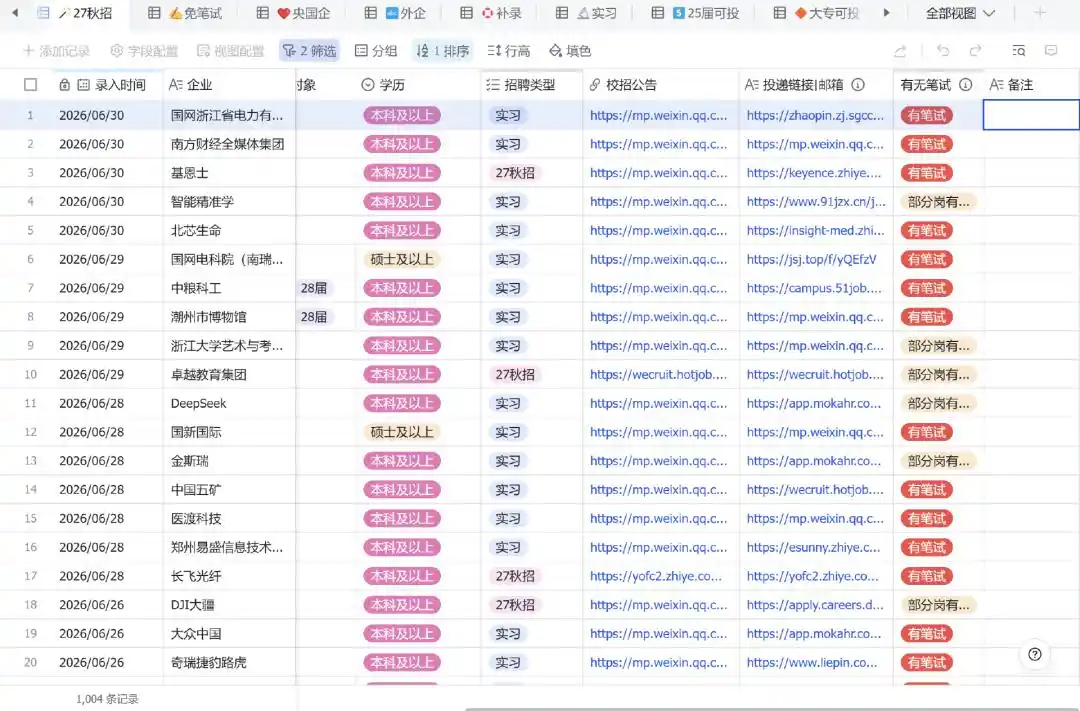
Image | Some companies explicitly mention a written test phase in related online autumn recruitment information

"AI interviews use algorithms to observe the candidate's body language and emotional changes, analyze their verbal logic, and finally, AI screens whether they proceed to the next stage," Yangliu explained. Some AI interviews are very strict; uncoordinated body movements or wandering eyes might be flagged as 'cheating.'

Besides AI interviews, written tests have also become more difficult than before. Some sections have time limits, and they might even suddenly ask you about specific details of certain company projects.

To improve her answer accuracy and efficiency, Yangliu had to prepare on multiple fronts—even though she graduated from a 211 university, her degree is not a significant advantage in the job market. "Without hardcore professional barriers, I can only rely on mass applications, taking many assessments, and trying widely, using quantity to exchange for probability."

Yangliu's senior used a similar strategy, applying to over 100 positions, taking more than 20 written tests, and finally finding a job. "This year, there are even more graduates, so the situation might be more severe," Yangliu said.

Currently, company written tests are mainly divided into three categories: position-specific professional ability tests, general aptitude tests similar to civil service exams, and personality tests used to screen for specific traits.
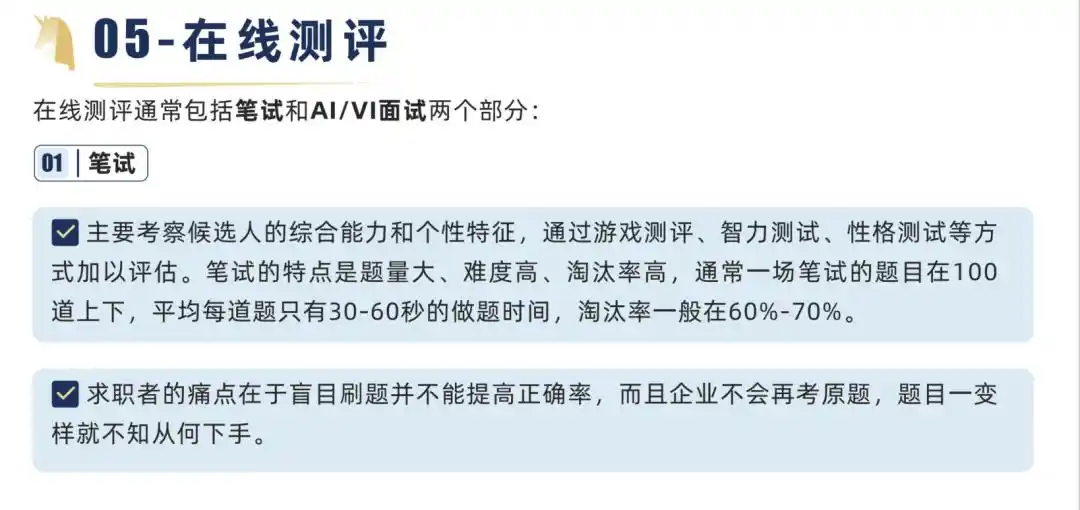
Image | Introduction to online assessments by a certain career service agency

These three question types are randomly combined with varying difficulty levels, so one can only rely on advance preparation as a safety net.

Her senior summarized a preparation formula: Professional questions are closely related to the business and are the most difficult; you can only accumulate problem-solving ideas by analyzing industry cases. Aptitude test questions have no shortcuts; only massive practice makes perfect. For personality tests, you cannot answer freely; you must simulate repeatedly to align with the workplace's core expectations for employee resilience, ambition, and stability.

In a way, this is also the job-seeking path for all current graduates: To not miss any opportunity, the vast majority of graduates choose to apply in bulk. The cost of mass applications is being swept along by countless online assessments.

Xu Wang, who just secured a summer internship offer, feels similarly. "Nowadays, even finding a summer internship requires participating in multiple assessments."

In the past two years, the number of internship positions in the market has shrunk by over 15%, while the number of applications has surged dramatically. The competition of 'many monks, little gruel' is intensifying.

To gain an advantage, starting in February this year, Xu Wang threw himself wholeheartedly into assessment preparation. By June, he had submitted over 120 applications, triggering 32 written test invitations.

After screening out some positions, Xu Wang took on 21 tests and ultimately secured 7 internship offers.

In contrast, Li Xin, an international student from the UK, was less fortunate. In the same timeframe, she submitted 15 internship applications, 12 triggered written assessments, and only 1 progressed to the interview stage.

"The written tests contain many obscure professional terms and comprehensive assessments that require long periods of thought," Li Xin said. The most mentally exhausting one required her to use a designated AI tool to answer continuously for three hours and independently complete a logically sound, data-rich, and comprehensive industry research report.

In the past, such tasks might only be undertaken independently by professionals with 3-5 years of experience. Now, they have become written test questions for newcomers.

Thinking they could escape over a decade of exam-driven competition after leaving school, they never expected that the first step into the workplace would be entering an even denser, harsher, and more inescapable cage of exams.

"Our generation seems to be born to be exam-taking tools," Li Xin often jokes.

"You Could Also See It as a Compliance Test"

Compared to school exams, pre-employment tests are more like a never-ending, answerless 'compliance test' that consumes you endlessly.

In one written test, Li Xin spent over two hours answering professional questions related to data maintenance and merchant operation optimization for a Key Account position at an internet company. However, the system wouldn't reveal her score or accuracy; she could only wait to see if anyone would notify her within two days.

After entering the interview, Li Xin was surprised to find that the interviewer didn't ask any business-related questions at all. All the questions revolved around her personal experience: "Your undergraduate internship experience isn't vertical enough. Why? Didn't you know what you wanted to do back then? How can I be sure you're passionate about this position?"

Towards the end of the interview, the HR representative was even more direct: "Aside from you being a local, I don't see any traits in your experience that fit this position."

Ultimately, Li Xin 'failed' the interview. The reason given was 'not a good match.'

This left Li Xin puzzled: "If they could tell I wasn't a good match for this position during the resume screening phase, why set up so many steps, keep me until the interview, and then tell me I'm not suitable?"

However, from the perspective of companies and HR, setting up these complex hurdles to challenge applicants is also a helpless move under the imbalance of market supply and demand.

Chen Chen, an HR professional with years of experience at a major internet company, explained that hiring fresh graduates carries higher risks than experienced hires. Most people's resumes are relatively simple and don't reveal their logical ability, learning ability, or resilience when facing actual work problems. Therefore, they can only screen through complex question design.

At the same time, the逐年暴涨 skyrocketing number of fresh graduates each year has infinitely lowered companies' tolerance for hiring mistakes. The number of graduates in 2026 is approximately 12.7 million, with graduates from top-tier 985 and 211 universities alone reaching the hundreds of thousands. In stark contrast, all the leading internet companies in China combined offer only about 25,000 summer internship positions per year.

Image | Scene from the 2026 Heilongjiang Talent Week

"This means that even if only one-third of the students from 985 and 211 schools intend to apply for internet summer internships, at least 300,000 people will be competing. Assuming each person applies for an average of 10 positions, that's 3 million resumes to process."

Chen Chen stated that without these assessment stages, companies simply wouldn't have a way to screen candidates in bulk.

Furthermore, with rising labor costs and the widespread adoption of AI, many companies themselves have entered an era of improving efficiency and tightening budgets. Even experienced employees face constant optimization and layoff risks, so companies are even more cautious about hiring new employees.

"We still hire fresh graduates now, but the graduates we bring in all have at least 2-3 internship experiences lasting around 3 months each, equivalent to the level of newcomers with 1-2 years of experience in the past," Chen Chen said.

This also means that pure newcomers are no longer welcome in the industry.

"Once we hire a newcomer who cannot quickly adapt or perform in the role, our recruitment department gets complaints from the business units and faces warnings or performance deductions," Chen Chen explained. To avoid recruitment risks and improve efficiency, companies can only continuously raise the hiring bar, increase the difficulty of written tests, and use high-intensity assessments to select the best from the best.

Therefore, Chen Chen doesn't deny the term 'compliance test.' "If you can't withstand these pre-employment tests during the job search, it will be very difficult to establish yourself in the future workplace. The written test itself is also a low-cost way to screen out potential hires who are more emotionally stable and compliant."

Moreover, for companies, compared to headhunting, written tests are relatively inexpensive.

"Having 200 people take a written test for one position costs less than half of what a headhunter charges. For the company, the written test is almost a zero-cost, zero-risk, high-return screening solution for newcomers."

As newcomers increase, positions decrease, and patience for training newcomers diminishes, the vicious cycle of assessment competition has become an unsolvable industry norm.

Struggling with All Their Might to 'Land' a Job

As pre-employment assessments become increasingly competitive, gray-market demands have also emerged. A commercialized gray industry chain, attached to job-seeking assessments and specifically serving fresh graduates' exam needs, has begun to permeate the entire graduation-season job market.

In major job-seeking communities and social media platforms, some people specifically compile and aggregate 'positions without written tests' lists. Such compilation posts are always traffic goldmines, instantly being saved, forwarded, and bookmarked by graduates upon release.
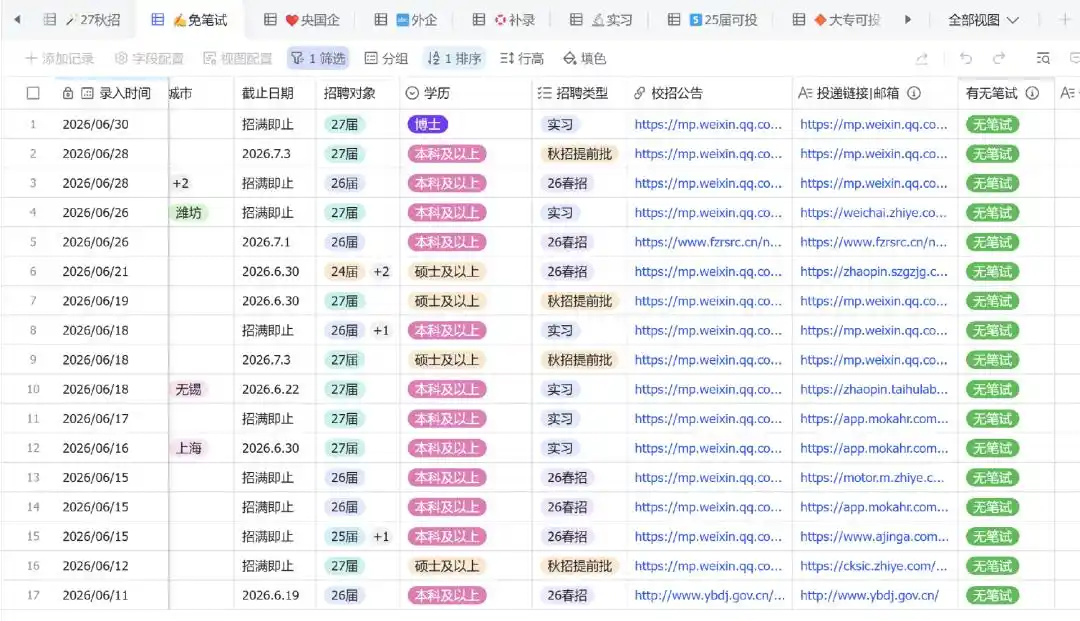
Image | In reality, the number of companies explicitly stating 'no written test' is extremely scarce in recruitment.

"Some people openly sell access to related positions at fixed prices," Chen Chen said, having seen people openly claim in their social media circles that they could secure state-owned enterprise jobs for a fee of 150,000 RMB. "But as things get stricter now, such things are mostly scams or only lead to outsourcing jobs."

Since the vast majority of job seekers can't avoid the written test stage, corresponding businesses have emerged: from test question banks and AI-powered answering services to guaranteed pass packages and full-process job-seeking guidance, each layer feeding on graduates' anxiety.

Li Xin tried buying a question bank.

When summer internship positions opened, she learned from friends that most companies' assessments rely on mainstream third-party platforms like Beisen, Zhiding, Niuke, and Saima—these platforms have fixed question banks, and the system randomly draws questions to form tests. Even though question types vary, the core test points and answering strategies are traceable.

"Taking the Beisen question bank as an example, I saw online that some say if you score below 50, your resume might be automatically filtered out and not reach the interview selection stage," Li Xin said. After learning this 'unspoken rule,' she felt particularly anxious and ultimately bought a set of Beisen assessment questions online for a low price of 4.9 RMB, claiming to be the 'most comprehensive on the entire internet.'
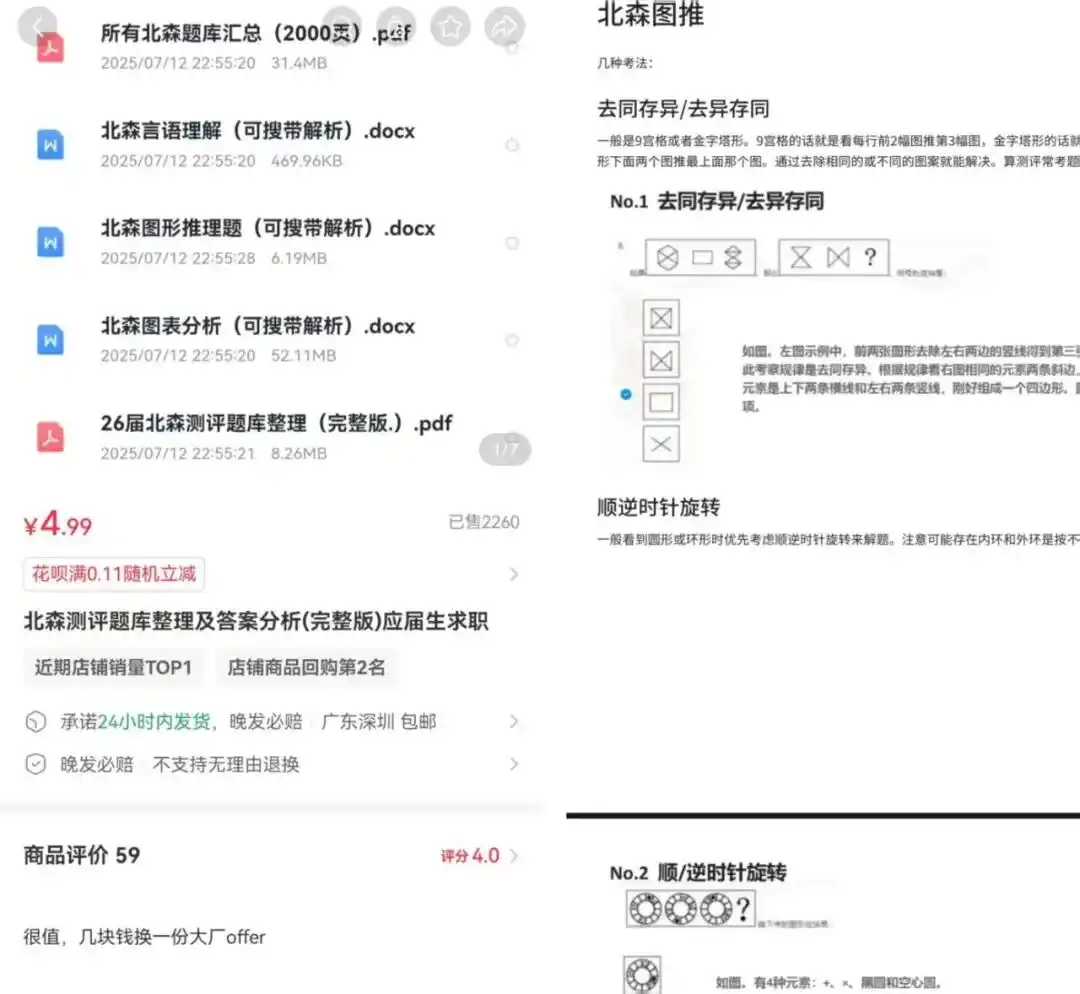
Image | Beisen question bank sold online

The question bank content is all-encompassing, covering past years' real questions, answering技巧 skills, standard answers for personality tests, and quick-solving思路 for aptitude tests. The purchase page showed that this document had already sold over 2,000 copies, meaning at least two thousand anxious graduates like her had clicked 'pay.'

Given mass applications, practicing questions is ultimately a笨办法消耗极大的体力消耗笨办法 that requires significant stamina. The autumn and spring recruitment windows are highly concentrated. A single student often submits hundreds of resumes and faces twenty or thirty assessments in succession. Aptitude tests, situational questions, and personality tests come one after another. No one has the energy to practice all the questions.

Many start taking risks, using AI to search for answers and cheat to提高通过率抬高通过率.

Image | The interviewer's system may display which candidates are suspected of cheating; in Chen Chen's words, he would directly screen out such candidates.

Fresh graduate Xu Wang is very familiar with these tactics—during summer internship recruitment, many of his classmates employed such methods.

"Each company's requirements are different," Xu Wang explained. Many中小企业的线上笔试中小企业的线上笔试 do not require enabling the camera or microphone; the entire test is done on a webpage, with supervision几乎形同虚设几乎形同虚设. Job seekers simply open AI tools, search for answers while answering, and can submit a logically complete答卷答卷 within a few dozen minutes.

Even when facing strict assessments with single-camera or dual-camera全程录像全程录像, the圈子圈子 had long prepared countermeasures: virtual machines, private browsers, device isolation—using technology to bypass system风控风控 and search for answers悄无声息悄无声息.

"There is a cost, though. If detected cheating, it might affect subsequent recruitment," Xu Wang said. Many of his competitors 'went under' this way.

Nevertheless, Chen Chen stated that every year, many job seekers still take the risk and cheat, betting on their luck.

"Even though there's a chance of being flagged for cheating, 'fortune favors the bold,'" some总结道总结道.

Practicing questions and自助作弊自助作弊 are just small-scale actions. To secure a stable and decent job, many middle-class families are willing to spend tens of thousands of RMB to sign up for '全程陪跑全程陪跑' services offered by career agencies.

"Every autumn and spring recruitment peak season, our business immediately booms," said Wang Weijia, who once worked at a career training institution, revealing the industry's引流套路引流套路. During recruitment seasons, a large number of accounts渲染就业焦虑渲染就业焦虑 appear online in batches, most of which are水军账号水军账号 operated by同行同行.

Online题库售卖帖题库售卖帖 and晒单帖晒单帖 are随处可见随处可见,帖子帖子 constantly渲染渲染 'successful上岸上岸 with coaching,' deliberately放大放大 graduates' job-seeking恐慌恐慌, all ultimately paving the way for引流引流 to高价付费业务高价付费业务.

Agencies charge based on company tiers. Guaranteed pass packages for written tests at internet giants, state-owned enterprises, and central enterprises are priced动不动上万动不动上万, "the highest can reach 36,800 RMB." Services bundled include内部内推内部内推, one-on-one远程协助答题远程协助答题, pre-exam真题梳理真题梳理, and even承诺承诺 'full refund if not passed' to打消打消 students' and parents'顾虑顾虑.

Image | A case shared by a career agency, claiming a student landed a Product Manager position at a major internet company through a 43,800 RMB全程陪跑全程陪跑 service.

Wang Weijia observed that the profile of those willing to pay a hefty price is very clear: middle-class families with decent financial means but no industry connections to help their children find jobs. "These parents lack the ability to pull strings for their children. Watching their children fail repeatedly at the written test stage, filled with anxiety, they would rather place a heavy bet just to secure a job entry ticket for their child."

Such衍生服务衍生服务 sell very well. The most popular 'background enhancement' costs around 10,000 RMB. "Simply put, it's paying to have your name listed on project rosters or purchasing short-term paid internships to包装包装 an impressive履历履历 and提高面试通过率提高面试通过率," Wang Weijia explained. Additionally,配套配套面试辅导面试辅导, career choice consultation are generally priced at 500 RMB per hour per subject, and many families are willing to pay this fee.
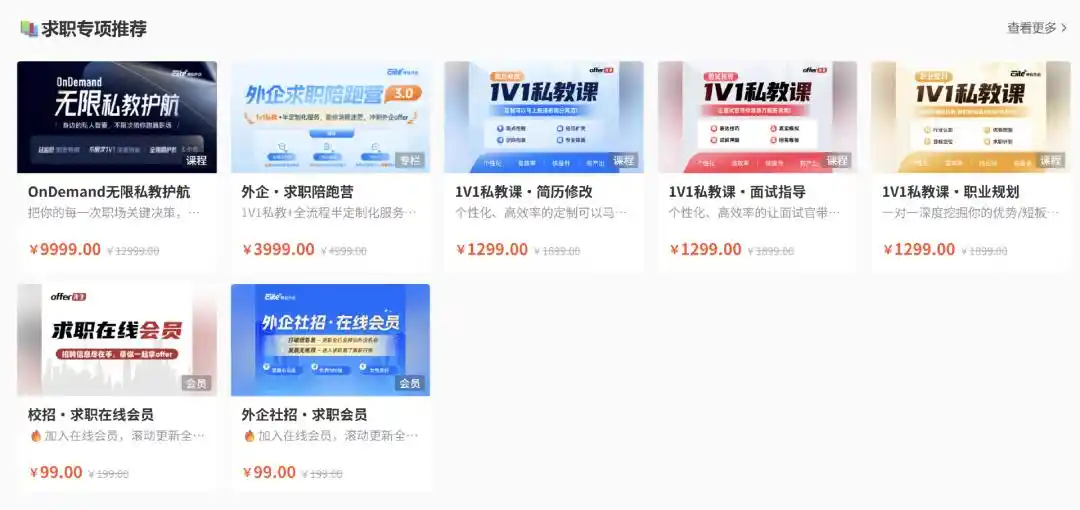
Image | Service pricing of a certain career agency

"Earlier, I found it hard to understand the concept of 'paying to work,' but after seeing more in recent years, I realized such businesses are booming year by year. Even requiring a deposit of several thousand RMB first, customers still keep coming," Wang Weijia感慨感慨.

On one side, companies continuously升级测评难度升级测评难度,抬高筛选门槛抬高筛选门槛, using rigorous assessments to筛选优质人才筛选优质人才,测试新人抗压能力测试新人抗压能力与服从性与服从性. On the other side, fresh graduates疯狂刷题疯狂刷题,付费买题付费买题,借助AI作弊借助AI作弊,购买保过服务购买保过服务, using every means to突破考核壁垒突破考核壁垒 to successfully 'land' a job.

No one wants to陷入无休止的应试内卷陷入无休止的应试内卷, and no one wants to依赖灰色手段求职依赖灰色手段求职. But in a job market with岗位稀缺岗位稀缺,竞争白热化竞争白热化, and淘汰无底线淘汰无底线, everyone is被大势裹挟被大势裹挟,只能被动挣扎只能被动挣扎,全力突围全力突围.

Changed Lives

The白热化白热化的求职考核与招聘节奏,一点一点地掰正了年轻人原本清晰的人生规划.

Yangliu originally had plans to pursue a Ph.D. Her teachers and seniors劝她冷静劝她冷静 time and again: nowadays, the threshold for academic positions in universities is越来越高越来越高, job prospects for humanities Ph.D. holders are狭窄狭窄, and emerging into the job market as a fresh graduate at thirty, with no work履历履历, would only make就业就业 even more被动被动.

After weighing her options several times, she temporarily搁置搁置 her academic理想理想 and plunged into the求职人海求职人海,开始了开始了 one笔试拉锯战笔试拉锯战 after another.

Li Xin originally planned to go to the United States for a one-year master's degree. But she carefully calculated the job-seeking节奏节奏: the one-year U.S. program is short, with graduation in June the following year. The graduation year刚好撞上刚好撞上 autumn recruitment. According to the current recruitment rule where companies lock in candidates a year in advance, she would have to仓促开启仓促开启 job search备战备战 even before setting foot on campus.

To争取喘息的余地争取喘息的余地, she临时改换赛道临时改换赛道, switching her target institutions to the UK. The UK system issues graduation certificates in December each year. Enrolling in 2025 would顺延划为顺延划为 the 2027 graduating class, finally giving herself an额外多出额外多出一整年的缓冲期缓冲期.

Li Xin has a friend who once满怀憧憬满怀憧憬,立志成为一名立志成为一名 free travel blogger. Faced with the现实现实 of连续多月投递无果连续多月投递无果, they最终妥协最终妥协, accepting an internet sales position. In the industry's求职履历求职履历, such positions are not considered优质经历优质经历 and might even become短板短板 for future job changes.

But they had no more挑选余地挑选余地, only hoping to尽快拿到尽快拿到 offer顺利上岸顺利上岸 and早日结束早日结束 the遥遥无期的等待遥遥无期的等待.

To this day, Li Xin still has零 offer零 offer and can only重整心态重整心态,备战备战 the even more竞争激烈的竞争激烈的 autumn recruitment.

She occasionally jokes about the闭环闭环 that has formed: "It's good. Graduates use AI to write theses, companies use AI for assessments, we use AI to search for answers, and then use AI to work after getting in. Everyone is魔法对轰魔法对轰."

This article is from the WeChat public account 'Micro-Story' (ID: xianweigushi), author: Micro-Story Editorial Department

Criptos en tendencia

Preguntas relacionadas

QWhat are the three main types of written assessments that enterprises commonly use in their online recruitment process for graduates?

AThe three main types are: 1) Professional Competency Tests specific to the job position; 2) General Aptitude Tests similar to civil service exams; and 3) Personality Tests used to screen for specific traits.

QWhy do HR professionals from enterprises justify the use of increasingly complex and difficult online assessments in graduate recruitment?

AHR professionals justify the complex assessments due to a severe market imbalance where a massive number of graduates far exceeds the available job positions. These tests allow for efficient bulk screening. Additionally, they serve as a low-cost way to assess a candidate's logical thinking, learning ability, and pressure tolerance, acting as a form of 'compliance test' to find candidates who are more stable and adaptable.

QWhat 'gray industry' practices have emerged in response to the intense competition and prevalence of online assessments?

ASeveral gray industry practices have emerged, including: selling 'written test-free job position lists'; compiling and selling past question banks and answer keys for common testing platforms; using AI tools or technical methods to cheat during online exams; and offering expensive 'full-process job-seeking coaching' services from agencies, which may include paid internships for resume padding, guaranteed interview packages, and one-on-one tutoring.

QAccording to the article, how has the intense job-seeking process impacted the life plans of some graduates mentioned?

AThe intense process has significantly altered their plans. One student (Yang Liu) postponed her PhD aspirations to focus on job hunting. Another (Li Xin) switched her intended study destination from the US to the UK to better align her graduation timeline with the recruitment cycle. A friend of Li Xin's abandoned his dream of being a travel blogger and reluctantly accepted a sales job just to secure an offer.

QWhat is the core irony or 'closed loop' that the graduate Li Xin sarcastically points out regarding the use of AI in the education-to-employment pipeline?

ALi Xin sarcastically points out a 'closed loop' or irony where: graduates use AI to write their theses, enterprises use AI to screen candidates (through assessments and interviews), candidates use AI to search for answers during tests, and finally, once hired, they use AI to perform their jobs. It's a cycle of 'magic against magic' where AI is used at every stage, often to counteract or navigate systems also powered by AI.

Lecturas Relacionadas

Institutions Have Already Bought the Dip: Is Bitcoin at $70,000 the Start of a Bull Run or a Local Top?

Institutional Investors Piled into Bitcoin Ahead of Rally: Is $70K a New Bull Market Start or Local Top? Bitcoin surged past $70,000 following pro-crypto remarks from former U.S. President Donald Trump on August 20. However, institutional investors had been accumulating exposure in Q2 2026, even as the price fell. 13F filings reveal that while total Bitcoin ETF holdings declined, institutional holdings increased by 7.5%, reaching a record 44.2% share of ETF assets. Key institutional moves include Jane Street increasing its Bitcoin ETF and MicroStrategy (MSTR) exposure by over $800 million, BlackRock adding ~$290 million in Bitcoin-related holdings (MSTR, its own IBIT ETF, and ASST), and JPMorgan boosting its IBIT position by $85.6 million. UBS significantly increased its call option exposure on IBIT. Notably, Paul Tudor Jones's fund reversed a multi-quarter selling trend to add IBIT shares. Market opinions are divided post-rally. The "bear market over" camp includes F2Pool's co-founder declaring the bear market ended, Strive's CEO citing a favorable macro backdrop for Bitcoin, and Standard Chartered targeting $100,000 by year-end. Conversely, the "not yet bottomed" camp includes CZ stating the super cycle hasn't arrived, CryptoQuant analysts warning of elevated retail demand often preceding local tops, and analysis from VanEck and Glassnode suggesting on-chain data shows a prolonged "capitulation phase" is still unfolding, indicating current price strength may be a relief rally rather than a definitive trend reversal.

Odaily星球日报Hace 14 min(s)

Institutions Have Already Bought the Dip: Is Bitcoin at $70,000 the Start of a Bull Run or a Local Top?

Odaily星球日报Hace 14 min(s)

Viewpoint: A $4 Billion Buyback Can Fix Liquidity, But Not U.S. Fiscal Health

On August 19, the U.S. Treasury announced it would increase its maximum single-operation buyback size for long-term bonds from $2 billion to at least $4 billion, aiming to improve market liquidity. This move initially led to a pullback in long-term yields, such as the 30-year Treasury yield which had recently hit a 2007 high near 5.34%, sparking talk of potential "Treasury support." However, an opposing perspective argues this is merely a temporary fix. While buybacks can enhance trading conditions for older, less-liquid bonds, they do not address the underlying fiscal pressures. The Treasury's actions are a form of debt management, not monetary stimulus like QE; the funds used for buybacks ultimately come from cash balances or new borrowing. They do not reduce the government's overall financing needs. The core issue is growing fiscal supply. With the federal deficit reaching a record $432 billion in July 2026 and cumulative deficits already surpassing the prior fiscal year's total, the market faces a massive wave of new debt issuance. The recent surge in long-term yields may reflect a repricing of this persistent fiscal risk and the associated term premium, rather than just a liquidity shortage. Furthermore, demand-side challenges loom. Foreign holdings of U.S. Treasuries have recently declined, and if official demand weakens, the market will rely more on price-sensitive private investors, potentially requiring higher yields to clear future auctions. In essence, the Treasury can use buybacks to soothe market "trading problems," but it cannot buy away the nation's "fiscal problem." The key factors to watch will be the appetite at long-term bond auctions, the trajectory of the fiscal deficit, and whether higher yields can sustainably attract buyers. Without improvement in these areas, the yield relief provided by the $4 billion buyback expansion is likely just a short-term buffer.

marsbitHace 23 min(s)

Viewpoint: A $4 Billion Buyback Can Fix Liquidity, But Not U.S. Fiscal Health

marsbitHace 23 min(s)

Trading

Spot

Artículos destacados

Qué es $S$

Entendiendo SPERO: Una Visión General Completa Introducción a SPERO A medida que el panorama de la innovación continúa evolucionando, la aparición de tecnologías web3 y proyectos de criptomonedas juega un papel fundamental en la configuración del futuro digital. Un proyecto que ha atraído la atención en este campo dinámico es SPERO, denotado como SPERO,$$s$. Este artículo tiene como objetivo reunir y presentar información detallada sobre SPERO, para ayudar a entusiastas e inversores a comprender sus fundamentos, objetivos e innovaciones dentro de los dominios web3 y cripto. ¿Qué es SPERO,$$s$? SPERO,$$s$ es un proyecto único dentro del espacio cripto que busca aprovechar los principios de descentralización y tecnología blockchain para crear un ecosistema que promueva la participación, la utilidad y la inclusión financiera. El proyecto está diseñado para facilitar interacciones de igual a igual de nuevas maneras, proporcionando a los usuarios soluciones y servicios financieros innovadores. En su esencia, SPERO,$$s$ tiene como objetivo empoderar a los individuos al proporcionar herramientas y plataformas que mejoren la experiencia del usuario en el espacio de las criptomonedas. Esto incluye habilitar métodos de transacción más flexibles, fomentar iniciativas impulsadas por la comunidad y crear caminos para oportunidades financieras a través de aplicaciones descentralizadas (dApps). La visión subyacente de SPERO,$$s$ gira en torno a la inclusividad, buscando cerrar brechas dentro de las finanzas tradicionales mientras aprovecha los beneficios de la tecnología blockchain. ¿Quién es el Creador de SPERO,$$s$? La identidad del creador de SPERO,$$s$ sigue siendo algo oscura, ya que hay recursos públicos limitados que proporcionan información de fondo detallada sobre su(s) fundador(es). Esta falta de transparencia puede derivarse del compromiso del proyecto con la descentralización, una ética que muchos proyectos web3 comparten, priorizando las contribuciones colectivas sobre el reconocimiento individual. Al centrar las discusiones en torno a la comunidad y sus objetivos colectivos, SPERO,$$s$ encarna la esencia del empoderamiento sin señalar a individuos específicos. Como tal, comprender la ética y la misión de SPERO sigue siendo más importante que identificar a un creador singular. ¿Quiénes son los Inversores de SPERO,$$s$? SPERO,$$s$ cuenta con el apoyo de una diversa gama de inversores que van desde capitalistas de riesgo hasta inversores ángeles dedicados a fomentar la innovación en el sector cripto. El enfoque de estos inversores generalmente se alinea con la misión de SPERO, priorizando proyectos que prometen avances tecnológicos sociales, inclusión financiera y gobernanza descentralizada. Estas fundaciones de inversores suelen estar interesadas en proyectos que no solo ofrecen productos innovadores, sino que también contribuyen positivamente a la comunidad blockchain y sus ecosistemas. El respaldo de estos inversores refuerza a SPERO,$$s$ como un contendiente notable en el dominio de proyectos cripto que evoluciona rápidamente. ¿Cómo Funciona SPERO,$$s$? SPERO,$$s$ emplea un marco multifacético que lo distingue de los proyectos de criptomonedas convencionales. Aquí hay algunas de las características clave que subrayan su singularidad e innovación: Gobernanza Descentralizada: SPERO,$$s$ integra modelos de gobernanza descentralizada, empoderando a los usuarios para participar activamente en los procesos de toma de decisiones sobre el futuro del proyecto. Este enfoque fomenta un sentido de propiedad y responsabilidad entre los miembros de la comunidad. Utilidad del Token: SPERO,$$s$ utiliza su propio token de criptomoneda, diseñado para servir diversas funciones dentro del ecosistema. Estos tokens permiten transacciones, recompensas y la facilitación de servicios ofrecidos en la plataforma, mejorando la participación y la utilidad general. Arquitectura en Capas: La arquitectura técnica de SPERO,$$s$ apoya la modularidad y escalabilidad, permitiendo la integración fluida de características y aplicaciones adicionales a medida que el proyecto evoluciona. Esta adaptabilidad es fundamental para mantener la relevancia en el cambiante paisaje cripto. Participación de la Comunidad: El proyecto enfatiza iniciativas impulsadas por la comunidad, empleando mecanismos que incentivan la colaboración y la retroalimentación. Al nutrir una comunidad sólida, SPERO,$$s$ puede abordar mejor las necesidades de los usuarios y adaptarse a las tendencias del mercado. Enfoque en la Inclusión: Al ofrecer tarifas de transacción bajas e interfaces amigables para el usuario, SPERO,$$s$ busca atraer a una base de usuarios diversa, incluyendo a individuos que anteriormente pueden no haber participado en el espacio cripto. Este compromiso con la inclusión se alinea con su misión general de empoderamiento a través de la accesibilidad. Cronología de SPERO,$$s$ Entender la historia de un proyecto proporciona información crucial sobre su trayectoria de desarrollo y hitos. A continuación se presenta una cronología sugerida que mapea eventos significativos en la evolución de SPERO,$$s$: Fase de Conceptualización e Ideación: Las ideas iniciales que forman la base de SPERO,$$s$ fueron concebidas, alineándose estrechamente con los principios de descentralización y enfoque comunitario dentro de la industria blockchain. Lanzamiento del Whitepaper del Proyecto: Tras la fase conceptual, se lanzó un whitepaper completo que detalla la visión, los objetivos y la infraestructura tecnológica de SPERO,$$s$ para generar interés y retroalimentación de la comunidad. Construcción de Comunidad y Primeras Interacciones: Se realizaron esfuerzos de divulgación activa para construir una comunidad de primeros adoptantes y posibles inversores, facilitando discusiones en torno a los objetivos del proyecto y obteniendo apoyo. Evento de Generación de Tokens: SPERO,$$s$ llevó a cabo un evento de generación de tokens (TGE) para distribuir sus tokens nativos a los primeros seguidores y establecer liquidez inicial dentro del ecosistema. Lanzamiento de la dApp Inicial: La primera aplicación descentralizada (dApp) asociada con SPERO,$$s$ se puso en marcha, permitiendo a los usuarios interactuar con las funcionalidades centrales de la plataforma. Desarrollo Continuo y Alianzas: Actualizaciones y mejoras continuas a las ofertas del proyecto, incluyendo alianzas estratégicas con otros actores en el espacio blockchain, han moldeado a SPERO,$$s$ en un jugador competitivo y en evolución en el mercado cripto. Conclusión SPERO,$$s$ se erige como un testimonio del potencial de web3 y las criptomonedas para revolucionar los sistemas financieros y empoderar a los individuos. Con un compromiso con la gobernanza descentralizada, la participación comunitaria y funcionalidades diseñadas de manera innovadora, allana el camino hacia un paisaje financiero más inclusivo. Como con cualquier inversión en el espacio cripto que evoluciona rápidamente, se anima a los posibles inversores y usuarios a investigar a fondo y participar de manera reflexiva con los desarrollos en curso dentro de SPERO,$$s$. El proyecto muestra el espíritu innovador de la industria cripto, invitando a una mayor exploración de sus innumerables posibilidades. Mientras el viaje de SPERO,$$s$ aún se desarrolla, sus principios fundamentales pueden, de hecho, influir en el futuro de cómo interactuamos con la tecnología, las finanzas y entre nosotros en ecosistemas digitales interconectados.

440 Vistas totalesPublicado en 2024.12.17Actualizado en 2024.12.17

Qué es $S$

Qué es AGENT S

Agent S: El Futuro de la Interacción Autónoma en Web3 Introducción En el paisaje en constante evolución de Web3 y las criptomonedas, las innovaciones están redefiniendo constantemente cómo los individuos interactúan con las plataformas digitales. Uno de estos proyectos pioneros, Agent S, promete revolucionar la interacción humano-computadora a través de su marco agente abierto. Al allanar el camino para interacciones autónomas, Agent S busca simplificar tareas complejas, ofreciendo aplicaciones transformadoras en inteligencia artificial (IA). Esta exploración detallada profundizará en las complejidades del proyecto, sus características únicas y las implicaciones para el dominio de las criptomonedas. ¿Qué es Agent S? Agent S se presenta como un marco agente abierto innovador, diseñado específicamente para abordar tres desafíos fundamentales en la automatización de tareas informáticas: Adquisición de Conocimiento Específico del Dominio: El marco aprende inteligentemente de diversas fuentes de conocimiento externas y experiencias internas. Este enfoque dual le permite construir un rico repositorio de conocimiento específico del dominio, mejorando su rendimiento en la ejecución de tareas. Planificación a Largo Plazo de Tareas: Agent S emplea planificación jerárquica aumentada por la experiencia, un enfoque estratégico que facilita la descomposición y ejecución eficiente de tareas complejas. Esta característica mejora significativamente su capacidad para gestionar múltiples subtareas de manera eficiente y efectiva. Manejo de Interfaces Dinámicas y No Uniformes: El proyecto introduce la Interfaz Agente-Computadora (ACI), una solución innovadora que mejora la interacción entre agentes y usuarios. Utilizando Modelos de Lenguaje Multimodal de Gran Escala (MLLMs), Agent S puede navegar y manipular diversas interfaces gráficas de usuario sin problemas. A través de estas características pioneras, Agent S proporciona un marco robusto que aborda las complejidades involucradas en la automatización de la interacción humana con las máquinas, preparando el terreno para una multitud de aplicaciones en IA y más allá. ¿Quién es el Creador de Agent S? Si bien el concepto de Agent S es fundamentalmente innovador, la información específica sobre su creador sigue siendo elusiva. El creador es actualmente desconocido, lo que resalta ya sea la etapa incipiente del proyecto o la elección estratégica de mantener a los miembros fundadores en el anonimato. Independientemente de la anonimidad, el enfoque sigue siendo en las capacidades y el potencial del marco. ¿Quiénes son los Inversores de Agent S? Dado que Agent S es relativamente nuevo en el ecosistema criptográfico, la información detallada sobre sus inversores y patrocinadores financieros no está documentada explícitamente. La falta de información disponible públicamente sobre las bases de inversión u organizaciones que apoyan el proyecto plantea preguntas sobre su estructura de financiamiento y hoja de ruta de desarrollo. Comprender el respaldo es crucial para evaluar la sostenibilidad del proyecto y su posible impacto en el mercado. ¿Cómo Funciona Agent S? En el núcleo de Agent S se encuentra una tecnología de vanguardia que le permite funcionar de manera efectiva en diversos entornos. Su modelo operativo se basa en varias características clave: Interacción Humano-Computadora Similar a la Humana: El marco ofrece planificación avanzada de IA, esforzándose por hacer que las interacciones con las computadoras sean más intuitivas. Al imitar el comportamiento humano en la ejecución de tareas, promete elevar las experiencias de los usuarios. Memoria Narrativa: Empleada para aprovechar experiencias de alto nivel, Agent S utiliza memoria narrativa para hacer un seguimiento de las historias de tareas, mejorando así sus procesos de toma de decisiones. Memoria Episódica: Esta característica proporciona a los usuarios una guía paso a paso, permitiendo que el marco ofrezca apoyo contextual a medida que se desarrollan las tareas. Soporte para OpenACI: Con la capacidad de ejecutarse localmente, Agent S permite a los usuarios mantener el control sobre sus interacciones y flujos de trabajo, alineándose con la ética descentralizada de Web3. Fácil Integración con APIs Externas: Su versatilidad y compatibilidad con varias plataformas de IA aseguran que Agent S pueda encajar sin problemas en ecosistemas tecnológicos existentes, convirtiéndolo en una opción atractiva para desarrolladores y organizaciones. Estas funcionalidades contribuyen colectivamente a la posición única de Agent S dentro del espacio cripto, ya que automatiza tareas complejas y de múltiples pasos con una intervención humana mínima. A medida que el proyecto evoluciona, sus posibles aplicaciones en Web3 podrían redefinir cómo se desarrollan las interacciones digitales. Cronología de Agent S El desarrollo y los hitos de Agent S pueden encapsularse en una cronología que resalta sus eventos significativos: 27 de septiembre de 2024: El concepto de Agent S fue lanzado en un documento de investigación integral titulado “Un Marco Agente Abierto que Usa Computadoras Como un Humano”, mostrando las bases del proyecto. 10 de octubre de 2024: El documento de investigación fue puesto a disposición del público en arXiv, ofreciendo una exploración profunda del marco y su evaluación de rendimiento basada en el benchmark OSWorld. 12 de octubre de 2024: Se lanzó una presentación en video, proporcionando una visión visual de las capacidades y características de Agent S, involucrando aún más a posibles usuarios e inversores. Estos marcadores en la cronología no solo ilustran el progreso de Agent S, sino que también indican su compromiso con la transparencia y la participación comunitaria. Puntos Clave Sobre Agent S A medida que el marco Agent S continúa evolucionando, varios atributos clave destacan, subrayando su naturaleza innovadora y potencial: Marco Innovador: Diseñado para proporcionar un uso intuitivo de las computadoras similar a la interacción humana, Agent S aporta un enfoque novedoso a la automatización de tareas. Interacción Autónoma: La capacidad de interactuar de manera autónoma con las computadoras a través de GUI significa un salto hacia soluciones informáticas más inteligentes y eficientes. Automatización de Tareas Complejas: Con su metodología robusta, puede automatizar tareas complejas y de múltiples pasos, haciendo que los procesos sean más rápidos y menos propensos a errores. Mejora Continua: Los mecanismos de aprendizaje permiten a Agent S mejorar a partir de experiencias pasadas, mejorando continuamente su rendimiento y eficacia. Versatilidad: Su adaptabilidad en diferentes entornos operativos como OSWorld y WindowsAgentArena asegura que pueda servir a una amplia gama de aplicaciones. A medida que Agent S se posiciona en el paisaje de Web3 y criptomonedas, su potencial para mejorar las capacidades de interacción y automatizar procesos significa un avance significativo en las tecnologías de IA. A través de su marco innovador, Agent S ejemplifica el futuro de las interacciones digitales, prometiendo una experiencia más fluida y eficiente para los usuarios en diversas industrias. Conclusión Agent S representa un audaz avance en la unión de la IA y Web3, con la capacidad de redefinir cómo interactuamos con la tecnología. Aunque aún se encuentra en sus primeras etapas, las posibilidades para su aplicación son vastas y atractivas. A través de su marco integral que aborda desafíos críticos, Agent S busca llevar las interacciones autónomas al primer plano de la experiencia digital. A medida que nos adentramos más en los reinos de las criptomonedas y la descentralización, proyectos como Agent S sin duda desempeñarán un papel crucial en la configuración del futuro de la tecnología y la colaboración humano-computadora.

826 Vistas totalesPublicado en 2025.01.14Actualizado en 2025.01.14

Qué es AGENT S

Cómo comprar S

¡Bienvenido a HTX.com! Hemos hecho que comprar Sonic (S) sea simple y conveniente. Sigue nuestra guía paso a paso para iniciar tu viaje de criptos.Paso 1: crea tu cuenta HTXUtiliza tu correo electrónico o número de teléfono para registrarte y obtener una cuenta gratuita en HTX. Experimenta un proceso de registro sin complicaciones y desbloquea todas las funciones.Obtener mi cuentaPaso 2: ve a Comprar cripto y elige tu método de pagoTarjeta de crédito/débito: usa tu Visa o Mastercard para comprar Sonic (S) al instante.Saldo: utiliza fondos del saldo de tu cuenta HTX para tradear sin problemas.Terceros: hemos agregado métodos de pago populares como Google Pay y Apple Pay para mejorar la comodidad.P2P: tradear directamente con otros usuarios en HTX.Over-the-Counter (OTC): ofrecemos servicios personalizados y tipos de cambio competitivos para los traders.Paso 3: guarda tu Sonic (S)Después de comprar tu Sonic (S), guárdalo en tu cuenta HTX. Alternativamente, puedes enviarlo a otro lugar mediante transferencia blockchain o utilizarlo para tradear otras criptomonedas.Paso 4: tradear Sonic (S)Tradear fácilmente con Sonic (S) en HTX's mercado spot. Simplemente accede a tu cuenta, selecciona tu par de trading, ejecuta tus trades y monitorea en tiempo real. Ofrecemos una experiencia fácil de usar tanto para principiantes como para traders experimentados.

1.6k Vistas totalesPublicado en 2025.01.15Actualizado en 2026.06.02

Cómo comprar S

Discusiones

Bienvenido a la comunidad de HTX. Aquí puedes mantenerte informado sobre los últimos desarrollos de la plataforma y acceder a análisis profesionales del mercado. A continuación se presentan las opiniones de los usuarios sobre el precio de S (S).

活动图片