Is the Fastest and Deepest Tech Stock Sell-off in History Nearing Its End?

marsbitPublicado a 2026-07-19Actualizado a 2026-07-19

Resumen

The article discusses whether the historically rapid and severe sell-off in tech momentum stocks is nearing its end. Citing analysis from Goldman Sachs and Morgan Stanley, it notes that the TMT momentum factor has plunged 40% from its peak in just 17 trading days, marking the fastest and deepest such decline on record. Key experts, including Goldman's Mark Wilson, attribute the crash primarily to extreme crowding, high leverage, and structural factors rather than a fundamental deterioration in the economy or corporate earnings. They point to strong underlying data, such as robust bank lending and raised guidance from companies like TSMC, which contrast sharply with the market's price action. While Wilson suggests the momentum unwinding process is likely "approaching its end," he cautions that immediate catalysts for a sharp reversal are lacking. The report highlights extreme internal market stress, with single-stock volatility far exceeding index volatility, and warns that despite the sell-off, positioning in momentum factors remains elevated. It concludes that the core market矛盾 (contradiction) lies in this disconnect between solid fundamentals and violent price corrections driven by positioning and leverage.

Source: Wall Street Insights

Tech momentum trading is experiencing its most severe unwinding in history. In just 17 trading days, the U.S. stock technology momentum factor (TMT MoMo) has plunged 40% from its peak, setting a record for the fastest and deepest drawdown on record, with contagion spreading comprehensively from semiconductors to hedge funds and credit markets.

Mark Wilson, partner and head of EMEA hedge fund business at Goldman Sachs, provided a systematic review of this "brutal rotation" this week. He noted that this sell-off is historically rare in both speed and depth, but its root cause stems more from non-fundamental factors such as crowded positioning and concentrated leverage, rather than a substantial deterioration in the economy or corporate earnings. He stated that the unwinding process for the momentum factor is "nearing its end," but lacks an immediate catalyst for reversal in the short term.

It is noteworthy that this momentum breakdown occurred against a backdrop of overall robust macro and corporate fundamentals—U.S. banks reported a 17% year-on-year increase in corporate lending, TSMC raised its 2026 revenue growth guidance to over 40%, and inflation data also came in moderately below expectations. This divergence between fundamentals and market price action is the core contradiction in the current market.

Tech Momentum Factor Suffers Historic Sell-off, Drawdown Speed and Depth Exceed Historical Median

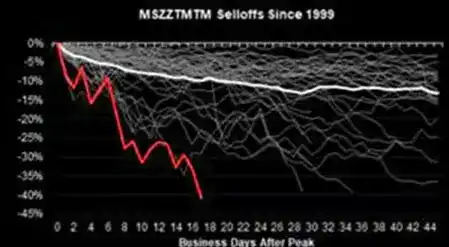
According to data from Morgan Stanley's Quantitative and Derivatives Strategy team (MS QDS), this momentum factor drawdown has lasted 17 trading days, with a peak-to-trough decline of 28%. In comparison, the median momentum factor drawdown since 1999 has been 22%, lasting an average of 33 trading days.

This means the current decline has exceeded the historical median in both speed and depth, marking the most severe episode since the 29% drawdown from December 2022 to February 2023.

The situation is even more extreme in the tech sector. The TMT momentum factor (TMT MoMo) has fallen 40% from its peak. According to MS QDS data, this represents the fastest and deepest sell-off ever for the tech momentum factor.

Looking across various subsectors, South Korea's Kospi index is down 27% from its peak, U.S. AI tech beneficiaries are down 25%, global memory chip stocks are down 36%, and European semiconductors are down 23%. Among these, memory chip stocks account for about two-thirds of the overall decline, while the broader AI beneficiaries are down about 24% from their highs.
Low Surface Volatility Masks High Internal Intensity, Market Risk Structure is Unraveling

Price declines are only the surface manifestation of this turmoil; changes in the market's internal risk structure are equally noteworthy.

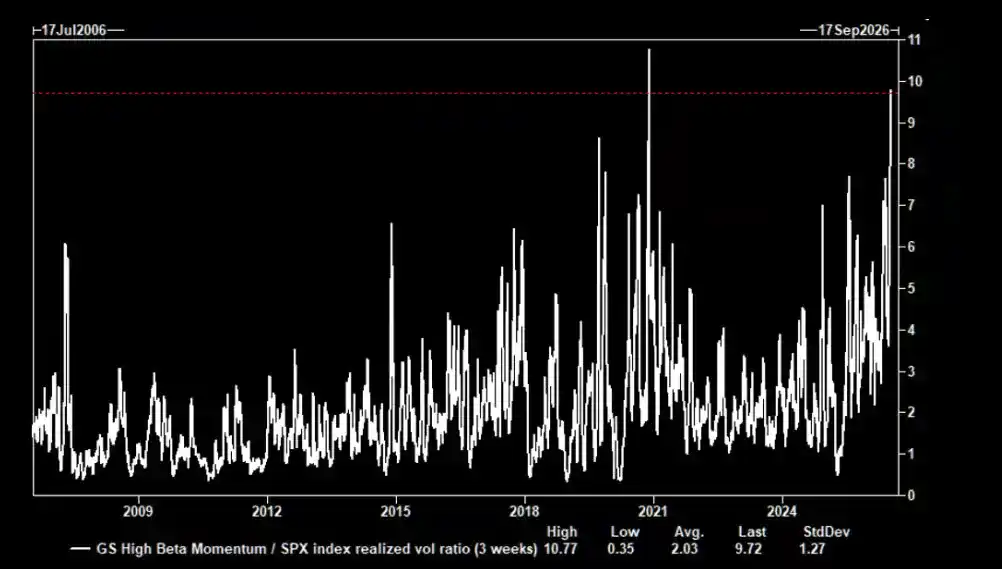
According to Goldman Sachs' volatility trading desk data, the current volatility of Goldman Sachs' High Beta Momentum portfolio (GSPRHIMO) is approximately 10 times that of the S&P 500's volatility. In the historical backtest over the past 20 years, such a stark volatility ratio has only been comparable to the situation during the pandemic shock in November 2020.
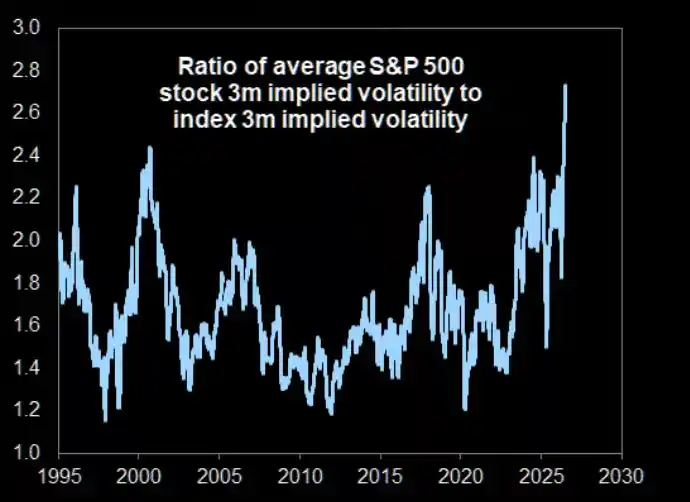
Simultaneously, the gap between single-stock volatility and index volatility has widened to historical extremes. Goldman Sachs data shows that the three-month average implied correlation among S&P 500 constituents fell to a record low of 0.14 this week, causing the S&P 500 index volatility to remain low, while the average implied volatility for single stocks is as high as 40%, 2.8 times that of the index's implied volatility, also setting a historical record.
Positions Remain Crowded, Risks Not Yet Cleared

Despite the recent historic drawdown in the momentum factor, hedge funds' net exposure to it remains high from a long-term perspective. J.P. Morgan data indicates that the combination of current positioning levels and the magnitude of the drawdown continues to make the momentum factor one of the core risks most deserving of caution in the market.

Meanwhile, the Goldman Sachs High Beta Momentum factor has fallen 33% since its June high, with its year-to-date gain plummeting from 60% to just 12%, a development also noted by Mark Wilson.

He cited signs of deleveraging in the Korean market as evidence: reports indicate that approximately one in every 30 South Korean adults had their stock margin accounts forcibly liquidated this week, showing that the deleveraging process has unfolded to a considerable extent.

Fundamentals Remain Sound, Risks Lie in Positioning and Structure

The peculiar aspect of this momentum breakdown is that it occurred against a backdrop of generally positive corporate fundamentals and macroeconomic data.

Mark Wilson pointed out that U.S. bank earnings this week presented an "unmistakably positive reading" of economic conditions: corporate lending grew 17% year-on-year, a record high, covering all economic sectors; U.S. consumer spending tracker growth is in the mid-single digits, with credit card spending up 6%; investment banking-related business lines collectively grew over 40%; large banks' tangible common equity return reached 19%, a post-financial crisis high.

On the tech capital expenditure front, TSMC raised its 2026 revenue growth guidance to over 40% (based on a revenue base exceeding $150 billion), while ASML's earnings report sparked market expectations for a 15% to 30% upward revision in its EPS over the next one to three years.

However, both companies' share prices fell following their earnings announcements, displaying a classic "sell the news" pattern. In contrast, IBM's stock price suffered its largest single-day drop in over 20 years due to large contract delays and underperformance in its consulting business.

Mark Wilson emphasized that this sell-off is "difficult to pinpoint to a clear signal at the fundamental level," reflecting more the influence of structural factors such as positioning, leverage, crowding, and concentration.

Rotation Nearing End, But Reversal Catalyst Still Awaited

Mark Wilson stated that he is inclined to believe the unwinding process for the momentum factor is nearing its end, but he also noted that there is a lack of immediate summer catalysts to drive a market reversal in the short term.

He also suggested that as efficiency and commercial viability improve, new market leadership will gradually emerge, and market breadth will expand accordingly—the Dow Jones Transportation Average breaking to new highs again this week serves as one example.

However, he also warned that the second derivative of earnings growth (i.e., the slowdown in the growth rate) will become increasingly important as the market digests Q2 earnings and enters the summer, while current valuation metrics across the board indicate that tech sector valuations remain elevated.

Furthermore, abnormal breakdowns in correlations are occurring both between traditional asset classes and within them; for example, the three-month correlation between gold and crude oil has fallen to an extreme inverse level in its 35-year history, further increasing the difficulty of risk management and portfolio construction.


Preguntas relacionadas

QWhat is the historical context of the current tech momentum factor sell-off in terms of speed and depth?

AAccording to the article, the current tech momentum factor (TMT MoMo) sell-off is the fastest and deepest on record, having fallen 40% from its peak in just 17 trading days. Historically, momentum factor drawdowns have a median decline of 22% over an average of 33 trading days.

QAccording to Mark Wilson of Goldman Sachs, what is the primary cause of this momentum factor sell-off?

AMark Wilson of Goldman Sachs attributes the sell-off primarily to structural factors like crowded positioning, concentrated leverage, and high congestion, rather than a deterioration in economic or corporate earnings fundamentals.

QDespite the market sell-off, what positive signals are mentioned regarding the underlying economic and corporate fundamentals?

AThe article highlights robust fundamentals: U.S. bank corporate loan growth at 17%, TSMC raising its 2026 revenue growth guidance to over 40%, and inflation data coming in softer than expected. Bank earnings also showed strong consumer spending and high returns on tangible equity.

QWhat does the data say about the current volatility and risk structure within the market during this event?

AThe volatility of Goldman Sachs's high-beta momentum basket is about 10 times that of the S&P 500, a disparity only seen during the November 2020 pandemic shock. Additionally, the correlation among S&P 500 stocks is at a record low, causing single-stock implied volatility to be 2.8 times higher than index volatility.

QWhat is Mark Wilson's outlook on the momentum factor sell-off and the potential for a market reversal?

AMark Wilson believes the momentum factor unwinding process is 'nearing its end.' However, he notes a lack of immediate catalysts for a sharp reversal in the near term (summer), and warns that valuations remain elevated and that the second derivative of earnings growth (a slowdown in growth acceleration) will become more important.

Lecturas Relacionadas

The Once-Niche Field of Philosophy Becomes a Hot Topic in "Governing" AI

"Cold" Philosophy Becomes Hot in Taming AI This article explores the rising prominence of philosophical inquiry at the World Artificial Intelligence Conference (WAIC), highlighting a shift from purely technical discussions to deeper questions about AI's nature and impact. A key theme is the foundational question of intelligence itself. Philosopher Sun Ning argued that true, grounded intelligence requires embodiment, environment, interaction with others, and historical context, summarized as "Before intelligence, there is a world. Before mind, there is relationship." The forum then examined AI's expanding role in science. Researchers presented AI systems that can autonomously generate scientific papers and mathematical proofs, raising critical questions about evaluation, attribution of discovery, and potential misuse. The proposed solution is a collaborative framework: AI expands the search space, humans define value and provide rigorous constraints, and machines handle verification. As AI models begin to simulate human societies and behaviors for research, new risks emerge. Simulations can inherit and amplify societal biases from their training data, and their outputs risk being mistaken for genuine social signals. This necessitates robust governance focused on auditability, bias correction, and clear human oversight—ensuring people retain intervention, correction, and explanation rights ("human-in-the-loop"). The discussion extended to industry, where AI integrates with wet labs for bio-manufacturing. Here, challenges involve bridging the digital-physical gap and adapting regulatory and business models from process-based to outcome-based partnerships, fundamentally altering production relationships. The convergence of philosophers, scientists, and entrepreneurs at WAIC signals a broader trend: as AI permeates knowledge creation and social systems, technical progress is increasingly intertwined with urgent questions of ethics, governance, economic distribution, and public policy. The core challenge becomes not just what AI *can* do, but what we *should* ask it, trust from it, and guide it towards.

marsbitHace 40 min(s)

The Once-Niche Field of Philosophy Becomes a Hot Topic in "Governing" AI

marsbitHace 40 min(s)

After six years of pie-in-the-sky fundraising, 90% of funds used to replenish cash flow: The illusion and reality of L'CI Technology's silicon carbide "industrialization"|TMTPost Deep Dive

After six years and raising approximately 3.2 billion yuan through two private placements, Luxshare Technology has officially terminated its two major SiC wafer projects. Only about 7.75% of the raised funds were actually invested in SiC construction and R&D, with the remaining 90% redirected to replenish working capital and repay loans. Despite previous ambitious plans for a 10-billion-yuan SiC industrial park and public assurances of progress, the company's actual SiC capacity remains unclear, with its subsidiary recording significant losses. The article details a pattern of chasing market trends, from electric vehicles and photovoltaics to the current focus on SiC. However, its SiC entry was late; while peers like Tianke Heda and Tianyue Advanced have moved from mass-producing 6-inch to 8-inch and even 12-inch wafers, Luxshare is still struggling with its 6-inch plans and now promises to develop larger sizes with its own funds. Key concerns include unclear disclosures about the status of its chief scientist, Chen Zhizhan, and significantly lower R&D investment compared to competitors. Financially, since its 2011 IPO, the company has raised over 7 billion yuan but generated only 221 million yuan in cumulative net profit. Meanwhile, the controlling shareholder family has cashed out nearly 2 billion yuan since 2018. The article positions Luxshare as a case study of a listed company focused more on financing and capital operation around hot topics than on substantive industrial development.

marsbitHace 1 hora(s)

After six years of pie-in-the-sky fundraising, 90% of funds used to replenish cash flow: The illusion and reality of L'CI Technology's silicon carbide "industrialization"|TMTPost Deep Dive

marsbitHace 1 hora(s)

ChatGPT Finally Can 'Search Itself': Nearly Four Years of Conversations, Retrieved with One Click

ChatGPT, nearly four years old, has long lacked a functional way for users to search their own accumulated history. This changed on July 14th, when OpenAI launched a comprehensive "Unified Search" feature across all platforms and plans. This new search allows users to find and instantly access past conversations, uploaded documents, generated images, and projects within their own ChatGPT account, all from a single sidebar entry. This update signifies a major shift in ChatGPT's role, transforming it from a transient chat tool into a personal knowledge base or "file system" for users' AI-generated content. It completes a critical missing piece as OpenAI expands ChatGPT's capabilities with features like Projects, Memory, Work, and Sites, aiming to make it a central hub for work and creativity. The ability to easily retrieve years of personal data makes that data more valuable as a unique, irreplaceable asset in the AI era. However, it also highlights the increasing weight and potential sensitivity of this data, given default settings that allow conversations to be used for model training and legal precedents involving user logs. While a significant improvement over the previous ineffective search, this move is seen as addressing an industry-wide oversight. As the competition between AI assistants (ChatGPT, Gemini, Claude) moves beyond raw model power, the new battleground is becoming which platform can best organize, retain, and leverage the valuable data co-created by users and AI.

marsbitHace 1 hora(s)

ChatGPT Finally Can 'Search Itself': Nearly Four Years of Conversations, Retrieved with One Click

marsbitHace 1 hora(s)

7-Year-Olds Starting Companies? 9-Year-Olds Making Movies? Post-90s Parents Are Raising 'AI Prodigies'

"AI Genius Kids: A New Wave or a Parental Anxiety Trap?" The article examines the recent surge in AI-focused educational camps and programs in China, heavily marketed to parents of young children with sensational claims like "7-year-olds start companies" and "9-year-olds make movies." These programs promise rapid, practical AI skills—from creating agents and business plans to generating content—often for significant fees, capitalizing on parental anxieties about the AI-dominated future. It contrasts this trend with earlier, more foundational AI education, arguing current offerings prioritize superficial, immediate application over deep learning. The author critiques this approach as premature for children still in basic education, suggesting it fosters a shortcut mentality and may even teach improper use, like using AI to cheat on homework. The driving force behind this trend is identified as the profound anxiety of the current generation of parents—largely professionals in tech or related fields—who are witnessing firsthand how AI disrupts and replaces jobs. This workplace fear translates into a desperate desire to equip their children with perceived competitive advantages from an extremely young age, viewing AI proficiency as a magical key to success. The piece also casts a skeptical eye on the phenomenon of real "AI child prodigies," citing examples like Australian teen Alby Churven, whose ventures attract media buzz but little serious investment. It suggests that beyond the hype, the business world remains wary of child-led enterprises. True advancement, the article implies, still relies on solid, traditional education and foundational knowledge, not just early exposure to tools. Ultimately, it frames the AI camp boom less as a legitimate educational movement and more as a reflection of societal pressure and a potentially expensive exploitation of parental fears in a rapidly changing technological landscape.

marsbitHace 1 hora(s)

7-Year-Olds Starting Companies? 9-Year-Olds Making Movies? Post-90s Parents Are Raising 'AI Prodigies'

marsbitHace 1 hora(s)

Trading

Spot
活动图片