Trump's Midterm Election Donors Exposed: From Crypto.com to OpenAI, Crypto and AI Giants Generously Contribute

marsbitPublicado a 2026-02-04Actualizado a 2026-02-04

Resumen

Donald Trump's midterm election fundraising has reached $429 million, with his super PAC holding $304 million—tens of millions more than Democratic opponents. Significant contributions came from the crypto and AI sectors, including $5 million from Elon Musk, $25 million from OpenAI co-founder Greg Brockman and his wife, and $16 million from SIG co-founder Jeff Yass. Crypto.com donated $30 million, while Blockchain.com and a16z founders Ben Horowitz and Marc Andreessen each contributed. Major donations also poured in from energy, healthcare, and finance industries, such as $10 million from Extremity Care, $12.5 million from energy entrepreneur Kelcy Warren, and $1 million each from figures like NFL Dallas Cowboys owner Jerry Jones and Chevron board member John Hess.

Is Trump's midterm election in jeopardy? ????

——Not sure, but he definitely has more money than his opponents! He has raised a total of $429 million, with his super PAC currently holding $304 million, tens of millions more than the Democratic camp!

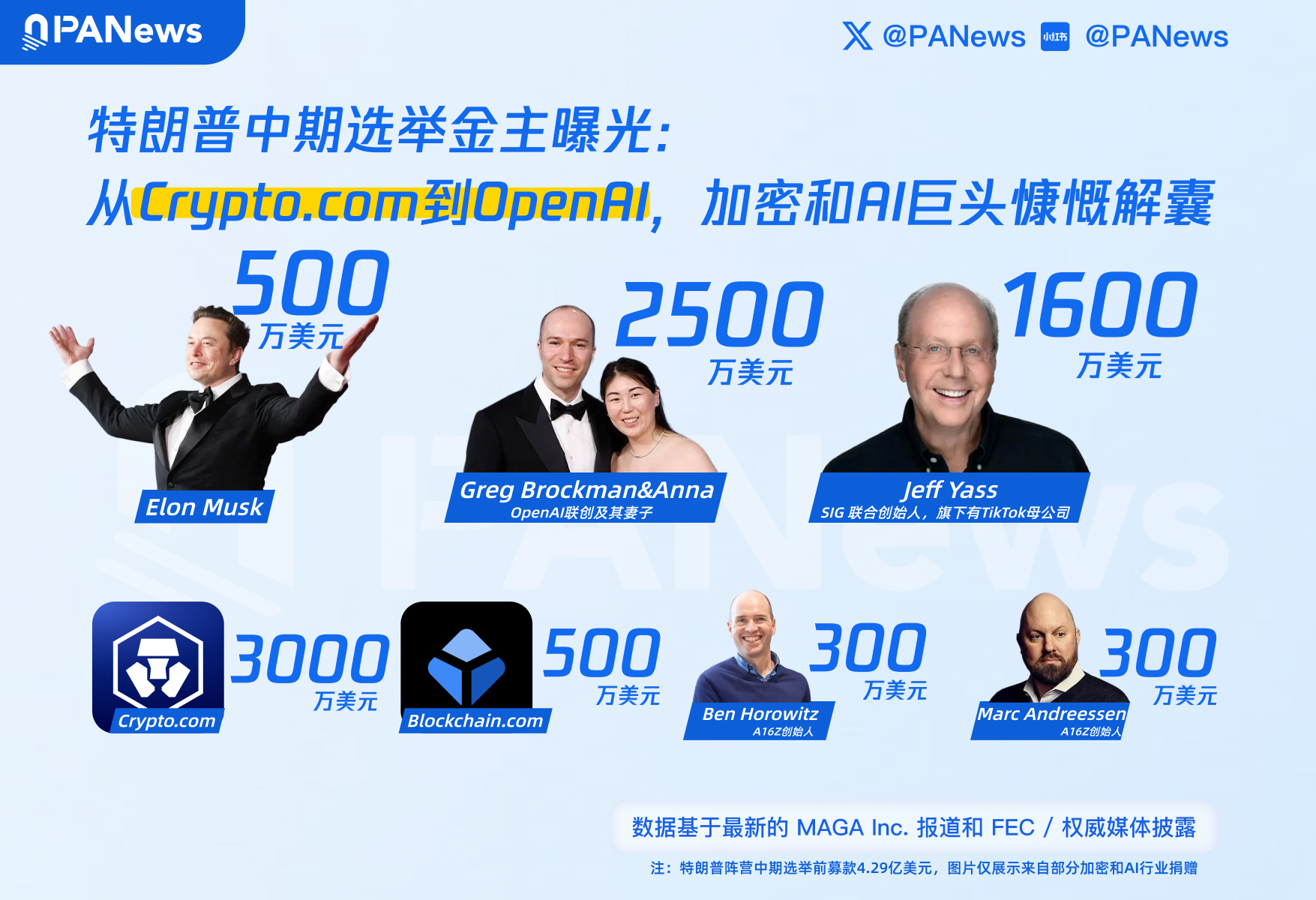
In this round of donations, the AI and crypto industries also accounted for a significant proportion:

Elon Musk: $5 million
OpenAI co-founder Greg Brockman and his wife Anna: $25 million
SIG co-founder Jeff Yass: $16 million

Crypto.com: $30 million
Blockchain.com: $5 million
A16Z founder Ben Horowitz: $3 million
A16Z founder Marc Andreessen: $3 million

Funds from the energy, healthcare, and financial industries are also heavily betting:

Extremity Care (medical company) and related parties: $10 million
RAI Services (tobacco company): $3 million

Energy entrepreneur Kelcy Warren: $12.5 million
Private equity investor Konstantin Sokolov: $11 million
Banker Julio Herrera Velutini and his daughter: $3.5 million
NYSE parent company ICE CEO Jeffrey Sprecher: $2.5 million
Food business heir Lynsi Snyder-Ellingson: $2 million
Venture capitalist William E. Ford: $1.25 million
NFL Dallas Cowboys owner Jerry Jones: $1 million
Chevron board member John Hess: $1 million
John Hess's wife Susan Hess: $1 million
Investor Warren Stephens: $1 million
Entrepreneur Jared Isaacman: $1 million
Preguntas relacionadas

QHow much money did Donald Trump raise for the midterm elections according to the article?

ADonald Trump raised a total of $429 million for the midterm elections.

QWhich AI and crypto industry leaders made significant donations to Trump's campaign, and how much did they contribute?

AElon Musk donated $5 million, OpenAI co-founder Greg Brockman and his wife Anna donated $25 million, and SIG co-founder Jeff Yass donated $16 million. From the crypto industry, Crypto.com donated $30 million, Blockchain.com donated $5 million, and A16Z founders Ben Horowitz and Marc Andreessen each donated $3 million.

QWhat is the amount of money currently available in Trump's super PAC, and how does it compare to the Democratic camp?

ATrump's super PAC currently has $304 million, which is tens of millions more than the Democratic camp.

QBesides AI and crypto, which other industries contributed significantly to Trump's midterm election funds?

ASignificant contributions also came from the energy, healthcare, and financial industries, including donations from Extremity Care ($10 million), RAI Services ($3 million), energy entrepreneur Kelcy Warren ($12.5 million), and others.

QWho are some of the notable individual donors from outside the AI and crypto sectors mentioned in the article?

ANotable individual donors include NYSE parent ICE CEO Jeffrey Sprecher ($2.5 million), NFL Dallas Cowboys owner Jerry Jones ($1 million), Chevron board member John Hess and his wife Susan Hess ($1 million each), and food business heiress Lynsi Snyder-Ellingson ($2 million).

Lecturas Relacionadas

A New Paradigm in Tokenomics? When Backpack Makes VCs 'Delay Gratification'

The article discusses Backpack's innovative tokenomics model, which challenges conventional practices in the cryptocurrency industry. Unlike typical projects where teams and venture capitalists (VCs) receive immediate token allocations, Backpack allocates 100% of liquid tokens to users at TGE. The remaining 37.5% of tokens, traditionally reserved for teams and investors, are locked in a corporate vault and tied to the company’s eventual IPO. This structure ensures that internal stakeholders can only benefit after a successful IPO, with an additional one-year lock-up period post-IPO to prevent early sell-offs. Backpack’s approach emphasizes long-term alignment with user interests and project sustainability. The token distribution prioritizes community incentives, with 25% of tokens released at TGE to reward users and NFT holders. Future unlocks are tied to product milestones, ensuring that new token releases contribute more value to the ecosystem than they dilute the token’s price. Additionally, Backpack prioritizes regulatory compliance, currently serving only 48% of global regions to adhere to legal standards. Its goal is to build a hybrid platform integrating crypto and traditional financial services. Market reactions are mixed: Backpack is reportedly seeking funding at a $1 billion valuation, but predictions about its token FDV reflect uncertainty. Ultimately, Backpack’s model represents a shift toward transparency, long-term value, and user-centric growth in Web3.

marsbitHace 1 hora(s)

A New Paradigm in Tokenomics? When Backpack Makes VCs 'Delay Gratification'

marsbitHace 1 hora(s)

Wall Street's Top Quantitative Firm Jump Trading Enters the Prediction Market, Is the Era of Retail Investors Over?

Wall Street quantitative trading giant Jump Trading is entering the prediction market sector through strategic partnerships with leading platforms Kalshi and Polymarket. In exchange for providing liquidity, Jump will receive equity stakes in both companies—a fixed share in Kalshi and a performance-based stake in Polymarket tied to its U.S. trading volume. Prediction markets have faced persistent liquidity challenges, with platforms often experiencing shallow order books and wide bid-ask spreads outside of major events. While Kalshi previously engaged SIG as a market maker and Polymarket relied on decentralized incentives and algorithmic traders, both platforms have struggled to maintain stable, deep liquidity consistently. The equity-for-liquidity model aligns incentives: platforms gain access to Jump’s sophisticated, low-latency market-making capabilities, while Jump positions itself to benefit from the sector’s growth—Kalshi and Polymarket are valued at approximately $11B and $9B, respectively. Market making in prediction markets offers potential profits from spreads, incentives, and arbitrage, but it also carries significant risks, including event-driven volatility, limited hedging options, and regulatory uncertainty. While Jump’s advanced infrastructure and cross-asset experience may allow it to capture alpha and leverage equity upside, smaller players face high barriers to entry. The move signals a maturation of the prediction market space, with institutional participation likely to improve liquidity but also centralize influence among top-tier firms.

marsbitHace 1 hora(s)

Wall Street's Top Quantitative Firm Jump Trading Enters the Prediction Market, Is the Era of Retail Investors Over?

marsbitHace 1 hora(s)

Trading

Spot
Futuros
活动图片