CFTC gives prediction markets leeway on data and record-keeping rules

cointelegraphPublicado a 2025-12-12Actualizado a 2025-12-12

Resumen

The U.S. Commodity Futures Trading Commission (CFTC) has issued no-action letters to several prediction market platforms—including Polymarket US, LedgerX, PredictIt, and Gemini Titan—exempting them from certain swap data reporting and record-keeping requirements. The exemption applies under specific conditions, such as ensuring full collateralization of contracts and publishing transaction data post-execution. Prediction markets allow trading on event outcomes and are regulated as designated contract markets. The no-action relief temporarily reduces enforcement risk but does not change existing laws. The sector has seen significant growth, with platforms like Kalshi and Polymarket recording billions in trading volume.

The Commodity Futures Trading Commission has issued “no-action” letters to a group of prediction markets, exempting them from requirements related to swap data reporting and record-keeping regulations.

The CFTC’s Division of Market Oversight and the Division of Clearing and Risk won’t initiate enforcement action against several prediction market platforms for shirking certain recordkeeping demands, provided they follow other specific requirements, the agencies said in a statement on Thursday.

“The no-action letters apply only in narrow circumstances and are comparable to no-action letters issued for other similarly situated designated contract markets and derivatives clearing organizations,” they added.

The companies that received a no-action letter are Polymarket US, LedgerX, PredictIt and crypto exchange Gemini’s prediction markets arm, Gemini Titan.
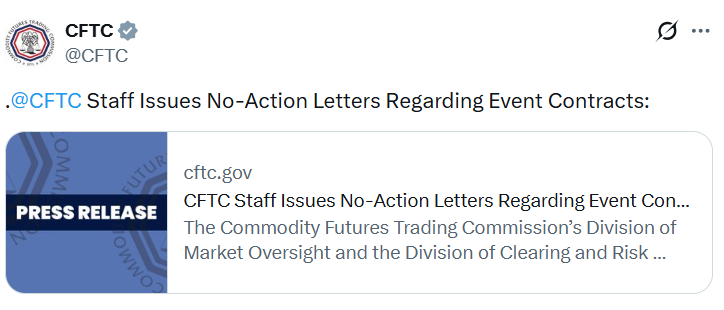
Source: CFTC


As part of the requirements to avoid enforcement, the platforms must fully collateralize all their contracts by ensuring its completely covered by assets held in reserve, and also publish time and sales data for all event contract transactions on their websites “after execution of the transactions,” according to the letters.

Prediction markets and event contracts enable traders to take positions on the outcome of various events, including sports and unconventional topics such as the clothing choices of political figures.

These contracts trigger extensive reporting and record-keeping obligations in the US as prediction markets are regulated as designated contract markets; however, the no-action letter now frees them from the threat of immediate enforcement risk if those obligations aren’t kept.

Related: Gemini soars 14% as new license opens door to US prediction markets

A no‐action letter means the CFTC staff won’t recommend enforcement if the requesting party fails to comply with certain regulations under very specific terms; however, it doesn’t change the law, and they are generally used to temporarily reduce regulatory risk while the market or product evolves.

Prediction markets record bumper 2025

Prediction markets have become one of the most popular crypto offerings this year, with trading volumes on platforms such as Kalshi and Polymarket regularly recording billions of transactions.

Kalshi has had a trading volume of $5.`14 billion over the last 30 days, according to DeFi data aggregator DefiLlama. In comparison, Polymarket, a cryptocurrency-based prediction market, has recorded $1.9 billion in trading volume over the last 30 days.

Crypto.com recently began offering a prediction market platform, which is set to be integrated with Trump Media, while tech researcher Jane Manchun Wong said on Nov.19 that website data indicated Coinbase was also working on creating a prediction market platform.

Magazine: Can Robinhood or Kraken’s tokenized stocks ever be truly decentralized?

Lecturas Relacionadas

The AI Stock Genius Who Made 60x Bets $7.7 Billion on Nvidia Topping Out

An AI-focused hedge fund named Situational Awareness LP, known for its 60x returns, has taken a significant bearish stance on semiconductor stocks in Q1 2026. Its 13F filing reveals a massive 148% quarterly increase in nominal exposure to $13.677 billion, with over 60% of the new exposure directed towards put options on major chip players. Key bearish bets include $2.04 billion in puts on the VanEck Semiconductor ETF (SMH) and $1.56 billion on NVIDIA, alongside positions against Broadcom, Oracle, AMD, and others. The fund simultaneously increased its long equity holdings in AI infrastructure and compute providers like CoreWeave and Bitcoin mining companies repurposing for compute. The core thesis behind this positioning is a shift in the primary constraint for AI expansion. The fund argues that while GPU supply was the critical bottleneck in previous years, the new limiting factors for large-scale AI cluster deployment are physical infrastructure: electrical grid access (with multi-year backlogs in the US), power availability, land, and data center construction timelines. The fund is not betting against AI's success but rather hedging against potential valuation corrections in semiconductor stocks whose prices may have run ahead, while directly investing in the downstream physical bottlenecks—power and data center capacity—it believes will capture value next. This move translates a previously theoretical narrative about infrastructure constraints into a concrete, high-conviction portfolio structure.

链捕手Hace 5 min(s)

The AI Stock Genius Who Made 60x Bets $7.7 Billion on Nvidia Topping Out

链捕手Hace 5 min(s)

Deep Dissection of the Anthropic Account Banning Storm: The Behind-the-Scenes of the Safety Religion, AI Civil War, and Claude's Dilemma Under US-China Decoupling

"Deconstructing Anthropic's Account Banning Storm: Safety Dogma, AI Civil War, and the Claude Dilemma Under US-China Decoupling" analyzes the aggressive user account suspension policies of Anthropic, particularly for its product Claude Code. The article attributes this to a multi-layered convergence of factors. The root cause is traced to founder Dario Amodei's personal "safety religion." Shaped by his father's illness and his exit from OpenAI over safety disagreements with Sam Altman, Amodei embedded this "zero-tolerance" philosophy into Anthropic's DNA. This manifests in technologies like Constitutional AI and a "preventive enforcement" approach to risk, prioritizing safety over user experience or growth. This stance defines Anthropic's position in the US "AI Civil War," pitting "safety-first" proponents like Amodei against "accelerationists" like Altman who prioritize rapid development and commercialization. Anthropic's strict model aligns with its business strategy targeting high-value, low-risk enterprise clients who pay a premium for security, unlike OpenAI's mass-market approach. Capital from Amazon and Google supports Anthropic but also creates a delicate balance, as these investors need its safety reputation without allowing overly restrictive policies to cripple its commercial viability. The conflict escalated when Anthropic refused a US Department of Defense contract requiring the removal of safety guardrails, leading to its placement on a "supply chain risk" blacklist—a key example of the public battle between the two AI factions. For Chinese users, the stringent bans are further compounded by US-China tech decoupling. Anthropic's policies act as a tool for compliance with US export controls, making Chinese users—who often circumvent regional blocks via VPNs or virtual cards—primary targets for "preventive" account terminations to avoid regulatory penalties. The article concludes that Anthropic's harsh account control measures are unlikely to loosen in the near future, being integral to its founding philosophy, business model, and geopolitical compliance needs, positioning it as a unique, security-obsessed player in the tripartite global AI competition involving US safety and acceleration factions and rising Chinese AI power.

marsbitHace 21 min(s)

Deep Dissection of the Anthropic Account Banning Storm: The Behind-the-Scenes of the Safety Religion, AI Civil War, and Claude's Dilemma Under US-China Decoupling

marsbitHace 21 min(s)

SpaceX IPO Rush: A Capital Feast That Could Reshape the Landscape of AI and Crypto

SpaceX's potential IPO is emerging as a pivotal event that could reshape the landscape for both AI and Crypto markets. Far more than a traditional aerospace offering, SpaceX represents the core of Musk's future-tech ecosystem, with its Starlink satellite network positioning it as a global digital infrastructure company. This shift could redefine the foundational layers of the internet, communication, and data flow. Historically, major tech capital market movements, like AI booms or Bitcoin ETF approvals, have profoundly influenced crypto cycles. The SpaceX IPO could trigger a similar "super-narrative" fusion, boosting investor sentiment toward future digital infrastructure. This is particularly relevant for Crypto, which aims to build decentralized versions of such global systems. Key crypto sectors likely to benefit include: * **DePIN (Decentralized Physical Infrastructure Networks):** Projects like Render, Filecoin, and Helium, which incentivize real-world infrastructure for compute, storage, and connectivity. * **AI Crypto:** Platforms such as Bittensor and Fetch.ai, which leverage blockchain for decentralized AI computation, data markets, and agent economies. * **On-chain Payments & SocialFi:** Ecosystems like Solana and Ton, which could gain traction if Musk's X platform integrates digital payments and stablecoins. Ultimately, the IPO symbolizes a broader capital re-evaluation of core digital-age assets—networks, AI, data, and decentralized systems—aligning closely with crypto's long-term vision. It may act as a catalyst, redirecting global tech investment flows toward the crypto space as the next chapter in digital infrastructure unfolds.

marsbitHace 1 hora(s)

SpaceX IPO Rush: A Capital Feast That Could Reshape the Landscape of AI and Crypto

marsbitHace 1 hora(s)

KUN and Pharos Network Forge Strategic Partnership to Jointly Drive Innovation in RealFi, RWA, and Cross-Border Payment Infrastructure

Hong Kong. Layer 1 infrastructure Pharos Network and licensed digital payment expert KUN have signed a strategic MoU. They will integrate Pharos's institutional blockchain with KUN's licensed global payment rails to drive the tokenization of supply chain credit assets and enable more efficient global settlement on-chain. **Background:** Emerging market SMEs face severe working capital challenges due to slow, costly traditional trade finance, often waiting 30-90 days for payment after delivery. While RWA tokenization is a focus, few projects effectively connect underlying infrastructure to real commerce and licensed payment networks. **Collaboration Focus:** The partnership aims to bridge this gap by bringing supply chain credit and B2B cross-border payments on-chain compliantly. Initial priorities include: * Tokenizing supply chain credit assets to unlock liquidity. * Enabling native on-chain settlement of digital assets. * Exploring enterprise virtual card solutions. * Providing compliant on-chain financial services for verticals like commodities, trade, B2B e-commerce, and Web3. **Executive Quotes:** * Wish Wu, Co-founder & CEO of Pharos Network, highlighted KUN's trusted, licensed payment network as a perfect fit for bringing supply chain assets and cross-border capital flows on-chain accessibly. * Dr. Louis Liu, Founder & CEO of KUN, stated that settlement certainty is RealFi's final hurdle. Bridging KUN's payment rails with Pharos's infrastructure will help convert on-chain assets into real-world liquidity with institutional-grade trust. They will also explore AI-driven optimization for global capital flows. Pharos mainnet is live with over 50 dApps. This partnership strengthens its position as RealFi infrastructure by linking licensed payment systems with on-chain finance.

marsbitHace 1 hora(s)

KUN and Pharos Network Forge Strategic Partnership to Jointly Drive Innovation in RealFi, RWA, and Cross-Border Payment Infrastructure

marsbitHace 1 hora(s)

Trading

Spot
Futuros

Artículos destacados

Cómo comprar HPP

¡Bienvenido a HTX.com! Hemos hecho que comprar House Party Protocol (HPP) sea simple y conveniente. Sigue nuestra guía paso a paso para iniciar tu viaje de criptos.Paso 1: crea tu cuenta HTXUtiliza tu correo electrónico o número de teléfono para registrarte y obtener una cuenta gratuita en HTX. Experimenta un proceso de registro sin complicaciones y desbloquea todas las funciones.Obtener mi cuentaPaso 2: ve a Comprar cripto y elige tu método de pagoTarjeta de crédito/débito: usa tu Visa o Mastercard para comprar House Party Protocol (HPP) al instante.Saldo: utiliza fondos del saldo de tu cuenta HTX para tradear sin problemas.Terceros: hemos agregado métodos de pago populares como Google Pay y Apple Pay para mejorar la comodidad.P2P: tradear directamente con otros usuarios en HTX.Over-the-Counter (OTC): ofrecemos servicios personalizados y tipos de cambio competitivos para los traders.Paso 3: guarda tu House Party Protocol (HPP)Después de comprar tu House Party Protocol (HPP), guárdalo en tu cuenta HTX. Alternativamente, puedes enviarlo a otro lugar mediante transferencia blockchain o utilizarlo para tradear otras criptomonedas.Paso 4: tradear House Party Protocol (HPP)Tradear fácilmente con House Party Protocol (HPP) en HTX's mercado spot. Simplemente accede a tu cuenta, selecciona tu par de trading, ejecuta tus trades y monitorea en tiempo real. Ofrecemos una experiencia fácil de usar tanto para principiantes como para traders experimentados.

137 Vistas totalesPublicado en 2026.04.29Actualizado en 2026.04.29

Cómo comprar HPP

Qué es GENIUS

I. Introducción al Proyecto1. ¿Qué es Genius?Genius (GENIUS) se posiciona como el “terminal en cadena definitivo”, una plataforma de trading descentralizada enfocada en la privacidad y la velocidad. Al integrar tecnología de privacidad de primer nivel, busca construir una infraestructura de trading privado de próxima generación en redes como BNB Chain, permitiendo a los usuarios interactuar en cadena con una experiencia fluida comparable a los intercambios centralizados.2. ¿Cómo Funciona Genius?La arquitectura técnica central de Genius está estructurada de la siguiente manera:(1) Invisible en la cadena: Los usuarios no necesitan manejar manualmente aprobaciones de múltiples pasos para operaciones entre cadenas, envoltura de activos o gestión compleja de gas.(2) Trading sin firma: A través de integraciones como Turnkey, Genius permite el trading instantáneo sin confirmaciones emergentes o autorización por transacción.(3) Agregador de Agregadores: Genius está impulsado por una pila de agregación de clase mundial integrada con más de 150 DEXs, reclamando una eficiencia de cotización superior en comparación con productos competidores.(4) Gestión de Cuentas: La plataforma adopta una arquitectura no custodial y aprovecha Turnkey y Lit Protocol para la gestión de claves, permitiendo a los usuarios acceder de manera segura a sus cuentas a través de claves de acceso.3. ¿Quién Creó Genius?Según sus Términos de Servicio oficiales, Genius fue desarrollado por Shuttle Labs, Inc. Basado en la cuenta oficial de X del proyecto, Ryan Myher es uno de los contribuyentes clave que impulsa la iteración del producto, incluyendo desarrollos como el lanzamiento del protocolo Ghost, así como un mayor compromiso con la comunidad.El fundador de Binance, CZ, se ha unido oficialmente al proyecto como asesor, con el objetivo de ayudar al equipo a construir una experiencia de trading en cadena más rápida y que preserve la privacidad.Además, el proyecto ha recibido un fuerte respaldo de YZi Labs, que ha invertido en Genius y trabaja junto a la Fundación Genius, responsable de mantener el Protocolo Genius Bridge (GBP).4. Tokenómica de GeniusGENIUS es el token nativo del ecosistema Genius. Hasta ahora, el proyecto no ha publicado un documento completo de tokenómica.Según las últimas divulgaciones oficiales, Genius incorpora un mecanismo deflacionario, y el 4.6% del suministro total de tokens ya había sido quemado durante la fase de lanzamiento inicial.Sistema de Puntos Genius (GP):(1) Comercio para Ganar: La plataforma ha establecido un fondo de recompensas de 200 millones de Puntos Genius, y los usuarios ganan GP por cada comercio ejecutado a través del terminal.(2) Clasificación y Insignias: Genius cuenta con un sistema de insignias basado en progresión que va desde Inteligente hasta Dios, con niveles más altos desbloqueando beneficios y ventajas adicionales.(3) Rendimiento Nativo: Los usuarios que posean activos designados como usdGG en el panel pueden ganar rendimiento nativo directamente sin pasar por un staking complejo.(4) Incentivos por Referidos: Los referidores pueden ganar reembolsos de tarifas de más del 45% pagados en USDC, junto con GP adicionales.5. Cronograma & Hitos ClaveMarzo 2020: Se creó la cuenta oficial de X del proyecto, marcando el inicio de su fase de preparación temprana.13 de enero de 2026: Genius anunció una inversión de varios millones de dólares de YZi Labs y simultáneamente confirmó a CZ como asesor para acelerar la construcción de su infraestructura de trading privado.18 de abril de 2026: El proyecto anunció que el protocolo de privacidad Ghost se lanzaría pronto.29 de abril de 2026: El protocolo Ghost se abrió oficialmente a sus primeros 50 testers, marcando el comienzo de una nueva era para el trading privado en BNB Chain. Al mismo tiempo, el equipo confirmó que el 4.6% de los tokens han sido quemados.​II. Información del Token1) Información BásicaNombre del token: GENIUS (Genius)III. Enlaces RelacionadosSitio web:https://www.tradegenius.com/homeExploradores:https://bscscan.com/address/0x1f12b85aac097e43aa1555b2881e98a51090e9a6Redes Sociales:https://x.com/GeniusTerminalNota: La introducción del proyecto proviene de los materiales publicados o proporcionados por el equipo oficial del proyecto, que es solo para referencia y no constituye asesoramiento de inversión. HTX no se hace responsable de ninguna pérdida directa o indirecta resultante.

244 Vistas totalesPublicado en 2026.04.29Actualizado en 2026.05.12

Qué es GENIUS

Cómo comprar GENIUS

¡Bienvenido a HTX.com! Hemos hecho que comprar Genius (GENIUS) sea simple y conveniente. Sigue nuestra guía paso a paso para iniciar tu viaje de criptos.Paso 1: crea tu cuenta HTXUtiliza tu correo electrónico o número de teléfono para registrarte y obtener una cuenta gratuita en HTX. Experimenta un proceso de registro sin complicaciones y desbloquea todas las funciones.Obtener mi cuentaPaso 2: ve a Comprar cripto y elige tu método de pagoTarjeta de crédito/débito: usa tu Visa o Mastercard para comprar Genius (GENIUS) al instante.Saldo: utiliza fondos del saldo de tu cuenta HTX para tradear sin problemas.Terceros: hemos agregado métodos de pago populares como Google Pay y Apple Pay para mejorar la comodidad.P2P: tradear directamente con otros usuarios en HTX.Over-the-Counter (OTC): ofrecemos servicios personalizados y tipos de cambio competitivos para los traders.Paso 3: guarda tu Genius (GENIUS)Después de comprar tu Genius (GENIUS), guárdalo en tu cuenta HTX. Alternativamente, puedes enviarlo a otro lugar mediante transferencia blockchain o utilizarlo para tradear otras criptomonedas.Paso 4: tradear Genius (GENIUS)Tradear fácilmente con Genius (GENIUS) en HTX's mercado spot. Simplemente accede a tu cuenta, selecciona tu par de trading, ejecuta tus trades y monitorea en tiempo real. Ofrecemos una experiencia fácil de usar tanto para principiantes como para traders experimentados.

181 Vistas totalesPublicado en 2026.04.29Actualizado en 2026.05.12

Cómo comprar GENIUS

Discusiones

Bienvenido a la comunidad de HTX. Aquí puedes mantenerte informado sobre los últimos desarrollos de la plataforma y acceder a análisis profesionales del mercado. A continuación se presentan las opiniones de los usuarios sobre el precio de A (A).

活动图片