Ripple Wins Another XRP Lawsuit: Court Throws Out Class Action

bitcoinistPublicado a 2026-01-29Actualizado a 2026-01-29

Resumen

A US appeals court upheld a summary judgment in favor of Ripple, dismissing a class action lawsuit alleging the sale of unregistered XRP securities. The court ruled the claims were time-barred by the Securities Act's three-year statute of repose, which began with Ripple's public offerings of XRP as early as 2013. The plaintiff argued that a 2017 sale constituted a separate offering, but the court found no material change in the nature of XRP and affirmed that the repose period had expired by the time the lawsuit was filed in 2018.

Ripple scored another courtroom win tied to XRP sales, after the US Court of Appeals for the Ninth Circuit affirmed summary judgment against investors who alleged the company sold unregistered securities, ruling the federal Securities Act claims were time-barred by the statute of repose.

In a not-for-publication memorandum filed Jan. 27, 2026, a three-judge panel upheld the Northern District of California’s decision that the three-year repose period in Section 13 of the Securities Act had already run by the time the class action was filed.

Ripple Wins: Court Punts XRP Securities Claims

The case was led by Bradley Sostack, who purchased XRP in January 2018 on Poloniex. The underlying class complaint was filed later in 2018; Sostack was appointed lead plaintiff in 2019 and amended the complaint in 2020.

At the center of the appeal was when XRP was “bona fide offered to the public” for purposes of the Securities Act’s repose clock. The ruling sided with Ripple, pointing to early XRP distribution and trading activity tied to the XRP Ledger’s built-in exchange.

“According to the record in this case, Ripple was offering XRP to the public as early as 2013. It is undisputed that Ripple sold over 500 million XRP on the Ledger’s built-in digital asset exchange. Those offers were made ‘to the public’ even if only technologically sophisticated consumers could navigate the Ledger to purchase XRP.”

That framing mattered because Section 13’s statute of repose is unforgiving: once the three years run from the first public offering, later buyers can’t revive a federal Section 12(a)(1) registration claim by filing years afterward. The district court had reached the same conclusion in its June 20, 2024 summary judgment order on the federal class claims.

Sostack’s primary effort to avoid the time bar was to argue Ripple’s conduct in 2017, when the company began releasing its XRP holdings in monthly tranches, amounted to a separate, later offering (or effectively a new investment contract) that should restart the clock.

The panel rejected that attempt to split the timeline, emphasizing the nature of the asset itself and the absence of a factual dispute that the 2013 and 2017 activity should be treated as distinct offerings.

“But Sostack has failed to raise a material issue of fact that the 2013 offering and the 2017 offering were separate offerings. The nature of XRP did not change between 2013 and 2017; all XRP cryptocurrency remained fungible and interchangeable.”

With no separate-offering finding, the panel held the repose period began with the 2013 public offering, leaving the 2018/2019 filings outside the window and affirming judgment for Ripple. The decision is also procedurally narrow: because the district court’s Rule 54(b) certification covered only certain claims, the Ninth Circuit said it was limiting its ruling accordingly.

At press time, XRP traded at $1.88.
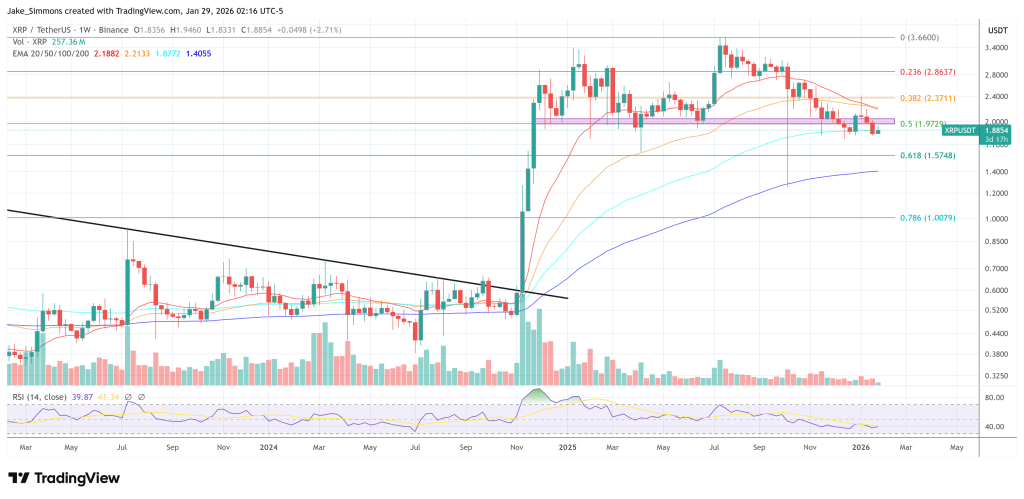
XRP tries to close above the 100-week EMA, 1-week chart | Source: XRPUSDT on TradingView.com

Preguntas relacionadas

QWhat was the main reason the US Court of Appeals for the Ninth Circuit ruled in favor of Ripple in the class action lawsuit?

AThe court ruled that the federal Securities Act claims were time-barred by the statute of repose, as the three-year repose period had already run by the time the class action was filed.

QWhen did the court determine that Ripple first began offering XRP to the public, which started the repose clock?

AThe court determined that Ripple was offering XRP to the public as early as 2013.

QWho was the lead plaintiff in the class action case against Ripple?

AThe lead plaintiff was Bradley Sostack, who purchased XRP in January 2018 on Poloniex.

QWhat argument did the plaintiff use to try to avoid the time bar, and why did the court reject it?

AThe plaintiff argued that Ripple's conduct in 2017, releasing XRP in monthly tranches, was a separate offering that should restart the clock. The court rejected this, stating that the nature of XRP did not change and the 2013 and 2017 activity were not separate offerings.

QWhat was the trading price of XRP at the time the article was published?

AAt press time, XRP traded at $1.88.
Lecturas Relacionadas

Research Status Report on AI Payment Protocols: The New Paradigm of Payment in the Agent Economy

AI Payment Protocol Research Status Report: A New Paradigm for Agent Economy Payments This report analyzes the rapid evolution of payment infrastructure designed for AI agents, driven by major industry moves from OpenAI, Google, Visa, Mastercard, Coinbase, and Stripe between late 2025 and early 2026. The core challenge is that traditional payment systems, built for human interaction, are incompatible with AI agents that require machine-readable interfaces, millisecond authorizations, and support for high-frequency micro-transactions. The emerging infrastructure is forming a two-layer architecture: 1. **Intent Orchestration Layer:** Translates agent intent into executable transactions. Two key segments exist: * **Agent Shopping for Humans:** Focuses on enabling agents to shop on human-centric e-commerce platforms. Protocols include OpenAI & Stripe's closed **Agentic Commerce Protocol (ACP)** and Google's open **Universal Commerce Protocol (UCP)** for standardized merchant interfaces. * **Agent-to-Agent (A2A) Transactions:** Solves trust issues in environments without human merchants, using blockchain-based smart contracts like **ERC-8183** for task execution and payment escrow. 2. **Settlement Layer:** Handles the actual movement of funds. Key competing protocols include: * **Stripe's SPT & Card Network Upgrades (Visa/Mastercard):** Extend existing card payments with delegated authorization tokens, ideal for standard retail but unsuitable for micro-payments. * **Coinbase's x402:** Uses the HTTP 402 status code for on-chain atomic swaps with stablecoins (e.g., USDC), enabling low-fee, account-less payments. * **Circle's Nanopayments:** An x402 enhancement for extreme micro-payments using off-chain batch processing. * **MPP (Stripe & Tempo):** A unified, pluggable framework supporting multiple payment rails (stablecoins, fiat, card tokens, Lightning Network) within a single "payment session." **Current State & Opportunities:** While core protocols are live, commercial adoption lags due to fragmentation in the intent layer. The key opportunities are: * **Settlement Layer:** Building multi-rail Agent wallets that abstract complexity and can route transactions across different payment protocols is a definitive, high-value opportunity. * **A2A Economy:** A significant blue-ocean opportunity exists in creating API services for agents to consume (e.g., data analysis, content creation) on a pay-per-use model (e.g., via HTTP 402), moving beyond subscription models. The future will see a dual-track evolution: consumer-facing agent commerce relying on card rails, and A2A transactions thriving on stablecoin rails. The inflection point will be when enterprises delegate spending authority to agents, making multi-rail wallets and service directories critical, unclaimed infrastructure.

marsbitHace 34 min(s)

Research Status Report on AI Payment Protocols: The New Paradigm of Payment in the Agent Economy

marsbitHace 34 min(s)

Trading

Spot
Futuros

Artículos destacados

Cómo comprar WIN

¡Bienvenido a HTX.com! Hemos hecho que comprar WINkLink (WIN) sea simple y conveniente. Sigue nuestra guía paso a paso para iniciar tu viaje de criptos.Paso 1: crea tu cuenta HTXUtiliza tu correo electrónico o número de teléfono para registrarte y obtener una cuenta gratuita en HTX. Experimenta un proceso de registro sin complicaciones y desbloquea todas las funciones.Obtener mi cuentaPaso 2: ve a Comprar cripto y elige tu método de pagoTarjeta de crédito/débito: usa tu Visa o Mastercard para comprar WINkLink (WIN) al instante.Saldo: utiliza fondos del saldo de tu cuenta HTX para tradear sin problemas.Terceros: hemos agregado métodos de pago populares como Google Pay y Apple Pay para mejorar la comodidad.P2P: tradear directamente con otros usuarios en HTX.Over-the-Counter (OTC): ofrecemos servicios personalizados y tipos de cambio competitivos para los traders.Paso 3: guarda tu WINkLink (WIN)Después de comprar tu WINkLink (WIN), guárdalo en tu cuenta HTX. Alternativamente, puedes enviarlo a otro lugar mediante transferencia blockchain o utilizarlo para tradear otras criptomonedas.Paso 4: tradear WINkLink (WIN)Tradear fácilmente con WINkLink (WIN) en HTX's mercado spot. Simplemente accede a tu cuenta, selecciona tu par de trading, ejecuta tus trades y monitorea en tiempo real. Ofrecemos una experiencia fácil de usar tanto para principiantes como para traders experimentados.

284 Vistas totalesPublicado en 2024.12.11Actualizado en 2025.03.21

Cómo comprar WIN

Discusiones

Bienvenido a la comunidad de HTX. Aquí puedes mantenerte informado sobre los últimos desarrollos de la plataforma y acceder a análisis profesionales del mercado. A continuación se presentan las opiniones de los usuarios sobre el precio de WIN (WIN).

活动图片