Do Not Apply Blindly: A Comprehensive Evaluation of the Eight Main Pathways to Hong Kong Residency by 2026

marsbitPublicado a 2026-06-24Actualizado a 2026-06-24

Resumen

Hong Kong has recently updated its talent attraction policies, offering eight mainstream pathways to residency. These include programs like the Top Talent Pass Scheme (TTPS), Quality Migrant Admission Scheme (QMAS), the newly introduced Technology Professionals Admission Scheme (TP Stream), and Vocational Professionals Admission Scheme (VPAS). Navigating these options involves understanding key details such as core eligibility criteria, employer sponsorship requirements, and the respective advantages and drawbacks of each scheme. A comprehensive comparison chart is provided to help applicants evaluate their choices and potentially save on consultancy fees. Applicants are reminded to always verify information with the official announcements from the Hong Kong Immigration Department.

Author: Biteye

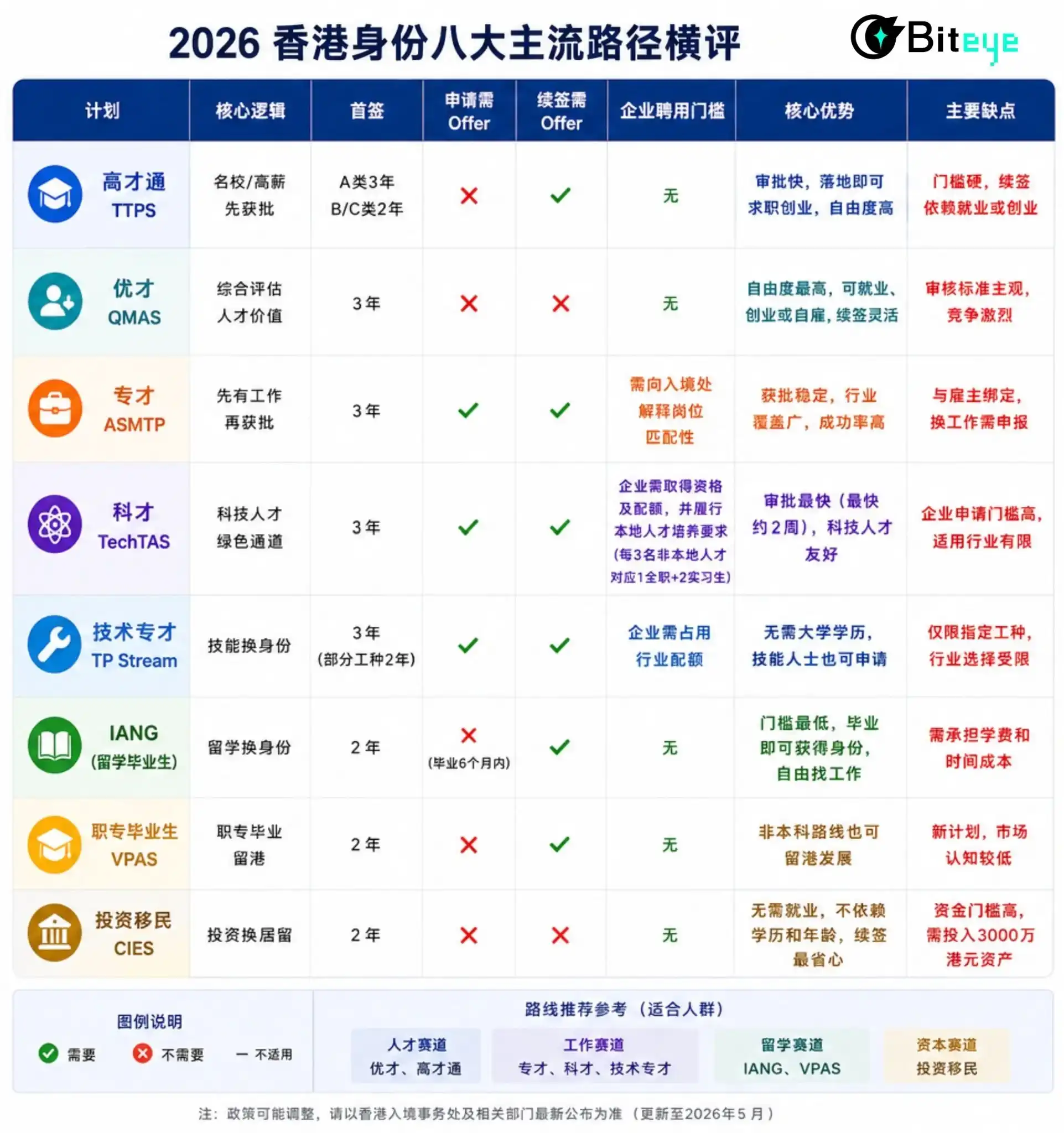
Recently, Hong Kong's talent policies have undergone intensive adjustments. From the Top Talent Pass Scheme (TTPS) and Quality Migrant Admission Scheme (QMAS) to the latest Technical Professionals Stream (TP Stream) and Vocational Professionals Admission Scheme (VPAS), there are now a total of eight mainstream pathways to obtaining residency.

There are many underlying unspoken rules regarding Hong Kong residency. Biteye has distilled the core logic, corporate sponsorship requirements, as well as the advantages and disadvantages of these eight schemes into the comprehensive comparison chart below.

This one chart can save you tens of thousands in agency fees.

(All interested individuals must remember: all information should be verified against the official announcements from the Hong Kong Immigration Department.)

Preguntas relacionadas

QAccording to the article, how many main pathways are there to obtain Hong Kong residency status in 2026?

AAccording to the article, there are eight main pathways to obtain Hong Kong residency status in 2026.

QWhat does the article claim its comprehensive comparison chart can help readers save money on?

AThe article claims its comprehensive comparison chart can help readers save tens of thousands of dollars on agency or intermediary fees.

QWhich Hong Kong government department's official announcements does the article advise readers to refer to for the final authoritative information?

AThe article advises readers to refer to the official announcements of the Hong Kong Immigration Department for the final authoritative information on all policies.

QWhat are two examples of the eight Hong Kong talent schemes mentioned in the article?

ATwo examples of the eight Hong Kong talent schemes mentioned in the article are the Top Talent Pass Scheme (TTPS) and the Quality Migrant Admission Scheme (QMAS).

QWhat does the article say are the key aspects condensed into its comparison chart regarding the eight residency pathways?

AThe article states that its comparison chart condenses the core logic, employer hiring thresholds, as well as the advantages and disadvantages of each of the eight residency pathways.

Lecturas Relacionadas

a16z: In the AI Era, Company Competition for Talent Starts with Job Title Naming

The article discusses how companies in the AI era are competing for talent through strategic "title arbitrage," or the renaming of key roles to reflect and attract new, high-value capabilities. It uses Palantir's creation of the "Forward-Deployed Engineer" (FDE) as a prime example. This title reframed client-facing technical work from a peripheral "implementation" role into a core, high-status engineering function. The move was strategic, allowing Palantir to attract talent that blended technical skill with business acumen and to dominate the market's perception of this capability. The piece argues that job titles are an organizational language that signals the value and authority of certain work. Effective new titles, like "Data Scientist" or "Site Reliability Engineer," emerge when a role's strategic importance genuinely outgrows its old name. Conversely, mere title inflation without substantive change is ineffective. For AI companies, particularly in B2B, this is a crucial strategy. AI transformation creates new high-leverage roles (e.g., "Legal Engineer," "GTM Engineer") that combine domain expertise with technical automation. By naming these roles, a company can help clients internally legitimize these change-makers. This, in turn, builds market mindshare, associating the company with the new capability. In conclusion, as AI blurs the lines between product and service, the ability to accurately name and organize the critical, client-adjacent work that defines product learning will be a key competitive advantage. The first to define this new organizational language plants a flag in the market's mind.

marsbitHace 31 min(s)
a16z: In the AI Era, Company Competition for Talent Starts with Job Title Naming

marsbitHace 31 min(s)

Interview with Strategy CEO: Can STRC Recover After Selling Bitcoin?

Interview with Strategy CEO Phong Le on the recent sale of 32 Bitcoin and its impact. He clarifies the move was a small, strategic action to demonstrate liquidity to debt holders, test internal processes, and prove operational discipline—not a response to fears of a "death spiral" from DeFi protocols leveraging STRC (Strategy's preferred stock product), which he notes holds less than 10% of STRC. Le emphasizes Strategy’s long-term focus as the largest corporate Bitcoin holder, using the adage that markets are a "voting machine" short-term but a "weighing machine" long-term. Decision-making is data-driven, involving the board, complex modeling, and multiple stakeholder considerations, moving beyond a founder-centric model. He outlines various capital options but stresses the strategic importance of "doing nothing" as a valid choice, citing resilience built during the 2022 bear market. Le expresses unwavering belief in Bitcoin's foundational value for global sovereignty and its future role in an AI-driven economy with trillions of autonomous agents. Addressing STRC's current price below its $100 face value, Le explains recent pressure was due to using dollar reserves for bond buybacks. He expects STRC to return to par as reserves are replenished and its semi-monthly dividend payments begin, noting the product is heavily over-collateralized. Finally, Le confirms the company sold Bitcoin the week prior to May 31st, as disclosed in an 8-K filing, leaving prediction market interpretations to others. The overarching philosophy remains "Spread Bitcoin with love," embracing all methods of gaining Bitcoin exposure.

marsbitHace 1 hora(s)

Interview with Strategy CEO: Can STRC Recover After Selling Bitcoin?

marsbitHace 1 hora(s)

IOSG Founder: Ethereum Doesn't Need Another Leap of Technical Faith, It Needs a Musk-style Compromise

Jocy, founder of IOSG Ventures, argues that Ethereum does not need renewed technological faith but a "Musk-like compromise." The recent formation of ETHLabs—funded by major ETH holders like BitMine and Lubin—highlights a market-driven move to fill a gap left by the Ethereum Foundation (EF), signaling a loss of confidence in its decentralized, hands-off approach. The core critique contrasts Vitalik Buterin's (V) idealistic, technology-first vision with Elon Musk's pragmatic, business-driven execution. The author asserts Ethereum's current shortage is not another technical roadmap but a clear, real-world application narrative and a leader willing to engage directly with commercial realities—like Musk. Internal issues are emphasized, citing EF's management problems and talent drain. While the new decentralized model with independent nodes like ETHLabs addresses the single foundation's limitations, it risks fragmentation without cohesive direction. True cohesion, the author suggests, must come from a shared, compelling narrative around ETH's value, not just from aligned financial interests. Independence claims for new entities are seen as aspirational, needing years of transparency to build trust. The ultimate threat is not competitors like Solana, but the broader shift of attention and talent toward AI. Ethereum has a limited window—12 to 18 months—to recapture focus by delivering tangible, real-world applications. The conclusion urges V to shift from abstract ideals to grounded, pragmatic leadership. The time for this crucial pivot is running out.

marsbitHace 2 hora(s)

IOSG Founder: Ethereum Doesn't Need Another Leap of Technical Faith, It Needs a Musk-style Compromise

marsbitHace 2 hora(s)

Trading

Spot
Futuros
活动图片