Goldman Sachs In-Depth Report: Who Will Be the Long-Term Winners in China's AI Large Model Industry?

marsbitPublicado a 2026-07-10Actualizado a 2026-07-10

Resumen

Goldman Sachs Report: China's AI Models at an Inflection Point China's open-source/open-weight large language models (LLMs) have reached performance parity with top global proprietary models, according to a Goldman Sachs report. This is driven by architectural innovations and higher parameter efficiency, allowing Chinese models to achieve comparable capabilities at 2%-10% the parameter size and significantly lower cost. The market is evolving into a two-tiered structure: a high-end segment (e.g., GLM5.2, Qwen3.7 Max) with premium pricing and a low-end, price-sensitive segment for global SMEs and individual users. Key points: * **Cost & Performance:** Innovations like Mixture of Experts (MoE) enable high performance with smaller models. Projects like Meituan's LongCat 2.0, trained on domestic hardware, highlight progress in tech self-sufficiency. * **Open-Source Strategy:** Most Chinese players use open-source/open-weight models for flexibility and ecosystem growth. However, Goldman notes this may underreport actual deployment and revenue. A shift toward "open-weight + community license" models with revenue sharing (e.g., MiniMax) could improve monetization. * **Market Shift & Global Expansion:** Enterprise AI adoption is shifting from "token maximization" to "ROI-first." International expansion, especially in non-US markets, is a major growth driver. Chinese models are increasingly available on global platforms like AWS Bedrock and Microsoft Copilot. * **Competitive...

Author: Wall Street News

China's AI large models are standing at a historic inflection point. Goldman Sachs believes that the intelligence performance of China's open-source/open-weight large models is approaching the world's top proprietary models, with rapid adoption by domestic enterprises and global SMEs, thereby creating a data flywheel effect that will further drive model iteration and upgrades.

According to Chasing Wind Trading Desk, Goldman Sachs' latest report points out that this evolutionary trajectory can be summarized as 'from DeepSeek's cost-efficiency moment last year to Zhipu GLM's model intelligence moment this year.' A team led by Goldman Sachs analyst Ronald Keung systematically evaluates four core questions in this 50-page report: how Chinese AI models achieve high performance at low cost, why the open-source path is chosen and how to monetize it, where the core addressable market lies, and who will be the long-term winners.

In assessing the competitive landscape, Goldman Sachs introduced a "competitive positioning framework" based on pricing power, cost advantage, and financial strength, and concluded accordingly that in the foundational text model field, Zhipu (initiating coverage) and DeepSeek (unlisted) have the strongest positioning; in the multimodal field, ByteDance (unlisted) leads. Goldman Sachs simultaneously maintains its Buy ratings on MiniMax and Kuaishou.
Achieving More with Less, Efficiency Wins

China's large models can achieve performance close to their US counterparts at a far lower cost, with the core lying in the dual breakthrough of architectural innovation and parameter efficiency.

The Goldman Sachs report points out that the parameter scale of Chinese open-source models generally ranges from 200 billion to 1.6 trillion, only 2% to 10% of the world's top models, mainly due to restricted access to high-end computing power. Meanwhile, innovations like the Mixture of Experts (MoE) architecture and sparse attention mechanisms have reduced the actual activated parameters to only 3% to 5% of the total parameters, significantly lowering training and inference costs.

At the specific model level, DeepSeek V4 Pro has 1.6 trillion parameters, Zhipu GLM5.2 has 0.7 trillion, and MiniMax M3 has 0.4 trillion.

Goldman Sachs attributes the recent leap in coding capabilities of Chinese models to the synergistic effects of data filtering, reinforcement learning post-training, and other factors. On June 27, DeepSeek launched the speculative decoding framework DSpark, already deployed in the online services of V4-Flash and V4 Pro, which increases generation speed per user by 60% to 85% (V4-Flash) and 57% to 78% (V4 Pro) without changing model weights or output quality.

Meituan's release of LongCat 2.0 on June 30 is regarded by Goldman Sachs as a significant milestone in the self-sufficiency of China's AI infrastructure—it's China's first open-source 1.6 trillion parameter MoE model fully trained and deployed based on 50,000 domestic compute cards. Goldman Sachs believes this proves the feasibility of a localized hardware stack during the compute-intensive pre-training phase, holding profound significance for China's AI models to reduce reliance on foreign high-end chips.

A Bifurcating Market, the Strong Get Stronger

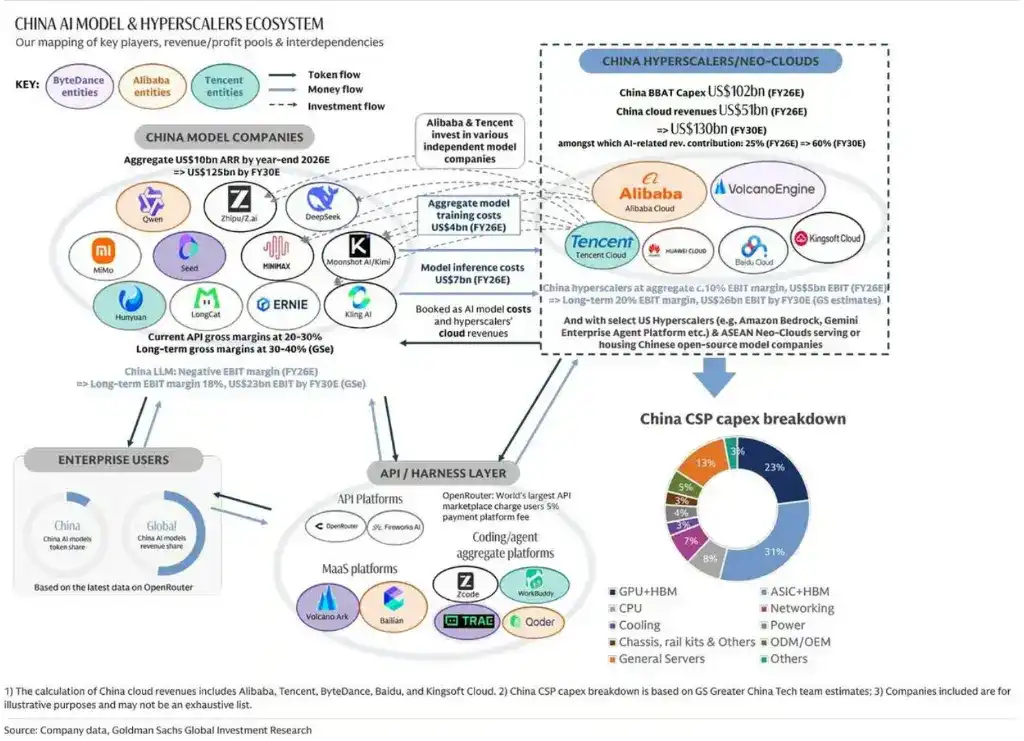
Goldman Sachs describes the Chinese AI model market as forming a "two-tier structure" and identifies two ARR-maximizing quadrants.

In the high-end market, top models represented by Zhipu GLM5.2 and Alibaba's Qwen3.7 Max are priced at about $1 per million tokens, which is 5 times that of low-end models, with estimated inference gross margins around 10% to 20%. In comparison, US top models are priced at $4 to $8 per million tokens; Chinese high-end models are only 10% to 25% of that price, yet can maintain positive gross margins thanks to a lower parameter activation ratio.

In the low-end market, models oriented for agent tasks are priced as low as $0.06 to $0.2 per million tokens, opening up markets among price-sensitive global SMEs and individual users. MiniMax derives 60% to 70% of its revenue from overseas. Notably, DeepSeek has announced the introduction of peak/off-peak pricing for the V4 series from mid-July, with peak rates twice the off-peak rate, with a blended pricing of about $0.35 (V4 Pro) and $0.12 (V4 Flash) per million tokens.

Goldman Sachs forecasts that Chinese AI model API and subscription revenue will grow from an estimated 35 billion yuan in 2026 to 879 billion yuan in 2030, corresponding to daily token consumption increasing from 35 trillion to 460 trillion, an approximately 25-fold increase.

Open-Source Strategy: Widespread Penetration, Monetization Path Awaits Upgrade

The Goldman Sachs report details the strategic logic behind the widespread adoption of open-source/open-weight routes by Chinese AI models and their monetization limitations.

The core advantages of the open-source strategy lie in deployment flexibility and community ecosystem. Alibaba's Qwen series, DeepSeek, Zhipu's GLM, and MiniMax's M3 all adopt open-source or open-weight methods, with ByteDance's Seed model being a major exception, following a fully closed-source proprietary route. The open-source model allows flexible deployment both within and outside mainland China and accelerates iteration through community feedback.

However, Goldman Sachs points out that the ARR numbers disclosed by open-source model companies likely significantly underestimate the actual deployment scale and revenue potential. Taking Zhipu as an example, its ARR target for the end of 2026 is $1 billion, but the actual global deployment volume of GLM5.2 will far exceed the token volume and revenue through Zhipu's own API channels—Alibaba Cloud's Bailian MaaS platform can directly host the open-source GLM5.2 model without paying Zhipu any fees.

Goldman Sachs expects the industry to gradually shift from pure open-source (MIT license, completely free) to an "open-weight + community license" model—where commercial use requires signing a revenue-sharing agreement with the model company. MiniMax's M series has pioneered this model. Goldman Sachs believes this transition will significantly improve the unit economics for AI model companies, as they can benefit from revenue-sharing agreements with platforms like AWS Bedrock and Alibaba Cloud Bailian without bearing the inference compute costs themselves.

From 'Token Maximization' to ROI Priority

Goldman Sachs characterizes international market expansion as the most important upside for Chinese AI models, especially in non-US markets.

Goldman Sachs' US research team estimates that by 2030, agent AI will drive a 24-fold increase in global token consumption to 12 quintillion tokens per month, with enterprise agents contributing a 55-fold growth and consumer agents contributing a 12-fold growth. In global (excluding China) markets, Chinese AI models have already achieved significant token share growth due to performance improvements and price advantages.

The Goldman Sachs report notes that the global enterprise AI usage paradigm is undergoing a fundamental shift from 'token maximization' to 'ROI priority'. The former prevailed from late 2025 to early 2026, where enterprises equated high token consumption with organizational productivity; the latter focuses more on clear task boundaries, daily active agent count, backend process automation, and actual output. Data from a Jellyfish AI engineering trends study shows that heavy AI users in enterprises consume 10 times the tokens but only increase output by 2 times.

At the channel level, Alphabet's Gemini Enterprise Agent Platform and Amazon's AWS Bedrock already offer hosting services for Chinese AI models like DeepSeek, MiniMax, Moonshot, GLM, and Qwen. According to the Wall Street Journal, Microsoft's CEO recently stated that Microsoft is considering hosting a version of DeepSeek in Copilot as an optional low-cost model, emphasizing that if DeepSeek is hosted, the model would run within Microsoft's cloud ecosystem, ensuring customer data remains within Azure.

Who Are the Long-Term Winners?

Goldman Sachs constructed a three-dimensional competitive positioning framework to evaluate each player's long-term winning probability with quantitative metrics, with the core formula being: ARR scale × gross margin advantage + financial strength.

The Pricing Power dimension examines release speed (compared to previous generation and same-level models), LMArena Arena score (based on large-scale blind user evaluations), and blended pricing level per million tokens.

The Cost Advantage dimension examines throughput (tokens per second), cache hit rate, parameter activation ratio, and inference gross margin. The Financial Strength dimension examines cash on hand, net cash as a percentage of total assets, and valuation multiples.

In the field of foundational text models, Goldman Sachs identifies Zhipu (initiating coverage, Neutral rating, target valuation $110 billion) and DeepSeek (unlisted) as having the strongest positioning, with both excelling in pricing power and cost advantage. The overall implied valuation of independent AI model companies exceeds $200 billion.

In the field of multimodal/video generation, ByteDance leads with Seedance. According to LatePost and 36Kr reports, Seedance has a gross margin as high as 70%, with an ARR run rate already exceeding $2 billion. Kuaishou's Kling and MiniMax's Hailuo/upcoming H3 models are also favored by Goldman Sachs, expected to benefit from functional breakthroughs in video generation and LLM integration and healthy pricing due to tight supply in the second half of 2026.

Goldman Sachs maintains a Buy rating on MiniMax with a target price of HK$860, citing its M3 model being in the ARR-maximizing quadrant of high token volume and attractive pricing, and its current valuation being only 13 times its ARR at the end of 2026, showing a significant discount compared to the valuation multiples of Chinese and global peers, with risk-reward skewed to the upside.


Criptos en tendencia

Preguntas relacionadas

QAccording to the Goldman Sachs report, which Chinese companies are identified as the strongest players in the foundational text model space?

AAccording to the Goldman Sachs report, Zhipu (首次覆盖) and DeepSeek (未上市) are identified as the strongest players in the foundational text model space, excelling in both pricing power and cost advantage.

QWhat key architectural and efficiency innovations have enabled Chinese AI models to achieve performance close to top global models at significantly lower costs?

AKey innovations enabling Chinese models' cost efficiency include architectural advances like Mixture-of-Experts (MoE) and sparse attention mechanisms. These innovations reduce the percentage of activated parameters during training and inference to only 3% to 5% of the total parameters, dramatically lowering costs. Chinese models also typically use smaller total parameter sizes (2% to 10% of top global models) due to constraints on accessing high-end compute.

QHow does Goldman Sachs describe the current market structure for Chinese AI models and the key characteristics of its high-end and low-end segments?

AGoldman Sachs describes the Chinese AI model market as forming a "two-tiered structure." The high-end market includes top models like Zhipu GLM5.2 and Alibaba Qwen3.7 Max, priced around $1 per million tokens (about 10-25% of US top models), with estimated inference gross margins of 10-20%. The low-end market targets price-sensitive global SMEs and individuals, with models priced as low as $0.06 to $0.2 per million tokens.

QWhat challenges and evolution paths does Goldman Sachs highlight for the open-source/ open-weight business models adopted by many Chinese AI model companies?

AGoldman Sachs notes that open-source models' reported ARR likely significantly underestimates actual deployment scale and revenue potential, as models can be hosted on third-party platforms (e.g., Alibaba Cloud Bailian) without direct payments to the model creator. The industry is expected to evolve from pure open-source (MIT license, free) towards an "open-weight + community license" model, where commercial use requires a revenue-sharing agreement. This shift, pioneered by MiniMax's M-series, is predicted to significantly improve unit economics for model companies.

QWhat is the three-dimensional competitive positioning framework used by Goldman Sachs to assess long-term winners, and which company leads in the multimodal/video generation space according to it?

AGoldman Sachs uses a three-dimensional framework evaluating: 1) Pricing Power (release speed, LMArena scores, pricing level), 2) Cost Advantage (throughput, cache hit rate, parameter activation ratio, inference gross margin), and 3) Financial Strength (cash on hand, net cash to assets ratio, valuation multiples). According to this framework, ByteDance (未上市) leads in the multimodal/video generation space with its Seedance model, reportedly boasting 70% gross margins and an ARR run-rate exceeding $2 billion.

Lecturas Relacionadas

After Aave's Exit and TVL's Sharp Fluctuation, Where Does MegaETH's Valuation Anchor Lie?

Following the withdrawal of Aave and a sharp drop in its Total Value Locked (TVL), the valuation of the high-performance DeFi blockchain MegaETH faces scrutiny. Once a highly anticipated project with a fully diluted valuation (FDV) reaching around $2 billion, MegaETH saw its TVL plummet from a May peak of $245 million to just over $30 million in July, a roughly 70% decline. Its native token, MEGA, currently trades around $0.048 with a market cap of approximately $54 million and an FDV of about $480 million. The report identifies a core vulnerability: MegaETH's TVL was heavily dependent on a single protocol, Aave V3, which at its peak contributed around 90% of the chain's TVL. A significant portion of this capital is attributed to leveraged yield-farming strategies involving stablecoins like USDe. When the profitability of these strategies diminished, capital rapidly exited, exposing the lack of diversified, sustainable activity. Three key mismatches between MegaETH's valuation and its fundamentals are highlighted: 1. **Valuation vs. Real Usage:** With an FDV of ~$4.8B but only ~$1M in annualized protocol revenue and ~2,600 daily active addresses, the valuation appears disconnected from current economic activity. 2. **Token Narrative vs. Ecosystem Reality:** Despite its DeFi narrative, nearly 80% of the chain's recent protocol revenue comes from a trading card game, Monster, not from core DeFi applications like Aave. The chain's native stablecoin, USDM, also shows low trading volume and a declining market cap. 3. **Short-Term Hype vs. Long-Term Delivery:** Initial hype from token generation, blue-chip integrations, and influencer support has faded. Major protocols like Uniswap now hold minimal TVL on the chain, indicating that early capital was largely transient and driven by incentives rather than organic demand. The situation reflects a broader market trend where investors are becoming less tolerant of valuations based on inflated TVL and narrative, demanding clearer evidence of sustainable transactions, revenue, and ecosystem development. While MEGA's price may experience short-term rebounds from market sentiment, a fundamental re-rating likely depends on the team's ability to convert its remaining resources into tangible, user-retaining applications and genuine ecosystem growth.

链捕手Hace 2 hora(s)

After Aave's Exit and TVL's Sharp Fluctuation, Where Does MegaETH's Valuation Anchor Lie?

链捕手Hace 2 hora(s)

Goldman Sachs Deep Dive Report: Who Will Become the Long-Term Winners in China's AI Large Model Industry?

Goldman Sachs Report: Who Will Be the Long-Term Winners in China's AI Large Model Industry? China's AI large model sector is at a historic inflection point. Goldman Sachs argues that the intelligence of Chinese open-source/open-weight models is approaching top global proprietary models. Rapid adoption by domestic enterprises and global SMEs is creating a data flywheel effect that will further drive model iteration. The evolution is summarized as moving from "DeepSeek's cost-efficiency moment last year to GLM's model-intelligence moment this year." Chinese models achieve near-state-of-the-art performance at significantly lower cost, primarily due to architectural innovations like Mixture of Experts (MoE) and higher parameter efficiency. Models like DeepSeek V4 Pro (1.6T params), GLM5.2 (0.7T), and MiniMax M3 (0.4T) are much smaller than global leaders. Recent advancements in coding capability are attributed to better data curation and RLHF. Landmarks like Meituan's LongCat 2.0, trained fully on domestic AI chips, demonstrate progress in hardware stack independence. The market is forming a "two-tiered structure." The high-end tier (e.g., GLM5.2, Alibaba's Qwen3.7 Max) prices around $1 per million tokens, about 10-25% of US top models, with estimated inference gross margins of 10-20%. The low-end tier (priced as low as $0.06-$0.2 per million tokens) targets price-sensitive global SMEs and individuals. MiniMax derives 60-70% of revenue overseas. Goldman forecasts China's AI model API/subscription revenue to grow from an estimated RMB 35bn in 2026 to RMB 879bn by 2030. Most Chinese players adopt open-source/open-weight strategies for deployment flexibility and community feedback, though this limits monetization as deployments on third-party platforms (e.g., Alibaba Cloud) may not generate direct revenue. A shift towards "open-weight + community license" models with revenue-sharing agreements (like MiniMax's approach) could improve unit economics. International expansion, particularly in non-US markets, is the key growth driver. The global enterprise AI paradigm is shifting from "token maximization" to "ROI prioritization." Chinese models are already hosted on major global platforms like AWS Bedrock and are under consideration for integration into Microsoft Copilot. Using a competitive framework based on pricing power, cost advantage, and financial strength, Goldman identifies the strongest players: In foundational text models, Zhipu AI (initiated coverage) and DeepSeek lead. In multimodal/video generation, ByteDance's Seed is the frontrunner, with Kuaishou's Kling and MiniMax's Hailuo also well-positioned. Goldman maintains a Buy rating on MiniMax, citing its attractive valuation.

链捕手Hace 3 hora(s)

Goldman Sachs Deep Dive Report: Who Will Become the Long-Term Winners in China's AI Large Model Industry?

链捕手Hace 3 hora(s)

Trading

Spot

Artículos destacados

Qué es $S$

Entendiendo SPERO: Una Visión General Completa Introducción a SPERO A medida que el panorama de la innovación continúa evolucionando, la aparición de tecnologías web3 y proyectos de criptomonedas juega un papel fundamental en la configuración del futuro digital. Un proyecto que ha atraído la atención en este campo dinámico es SPERO, denotado como SPERO,$$s$. Este artículo tiene como objetivo reunir y presentar información detallada sobre SPERO, para ayudar a entusiastas e inversores a comprender sus fundamentos, objetivos e innovaciones dentro de los dominios web3 y cripto. ¿Qué es SPERO,$$s$? SPERO,$$s$ es un proyecto único dentro del espacio cripto que busca aprovechar los principios de descentralización y tecnología blockchain para crear un ecosistema que promueva la participación, la utilidad y la inclusión financiera. El proyecto está diseñado para facilitar interacciones de igual a igual de nuevas maneras, proporcionando a los usuarios soluciones y servicios financieros innovadores. En su esencia, SPERO,$$s$ tiene como objetivo empoderar a los individuos al proporcionar herramientas y plataformas que mejoren la experiencia del usuario en el espacio de las criptomonedas. Esto incluye habilitar métodos de transacción más flexibles, fomentar iniciativas impulsadas por la comunidad y crear caminos para oportunidades financieras a través de aplicaciones descentralizadas (dApps). La visión subyacente de SPERO,$$s$ gira en torno a la inclusividad, buscando cerrar brechas dentro de las finanzas tradicionales mientras aprovecha los beneficios de la tecnología blockchain. ¿Quién es el Creador de SPERO,$$s$? La identidad del creador de SPERO,$$s$ sigue siendo algo oscura, ya que hay recursos públicos limitados que proporcionan información de fondo detallada sobre su(s) fundador(es). Esta falta de transparencia puede derivarse del compromiso del proyecto con la descentralización, una ética que muchos proyectos web3 comparten, priorizando las contribuciones colectivas sobre el reconocimiento individual. Al centrar las discusiones en torno a la comunidad y sus objetivos colectivos, SPERO,$$s$ encarna la esencia del empoderamiento sin señalar a individuos específicos. Como tal, comprender la ética y la misión de SPERO sigue siendo más importante que identificar a un creador singular. ¿Quiénes son los Inversores de SPERO,$$s$? SPERO,$$s$ cuenta con el apoyo de una diversa gama de inversores que van desde capitalistas de riesgo hasta inversores ángeles dedicados a fomentar la innovación en el sector cripto. El enfoque de estos inversores generalmente se alinea con la misión de SPERO, priorizando proyectos que prometen avances tecnológicos sociales, inclusión financiera y gobernanza descentralizada. Estas fundaciones de inversores suelen estar interesadas en proyectos que no solo ofrecen productos innovadores, sino que también contribuyen positivamente a la comunidad blockchain y sus ecosistemas. El respaldo de estos inversores refuerza a SPERO,$$s$ como un contendiente notable en el dominio de proyectos cripto que evoluciona rápidamente. ¿Cómo Funciona SPERO,$$s$? SPERO,$$s$ emplea un marco multifacético que lo distingue de los proyectos de criptomonedas convencionales. Aquí hay algunas de las características clave que subrayan su singularidad e innovación: Gobernanza Descentralizada: SPERO,$$s$ integra modelos de gobernanza descentralizada, empoderando a los usuarios para participar activamente en los procesos de toma de decisiones sobre el futuro del proyecto. Este enfoque fomenta un sentido de propiedad y responsabilidad entre los miembros de la comunidad. Utilidad del Token: SPERO,$$s$ utiliza su propio token de criptomoneda, diseñado para servir diversas funciones dentro del ecosistema. Estos tokens permiten transacciones, recompensas y la facilitación de servicios ofrecidos en la plataforma, mejorando la participación y la utilidad general. Arquitectura en Capas: La arquitectura técnica de SPERO,$$s$ apoya la modularidad y escalabilidad, permitiendo la integración fluida de características y aplicaciones adicionales a medida que el proyecto evoluciona. Esta adaptabilidad es fundamental para mantener la relevancia en el cambiante paisaje cripto. Participación de la Comunidad: El proyecto enfatiza iniciativas impulsadas por la comunidad, empleando mecanismos que incentivan la colaboración y la retroalimentación. Al nutrir una comunidad sólida, SPERO,$$s$ puede abordar mejor las necesidades de los usuarios y adaptarse a las tendencias del mercado. Enfoque en la Inclusión: Al ofrecer tarifas de transacción bajas e interfaces amigables para el usuario, SPERO,$$s$ busca atraer a una base de usuarios diversa, incluyendo a individuos que anteriormente pueden no haber participado en el espacio cripto. Este compromiso con la inclusión se alinea con su misión general de empoderamiento a través de la accesibilidad. Cronología de SPERO,$$s$ Entender la historia de un proyecto proporciona información crucial sobre su trayectoria de desarrollo y hitos. A continuación se presenta una cronología sugerida que mapea eventos significativos en la evolución de SPERO,$$s$: Fase de Conceptualización e Ideación: Las ideas iniciales que forman la base de SPERO,$$s$ fueron concebidas, alineándose estrechamente con los principios de descentralización y enfoque comunitario dentro de la industria blockchain. Lanzamiento del Whitepaper del Proyecto: Tras la fase conceptual, se lanzó un whitepaper completo que detalla la visión, los objetivos y la infraestructura tecnológica de SPERO,$$s$ para generar interés y retroalimentación de la comunidad. Construcción de Comunidad y Primeras Interacciones: Se realizaron esfuerzos de divulgación activa para construir una comunidad de primeros adoptantes y posibles inversores, facilitando discusiones en torno a los objetivos del proyecto y obteniendo apoyo. Evento de Generación de Tokens: SPERO,$$s$ llevó a cabo un evento de generación de tokens (TGE) para distribuir sus tokens nativos a los primeros seguidores y establecer liquidez inicial dentro del ecosistema. Lanzamiento de la dApp Inicial: La primera aplicación descentralizada (dApp) asociada con SPERO,$$s$ se puso en marcha, permitiendo a los usuarios interactuar con las funcionalidades centrales de la plataforma. Desarrollo Continuo y Alianzas: Actualizaciones y mejoras continuas a las ofertas del proyecto, incluyendo alianzas estratégicas con otros actores en el espacio blockchain, han moldeado a SPERO,$$s$ en un jugador competitivo y en evolución en el mercado cripto. Conclusión SPERO,$$s$ se erige como un testimonio del potencial de web3 y las criptomonedas para revolucionar los sistemas financieros y empoderar a los individuos. Con un compromiso con la gobernanza descentralizada, la participación comunitaria y funcionalidades diseñadas de manera innovadora, allana el camino hacia un paisaje financiero más inclusivo. Como con cualquier inversión en el espacio cripto que evoluciona rápidamente, se anima a los posibles inversores y usuarios a investigar a fondo y participar de manera reflexiva con los desarrollos en curso dentro de SPERO,$$s$. El proyecto muestra el espíritu innovador de la industria cripto, invitando a una mayor exploración de sus innumerables posibilidades. Mientras el viaje de SPERO,$$s$ aún se desarrolla, sus principios fundamentales pueden, de hecho, influir en el futuro de cómo interactuamos con la tecnología, las finanzas y entre nosotros en ecosistemas digitales interconectados.

120 Vistas totalesPublicado en 2024.12.17Actualizado en 2024.12.17

Qué es $S$

Qué es AGENT S

Agent S: El Futuro de la Interacción Autónoma en Web3 Introducción En el paisaje en constante evolución de Web3 y las criptomonedas, las innovaciones están redefiniendo constantemente cómo los individuos interactúan con las plataformas digitales. Uno de estos proyectos pioneros, Agent S, promete revolucionar la interacción humano-computadora a través de su marco agente abierto. Al allanar el camino para interacciones autónomas, Agent S busca simplificar tareas complejas, ofreciendo aplicaciones transformadoras en inteligencia artificial (IA). Esta exploración detallada profundizará en las complejidades del proyecto, sus características únicas y las implicaciones para el dominio de las criptomonedas. ¿Qué es Agent S? Agent S se presenta como un marco agente abierto innovador, diseñado específicamente para abordar tres desafíos fundamentales en la automatización de tareas informáticas: Adquisición de Conocimiento Específico del Dominio: El marco aprende inteligentemente de diversas fuentes de conocimiento externas y experiencias internas. Este enfoque dual le permite construir un rico repositorio de conocimiento específico del dominio, mejorando su rendimiento en la ejecución de tareas. Planificación a Largo Plazo de Tareas: Agent S emplea planificación jerárquica aumentada por la experiencia, un enfoque estratégico que facilita la descomposición y ejecución eficiente de tareas complejas. Esta característica mejora significativamente su capacidad para gestionar múltiples subtareas de manera eficiente y efectiva. Manejo de Interfaces Dinámicas y No Uniformes: El proyecto introduce la Interfaz Agente-Computadora (ACI), una solución innovadora que mejora la interacción entre agentes y usuarios. Utilizando Modelos de Lenguaje Multimodal de Gran Escala (MLLMs), Agent S puede navegar y manipular diversas interfaces gráficas de usuario sin problemas. A través de estas características pioneras, Agent S proporciona un marco robusto que aborda las complejidades involucradas en la automatización de la interacción humana con las máquinas, preparando el terreno para una multitud de aplicaciones en IA y más allá. ¿Quién es el Creador de Agent S? Si bien el concepto de Agent S es fundamentalmente innovador, la información específica sobre su creador sigue siendo elusiva. El creador es actualmente desconocido, lo que resalta ya sea la etapa incipiente del proyecto o la elección estratégica de mantener a los miembros fundadores en el anonimato. Independientemente de la anonimidad, el enfoque sigue siendo en las capacidades y el potencial del marco. ¿Quiénes son los Inversores de Agent S? Dado que Agent S es relativamente nuevo en el ecosistema criptográfico, la información detallada sobre sus inversores y patrocinadores financieros no está documentada explícitamente. La falta de información disponible públicamente sobre las bases de inversión u organizaciones que apoyan el proyecto plantea preguntas sobre su estructura de financiamiento y hoja de ruta de desarrollo. Comprender el respaldo es crucial para evaluar la sostenibilidad del proyecto y su posible impacto en el mercado. ¿Cómo Funciona Agent S? En el núcleo de Agent S se encuentra una tecnología de vanguardia que le permite funcionar de manera efectiva en diversos entornos. Su modelo operativo se basa en varias características clave: Interacción Humano-Computadora Similar a la Humana: El marco ofrece planificación avanzada de IA, esforzándose por hacer que las interacciones con las computadoras sean más intuitivas. Al imitar el comportamiento humano en la ejecución de tareas, promete elevar las experiencias de los usuarios. Memoria Narrativa: Empleada para aprovechar experiencias de alto nivel, Agent S utiliza memoria narrativa para hacer un seguimiento de las historias de tareas, mejorando así sus procesos de toma de decisiones. Memoria Episódica: Esta característica proporciona a los usuarios una guía paso a paso, permitiendo que el marco ofrezca apoyo contextual a medida que se desarrollan las tareas. Soporte para OpenACI: Con la capacidad de ejecutarse localmente, Agent S permite a los usuarios mantener el control sobre sus interacciones y flujos de trabajo, alineándose con la ética descentralizada de Web3. Fácil Integración con APIs Externas: Su versatilidad y compatibilidad con varias plataformas de IA aseguran que Agent S pueda encajar sin problemas en ecosistemas tecnológicos existentes, convirtiéndolo en una opción atractiva para desarrolladores y organizaciones. Estas funcionalidades contribuyen colectivamente a la posición única de Agent S dentro del espacio cripto, ya que automatiza tareas complejas y de múltiples pasos con una intervención humana mínima. A medida que el proyecto evoluciona, sus posibles aplicaciones en Web3 podrían redefinir cómo se desarrollan las interacciones digitales. Cronología de Agent S El desarrollo y los hitos de Agent S pueden encapsularse en una cronología que resalta sus eventos significativos: 27 de septiembre de 2024: El concepto de Agent S fue lanzado en un documento de investigación integral titulado “Un Marco Agente Abierto que Usa Computadoras Como un Humano”, mostrando las bases del proyecto. 10 de octubre de 2024: El documento de investigación fue puesto a disposición del público en arXiv, ofreciendo una exploración profunda del marco y su evaluación de rendimiento basada en el benchmark OSWorld. 12 de octubre de 2024: Se lanzó una presentación en video, proporcionando una visión visual de las capacidades y características de Agent S, involucrando aún más a posibles usuarios e inversores. Estos marcadores en la cronología no solo ilustran el progreso de Agent S, sino que también indican su compromiso con la transparencia y la participación comunitaria. Puntos Clave Sobre Agent S A medida que el marco Agent S continúa evolucionando, varios atributos clave destacan, subrayando su naturaleza innovadora y potencial: Marco Innovador: Diseñado para proporcionar un uso intuitivo de las computadoras similar a la interacción humana, Agent S aporta un enfoque novedoso a la automatización de tareas. Interacción Autónoma: La capacidad de interactuar de manera autónoma con las computadoras a través de GUI significa un salto hacia soluciones informáticas más inteligentes y eficientes. Automatización de Tareas Complejas: Con su metodología robusta, puede automatizar tareas complejas y de múltiples pasos, haciendo que los procesos sean más rápidos y menos propensos a errores. Mejora Continua: Los mecanismos de aprendizaje permiten a Agent S mejorar a partir de experiencias pasadas, mejorando continuamente su rendimiento y eficacia. Versatilidad: Su adaptabilidad en diferentes entornos operativos como OSWorld y WindowsAgentArena asegura que pueda servir a una amplia gama de aplicaciones. A medida que Agent S se posiciona en el paisaje de Web3 y criptomonedas, su potencial para mejorar las capacidades de interacción y automatizar procesos significa un avance significativo en las tecnologías de IA. A través de su marco innovador, Agent S ejemplifica el futuro de las interacciones digitales, prometiendo una experiencia más fluida y eficiente para los usuarios en diversas industrias. Conclusión Agent S representa un audaz avance en la unión de la IA y Web3, con la capacidad de redefinir cómo interactuamos con la tecnología. Aunque aún se encuentra en sus primeras etapas, las posibilidades para su aplicación son vastas y atractivas. A través de su marco integral que aborda desafíos críticos, Agent S busca llevar las interacciones autónomas al primer plano de la experiencia digital. A medida que nos adentramos más en los reinos de las criptomonedas y la descentralización, proyectos como Agent S sin duda desempeñarán un papel crucial en la configuración del futuro de la tecnología y la colaboración humano-computadora.

524 Vistas totalesPublicado en 2025.01.14Actualizado en 2025.01.14

Qué es AGENT S

Cómo comprar S

¡Bienvenido a HTX.com! Hemos hecho que comprar Sonic (S) sea simple y conveniente. Sigue nuestra guía paso a paso para iniciar tu viaje de criptos.Paso 1: crea tu cuenta HTXUtiliza tu correo electrónico o número de teléfono para registrarte y obtener una cuenta gratuita en HTX. Experimenta un proceso de registro sin complicaciones y desbloquea todas las funciones.Obtener mi cuentaPaso 2: ve a Comprar cripto y elige tu método de pagoTarjeta de crédito/débito: usa tu Visa o Mastercard para comprar Sonic (S) al instante.Saldo: utiliza fondos del saldo de tu cuenta HTX para tradear sin problemas.Terceros: hemos agregado métodos de pago populares como Google Pay y Apple Pay para mejorar la comodidad.P2P: tradear directamente con otros usuarios en HTX.Over-the-Counter (OTC): ofrecemos servicios personalizados y tipos de cambio competitivos para los traders.Paso 3: guarda tu Sonic (S)Después de comprar tu Sonic (S), guárdalo en tu cuenta HTX. Alternativamente, puedes enviarlo a otro lugar mediante transferencia blockchain o utilizarlo para tradear otras criptomonedas.Paso 4: tradear Sonic (S)Tradear fácilmente con Sonic (S) en HTX's mercado spot. Simplemente accede a tu cuenta, selecciona tu par de trading, ejecuta tus trades y monitorea en tiempo real. Ofrecemos una experiencia fácil de usar tanto para principiantes como para traders experimentados.

1.1k Vistas totalesPublicado en 2025.01.15Actualizado en 2026.06.02

Cómo comprar S

Discusiones

Bienvenido a la comunidad de HTX. Aquí puedes mantenerte informado sobre los últimos desarrollos de la plataforma y acceder a análisis profesionales del mercado. A continuación se presentan las opiniones de los usuarios sobre el precio de S (S).

活动图片