BIS Latest Research: The Future of Stablecoins and the Global Monetary Landscape

marsbitPublicado a 2026-06-01Actualizado a 2026-06-01

Resumen

BIS Working Paper No. 170, released in May 2026, analyzes the impact of stablecoins on the global monetary system. The market has grown exponentially since 2014, with over 300 active stablecoins exceeding $300 billion in market capitalization. It is highly concentrated, dominated by USD-linked stablecoins (98% by market cap, mainly USDT and USDC), which function as new forms of private offshore dollar claims on blockchain. Currently, stablecoin use remains largely within crypto ecosystems for trading and DeFi collateral. Real-economy adoption, such as in cross-border payments, is nascent but growing in emerging markets and developing economies (EMDEs) facing high inflation and volatile currencies, where they facilitate capital flight and "digital dollarization." The paper assesses impacts using the Cohen-Kennen framework. For private-sector functions, stablecoins most directly affect value storage (as a dollar-denominated safe haven in EMDEs) and the medium of exchange (enhancing cross-border payment efficiency, further entrenching dollar use). Impacts on the unit of account and official-sector functions are currently limited but could indirectly constrain monetary policy autonomy and capital controls. The report outlines three potential future scenarios: 1) **Niche adoption**, where stablecoins remain crypto-centric with minimal systemic impact; 2) **Digital dollarization**, a high-risk scenario where USD stablecoins become de facto standards in EMDEs, eroding monetary so...

Original AuthorBIS

Source丨China Financial Case Center Compiled by丨Xie Binbin, Qi Zhiping

The rapid global development of digital finance has seen stablecoins evolve from niche tools within the cryptocurrency sphere into novel digital assets with cross-border payment and value storage functions, profoundly impacting the international monetary landscape. In May 2026, the Bank for International Settlements (BIS) released Working Paper No. 170, systematically analyzing the development characteristics, operational mechanisms, and impact of stablecoins on the international monetary system, and proposing three future scenarios and regulatory approaches. The report concludes that stablecoins will reinforce the dominant position of the US dollar in the short term, posing risks to the monetary sovereignty of emerging markets and developing economies (EMDEs). Their long-term trajectory will depend on adoption patterns, regulatory responses, and synergy within the digital finance ecosystem.

Stablecoin Market: Rapidly Expanding, USD Dominance

Stablecoins are privately issued blockchain tokens pegged to fiat currencies or assets to maintain stable value, combining payment and store-of-value functions. Since the first stablecoin emerged in 2014, the industry has experienced exponential growth; by 2026, there were over 300 active stablecoins globally, with a total market capitalization surpassing $300 billion.

In terms of market structure, stablecoins exhibit high concentration and US dollar dominance. In quantity, USD-pegged stablecoins account for approximately 64%; in market value, USD stablecoins represent as high as 98%, with USDT and USDC dominating the market, while stablecoins pegged to other currencies remain extremely small in scale. Regarding reserve assets, major fiat-backed stablecoins primarily hold US short-term Treasury bonds, reverse repurchase agreements, and cash equivalents as core reserves. However, some issuers lack transparency and insufficient auditing, posing potential redemption risks.

Current stablecoin applications remain predominantly within the crypto ecosystem, serving as trading and settlement media for crypto assets, and as collateral in Decentralized Finance (DeFi) lending and liquidity protocols. After excluding automated wash trading and high-frequency trading, the actual transaction volume is only 1% of the nominal volume. Retail scenarios (single transactions below $250) account for less than 0.9%. Real-economy applications like cross-border remittances and retail payments are still in early pilot stages. However, in emerging markets with high inflation and volatile exchange rates, cross-border stablecoin flows continue to rise, becoming a hidden channel to avoid currency depreciation and circumvent capital controls.

Operational Mechanisms: A New Form of Offshore Dollar Carrier

Stablecoins operate on a "on-chain circulation, off-chain reserves" model: the issuer collects fiat currency at a 1:1 ratio and mints tokens, users hold them via digital wallets, enabling 24/7 global transfers via public blockchains, with reserve assets used for redemptions to maintain the peg. This model combines features of 19th century private banknotes, the Eurodollar market, and Money Market Funds (MMF). Essentially, they are private on-chain claims on offshore dollars, extending dollar liquidity through financial innovation.

Unlike the traditional Eurodollar market, stablecoins lack bank credit elasticity and central bank liquidity support. Their stability relies entirely on the quality of reserve assets and market arbitrage mechanisms. The collapse of TerraUSD in 2022 and the temporary de-pegging of USDC in 2023 demonstrated that stablecoins without sufficient high-liquidity reserves are highly prone to losing their peg under stress. A global regulatory consensus has emerged: focus on regulating fiat-collateralized stablecoins and reject algorithmic stablecoins.

In terms of risk transmission, stablecoins' reserves are heavily concentrated in US short-term Treasuries, creating a transmission chain of "global demand → stablecoin issuance → increased US Treasury holdings," directly affecting US Treasury yields and the transmission efficiency of Federal Reserve monetary policy.

Global Impact: Intensifying Monetary Hierarchy, Challenging Emerging Markets' Monetary Autonomy

Using the Cohen-Kenen international monetary function framework, the report systematically assesses the impact of stablecoins on the international monetary system across three functions (unit of account, medium of exchange, store of value) and two sectors (private and official). The conclusion indicates that stablecoins have the most direct impact on the private sector's store-of-value and medium-of-exchange functions, with limited impact on the unit of account and official sector functions, but they implicitly constrain monetary policy autonomy.

  • 1. Store of Value: The Core Channel of Digital Dollarization In high-inflation emerging markets, USD stablecoins, requiring no foreign currency accounts and allowing anonymous cross-border holding, have become residents' preferred safe-haven asset, leading to "hidden dollarization". Stablecoin inflows are highly correlated with local currency depreciation and widening exchange rate gaps, squeezing local currency deposits and weakening central bank control capabilities.

  • 2. Medium of Exchange: Enhancing Cross-Border Payment Efficiency Stablecoins offer advantages like real-time settlement, no operational hour restrictions, and low fees, leading to rapid penetration in scenarios like cross-border remittances and e-commerce. Their development further reduces friction in using the US dollar, expanding its share in retail cross-border payments and e-commerce transactions.

  • 3. Unit of Account: Limited Impact, Hard to Break Commercial Inertia Trade invoicing and contract pricing exhibit strong path dependence. Stablecoins have not yet altered the global trade pattern dominated by the US dollar and euro. They are only sporadically used in some retail scenarios in high-inflation economies, not forming a systematic substitute.

  • 4. Official Sector: Indirect Constraints, No Direct Substitution Central banks have not yet included stablecoins in foreign exchange reserves or as exchange rate intervention tools; official unit-of-account and intervention functions have not been directly impacted. However, widespread private-sector use of stablecoins can render capital controls ineffective and hinder monetary policy transmission, exacerbating the "trilemma": financial openness is passively increased, intensifying conflicts between exchange rate stability and monetary policy autonomy.

Three Future Scenarios: From Limited Penetration to Systemic Change

Based on adoption scale, regulatory environment, and cross-border impact, the report constructs three mutually exclusive yet parallel future scenarios, covering possible paths from marginal influence to reshaping the system.

  • Scenario 1: Niche Adoption (Baseline Scenario) Stablecoins remain confined within the crypto ecosystem, with limited penetration into the real economy. Localized holdings emerge in high-inflation countries, but retail payments and trade settlements remain primarily in local currencies. Regulation focuses on anti-money laundering and consumer protection. Capital flow spillover is small, monetary sovereignty and financial stability in emerging markets remain largely controllable, and central banks retain full policy autonomy. This scenario aligns most closely with current market characteristics and is the most likely short-term trajectory.

  • Scenario 2: Digital Dollarization (High-Risk Scenario) USD stablecoins become the de facto standard for cross-border retail payments and domestic pricing in emerging markets, with banks offering related services, accelerating deposit dollarization. Local currency policies become ineffective, capital controls are rendered meaningless, domestic savings flow into US Treasuries via stablecoins, and local credit markets shrink. Exchange rate transmission effects intensify, stablecoin run risks directly impact emerging market financial stability, leading to irreversible digital dollar dependency. This scenario's impact on monetary sovereignty far exceeds traditional dollarization and is an extreme risk emerging markets must prioritize preventing.

  • Scenario 3: Integration of Local Currency Stablecoins (Ideal Scenario) Emerging markets, through regulatory authorization, allow licensed institutions to issue local currency stablecoins, interoperable with domestic fast payment systems and Central Bank Digital Currencies (CBDCs). Reserve assets are restricted to local currency government bonds and central bank deposits, balancing technological efficiency with policy autonomy. Stablecoins are used for government payments, e-commerce settlements, and securities clearing, enhancing payment efficiency and financial inclusion while avoiding foreign currency substitution risks. However, this scenario requires robust regulatory capacity, financial infrastructure, and macroeconomic stability, conditions currently lacking in most low-income emerging markets.

Regulatory Challenges and Policy Implications: Global Coordination is Key

The cross-border nature of stablecoins makes single-country regulation ineffective. The report proposes four core policy directions::

  • 1. Unify Global Regulatory Standards: Implement the Financial Stability Board's (FSB) recommendations on stablecoin regulation, clarifying reserve requirements, disclosure rules, and redemption mechanisms to avoid regulatory arbitrage.

  • 2. Strengthen Cross-Border Collaboration: Establish regulatory information sharing and risk management mechanisms between issuing and using countries to address cross-border runs and capital flow shocks.

  • 3. Upgrade Domestic Defenses: Emerging markets should improve macroeconomic stability, optimize domestic payment systems, and advance CBDC development to counter the appeal of foreign currency stablecoins.

  • 4. Prevent Illicit Activities: Leverage blockchain traceability technology to combat money laundering, terrorist financing, and other abuses, balancing innovation and risk.

In summary, stablecoins are not simple financial innovations but structural forces reshaping the international monetary hierarchy. In the short term, they may reinforce dollar hegemony and exacerbate financial subordination in emerging markets; in the long term, the outcome depends on global regulatory coordination, innovation in local currency digital tools, and market adoption paths. For emerging markets, stablecoins are a double-edged sword offering both opportunities and risks: they can enhance payment efficiency and promote financial inclusion but may also trigger digital dollarization and erode monetary sovereignty.

The future global monetary system will enter a new stage of coexistence between public digital currencies (CBDCs) and private digital currencies (stablecoins), with competition between fiat currencies and digital dollars. Only through sound macroeconomic policies, robust regulatory frameworks, and international coordination can we embrace technological benefits while safeguarding financial security and monetary sovereignty, avoiding new forms of digital financial subordination.

Original Link

Preguntas relacionadas

QAccording to the BIS report, what are the three potential future scenarios for stablecoins, and which one is considered the most likely in the short term?

AThe three potential future scenarios are: 1) Niche adoption (baseline scenario), where stablecoins remain confined to the crypto ecosystem with limited real-economy penetration. 2) Digital dollarization (high-risk scenario), where USD stablecoins become a de facto standard in emerging markets. 3) Local currency stablecoin integration (ideal scenario), where licensed entities issue local currency stablecoins linked to national payment systems. The report considers the niche adoption scenario as the most likely in the short term.

QHow does the BIS report describe the current market structure of stablecoins in terms of currency dominance and concentration?

AThe report describes the stablecoin market as highly concentrated and dominated by the US dollar. By quantity, USD-pegged stablecoins account for about 64% of all stablecoins. By market capitalization, USD stablecoins represent a staggering 98% share, with USDT and USDC dominating the market. Stablecoins pegged to other currencies remain negligible in size.

QWhat is the core mechanism of fiat-collateralized stablecoins, and how does the BIS report characterize their economic nature?

AThe core mechanism is an 'on-chain circulation, off-chain reserves' model. Issuers create tokens on a 1:1 basis with fiat currency received, which users hold in digital wallets. The reserves are used for redemption to maintain the peg. The BIS characterizes this as essentially a private, on-chain claim on offshore US dollars, combining features of 19th-century private banknotes, the Eurodollar market, and money market funds, extending dollar liquidity through financial innovation.

QWhich functions of an international currency are most directly impacted by stablecoins, according to the report's analysis based on the Cohen-Kenen framework?

AAccording to the analysis using the Cohen-Kennen international currency functions framework, stablecoins most directly impact the store of value and medium of exchange functions for the private sector. Their impact on the unit of account function and official sector functions (like foreign exchange reserves) is currently limited, but they can indirectly constrain monetary policy autonomy.

QWhat are the four core policy directions proposed by the BIS report to address the regulatory challenges posed by stablecoins?

AThe four core policy directions are: 1) Unify global regulatory standards (e.g., implement FSB recommendations on reserves, disclosure, and redemption). 2) Strengthen cross-border collaboration for information sharing and crisis management. 3) Upgrade domestic defenses in emerging markets by improving macroeconomic stability, payment systems, and CBDCs. 4) Prevent illicit activities by using blockchain analytics to combat money laundering and terrorist financing.

Lecturas Relacionadas

Bitcoin's Weak Rebound Fails to Mask Adjustment Trend, HYPE's Top Signal Warns of Short-Term Risks | Invited Analysis

**Title:** Bitcoin's Weak Rebound Fails to Mask Downtrend; HYPE Top Signal Alerts of Short-Term Risks | Exclusive Analysis **Abstract:** This weekly market analysis examines the current technical structures of Bitcoin and HYPE, outlining key trading strategies. Bitcoin's daily chart shows it has broken below the median line of its primary ascending channel, indicating structural weakness. It is currently experiencing a weak rebound within a short-term descending channel, targeting resistance at $75,000-$76,000. Failure to break above this zone could lead to a resumption of the downtrend, testing support at $69,500-$70,500. Trading strategies include positioning for a rebound rejection (Plan A) or a breakdown below key support (Plan B) with controlled short positions. For HYPE, the 4-hour chart reveals a potential seven-wave advance from the May 14 low, now showing signs of exhaustion. A bearish divergence (momentum weakening) has been observed, coupled with a top signal from the proprietary "Spread Trading Model" at potential endpoint 47. The key this week is to monitor if a confirmed top forms here, especially upon a breach of the $62.5-$64.57 support area. If broken, a larger corrective move towards $54-$56.30 is anticipated. The short-term strategy for HYPE focuses on cautious long entries only upon confirmed stabilization within the support zone. The report also details a successful short BTC trade from the previous week, yielding a ~5.07% profit, executed based on model signals and price action. Strict risk management rules, including dynamic stop-loss adjustments, are emphasized.

marsbitHace 16 min(s)

Bitcoin's Weak Rebound Fails to Mask Adjustment Trend, HYPE's Top Signal Warns of Short-Term Risks | Invited Analysis

marsbitHace 16 min(s)

Bitcoin's Weak Rebound Fails to Conceal Adjustment Trend; HYPE's Top Signals Warn of Short-Term Risks | Guest Analysis

Bitcoin's Weak Bounce Fails to Mask Correction Trend; HYPE Top Signals Warn of Short-Term Risks | Invited Analysis Core Weekly View: Bitcoin's daily chart structure has weakened. The key question is whether its short-term rebound can effectively break above the upper boundary of the descending channel. Has HYPE's seven-wave advance reached its conclusion? This analysis systematically examines the current market structure across multiple timeframes and outlines operational strategies for the week. **Bitcoin (BTC) Analysis:** The daily chart shows BTC trading within a long-term rising channel (yellow) since February but has recently broken below its midline, indicating structural weakness. It is currently confined within a short-term descending channel (blue) originating from the May 6 high. The ongoing bounce appears to be a weak technical correction targeting the blue channel's upper rail (approx. $75,000-$76,000). The 4-hour chart reveals a complex 10-segment corrective structure from the May high, containing two downward pivot zones (Central D and E). The current rebound (segment 36-37) is expected to face resistance in the $75,000-$76,000 area. A failure to break above could lead to a resumption of the downtrend, testing support at $69,500-$70,500 and potentially $65,000. **BTC Weekly Strategy:** The price is currently below the "Bull-Bear Channel," placing it in a technically weak zone. The core focus is on the test of the $75,000-$76,000 resistance and $69,500-$70,500 support. * *Medium-term*: Consider initiating short positions (up to 30% allocation) if the price rejects the $75,000-$76,000 area. Increase exposure to 60% if the long-term rising channel's lower support fails. * *Short-term (30% allocation)*: Two scenarios are outlined: * *Plan A (Sell on Rally)*: Short on rejection at $75,000-$76,000, with a stop-loss above $77,000. * *Plan B (Breakdown Sell)*: Short on a confirmed breakdown below $69,500-$70,500, with a stop-loss above $72,000. **HYPE Analysis:** The 4-hour chart shows HYPE has completed a seven-wave advance from its May 14 low, including a central consolidation zone. A bearish divergence was noted at the prior high (point 45), leading to a 13% correction. The current rally leg (46-47) shows weakening momentum compared to the initial leg (42-43), suggesting a potential momentum divergence. Furthermore, the proprietary "Spread Trading Model" has triggered a strong top warning signal at point 47. A confirmed top here, combined with the momentum divergence, could signal the end of the current uptrend. **HYPE Weekly Strategy:** The core is observing whether a confirmed top at point 47 coincides with the momentum divergence. * Monitor the key support zone of $62.5-$64.75. A hold and bounce from this area, supported by model buy signals, could allow for a light long position (<30% allocation). * A decisive break below this support would indicate a shift to a larger-degree correction, targeting the $54-$56.3 area. **Trade Review:** A previous short trade on BTC was executed at $77,449 based on model top signals (bearish candlestick pattern, spread model warning, momentum divergence) and closed at $73,519 for a 5.07% profit. **Risk Management Reminder:** Always set an initial stop-loss immediately upon entry. Move the stop-loss to breakeven once a 1% profit is achieved, and trail it upwards to lock in profits as the trade progresses. *Disclaimer: Market conditions change rapidly. All views, models, and strategies are for educational purposes and personal trading logs only, not investment advice. Trading carries significant risk.*

Odaily星球日报Hace 21 min(s)

Bitcoin's Weak Rebound Fails to Conceal Adjustment Trend; HYPE's Top Signals Warn of Short-Term Risks | Guest Analysis

Odaily星球日报Hace 21 min(s)

How to Define "Real U.S. Stocks": Differences Between On-Chain Tokens, Price Contracts, and Direct Broker Connections

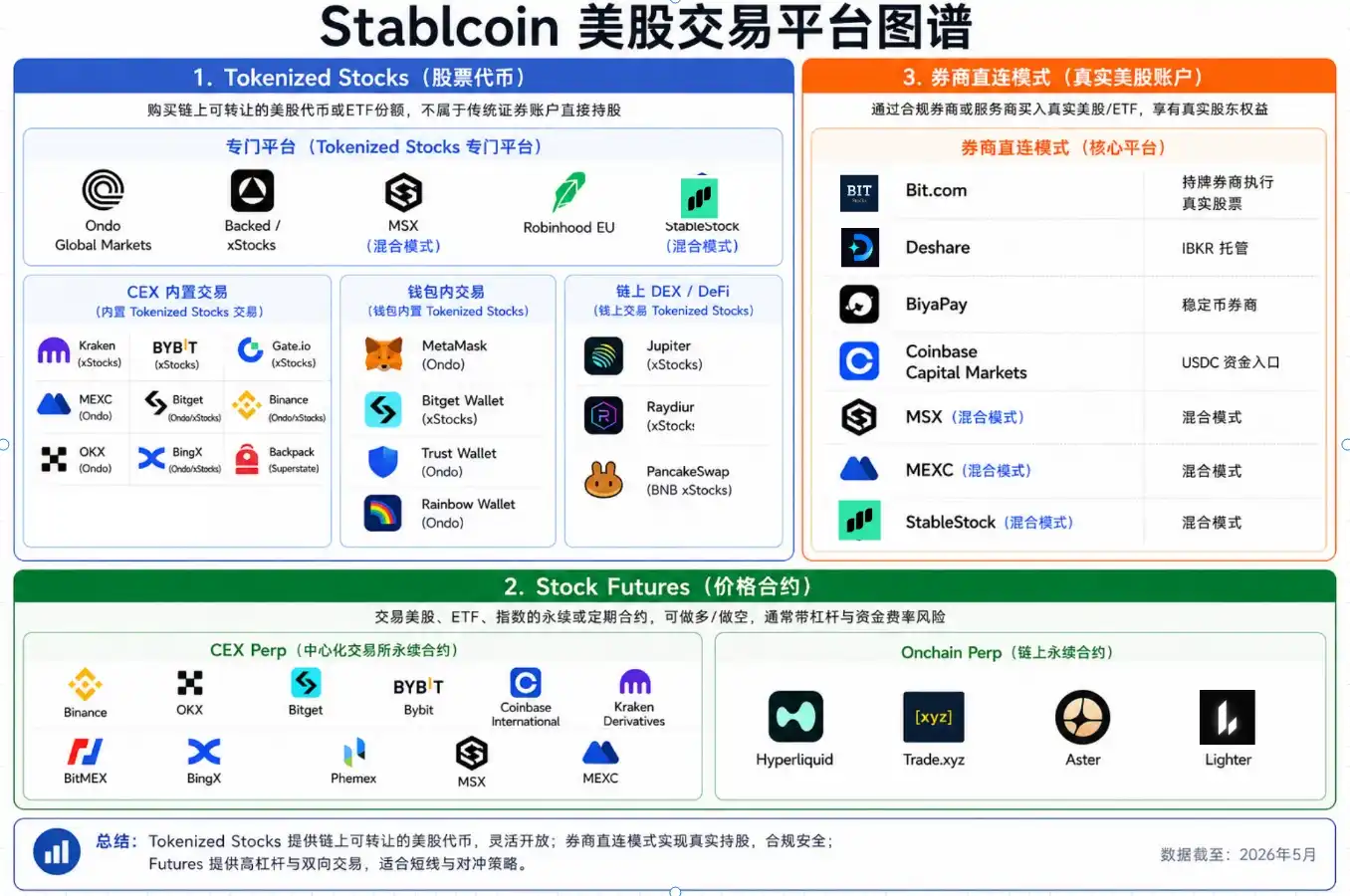
**Title:** Defining "Real US Stocks": Differences Among On-Chain Tokens, Price Contracts, and Broker-Direct Access **Summary:** In 2026, using stablecoins to purchase US stocks is mainstream, but products marketed as "buying US stocks with USDT" offer fundamentally different assets. This article analyzes three primary models. **1. Tokenized Stocks:** These are on-chain tokens representing economic exposure to underlying stocks, held by an issuer or custodian. They offer benefits like 24/7 trading and DeFi composability (e.g., use as loan collateral). However, users lack direct legal shareholder status; dividends may not be paid in cash, and voting rights are typically non-binding advisory expressions. Examples include platforms like Ondo Finance. **2. Stock Futures / Equity Perpetuals:** These are derivative contracts tracking a stock's price, allowing leveraged long/short positions 24/7, similar to crypto perpetuals. They offer high efficiency and flexibility but involve funding fees, which can be a significant long-term cost, especially during strong trends. Crucially, they confer no ownership rights (dividends, voting) to the holder. **3. Broker-Direct Model:** This model provides access to real securities via licensed broker-dealers. Stocks/ETFs are bought and held within the US clearing and custodial system (e.g., DTCC), making it the only path to genuine stock ownership. Users receive cash dividends and formal proxy voting rights (where applicable). It supports thousands of stocks and ETFs, far exceeding the coverage of the other two models. Key advantages include no funding fees, a clean cost structure for long-term holds, and the potential to transfer holdings to other brokers. Some platforms facilitate stablecoin (USDT/USDC) deposits, reducing reliance on traditional banking. A critical distinction exists *within* the broker-direct model: the underlying brokerage architecture (e.g., Fully Disclosed IB, Omnibus IB, Self-Clearing) determines how client assets are held, protected, and how safeguards like SIPC insurance are conveyed. Users should verify the specific clearing structure and regulatory compliance of any platform. In conclusion, "buying US stocks with USDT" can mean holding an on-chain economic proxy (Tokenized Stocks), trading a price derivative (Stock Futures), or owning the actual security (Broker-Direct). For users seeking full ownership rights and long-term investment, the broker-direct model is the definitive choice, though its implementation details require careful scrutiny.

marsbitHace 1 hora(s)

How to Define "Real U.S. Stocks": Differences Between On-Chain Tokens, Price Contracts, and Direct Broker Connections

marsbitHace 1 hora(s)

NVIDIA Launches DSX Platform, Expanding into AI Factory Infrastructure

NVIDIA has unveiled the DSX platform at its GTC Taipei event, marking a strategic expansion from GPU sales into comprehensive AI factory infrastructure solutions. The platform addresses challenges like power supply, cooling, and resource orchestration as AI models scale, shifting the industry focus from single-chip performance to overall infrastructure efficiency. DSX integrates NVIDIA's chips, systems, software, and partner technologies to cover the entire AI factory lifecycle—from design and simulation to deployment and operations. It aims to accelerate deployment, improve reliability and operational efficiency, and reduce the cost per generated token in AI inference. The software suite includes DSX MaxLPS, which uses 45°C liquid cooling and rack-level optimization to allow up to 40% more GPUs per megawatt, and DSX OS, an open-source platform for AI factory operations. The platform also encompasses reference designs, digital twin simulation (DSX Sim), dynamic workload adjustment based on grid conditions (DSX Flex), and data exchange between systems. Early adopters include cloud providers like CoreWeave and Lambda. Major hardware partners, including Dell, HPE, Lenovo, and Supermicro, are developing DSX-ready systems. Pilot projects for DSX Flex are underway with energy providers. Strategically, DSX represents NVIDIA's ongoing transition from an AI chip supplier to a full-stack AI infrastructure platform provider, aiming to set industry standards and solidify its market leadership.

marsbitHace 1 hora(s)

NVIDIA Launches DSX Platform, Expanding into AI Factory Infrastructure

marsbitHace 1 hora(s)

Trading

Spot
Futuros
活动图片