XRP Price Falls 69% from Peak While Activity of Existing Wallets Increases

cryptonews.ruPublicado a 2026-08-14Actualizado a 2026-08-14

Resumen

The price of XRP has fallen approximately 69% from its January 2025 peak of around $3.30, trading near $1.00 in mid-August, its lowest level since November 2024. However, blockchain activity shows a contrasting trend. Data from Santiment reveals that the average daily number of active XRP addresses surged by about 35% in August compared to July, reaching around 35,700. Notably, August 11th was the most active day since early June. This increase in network usage occurred without a corresponding rise in new user adoption. The average number of new addresses created daily remained virtually flat at around 2,260. The analysis indicates that existing wallet holders are transacting more frequently, rather than a wave of new users entering the network. Other metrics show mixed signals. The number of wallets holding at least 1 million XRP tokens increased by 32 over three months, even as the token's market cap fell. Institutional access is growing through regulated derivatives, with CME Group launching products and open interest previously exceeding $1 billion. Corporate use cases, like payroll, are also cited, though they do not directly explain the short-term spike in address activity. The data suggests heightened engagement from the existing holder base amid a significant price decline.

On August 13, $XRP was trading near the $1 mark — its lowest level since November 2024 and approximately 69% below the January 2025 peak of around $3.30, while on-chain activity increased despite the sharp price drop. Analysis by Santiment showed a sharp rise in the number of active addresses in August, while the number of new addresses remained virtually unchanged compared to July.

Amid favorable regulatory developments, $XRP climbed even higher in July 2025, reaching a new peak of around $3.65. The summer rally briefly pushed its market capitalization above $200 billion, cementing its status as one of the most profitable assets of that period.

"On August 12, the price closed at ~$1.00 — its lowest daily close since November 2024 and approximately 69% below the January 2025 peak of around $3.30," writes Santiment, illustrating how much the asset has fallen during the prolonged decline. The company added:

"Activity, however, has increased. In August, the average daily number of active addresses was about 35,700 compared to approximately 26,400 in July, which is a third higher, with August 11 being the most active day since June 5."

This calculation reflects market dynamics, not network health, and the simultaneous increase in address activity does not provide direct evidence that more intensive use of the blockchain can reverse the price trend.
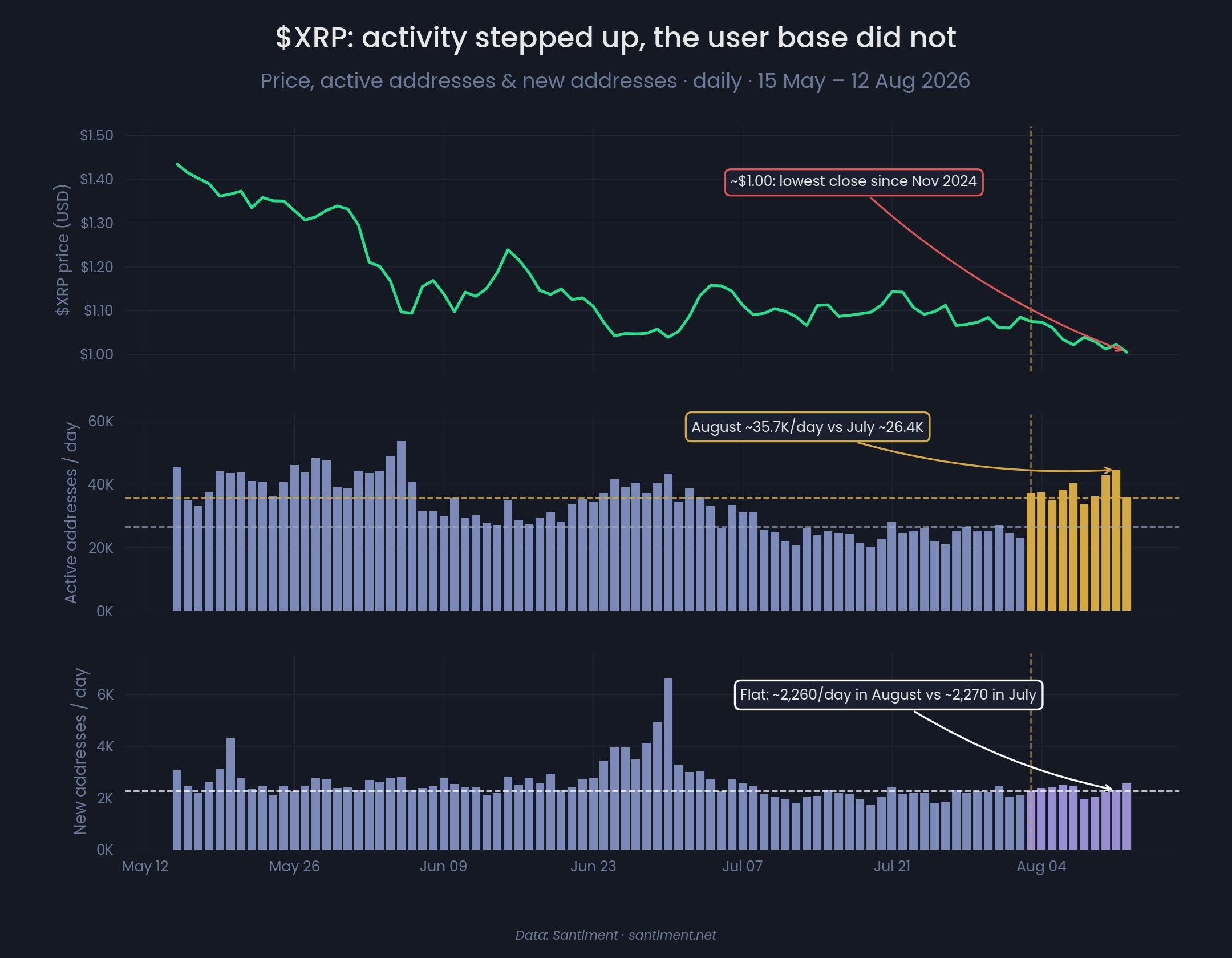
Activity for $XRP has increased according to Santiment. Source: Santiment post on X.

This data indicates that activity on the $XRP ledger increased without a comparable rise in newly created addresses. This pattern allows for a more narrow conclusion than claims of broad adoption: engagement with the ledger intensified throughout August, while available metrics showed virtually no growth in the number of new addresses.

Address Data Shows Activity Without Growth in Account Numbers

From August 1 to 12, the average daily number of active addresses was about 35,700, compared to approximately 26,400 throughout the entire month of July, representing an increase of nearly 35%. Santiment defines the daily number of active addresses as unique addresses participating in transactions during a day, making this metric an indicator of network usage, not a direct count of people.

In August, the number of new addresses averaged about 2,260 per day, almost matching the July figure of 2,270, although August 11 saw the highest number of active addresses since June 5. This gap highlights the limitations of public blockchain data: address activity does not directly equate to unique users.

Data on large holders reflects another form of activity during the downturn, although it measures account balances rather than the number of new participants or transaction frequency. Analysis from August 12 showed that the number of $XRP wallets holding at least 1 million tokens increased by 32 over three months, while the token's market capitalization fell by 29% over the same period.

Institutional Investor Access Grows, While Adoption Data Remains Mixed

Corporate use cases also remain separate from Santiment's August address data and cannot explain the short-term increase without transaction-level attribution. Anodos Finance co-founder and CEO Panos Mekras characterized $XRP as a treasury and payment asset, stating that his company has been buying, holding, and using $XRP for employee payments since 2023.

Ripple CEO Brad Garlinghouse separately outlined institutional opportunities in sectors that process about $16 trillion in annual payments and clearing. Garlinghouse noted that the share of digital assets in these flows is close to zero, presenting this figure as a potential market reach, not as a volume of completed $XRP transactions.

Regulated derivatives have expanded professional investors' access to $XRP, even as the token's spot price remains under pressure. CME Group launched continuous cryptocurrency trading with Ripple Prime as the clearing and funding partner, and open interest for $XRP futures previously exceeded $1 billion within a three-month period.

Events in the institutional investor, treasury operations, and large wallet spheres demonstrate several channels of engagement with $XRP, yet none allow the conversion of August's growth in active addresses into confirmed data on the number of new users. Santiment's average daily new address figure provides the clearest insight: up to August 12, approximately 2,260 new addresses appeared daily, about 10 fewer than the corresponding July average. At the time of writing, $XRP is trading at $1.008.

end-content

Criptos en tendencia

Preguntas relacionadas

QAccording to the article, what was XRP's price on August 13th and how much has it fallen from its January 2025 peak?

AOn August 13th, XRP was trading near $1, which is approximately 69% lower than its January 2025 peak of about $3.30.

QWhat does Santiment's data show about the activity of XRP addresses in August compared to July?

AAccording to Santiment, the average daily number of active XRP addresses in August was about 35,700, a roughly 35% increase compared to approximately 26,400 in July.

QDespite the increase in active addresses, what key metric showed almost no growth according to the analysis?

AThe number of new XRP addresses created daily showed almost no growth. The daily average in August was about 2,260, nearly identical to the July figure of 2,270.

QWhat trend was observed among large XRP holders (wallets containing at least 1 million tokens) during the three-month period ending August 12th?

AThe number of XRP wallets holding at least 1 million tokens increased by 32 over the three-month period ending August 12th, even as the token's market cap fell by 29%.

QWhat institutional development mentioned in the article expanded professional investor access to XRP despite its spot price pressure?

ACME Group launched round-the-clock cryptocurrency trading with Ripple Prime as a clearing and financing partner. Open interest for XRP futures on CME had previously exceeded $1 billion within three months.

Lecturas Relacionadas

Staking Inflation Reforms Trap Ethereum and Solana

The article discusses the "Morton's Fork" dilemma facing both Ethereum and Solana, where both blockchains must choose between two paths that lead to the same outcome: increased centralization of their validator networks. Ethereum researchers have proposed EIP-8363, a "Progressive Issuance Burn" plan. It would gradually increase the proportion of validator rewards burned as the total staked ETH rises, aiming to reduce new token issuance. If staking reaches 50% of the supply, rewards would drop to zero. This proposal has faced strong opposition from major staking service providers and DeFi platforms (e.g., Aave, ether.fi), as staking yields form a crucial base rate for DeFi leverage strategies. Critics argue slashing rewards would first hurt small, individual node operators due to fixed operational costs, accelerating centralization. Solana faces a similar challenge. Its validators have fixed costs but rely heavily on token issuance for rewards (only ~13% of validator income comes from fees). Two current proposals, SIMD-0550 and SIMD-0553, aim to accelerate the reduction of its inflation rate and increase fee burns, respectively. A vote concludes on August 18th. The core conflict is between large token holders (whose assets are diluted by issuance) and the concentrated staking industry that depends on high yields. While reducing issuance could curb the influx of capital into centralized staking services, it could also force out smaller validators first. The article concludes that as blockchains grow into large financial systems, underlying economic forces—yields, leverage, and operational costs—ultimately constrain their original design visions and push them toward centralization, regardless of the specific policy path chosen.

marsbitHace 10 min(s)

Staking Inflation Reforms Trap Ethereum and Solana

marsbitHace 10 min(s)

Trading

Spot

Artículos destacados

Qué es XRP 2.0

XRP 2.0: Una Nueva Frontera en el Panorama de las Criptomonedas Introducción a XRP 2.0 En el siempre cambiante ámbito de las criptomonedas, nuevos proyectos surgen continuamente, compitiendo por atención y adopción. Una de estas iniciativas prometedoras es XRP 2.0, un nuevo proyecto de criptomoneda diseñado para aprovechar la tecnología blockchain avanzada y metodologías de encriptación robustas. Aunque el nombre establece paralelismos con el XRP de Ripple, es crucial señalar que XRP 2.0 opera de manera independiente, enfocándose en mejorar la seguridad de las transacciones, la privacidad y la escalabilidad. A medida que el panorama financiero digital abraza cada vez más soluciones descentralizadas, XRP 2.0 busca contribuir de manera significativa a web3 y a la expansión general de los proyectos de criptomonedas. ¿Qué es XRP 2.0? En esencia, XRP 2.0 es un proyecto de criptomoneda que busca crear un ecosistema de moneda digital seguro y descentralizado. Su tecnología fundamental integra principios avanzados de blockchain con técnicas de encriptación de vanguardia. El objetivo principal de XRP 2.0 es establecerse como una plataforma confiable y eficiente que permita la ejecución rápida de transacciones mientras prioriza la protección de la privacidad de sus usuarios. El proyecto se promociona como una solución a muchas limitaciones enfrentadas por las criptomonedas existentes, proponiendo un sistema que puede manejar un mayor volumen de transacciones con mejor velocidad y privacidad. Esta versatilidad posiciona a XRP 2.0 como un competidor significativo en un mercado plagado de diversas monedas digitales. ¿Quién es el Creador de XRP 2.0? La identidad del creador detrás de XRP 2.0 ha sido señalada como 'Wilbur.' Sin embargo, los detalles completos sobre Wilbur o su entidad asociada siguen siendo elusivos. La anonimidad de muchos creadores de criptomonedas no es un fenómeno poco común en la industria, a menudo diseñado para mantener un grado de privacidad y seguridad. ¿Quiénes son los Inversores de XRP 2.0? Hasta ahora, la información específica relacionada con las fundaciones o organizaciones de inversión que apoyan a XRP 2.0 no está disponible públicamente. En el sector de las criptomonedas, el respaldo de inversores respetables puede influir significativamente en la credibilidad y el éxito de un proyecto, sin embargo, la transparencia sobre los patrocinadores financieros de XRP 2.0 no se ha establecido. ¿Cómo Funciona XRP 2.0? XRP 2.0 se destaca al emplear una combinación de tecnología blockchain y algoritmos de encriptación avanzados que aseguran transacciones seguras y descentralizadas. Su estructura innovadora incluye características únicas diseñadas para fomentar el compromiso del usuario y ampliar las funcionalidades más allá de las transacciones convencionales de criptomonedas. Entre estas características, XRP 2.0 incorpora capacidades impulsadas por IA, como funcionalidades de texto a imagen y de texto a voz. Estas adiciones están diseñadas para mejorar la experiencia interactiva de los usuarios, promoviendo una mayor aplicabilidad en diversos sectores. Al unir avances tecnológicos con un diseño centrado en el usuario, XRP 2.0 busca captar la atención de una amplia gama de individuos y empresas que buscan integrar soluciones de criptomonedas en sus marcos operativos. Cronología de XRP 2.0 Entender XRP 2.0 requiere examinar los hitos que han definido su viaje hasta ahora: 23 de julio de 2023: Se presenta XRP 2.0 como un nuevo proyecto de criptomonedas, con el objetivo de revolucionar las capacidades de transacciones seguras y descentralizadas en el ámbito de blockchain. 8 de septiembre de 2023: Se lanza otro proyecto, XRP20, marcando la aparición de un token ERC-20 en la blockchain de Ethereum que no guarda relación con XRP 2.0. 13 de noviembre de 2023: El Libro Mayor de XRP experimenta una actualización significativa con el lanzamiento de la versión 2.0.0 del software del servidor rippled. Es esencial señalar que este desarrollo está desconectado del proyecto de criptomonedas XRP 2.0. Puntos Clave sobre XRP 2.0 Para destilar la esencia de XRP 2.0, surgen varios factores críticos: Características Únicas: La inclusión de características como texto a imagen y texto a voz impulsadas por IA diversifica aún más las aplicaciones potenciales de XRP 2.0. Tecnología Blockchain: El marco utiliza mecanismos avanzados de blockchain y protocolos de encriptación, asegurando un entorno seguro y descentralizado para las transacciones. Escalabilidad y Privacidad: XRP 2.0 prioriza la protección mejorada de la privacidad en los procesos de transacción y la escalabilidad necesaria para acomodar una base de usuarios creciente. No Afiliación con Ripple: Es importante destacar que, a pesar de su nombre, XRP 2.0 no tiene ninguna lealtad ni colaboración con el XRP de Ripple, diferenciando su marco operativo y objetivos dentro del ecosistema de criptomonedas. Conclusión XRP 2.0 representa una ambiciosa aventura en la esfera de las criptomonedas, buscando ofrecer una combinación de seguridad, privacidad y eficiencia en las transacciones digitales. Al integrar tecnologías sofisticadas y características amigables para el usuario, el proyecto se propone ampliar los horizontes de lo que la criptomoneda puede lograr en la economía digital de hoy. Si bien la anonimidad de su creador y la falta de inversores revelados pueden generar cuestionamientos para algunos, el enfoque de XRP 2.0 en funcionalidades avanzadas y descentralización realza su atractivo en un mercado de criptomonedas cada vez más abarrotado. A medida que el paisaje de las criptomonedas sigue evolucionando, XRP 2.0 podría emerger como un jugador crucial en la expansión de soluciones blockchain seguras y escalables.

305 Vistas totalesPublicado en 2024.04.05Actualizado en 2024.12.03

Qué es XRP 2.0

Cómo comprar XRP

¡Bienvenido a HTX.com! Hemos hecho que comprar XRP (XRP) sea simple y conveniente. Sigue nuestra guía paso a paso para iniciar tu viaje de criptos.Paso 1: crea tu cuenta HTXUtiliza tu correo electrónico o número de teléfono para registrarte y obtener una cuenta gratuita en HTX. Experimenta un proceso de registro sin complicaciones y desbloquea todas las funciones.Obtener mi cuentaPaso 2: ve a Comprar cripto y elige tu método de pagoTarjeta de crédito/débito: usa tu Visa o Mastercard para comprar XRP (XRP) al instante.Saldo: utiliza fondos del saldo de tu cuenta HTX para tradear sin problemas.Terceros: hemos agregado métodos de pago populares como Google Pay y Apple Pay para mejorar la comodidad.P2P: tradear directamente con otros usuarios en HTX.Over-the-Counter (OTC): ofrecemos servicios personalizados y tipos de cambio competitivos para los traders.Paso 3: guarda tu XRP (XRP)Después de comprar tu XRP (XRP), guárdalo en tu cuenta HTX. Alternativamente, puedes enviarlo a otro lugar mediante transferencia blockchain o utilizarlo para tradear otras criptomonedas.Paso 4: tradear XRP (XRP)Tradear fácilmente con XRP (XRP) en HTX's mercado spot. Simplemente accede a tu cuenta, selecciona tu par de trading, ejecuta tus trades y monitorea en tiempo real. Ofrecemos una experiencia fácil de usar tanto para principiantes como para traders experimentados.

1.6k Vistas totalesPublicado en 2024.12.10Actualizado en 2026.06.02

Cómo comprar XRP

Discusiones

Bienvenido a la comunidad de HTX. Aquí puedes mantenerte informado sobre los últimos desarrollos de la plataforma y acceder a análisis profesionales del mercado. A continuación se presentan las opiniones de los usuarios sobre el precio de XRP (XRP).

活动图片