Written by: Gino Matos
Compiled by: Saoirse, Foresight News
Robinhood officially launched the Robinhood Chain mainnet this month. This chain is built on Arbitrum, is a permissionless Layer2, and focuses on tokenized stocks, real-world assets (RWA), DeFi lending, and native AI financial scenarios.
Within just one week of launch, the highest-volume retail trading activity on the entire chain has been driven by CASHCAT. This meme coin, named after the early, discarded Robinhood brand name 'CashCat', saw its market capitalization approach $150 million at one point, with a 24-hour trading volume exceeding $159 million.
CASHCAT did not go through Robinhood's internal application listing process. Instead, it leveraged the Uniswap V3 liquidity pool, paired with third-party launch and routing infrastructure like Noxa.fun and Pump.fun to gain liquidity, price display pages, and market attention.
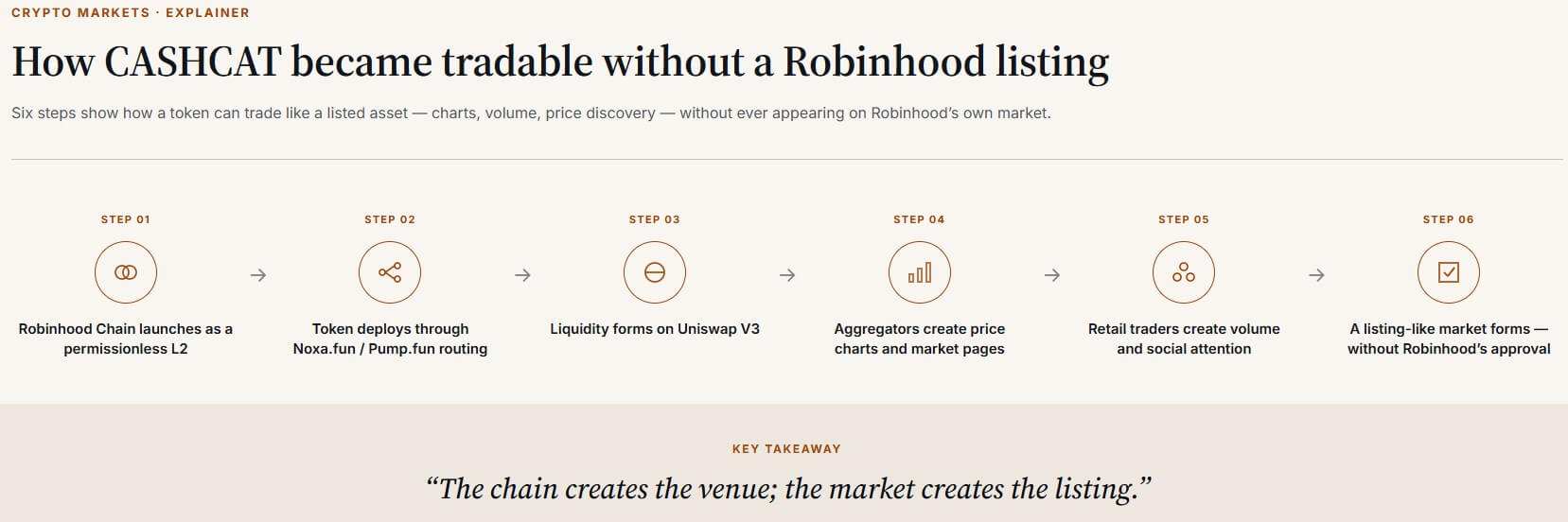
A chart detailing six key steps clearly shows how CASHCAT achieved trading, liquidity accumulation, and volume on the Robinhood Chain without official listing approval.
Behind the "Listing" Without Official Permission
Upon launch, Robinhood Chain integrated with partners like Uniswap and connected Robinhood's own on-chain wallet users. This open architecture, originally designed for tokenized securities and RWA-collateralized assets, simultaneously provided all tokens deployed on the chain access to external decentralized exchange liquidity and price aggregation pages — even tokens that haven't passed Robinhood's app-level review process can obtain near-formal listing trading conditions.
Vlad Tenev (Robinhood co-founder and CEO) and Baiju Bhatt (Robinhood co-founder and Chief Creative Officer) had named the company CashCat before settling on Robinhood; the name came from Baiju's fondness for cats. This piece of corporate history gave an anonymous developer the narrative source for creating a meme coin.
A dashboard created by user Adam_tehc on Dune shows that among the top 25 meme coins by market cap on Robinhood Chain, CASHCAT accounts for nearly 79% of the total market capitalization and 74% of the trading volume; the second largest by size, Dog In Hood, is only one-sixteenth its size.
The same dashboard shows a rapid increase in on-chain trading activity: approximately 1.2 million daily transactions on July 7th, soaring to nearly 2.8 million on July 8th, a single-day increase of 133%. During the same period, the number of tokens launched via Noxa.fun grew from 1,858 to 6,675, a 259% increase.
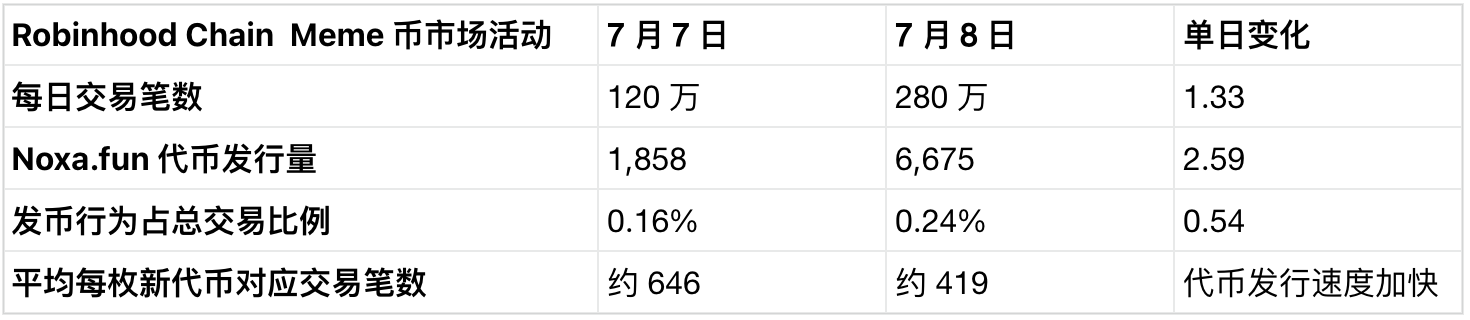
As of July 8th, the growth rate of new token launches has already surpassed the overall trading volume growth rate. Noxa.fun launch-related transactions accounted for only 0.155% of all transactions on July 7th, rising to 0.238% the next day. Sustained high-speed token launches mean a large number of new projects competing for market attention, making it difficult to concentrate liquidity to nurture quality assets and instead potentially causing capital fragmentation.
DefiLlama data shows the chain's total value locked is approximately $107.8 million; the total stablecoin market capitalization is close to $246.8 million, while the market cap of the RWA sector currently being implemented is only $12.5 million.
CASHCAT has an extremely high ratio of trading volume to market capitalization, with capital characterized by high intraday turnover, leaning more towards high-frequency speculative trading rather than long-term asset holding.
Risks Lurk Beneath the Soaring Market
In a July 2nd interview with CNBC, Vlad Tenev stated that the future of the crypto industry belongs to real-world assets (RWA). Just a few days later, he posted that Robinhood Chain is committed to building the optimal RWA public chain, while adding that the chain "also works great for hosting meme coins."
This statement reflects the nature of permissionless infrastructure: once Robinhood opens public chain access to all developers, the market will autonomously select breakout assets. CASHCAT was born from Robinhood's early history, even pulling the founders into a meme narrative that the company cannot control.
A large number of copycat tokens and social media accounts impersonating official ones have already appeared in the market; CASHCAT's liquidity is concentrated in a single decentralized trading pair, making it highly susceptible to slippage and severe price spikes (wicking).
A 2026 academic study analyzed 34,988 meme coins on Ethereum, BNB Chain, Solana, and Base, showing that 1,801 of them (5.15%) completely lost trading liquidity within 24 hours of launch.
Although CASHCAT's current scale far exceeds these short-lived tokens, the same permissionless channels that support it also accommodate thousands of projects that will likely quickly go to zero.
Two Possible Development Scenarios for the Next 60 Days
Optimistic Scenario
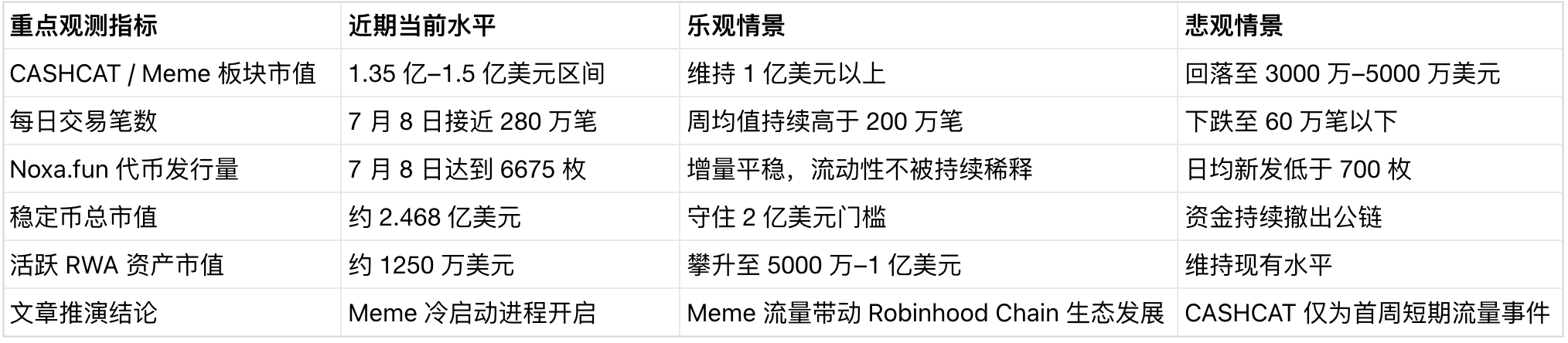
CASHCAT or the overall meme sector market cap remains above $100 million, weekly on-chain transactions stabilize above 2 million, the total stablecoin market cap holds the $200 million mark, and the RWA sector market cap gradually moves towards the $50–100 million range.
If the market evolves along this path, the liquidity brought by memes will become the catalyst for Robinhood Chain's cold start, accumulating wallet users and stablecoin capital for the RWA narrative Robinhood has been promoting since July 1st.
Pessimistic Scenario
CASHCAT's market cap falls back to the $30–50 million range, daily on-chain transactions drop below 600,000, Noxa.fun's daily token launches fall to less than 700, and the RWA sector market cap stagnates at current levels.
In this scenario, CASHCAT would only be a short-term traffic spike upon the chain's launch. After the hype fades, Robinhood Chain's RWA vision would need to attract users from scratch.
Citi's 2026 Tokenized Assets Research Report points out: The current global tokenized asset market size is approximately $17 billion; under a base case scenario, the size is expected to reach $5.5 trillion by 2030, with tokenized stocks and U.S. Treasuries becoming early mainstream applications. The report estimates that if 10% of U.S. retail investors shift to on-chain solutions by 2030, the tokenized U.S. stock sector alone could generate $2.6 trillion in demand.
Robinhood's Q1 2026 crypto business revenue fell 47% year-over-year to $134 million; the company's total net revenue for the same period grew 15% year-over-year to $1.07 billion, with assets under custody on the platform at $307 billion.
This Layer2 chain can accommodate trading demand beyond the platform's official listing inventory, effectively opening a second growth curve for Robinhood's crypto business. Ecosystem development is no longer completely tied to the fate of a single meme coin.
However, Robinhood Chain's RWA vision heavily relies on institutional adoption over several years, as indicated by Citi's prediction—asset tokenization is a long-term endeavor spanning a decade.
The CASHCAT incident has already confirmed one fact: once permissionless infrastructure officially launches, the market can autonomously incubate popular assets with market capitalizations in the hundreds of millions of dollars, regardless of platform approval.