By: Liam 'Akiba' Wright
Compiled by: Saoirse, Foresight News
Key Takeaways
- Keir Starmer announces resignation, triggering Labour leadership contest; Andy Burnham quickly emerges as the frontrunner.
- Crypto industry executives hope Burnham will soften Labour's hardline stance on digital assets, but the UK Financial Conduct Authority's (FCA) work on the full set of 2027 regulations continues unabated.
- A Burnham premiership could change cabinet ministers and policy priorities, but only strong, proactive government intervention could potentially alter the overall direction of the new regulatory framework.
Keir Starmer's announcement that he is stepping down as UK Prime Minister has triggered a contest for his successor at 10 Downing Street. At the same time, a far-reaching new financial regulatory framework is entering its final stages of implementation.
(Note: The UK operates under a parliamentary system. When the Labour Party is in government, the Labour leader automatically becomes Prime Minister; changing the party leader also changes the Prime Minister.)
Starmer stated on June 22nd that he will remain as Prime Minister until Labour elects a new leader, marking the end of his tenure of less than two years. He conceded that Labour needs a new leadership team before the next general election, which must be held by 2029, and that he wants to spend more time with his family.
Andy Burnham, who just returned to Parliament via a by-election in the Marketfield constituency, immediately became the overwhelming favorite to replace Starmer.
His rise offers a glimmer of cautious optimism for crypto industry professionals. Insiders believe the former Mayor of Greater Manchester has a higher acceptance of digital assets and blockchain technology than most senior Labour figures.
Burnham's Firm Support Within Party, Prediction Markets Bet on Smooth Transition
Last week, Burnham won the Marketfield by-election, clearing the procedural hurdle to run for Labour leader. Following Starmer's announcement, Burnham immediately confirmed his candidacy and urged the party to continue focusing on economic growth, housing, public services, and the cost of living during the transition period.
Wes Streeting, previously seen as one of Burnham's strongest rivals, dropped out of the race and publicly endorsed the former Manchester mayor. Streeting called on Labour members to unite behind Burnham and avoid internal disputes over largely non-divisive policies this summer.
Labour will open nominations for leader on July 9th. If no one challenges Burnham, the election process could conclude by mid-July; a multi-candidate contest could prolong the transition until September.
Predictions market Polymarket has already seen traders betting on a swift Burnham succession. Data on Monday showed the market assigned him a 97% implied probability of becoming the UK's next Prime Minister, with a total of about $12.5 million wagered on the contract.
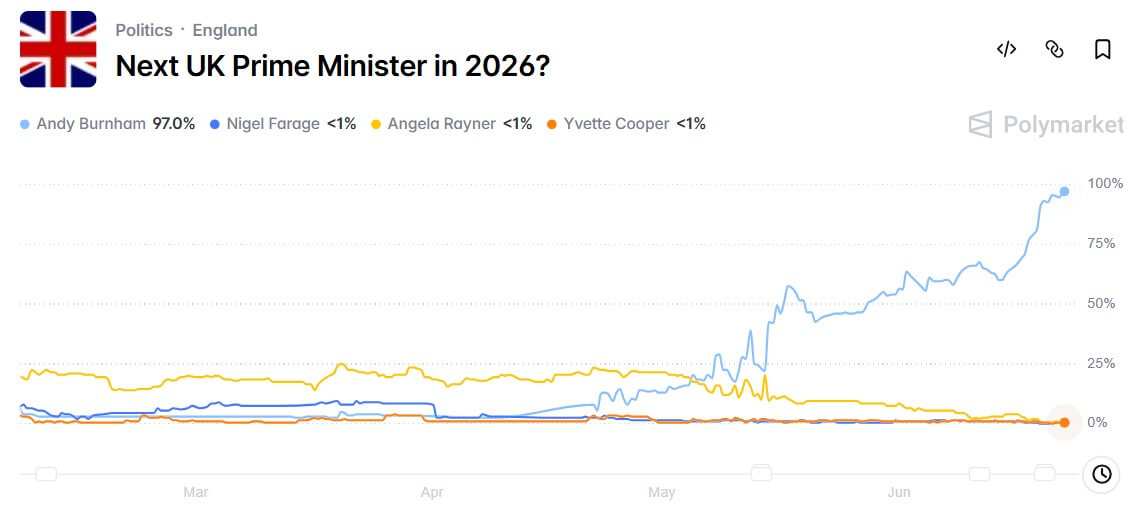
UK Next Prime Minister (Source: Polymarket)
This probability represents a market judgment backed by real money, not a rigorous poll, but it reflects how the market has swung decisively towards Burnham since Streeting's withdrawal.
Traditional financial markets saw little immediate volatility: movement in the pound and UK government bonds was minimal, indicating investors had already priced in Starmer's departure. Market focus has shifted to Burnham's stance on fiscal policy and the identity of the next Chancellor of the Exchequer.
If Burnham assumes office smoothly, he will be the UK's seventh Prime Minister in a decade. The country has seen frequent leadership changes since the 2016 Brexit referendum.
UK Cryptocurrency Regulatory Framework Already Set, Formal Implementation in 2027
The regulatory system the new Prime Minister will inherit has already moved beyond mere policy slogans.
Legislation passed in February formally brought crypto-related activities under the UK's formal financial regulatory umbrella, covering all operations such as crypto trading platform operations, compliant stablecoin issuance, user asset custody, and digital asset transactions.
The UK Financial Conduct Authority (FCA) is still refining the supporting rules, having conducted multiple public consultations on areas including asset custody, stablecoins, prudential requirements, market abuse controls, consumer protection, and business authorization processes. The regulator plans for the full set of new rules to take effect on October 25, 2027.
Once implemented, any firm conducting the specified crypto activities, even if already holding other financial licenses or having completed basic FCA registration, must obtain separate crypto-specific authorization.
While a new Prime Minister can adjust government policy priorities, replace Treasury officials, or push for amendments to legislation, a mere leadership change cannot repeal existing laws or force the FCA to restart its comprehensive rule-making process from scratch.
However, risks exist in the implementation process: a cabinet reshuffle could replace officials familiar with the crypto regulatory framework, just as regulators and industry firms are intensively preparing for authorization applications. Meanwhile, government attention could be diverted by more pressing issues like public spending, economic growth, or Labour's electoral prospects.
Such shifts in policy focus could affect the pace of implementing secondary legislation and resolving contentious details. However, the core architecture of the regulatory system is largely fixed, and without strong, proactive intervention from a new government, a complete reversal of the overall regulatory direction is highly unlikely.
This is fundamentally different from the earlier policy debate phase. The industry now most needs detailed implementation rules and clear compliance guidance, not another round of vague slogans about making the UK a digital assets hub.
Industry Hopes New Government Embraces Growth-Oriented Path
Burnham has spoken little publicly about cryptocurrency, but past comments have given many industry insiders cause for optimism. Freddie New, CEO of BHODL and co-founder of UK Bitcoin Policy, told CryptoSlate that with Burnham's likely ascension, the industry has a chance to reshape its public image, positioning crypto as a potential driver of UK economic growth rather than a risky sector to be suppressed, as previously perceived by mainstream Labour thinking.
He noted that several bitcoin reserve companies are already seeking London listings. The UK stock market has long struggled to attract new IPOs, and digital asset firms could bring fresh capital and global attention to London. "We should welcome and support emerging companies listing in London, not impose restrictions everywhere. I hope Burnham sees this," he said.
Industry executives plan to lobby the new government for several key priorities: proportionate capital requirements, a streamlined and practical authorization process, and clear regulatory definitions for staking, lending, and stablecoin payments. They also hope the FCA will more tangibly implement the government's previously stated mandate for growth-oriented regulation when finalizing the rules.
Despite market optimism about Burnham, the digital assets industry remains wary of certain factions within Labour. Freddie New mentioned that domestic financial regulators have not yet fully implemented the growth-first regulatory approach previously advocated by Rachel Reeves.
He added: "The UK has deep strengths in finance and computing technology and should be leading globally in crypto. The sooner politicians and regulators truly understand and accept this industry, the more the country will benefit."