Just when you thought crypto market morale couldn’t sink any lower, along comes the Coldcard entropy bug to prove you wrong.
The discovery of a flaw in one of the industry’s longest-running hardware wallets last Friday serves as a stark reminder that there is no perfectly safe place to put all your Bitcoin.
Coldcard disclosed the entropy-generation flaw affecting multiple Coldcard devices on July 31. Since then, researchers at Galaxy Digital say attackers have been able to steal more than 1,596 Bitcoin worth at least $100 million through several coordinated attacks.
Wallet manufacturers are now being forced to explain a process most users never even think about: how their wallet generates the private key to protect their Bitcoin.
Michael Tanguma, head of product at Bitcoin custody firm Onramp Bitcoin, tells Magazine:
“The whole model rests on trust that the vendor got it right [...] Almost no individual can audit the hardware, the firmware and the entropy generation underneath their device.”
Coinkite, the company behind Coldcard, has released firmware fixes and told affected users to migrate their funds, but the incident has shaken Bitcoin HODLers to the core, and it raises an uncomfortable question:
If Coldcard wallets can be exploited, does that mean all hardware wallets are potentially insecure?
A bug hidden in the foundations
The Coldcard vulnerability did not exploit Bitcoin itself nor break modern cryptography, but it struck at something much more fundamental: randomness.
Every Bitcoin wallet begins by generating a seed phrase from a pool of random data, which means that randomness should be sufficiently unpredictable to make the resulting private keys effectively impossible to guess. Entropy refers to how random it is.
If that randomness is weakened for any reason, attackers can reduce the number of possible keys that could be generate and eventually find a way to reproduce them.
Related: Coldcard hack sparks biggest sub-1 BTC move since FTX: CryptoQuant
Coinkite first alerted users on July 31 that wallets created on affected firmware should be considered at risk and told customers to migrate funds to newly generated wallets. As researchers dug further into the bug over the following days, their attention quickly turned to how a flaw in such a critical part of the wallet had gone unnoticed for more than five years.
Core Lightning developer Dustin Dettmer suggested that it might have originated during firmware changes made in 2021.
He believes that code intended to interface with the hardware random number generator instead disabled it, which caused wallet creation to fall back to MicroPython’s weaker Yasmarang pseudo-random number generator.
His theory has become one of the leading explanations for how the bug may have entered production firmware, although Coinkite has not confirmed that exact sequence of events, and says that it will publish a full technical postmortem “soon.” A Coinkite spokesperson tells Magazine:
“Certain firmware versions had a fallback path in seed generation that could produce weak entropy when generated on the device firmware itself.”
Devices where users generated their own entropy through dice rolls or similar manual methods “were not affected by this specific fallback path,” the spokesperson says.
Weak random number generation (RNG) is not unprecedented, but unlike many other security flaws, it is difficult to detect.
Bitcoin security expert Jameson Lopp noted that RNG vulnerabilities have previously affected a long list of cryptocurrency wallets and libraries, ranging from Blockchain.com’s Android wallet to Trust Wallet.
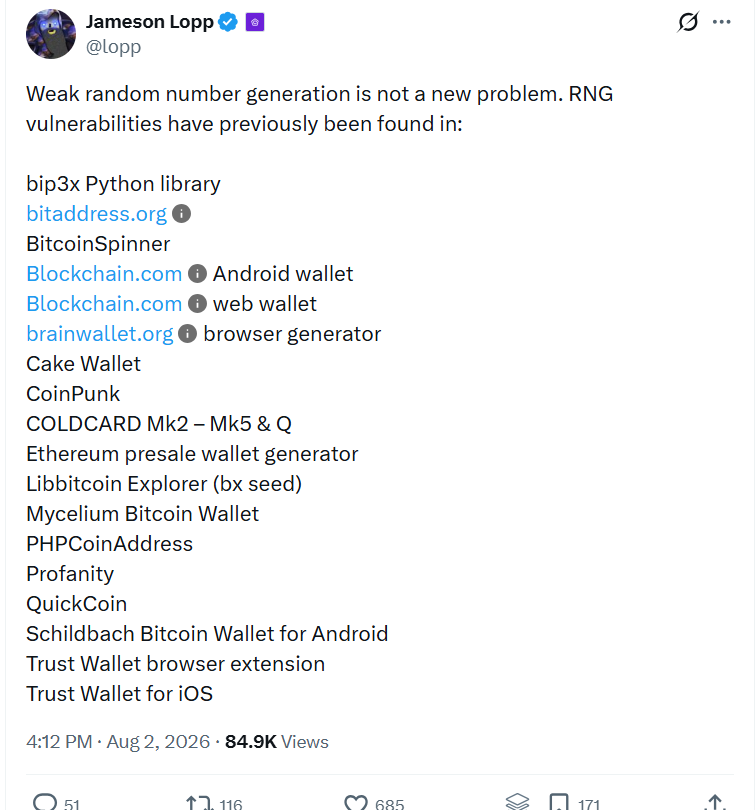
Weak random number generation is not a new problem. Source: Jameson Lopp
Ledger director of product security Vincent Bouzon tells Magazine that “weak randomness passes output tests,” which means that compromised random-number generators can still produce values that appear random, making flaws difficult to identifiy.
Different wallets, different randomness assumptions
Hardware wallet manufacturers agree that secure entropy generation is non-negotiable, but they take different approaches to achieving it.
Related: Zilliqa Ledger app vulnerability lets attackers recover signer’s private keys
Ledger’s philosophy centers on dedicated security hardware. Bouzon says Ledger devices generate seeds using a true random number generator embedded in a certified Secure Element. The entropy source is certified under the AIS-31 PTG.2 standard and the Secure Element undergoes Common Criteria certification. He says:
“This Coldcard incident was a failure in one specific implementation, not a verdict on secure self-custody [...] The generation of that entropy must be anchored in secure hardware, with an architecture that cannot silently downgrade to an untrusted software-based source.”
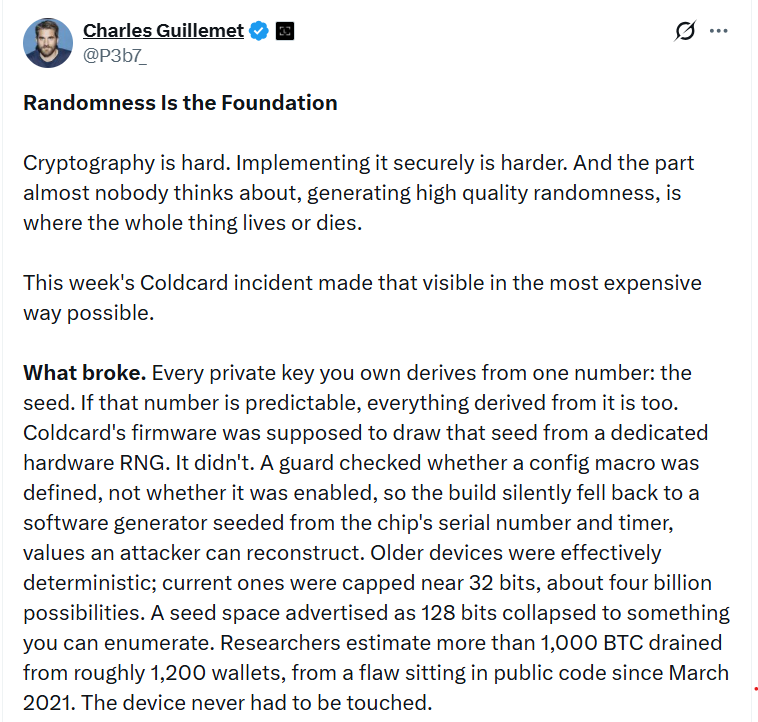
Generating high-quality randoness is where the whole thing lives or dies. Source: Charles Guillemet
For its part, Trezor combines randomness generated inside the device with randomness supplied by the host computer, rather than depending on a single entropy source, and newer models also incorporate additional hardware sources.
The company also includes entropy checks to confirm that the device actually contributed unpredictable randomness during wallet creation. Tomáš Sušánka, Trezor’s chief technical officer, tells Magazine:
“The takeaway for the whole industry is that randomness cannot depend on a single source or a single line of code being correct.”
Foundation’s Passport wallet similarly rely on multiple entropy sources while emphasizing transparency. Chief executive Zach Herbert says Passport combines randomness generated by separate hardware components before creating a wallet.
The firmware is also published as free and open-source software with reproducible builds, so independent researchers can verify that the software running on the device matches the published code. Herbert says:
“The bug itself was specific to Coldcard [...] The larger warning is that this went unnoticed for more than five years while people trusted the product with life-changing amounts of money.”
Trust, transparency and verification
The real divide between Ledger, Trezor and Foundation is not about the importance of randomness, but over how users can be certain that it is actually working.
Ledger argues that independent certification provides the strongest assurance. Foundation relies on open-source development, reproducible builds and welcoming external researchers, and Trezor combines open firmware with layered entropy sources to avoid relying on any single component.
Coinkite’s approach to security disclosures has also come under fire, with several Bitcoin developers criticizing the company over past responses to vulnerability reports and the absence of a traditional bug bounty program.
Related: Fears of AI-driven DeFi hack epidemic overstated for now — but not for long
Herbert argues that welcoming external researchers is itself part of building secure products, alongside open-source development and independent audits.
Nick Percoco, chief security officer at Kraken and former chief security officer at Uptake, sees the Coldcard incident as an opportunity for the industry to adopt stronger standards, no matter which design philosophy manufacturers choose.
“The Coldcard entropy failure should be a wake-up call for the entire hardware wallet industry,” he said, arguing that today’s certification schemes often validate individual components without confirming that production firmware is actually using them correctly.
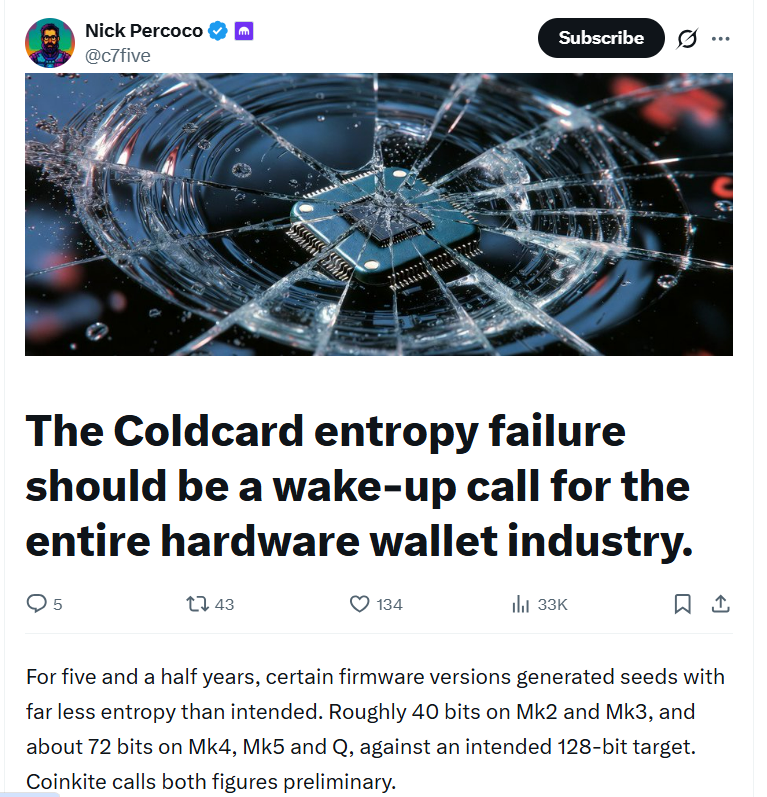
The Coldcard entropy failure should be a wake-up call. Source: Nick Percoco
Percoco proposed an industry-specific assurance standard requiring independent validation of entropy sources, verification that firmware calls the intended hardware random number generator and certification tied to specific hardware and firmware versions.
But the debate goes further than technical implementation, with voices like Herbert arguing that open-source development also shapes security culture. He points to bug bounty programs and constructive engagement with independent researchers as essential parts of secure product development.
What should Bitcoiners do now?
For Coldcard users, their immediate priority is to follow Coinkite’s migration guidance if they believe their wallets were created using affected firmware.
Longer term, Bitcoiners as a whole should use this episode as a learning moment, with experts like Tanguma stressing the need to avoid design architectures in which any single failure can compromise their funds. He says:
“Today, realistically, you want multisig and independently generated entropy [...] The mitigation that actually scales is architectural: setups where no single device, vendor or institution being wrong can lose the funds.”
So for now, the answer appears to be no; not all hardware wallets are insecure.
The Coldcard incident exposed a failure in one implementation, but it has also forced manufacturers to lift the veil on the process at the heart of self-custody: generating a secret that nobody else can predict.
Magazine: The 100x obsession: Fundamentals grow in importance as crypto matures