In February, we wrote about Dash's plans to integrate Orchard. At that time, it concerned a future release and the prospect of private user tokens.
Now, the first part of the plan has been realized: in Dash Platform v4.0.0, shielded operations have become part of the consensus. This is not an external mixer, not a custodial service, and not an experimental smart contract — privacy is built directly into the protocol.
For Dash, historically associated with CoinJoin, this is not a replacement for the old mechanism, but a second privacy model. CoinJoin continues to work on the main network, while Platform uses ZK-proofs instead of mixing rounds with multiple participants. This approach is better suited for fast mobile wallets. At the same time, regular Dash transactions remain transparent: confidentiality is optional.
The shielded pool hides the balance, sender, recipient, and transfer amount within the pool. The network verifies that the funds exist, belong to the sender, and are not spent twice, but does so without revealing the operation's contents.
A user can deposit credits into the pool from a transparent Platform address, conduct a private transfer, and return the funds. For DASH holders, two other routes are more important: ShieldFromAssetLock sends funds to the shielded pool directly from Core, and ShieldedWithdrawal withdraws them to a specified Core address. To avoid linking the withdrawal to previous activity, the wallet must use a new address.
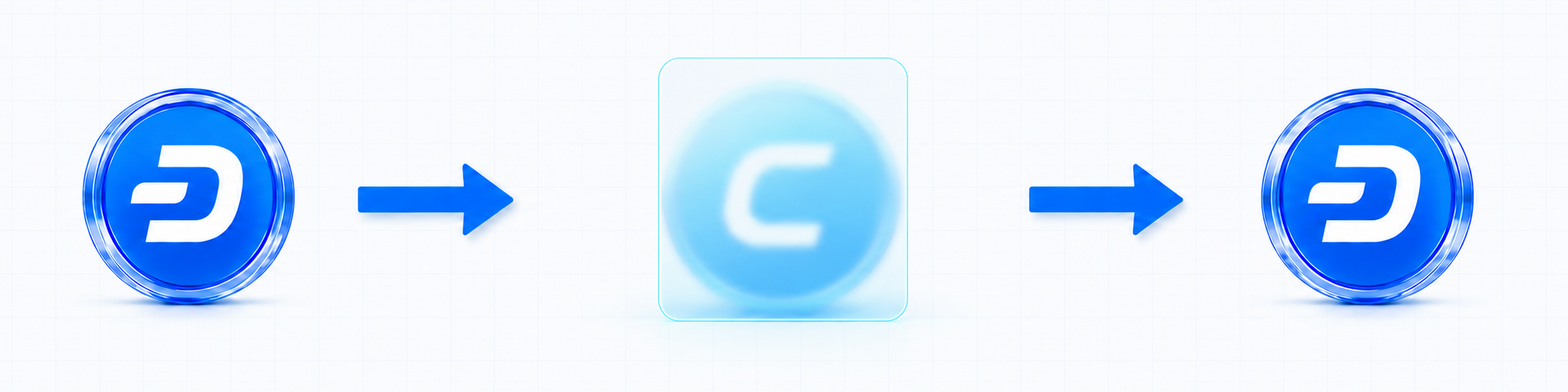
Platform Credits — the internal settlement unit of Dash Platform, tied to Dash at a fixed ratio: one Dash corresponds to 100 billion credits.
How the Privacy Works — Without the Complicated Math
Dash did not create a new ZK-scheme from scratch. The implementation is based on Orchard, Zcash's shielded protocol built on Halo 2 without a trusted setup. Dash's engineering work involved adapting it to Platform: custom state transitions, storage in GroveDB, fees, wallet synchronization, and the route back to Core.
Shortly before the release, a critical vulnerability was discovered in Orchard, potentially allowing double spending within the pool. The Zcash team fixed the proof scheme, and Dash Core Group transitioned its implementation to the updated libraries even before the release of Platform 4.0. An additional layer of control in Dash is provided by SumTree: this structure stores and cross-references the pool's state, preventing hidden inflation from going unnoticed.
One of the main problems with shielded systems is wallet synchronization. To detect incoming funds, the application receives encrypted notes and locally checks which ones its key can decrypt. The server does not learn which transfers belong to the user.
In the test version of the application, we created a new wallet and started synchronization: it took about 21 seconds, which is significantly faster than synchronizing the Zodl wallet for ZCash.
The release of mobile wallets with support for the new technology is expected soon.
Currently, the pool only works with Platform Credits. However, Dash has already announced plans to add separate shielded pools for native Platform tokens.
Private user assets are not a new concept. Dash's strength lies in the specific combination of capabilities: ZK-privacy, token and NFT issuance, and the ability to exchange created assets for Dash and back. Thanks to this, each asset gains a direct connection to an already established coin, and through it — to the external market.